A novel multi-server authentication protocol
Yalin Chen1, Chun-Hui Huang2,*Jue-Sam Chou3
1Institute of information systems and applications, National Tsing Hua University
2Department of Information Management, Nanhua University Chiayi 622 Taiwan, R.O.C
3Department of Information Management, Nanhua University Chiayi 622 Taiwan, R.O.C
*: corresponding author [email protected] Tel: 886+ (0)5+272-1001 ext.56536
Abstract
Recently, Tsai and Hsiang et al. each proposed a multi-server authentication protocol. They claimed their protocols are secure and can withstand various attacks. However, after our analysis, we found some security loopholes in each protocol. We will first show the attacks on their schemes and then present ours. After the security analysis, we conclude that our scheme is the most secure one among all of the proposed protocols in multi-server environments nowadays.
Keywords:multi-server, password authentication protocol, smart card, password change, key agreement
1. Introduction
For password-based authentication protocols using smart cards are widely used in an open network. A two-party password authentication protocol for client-server architecture is therefore not sufficient when networks are getting larger and larger. Consequently, several multi-server protocols were proposed [1-15].
registration center’s card-issue cost. Also, in 2008, Tsai [1] proposed an efficient multi-server authentication scheme. He claims that his protocol can withstand seven known attacks. Yet, after our analysis, we found that it is vulnerable to the server spoofing attack. Recently, in 2009, Liao et al. [2] proposed a secure dynamic ID scheme for multi-server environment. They claim that their protocol is secure. However, Hsiang and Shih [14] found their scheme suffers from both the server spoofing attack and the insider attack. Hence, they proposed an improvement on the protocol. We also illustrate the same weakness of Liaoet al.’s scheme in eprint [15]. Yet, we found that their improvement is still insecure. It is vulnerable to the insider attack. In this paper, we will first show the attacks on [1] and [14], respectively. Then, we show our scheme and examine its security.
The remainder of this paper is organized as follows: In Section 2, we review both Tsai’sand Hsiang-Shih’s protocols. In Section 3, we demonstrate the vulnerabilities existing in their schemes, respectively. Then, we propose a novel protocol in Section 4 and analyze its security in Section 5. The discussions and comparisons are made in Section 6. Finally, a conclusion is given in Section 7.
2. Review of Tsai’sand Hsiang-Shih’sprotocols
In this section, we review Tsai’sprotocolin Section 2.1 and Hsiang-Shih’sprotocol
in Section 2.2, respectively. Before that, the notations used throughout this paper are first defined as follows.
RC : the registration center Uu : a legal user u
Un : a legal malicious user n Sj : a legal server j
E(P) : an attacker E who masquerades as a peer P. SIDj : the identity of Sj
IDu : the identity of Uu PWu : the password of Uu x,y,r : RC’s secret keys
Flag : a word string which is set to‘the first time login’,‘not the first time login’,‘for password change’or‘accept’used in our proposed protocol in Section 4.3. g : the primitive element in a Galois field GF(p) where p is a large prime number. H( ) : a collision-resistant one-way hash function
(a,b) : a string denotes that stringais concatenated with stringb.
⊕ : a bitwise XOR operator => : a secure channel
2.1 Review of Tsai’sprotocol
Tsai’s protocolassumes s servers exists in the system. At the beginning, RC computes and sends H(SIDj,y) to each Sj, for j = 1 tos, with Sj keeping it secret, via a secure channel. Tsai’sprotocol contains four phases. They are: (1)registration phase, (2)login phase, (3)authentication of server and RC phase, and (4)authentication of server and user phase. We describe them as follows.
(1) Registration phase
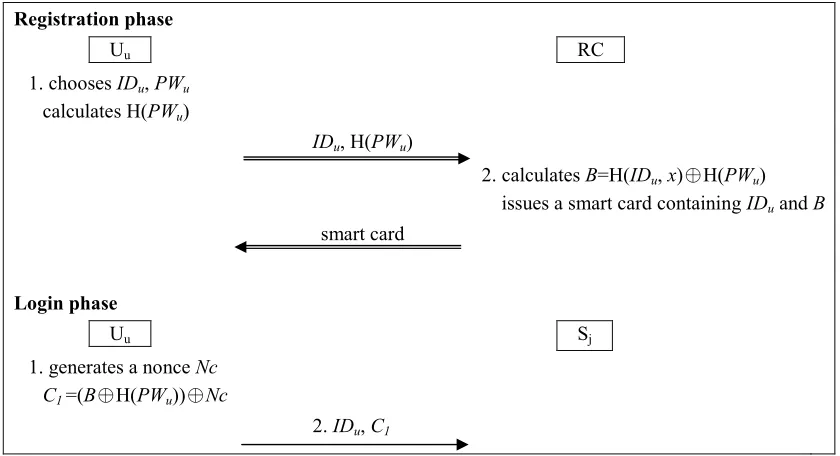
In this phase (as shown in Fig. 1), Uu performs the following steps for obtaining a smart card from RC.
1. Uu freely chooses his IDu and PWu and calculates H(PWu). He then sends {IDu, H(PWu)} to RC through a secure channel.
2. RC calculates B=H(IDu, x)⊕H(PWu) and issues Uu a smart card containing IDu andBthrough a secure channel.
(2) Login phase
When Uuwants to login to Sj, he inserts his smart card and performs the following steps.
1. Uukeys his IDuandPWuand generates a random nonceNc. He then computesC1 =(B⊕H(PWu))⊕Nc= H(IDu,x)⊕Nc.
2. Uusends {IDu,C1} to Sj.
Registration phase
Uu RC
1. choosesIDu,PWu
calculates H(PWu)
IDu, H(PWu)
2. calculatesB=H(IDu,x)⊕H(PWu)
issues a smart card containingIDuandB
smart card
Login phase
Uu Sj
1. generates a nonceNc C1=(B⊕H(PWu))⊕Nc
2.IDu,C1
(3) Authentication of server and RC phase
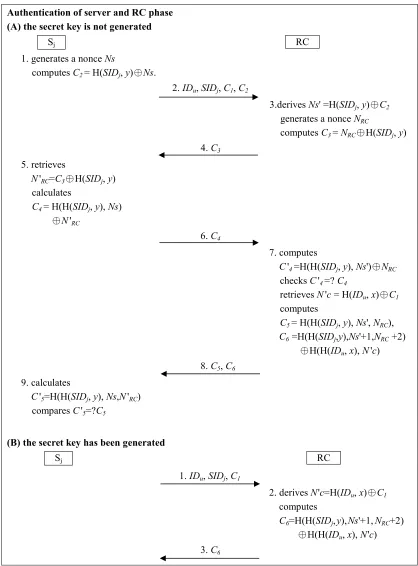
In this phase (as shown in Fig. 2), after receiving message {IDu, C1} from Uu, Sj runs the following steps to let himself be authenticated by RC, verify Uu’s legitimacy, and negotiate the session key with Uu. Here, let the secret key shared between Sj and RC be H(H(SIDj, y), Ns+1, NRC+2), where Ns and NRC are Sj’s and RC’s randomly
Authentication of server and RC phase (A) the secret key is not generated
Sj RC
1. generates a nonceNs
computesC2= H(SIDj,y)⊕Ns.
2.IDu,SIDj,C1,C2
3.derivesNs' =H(SIDj,y)⊕C2
generates a nonceNRC
computesC3=NRC⊕H(SIDj,y)
4.C3
5. retrieves
N'RC=C3⊕H(SIDj,y)
calculates
C4= H(H(SIDj,y),Ns)
⊕N'RC
6.C4
7. computes
C'4=H(H(SIDj,y),Ns')⊕NRC
checksC'4=?C4
retrievesN'c= H(IDu,x)⊕C1
computes
C5= H(H(SIDj,y),Ns',NRC),
C6=H(H(SIDj,y),Ns'+1,NRC+2)
⊕H(H(IDu,x),N'c)
8.C5,C6
9. calculates
C'5=H(H(SIDj,y),Ns,N'RC)
comparesC'5=?C5
(B) the secret key has been generated
Sj RC
1.IDu,SIDj,C1
2. derivesN'c=H(IDu,x)⊕C1
computes
C6=H(H(SIDj,y),Ns'+1,NRC+2)
⊕H(H(IDu,x),N'c)
3.C6
chosen nonces respectively. To reduce the computational cost, this phase is divided into two scenarios: (A) the secret key is not generated, and (B) the secret key has been generated. We describe them below.
(A) the secret key is not generated.
1. Sjgenerates a random nonceNsand computesC2= H(SIDj,y)⊕Ns. 2. Sjsends {IDu,SIDj,C1,C2} to RC.
3. RC derives Ns'=H(SIDj, y)⊕C2. He then generates a random nonce NRC and computesC3=NRC⊕H(SIDj,y).
4. RC sends {C3} to Sj.
5. After receiving the message from RC, Sjretrieves N'RC = C3⊕H(SIDj, y) and calculatesC4= H(H(SIDj,y),Ns)⊕N'RC.
6. Sjsends {C4} to RC.
7. RC computes C'4= H(H(SIDj, y), Ns')⊕NRC and checks to see if C'4 is equal to the received C4. If so, Sj is authentic. He then retrieves N'c=H(IDu, x)⊕C1 and computes C5 = H(H(SIDj, y), Ns', NRC), C6 = H(H(SIDj, y), Ns'+1, NRC +2)⊕
H(H(IDu,x),N'c). 8. RC sends {C5,C6} to Sj.
9. After receiving the message from RC, Sj calculates C'5= H(H(SIDj,y), Ns,N'RC) and compares it with the received C5. If they are equal, RC is authentic. Both Sj and RC will store the common secret key AuthS-RC=H(H(SIDj, y), Ns+1,N'RC+2) for next execution of server and RC authentication to reduce the computational cost in the verifier table.
(B) the secret key has been generated.
1. Sjsends {IDu,SIDj,C1} to RC.
2. RC derives N'c=H(IDu, x)⊕C1and uses his AuthS-RC to computeC6= H(H(SIDj, y),Ns'+1,NRC+2)⊕H(H(IDu,x),N'c).
3. RC sends {C6} to Sj.
(4) Authentication of server and user phase
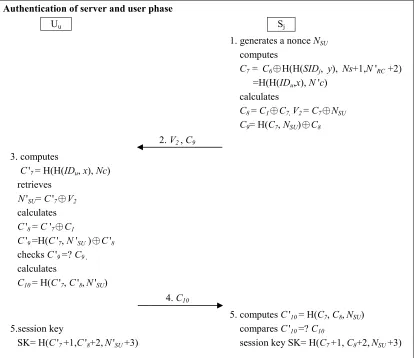
After the authentication of server and RC phase, Sj and Uu perform the following steps for mutual authentication (as shown in Fig. 3).
1. Sj generates a random nonce NSU and uses his AuthS-RC to compute C7= C6⊕
H(H(SIDj,y), Ns+1,N'RC+2)=H(H(IDu,x), N'c). He then calculatesC8= C1⊕C7, V2=C7⊕NSU, andC9= H(C7,NSU)⊕C8.
2. Sjsends {V2,C9} to Uu.
Authentication of server and user phase
Uu Sj
1. generates a nonceNSU
computes
C7= C6⊕H(H(SIDj, y), Ns+1,N'RC+2)
=H(H(IDu,x),N'c)
calculates
C8=C1⊕C7,V2=C7⊕NSU
C9= H(C7,NSU)⊕C8
2.V2,C9
3. computes
C'7= H(H(IDu,x),Nc)
retrieves N'SU=C'7⊕V2
calculates C'8=C'7⊕C1
C'9=H(C'7,N'SU)⊕C'8
checksC'9=?C9 ,
calculates
C10= H(C'7,C'8,N'SU)
4.C10
5.session key
SK= H(C'7+1,C'8+2,N'SU+3)
5. computesC'10= H(C7,C8,NSU)
comparesC'10=?C10
session key SK= H(C7+1,C8+2,NSU+3)
Fig. 3. Authentication of server and user phase of Tsai’sprotocol
C'7⊕V2, and calculates C'8= C'7⊕C1,C'9= H(C'7,N'SU)⊕C'8. He then checks to see if the newly computedC'9is equal to the receivedC9. If so, Sjis authentic. Uu then calculateC10= H(C'7,C'8,N'SU).
4. Uusends {C10} to Sj.
5. After receiving {C10}, Sj computesC'10= H(C7,C8,NSU) and checks to see ifC'10 is equal to the received C10. If so, Uu is authentic. They then have the same session key SK= H(C'7+1, C'8+2,N'SU+3) and SK= H(C7+1, C8+2,NSU+3) , respectively.
2.2 Review of Hsiang-Shih’sprotocol
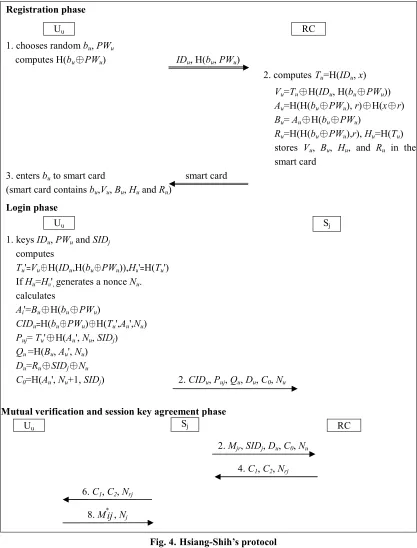
In this section, we review Hsiang-Shih’sprotocol. Their protocol consists of four phases: (1) registration phase, (2) login phase, (3) mutual verification and session key agreement phase, and (4) password change phase. In their protocol, RC first computes and sends H(SIDj,y) to legal servers Sj, for j=1 to w. (Assume that there arewservers in the system.) We describe their protocol as follows and also depict it in Figure 4.
In this phase, Uu performs the following steps to register at RC for obtaining a smart card so that he can access the resources of all servers.
1. Chooses PWu, a random number bu, and computes H(bu⊕PWu). He then sends {IDu, H(bu,PWu)} to RC through a secure channel.
2. RC computesTu=H(IDu,x),Vu=Tu⊕H(IDu, H(bu⊕PWu)),Au=H(H(bu⊕PWu),r)
⊕H(x⊕r),Bu=Au⊕H(bu⊕PWu),Ru= H(H(bu⊕PWu),r) , andHu=H(Tu). He then storesVu,Bu,HuandRuto the smart card and issues the card to Uuthrough a secure channel.
3. Uuentersbuto his card and the smart card now containsbu,Vu,Bu,HuandRu.
(2) Login phase
When Uuwants to login to Sj, he inserts his smart card and performs the following steps.
1. Uukeys hisIDu,PWuandSIDjto the smart card. The smart card computesTu'=Vu
⊕H(IDu, H(bu⊕PWu)), Hu'=H(Tu'), and checks to see if Hu stored is equal to the computedHu'. If so, smart card knows Uuis the real card holder. It then generates a random nonce Nu and calculates Ai'=Bu⊕H(bu⊕PWu), CIDu= H(bu⊕PWu)⊕
H(Tu',Au', Nu), Puj=Tu'⊕H(Au',Nu, SIDj), Qu=H(Bu,Au',Nu), Du=Ru⊕SIDj⊕Nu, andC0=H(Au',Nu+1,SIDj).
2. Uusends {CIDu,Puj,Qu,Du,C0,Nu} to Sj.
(3) Mutual verification and session key agreement phase
After receiving the login message from Uu, Sjexecutes the following steps together with Uuto authenticate each other and compute a common session key.
1. Sjgenerates a random nonceNjrand calculatesMjr= H(SIDj,y)⊕Njr. 2. Sjsends {Mjr,SIDj,Du,C0,Nu} to RC.
3. RC computes N*
jr=Mjr⊕H(SIDj, y), R*u=Du⊕SIDj⊕Nu, A*u=R*u⊕H(x⊕r), C*o= H(A*
u,Nu+1,SIDj) and checks to see ifC*o is equal to the received C0. If so, Sjis authentic. RC then generates a random nonce Nrj and calculates C1= H(N*
jr, H(SIDj,y),Nrj),C2=A*
u⊕H(H(SIDj,y),Njr*). 4. RC sends {C1,C2,Nrj} to Sj.
Registration phase
Uu RC
1. chooses randombu,PWu
computes H(bu⊕PWu) IDu, H(bu,PWu)
2. computesTu=H(IDu,x)
Vu=Tu⊕H(IDu, H(bu⊕PWu))
Au=H(H(bu⊕PWu),r)⊕H(x⊕r)
Bu=Au⊕H(bu⊕PWu)
Ru=H(H(bu⊕PWu),r),Hu=H(Tu)
stores Vu, Bu, Hu, and Ru in the
smart card 3. entersbuto smart card smart card
(smart card containsbu,Vu,Bu,HuandRu) Login phase
Uu Sj
1. keysIDu,PWuandSIDj
computes
Tu'=Vu⊕H(IDu,H(bu⊕PWu)),Hu'=H(Tu')
IfHu=Hu',generates a nonceNu.
calculates
Ai'=Bu⊕H(bu⊕PWu)
CIDu=H(bu⊕PWu)⊕H(Tu',Au',Nu)
Puj=Tu'⊕H(Au',Nu,SIDj)
Qu=H(Bu,Au',Nu)
Du=Ru⊕SIDj⊕Nu
C0=H(Au',Nu+1,SIDj) 2.CIDu,Puj,Qu,Du,C0,Nu
Mutual verification and session key agreement phase
Uu Sj RC
2.Mjr,SIDj,Du,C0,Nu
4.C1,C2,Nrj
6.C1,C2,Nrj
8.M*ij,Nj
Fig. 4. Hsiang-Shih’sprotocol
Mij=H(B''u,Ni,A''u,SIDj). 6. Sjsends {Mij,Nj} to Uu.
7. Uucomputes H(Bu,Ni,Au,SIDj) and checks to see if it is equal to the receivedMij. If it is, Sjis authentic. He then calculates M*ij=H(Bu,Nj,Au,SIDj).
8. Uusends {M*ij} to Sj.
10. After finishing mutual authentication, Uuand Sjcan compute the common session key SK= H(Bu,Au,Nu,Nj,SIDj) and SK= H(B''u,A''u,Nu,Nj,SIDj), respectively.
(4) Password change phase
When Uu wants to change his password from PWu to PWunew, he executes the following steps.
1. Keys hisIDu,PWu.
2. The smart card computes Tu'=Vu⊕H(IDu, H(bu⊕Wu)), Hu'=H(Tu') and checks to see ifHustored in the smart card is equal to the computedHu'. If so, Uuis the real card holder.
3. The smart card allows Uuto submit a new passwordPWunew.
4. The smart card computesVunew=Tunew⊕H(IDu, H(bu⊕PWunew)), Bunew=Bu⊕H(bu
⊕PWu)⊕H(bu⊕PWunew) and replacesVu,BuwithVunew,Bunew, respectively.
3. Security loopholes in Tsai’sand Hsiang-Shih’sprotocols
In this section, we will show that Tsai’s protocol suffers server spoofing attacks in both scenarios and Hsiang-Shih’sprotocol suffers user impersonation attack and off-line password guessing attack when the smart card is lost. We demonstrate the security loopholes of both schemes in Section 3.1 and Section 3.2, respectively.
3.1 Server spoofing attack by an insider server on Tsai’sprotocol
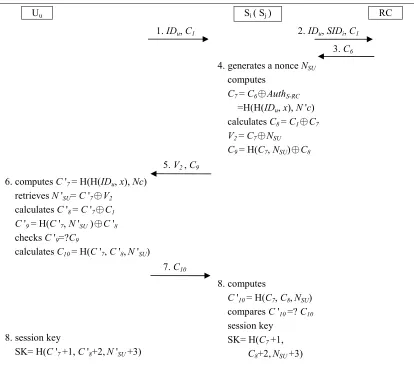
Assume that Si is a legal server registered at RC. He also has his H(SIDi, y) and keeps it secret. He can then masquerade as a legal server to cheat a remote user. This is because in the authentication of server and user phase, a user doesn’t examine if the message is indeed sent from the correct server. In the following, we present server spoofing attacks on the two scenarios, (A) and (B), and also illustrate them in Figure 5 and 6, respectively.
(A) the secret key is not generated.
For this case, we describe the attack as follows and also illustrate it in Figure 5.
1. When Uuwants to communicate with Sj, he starts the protocol and sends {IDu,C1} to Sjwho Simasquerades.
3. RC and Si then negotiate to establish the common secret keyAuthS-RC=H(H(SIDi, y), Ns+1, N'RC+2)=H(H(SIDi, y), Ns'+1, NRC+2) in the phase of server and RC authentication. Then, Si and Uu perform the authentication of server and user phase.
4. Si generates a random nonce NSU and uses his AuthS-RC to compute C7= C6⊕
AuthS-RC =H(H(IDu, x), N'c). He then calculates C8= C1⊕C7,V2= C7⊕NSU, and C9= H(C7,NSU)⊕C8.
5. Sisends {V2,C9} to Uu.
6. After receiving the message, Uu computesC'7= H(H(IDu,x), Nc), retrievesN'SU= C'7⊕V2, and calculates C'8= C'7⊕C1, C'9= H(C'7, N'SU)⊕C'8. He then checks to see ifC'9is equal to the receivedC9. If so, Uuconfirms that the message is sent from the sender who had received hisC1in the login phase. Si disguising himself as Sj is thus regarded as being authentic by Uu. Uu then calculatesC10= H(C'7,C '8,N'SU).
7. Uusends {C10} to Si.
8. SicomputesC'10= H(C7,C8,NSU) and checks to see ifC'10is equal to the received
Uu Si( Sj) RC
1.IDu,C1 2.IDu,SIDi,C1,C2
3. establishesAuthS-RC
4. generates a nonceNSU
computes C7=C6⊕AuthS-RC
=H(H(IDu,x),N'c)
C8=C1⊕C7
V2=C7⊕NSU
C9= H(C7,NSU)⊕C8
3. establishes AuthS-RC
5.V2,C9
6. computes
C'7= H(H(IDu,x),Nc)
retrievesN'SU=C'7⊕V2
calculatesC'8=C'7⊕C1
C'9= H(C'7,N'SU)⊕C'8
checksC'9=?C9
calculates
C10= H(C'7,C'8,N'SU)
7.C10
8. session key
SK= H(C'7+1,C'8+2,N'SU+3)
8. computes
C'10= H(C7,C8,NSU)
comparesC'10=?C10
session key
SK= H(C7+1,C8+2,NSU+3)
C10. If so, Uu is authentic. They, Uu and Si, compute the common session key as SK= H(C'7+1,C'8+2,N'SU+3) and SK= H(C7+1,C8+2,NSU+3), respectively. From the above-mentioned steps, we can see that a server spoofing attack can besuccessfully launched by insider attacker Sifor this case.
(B) the secret key has been generated.
For this case, we describe the attack as follows and also illustrate it in Figure 6.
1.Uustarts the protocol and sends {IDu,C1} to Siwho masquerades as Sj.
2. When Si runs the authentication of server and RC phase, he simply sends {IDu, SIDi,C1} to RC. RC deducesN'c=H(IDu,x)⊕C1and computesC6= H(H(SIDi,y), Ns'+1,NRC+2)⊕H(H(IDu,x),N'c).
3. RC sends {C6} to Si. Sithen performs the authentication of server and user phase with Uu.
4. Si generates a random nonce NSU and uses the generated common secret key AuthS-RC to computeC7= C6⊕AuthS-RC =H(H(IDu,x), N'c). He then calculatesC8 =C1⊕C7,V2=C7⊕NSU, andC9= H(C7,NSU)⊕C8.
Uu Si( Sj) RC
1.IDu,C1 2.IDu,SIDi,C1
3.C6
4. generates a nonceNSU
computes
C7=C6⊕AuthS-RC
=H(H(IDu,x),N'c)
calculatesC8=C1⊕C7
V2=C7⊕NSU
C9= H(C7,NSU)⊕C8
5.V2,C9
6. computesC'7= H(H(IDu,x),Nc)
retrievesN'SU=C'7⊕V2
calculatesC'8=C'7⊕C1
C'9= H(C'7,N'SU)⊕C'8
checksC'9=?C9
calculatesC10= H(C'7,C'8,N'SU)
7.C10
8. session key
SK= H(C'7+1,C'8+2,N'SU+3)
8. computes
C'10= H(C7,C8,NSU)
comparesC'10=?C10
session key SK= H(C7+1,
C8+2,NSU+3)
5. Sisends {V2,C9} to Uu.
6. After receiving the message, Uu computesC'7= H(H(IDu,x), Nc), retrievesN'SU= C'7⊕V2, and calculates C'8= C'7⊕C1, C'9= H(C'7, N'SU)⊕C'8. He then checks to see ifC'9is equal to the receivedC9. If so, Uuconfirms that the message is sent from the sender who has received his C1in the login phase. Si disguising himself as Sj is therefore regarded as being authentic. Uu then proceeds to calculateC10= H(C'7,C'8,N'SU).
7. Uusends {C10} to Si.
8. After obtaining the message from Uu, Si computes C'10 = H(C7, C8,NSU) and checks to see ifC'10is equal to the receivedC10. If so, Uu is authentic. They then compute the common session key SK= H(C'7+1, C'8+2,N'SU+3) and SK= H( C7+1,C8+2,NSU+3), respectively.
From the above-mentioned steps, we can see that a server spoofing attack launched by insider attacker Sihas been successfully accomplished in case (B).
3.2 Attack on Hsiang-Shih’sprotocol
In the following, we demonstrate two attacks, (a) the impersonation attack and (b) the off-line password guessing attack if the smart card is lost, on Hsiang-Shih’s
protocol.
(a) The impersonation attack
We further divide this kind of attack into following two cases: (1) outsider impersonation attack, and (2) insider impersonation attack.
(1) Outsider impersonation attack
In Hsiang-Shih’s protocol, it can easily be seen that any passive attacker can deduce all of a user Uu’s secrets stored in the smart card from the messages, {Mjr,SIDj, Du,C0,Nu}, {CIDu,Puj,Qu,Du,C0,Nu}, and {C1,C2,Nrj}, transmitted among Uu, Sj and RC. For he can deduce Au= C2⊕H(Mjr), and then obtain Ru,Tu, H(bu⊕PWu) by computingRu=Du⊕SIDj⊕Nu,Tu=Puj⊕H(Au,Nu,SIDj), and H(bu⊕Wu)=CIDu⊕H(Tu, Au,Nu). Hence, he can impersonate Uu to login to Sj by sending a login request. For example, he sends the login request {CIDu,Puj',Qu',Du',C0',Nu'} to Sjby selecting a new random nonce Nu' and computingCIDu= H(bu⊕PWu)⊕H(Tu,Au,Nu'),Puj=Tu⊕
H(Au, Nu', SIDj), Qu=H(Bu, Au, Nu'), Du=Ru⊕SIDj⊕Nu', and C0=H(Au, Nu'+1, SIDj). Obeying their protocol, it is obvious that he can pretend Uu and access all servers’s resources successfully.
An insider attacker E is a malevolent user registered at RC. He can use his secretbe, PWe,Be,Reto deduce H(x⊕r) by computing H(x⊕r)=Be⊕Re⊕H(be⊕PWe). Then, he can use his computed H(x⊕r), the eavesdropped message {CIDu,Puj,Qu,Du,C0,Nu} transmitted between Uu and Sj in the login phase, and the public parameter SIDj to deduce Ru, Au, Tu, H(bu⊕PWu) by computing Ru=Du⊕SIDj⊕Nu, Au=Ru⊕H(x⊕r), Tu=Puj⊕H(Au,Nu,SIDj), and H(bu⊕Wu)=CIDu⊕H(Tu,Au,Nu). He then can calculate all of Uu’s secrets {Vu, Bu} stored in the smart card by computing Vu= Tu⊕H(IDu, H(bu⊕PWu)) and Bu= Au⊕H(bu⊕PWu). For E has all the secret data of Uu, he can therefore impersonate Uu in the same manner successfully as described in Section 3.2.(a).(1).
(b) Off-line password guessing attack if the smart card is lost
In the password change phase, when a user wants to change his password, the smart card has to verify the correctness of the card holder’s password. If the smart is lost or stolen, the attacker can read the secret data {bu,Vu,Hu} stored in the smart card. He then can compute T’=Vu⊕H(IDu, H(bu⊕PW’)), where PW’is his guessing password, and check to see if his computed H(T’) is equal to the stored value of Hu without the help of any other entities. If the two values equal, he successfully launches the attack. Else, he can repeat the above password guessing attack until he obtains the correct one. Therefore, a smart-card-lost off-line password guessing attack can be launched.
Furthermore, after guessing the correct password, the attacker can enforce the password change phase. Subsequently, from then on, the real card holder cannot use his password to login to the remote server anymore. That is, their scheme suffers from Denial-of-service attack as well.
4. Our protocol
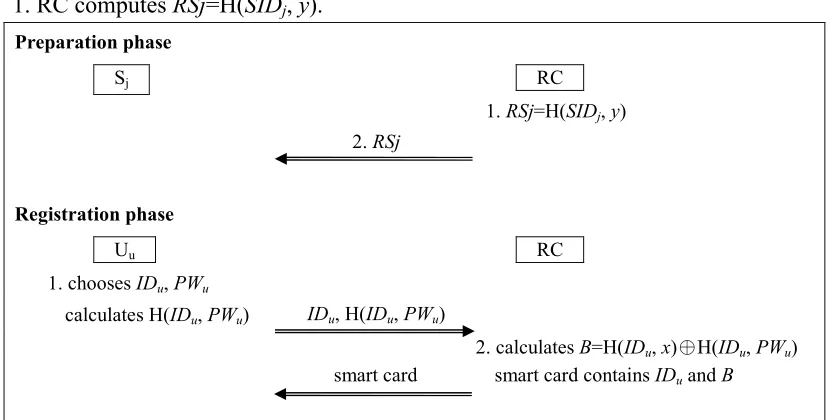
After presenting the attacks on protocols [1] and [14], in this section, we present our scheme. Our protocol contains four phases. They are: (1)preparation phase, (2)registration phase, (3)login phase, and (4)authentication and session key agreement phase or authentication and password change phase. In our protocol, RC is trustworthy and has two secret keys, x and y. All identities of users and servers are public, e.g. IDuand SIDj. We describe the first two phases in Section 4.1 and Section 4.2 respectively and also depict them in Figure 10. The last two phases are combined and divided into three scenarios. We discuss them in Section 4.3 and also depict them in Figure 11, 12, and 13, respectively.
In this phase, for each server Sj with identity SIDj, RC performs the following steps.
1. RC computesRSj=H(SIDj,y).
Preparation phase
Sj RC
1.RSj=H(SIDj,y)
2.RSj
Registration phase
Uu RC
1. choosesIDu,PWu
calculates H(IDu,PWu) IDu, H(IDu,PWu)
2. calculatesB=H(IDu,x)⊕H(IDu,PWu)
smart card smart card containsIDuandB
Fig. 10. Preparation phase and registration phase
2. RC sendsRSjto Sjvia a secure channel.
(2) Registration phase
In this phase, Uu performs the following steps to register at RC for obtaining a smart card. Once having registered at RC, he can use the card to login to any eligible server for accessing resources.
1. Uu randomly chooses his IDu, PWu and calculates H(IDu, PWu). He then sends {IDu, H(IDu,PWu)} to RC through a secure channel.
2. RC calculates B=H(IDu,x)⊕H(IDu, PWu) and issues Uu a smart card containing IDuandBthrough a secure channel.
(3) Login for authentication and session key agreement or for password change
In our scheme when Uu wants to login Sj, he may want to execute either authentication and session key agreement or password change. We first describe former case using two scenarios: (A) the first time execution (of login for authentication and session key agreement phase), and (B) not the first time execution (of login for authentication and session key agreement phase). Then, we describe the latter case using scenario (C) (login for password change phase). We describe them as follows and also depict them in Figure 11, 12, and 13, respectively.
(a) Login phase
When Uuwants to access Sj’s resources, he inserts his smart card and performs the following steps. The steps are also illustrated in Figure 11.
1. Uu keys his IDu and PWu to the smart card. The smart card computes Bu=B⊕
H(IDu,PWu), generates a random nonce c and calculates Nc=gc,C1=H(Bu,SIDj, Nc).
2. Uusends {IDu,SIDj,C1,Nc,Flag} to Sj, whereFlagis set to‘the first time login’.
(b) Authentication and session key agreement phase
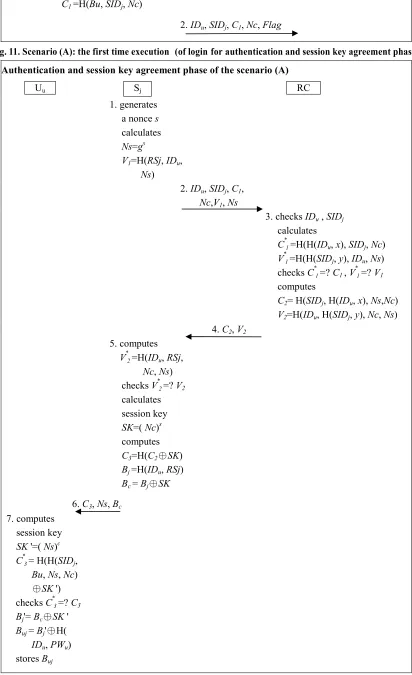
When receiving the login message from Uu, Sj executes the following steps to determine if Uu is valid. If so, he negotiates the session key with Uu. We describe them using the following steps. The steps are also illustrated in Figure 11-continued.
1. After receiving {IDu,SIDj,C1,Nc, Flag} from Uu, Sj reads Flagand knows that Uu is the first time login. He then generates a random nonce s and calculates Ns=gs,V1=H(RSj,IDu,Ns).
2. Sjsends {IDu,SIDj,C1,Nc,Tu,V1,Ns} to RC.
3. After receiving the authentication request, RC first checks to see if IDu andSIDj are valid. If so, RC calculatesC*
1=H(H(IDu,x),SIDj,Nc), V *
1=H(H(SIDj,y), IDu,
Ns) and checks to see if they are equal to the received C1and V1, respectively. If so, RC confirms that both Uu and Sj are authentic and knows that Uu attempts to login to Sj. He then computes C2=H(SIDj, H(IDu, x), Ns, Nc) and V2=H(IDu, H(SIDj,y),Nc,Ns).
4. RC sends {C2,V2} to Sj.
5. After receiving the message from RC, Sj computesV*
2=H(IDu, RSj, Nc,Ns) and
checks to see if it is equal to the received V2. If it is, Sj confirms that RC is authentic. He then calculates the session keySK=(Nc)sto be shared with Uu and computesC3=H(C2⊕SK),Bj=H(IDu,RSj), andBc=Bj⊕SK.
6. Sjsends {C3,Ns,Bc} to Uu.
7. After receiving the message from Sj, Uu computes SK'=(Ns)c, C*
3=H(H(SIDj,Bu,
Ns,Nc)⊕SK') and checks to see if this computed C*
3 is equal to the receivedC3.
If so, Uuconfirms that Sj is authentic. He then calculatesBj'=Bc⊕SK', Buj=Bj'⊕
Login phase of the scenario (A)
Uu Sj
1. keysIDu,PWu
computes
Bu=B⊕H(IDu,PWu)
C1=H(Bu,SIDj,Nc)
2.IDu,SIDj,C1,Nc,Flag
Fig. 11. Scenario (A): the first time execution (of login for authentication and session key agreement phase Authentication and session key agreement phase of the scenario (A)
Uu Sj RC
1. generates a nonces calculates Ns=gs
V1=H(RSj,IDu,
Ns)
2.IDu,SIDj,C1,
Nc,V1,Ns
3. checksIDu,SIDj
calculates
C*1=H(H(IDu,x),SIDj,Nc)
V*1=H(H(SIDj,y),IDu,Ns)
checksC*1=?C1,V *
1=?V1
computes
C2= H(SIDj, H(IDu,x),Ns,Nc)
V2=H(IDu, H(SIDj,y),Nc,Ns)
4.C2,V2
5. computes V*2=H(IDu,RSj,
Nc,Ns) checksV*2=?V2
calculates session key SK=(Nc)s
computes C3=H(C2⊕SK)
Bj=H(IDu,RSj)
Bc=Bj⊕SK
6.C3,Ns,Bc
7. computes session key SK'=(Ns)c
C*3= H(H(SIDj,
Bu,Ns,Nc)
⊕SK') checksC*3=?C3
Bj'=Bc⊕SK'
Buj=Bj'⊕H(
IDu,PWu)
storesBuj
H(IDu,PWu) and stores the common secret keyBuj in his smart card for login Sj without the help of RC’s authentication next time. Uu and Sj then have the common session keySK'=SK= gc.s.
(B) not the first time execution (of login for authentication and session key agreement phase)
When Uu wants to access Sj’s resources again, he inserts his smart card and performs the following steps. The steps are also illustrated in Figure 12.
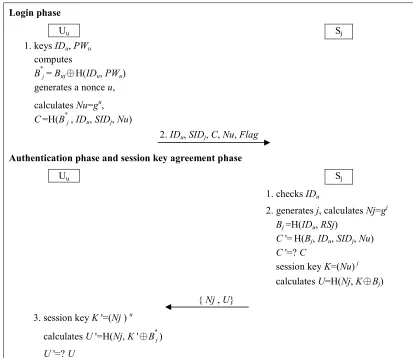
(a) Login phase
1. Uu keys hisIDu and PWu to the smart card. The smart card computesB*
j= Buj⊕
H(IDu, PWu), generates a random nonce u and calculates Nu=gu, C=H(B* j, IDu,
SIDj,Nu).
2. Uu sends {IDu,SIDj,C, Nu, Flag} to Sj, where Flag is set to ‘not the first time login’.
(b) Authentication and session key agreement phase
When receiving the login message from Uu, Sj executes the following steps to determine if Uuis valid. If so, he negotiates the session key with Uu.
Fig. 12. Scenario (B): not the first time execution (of login for authentication and session key agreement phase )
that Uuis authentic. He then calculates the session keyK=(Nu)jandU=H(Nj,K⊕
Bj).
2. Sjsends {Nj,U} to Uu.
3. After receiving the message from Sj, Uu computes the session key K'=(Nj)u,U '=H(Nj,K'⊕B*
j) and checks to see if U' is equal to the received U. If it is, Uu
confirms that Sj is authentic. Uu and Sj then have the common session key K'= K=gu j.
(C) Login for authentication and password change phase
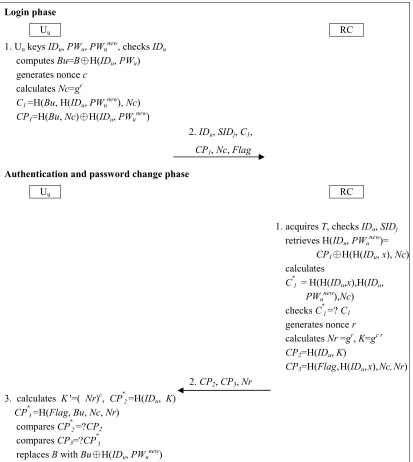
To get rid of the weakness as described in Section 3.2.(b), the clients must change his password under the intervention of RC when executing the password change phase. Under such limitation, it not only can prevent the password guessing attack if the smart card is lost but also meet the requirement that the client can choose and change his password at will. To attain this purpose, the password change phase of our protocol contains two phases, (a) Login phase and (b) Authentication and password change phase.
When Uuwants to change his password, he performs the following steps. The steps
Login phase
Uu Sj
1. keysIDu,PWu
computes
B*j=Buj⊕H(IDu,PWu)
generates a nonceu, calculatesNu=gu,
C=H(B*j,IDu,SIDj,Nu)
2.IDu,SIDj,C,Nu,Flag Authentication phase and session key agreement phase
Uu Sj
1. checksIDu
2. generatesj, calculatesNj=gj
Bj=H(IDu,RSj)
C'= H(Bj,IDu,SIDj,Nu)
C'=?C
session keyK=(Nu)j
calculatesU=H(Nj,K⊕Bj)
{Nj,U} 3. session keyK'=(Nj)u
calculatesU'=H(Nj,K'⊕B*j)
are also illustrated in Figure 13.
(a) Login phase
1. Uu keys his IDu, PWu, and new password PWunew to the smart card. The smart card checks PWu to see if IDu is the real cardholder. If so, the card computes Bu=B⊕H(IDu, PWu), generates a random nonce c, and calculates Nc=gc, C1 =H(Bu, H(IDu,PWunew),Nc), andCP1=H(Bu,Nc)⊕H(IDu,PWunew).
2. Uusends {IDu,SIDj,C1,CP1,Nc,Flag} to RC,whereFlagis set to‘for password change’.
Login phase
Uu RC
1. UukeysIDu,PWu,PWunew, checksIDu
computesBu=B⊕H(IDu,PWu)
generates noncec calculatesNc=gc
C1=H(Bu, H(IDu,PWunew),Nc)
CP1=H(Bu,Nc)⊕H(IDu,PWunew)
2.IDu,SIDj,C1,
CP1,Nc,Flag Authentication and password change phase
Uu RC
1. acquiresT, checksIDu,SIDj
retrieves H(IDu,PWunew)=
CP1⊕H(H(IDu,x),Nc)
calculates
C*1 = H(H(IDu,x),H(IDu,
PWunew),Nc)
checksC*1=?C1
generates noncer calculatesNr=gr,K=gc.r
CP2=H(IDu,K)
CP3=H(Flag,H(IDu,x),Nc,Nr)
2.CP2,CP3,Nr
3. calculates K'=( Nr)c, CP*
2=H(IDu, K)
CP*3=H(Flag,Bu,Nc,Nr)
comparesCP*2=?CP2
comparesCP3=?CP *
3
replacesBwithBu⊕H(IDu,PWunew)
(2) Authentication and password change phase
1. After receiving the password change request, RC checks to see ifIDuandSIDjare valid. If they are valid, RC retrieves H(IDu, PWunew) by computing CP1⊕
H(H(IDu,x),Nc), calculatesC*
1= H(H(IDu,x), H(IDu,PWu
new),Nc), and checks to
see if C*
1 is equal to the received C1. If so, Uu is authentic. RC generates a
random noncer and calculatesNr =gr, K=gc.r,CP2=H(IDu,K), andCP3=H(Flag, H(IDu,x),Nc, Nr), whereFlagis set to‘accept’.
2. RC sends {CP2,CP3,Nr} to Uu.
3. After receiving the message from RC, Uu calculatesK'=(Nr)c,CP*
2=H( IDu,K),
and CP*
3=H(Flag,Bu,Nc,Nr) and checks to see if CP *
2 is equal to the received
CP2. If so, Uu confirms that RC is authentic. He then comparesCP3with CP* 3. If
they are equal, Uu knows that his password change request has been accepted. The smart card then replaces the storedBwithBu⊕H(IDu,PWunew).
5. Security analysis for our protocol
We will show that our protocol not only can provide mutual authentication, perfect forward secrecy, changing password freely and securely, and session key agreement but also can resist various attacks such as, stolen-verifier attack, insider-server spoofing attack, insider-user impersonating attack, off-line password guessing attack, on-line password guessing attack, replay attack, parallel session attack ( Man-in-the -Middle attack), and smart-card-lost attack. In the following, for each security attribute analysis, we mainly concern the most complex part, scenario (A) as indicated in Figure 11, in our protocol. The other two scenarios, (B) and (C), can be reasoned in a similar manner. We omit them unless stated otherwise.
5.1 Mutual authentication
In the following, we demonstrate that scenario (A) depicted in Figure 11 can provide mutual authentication between each pair among the three parties, user Uu, server Sjand RC. We describe it below.
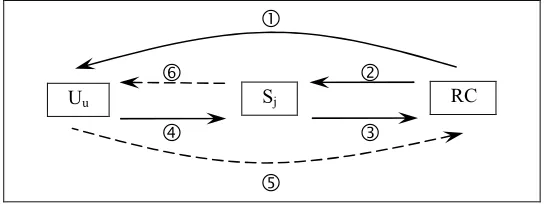
communicating parties and their common secret are committed. Otherwise, the PKI infrastructure will not work. From this observation, if there is an authenticity from A to B and from B to C, then there is an authenticity from A to C. According to this rule, we can obtain the dashed arrow from and (as shown in Figure 14). The remaining dashed arrow can be obtained by using the following proof of contradiction. If we use A B to represent A authenticates B, or equivalently, B is regarded as authentic by A, for we already know the facts that RC Sjand RC Uu, if Sj Uudoesn’t hold, then from the transitive property, RC Uu cann’t hold as well. This contradicts the fact that RC Uu. Hence, the dashed arrowexists. This completes the figure. From the figure, we can see that the mutual authentications between each pair of the three parties can be satisfied.
Fig. 14. Authenticity relationship
5.2 Session key agreement
In our protocol, after a legal user Uuhas logged into an eligible server and finished the authentication and session key agreement phase, they have the same session key. This can easily be seen in the two steps, step 5 and step 7, of the authentication and key agreement phase executed by Sjand Uurespectively in Section 4.(3).(A).(b).
5.3 Perfect forward secrecy
In our scheme, a compromised password can’t be used to construct previous
session keys for that we use the Diffie-Hellman key agreement protocol which are based on random nonces. In other words, the session keys generated before in each session between the user and server are independent. Accordingly, our scheme provides perfect forward secrecy.
5.4 Changing password freely and securely
In our protocol, user Uu can change his password securely. Even if an attacker E can temporarily obtain Uu’s smart card; however, without the knowledge of Uu’s password, he can’t change Uu’s password by choosing two different passwords,PW1 guessed by E as the old andPW2as the new one, and replacingBwithB⊕H(IDu,PW1)
⊕H(IDu, PW2), where B is the value stored in Uu’s smart card. This is because the password change request can only be accepted after successful mutual authentication between Uuand RC as stated in Section 4.(3).(C).(b).
5.5 Preventing the stolen-verifier attack
The protocol we proposed doesn’t hold any verifier table. RC holds only two secret keys, x and y. Each user has only one secret H( his identity, x) and each server has only one secret H( his identity, y). Therefore, our scheme gets rid of using verifier tables and thus can prevent stolen-verifier attack.
5.6 Preventing the insider-server spoofing attack
It is unnecessary to assume that all servers are trustworthy as needed in [7, 9, 12], because in our protocol, an illegal or spoofing server’s request will be rejected. More precisely, if a legal server Si having his own RSi sends message 2 in Figure 11-continued to RC by impersonating Sj, without the knowledge of Sj’s RSjand RC’s secret keyy, the value of V1 he computes would be different from the value of RC’s computation V*
1. Hence, he can’t be authenticated by RC. Therefore, the server
spoofing attack fails.
5.7 Preventing insider-user impersonating attack
If a legal client Un wants to impersonate client Uu to login to Sj. Without the knowledge of Uu’s B and PWu, the value of C1 he computes would be different from the value of RC’s computation C*
1 as shown in Figure 11-continued. Hence, he can’t
be authenticated by RC. Therefore, the insider-user impersonating attack fails.
5.8 Preventing off-line and on-line password guessing attack
attacker can not launch an on-line password guessing attack if we set our protocol to tolerate three times of wrong password logins.
5.9 Preventing replay attack
For our protocol uses different random nonces,cands, each time in computingNc and Nswhich are needed in computing the related values, such as C1,V1,C2,V2 and C3, to prevent any replay attack. Therefore, an attacker cannot be authenticated successfully by resending any previous transmitted values.
5.10 Preventing parallel session (Man-in-the-Middle) attack
In scenario (A), assume that Un wants to launch a parallel session attack by masquerading as both Sj to Uu and Uu to Sj. After receiving the message M1={IDu, SIDj,C1,Nc,Flag} from Uuin the login phase, Unmasquerading as Uu starts another protocol by resendingM1to Sj. For more clarity, we briefly show this scenario in Fig. 15. Although, using valueC1, Un can pass RC’s authentication after Sj sendingM1 to RC. However, without the knowledge of Uu’s nonce c, he can’t finish the authentication and session key agreement phase to impersonate Uuto Sj. Because Un, without the knowledge ofc, can’t compute the correct session key SK', (Ns)c, shared with Sj. Similarly, Un can’t impersonate Sj to Uu for he hasn’t Sj’s secret RSj to compute V1 for being verified by RC. Hence, Un can’t obtain C2, V2 from RC to compute a validC3which will be transmitted to Uu for Uuto authenticate Sj. In other words, Un can not succeed in impersonating Sj to Uu. Therefore, the parallel session attack fails.
Sj ( Uu)
M1
Un ( Sj) Uu
M1
Fig. 15. Parallel session attack
5.11 Preventing smart-card-lost attack
Assume that an attacker Unhas got Uu’ssmartcardand knows the stored value B. Even under such a situation, our protocol still can prevent various attacks including: (1) insider impersonating attack, (2) off-line/on-line password guessing attack, (3) outsider impersonation attack, (4) replay attack. We analyze each type of attack as follows.
(1) Insider impersonating attack: Although, Uu obtains the smart card and knows the valueB. However, without the knowledge of Uu’sPWu, the valueC1=H(B
value of RC’s computation C*
1. Hence, he can’t be authenticated by RC.
Therefore, the insider attack fails.
(2) Off-line/On-line password guessing attack: When Ungets the smart card, he may want to launch an off-line password guessing attack. However, for the smart card only stores IDu and B, without the help of on-line RC which will responds with C2, V2 to Sj only under the situation that C1 equals his computation C*
1. That can happen only Un can guess the correctPWu. Hence,
he can’t launch such an off-line password guessing attack. In other words, without a correct password PWto compute the specified Bu=B⊕H(IDu,PW), Un can’t compute the right value of C1=H(Bu, SIDj, Nc) to pass RC’s verification. More precisely, since the computed C1 for each guessing needed to be verified by RC to confirm its correctness, Uncan’t implement the off-line password guessing attack without the help of RC. In the same fashion, the impossibility of on-line password guessing attack can be obviously seen if we set the protocol to tolerate three times of wrong password logins.
(3) Outsider impersonation attack: Assume that an un-registered user getting Uu’s smart card wants to impersonate Uuby starting the protocol with Sj. Similarly, without the knowledge of Uu’s password PWu, he can not deduce the correct value of Bu=B⊕H(IDu, PWu)=H(IDu, x) and henceforth C1, which will be verified by RC. In other words, since each password guessing for each impersonation needs the help of RC’s verification, the attacker could hardly be authenticated successfully. This means the outsider impersonation attack fails. Except for the resistance of the above mentioned attacks, our protocol also can prevent replay attack under the situation of smart card loss. The reasons are the same as the ones previously described in Section 5.9. We omit them here.
6. Discussion
In this section, we first show that our protocol meets the requirement of single registration property. Then, to show the advantage of our scheme, we compare our protocol with bothTsai’s [1] and Hsiang-Shih’s [14] in communication cost and with [3,4,6,10,11] in the aspect of card-issue cost.
6.1 Single registration
In our protocol, a user needs not to register at each server. Instead, he only needs to register at RC. Consequently, he needs to remember only one password and can access all of the legal servers’resources.
Tsai’s protocol needs seven passes from login to complete mutual authentication in the first scenario and five passes in the second scenario as indicated in Figure 1 through Figure 3. Hsiang-Shih’s protocol needs five passes as indicated in Figure 4. However, ours needs four passes in scenario (A) and only two passes in scenario (B). Therefore, our protocol is significantly more efficient than [1] and [14]. That is because when estimatly the efficiency of a protocol, the number of passes is the dominant factor when compared with the computation overhead the protocol requires. That is, our scheme has the lowest communication cost when compared with theirs.
6.3 Increasing servers freely/ Low card-issue cost
Several schemes [3,4,6,10,11]can’tadd aserverfreely.For in them, when a server is added, all users who want to login to the newly added server need to re-register to get a new smart card. It increases the system’s card-issue cost. In our protocol, when a server is added, all users don’t need re-register. He can use his own card to access the new server’s resources. That is, our protocol can let the number of servers increase freely and thus has low card-issue cost.
6.4 Comparison
In this section, we compare the security features and some other properties among our scheme and the other proposed schemes listed in the reference, except [8] and [15] which only pointed out the weakness of [5] and [2] respectively without proposing a new method. Comparing with those schemes, our scheme not only can provide the secure RC-off-line authentication and resist against all attacks but also can add a server freely. We summarize the comparison of each property in Table 1. From Table 1, we can see our protocol is the most favorite one in multi-server environments.
Tab. 1. The comparison of our scheme and other proposed schemes
Ours [1] [2] [3] [4] [5] [6] [7] [9] [10][11][12][13][14] 1. RC-off-line authentication ○ × ○ ○ ○ ○ ○ ○ ○ ○ ○ ○ × ×
2. Increasing servers freely ○ ○ ○ × × ○ × ○ × × × ○ ○ ○ 3. No assuming that all servers are trustworthy ○ ○ ○ ○ ○ ○ ○ × × ○ ○ × ○ ○ 4. Low computationally intensive ○ ○ ○ × × × ○ ○ ○ ○ ○ ○ ○ ○ 5. No verifier table in RC or any server ○ ×a. ○ ○ ○ ○ ○ ○ ○ ○ ○ ○ × ○
6. Mutual authentication ○ ○ ○ × × × ○ ○ × ○ ○ ○ ○ ○
7. Preventing insider-server spoofing attack ○ × × ○ ○ ○ ○ × × ○ ○ × ○ ○ 8. Preventing off-line password guessing attack ○ ○ × ○ ○ × ○ ○ ○ ○ ○ ○ ○ ○ 9. Preventing parallel session attack ○ ○ × × × × ○ ○ ○ ○ ○ ○ ○ ○ 10. Preventing smart-card-lost attack ○ ○ × × ○ × × × ○ × × × × ×
7. Conclusion
We have analyzed the security of Tsai’sand Hsiang-Shih’sprotocols. Although they claimed their protocols are secure, we have showed several attacks on their schemes. In addition, we propose a novel secure efficient protocol. After the security analysis, we conclude that our protocol has the following merits including: 1. single registration, 2. no verifier table, 3. low communicational cost, 4. increasing servers freely, 5. mutual authentication, 6. session key agreement, 7. perfect forward secrecy, 8. changing password freely and securely, and 9. preventing various attacks such as, stolen-verifier attack, insider-server spoofing attack, insider-user impersonating attack, off-line password guessing attack, on-line password guessing attack, replay attack, parallel session attack, and smart-card-lost attack. That is, up to date, our protocol is not only the most secure but also the most efficient scheme using smart card in a multi-server environment.
References
[1] J.L. Tsai, “Efficient multi-server authentication scheme based on one-way hash function without verification table”,Computers & Security, Vol. 27, No. 3-4, pp. 115-121, May-June 2008.
[2] Y.P. Liao, S.S. Wang, “A secure dynamic ID based remote user authentication scheme for multi-server environment”, Computer Standards & Interfaces, Vol. 31, No. 1, pp. 24-29, January 2009.
[3] W.J. Tsaur, C.C. Wu, W.B. Lee, “An enhanced userauthentication schemefor
multi-serverInternetservices”,Applied Mathematics and Computation, Vol. 170, No. 1-1, pp. 258-266, November 2005.
[4] W.J. Tsaur, C.C. Wu, W.B. Lee, “A smart card-based remote scheme for password authentication in multi-serverInternetservices”, Computer Standards & Interfaces, Vol. 27, No. 1, pp. 39-51, November 2004.
[5] I.C. Lin, M.S. Hwang, L.H. Li, “A new remoteuserauthentication schemefor
multi-serverarchitecture”,Future Generation Computer Systems, Vol. 19, No. 1, pp. 13-22, January 2003.
[6] J. H. Lee, D. H. Lee, “Efficient and Secure Remote Authenticated Key
Agreement Scheme for Multi-serverUsing MobileEquipment”, Proceedings of International Conference on Consumer Electronics, pp. 1-2, January 2008. [7] L. Hu, X. Niu, Y. Yang,“An EfficientMulti-server Password Authenticated Key
Agreement Scheme Using Smart Cards”, Proceedings of International Conference on Multimedia and Ubiquitous Engineering, pp. 903-907, April 2007.
-serverarchitecture”,IEEE Communications Letters, Vol. 10, No. 8, pp. 580-581, August 2006.
[9] Z.F. Cao, D.Z. Sun, “Cryptanalysis and ImprovementofUserAuthentication
Scheme using Smart Cards for Multi-Server Environments”, Proceedings of International Conference on Machine Learning and Cybernetics, pp. 2818-2822, August 2006.
[10] C.C. Chang, J.Y. Kuo, “An efficientmulti-server password authenticated key agreement scheme using smart cards with access control”, Proceedings of International Conference on Advanced Information Networking and Applications, Vol. 2, No. 28-30, pp. 257-260, March 2005.
[11] R.J. Hwang, S.H. Shiau, “Password authenticated key agreementprotocolfor multi-serversarchitecture”,Proceedings of International Conference on Wireless Networks, Vol. 1, No. 13-16, pp. 279-284, June 2005.
[12] C.C. Chang, J.S. Lee, “An efficient and secure multi-server password
authentication scheme using smart cards”, Proceedings of International Conference on Cyberworlds, No. 18-20, pp. 417-422, November 2004.
[13] W.S. Juang,“Efficientmulti-server password authenticated key agreement using
smartcards”, IEEE Transactions on Consumer Electronics, Vol. 50, No. 1, pp. 251-255, February 2004.
[14] H.C. Hsiang, W.K. Shih,“Improvement of the secure dynamic ID based remote user authentication scheme for multi-serverenvironment”, Computer Standards & Interfaces, In Press, Available online December 2008.
[15] Y. Chen, C.H. Huang, J.S. Chou,“Comments on two multi-server authentication