Improved Collisions for Reduced
ECHO
-256
Martin Schl¨affer
Institute for Applied Information Processing and Communications (IAIK) Graz University of Technology, Inffeldgasse 16a, A-8010 Graz, Austria
Abstract. In this work, we present a collision attack on 5 out of 8 rounds of the ECHO -256 hash function with a complexity of 2112 in time and 285.3 memory. In this work, we further show that the merge inbound phase can still be solved in the case of hash func-tion attacks on ECHO. As correctly observed by Jean et al., the merge inbound phase of previous hash function attacks succeeds only with a probability of 2−128. The main reason for this behavior is the low rank of the linearSuperMixColumns transformation. However, since there is enough freedom in ECHO we can solve the resulting linear equations with a complexity much lower than 2128. On the other hand, also this low rank of the linear
SuperMixColumns transformation allows us to extend the collision attack on the reduced
hash function from 4 to 5 rounds. Additionally, we present a collision attack on 6 rounds of the compression function of ECHO-256 and show that a subspace distinguisher is still possible for 7 out of 8 rounds of the compression function of ECHO-256. Both compression function attacks have a complexity of 2160with memory requirements of 2128and chosen salt.
Keywords: hash functions, SHA-3 competition, ECHO, cryptanalysis, truncated
dif-ferential path, rebound attack, collision attack
1 Introduction
Many new and interesting hash function designs have been proposed in the NIST SHA-3 competition [7]. In this paper, we improve the cryptanalysis of the hash functionECHO [1], which is one of 14 Round 2 candidates of the competition.ECHO is a wide-pipe, AES based design which transforms bit words similar as AES transforms bytes. Inside these 128-bit words, two standard AES rounds are used. The best result on the hash function of ECHO-256 is a collision attack for 4 rounds and a subspace distinguisher for 5 rounds [8]. In this work, we show how to extend these attacks to get collisions for 5 out of 8 rounds of theECHO-256 hash function.
As correctly observed by Jean et al. in [3], the merge inbound phase of [8] succeeds only with a probability of 2−128. The main reason for this behavior is the low rank of the linear
2 Description of ECHO
In this section we briefly describe the AES based SHA-3 candidateECHO. For a detailed description of ECHO we refer to the specification [1].ECHO is a double-pipe, iterated hash function and uses the HAIFA [2] domain extension algorithm. More precisely, a paddedt -block messageM and a saltsare hashed using the compression functionf(Hi−1, Mi, ci, s),
whereciis a bit counter, IV the initial value andtrunc(Ht) a truncation to the final output
hash size ofn bits:
H0=IV
Hi=f(Hi−1, Mi, ci, s) for 1≤i≤t
h=truncn(Ht).
The message block size is 1536 bits for ECHO-256 and 1024 bits for ECHO-512, and the message is padded by adding a single 1 followed by zeros to fill up the block size. Note that the last 18 bytes of the last message block always contain the 2-byte hash output size, followed by the 16-byte message length.
The compression function of ECHO uses one internal 2048-bit permutation P which manipulates 128-bit words similar as AES manipulates bytes. The permutation consists of 8 rounds in the case ofECHO-256 and has 10 rounds forECHO-512. The internal state of the permutation P can be modeled as a 4×4 matrix of 128-bit words. We denote one ECHO state bySi and each 128-bit word or AES state is indexed by [r, c], with rowsr∈ {0, ...,3}
and columnsc∈ {0, ...,3} of theECHO state.
The 2048-bit input of the permutation (which is also tweaked by the counterciand salt
s) are the previous chaining variableHi−1and the current message blockMi, concatenated
to each other. After the last round of the permutation, a feed-forward (FF) is applied to get the preliminary outputV:
V =Pci,s(Hi−1||Mi)⊕(Hi−1||Mi). (1) To get the 512-bit chaining variableHi forECHO-256, all columns of theECHO output state
V are XORed. In the case of ECHO-512, the 1024-bit chaining variableHi is the XOR of the
two left and the two right columns ofV. The feed-forward together with the compression of columns is called theBigFinal(BF) operation. To get the final output of the hash function, the lower half is truncated in the case of ECHO-256 and the right half is truncated for ECHO-512.
The round transformations of the ECHO permutation are very similar to AES rounds, except that 128-bit words are used instead of bytes. One round is the composition of the following three transformations in the given order:
– The non-linear layer BigSubWords (BSW) applies two AES rounds to each of the 16 128-bit words of the internal state. The first round key consists of a counter value initialized by ci and increased for every AES state and round of ECHO. The second
round key consists of the 128-bit salts.
– The cyclical permutationBigShiftRows(BSR) rotates the 128-bit words of rowjto the left byj words.
– The linear diffusion layer BigMixColumns (BMC) mixes the AES states of each ECHO column by the same MDS matrixMMC but applied to those bytes with equal position
inside the AES states.
transformation of the second AES round. Second, we swapSubByteswithShiftRowsof the first AES round. Swapping these operations does not change the computational result of ECHO and similar alternative descriptions have already been used in the analysis of AES. This results in the two super-round transformationsSuperBoxandSuperMixColumnswhich are separated just by byte shuffling operations. For more details on these transformations and their differential properties we refer to [8].
3 Collisions for 5 Rounds of the ECHO-256 Hash Function
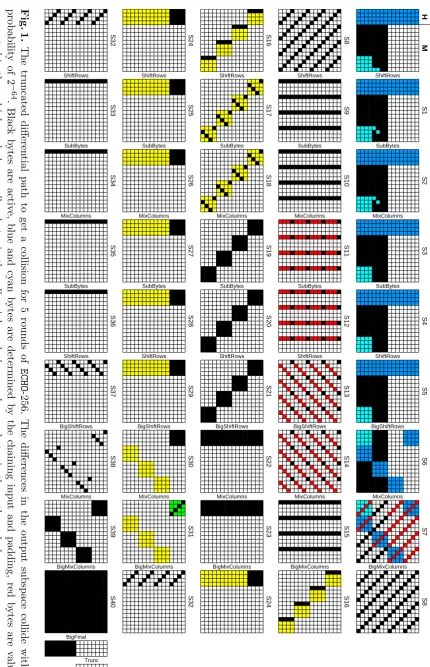
Three improvements are needed to get a collision for 5 rounds. Firstly, we split the merge inbound phase into two parts. In the first part, we efficiently fulfill the 128-bit condition raised in [3] such that a hash function attack is still possible. Note that this also changes the inbound phases slightly. Secondly, we show that the resulting differences in the subspace of the hash function output collide with a probability of 2−64. Finally, we improve the second part of the merge inbound phase which determines the remaining white bytes to get an average complexity of 221.3 to compute one such solution. Then, the total complexity to get a collision for 5 rounds of ECHO-256 is about 2112 with memory requirements of 285.3. For this attack, we use exactly the same truncated differential path as in [8], except that we get a collision at the output (see Fig. 1).
3.1 Solving and Merging the Inbound Phases
To find input pairs according to the truncated differential path given in Fig. 1, we use a rebound attack [6] with multiple inbound phases [4, 5, 8]. The main advantage of multiple inbound phases is that we can first find pairs for each inbound phase independently and then, connect (or merge) the results. For the attack on 5 rounds of ECHO-256 we use an inbound phase in round 2 (red) and another inbound phase in round 3 (yellow). In the yellow inbound and green outbound phase we construct (partial) pairs such that the truncated differential path in round 3, 4 and 5 is fulfilled. In the red inbound phase we search for many pairs conforming to the red part. Additionally, we ensure the 128-bit condition such that the yellow and red part can be connected. Then, we merge (connect) the resulting pairs of the red and yellow inbound phase with the chaining input (blue) and padding (cyan). Note that for each found pair in these phases, the white bytes are still free to choose. We find values which also satisfy the remaining white bytes in the subsequent sections.
Yellow Inbound and Green Outbound. We start the attack by choosing a difference in state S16 such that the truncated differential path of SuperMixColumns between state
S14 and S16 is fulfilled. Then, we can find one pair for the yellow and green part with a complexity of 296 and memory requirements of 264. Since we do not change this part of the attack, we refer to [8] for more details on how to find such a pair. Note that this step determines the values of all yellow and black bytes in stateS16.
stay independent until they are mixed by the following BigMixColumns transformation between state S15 and S16. Hence, we can independently iterate through all 232 starting differences for the 1st, 2nd and 3rd column, and through all 264starting differences for the 4th column of stateS7. Then, we get 232 pairs for each of the first three columns and 264 pairs for the 4th column. The total complexity to find all these pairs is 264and determined by the last column (also see [8]). For each pair, the red and black bytes in state S14 are determined.
Additional Conditions atSuperMixColumns. For each pair of the previous two phases, the values of the red, yellow and black bytes of state S14 and S16 are fixed. These two states are separated by the linearSuperMixColumnstransformation and we get for the first column-slice the following relation
MSM C·
a0∗ ∗ ∗a1∗ ∗ ∗a2 ∗ ∗ ∗a3 ∗ ∗ ∗
T
=b0b1 b2b3∗ ∗ ∗ ∗ ∗ ∗ ∗ ∗ ∗ ∗ ∗ ∗
T ,
where MSM C is the SuperMixColumns transformation matrix, ai the input bytes
deter-mined by the red inbound phase andbithe output bytes determined by the yellow inbound
phase. All bytes marked by ∗ are free to choose. We get a similar relation for all other 16 column-slices. As correctly observed by Jean et al. [3], we only get a solution with probability 2−8 for each column-slice due to the low rank of theMSM C matrix. In total,
each pair of the red and yellow inbound phase imposes a 128-bit condition on the whole state due to theSuperMixColumnstransformation between stateS14 andS16. In detail, we get for each of the 16 column-slices one linear 8-bit conditions on the 8 values of the red, yellow and black bytes. The 8-bit condition for the first column-slice is then
2·a0+ 3·a1+a2+a3 = 14·b0+ 11·b1+ 13·b2+ 9·b3 (2) and similar conditions exist for all other columns.
1st Part of the Merge Inbound Phase. At this point, we have constructed one pair for the yellow inbound phase and in total, 232·232·232·264 = 2160 pairs for the red inbound phase. Among these 2160pairs we expect to find 232 right pairs which also satisfy the 128-bit condition onSuperMixColumnsbetween stateS14andS16. In the following, we show how to find all these 232 pairs with a complexity below 2128. First, we combine the 232·232 = 264 pairs determined by the first two columns of state S7 in a list L1, and the 232·264= 296 pairs determined by the last two columns of stateS
7 in a listL2. Note that the pairs in these two lists are independent. Hence, we can use a birthday attack to find those pairs which satisfy the 128-bit condition imposed by SuperMixColumns. This way, we get 264×296×2−128 = 232 pairs with a total complexity of 296. Note that the memory requirements can be reduced to 264 if we do not store the elements of L2 but compute them online instead. In detail, we first separate Equation 2 into terms determined byL1 and terms determined byL2:
Merge Chaining Input. Next, we need to merge the 232 results of the previous phase with the chaining input (blue) and the bytes fixed by the padding (cyan). The chaining input and padding overlap with the red inbound phase in state S7 on 5·4 = 20 bytes. This results in a 160-bit conditions on the overlapping blue/cyan/red bytes. We use 2112 randomly generated first message blocks to find a pair according to this condition. Addi-tionally, we repeat from the yellow inbound phase with 216 different starting points. This way, we get 216·232 = 248 pairs for the combined yellow and red inbound phases which also satisfy the 128-bit condition of SuperMixColumns between state S14 and S16. Next, we do a birthday match on the overlapping 160-bits and get 2112×248×2−160 = 1 final pair. If we compute the 2112blocks online, the complexity of this step is 2112with memory requirements of 248. For the resulting pair, all differences (black) between state S4 and stateS33, and all colored values (blue, cyan, red, yellow, green) between stateS0 and state
S31are determined.
3.2 Colliding Subspace Differences
As shown in [8], we can combine the linearMixColumns and BigMixColumns transforma-tions with the BigFinal function and the final output truncation. Note that in all these transformations, the resulting one-byte columns of the output hash value can be computed independently of each other. Further, column i∈ {0,1,2,3} of the output hash value de-pends only on columns i·4 of stateS38. It follows that the output difference in the first columni= 0 of the output hash value depends only on the 4 active differences in columns 0, 4, 8, and 12 of stateS38 which we denote by a, b, c, d. Using Mcomb of the first output
column (see [8, Section 3.3]), we get the following linear system of equations:
4 6 2 2 2 3 1 1 2 3 1 1 6 5 3 3 2 4 6 2 1 2 3 1 1 2 3 1 3 6 5 3
·
a b c d
=
0 0 0 0 0 0 0 0
Since we cannot directly control the differences a, b, c, d in the attack, we need to solve this system of equations by brute-force. However, the brute-force complexity is less than expected due to the reduced rank of the given matrix. Since the rank is 2, 216 solutions exist and a random difference results in a collision with a probability of 2−16 instead of 2−32 for the first output column. Since the rank of each of the 4 output column matrices is 2 as well, we get a collision at the output of the hash function with a total probability of 2−64 for any random difference in state S38 of Fig. 1.
3.3 Improved Merge Inbound Phase
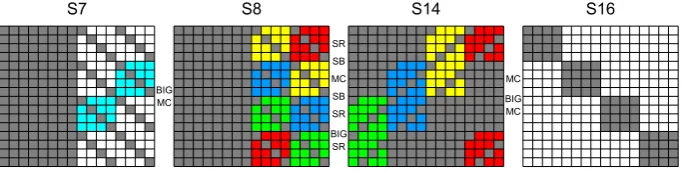
To get a collision attack with a complexity below 2128 for 5 rounds, we need to improve the merge inbound phase further. We start exactly as in the merge inbound phase of the hash function attack in [8]. First, we choose random values for the white bytes in the first two BigColumns of stateS7 and propagate the resulting pairs forward to state S14. Note that we again need to ensure that the conditions on the linear SuperMixColumns
time and memory and we refer to [8] for a detailed description of this part. At this point, all gray values of Fig. 2 are determined and we know that for these values a solution according toSuperMixColumns exists.
S7 S8 S14 S16
SR SB
MC MC
BIG
SB BIG
MC
SR MC
BIG SR
Fig. 2.States used to merge the two inbound phases with the chaining values. Gray bytes show values already determined. Green, blue, yellow and red bytes show independent values used in the generalized birthday attack and cyan bytes represent values with the target conditions.
After this part, we can choose from up to 2384values for each of the green, blue, yellow and red column bytes in state S14 (see [8]). In the last part of the merge inbound phase, we do a generalized birthday attack to find values which also match the 24 cyan bytes (a 192-bit condition) in stateS7 of Fig. 2. First, we choose 264 values for each of the green, blue, yellow and red columns in stateS14 and independently compute them backward to state S8. Since we get 4 independent lists with 264 values in state S8, we can use the generalized birthday attack [10] to find one solution with a complexity of 2192/3 = 264 in time and memory.
To improve the average complexity of this generalized birthday attack, we can start with 285.3values for the green, blue, yellow and red columns in stateS14. Since we need to match a 192-bit condition, we get 23·85.3×2−192= 264 solutions with a complexity of 285.3 in time and memory, or with an average complexity of 221.3 per solution (see [10] for more details). Note that we can even find solutions with an average complexity of 1 by starting with lists of size 296. Each of these 264 solution of the generalized birthday match results in a valid pair conforming to the whole 5-round truncated differential path. According to the previous section, among these 264 pairs we expect to find one pair which collides at the output of the hash function. The maximum time complexity is determined by merging the chaining input and the memory complexity by the generalized birthday attack. In total, the complexity to find a collision for 5 rounds of theECHO-256 hash function is 2112 compression function evaluations with memory requirements of 285.3.
4 Compression Function Attacks for Reduced ECHO-256
In this section we show how to get a collision attack for 6 and a subspace distinguisher for 7-rounds of theECHO-256 compression function, both with chosen salt. Note that in these attacks we also fulfill the 128-bit conditions onSuperMixColumnsobserved by Jean et al. in [3]. For both attacks we get a complexity of 2160 with memory requirements of 2128.
4.1 Finding Pairs for 6 Rounds of the Truncated Differential Path
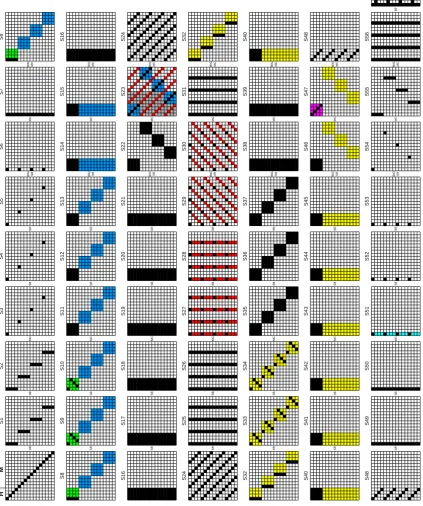
round) is shown in Fig. 3. In this figure, black bytes are active and colored bytes show the different inbound and outbound phases. The complexity to find one such pair for the first 6 rounds of the truncated differential path is 2160 in time with 2128 memory. We use this path to get a collision for 6 rounds and a distinguisher for 7 rounds of theECHO-256 compression function with chosen salt.
Outline of the Attack. The main idea of the attack is to find solutions for the forward and backward part independently for a fixed differences between state S30 and S32. For the yellow/purple part, we can find 2128 pairs with a complexity of 2128 by choosing the salt value. For the green/blue/red part, we can also find 2128 pairs but with a complexity of 2160 and chosen salt. Then, we just need to match the 128-bit salt value of the forward and backward part and fulfill the 128-bit condition on the input (red) and output (yellow) values ofSuperMixColumns. Since we get 2128 independent pairs for both the forward and backward part, we can again fulfill the resulting 256-bit condition using a meet-in-the-middle approach.
Yellow Inbound Phase. Again we start the attack with theSuperMixColumns transfor-mation between the yellow and red part. We choose a difference for state S32 such that the truncated differential path ofSuperMixColumnsbetween state S30and S32 is fulfilled. Then, for each of the 2128 differences in state S40 we do an inbound phase between state
S32 and S40. Since we get one solution on average and with average complexity one, we can compute 2128 pairs for the yellow inbound phase with complexity 2128. We store these pairs sorted by their difference in stateS40 in list L1.
Purple Outbound Phase. We continue to find pairs which also satisfy the truncated differential path until state S47. We choose 2128 random pairs for the AES state in S47
(according to the given truncated differential path) and compute backwards to stateS40. For each resulting difference inS40we lookup the matching difference in listL1. To match also the values, we can choose the 128-bit salt value accordingly. Hence, we get 2128 pairs with complexity 2128 according to the truncated differential path from state S32 toS48.
Red Inbound Phase. The red inbound phase is the same as in the hash function attack. We start with the difference between stateS30andS32, which has been chosen in the yellow inbound phase. Then, we do 4 independent inbound phases for each BigColumn in state
S23. Since we can start with 232 differences for each column in S23, we also get 232 pairs for each column with a total complexity of 232.
Blue Inbound Phase. In the blue inbound phase, we start with a fixed difference in stateS15 and compute this difference forward to state S17. Again, we can choose all 232 differences for eachBigColumnof stateS23and do the blue inbound phases independently for each active AES state in backward direction. For each column, we get 232 pairs with a complexity of 232.
H M S 1 S 2 S 3 S 4 S 5 S 6 S 7 S 8 B IG B IG S R S B M C S B S R M C S R M C S 8 S 9 S 1 0 S 1 1 S 1 2 S 1 3 S 1 4 S 1 5 S 1 6 B IG B IG S R S B M C S B S R M C S R M C S 1 6 S 1 7 S 1 8 S 1 9 S 2 0 S 2 1 S 2 2 S 2 3 S 2 4 B IG B IG S R S B M C S B S R M C S R M C S 2 4 S 2 5 S 2 6 S 2 7 S 2 8 S 2 9 S 3 0 S 3 1 S 3 2 B IG B IG S R S B M C S B S R M C S R M C S 3 2 S 3 3 S 3 4 S 3 5 S 3 6 S 3 7 S 3 8 S 3 9 S 4 0 B IG B IG S R S B M C S B S R M C S R M C S 4 0 S 4 1 S 4 2 S 4 3 S 4 4 S 4 5 S 4 6 S 4 7 S 4 8 B IG B IG S R S B M C S B S R M C S R M C S 4 8 S 4 9 S 5 0 S 5 1 S 5 2 S 5 3 S 5 4 S 5 5 S 5 6 B IG B IG S R S B M C S B S R M C B F S R M C
we get 232×232×2−32 = 232 pairs with matching differences but non-matching values. To match also these 4-byte values, we choose (only) the diagonal 4 bytes of the salt value. For each of the 232 pairs with matching difference, we compute the diagonal bytes of the salt such that the values match. We sort the resulting list according to the 4-byte salt value and repeat the same for all 4BigColumns of stateS23. Then, we just need to iterate through all 4 lists and search for matching salt values. Note that for some salt values, we will get no solution, but for some we will get more than one solution. On average, we expect to get 232 matching pairs with a complexity of 232 with chosen diagonal bytes of the salt.
Green Inbound Phase. To find a pair also for the green part, we first choose a difference according to the truncated differential path between stateS6 andS8. The second starting point for the green inbound phase is the difference of stateS15, which has been chosen in the blue inbound phase. Again, we get one pair on average for each starting differential. This pair needs to be connected with the solutions of the blue inbound phase. First, we match the values in the diagonal bytes of stateS15. Remember that in the previous phases, we have constructed 232 pairs for a single difference in state S15. Among these pairs, we expect to find one pair such that the diagonal 4-byte values between the green and blue inbound phase match. To match the other 12 bytes, we can simply choose the remaining 12 bytes of the salt value. Hence, we get one solution for the combined green, blue and red part with an average complexity of 232.
1st Part of the Merge Inbound Phase. To merge the inbound phases, we first compute 2128 pairs for the yellow/purple part with a total complexity of 2128 and store these pairs in a listL2. We also compute 2128pairs for the green/blue/red part. Since the complexity to compute one solution for this part is 232, the total complexity to compute all 2128 pairs is 2160. To connect the resulting pairs between state S30 and S32 we need to satisfy two 128-bit conditions. First of all, we need to satisfy the linear 128-bitSuperMixColumns
condition observed by Jean et al. in [3]. Since each solution of the yellow/purple and green/blue/red part has also a different salt value, we need to match the 128-bit salt as well. In total, this gives a 256-bit condition which we can satisfy using the birthday effect and get 2128×2128×2−256= 1 pair which satisfies the whole 6-round truncated differential path. The time complexity is 2160 and with a memory complexity if 2128.
2nd Part of the Merge Inbound Phase. In the second part of the merge inbound phase, we need to find values for the remaining white bytes again. This part of the attack is again the same as in the improved hash function attack on ECHO-256 (see Section 3). The only difference is that we change the time-memory trade-off slightly to get an average complexity of one for each solution. Again, we do a generalized birthday attack but this time, we start with 296 independent values for each column of state S
30 (also compare with Fig. 2). Since we have a 192-bit condition in state S23, we get 23·96×2−192 = 296 solutions with a complexity of 296 in time and memory, or with an average complexity of 1 per solution (see [10] for more details). It follows, that we can find one pair, as well as 2160 pairs for the 6-round truncated differential path with a total complexity of 2160 and memory requirements of 2128 with chosen salt.
4.2 Collisions for 6 Rounds with Chosen Salt
of the permutation. This happens with a probability of 2−128. Since we can find 2128 pairs for the truncated differential path with a complexity of 2160, we can get a collision at the output of the compression function after 6 rounds with a complexity of 2160 and memory requirements of 2128 with chosen salt.
4.3 Subspace Distinguisher for 7 Rounds with Chosen Salt
To get a distinguisher for 7 rounds of the compression function of ECHO-256 with chosen salt, we use the truncated differential path given in Fig. 3. Note that the truncated dif-ferential path in the last round is followed with a probability of 2−96. Furthermore, with an additional 32-bit condition on the active bytes in state S52 we can fix the difference at the output of the permutation, prior to the feed-forward. In this case, only the 16-byte differences in the diagonal bytes of the output of the compression function change for each additional found pair. In other words, the difference vector space at the output of the compression function reduces to a dimension of 128. We use a 3rd outbound phase to satisfy these conditions in the last round. Since we can find one solution for the white bytes of the 6-round path with an average complexity of 1, we can find one pair which also satisfies the conditions in the last round with a complexity of 2128 in time and memory. Note that we can find up to 232 such pairs with a total complexity of 2160in time and 2128 memory.
Again, we use [4, Equation (19)] to compute the complexity of a generic distinguishing attack on theECHO-256 compression function. We get the parametersN = 512 (compres-sion function output size), n = 128 (dimension of output difference vector space) and
t = 232 (number of outputs in vector space) for the subspace distinguisher. Then, the generic complexity to construct 232 elements in a vector space of dimension 128 is about 2207.8 compression function evaluations. Hence, with chosen salt we get a distinguisher for 7 rounds of theECHO-256 compression function with a complexity of 2160 in time and 2128 memory.
Note that we can use the almost the same attack to construct 232 near-collisions with a zero difference in the same 320 bits. Again we need to satisfy the 96-bit condition in the cyan bytes in the last round. However, this time we require that the overlapping 4-byte differences in the feed-forward cancel each other. This 32-bit condition ensures that we get only 4×6 = 24 active bytes at the output of the compression function for 232 pairs with a total complexity of 2160 in time and 2128 memory and with chosen salt.
5 Conclusion
In this work, we have shown how to efficiently solve the condition observed by Jean et al. in [3] for the hash function of ECHO as well. This condition occurs due to the low rank of theSuperMixColumnstransformation inECHO. However, using the large degrees of freedom and a meet-in-the-middle approach, this 128-bit condition can be solved with a complexity much lower than 2128. On the other hand, the low rank of theSuperMixColumns
Acknowledgements
We would like to thank J´er´emy Jean and Mar´ıa Naya-Plasencia for their comments and useful discussions. The work described in this paper has been supported by the European Commission through the ICT programme under contract ICT-2007-216676 ECRYPT II.
References
1. Ryad Benadjila, Olivier Billet, Henri Gilbert, Gilles Macario-Rat, Thomas Peyrin, Matt Robshaw, and Yannick Seurin. SHA-3 Proposal: ECHO. Submission to NIST, 2008. Available online: http: //crypto.rd.francetelecom.com/echo.
2. Eli Biham and Orr Dunkelman. A Framework for Iterative Hash Functions - HAIFA. Cryptology ePrint Archive, Report 2007/278, 2007. http://eprint.iacr.org/.
3. J´er´emy Jean and Pierre-Alain Fouque. Practical Near-Collisions and Collisions on Round-Reduced ECHO-256 Compression Function. Cryptology ePrint Archive, Report 2010/569, 2010. http: //eprint.iacr.org/.
4. Mario Lamberger, Florian Mendel, Christian Rechberger, Vincent Rijmen, and Martin Schl¨affer. Re-bound Distinguishers: Results on the Full Whirlpool Compression Function. In Mitsuru Matsui, editor,
ASIACRYPT, volume 5912 ofLNCS, pages 126–143. Springer, 2009.
5. Krystian Matusiewicz, Mar´ıa Naya-Plasencia, Ivica Nikolic, Yu Sasaki, and Martin Schl¨affer. Rebound Attack on the Full Lane Compression Function. In Mitsuru Matsui, editor,ASIACRYPT, volume 5912 ofLNCS, pages 106–125. Springer, 2009.
6. Florian Mendel, Christian Rechberger, Martin Schl¨affer, and Søren S. Thomsen. The Rebound Attack: Cryptanalysis of Reduced Whirlpool and Grøstl. In Orr Dunkelman, editor, FSE, volume 5665 of
LNCS, pages 260–276. Springer, 2009.
7. National Institute of Standards and Technology (NIST). Announcing Request for Candidate Al-gorithm Nominations for a New Cryptographic Hash AlAl-gorithm (SHA-3) Family. Federal Register, 27(212):62212–62220, November 2007. Available online: http://csrc.nist.gov/groups/ST/hash/ documents/FR_Notice_Nov07.pdf.
8. Martin Schl¨affer. Subspace Distinguisher for 5/8 Rounds of the ECHO-256 Hash Function. InSelected Areas in Cryptography, 2010. to appear.
9. Martin Schl¨affer. Subspace distinguisher for 5/8 rounds of the echo-256 hash function. Cryptology ePrint Archive, Report 2010/321, 2010. http://eprint.iacr.org/.