Decentralized Attribute-Based Signatures
Tatsuaki Okamoto1 and Katsuyuki Takashima2
1 NTT, [email protected]
2 Mitsubishi Electric, [email protected] July 27, 2012
Abstract. We present the first decentralized multi-authority attribute-based signature (ABS) scheme, in which no central authority and no trusted setup are required. The proposed DMA-ABS scheme for general (non-monotone) predicates is fully secure (adaptive-predicate unforgeable and perfect private) under a standard assumption, the decisional linear (DLIN) assumption, in the random oracle model. Our DMA-ABS scheme is comparably as efficient as the most efficient ABS scheme. As a by-product, this paper also presents an adaptively secure DMA functional encryption (DMA-FE) scheme under the DLIN assumption.
1 Introduction
1.1 Background
Recently a versatile and privacy-enhanced class of digital signatures have been studied as attribute-based signatures (ABS) [23, 30–32, 39, 40, 42, 43, 48, 54, 59]. A signing (secret) key,skx, in ABS is parameterized by attribute x, and the verification is executed using public key pk
and predicate (or policy) Υ. A messagem along with predicate Υ can be signed by signing key
skx (i.e., signature σ:=Sig(skx, m, Υ)), if and only if xsatisfiesΥ. Signed message (m, Υ, σ) is verified by using public-key pk and predicateΥ, i.e., Ver(pk, m, Υ, σ) ∈ {0,1}. The privacyof a signer in this class of signatures requires that a signature (m, Υ, σ) generated by skx (where x satisfiesΥ) release no information regardingxexcept that xsatisfies Υ.
There are many applications of ABS such as based messaging (ABM), attribute-based authentication, trust-negotiation and leaking secrets (see [43] for more details). For exam-ple, in a country (say country U), public comments on a new government’s policy on scientific research are widely requested, especially to a class of people who should be responsible or heavily related to this topic from academia, government and industries. Comments from this class of people are requested to be signed (authenticated) to prove that the comments are from such people. In addition, the privacy of the people who send comments should be ensured. So there are contradictory requirements on authentication and privacy. The concept of ABS provides a nice solution to this type of problems. For example, a professor of University A sends a comment signed through ABS with a predicate such that ((Affiliation = University AORBORC)AND (Po-sition = ProfessorORLecturer))OR((Affiliation = Government of Country U)AND(Qualification = PhD)) OR ((Affiliation = Company X OR Y OR Z) AND(Position = Chief Scientist OR Senior Manager)). A recipient of this signed comment can confirm that the signer of this comment is from the class of people, and the privacy is also preserved since there are too many people who satisfy the predicate and it is hard to identify the actual signer among so many possible signers due to the privacy condition of ABS.
(certificates/credentials) associated with all attributes in the system, i.e., all positions of all organizations (e.g., all positions of Universities A, B and C, Governments of Countries U, V and W, and Companies X, Y and Z). If the party is corrupted, the system will be totally broken.
To overcome the drawback, the concept of multi-authority (MA-)ABS, was introduced [42, 43, 48], in which there are multiple authorities and each authority is responsible for issuing a secret key associated with a category or sub-universe of attributes, i.e., a user obtains several secret keys, each of which is issued by each authority. For example, a professor of university A obtains a secret key (for the position) from university A, a secret key for the citizenship from country U, and a secret key for a consultant position from company X, where university A, country U and company X are individual authorities. An important requirement for MA-ABS is the security (unforgeability) against collusion attacks. For example, it is required that a professor of university A, Alice, with a secret key for her position and a student, Bob, with a secret key for his citizenship of country W cannot collude to forge a signature endorsed by a professor of university A with the citizenship of country W.
The existing MA-ABS schemes, however, still have a problem that a special central authority is required in addition to multiple authorities regarding attributes, and if the central authority is corrupted, the security (unforgeability) of the system will be totally broken. As a typical example, we show in Appendix A that all MA-ABS schemes in [43] will be totally broken if the central authority is corrupted.
Any MA-ABS scheme with no central authority,decentralizedMA-ABS (DMA-ABS) scheme, has not been proposed.
Recently, Lewko and Waters [38] presented the first DMA system for attribute-based encryp-tion (ABE) (but not for ABS). Their scheme, however, still has a problem. It requires a trusted setup of a parameter, composite number N := p1p2p3 (p1, p2, p3 are primes) and a generator g1 of secret subgroupGp1. That is, there exists a trapdoor, (p1, p2, p3), and the security of the system will not be guaranteed by the security proof, if the trapdoor is compromised. In other words, their system requires a trusted setup. A generic conversion method from a composite-order-group-based system to a prime-composite-order-group-based system has been presented by Lewko [35] and it may be applicable to the DMA-ABE scheme.
1.2 Our Results
– This paper proposes the first DMA-ABS scheme, which supports general relations, non-monotone access structures, in which no central authority exists and no global coordination is required except for the setting of a parameter for a prime order bilinear group and hash functions. Note that parameters for a prime order bilinear group on supersingular and some ordinary elliptic curves and specification of hash functions such as the SHA families can be available from public documents, e.g., ISO and FIPS official documents [33, 25] and [24], or can be included in the specification of the scheme. That is, no trusted setup is necessary in the proposed DMA-ABS system.
– This paper also proposes a more general signature scheme, DMA functional signature (FS) scheme, which supports more general predicates, non-monotone access structures combined with inner-product relations [47]. The proposed DMA-ABS scheme is a special case of the DMA-FS scheme, where the underlying inner-product relations are specialized to be two-dimensional inner-product relations for equality.
Remark: The general relations (non-monotone access structures combined with inner-product relations [47]) supported by the proposed DMA-FS scheme are:x:= (x1, . . . , xi)∈Fn1+···+ni
q
for verification, and Υ := ( ˆM ,(v1, . . . , vi) ∈ Fn1+···+ni
q ) for a secret key. The
component-wise inner-product relations for attribute vector components, e.g., {xt ·vt = 0 or not }t∈{1,...,i}, are input to span program ˆM, and x satisfies Υ iff the truth-value vector of (T(x1·v1 = 0), . . . ,T(xi·vi = 0)) is accepted by span program ˆM. If the DMA-FS is spe-cialized to DMA-ABS, then nt:= 2, i.e.,xt:= (1, xt) andvt:= (vt,−1), wherext·vt= 0 iff xt=vt.
– This paper proves that the proposed DMA-FS scheme is fully secure (adaptive-predicate unforgeable and perfect private in the DMA security model) under the DLIN assumption in the random oracle model. It implies that the proposed DMA-ABS scheme is fully secure under the DLIN assumption in the random oracle model.
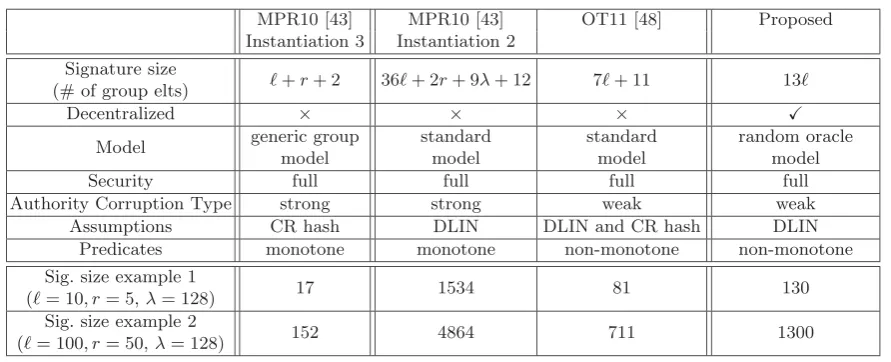
– The efficiency of the DMA-ABS scheme is comparable to those of the existing ABS schemes (e.g., [43, 48]). See Table 1 in Section 5.5.
– Although the main aim of this paper is to propose the first DMA-ABS scheme, there is a by-product, a new DMA-FE (or DMA-ABE) scheme, which an adaptively secure DMA-FE scheme without a trusted setup under the DLIN assumption in the random oracle model. Our DMA-ABS scheme is considered to be a natural extension of ring signatures [51, 53]. In ring signatures, no central authority and no trusted setup are required and every process is fully distributed. Our DMA-ABS also requires no central authority and no trusted setup and every process is fully distributed. In other words, ring signatures are a very special case of our DMA-ABS where the underlying predicate is just a disjunction and each authority is a user in a ring. For many applications of ring signatures, our DMA-ABS is more suitable. For example, in an application to whistle-blowing, an expose document on a financial scandal to a newspaper company would be better to be endorsed by someone with certain possible positions and qualifications related to the scandal than by someone in a list of real persons.
1.3 Key Techniques
There are two major requirements for DMA-ABS,(collusion resistant) unforgeabilityandprivacy
in the decentralized multi-authority model. Our target is to construct a DMA-ABS scheme that is secure (unforgeable and private in the decentralized multi-authority model) under a standard assumption, the DLIN assumption. It is a challenging task even in the random oracle model. For some notations hereafter, see Section 1.5.
To realize such a DMA-ABS scheme, we follow several established key ideas; dual pairing vector spaces (DPVS) [47, 48], Naor’s paradigm (where an encryption counterpart, (2-level) DMA-ABE scheme, is designed first, and then DMA-ABS is constructed on it), global identifier
gid [19], (random oracle) hashing of gid [38], dual system encryption [58, 38], and the linear transformation technique to produce (δxt, . . .)B∗
t by usingXt(the master secret key of authority
strategy is based on Naor’s paradigm, this paper directly proves the security of the proposed DMA-ABS scheme from the DLIN assumption.
A specific central space,V0 (t= 0), played an essential role in the security proof (based on the dual system encryption technique) of previous ABS and FE schemes in [47, 48]. No such a central space, however, is allowed in our DMA setting, where only spaces, Vt (t = 1, . . .), generated by decentralized authorities are available. A crucial part of the key techniques in our DMA-ABS (and DMA-FE) scheme is to distribute the dual system encryption trick for the central space in the previous schemes into all the spaces.
More precisely, the secret-key and verification-text (where the negative term case in the span program, i.e., ρ(i) = ¬(t, vi), is used, for simplicity of expression) are of the forms of (xt, δxt,0nt,0nt, . . .)B∗
t and (sivi, sivi,0nt,0nt, . . .)Bt, respectively. Here,si andsi are shares from
an access structure with a signature. Subspaces with{sivi}and{xt}are used for verification (or decryption), and subspaces with{sivi}and {δxt} are for thedistributeddual system encryption trick. To execute the trick over the subspaces, we develop a new technique,swap and conceptual change, in which 4-dimensional (in DMA-FS, 2nt-dimensional) hidden subspaces are employed for semi-functionalforms of secret-keys and verification-texts. In the previous dual system en-cryption tricks [47, 48], the semi-functional form of secret-keys and verification-texts in a central space V0 (t = 0) played a key role. In our distributed dual system encryption trick, the left 2-dimensional subspaces in the 4-dimensional hidden subspaces are used for a computational change of secret-keys from DLIN and a conceptual change on key query restrictions. The right 2-dimensional subspaces are swapped with the left ones through a computational change from DLIN, and these subspaces for allVt (t= 1, . . .) play the key role in a distributed manner that corresponds to that of V0 (t= 0) in the previous schemes (see Appendix C.5).
In addition, a new re-randomization technique is developed in this paper to achieve the privacy of our DMA-ABS, since the re-randomization technique for the privacy in [48] is not effective in the DMA-ABS setting due to the fully distributed structure (see Section 5.2).
For more details on the techniques in the security proofs of DMA-ABS, see Appendices C.4–C.6 and D.
1.4 Related Works
1. Themesh signatures [13] are a variation of ring signatures, where the predicate is an access structure on a list of pairs comprising a message and public key (mi,pki), and a valid mesh signature can be generated by a person who has enough standard signatures σi on mi, each valid underpki, to satisfy the given access structure.
A crucial difference between mesh signatures and DMA-ABS is the security against the collusion of users. In mesh signatures, several users can collude by pooling their signatures together and create signatures that none of them could produce individually. That is, such collusion is considered to be legitimate in mesh signatures. In contrast, the security against collusion attacks is one of the basic requirements in ABS and DMA-ABS.
2. Another related concept is anonymous credentials (ACs) [2, 3, 15, 17, 18, 21]. The notion of ACs also provides a functionality for users to demonstrate anonymously possession of at-tributes, but the goals of ACs and (DMA-)ABS differ in several points.
more efficient constructions and new applications. In addition, (DMA-)ABS is a signature scheme and a simpler primitive compared with ACs. See Appendix B for more details.
1.5 Notations
WhenAis a random variable or distribution,y←R Adenotes thatyis randomly selected fromA according to its distribution. When Ais a set,y←UA denotes thaty is uniformly selected from A. We denote the finite field of orderq by Fq, and Fq\ {0} by Fq×. A vector symbol denotes a vector representation overFq, e.g.,xdenotes (x1, . . . , xn)∈Fqn. For two vectorsx= (x1, . . . , xn) andv= (v1, . . . , vn),x·vdenotes the inner-productni=1xivi. The vector0 is abused as the zero vector inFqnfor anyn.XT denotes the transpose of matrixX.I and 0denote the×identity matrix and the × zero matrix, respectively. A bold face letter denotes an element of vector space V, e.g., x∈V. Whenbi ∈V (i= 1, . . . , n), spanb1, . . . ,bn ⊆V (resp. spanx1, . . . , xn)
denotes the subspace generated byb1, . . . ,bn(resp.x1, . . . , xn). For basesB:= (b1, . . . ,bN) and B∗ := (b∗
1, . . . ,b∗N), (x1, . . . , xN)B :=
N
i=1xibi and (y1, . . . , yN)B∗ :=
N
i=1yib∗i. For a format
of attribute vectorsn:= (d;n1, . . . , nd) that indicates dimensions of vector spaces, et,j denotes the canonical basis vector (
j−1
0· · ·0,1,
nt−j
0· · ·0)∈Fnt
q for t= 1, . . . , d and j = 1, . . . , nt. GL(n,Fq)
denotes the general linear group of degreen overFq.
2 Dual Pairing Vector Spaces by Direct Product of Symmetric Pairing Groups
Definition 1. “Symmetric bilinear pairing groups” (q,G,GT, G, e) are a tuple of a prime q,
cyclic additive group G and multiplicative group GT of order q, G= 0∈G, and a polynomial-time computable nondegenerate bilinear pairing e:G×G→GT i.e.,e(sG, tG) =e(G, G)st and
e(G, G)= 1. Let Gbpg be an algorithm that takes input 1λ and outputs a description of bilinear pairing groups (q,G,GT, G, e) with security parameterλ.
Definition 2. “Dual pairing vector spaces (DPVS)”(q,V,GT,A, e) by a direct product of
sym-metric pairing groups (q,G,GT, G, e) are a tuple of prime q, N-dimensional vector space V:=
N
G× · · · ×Gover Fq, cyclic group GT of order q, canonical basis A:= (a1, . . . ,aN) of V, where
ai := ( i−1
0, . . . ,0, G,
N−i
0, . . . ,0), and pairing e : V×V → GT. (Symbol e is abused as pairing for G and for V.) The pairing is defined by e(x,y) := Ni=1e(Gi, Hi) ∈ GT where x := (G1, . . . , GN)∈V and y:= (H1, . . . , HN) ∈V. This is nondegenerate bilinear i.e.,e(sx, ty) = e(x,y)st
and if e(x,y) = 1 for all y ∈ V, then x = 0. For all i and j, e(ai,aj) = e(G, G)δi,j where
δi,j = 1 if i=j, and0 otherwise, and e(G, G)= 1∈GT.
DPVS also has linear transformations φi,j on Vs.t.φi,j(aj) =ai and φi,j(ak) =0 if k=j, which can be easily achieved by φi,j(x) := (
i−1
0, . . . ,0, Gj,
N−i
0, . . . ,0) where x:= (G1, . . . , GN). We call φi,j “canonical maps”.
For the asymmetric version of DPVS, (q,V,V∗,GT,A,A∗, e), see Appendix A.2 in the full version of [47].
3 General Predicates: Non-Monotone Access Structures with Inner-Product Relations
3.1 Span Programs and Non-Monotone Access Structures
Definition 3 (Span Programs [1]). Let {p1, . . . , pn} be a set of variables. A span program
over Fq is a labeled matrix Mˆ := (M, ρ) where M is a (×r) matrix over Fq and ρ is a labeling of the rows of M by literals from{p1, . . . , pn,¬p1, . . . ,¬pn} (every row is labeled by one literal), i.e., ρ : {1, . . . , } → {p1, . . . , pn,¬p1, . . . , ¬pn}. A span program accepts or rejects an input by the following criterion. For every input sequence δ ∈ {0,1}n define the submatrix Mδ of M consisting of those rows whose labels are set to 1 by the input δ, i.e., either rows labeled by some
pi such that δi = 1 or rows labeled by some ¬pi such that δi = 0. (i.e., γ:{1, . . . , } → {0,1} is defined by γ(j) = 1 if [ρ(j) = pi]∧[δi = 1] or [ρ(j) =¬pi]∧[δi = 0], and γ(j) = 0 otherwise.
Mδ:= (Mj)γ(j)=1, where Mj is thej-th row of M.)
The span program Mˆ acceptsδ if and only if1∈spanMδ, i.e., some linear combination of the rows ofMδ gives the all one vector1. (The row vector has the value 1 in each coordinate.) A span program computes a Boolean function f if it accepts exactly those inputsδ where f(δ) = 1. A span program is called monotone if the labels of the rows are only the positive literals
{p1, . . . , pn}. Monotone span programs compute monotone functions. (So, a span program in general is “non”-monotone.)
We assume that no row Mi (i = 1, . . . , ) of the matrix M is0. We now introduce a non-monotone access structure with evaluating mapγby using the inner-product of attribute vectors, that is employed in the proposed DMA-ABS (and DMA-FS, DMA-FE) scheme.
Definition 4 (Inner-Products of Attribute Vectors and Access Structures). Ut(t= 1,
. . . , dandUt⊂ {0,1}∗) is a sub-universe, a set of attributes, each of which is expressed by a pair of sub-universe id and nt-dimensional vector, i.e.,(t, v), wheret∈ {1, . . . , d} andv∈Fnt
q \ {0}. We now define such an attribute to be a variable pof a span programMˆ := (M, ρ), i.e.,p:= (t, v). An access structureSis a span programMˆ := (M, ρ)along with variablesp:= (t, v), p := (t, v), . . ., i.e., S := (M, ρ) such that ρ : {1, . . . , } → {(t, v),(t, v), . . ., ¬(t, v),¬(t, v), . . .}. Let Γ be a set of attributes, i.e.,Γ :={(t, xt)|xt∈Fnt
q \ {0},1≤t≤d}, where t runs through some subset of {1, . . . , d}, not necessarily the whole indices.
When Γ is given to access structure S, map γ :{1, . . . , } → {0,1} for span program Mˆ := (M, ρ) is defined as follows: For i = 1, . . . , , set γ(i) = 1 if [ρ(i) = (t, vi)] ∧[(t, xt) ∈ Γ] ∧[vi·xt= 0]or [ρ(i) =¬(t, vi)] ∧[(t, xt)∈Γ] ∧[vi·xt= 0]. Set γ(i) = 0 otherwise.
Access structure S:= (M, ρ) accepts Γ iff1∈span(Mi)γ(i)=1.
Remark 1 The simplest form of the inner-product relations in the above-mentioned access
When Γ is given to access structure S, map γ :{1, . . . , } → {0,1} for span program Mˆ := (M, ρ) is defined as follows: For i = 1, . . . , , set γ(i) = 1 if [ρ(i) = (t, vi)] ∧[(t, xt) ∈ Γ] ∧[vi =xt]or [ρ(i) =¬(t, vi)] ∧[(t, xt)∈Γ] ∧[vi =xt]. Set γ(i) = 0 otherwise.
Remark 2 When a user has multiple attributes in a sub-universe (category) t, we can employ
dimension nt > 2. For instance, a professor (say Alice) in the science faculty of a university is also a professor in the engineering faculty of this university. If the attribute authority of this university manages sub-universe t:= “faculties of this university”, Alice obtains a secret key for
(t, xt:= (1,−(a+b), ab) ∈F3q) with a:= “science” and b:= “engineering” from the authority. When a user verifies a signature for an access structure with a single negative attribute ¬(t, “science”), the verification text is encoded as ¬(t, vi := (a2, a,1)) with a := “science”. Since
xt·vi = 0, Alice cannot make a valid signature for an access structure with the negative attribute
¬(t, “science”). For such a case with nt>2, see Appendix C.3 with our DMA-FS scheme.
We now construct a secret-sharing scheme for a span program.
Definition 5. A secret-sharing scheme for span programMˆ := (M, ρ) is:
1. Let M be ×r matrix. Let column vector fT := (f1, . . . , fr)T ←U Fqr. Then, s0 :=1·fT =
r
k=1fk is the secret to be shared, andsT:= (s1, . . . , s)T:=M·fT is the vector of shares of the secret s0 and the share si belongs toρ(i).
2. If span program Mˆ := (M, ρ) accept δ, or access structure S := (M, ρ) accepts Γ, i.e.,
1∈span(Mi)
γ(i)=1 with γ :{1, . . . , } → {0,1}, then there exist constants {αi∈Fq|i∈I} such that I ⊆ {i ∈ {1, . . . , } | γ(i) = 1} and i∈Iαisi =s0. Furthermore, these constants
{αi} can be computed in time polynomial in the size of matrix M.
4 Decisional Linear (DLIN) Assumption
Definition 6 (DLIN: Decisional Linear Assumption [8]). The DLIN problem is to guess
β ∈ {0,1}, given (paramG, G, ξG, κG, δξG, σκG, Yβ)← GR βDLIN(1λ), where
GDLIN
β (1λ) :paramG := (q,G,GT, G, e)← GR bpg(1λ),
κ, δ, ξ, σ←UFq, Y0 := (δ+σ)G, Y1 ←UG, return (paramG, G, ξG, κG, δξG, σκG, Yβ),
forβ ← {U 0,1}. For a probabilistic machineE, we define the advantage ofEfor the DLIN problem as: AdvDLINE (λ) := Pr E(1λ, )→1 ←GR 0DLIN(1λ)
−Pr E(1λ, )→1 ←GR 1DLIN(1λ).
The DLIN assumption is: For any probabilistic polynomial-time adversary E, the advantage AdvDLINE (λ) is negligible in λ.
5 Decentralized Multi-Authority Attribute-Based Signatures (DMA-ABS)
5.1 Definitions for DMA-ABS
Definition 7 (Decentralized Multi-Authority ABS : DMA-ABS).A decentralized
GSetup A party runs the algorithm GSetup(1λ) which outputs a global parameter gparam. The party publishes gparam.
ASetup An attribute authority t(1≤t≤d)who wishes to issue attributes runs ASetup(gparam, t, nt) which outputs an attribute-authority public key apkt and an attribute-authority secret key askt. The attribute authority t publishes apkt and stores askt.
AttrGen When an attribute authorityt issues usergid a secret key associated with an attribute
xt, it runs AttrGen(gparam, t, askt, gid, xt) that outputs an attribute secret keyuskgid,(t,xt).
The attribute authority gives uskgid,(t,xt) to the user.
Sig This is a randomized algorithm. A user signs messagemwith claim-predicate (access struc-ture) S := (M, ρ), only if there is a set of attributes Γ such that S accepts Γ, the user has obtained a set of keys {uskgid,(t,xt) | (t, xt) ∈ Γ} from the attribute authorities. Then sig-nature σ can be generated using Sig(gparam,{apkt,uskgid,(t,xt)}, m, S), where uskgid,(t,xt) ←R AttrGen(gparam, t,askt,gid, xt).
Ver To verify signature σ on message m with claim-predicate (access structure) S, using a set of public keys for relevant authorities{apkt}, a user runs Ver(gparam,{apkt}, m,S, σ) which outputs boolean value accept:= 1 or reject:= 0.
Definition 8 (Perfect Privacy of DMA-ABS). A DMA-ABS scheme is perfectly private,
if, for all gparam ←R GSetup(1λ), for all (ask t,apkt)
R
← ASetup(gparam, t) (1 ≤ t ≤ d), all messages m, all attribute sets Γ1 associated with gid1 and Γ2 associated with gid2, all signing keys{uskt,1←R AttrGen(gparam, t,askt,gid1, xt,1)}(t,xt,1)∈Γ1 and{uskt,2 ←R AttrGen(gparam, t,askt,
gid2, xt,2)}(t,xt,2)∈Γ2, all access structuresSsuch thatS acceptsΓ1 andSacceptsΓ2, the distribu-tions Sig(gparam,{apkt,uskt,1 | (t, xt,1) ∈Γ1}, m,S) and Sig(gparam,{apkt,uskt,2 | (t, xt,2) ∈ Γ2}, m,S) are equal.
For a DMA-ABS scheme with perfect privacy, we define algorithmAltSig(gparam,{apkt,askt},
m,S) withSand master keyasktinstead ofΓ and{uskgid,(t,xt)}(t,xt)∈Γ: First, generateuskgid,(t,xt)
R
← AttrGen(gparam, t,askt,gid, xt) for arbitrary Γ := {(t, xt)} which satisfies S, then σ ←R
Sig(gparam,{apkt,uskgid,(t,xt)}, m,S). Returnσ.
Let T be the set of authorities. We assume each attribute is assigned to one authority.
Definition 9 (Unforgeability of DMA-ABS).For an adversary, we defineAdvDMAA -ABS,UF(λ)
to be the success probability in the following experiment for any security parameter λ. A DMA-ABS scheme is existentially unforgeable if the success probability of any polynomial-time adver-sary is negligible:
1. Run gparam ←R GSetup(1λ) and givegparam to the adversary A. For authorities t∈ T, run
(askt,apkt) ←R ASetup(gparam) and give{apkt}t∈T to A. AdversaryA specifies a set T⊂T
of corrupt attribute authorities, and gets {askt}t∈Te.
2. The adversaryA is given access to oracles AttrGen andAltSig over S:=T\T. 3. At the end, the adversary outputs (m,S, σ).
Let Γgidi := {(t ∈ S, xt)} (i = 1, . . . , νH) queried to the AttrGen oracle with gidi. We say the adversary succeeds, if (m,S) was never queried to the AltSig oracle, S does not accept
Remark 3 The model regarding corrupted authoritiesin this definition is weaker than that in [43]. Roughly, the security on this model implies that no adversaryAcan forge a signature with a predicateSS unlessAissues key queries forΓS such thatSS acceptsΓS, whereSS andΓS are a predicate and attributes over uncorrupted parties S. On the other hand, the security on the model in [43] implies that no adversaryAcan forge a signature with a predicateS
S∪Te unlessA
issues key queries for ΓS such that, for someΓTe,S
S∪Te accepts (ΓS∪ΓTe).
5.2 Construction Idea of the Proposed DMA-ABS Scheme
Here we will show some basic idea to construct the proposed DMA-ABS scheme, which is designed on the DMA-FE scheme (Appendix E.2) through Naor’s paradigm. Note that the privacy condition is not included in Naor’s paradigm.
Roughly speaking, a secret signing keyskΓ with attribute setΓ and a verification textcwith access structure S (for signature verification) in our DMA-ABS scheme correspond to a secret decryption keyskΓ with Γ and a ciphertextc with S in the DMA-FE scheme, respectively. No counterpart of a signatures∗in the DMA-ABS exists in the DMA-FE, and the privacy property for signature s∗ is also specific in DMA-ABS. Signatures∗ in DMA-ABS may be interpreted to be a decryption key specialized to decrypt a ciphertext with access structureS, that is delegated from secret key skΓ. The algorithms of the proposed DMA-ABS scheme can be described in the light of such correspondence to the DMA-FE scheme:
GSetup Almost the same as that in the DMA-FE scheme except that a hash function, H2, is added ingparam. This is used for hashing of message and access structure in the signing and verification algorithms.
ASetup Almost the same as that in the DMA-FE scheme except that B∗t is revealed as a public
parameter in our DMA-ABS, while it is secret in the DMA-FE scheme. They are published in our DMA-ABS for the signature generation procedure Sig to meet the privacyof signers (for randomization). This is an essential difference between DMA-FE and DMA-ABS. Since (a part of)B∗0is a master secret in [48], other bases{B∗t}t>0can be published. However, for lack ofV0 in our DMA-ABS,modifiedsub-bases (b∗t,ι)ι=1,2 are used in public key{B∗t}t>0 in place of sub-bases (b∗t,ι)ι=1,2, and a new security proof technique is required.
AttrGen The same as that in the DMA-FE scheme.
Sig Specific in DMA-ABS. To meet the privacy condition fors∗, a novel technique is employed to randomly generate a signature from skΓ and {Bt∗}(t,xt)∈Γ. In [48], an attribute vector (1, xt) is encoded on 2-dimensional subspace spanb∗t,1,b∗t,2 fort > 0. Since our DMA-ABS lacks the space V0, however, the vector is also encoded on another subspacespanbt,∗3,b∗t,4. To re-randomize both vectors independently using public (b∗t,ι,bt,∗2+ι)ι=1,2 is one of key tricks here.
Ver The signature verification in our DMA-ABS checks whether a signature (or a specific de-cryption key) s∗ works as a decryption key to decrypt a verification text (or a ciphertext) associated with Sand H2(m,S).
5.3 Proposed DMA-ABS Scheme
injective for S := (M, ρ) with signature σ = σS. We will show how to relax the restriction in Appendix F. We refer to Section 1.5 for notations on DPVS, e.g., (x1, . . . , xN)B,(y1, . . . , yN)B∗
forxi, yi∈Fq, andet,j. For matrixX:= (χi,j)i,j=1,...,N ∈FqN×N and elementv inN-dimensional
V, X(v) denotes N,Ni=1,j=1χi,jφi,j(v) using canonical maps {φi,j} (Definition 2). Similarly, for matrix (ϑi,j) := (X−1)T, (X−1)T(v) :=N,Ni=1,j=1ϑi,jφi,j(v). It holds thate(X(x),(X−1)T(y)) = e(x,y) for any x,y∈V.
GSetup(1λ) : paramG := (q,G,GT, G, e)← GR bpg(1λ), H1:{0,1}∗→G; H2 :{0,1}∗→Fq;
return gparam:= (paramG, H1, H2).
Remark : Givengparam, the following values can be computed by anyone and shared by all parties:
G0:=H1(0λ)∈G, G1:=H1(0λ−1,1)∈G, G2 :=H1(0λ−2,1,0)∈G, gT :=e(G0, G1).
ASetup(gparam, t) : paramVt := (q,Vt,GT,At, e) :=Gdpvs(1λ,13,paramG),
Xt←UGL(13,Fq), (ϕt,ι,1,ϕt,ι,2)←UFq2 for ι= 1,2,
bt,ι:=Xt((0ι−1, G0, 013−ι)), b∗t,ι:= (XtT)−1((0ι−1, G1, 013−ι)) forι= 1, . . . ,13,
2
8 2 1
b∗t,1:= (XtT)−1 (( G2, 0, 08, ϕt,1,1G1,ϕt,1,2G1, 0 )), 2
8 2 1
b∗t,2:= (XtT)−1 (( 0, G2, 08, ϕt,2,1G1,ϕt,2,2G1, 0 )),
Bt:= (bt,1, . . . ,bt,13), B∗t := (b∗t,1, . . . ,b∗t,13), Bt:= (bt,1, . . . ,bt,6,bt,13),
B∗t := (b∗t,1,b∗t,2,bt,∗3, . . . ,b∗t,6,b∗t,11,b∗t,12), return askt:=Xt, apkt:= (paramVt,Bt,B∗t).
Remark : Letπ∈Fq s.t.G2 =πG1,
thenb∗t,1= ( 2
π,0, 8
08 , 2
ϕt,1,1,ϕt,1,2, 1
0 )B∗
t, b∗t,2 = (
2
0, π , 8
08 , 2
ϕt,2,1,ϕt,2,2, 1
0 )B∗
t.
AttrGen(gparam, t, askt, gid, xt∈Fq) : Ggid :=H1(gid), (ϕt,1, ϕt,2)
U
←F2
q,
2
2 6 2 1
k∗t := (XtT)−1(( G1, xtG1, Ggid, xtGgid, 06, ϕt,1G1, ϕt,2G1, 0 )),
return uskgid,(t,xt):= (gid,(t, xt),k∗t).
Remark : Letδ∈Fq s.t.Ggid=δG1, thenkt∗= (
2
(1, xt), 2
δ(1, xt), 6
06 , 2
ϕt,1, ϕt,2, 0 )B∗
t.
Sig(gparam,{apkt,uskgid,(t,xt):= (gid,(t, xt),k∗t)}, m, S:= (M, ρ)) :
IfS:= (M, ρ) accepts Γ :={(t, xt) ∈ uskgid,(t,xt)}, then compute I and {αi}i∈I
such that 1 =i∈IαiMi, where Mi is the i-th row of M, and I ⊆ {i∈ {1, . . . , }| [ρ(i) = (t, vi) ∧ (t, xt)∈Γ ∧ vi =xt]
ψ←U Fq, ψi :=ψif i∈I, ψi:= 0 if i∈I fori= 1, . . . , ,
fori= 1, . . . , , ζi ←UFq, (βi,0),(βi,1)← {U (β1, . . . , β) | i=1βiMi=0},
Remark : If detM = 0, the set contains only 0, i.e., allβi= 0 fori= 1, . . . , . s∗i :=γi·k∗t +ψi(b∗t,3+xtb∗t,4) +2ι=1
yi,0,ιb∗t,ι+yi,1,ιb∗t,2+ι
+ζib∗t,5+H2(m,S)b∗t,6+ri∗,
where ri∗←Uspanb∗t,11,b∗t,12, and γi, yi,j := (yi,j,1, yi,j,2) for j= 0,1, are defined as if i∈I ∧ ρ(i) = (t, vi), γi:=αi, yi,j:=βi,j(1, vi),
if i∈I ∧ ρ(i) =¬(t, vi), γi:= αi
vi−xt, yi,j := βi,j
vi−yi,j(1, yi,j) whereyi,j
U
←Fq\ {vi},
if i∈I ∧ ρ(i) = (t, vi), γi:= 0, yi,j :=βi,j(1, vi), if i∈I ∧ ρ(i) =¬(t, vi), γi:= 0, yi,j := βi,j
vi−yi,j(1, yi,j) whereyi,j
U
←Fq\ {vi},
return s∗ := (s∗1, . . . ,s∗).
Ver(gparam, {apkt}, m, S:= (M, ρ), s∗) : f←UFrq, sT:= (s1, . . . , s)T :=M·fT, s0:=1·fT,
f←R Frq s.t.1·fT = 0, sT:= (s1, . . . , s)T:=M·fT,
fori= 1, . . . , , θi, θi, θi, ηi ←UFq, if ρ(i) = (t, vi),
2
2 2 6 1
ci:= ( si+θivi, −θi, si+θivi, −θi, θi(H2(m,S),−1), 06, ηi )Bt,
2
2 2 6 1
if ρ(i) =¬(t, vi), ci := ( si(vi, −1), si(vi, −1), θi(H2(m,S),−1), 06, ηi )Bt,
cd+1 :=gsT0, return 1 if i=1e(ci,s∗i) =cd+1, return 0 otherwise. [Correctness] IfS:= (M, ρ) accepts Γ :={(t, xt) ∈ uskgid,(t, xt)},
i=1e(ci,s∗i) =
i∈I
e(ci,k∗t)γie(ci,b∗3+xt,ιb∗4)ψ
· i=1
2
ι=1e(ci,b∗ι)yi,0,ιe(ci,b∗2+ι)yi,1,ι
=i∈IgTαi(si+(δ+ψ)si)·i=1gTπβi,0si+βi,1si =g
P
i∈Iαi(si+(δ+ψ)si)
T ·g
P
i=1(πβi,0si+βi,1si)
T
=gs0
T , since
i∈Iαisi =s0 and
i∈Iαisi =
i=1βi,0si =
i=1βi,1si = 0.
Comparison with the MA-ABS Scheme in [48] Okamoto-Takashima [48] gave a fully
the hidden part for semi-functional signatures, the third the signature randomness part, and the last is the verification text (VT) randomness part.
In the DMA setting, we cannot use special (central) spaces,V0 andVd+1. Instead, we should distribute the roles of these spaces into the secret share components, (s∗1, . . . , s∗). As a result, these components become 13-dimensional (13 = 6 + 4 + 2 + 1), where the real part (hidden part, resp.) is expanded to dimensions (4-dimensions, resp.) (see the figure below). The 6-dimensional real part consists of 2 dimensions to distribute the role ofV0, 2 dimensions for secret shares, and 2 dimensions to distribute the role ofVd+1. We also use additional 2 dimensions in the hidden part to execute theswapping technique in the security proof.
2
2 2 1
SIG component (t= 0, d+ 1)
in [48] MA-ABS : ( real hidden SIG ran. VT ran.), 6
4 2 1
SIG component
in our DMA-ABS : ( real hidden SIG ran. VT ran. ).
5.4 Security of the Proposed DMA-ABS
Theorem 1. The proposed DMA-ABS scheme is perfectly private.
Theorem 2. The proposed DMA-ABS scheme is unforgeable (adaptive-predicate unforgeable)
under the DLIN assumption in the random oracle model.
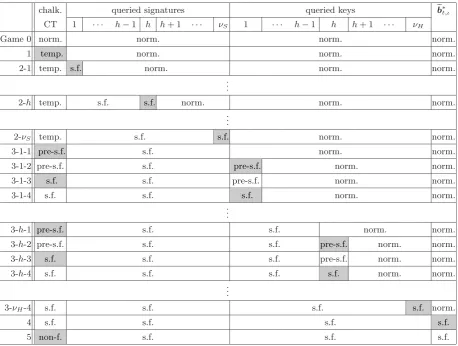
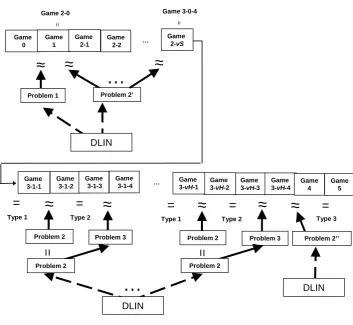
For any adversaryA, there exist probabilistic machinesE1,E2,E3-1,E3-2andE4, whose running times are essentially the same as that of A, such that for any security parameter λ,
AdvDMAA -ABS,UF(λ)≤AdvDLINE1 (λ) +
νS
h=1
AdvDLINE2-h (λ)
+
νH
h=1
AdvDLINE3-h-1(λ) +AdvDLINE3-h-2(λ)
+AdvDLINE4 (λ) +,
whereE2-h(·) :=E2(h,·),E3-h-1(·) :=E3-1(h,·),E3-h-2(·) :=E3-2(h,·),νS(resp.νH) is the maximum number of queries to signing oracle (resp. random oracleH1), and := ((d+6)νS+(2d+10)νH+ 3d+ 11)/q.
The (standard) DLIN assumption is given in Appendix 4. Theorems 1 and 2 are immediately obtained from Theorems 3 and 4 (in Appendix C.4) on the proposed DMA-FS, whose proofs are also given in Appendix C.4.
5.5 Performance
the size of a group element can be around the size of Fq (e.g., 256 bits). In Table 1, and r represent the size of the underlying access structure matrix M for a predicate, i.e.,M ∈F×r
q .
For example, some predicate with 4 AND and 5 OR gates as well as 10 variables may be expressed by a 10×5 matrix, and a predicate with 49 AND and 50 OR gates as well as 100 variables may be expressed by a 100×50 matrix (see the appendix of [38]). λ is the security parameter (e.g., 128).
Table 1.Comparison with the Existing MA-ABS Schemes
MPR10 [43] MPR10 [43] OT11 [48] Proposed
Instantiation 3 Instantiation 2 Signature size
(# of group elts) +r+ 2 36+ 2r+ 9λ+ 12 7+ 11 13
Decentralized × × × X
Model generic group
model
standard model
standard model
random oracle model
Security full full full full
Authority Corruption Type strong strong weak weak
Assumptions CR hash DLIN DLIN and CR hash DLIN
Predicates monotone monotone non-monotone non-monotone
Sig. size example 1
(= 10, r= 5,λ= 128) 17 1534 81 130
Sig. size example 2
(= 100, r= 50,λ= 128) 152 4864 711 1300
6 Concluding Remarks
We presented the first DMA-ABS scheme, in which no central authority and no trusted setup are required. An adaptively secure DMA-FE scheme with no trusted setup was also presented.
One of the most important remaining problems in this paper is to construct a DMA-ABS (and DMA-FE) scheme in the standard model (without random oracles). It would be also important to realize a DMA-ABS (and DMA-FE) scheme with no trusted setup in a stronger authority corruption model (like that in [43]), and to introduce a revocation mechanism in a DMA-ABS scheme.
References
1. Beimel, A., Secure schemes for secret sharing and key distribution. PhD Thesis, Israel Institute of Technology, Technion, Haifa, Israel, 1996.
2. Belenkiy, M., Camenisch, J., Chase, M., Kohlweiss, M., Lysyanskaya, A., Shacham, H.: Randomizable proofs and delegatable anonymous credentials. In: Halevi, S. (ed.) CRYPTO 2009. LNCS, vol. 5677, pp. 108–125. Springer Heidelberg (2009)
3. Belenkiy, M., Chase, M., Kohlweiss, M., Lysyanskaya, A.: P-signatures and noninteractive anonymous creden-tials. In: Canetti, R. (ed.) TCC 2008. LNCS, vol. 4948, pp. 356–374. Springer Heidelberg (2008)
4. Bethencourt, J., Sahai, A., Waters, B.: Ciphertext-policy attribute-based encryption. In: 2007 IEEE Sympo-sium on Security and Privacy, pp. 321–334. IEEE Press (2007)
6. Boneh, D., Boyen, X.: Secure identity based encryption without random oracles. In: Franklin, M.K. (ed.) CRYPTO 2004. LNCS, vol. 3152, pp. 443–459. Springer Heidelberg (2004)
7. Boneh, D., Boyen, X., Goh, E.: Hierarchical identity based encryption with constant size ciphertext. In: Cramer, R. (ed.) EUROCRYPT 2005. LNCS, vol. 3494, pp. 440–456. Springer Heidelberg (2005)
8. Boneh, D., Boyen, X., Shacham, H.: Short group signatures. In: Franklin, M. (ed.) CRYPTO 2004. LNCS, vol. 3152, pp. 41–55. Springer, Heidelberg (2004)
9. Boneh, D., Franklin, M.: Identity-based encryption from the Weil pairing. In: Kilian, J. (ed.) CRYPTO 2001. LNCS, vol. 2139, pp. 213–229. Springer Heidelberg (2001)
10. Boneh, D., Hamburg, M.: Generalized identity based and broadcast encryption scheme. In: Pieprzyk, J. (ed.) ASIACRYPT 2008. LNCS, vol. 5350, pp. 455–470. Springer Heidelberg (2008)
11. Boneh, D., Katz, J., Improved efficiency for CCA-secure cryptosystems built using identity based encryption. RSA-CT 2005, LNCS, Springer Verlag (2005)
12. Boneh, D., Waters, B.: Conjunctive, subset, and range queries on encrypted data. In: Vadhan, S.P. (ed.) TCC 2007. LNCS, vol. 4392, pp. 535–554. Springer Heidelberg (2007)
13. Boyen, X.: Mesh signatures. In: Naor, M. (ed.) EUROCRYPT 2007, LNCS, vol. 4515, pp. 210–227. Springer Heidelberg (2007)
14. Boyen, X., Waters, B.: Anonymous hierarchical identity-based encryption (without random oracles). In: Dwork, C. (ed.) CRYPTO 2006. LNCS, vol. 4117, pp. 290–307. Springer Heidelberg (2006)
15. Camenisch, J., Groß, T.: Efficient attributes for anonymous credentials. In: CCS 2008. pp.345–356. ACM (2008)
16. Canetti, R., Halevi S., Katz J.: Chosen-ciphertext security from identity-based encryption. EUROCRYPT 2004, LNCS, Springer Heidelberg (2004)
17. Camenisch, J., Lysyanskaya, A.: An efficient system for non-transferable anonymous credentials with optinal anonymity revocation. In: Pfitzmann, B. (ed.) EUROCRYPT 2001. LNCS, vol. 2045, pp. 93–118. Springer Heidelberg (2001)
18. Camenisch, J., Lysyanskaya, A.: Signature schemes and anonymous credentials from bilinear maps. In: Franklin, M.K. (ed.) CRYPTO 2004. LNCS, vol. 3152, pp. 56–72. Springer Heidelberg (2004)
19. Chase, M.: Multi-authority attribute based encryption. TCC, LNCS, pp. 515–534, Springer Heidelberg (2007). 20. Chase, M. and Chow, S.: Improving privacy and security in multi-authority attribute-based encryption, ACM
Conference on Computer and Communications Security, pp. 121–130, ACM (2009).
21. Chaum, D.: Security without identification: Transaction systems to make big brother obsolete. In: CACM, vol. 28 (10), pp. 1030–1044. ACM (1985)
22. Cocks, C.: An identity based encryption scheme based on quadratic residues. In: Honary, B. (ed.) IMA Int. Conf. LNCS, vol. 2260, pp. 360–363. Springer Heidelberg (2001)
23. Escala, A., Herranz, J., Morillo, P.: Revocable attribute-based signatures with adaptive security in the stan-dard model, AFRICACRYPT 2011. LNCS, vol. 6737, pp. 224–241. Springer Heidelberg (2011)
24. Estibals, N.: Compact hardware for computing the Tate pairing over 128-bit-security supersingular curves, IACR ePrint Archive: Report 2010/371 (2010).
25. SECURE HASH STANDARD, FIPS PUB 180-1, 180-2, NIST, USA (1995,2002)
26. Gentry, C.: Practical identity-based encryption without random oracles. In: Vaudenay, S. (ed.) EUROCRYPT 2006. LNCS, vol. 4004, pp. 445–464. Springer Heidelberg (2006)
27. Gentry, C., Halevi, S.: Hierarchical identity-based encryption with polynomially many levels. In: Reingold, O. (ed.) TCC 2009. LNCS, vol. 5444, pp. 437–456. Springer Heidelberg (2009)
28. Gentry, C., Silverberg, A.: Hierarchical ID-based cryptography. In: Zheng, Y. (ed.) ASIACRYPT 2002. LNCS, vol. 2501, pp. 548–566. Springer Heidelberg (2002)
29. Goyal, V., Pandey, O., Sahai, A., Waters, B.: Attribute-based encryption for fine-grained access control of encrypted data. In: ACM Conference on Computer and Communication Security 2006, pp. 89–98, ACM (2006) 30. S. Guo and Y. Zeng: Attribute-based signature scheme, In: ISA 08, pp. 509–511. IEEE (2008)
31. D. Khader: Attribute based group signatures, ePrint, IACR,http://eprint.iacr.org/2007/159.
32. D. Khader: Attribute based group signature with revocation. ePrint, IACR,http://eprint.iacr.org/2007/ 241
33. ISO/IEC 15946-5, Information technology – Security techniques – Cryptographic techniques based on elliptic curves – Part 5: Elliptic curve generation (2009).
35. Lewko, A.: Tools for simulating features of composite order bilinear groups in the prime order setting. ePrint, IACR,http://eprint.iacr.org/2011/490
36. Lewko, A., Okamoto, T., Sahai, A., Takashima, K., Waters, B.: Fully secure functional encryption: Attribute-based encryption and (hierarchical) inner product encryption, EUROCRYPT 2010. LNCS, vol. 6110, pp. 62–91. Springer Heidelberg (2010)
37. Lewko, A.B., Waters, B.: New techniques for dual system encryption and fully secure HIBE with short ciphertexts. In: Micciancio, D. (ed.) TCC 2010. LNCS, vol. 5978, pp. 455–479. Springer Heidelberg (2010) 38. Lewko, A.B., Waters, B.: Decentralizing Attribute-Based Encryption, EUROCRYPT 2011. LNCS, vol. 6632,
pp. 568–588. Springer Heidelberg (2011)
39. Li, J., Au, M.H., Susilo, W., Xie, D., Ren. K.: Attribute-based signature and its application, In: ASIACCS 2010, pp. 60–69. ACM (2010)
40. Li, J., Kim, K.: Attribute-based ring signatures. ePrint, IACR,http://eprint.iacr.org/2008/394 41. H. Lin, Z. Cao, X. Liang, and J. Shao.: Secure threshold multi authority attribute based encryption without
a central authority, INDOCRYPT, LNCS, vol. 5365, pp. 426–436, Springer Heidelberg (2008).
42. Maji, H., Prabhakaran, M., Rosulek, M.: Attribute-based signatures: Achieving attribute-privacy and collusion-resistance. ePrint, IACR,http://eprint.iacr.org/2008/328
43. Maji, H., Prabhakaran, M., Rosulek, M.: Attribute-Based Signatures. CT-RSA 2011, LNCS 6558, pp. 376–392 (2011).
44. S. M¨uller, S. Katzenbeisser, and C. Eckert.; On multi-authority ciphertext-policy attribute-based encryption, Bull. Korean Math Soc. 46, No.4, pp. 803–819 (2009).
45. Okamoto, T., Takashima, K.: Homomorphic encryption and signatures from vector decomposition. In: Gal-braith, S.D., Paterson, K.G. (eds.) Pairing 2008. LNCS, vol. 5209, pp. 57–74, Springer Heidelberg (2008) 46. Okamoto, T., Takashima, K.: Hierarchical predicate encryption for inner-products, In: ASIACRYPT 2009,
Springer Heidelberg (2009)
47. Okamoto, T., Takashima, K.: Fully secure functional encryption with general relations from the decisional linear assumption. In: Rabin, T. (ed.) CRYPTO 2010. LNCS, vol. 6223, pp. 191–208. Springer Heidelberg (2010). Full version is available athttp://eprint.iacr.org/2010/563
48. Okamoto, T., Takashima, K.: Efficient attribute-based signatures for non-monotone predicates in the standard model, In: PKC 2011, LNCS, vol. 6571, pp. 35–52. Springer Heidelberg (2011)
49. Ostrovsky, R., Sahai, A., Waters, B.: Attribute-based encryption with non-monotonic access structures. In: ACM Conference on Computer and Communication Security 2007, pp. 195–203, ACM (2007)
50. Pirretti, M., Traynor, P., McDaniel, P., Waters, B.: Secure attribute-based systems. In: ACM Conference on Computer and Communication Security 2006, pp. 99–112, ACM, (2006)
51. Rivest, R.L., Shamir, A., Tauman, Y.: How to leak a secret. In: Boyd, C. (ed.) ASIACRYPT 2001. LNCS, vol. 2248, pp. 552–565. Springer Heidelberg (2001)
52. Sahai, A., Waters, B.: Fuzzy identity-based encryption. In: Cramer, R. (ed.) EUROCRYPT 2005. LNCS, vol. 3494, pp. 457–473. Springer Heidelberg (2005)
53. Shacham, H., Waters, B.: Efficient ring signatures without random oracles. In: Okamoto, T., Wang, X. (eds.) PKC 2007. LNCS, vol. 4450, pp. 166–180. Springer Heidelberg (2007)
54. Shahandashti, S.F., Safavi-Naini, R.: Threshold attribute-based signatures and their application to anony-mous credential systems. In: Preneel B. (ed.) AFRICACRYPT 2009. LNCS, vol. 5580, pp. 198–216. Springer Heidelberg (2009)
55. Shi, E., Waters, B.: Delegating capability in predicate encryption systems. In: Aceto, L., Damg˚ard, I., Gold-berg, L.A., Halldørsson, M.M., Ingølfsdøttir, A., Walukiewicz, I. (eds.) ICALP (2) 2008. LNCS, vol. 5126, pp. 560–578. Springer Heidelberg (2008)
56. Waters, B.: Efficient identity based encryption without random oracles. Eurocrypt 2005, LNCS, vol. 3152, pp.443–459. Springer Verlag, (2005)
57. Waters, B.: Ciphertext-policy attribute-based encryption: an expressive, efficient, and provably secure real-ization. In: PKC 2011, LNCS, vol. 6571, pp. 53–70. Springer Heidelberg (2011)
58. Waters, B.: Dual system encryption: realizing fully secure IBE and HIBE under simple assumptions. In: Halevi, S. (ed.) CRYPTO 2009. LNCS, vol. 5677, pp. 619–636. Springer Heidelberg (2009)
59. Yang, P., Cao, Z., Dong, X.: Fuzzy identity based signature (2008). ePrint, IACR,http://eprint.iacr.org/ 2008/002.
A Security of MA-ABS Schemes When Central Authority is Corrupted
3-MA. In this appendix, we will show that the three MA-ABS schemes are totally broken if the central authority (called “the signature trustee” in [43]) is corrupted.
In Schemes 1-MA and 2-MA, the role of the central authority is to issue its own signature verification key (public key) and a CRS for the NIWI protocol. Their attribute-based signature scheme is based on the OR-proof on attribute authorities’ signatures for attributes or the central authority’s signature for pseudo-attributes. Therefore, if the central authority is corrupted, or an attacker can get the signing key (secret key) of the central authority, then the attacker can forge a signature for any policy and message, as the simulator for the security proof can do.
In Scheme 3-MA, the role of the central authority is to issue a public key including (A0, h0) and signature verification key T V er, where a0 with A0 = ha00 is a secret key of the central authority, and to issue user uid a token τ := (uid, Kbase, K0, ρ), where ρ is the authority’s
signature on uid||Kbase that is verified byT V er.
In the last paragraph of Appendix F.1, a modification based on the random oracle model (ROM) is described such that Kbase can be a hash value of uid, i.e., Kbase := R(uid) for some
hash functionRor the random oracle. By this modification, the token can be simper under ROM such that τ := (uid, K0). Note that, however, even in this modification, the central authority still has a secret key a0, and the secret key plays an essential role for the security.
If the central authority is corrupted, or an attacker can get the secret key, a0, then for any policy Υ and message m, the attacker can compute Si := (Cgμ)ri (∀i ∈ []), Y := (Cgμ)w
(w←UZp),P1:=h1−w·i=1(A1B1u(i))Mi1·ri,W :=Y1/a0, andP
j forj= 2, . . . , t are the same as
the original ones. Here, all the notations follow those in the description of ABS.Sign in page 12 of [43]. The obtained (forged) signature,σ := (Y, W, S1, . . . , S, P1, . . . , Pt), for (Υ, m) is verified validly. That is, by getting the secret key of the central authority, the attacker can forge a signature for any policy and message (even using ROM additionally).
B Anonymous Credentials
The notion of anonymous credentials (ACs) [2, 3, 15, 17, 18, 21] provides a functionality for users to demonstrate anonymously possession of attributes, but the goals of ACs and (DMA-)ABS differ in several points.
First of all, (DMA-)ABS is a class of signatures, which are non-interactive primitives and can be used as transferable digital evidence, while ACs are typically (non-transferable) interac-tive protocols to prove the possession of credentials. Nevertheless, chosen-message-attack secure signatures can be employed to construct an interactive protocol by signing a random number challenge from a verifier, and non-interactive ACs [3] have been proposed. So, we will focus on the other properties of (DMA-)ABS and ACs rather than the difference in signatures and interactive protocols. Since AC considers multiple authorities, we will compare DMA-ABS and AC hereafter.
The first difference between DMA-ABS and ACs is the number of attributes for which an attribute authority is responsible. In DMA-ABS, each authority can issue credentials (or keys) to users for an unbounded number of attributes (e.g., q = O(2λ) many attributes, where λ is
unbounded number of attributes for an authority, but the admissible predicates are limited to a single level of disjunctions or conjunctions of attributes, whereas more general predicates are typically available in our DMA-ABS.
The second difference is the anonymity when a user registers with multiple authorities (or requests multiple authorities to issue credentials/keys with attributes). In ACs the multiple registrations of a user cannot be linked to each other, while they can be linked in DMA-ABS schemes. For example, in this paper a user provides the identity of the user to multiple author-ities. However, this information in the registration (key-issuing) stage is the only information that DMA-ABS leaks, and no privacy is revealed after the registration stage, e.g., even collud-ing authorities cannot identify the user when a user proves some predicate on the credentials in DMA-ABS. This provides sufficient anonymity in many applications.
As a summary, ACs and (DMA-)ABS aim at different goals: ACs target very strong anonymity even in the registration phase, whereas under less demanding anonymity requirements in the registration phase, (DMA-)ABS aims to achieve more expressive functionalities, more efficient constructions and new applications. In addition, (DMA-)ABS is a signature scheme and a simpler primitive compared with ACs.
C Decentralized Multi-Authority Functional Signatures
C.1 Definitions of DMA-FS
Definition 10 (Decentralized Multi-Authority FS : DMA-FS). A decentralized
multi-authority FS scheme consists of the following algorithms/protocols.
GSetup,ASetup,AttrGen are the same as those for DMA-ABS in Definition 7.
Sig This is a randomized algorithm. A user signs messagemwith claim-predicate (access struc-ture) S := (M, ρ), only if there is a set of attributes Γ such that S accepts Γ, the user has obtained a set of keys {uskgid,(t, xt) | (t, xt) ∈ Γ} from the attribute authorities. Then sig-nature σ can be generated using Sig(gparam,{apkt,uskgid,(t, xt)}, m, S), where uskgid,(t, xt)
R
←
AttrGen(gparam, t,askt,gid, xt).
Ver To verify signature σ on message m with claim-predicate (access structure) S, using a set of public keys for relevant authorities{apkt}, a user runs Ver(gparam,{apkt}, m,S, σ) which outputs boolean value accept:= 1 or reject:= 0.
C.2 Security Definition of DMA-FS
The definition of perfect privacy for the decentralized multi-authority FS is essentially the same as that of the ABS given in [48].
Definition 11 (Perfect Privacy of DMA-FS). A DMA-FS scheme is perfectly private,
if, for all gparam ←R GSetup(1λ), for all (askt,apkt) ←R ASetup(gparam, t) (1 ≤ t ≤ d), all messages m, all attribute sets Γ1 associated with gid1 and Γ2 associated with gid2, all signing keys{uskt,1←R AttrGen(gparam, t,askt,gid1, xt,1)}(t, xt,1)∈Γ1 and{uskt,2 ←R AttrGen(gparam, t,askt,