Key Snooping Method on Virtual Machine.
Exception Handling Attack for AESNI
-Tatsuya TAKEHISA?, Hiroki NOGAWA??, and Masakatu MORII? ? ?
Abstract. In this paper, we propose a method for snooping AES en-cryption key on Virtual Machine Monitor (VMM), and we present coun-termeasures against this attack. Recently, virtualization technology has rapidly emerged as a key technology for cloud computing. In general, the virtualization technology composes two software parts: one is vir-tual machine (VM) management software called Virvir-tual Machine Moni-tor (VMM), and the other is its associated software. The virtualization technology at present does not provide methods for certifying depend-ability of the VMMs. In this situation, the following case is possible: when malicious service providers serve tampered VMMs and their users run their VMs on these VMMs, the users will suffer unintended infor-mation leakage. As one leakage case, in this paper, we propose a method for snooping AES encryption key on the VMM. In addition, we present countermeasures against this key snooping.
Keywords: Virtualization, Side Channel Attack, AES-NI, Key Snoop-ing, Exception Handling
1
Introduction
Recently, virtualization technology has emerged for accommodating multiple function units into one computer. In the center of the virtualization technology, software called Virtual Machine Monitor(VMM) controls virtual machines that are virtualized computers and the VMM intercepts virtual machines for system stability. The virtual machines encrypt data inside them for security reason. Among encryption methods, common key encryption methods are used for en-cryption performance. Among many common key enen-cryption methods, Advanced Encryption Standard (AES)[1] is used in most cases, and AES is implemented as software in some cases, and as hardware in other cases.
Against AES, many attack methods have been proposed. Among these at-tacks, in this paper, we focus on methods that attack vulnerability of software
?Japan Datacom, Co., Ltd., Akasaka, Comfy Homes 6B 6-6-28 Akasaka, Minato-ku,
Tokyo 107-0052, Japan, [email protected]
?? Secureware Inc., Kamishinden 1-74-1-204, Toyonaka City, Osaka, 560 0085 Japan,
? ? ?
implementation of AES. Previous papers proposed side channel attack against AES. Side channel attacks proposed are not able to obtain the encryption key itself, and only able to get candidates of the encryption keys more efficiently than brute force attack.
However, our method enables an attacker to guess the encryption key itself when he intercepts a VM by a modified VMM. As a result, the attacker is able to decrypt the secret data and to tamper with it. Our method consists of three stages as follows:
1) An attacker executes a modified VMM on a CPU where Intel AES-NI in-struction is not implemented.
2) The attacker intercepts a guest OS with fake return value of CPUID instruc-tion by the modified VMM.
3) When the guest OS executes the AES-NI instruction, the modified VMM generates invalid Opcode Exception. Then, the attacker is able to estimate the encryption key stored in CPU registers or memory at Opcode Exception.
2
Architecture for Key Snooping
In this section, we briefly state architecture where our key snooping method is possible. This section consists of four subsections describing the following components: 1) AES-NI that is a hardware implementation of AES, 2) CPUID instruction that is a basis of our attack method, 3) Method for checking whether application software can call AES-NI, 4) Intel-VT for obtaining the timing of the attack.
2.1 Intel AES New Instruction(AES-NI)
Intel developed AES-NI for rapid processing (by hardware) of the AES algo-rithm[3]. AES-NI contains some AES sub step components as hardware imple-mentation for rapid processing of AES encryption/decryption. In addition, im-plementation of AES-NI instructions in hardware prevents software side channel attacks.
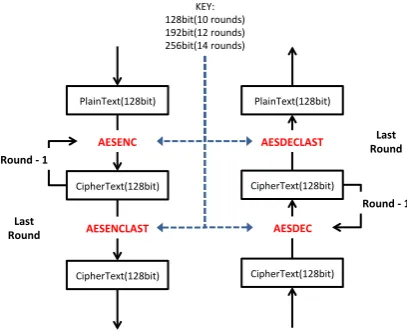
AES-NI consists of six instructions that provide complete hardware support for AES. Four instructions support the AES encryption and decryption, and the other two instructions support the AES key expansion. Table 1 shows details of the six instructions of AES-NI.
AES-NI Instruction Description
AESENC Perform One Round of an AES Encryption Flow
AESENCLAST Perform Last Round of an AES Encryption Flow
AESDEC Perform One Round of an AES Decryption Flow
AESDECLAST Perform Last Round of an AES Decryption Flow
AESIMC Perform the AES InvMixColumn Transformation
AESKEYGENASSIST AES Round Key Generation Assist
Table 1.AES-NI Instructions
PlainText(128bit)�
KEY: 128bit(10 rounds) 192bit(12 rounds) 256bit(14 rounds)
CipherText(128bit)�
AESENC
CipherText(128bit)�
AESENCLAST
Round -‐ 1
PlainText(128bit)�
CipherText(128bit)�
AESDECLAST
CipherText(128bit)�
AESDEC
Round -‐ 1 Last
Round
Last Round
Fig. 1.AES-NI Encription/Decription Flow for AES-ECB mode
2.2 CPUID Instruction
Intel-based CPU contains extended instructions for rapid processing and func-tion extensions. When a CPU performs an extended CPU instrucfunc-tion in a case where the CPU does not implement the instruction, interrupt execution occurs as a general protection error. This is the reason why OS and application soft-ware have to implement methods for checking the extended CPU instructions. For checking the extended CPU instructions, OS and application software call the CPUID instruction, the return value of which are four types of information: vender, serial number, enhanced feature and cache information of CPU.
In addition, CPUID instruction returns processor identification and feature information by means of EAX, EBX, ECX and EDX registers. The instruction’s output depends on the contents of the EAX register. Table 2 shows arguments and return values of the CPUID instruction.
2.3 How to Check AES-NI support
Argument(EAX) Return values
0 EAX=Maximum Input Value for Basic CPUID Information
EBX,ECX,EDX=Vendor ID
1 EAX=Version Information
EBX,ECX,EDX=Processor Signature and Feature Bits
2 EAX,EBX,ECX,EDX=Cache and TLB Information
3 EAX,EBX=Reserved
ECX,EDX=Processor Serial Number
Table 2.Argument and return value of CPUID
1) Check whether the processor supports SSE/SSE2 (if CPUID.01H:EDX.SSE[bit 25] = 1)
2) Check whether the processor supports AESNI (if CPUID.01H:ECX.AESNI[bit 25] = 1)
3) Check whether the processor supports PCLMULQDQ (if CPUID.01H:ECX.PCLMULQDQ[bit 1] = 1) In most cases, only the second procedure works well.
2.4 Intel VT
VM Monitor(VMM)�
VMXON VMXOFF
VM
(Guest 0)� (Guest 1)�VM
VMCS(Guest 0)� VMCS(Guest 1)�
VM Entry VM Entry
VM Exit VM Exit
VMX root VMX non-‐root
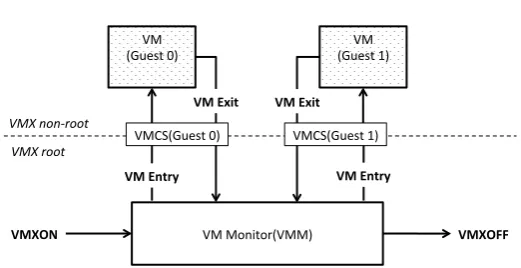
Fig. 2.Interaction of a VMM and Guest OSes (VMs)
VMX modes are able to use conventional privilege level so that running the guest OS at privilege level is possible.
Figure 2 displays interaction of VMM and guest OSes on the Intel-VT. For executing a guest OS with a VMX mode, at first VMXON instruction is exe-cuted, and then, the VMM runs in the VMX root mode. Then, VMM prepares a structure body (VMCS) to store a state (CPU register, CPU State, etc.) of each VM. When the VMM switches over to VMX non-root mode, it executes a VMRESUME instruction, and this state transition is named as VM Entry. When the guest OS executes privileged instruction and hardware access, the guest OS switches from the VMX non-root mode to the VMX root mode, and this state transition is named as VM exit. At this state transition, The VMM checks operations in the VM exit, and the VMM processes the operations on behalf of the guest OS. In this way, VMM runs multiple guest OSes while it switches between the state of VM Enter and VM Exit.
3
Key Snooping Method
In this section, we present our method for AES key snooping. Our attack consists of two parts: one is to fake the return value of CPUID instruction of the VM, and the other is to estimate an AES key by intercepting exceptions of the VM. Subsection 3.1 describes the first part, and subsection 3.2 shows the second part.
3.1 Faking the CPUID instruction
Virtual Machine�
So0ware�
OS�
VMM� VM Exit�
(CPUID)
CPUID Handler�
If EAX=1�
ECX[bit 25]=1 VM Enter
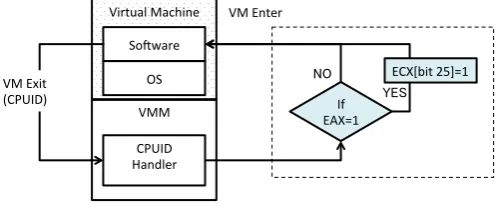
Fig. 3.How to fake CPUID
the VM as if is working on a real machine. In addition, the VMM sometimes makes the VM not to use some functions of the CPU while the CPU implements the functions. When the VMM informs fake information of CPU instruction extension to the VM, the VM usually tries to use its instruction extension to increase processing speed. When the CPU receives an unimplemented instruc-tion, the CPU generates an exception called Invalid Opcode instruction. Our attack method changes return value of the CPUID instruction so that AESNI bit (CPUID.01H:ECA.AESIN[bit 25 ]) is on. This change causes the VM to call exception.
3.2 Exception handling of AES-NI instrcution
Virtual Machine�
So0ware�
OS�
VMM�
VM Exit�
(Invalid Opcode Excep:on)
#UD
Handler� (1)�
NO
YES
Encoding Operand2 (=RoundKey)
(1)If Opcode=AESENC/AESDEC�
Emulate AES-‐NI VM Enter
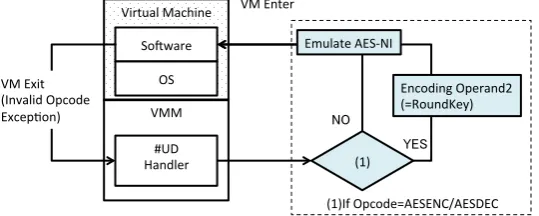
Fig. 4.Exception Handling on VMM
Figure 4 displays our attack method in view of exception handling of AES-NI instruction. Our attack method consists of six steps as follows, from interception of exception in the VMM to AES key estimation:
1) When the VM executes AES-NI instruction, the CPU generates an invalid opcode exception, which causes VM exit state transition. Then, the VMM recovers control.
2) The attacker observes VM exit state transition cause and checks whether in-valid opcode instruction is AESENC or AESDEC instruction. Table 3 shows detail of AES-NI instructions, opcode, and operand.
3) If the invalid opcode instruction is AESENC or AESDEC instruction, then the attacker estimates the next operands of the instructiion.
4) The attacker examines the place of stored key from the estimated operands.1
5) The attacker estimates AES key or the relevant plaintext from the result of 4), as the keys exists in memory or XMM register on the VM.
1 As shown in table 3, the first operand is ModRM:reg(r,w) and the second operand
is ModRM:r/m(r) . The attacker is able to estimate the place of stored key in
memory or XMM register of the VM from the contents of ModRM:reg(r,w) ,
6) After estimation of the AES key or the relevant plaintext, the attacker em-ulates AES-NI, not to let the VMM notice failure of AES-NI procedure.2
Instruction Opecode Operand 1 Operand 2 Operand 3
AESENC 0x66,0x0F,0x38,0xDC ModRM:reg(r,w) ModRM:r/m(r) none
AESENDLAST 0x66,0x0F,0x38,0xDD ModRM:reg(r,w) ModRM:r/m(r) none
AESDEC 0x66,0x0F,0x38,0xDE ModRM:reg(r,w) ModRM:r/m(r) none
AESDECLAST 0x66,0x0F,0x38,0xDF ModRM:reg(r,w) ModRM:r/m(r) none
AESIMC 0x66,0x0F,0x38,0xDB ModRM:reg(w) ModRM:r/m(r) none
AESKEYGENASSIST 0x66,0x0F,0x3A,0xDF ModRM:reg(w) ModRM:r/m(r) imm8
Table 3.AES-NI Instruction, Opecode, Operand
4
Discussion on AES key Snooping
In this section, we discuss essential basis of AES key snooping we have stated, and countermeasures against it. In section 3, we showed our AES key snooping attack that induces exception and does snooping of the AES key or related plaintext when the exception occurs. Here, we define our attack as Exception Handling Attack (EH Attack).
Let us consider the situation where EH attack is possible. The situation is as follows: when a CPU vendor adds new cryptographic instructions and pro-duces new CPUs that implement the new instruction in hardware, a time lag or gap exists until every server installs the new CPUs. A malicious attacker takes advantage of this gap, which means the attacker enjoys EH attack. When an at-tacker provides massive cloud service over the modified VMM, he obtains every encryption key used in every VM.
Here, we state countermeasures against the EH attack, although these coun-termeasures do not provide fundamental solutions.
– Suggestion A:(best)
Users should use CPUs which support AES-NI instruction, where exception handling for AES-NI is impossible.
– Suggestion B:(better)
Users should not use AES-NI instruction in the OS and an application on VM, where exception handling for AES-NI does not occur in the VMM.
2
– Suggestion C:(so-so)
When users execute AES-NI instruction, users should confirm CPU cycles of the AES-NI instruction by RDTSC instruction3, and should check whether EH attack is not running.4
5
Conclusion
In this paper, we have stated a new AES key snooping attack on virtual en-vironment, and presented countermeasures against this attack. Our AES key snooping attack is possible when a virtual machine runs on a CPU, which does not support AES-NI, and the virtual machine monitor is modified so that it fakes return value of CPUID instruction. Our AES key snooping attack runs when AES-NI executes in a virtual machine.
Here, we define our attack as Exception Handling Attack (EH Attack). EH attack is executable in the following situation: 1) when a CPU vendor adds new cryptographic instructions and produces new CPUs that implement the new instruction in hardware, and 2) virtual machines are running on CPUs that do not implement the new cryptographic instructions in hardware. This situation tells that for avoiding EH attacks, users should avoid utilizing the new cryptographic instructions until the new CPUs are available for their virtual machines. This avoidance is also applicable when using IaaS (Infrastructure As A Service) or PaaS (Platform As A Service).
Toward facilitating the development and utilization of cloud services, we strongly believe we have to make research for dependability of virtual machine monitors on which virtual machines run.
References
1. FIPS PUB 197, Advanced Encryption Standard(AES), National Institute of
Stan-dards and Technology, Nov. 2001, http://csrc.nist.gov/publications/fips/
fips197/fips-197.pdf
2. Securing the Enterprice with Intel AES-NI, Intel Corporation, Sept. 2010, http:
//www.intel.com/Assets/en\US/PDF/whitepaper/323587.pdf
3. Intel Advanced Encryption Standard (AES) Instructions Set
-Rev 3, Jan. 2010, http://software.intel.com/en-us/articles/
intel-advanced-encryption-standard-aes-instructions-set/
4. Intel 64 and IA-32 Architectures Software Developer s Manual Volume 1:Basic
Architecture, Intel Corporation, May 2011, http://www.intel.com/Assets/PDF/
manual/253665.pdf
5. Intel 64 and IA-32 Architectures Software Developer s Manual Volume 2 (2A&2B):
Instruction Set Reference, A-Z, Intel Corporation, May 2011, http://www.intel.
com/Assets/PDF/manual/325383.pdf
3 We assume execution cycles of AES-NI instruction such as AESENC/AESDEC
would be larger in two digits during the EH attack.
Appendix: Pseudocode for AES-NI Instruction
AESENC xmm1, xmm2/m128 Tmp = xmm1;
RoundKey = xmm2/m128; Tmp = ShiftRows( Tmp ); Tmp = SubBytes( Tmp ); Tmp = MixColumns( Tmp ); xmm1 = Tmp XOR RoundKey;
AESENCLAST xmm1, xmm2/m128 Tmp = xmm1;
RoundKey = xmm2/m128; Tmp = ShiftRows( Tmp ); Tmp = SubBytes( Tmp ); xmm1 = Tmp XOR RoundKey;
AESDEC xmm1, xmm2/m128 Tmp = xmm1;
RoundKey = xmm2/m128; Tmp = InvShiftRows( Tmp ); Tmp = InvSubBytes( Tmp ); Tmp = InvMixColumns( Tmp ); xmm1 = Tmp XOR RoundKey;
AESDECLAST xmm1, xmm2/m128 Tmp = xmm1;
RoundKey = xmm2/m128; Tmp = InvShiftRows( Tmp ); Tmp = InvSubBytes( Tmp ); xmm1 = Tmp XOR RoundKey;
AESIMC xmm1, xmm2/m128
xmm1 = InvMixColumns( xmm2/m128 );
AESKEYGENASSIST xmm1, xmm2/m128, imm8 Tmp3[31:0] = xmm2/m128[127: 96]; Tmp2[31:0] = xmm2/m128[ 95: 64]; Tmp1[31:0] = xmm2/m128[ 63: 32];
Tmp0[31:0] = xmm2/m128[ 31: 0];
RCON[31:0] = ZeroExtend( imm8[7:0] ); xmm1[ 31: 0] = SubWord( Tmp1 );
xmm1[ 63:32] = RotWord( SubWord( Tmp1 ) ) XOR RCON; xmm1[ 95:64] = SubWord( Tmp2 );