Hiding the Policy in Cryptographic Access Control
Sascha M¨uller and Stefan Katzenbeisser
Technische Universit¨at Darmstadt &
Center for Advanced Security Research Darmstadt (CASED) Security Engineering Group
{mueller,katzenbeisser}@seceng.informatik.tu-darmstadt.de
Abstract. Recently, cryptographic access control has received a lot of atten-tion, mainly due to the availability of efficientAttribute-Based Encryption (ABE) schemes. ABE allows to get rid of a trusted reference monitor by enforcing access rules in a cryptographic way. However, ABE has a privacy problem: The access policies are sent in clear along with the ciphertexts. Further generalizing the idea of policy-hiding in cryptographic access control, we introducepolicy anonymity where – similar to the well-understood concept ofk-anonymity – the attacker can only see a large set of possible policies that might have been used to encrypt, but is not able to identify the one that was actually used. We show that using a concept from graph theory we can extend a known ABE construction to achieve the desired privacy property.
Keywords:access control, privacy, tree majors, abe, anonymity, hidden policies
1
Introduction
In the last years, new primitives like Attribute-Based Encryption (ABE) and Predicate Encryption (PE) that enable cryptographic access control have been developed in the cryptographic community. Using these ideas, access controls systems can now be con-structed that do not rely on a trusted reference monitor to enforce access rules. Instead, the information is encrypted in a way that allows decryption only by parties that are eligible to decrypt them. Specifically, in Ciphertext-Policy Attribute-Based Encryption (CP-ABE), every user receives a private key that corresponds to an individual set of attributes, each attribute attesting a certain property that the user has. Each ciphertext is encrypted with a policy over these attributes in the form of a Boolean formula, and everyone whose attributes satisfy that policy can decrypt the ciphertext. The encrypted data cannot be decrypted and thus is invisible to all other users.
This approach allows to enforce access rules in many practical scenarios. For ex-ample, in the popularRole-based Access Control (RBAC)approach, users are assigned
torolesand each user’s roles determine which rights he has. CP-ABE can be used to
efficiently enforce access rights in an RBAC scenario: For each role there is an attribute, and for each role a user possesses, he receives the corresponding attribute. Access rights are described as logical formulas over the universe of attributes. For example, if data is encrypted with a policyRoleA AND (RoleB OR RoleC), every user who is active in the roleRoleAand eitherRoleBorRoleCcan decrypt the data.
containing keys required to decrypt the protected files. Let us assume that two such content providers arecontprov1 andcontprov2. A usage license could be ex-pressed as a Boolean formula over attributes. For example, the policy could state that the protected file should only be decrypted by someone who has purchased licenses from at least one of the given content providers and is authenticated as an adult. Policy P2 in Figure 2 is an example of such a DRM policy. It is also possible to automati-cally extract such policies from policies written in the Open Digital Rights Language (ODRL) [12].
Note that in both examples, rules are enforced automatically by the cryptographic construction. Also, the access rules may be very complex allowing for elaborate, fine-grained access control if so desired by the scenario. Numerous CP-ABE schemes have been proposed with varying features that support different types of policy languages.
While CP-ABE today is well-developed and can be considered practical, there are still some desirable features missing, one of which we are concerned with in this work: In most CP-ABE constructions, the policy is sent along with the ciphertext. This appears sensible as the decryptor needs to know which of his attributes are needed to access the data. However, the policy itself might be considered worth to protect as it might reveal clues to the content of the encrypted data. For example, consider a patient report in a hospital setting that is encrypted with a policy that allows encryption only by parties with the roleneurologistorgerontologist. This policy alone reveals some information about the content, i.e., the patient seems to be advanced in years and might have a neurological condition. Thus, policy privacy can be an essential feature.
1.1 Towards Policy Privacy
Currently, there are two approaches to realize policy privacy. The first and most well-understood approach is predicate encryption (PE), which can be seen as a generalization of ABE in which policies are hidden. Unfortunately, while some PE constructions to-day are very expressive, they are still quite limited: No particular PE instance is able to support every possible Boolean formula and PE policies are often formulated in unin-tuitive or inefficient ways. (We will elaborate on this important aspect later on.) This is contrary to our goal of high expressiveness and intuitive policies.
The second approach, which we are concerned with here, is to modify common CP-ABE constructions to somehow hide the policy while still allow an eligible user to decrypt. We first examine that a policy can never beencompletelyhidden in a ciphertext, as it has to be stored in a finite space and a known format, so there is always a limited, finite set of possible policies that can be encoded in a particular ciphertext. This mo-tivates to introduce the notion ofpolicy anonymity, which is similar to the established notion of anonymity sets [19] andk-anonymity [7]: Given a number of candidates for a policy, the anonymity set, an attacker cannot determine which actual policy was used for the encryption.
consists of all policies that consists of a single AND-gate over a subset of all attributes of the system.
In this paper we show that one of Nishide’s CP-ABE constructions [14] can be modified in order to support the encryption with every Boolean formula by combining several AND-gates in a specific way and using a novel idea from graph theory. This in turn allows the encryptor to choose a particular anonymity set which contains – among with the original policy – many others.
The idea of the construction is as follows: Given a policy, represented by a syntax tree with∧and∨-gates, we construct amajorof this tree, i.e., a supertree that is built by expanding nodes of the original tree into new subtrees. Such a major can be used to express many different policies by assigning different expressions to its leaves. The set of all such policies makes up the anonymity set. The decryptor knows only that the used policy is among all policies that can be encoded by the supertree. The leaves of this major are encryptions of blinded partial secrets that represent∧-gates. As these∧-gates are hidden, an adversary does not know which of the possible policies of the anonymity set is used in the encryption, but by our construction he is still able to decrypt the message if he fulfills the hidden policy. He will determine which of the leaves he is able to satisfy, obtain some of the encoded partial secrets, combine them according to the tree structure using his private key, and unblind the resulting combination to retrieve the secret. Our application of Nishide’s construction takes collusion attacks into account, so no group of users (who fulfill different parts of a policy) can decrypt the policy unless one member of the group fulfills the complete policy.
Example To give an intuition of the hiding property of our system, examine Figure 1,
which represents the structure of a policy anonymity set which is sent along with a ci-phertext. The form of this tree is known to everyone, but the leaves are hidden using the ideas of Nishide’s construction. Each leaf hides an∧-gate with an unknown
con-∧
∨ ∨
v1 v2 v3 v4 ←−
leaves hidden by construction
Fig. 1: Sample obfuscated policy
v2≡x1∧x2v3≡ >, andv4to a random∧-gate, or by mappingv1≡x1,v2≡ ⊥,v3≡x2, andv4≡ ⊥. Several other mappings are possible. This shows that the policies encoded in a simple tree can be very complex and diverse.
P1: RoleA ∧(RoleB ∨ RoleC)
P2: (adult ∨ cc = verified) ∧
((contprov1.article1 = purchased ∧ account1 = balanced) ∨ (contprov2.article1 = purchased ∧ account2 = balanced)) P3: userrole = surgeon ∧ employer = hospitalx
P4: ((x1∧x2∧x3)∨x4)∧((x5∧x6)∨(x7∧x8∧x9∧x10))
Fig. 2: Example policies for Fig. 1
An attacker cannot know the concrete semantics of the leaves, but he can determine if an attribute set satisfies the partial policy of a leaf. We will use this ability in the decryption algorithm.
1.2 Related Work
In predicate encryption schemes [10, 9, 20, 5], decryption is possible if a predicate over the user attributes and the ciphertext attributes is fulfilled. Current PE constructions are very powerful and support rather expressive predicates. Currently the most versatile solutions seem to be those that use inner product queries [10, 9]. It has been shown [9] that such a scheme can be used to construct a scheme that supports, for example, DNFs or CNFs of some bounded degree, or a predicate that can be expressed by a polynomial over the attributes. However, this predicate (for example a predicate for DNFs of some degreed) is encoded in the user keys, so it is fixed after the key generation algorithm. The complexity of the system is dependent on the size of that predicate. This means that no single PE scheme is able to express every possible policy in polynomial size and due to the bounded size of the predicate can only support a limited set of policies. Speaking in terms of anonymity, there is a fixed anonymity set that applies to all ciphertexts of an instantiation of a PE system.
In our approach, there is no fixed anonymity set. Instead, each encrypting party decides on the anonymity set when encrypting. All policies are expressed as syntax trees, so every Boolean formula can be expressed in polynomial size. As we will show in Section 4.1, the anonymity set is exponential in the size of the tree major that was used to encode the policy.
Furthermore it should be noted that predicate encryption schemes require very large groups and are only efficient for small attribute sets thereby making them unfeasible for many applications.
interactive process whereas in this paper we are concerned with an off-line access con-trol mechanism. Recently, Seyalioglu and Sahai [18] proposed an encryption scheme which also uses garbled circuits and hides the policy. However, in their scheme, the public key of a recipient must be used for the encryption, making it infeasible in the CP-ABE setting where the identities of the recipients are not known.
Literature on smallest common supertrees and related topics is extensive [17, 22, 16], however the constraints we are dealing with in our scenario have to our knowledge not yet been discussed. For a good, though somewhat dated, survey see [3]. There are several CP-ABE schemes [10, 13, 23, 2], but only [14], which we modify in this paper, and [24] support policy hiding.
Outline In the following section we discuss how to obfuscate policies by creating syn-tax tree majors. The synsyn-tax tree majors are then used in our CP-ABE system described in Section 3. Section 4 discusses various security aspects of this system. Section 5 con-cludes.
2
Syntax Tree Majors
The basic idea of our system is to take a policy, encoded as a monotonic syntax tree, and find another policy that semantically contains many different policies, including the original one. An attacker is not able to decide which policy was actually used for the encryption.
Definition 1 (monotonic syntax tree).A monotonic syntax tree T is a tree where all
inner nodes are labeled with either ∧or ∨and the leaves represent either Boolean
variables or the constant values⊥or>. If the root of T is labeled∧, then every inner node of odd depth is labeled∨, and every inner node of even depth is labeled∧. We call such a tree∧-rooted. Analogously, a∨-rootedtree is a tree whose root is labeled∨and where every inner node of odd depth is labeled∧, and every inner node of even depth is labeled∨.
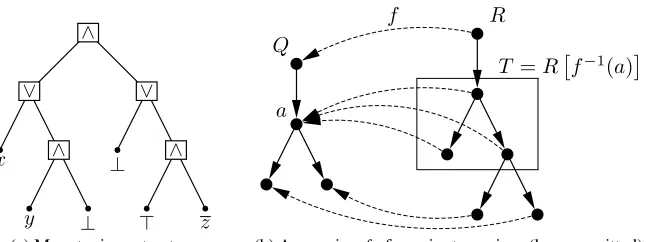
It is easy to see that any syntax tree over the operands∧and∨can be transformed into a monotonic syntax tree by contracting adjacent∧- and∨-nodes. As the labeling of all inner nodes follows from the labeling of the root node, we usually omit the labels of the inner nodes, calling the resulting treeimplicitly labeled.
As explained in the introduction, we will use a CP-ABE scheme that encrypts the leaves, which correspond to attributes, but the construction will hide the concrete corre-spondence between leaves and attributes. Also note that our construction supports only monotonic syntax trees, but as there might be negative attributes (i.e., attributes that attest that the possessor doesnothave a certain property), even non-monotonic policies can be represented by monotonic syntax trees by applying DeMorgan’s laws until all negations are atomic.
∧
∨ ∨
∧ ∧
x
y ⊥
⊥
⊤ z
(a) Monotonic syntax tree
Q
R f
T =Rf−1(a)
a
(b) A mappingfof a major to a minor (leaves omitted) Fig. 3: Examples
leaves is hidden, he is not able to access the concrete policy. We say that the larger policysemantically containsmany smaller policies. More formally:
Definition 2 (semantic containment).Let F and G be Boolean formulas over vectors of Boolean variables x= (x1, . . . ,xn), resp. y= (y1, . . . ,ym)where m≤n. We call F
semantically contained in G if there exists a functionφ that maps the variables of x to
either variables of y or to constant values>or⊥, such that G(ψ(φ(x))) =F(ψ(x))
for all configuration mappingsψ:x7→ {⊥,>}n.
We can apply this definition to syntax trees as follows: LetQbe a monotonic syntax tree with leavesL(Q) =u1, . . . ,u|L(Q)| andRa monotonic syntax tree with leaves
L(R) =v1, . . . ,v|L(R)| . We say thatR semantically contains Q, if there is a function φ:L(R)→L(Q)∪{⊥,>}such that for all configurationsψ:L(Q)→ {>,⊥}, it holds
thatψ(φ(R))≡ψ(Q), i.e., after applyingφ toR, it computes the same value asQfor every possible configuration of the variables.
The type of supertree we examine is closely related to the notion oftree majors. Informally, a treeRis a major of a treeQ, ifQcan be obtained fromRby contracting a number of edges. Equally, a major ofQcan be constructed by expanding some nodes into subtrees. A major can be characterized by a mapping f :V(R)→V(Q)of vertexes of a treeRtoQ. We callRasyntax tree majorofQif we can find a mapping fwith the following properties: Given a nodea∈Q, the nodes off−1(a)form a connected subtree T of R, which we denoteT =Rf−1(a). This is illustrated in Figure 3b. Different subtrees must not overlap and all edges ofQmust be preserved inR. This is similar to the definition of a tree major.
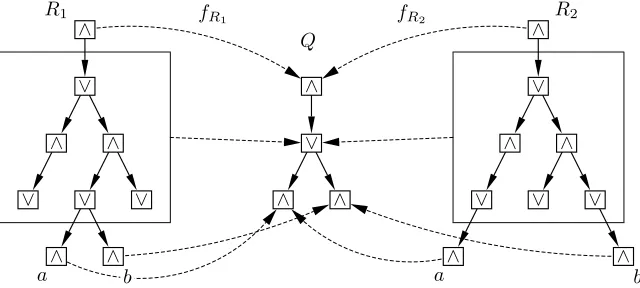
BothR1andR2of Figure 4 are examples of such majors. Note the placements of the leavesaandb. In both cases, the root of the smallest subgraph that contains both nodes has a root labeled with∨. This node will take on the role that the parent of f(a) and f(b)inQhas (which is also an∨-node).
Q
fR1 fR2
∧
∨
∧ ∧
∧
R1
∨
∧ ∧
∨ ∨
∧
b
∨
∧
a
∧ R2
∨
∧ ∧
∨ ∨
∧
a
∨
∧
b
Fig. 4: Two valid syntax tree majors
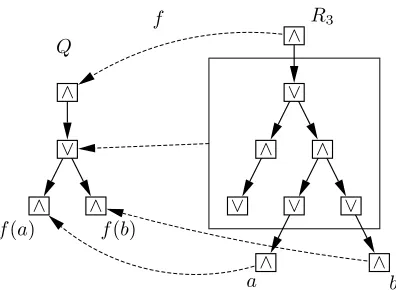
Generally, all syntax tree majors must follow the rule that if two nodesaandbhave a common parent inQ, then their unique common ancestor inRmust have the same label as that parent. As a counter example consider the tree majorR3(Figure 5), where the root of the smallest subtree containingaandbis an∧-node, thus not qualifying as a syntax tree major. The original graph contained a formula f(a)∨f(b), but this cannot be encoded in the given major, asaandbare only connected by an∧-node. It is now easy to see that in these cases the smallest subtrees containingaandbmust have odd height.
More formally, we adapt the definition of tree minors from [15] to implicitly labeled monotonic syntax trees and definesyntax tree majorsas follows:
Definition 3 (syntax tree major). A tree R is a syntax tree major of a tree Q if there exists a surjection f:V(R)→V(Q)such that
1. for each a∈V(Q),T=Rf−1(a)is a connected subtree of R, and every path from the root of T to a leaf of T consists of an even number of edges;
2. for each pair a,b∈V(Q), f−1(a)∩f−1(b) =/0;
3. for S={(u,v)∈E(R)|f(u)6= f(v)}, there exists a bijectionξ :S→E(Q)such
that for each e(s,t)∈S,ξ(e) = (f(s),f(t)).
4. For each pair of edges(x,a)∈E(Q)and(x,b)∈E(Q), let U be the smallest subtree of R that has both a and b as leaves. Then the paths from the root of U to the roots of the subtrees f−1(a)and f−1(b)have odd length.
We call f thecharacteristic functionof the major.
Q
f
∧
∨
∧
f(a) ∧f(b)
∧ R3
∨
∧ ∧
∨ ∨
∧
a
∨
∧
b
Fig. 5: An invalid syntax tree major
3
Building the System
We now describe a CP-ABE system with hidden policies, where policies are represented as syntax trees. It is based on [14], but extended to support any Boolean formula by utilizing syntax tree majors. The leaves of the syntax tree are expressions of the form A=x, whereAidentifies an attribute andxthe value that this attribute must have. See Figure 2 for some example policies. Our construction supports n attributes, denoted L1, . . . ,Ln. Each attribute can take on one of a number of symbolic values. We denote
the number of possible values of an attributeLibyniand the symbolic values of the
attribute byvi,1, . . . ,vi,ni. Thus, each leaf of the tree encodes an expressionLi=vi,t.
Using this approach, we are able to support every policy that can be expressed as a Boolean formula.
Note that we can also emulate numeric attributes using a bag of bits representation [2], where each number is represented by a bit string and there are two attributes for each bit. To use this, the policy would first be formulated in a more abstract form, using comparisons with numbers in the leaves likeA=x,A≤x, orA≥x. These leaves would then be expanded into subtrees that evaluate the expressions using the bit representa-tions, as outlined in [2].
3.1 Setup and KeyGen
Setup An asymmetric bilinear group e:G1×G2→GT of order p with generators
g1∈G1andg2∈G2 is chosen. The trusted authority randomly selects random val-ues forω,ω,β,β ∈Z∗pand for each valuevi,t of each attribute he also selects a
ran-domai,t∈Z∗p 1≤t≤ni,1≤i≤n. The public key PK consists of the bilinear group with
generators g1,g2and the values n
Ai,t=g ai,t
1 o
1≤t≤ni,1≤i≤n, as well asY =e(g1,g2)
ω,
Y =e(g1,g2)ω,B=gβ1, andB=g β
1. The master keyMKis
MK=Dω,β,ω,β,{{ai,1}1≤t≤ni}1≤i≤n
Intuitively we hereby construct two parallel cryptosystems that use the same group structure and the same secret attribute keys but differ in the values of the secret key com-ponentsω andβ. We will the denote the cryptosystem that usesω andβ theprimary cryptosystem and the one that usesωandβ thesecondarycryptosystem. The primary cryptosystem will be used to encrypt the actual secret message, while the secondary one will help the decryptor to decide which nodes he can access with his attribute set. To this end, we encrypt the fixed value 1 using the secondary cryptosystem. The decryptor will try to decrypt this value from the ciphertext to see if he can satisfy the policy of the gate.
KeyGen LetL= [L1,L2, . . . ,Ln] = [v1,t1,v2,t2, . . . ,vn,tn]be the attribute list for the user who wishes to obtain the secret key. If the user is not eligible of the requested at-tributes, the trusted authority returns⊥. Otherwise, it picks random valuess,λi∈Z∗p
for 1≤i≤n, and computesD0=g β−1(ω−s)
2 andD0=g
β−1(ω−s)
2 . For 1≤i≤n, the authority also computes[Di,1,Di,2] = [g
s+ai,tiλi
2 ,g
λi
2]whereLi=vi,ti. The secret key SKL
isD0,D0,{Di,1,Di,2}1≤i≤n
.
3.2 Encryption
After the encryptor has decided on the encryption policy and constructed a monotonic syntax treeQ, he creates a syntax tree majorRofQwhich is used to hide the actual policyQ.
Constructing a tree major. There are three ways to construct a syntax tree major of a syntax treeQthat represents a policy: One way is to randomly expand edges ofQinto trees of even height. This will result in a random majorR.
Another, more interesting approach is to “mix”Qwith other trees, constructing a common major that from an adversary’s point of view could encode all of the input trees as well as numerous combinations of them. This is discussed in Appendix B. Note that while the resulting tree could encode all of the input trees, we will configure the leaves such that only the desired treeQis encoded, so satisfying any of the other trees used as input to the algorithm does not allow decryption unlessQis satisfied, too.
The result of any of these the possible approaches is a syntax tree majorRand a mapping f :V(R)→V(Q) that characterizes the relationship betweenQandR. We will configureRsuch that it computes exactly the same function asQ, but keep this configuration invisible to an attacker.
Encoding the formula. After constructing a syntax tree majorRwith rootT and map-pingf, the encryptor randomly chooses anr∈Z∗pand executesEncodeSecret(T,r) (see Algorithm 1). This algorithm encodes the secret valuer∈Z∗pinto the tree.
Be-ginning from the root of the tree, the algorithm recursively traverses downwards to the leaves. If a node is an∧-node, the secretris split into partial secrets, one for each child of the node (the decryptor must satisfy all children to recover the secret), so that the sum of all partial secrets equalsr. If a node is an∨-node, the secret is propagated to all child nodes. The output is a labelingm(c)of all nodes ofc∈Rto partial secrets inZ∗p.
The idea is that a decryptor needs to be able decrypt a sufficient set of partial secrets to recover the main secretr. In the next step, the encryptor chooses which of the leaves of Rshould be used to compute the desired formula and which ones should be set to⊥or
>such thatRcomputes the same function asQ. Let ˜M:L(R)→ {F,⊥,>,rand}be
the result of this, i.e., if ˜M(v) =F, encode a genuine part ofQ, if ˜M(v) =⊥, encode
⊥, ˜M(v) =>, encode>, or else randomly choose what to compute. There are various ways to find such a mapping. We explain one such way in Appendix A (see Algorithms 2 and 3). After this process, each leafvis marked with ˜M(v), a partial secretm(v), and there is a mapping f(v)that mapsvto a leaf ofQthat represents an expression of the formLi=vi,t. (Note that the algorithms mark all nodes ofR, but from now on we will
only need the marks of the leaves.)
The first part of the ciphertext is ˜C=MYrandC0=Br, which encodes the valuer and the secret messageM.
Algorithm 1:EncodeSecret(T,r)
Input : Tree R, SubtreeTofR(represented by its root), numberr Output:m:V(R)→Z∗p
m(T)←−r; ifT is no leafthen
ifT is∧-rootedthen
Let the number of child nodes ben. ri
R
←−Z∗p,1≤i≤n, such that∑iri=r.
forallchildren cdoEncodeSecret(c,ri)
else
forallchildren cdoEncodeSecret(c,r) end
end
sole childv). For each of these last inner∧-gatesv, the encryptor computes ciphertext componentsCT(v)for the primary cryptosystem as follows:
Case 1: If all children ofvare either >or F, encode a genuine∧-gate as follows: Pick random valuesr(iv),∀i=1. . .n, such thatm(v) =∑ir
(v)
i . For each attribute
1≤i≤nsetCi(,v1)=gr
(v)
i
1 and compute{C
(v)
i,t,2}1≤t≤ni as follows: if theith attribute
is not found in the children of f(v)(i.e., the value isdon’t care) or the attribute
valuevi,t is found in the children, setC(
v)
i,t,2=A
r(iv)
i,t ; otherwise (i.e., the valuevi,t is
forbidden for this attribute), selectCi(,vt,)2randomly.
Case 2: If one of the children is⊥, the decryption must never succeed. In this case, all Ci(,v1)andCi(,vt,)2are set to random values.
Case 3: If all children are marked rand, flip a coin to decide whether to proceed with Case 1 (encrypting with a random∧-gate) or with Case 2.
Finally, compute the ciphertext componentsH(v)=Ym(
v)
andC0
(v)
=Bm(v). This en-crypts an additional ciphertext in the secondary cryptosystem which equals to 1.
Combining these components, the ciphertext for leafvis
CT(v)=
*
C0(v),H(v),
Ci(,v1),nCi(,vt,)2,o 1≤t≤ni
1≤i≤n
+ .
The final ciphertext is
CT=DC,C˜ 0,nCT(v)∀leavesvoE,
along with a topological description of the tree (including the labels but excluding any other marks).
3.3 Decryption
In order to decrypt, the decryptor determines which leaves his attribute set satisfies. This is done by decrypting the second encrypted value using the second cryptosystem with all attributes that he has and comparing the result to the value 1. If the decryptor’s attribute set does not fulfill the policy, he gets a value different from 1. For each leaf v∈L(R)setC0(i,v2)=C
(v)
i,ti,2, where 1≤i≤nandLi=vi,tiand compute
M(v)=
n
∏
i=1
e(Ci(,v1),Di,1)
e(C0(i,v2),Di,2)
and τ(v)= H
(v)·M(v)
e(C0(v),D0).
For eachv,M(v)=e(g1,g2)s·m(v), wheresis specific to the used attribute set and was
might also be equal to 1. However, the probability for this occurring is 1/pfor p the order of the bilinear group, which is negligible.
Note that while the decryptor now knows which parts of the tree he satisfies, he does not know the policies of the respective leaves since their configuration is hidden by the construction. However, with allτ(v), he is able to decrypt as follows: First he removes some of the leaves that he does not satisfy (i.e., whereτ(v)6=1) as they do not contain any information that he can use. For allτ(v)6=1, replacevwith the constant value⊥and simplify the tree by substituting subtrees with their obvious results using the formulasA∧ ⊥=⊥andA∨ ⊥=A. The remaining tree either contains only leaves that can be satisfied or is a single node⊥. In the latter case, return⊥(as the attribute set does not satisfy the policy). For each remaining∨-nodeN, randomly choose a subtree ofNand substituteNwith it. (This works because Algorithm 1 encoded the same value in all subtrees of an∨node, so we can use any of them to retrieve it.)
Finally, collapse all remaining∧-nodes to a single one. The messageMcan now be retrieved as
M=C˜∏vM
(v)
e(C0,D0) ,
wherevare all remaining leaves of that single∧-node. By multiplying a valid combi-nation ofM(v)together, the partial secretsm(v)add up to the secret valuerwhich then is unblinded by the above formula.
Correctness. Using a secret key SKLthat satisfies the tree, we have
˜
C∏vM(v)
e(C0,D0)
=M· Y
r
e(C0,D0)
∏
v∏
ie(Ci(,v1),Di,1)
e(C0(i,v2),Di,2)
=M·e(g1,g2)ωr−βrβ−1(ω−s)+∑v
∑i(r(iv)·(s+ai,tiλi)−(ai,tri(v)λi)
=M·e(g1,g2)−rs+∑v
∑ir(
v)
i s
.
The tree is constructed such that for a leafvthat is satisfied,∑ir
(v)
i =m(v)and for
a sufficient subset of the leaves,∑vm(v) =r, so∑v
∑ir
(v)
i s
=rsand the equation
yieldsM·e(g1,g2)rs−rs=M. Note that if the equation is computed using a key SKL
that does not satisfy the tree, then someC0(i,v2)will be random values instead ofgai,tr
(v)
i
1 .
In this case, somem(v)will not be computed correctly, so the exponents do not cancel out and the result will be different fromM(with overwhelming probability).
4
Discussion
4.1 Anonymity of the Policy
In our construction the ciphertext is encrypted with a major of the syntax tree. As the leaves of this tree are hidden from an adversary, he cannot decide which of the possible policies was actually used. The anonymity setA(E,L)is determined by the ciphertext Eand the attribute set of the decryptorL= [L1, . . . ,Ln]. We will now briefly discuss the
size ofA(E,L). As a lower bound, assumeni=2 for all 1≤i≤n, i.e., every attribute
has only two possible symbolic values. If the decryptor can access an∧-gate with his attribute setL, he can conclude that eachith attribute encoded in the policy of the∧ -gate is either set to the valueLithat he owns or is a “don’t care”. Similarly, if he cannot
decrypt an∧-gate, he can conclude that there is at least one attributeiin the policy of the∧-gate that is unequal to his attribute valueLi. In both cases the number of possible
∧-gates isO(2n). For a treeRwith leavesL(R), the number of possible policies is in O(2n·|L(R)|).
In some scenarios, it might suffice if the attacker knows only the general form of the policy, i.e., he wants to know, which nodes of the tree belong to the actual policy and which ones are dummy gates introduced in order to obfuscate the policy. In our construction, the form of the policy is determined by the leaves. Some of these are set to a constant value (>or ⊥) to render unused inner nodes inoperative, some are genuine∧-gates encoding parts of the policy. Thus, to find out which form the original policy has, an attacker must know which∧-gates are constant values and which ones are not, which for a treeRwith leavesL(R)givesO(2|L(R)|)combinations. However, for
reasons of symmetry, some of these forms may be topologically identical, so the number of forms might be smaller than that. The most symmetries are found in a completen-ary tree. However, in [11] it is shown that even in such a tree, the number of topologically different subtrees is exponential in the number of nodes, so it is at least exponential in the number of leaves. Thus, even taking into account symmetries, the number of possible forms of a policy encoded in a syntax tree major is exponential in the number of leaves.
We show that an attacker cannot distinguish between policies within his anonymity set in Appendix D.
4.2 Comparison with Nishide’s Construction
with the ciphertext. For example, the 2-CNF formula shown in Figure 6 can be encoded with 10 leaves, but its DNF representation consists of 25=32 conjunctions, so 32 in-stances of Nishide’s construction would be needed to encode it. This is not a problem in our construction as the original 2-CNF form can be used for the encryption. (Note that when using the 2-CNF syntax tree as a major for encryptions, the policy automatically supports∧-gates as leaves, so it is actually stored as a conjunction of DNFs. This form has been called CDNF in [21] and is considered very expressive.)
∧
∨ ∨ ∨ ∨ ∨
Fig. 6: 2-CNF of size 5
4.3 Reducing the Size of the Ciphertext
For each leave’s encryption every attribute of the system is used. This is the only way to maximize the anonymity set, because when some attributeAis not used for the decryp-tion of a leafv, then the decryptor can obviously conclude that the partial policy ofv does not containA. However, if the universe of attributes of a given system is very large, it might be feasible to use only a comparatively small set of attributes for the encryption of each leaf while still using enough attributes to get a sufficiently large anonymity set. Similarly to [14], each leafvmay be encrypted with its own set of attributesAv.Av
can be a random superset of the set attributes actually used in the leaf. However, in or-der to hide as much of the semantics of each partial policy, some care must be taken, as it should be understood which information an attacker gains by the knowledge ofAv.
It must also be considered thatAv must be sent along with each leaf, which slightly
increases the size of the ciphertext.
As a more systematic approach, the universe of attributes could be partitioned into different domains Di,1≤i≤nD withnD the number of domains. For example one
domainD1could contain all user-specific attributes,D2could contain all device-specific attributes, D3 all location-specific attributes, etc. If each domainDi consists of|Di|
attributes, then the anonymity set of a respective leaf Av withAv=Di isO(2|Di|).
With this approach, an advisor knows that a leafvwithAv=D1might encode a partial policy over some user-specific properties (or as always an encoding of⊥or>), but he does not know which one or which ones. This gives the encryptor precise control over what information is disclosed with an encrypted leaf. Moreover, instead of listing each element ofAv, with this approach only the indexiofDineeds to be sent along with the
5
Conclusion
We introduced the notion of policy anonymity in cryptographic access control. To this end, we proposed the idea to obfuscate the policy used in an encryption by constructing a syntax tree major of the syntax tree that encodes the desired policy. The leaves are then hidden from an adversary using a cryptographic primitive. We discussed how these majors can be characterized and how to configure the leaves to encode a specific, given policy in one of its majors. The majors can be chosen arbitrarily large, and the larger a major is the larger becomes the anonymity set. From the anonymity set, an adversary gains only very general informations about the encoded policy; for example he knows an upper bound of its complexity and that some of his attribute sets satisfy certain parts of the major. We then used these primitives to modify a CP-ABE scheme with partially hidden policies to support every policy that can be expressed as a Boolean formula and enable an encryptor to obfuscate that policy.
Our construction compares favorably to [14] as it is able to efficiently encode any policy that can be expressed as a Boolean formula and is not limited to policies with small DNF represenations and to the various Predicate Encryption schemes. However, it may be possible to construct a scheme that hides even more properties of the encoded policy by using a different encoding of the it, like garbled circuits which presently have been utilized to solve different problems [8, 18]. We leave this as future work. Also, our approach may be applicable to other CP-ABE system that like Nishide’s support only
∧-conjunctions.
References
1. 2007 IEEE Symposium on Security and Privacy (S&P 2007), 20-23 May 2007, Oakland, California, USA. IEEE Computer Society, 2007.
2. J. Bethencourt, A. Sahai, and B. Waters. Ciphertext-policy attribute-based encryption. In IEEE Symposium on Security and Privacy[1], pages 321–334.
3. P. Bille. A survey on tree edit distance and related problems. Theor. Comput. Sci., 337(1-3):217–239, 2005.
4. D. Boneh, X. Boyen, and E.-J. Goh. Hierarchical identity based encryption with constant size ciphertext. In R. Cramer, editor,EUROCRYPT, volume 3494 ofLecture Notes in Computer Science, pages 440–456. Springer, 2005.
5. D. Boneh and B. Waters. Conjunctive, subset, and range queries on encrypted data. In S. P. Vadhan, editor,TCC, volume 4392 ofLecture Notes in Computer Science, pages 535–554, Amsterdam, The Netherlands, February 2007. Springer.
6. L. Cheung and C. C. Newport. Provably secure ciphertext policy ABE. In P. Ning, S. D. C. di Vimercati, and P. F. Syverson, editors,ACM Conference on Computer and Communica-tions Security, pages 456–465. ACM, 2007.
7. V. Ciriani, S. D. C. di Vimercati, S. Foresti, and P. Samarati.k-anonymity. In T. Yu and S. Ja-jodia, editors,Secure Data Management in Decentralized Systems, volume 33 ofAdvances in Information Security, pages 323–353. Springer, 2007.
8. K. B. Frikken, J. Li, and M. J. Atallah. Trust negotiation with hidden credentials, hidden policies, and policy cycles. InNDSS. The Internet Society, 2006.
9. J. Katz, A. Sahai, and B. Waters. Predicate encryption supporting disjunctions, polynomial equations, and inner products. In N. P. Smart, editor,EUROCRYPT, volume 4965 ofLecture Notes in Computer Science, pages 146–162. Springer, 2008.
11. D. W. Matula. On the number of subtrees of a symmetric n-ary tree. SIAM Journal on Applied Mathematics, 18(3):668–703, May 1970.
12. S. M¨uller and S. Katzenbeisser. A new DRM architecture with strong enforcement. InARES, pages 397–403. IEEE Computer Society, 2010.
13. S. M¨uller, S. Katzenbeisser, and C. Eckert. On multi-authority ciphertext-policy attribute-based encryption. Bulletin of the Korean Mathematical Society (B-KMS), 46(4):803–819, July 2009.
14. T. Nishide, K. Yoneyama, and K. Ohta. Attribute-based encryption with partially hidden ciphertext policies.IEICE Transactions, 92-A(1):22–32, 2009.
15. N. Nishimura, P. Ragde, and D. M. Thilikos. Finding smallest supertrees under minor con-tainment. In P. Widmayer, G. Neyer, and S. Eidenbenz, editors,WG, volume 1665 ofLecture Notes in Computer Science, pages 303–312. Springer, 1999.
16. K. Riesen and H. Bunke. Approximate graph edit distance computation by means of bipartite graph matching. Image Vision Comput., 27(7):950–959, 2009.
17. F. Rossell´o and G. Valiente. An algebraic view of the relation between largest common subtrees and smallest common supertrees.CoRR, abs/cs/0604108, 2006.
18. A. Sahai and H. Seyalioglu. Worry-free encryption: functional encryption with public keys. In E. Al-Shaer, A. D. Keromytis, and V. Shmatikov, editors,ACM Conference on Computer and Communications Security, pages 463–472. ACM, 2010.
19. A. Serjantov and G. Danezis. Towards an information theoretic metric for anonymity. In R. Dingledine and P. F. Syverson, editors,Privacy Enhancing Technologies, volume 2482 of Lecture Notes in Computer Science, pages 41–53. Springer, 2002.
20. E. Shi, J. Bethencourt, H. T.-H. Chan, D. X. Song, and A. Perrig. Multi-dimensional range query over encrypted data. InIEEE Symposium on Security and Privacy[1], pages 350–364. 21. N. P. Smart. Access control using pairing based cryptography. In M. Joye, editor,CT-RSA,
volume 2612 ofLecture Notes in Computer Science, pages 111–121. Springer, 2003. 22. G. Valiente. Constrained tree inclusion.J. Discrete Algorithms, 3(2-4):431–447, 2005. 23. B. Waters. Ciphertext-policy attribute-based encryption: An expressive, efficient, and
prov-ably secure realization. InThe 14th IACR International Conference on Practice and Theory of Public Key Cryptography, PKC, Mar. 2008.
24. S. Yu, K. Ren, and W. Lou. Attribute-based content distribution with hidden policy. InSecure Network Protocols, 2008, NPSEC, 2008.
A
Embedding a Formula in a Syntax Tree Major
In this section, we construct a mapping ˜M:V(R)→ {F,>,⊥,rand} that allows us to embed a monotonic syntax treeQin a syntax tree majorRsuch thatRcomputes the same function asQ. This is achieved by mapping some of the leaves ofRto the constant values⊥or>. The effect of this is that some inner nodes ofRthat are connected to these leaves will map to trivial formulas likex∧ >orx∧ ⊥, which are equal toxor⊥. For an example, we refer to Figure 3a. The remaining leaves (that are not set to>or⊥) are then mapped to leaves ofQsuch thatRevaluates the same function asQ.
Finding such a mapping can be done in a two step process. In the first step, we mark all inner nodes ofRthat are needed to encode nodes ofQwith a special symbol that we callF. For convenience, all other nodes will be marked /0. Call this mapping M:V(R)→ {/0,F}. AsRis a syntax tree major ofQ, this marking can be found by the following iterative algorithm: For each leaf ofQ, a corresponding leaf inRis selected and the path from the root of R to this node is marked by traversing upwards (see Algorithm 2).
Algorithm 2:MarkRelevantNodes(R,Q,f)
Input :R,Q,f:V(R)→V(Q)
Output:M:V(R)→ {/0,F} forallT∈V(R)doM(T)←−/0; M(root(R))←−F;
foreachleafuof Qdo T←−R leaf off−1(u); whileM(T)6=Fdo
M(T)←−F; T ←−parent(T); end
end
any policy. This will be useful in the cryptographic construction. Algorithm 3 marks all nodes that were marked with /0 to⊥,>, or rand. Call this mapping ˜M:V(R)→
{F,>,⊥,rand}. The algorithm marks the nodes as follows: If a node is an∧-node markedF, all children marked /0 will recursively be set to>. Similarly, if a node is an
∨-node markedF, all children marked /0 will recursively be set to⊥. For nodes that are not markedF, an appropriate mapping of the children to⊥,>, or rand is chosen, such that the nodes do not influence the computation.
Algorithm 3:SetNodeValue(T,m)
Input : TreeRwith labelM:V(R)→ {/0,F}, subtreeTofR(represented by its root), m∈ {F,⊥,>,rand}
Output: ˜M:V(R)→ {F,⊥,>,rand} ifT is not a leafthen
˜
M(T)←−m;
ifT is an∧-nodethent←−⊥elset←−>; switchmdo
caseF
foreachchild c,M(c) =Fdo SetNodeValue(c,F); foreachchild c,M(c)6=Fdo SetNodeValue(c,nott); end
caset
Select a random childc; SetNodeValue(c,t);
forallother children cdo SetNodeValue(c, rand); end
otherwise
forallchildren cdo SetNodeValue(c,m); end
end end
The following theorem states that these algorithms are correct:
φ:L(R)→L(Q)∪ {⊥,>}, defined as
φ(v) =
f(v), ifM˜(v) =F, ˜
M(v), otherwise
to the leaves of R yields a tree φ(R), which is semantically equal to Q, i.e., for all configurationsψ:L(Q)→ {>,⊥},ψ(φ(R)) =ψ(Q).
For every nodeq∈Q, letT(q):=R[f−1(q)]be the subtree ofRthatqis expanded into. Consider Definition 3. As f is a surjection, all nodes ofQare reached by applying f to the nodes ofR. By (1), for each nodeq∈Q, f−1(q)is a connected subtree and by (2), all expanded subtreesT(q)of nodesqare disjunct.
We will show that after applyingφto the leaves ofR, each subtree ofQstarting with anyq∈Qis semantically equivalent to the respective subtree ofRrooted at the root of T(q), i.e., they compute the same function for all configurationsψ :L(Q)→ {⊥,>}.
For any nodeqand extended subtreeT(q)we will writeq≡T(q)if this is the case. We need the following lemmas:
Lemma 1. For the root rRof R and the root rQof Q, it holds that f(rR) =rQ.
Proof. Suppose not. Thenf(rR)has a predecessorxand is connected to this predecessor
by an edge(x,rR). By (3) of Definition 3, this edge is preserved inR, sorRalso has a
predecessor. This contradicts the assumption thatrRis a root. ut
Lemma 2. Let R be a syntax tree major of Q, and let Q and R be equally rooted (i.e.,
both are ∧-rooted or both are∨-rooted). Then for each node q∈Q, the root of the
subtree T(q)has the same (implicit) label as q.
Proof. We prove this lemma by induction over the structure of the tree. Lemma 1
im-plies that the rootrQofQhas the same label as the root ofT(rQ)(because the root of
T(rQ)is the root ofRand both trees are equally rooted). Now letq∈Qbe a node for
which Lemma 2 holds, i.e., the root ofT(q)has the same label asq. By (1) of Definition 3,T(q)has even height, so the leaves ofT(q)also have the same label asq. Suppose that the label ofq is∧and letrbe a child ofq inQ. Then the label of rmust be∨ (by Definition 1). By the induction hypothesis, the root ofT(q)is labeled∧. Then the leaves ofT(q)are also labeled∧. Again, by (3), the edge(r,q)∈E(Q)is preserved in R, so there is an edge from a leaf ofT(q)to the root ofT(r). This root must be labeled
∨. If the label ofqis∨, a similar argument holds. ut
We are now in a position to prove Theorem 1 by structural induction.
Proof. Letube a leaf ofQ. Algorithm 2 randomly marked a leafv∈T(u)ofRwith
F, as well as all nodes of the single path from vto the root of T(u). Algorithm 3 configured all nodes on this path such that they return the value of their single marked child (this means that they compute the identify function). By this, the value of the marked leaf is propagated along the path to the root. It follows that for all configurations ψ:L(Q)→ {⊥,>},ψ(T(u)) =ψ(φ(v))) =ψ(f(v))) =ψ(u).
Now suppose that for all childrenwi,1≤i≤nqof a nodeq,wi≡T(wi)(wherenq
T(wi). From Lemma 2 we know that the root ofT(q)and all leaves ofT(q)have the
same label asq. From (4) of Definition 3 we conclude that marked paths meet only at nodes that have the same label as the root ofT(q). All other nodes on the marked paths are set by Algorithm 3 such that they compute the identity function, and all other nodes that are unmarked are configured to have no influence on the computation.
Ifqis an∧-gate (qcomputesw1∧w2∧. . .∧wnq) then the roots of allT(wi)will
be connected by∧-gates inT(q)andT(q)computesT(w1)∧T(w2)∧. . .∧T(wnq)
But we know thatwi≡T(wi), soq≡T(q). Similarly, ifqis an∨-gate (q computes
w1∨w2∨. . .∨wnq) then the roots of allT(wi)will be connected by∨-gates inT(q)
andT(q)computesT(w1)∨T(w2)∨. . .∨T(wnq). But we know thatwi≡T(wi), so
q≡T(q). ut
A direct consequence of this Theorem is:
Corollary 1. Every syntax tree major R of a monotonic syntax tree Q semantically contains Q.
B
Finding a Small Common Syntax Tree Major
We will now briefly discuss one way to find a common syntax tree major of a set of syn-tax tree. Ideally, we would like such combinations of trees to be as small as possible. This problem is known as the smallest common supertree problem and is well-studied for tree majors [17, 22, 16]. Generally, this problem is NP-hard, but by adding some rea-sonable constraints on the input trees, it becomes tractable. We can adopt the algorithm for finding the smallest common major of two trees described by Nishimura et al. [15] to our definition of syntax tree majors. The only constraint of Nishimura’s algorithm is that the input trees must have a bounded degree. This is reasonable for our settings as a sufficient upper bound for all realistic syntax trees of a particular scenario can easily be estimated.
As our definition of syntax tree majors is based on the definition of tree majors used in [15], we can modify Nishimura’s algorithm to work for our definition of syntax tree majors. We briefly describe the necessary modifications: The most important restriction in our definition compared to the original one is that nodes of treeRcan only be com-bined with nodes ofQthat have equal labels. As the algorithm of [15] always combines the roots ofQandR, both trees must be either∧-rooted or∨-rooted. If they are not equally rooted, construct a new nodeNand attach eitherQorRas a subtree. The main loop of the algorithm tries all possible combinations of nodes ofQwith nodes ofR. For syntax tree majors, we must restrict these combinations to combinations that map nodes of equal labels, i.e., the distances of the combined nodes to their respective root must both be even or odd. Finally, the remainder of the algorithm must be restricted such that only mappings that preserve the labels and furthermore adhere to (4) are tried.
With this modification the algorithm can be utilized by the encryptor to systemat-ically construct a treeRthat is a syntax tree major of a set of trees: In addition to the monotonic syntax treeQ, select some monotonic syntax treesP1, . . . ,Pn. Find the
small-est common tree major of allQandPias follows: SetQ0:=Qand for alli∈ {1, . . . ,n}
letQibe the smallest common major ofQi−1andPi. The resulting treeQnis a syntax
tree major ofP1, . . . ,PnandQand can be used to encode any of the formulas encoded
C
CPA-Security
As the system uses the same structures as Nishide’s construction, its CPA-security can directly be derived from it. We can model the security using a standard security game as for example used in [2]. As we only claim security in the generic group model, the more powerful non-selective version can be used:
Setup The challenger runs the Setup algorithm and gives the public key PK to the adversary.
Phase 1 The adversary queries the challenger for private keys corresponding to lists of attributesL= [L1,L2, . . . ,Ln] = [v1,t1,v2,t2, . . . ,vn,tn].
Challenge The adversary declares two messagesM0andM1and a policy W. The policy must not be satisfied by any of the queried attribute lists. The challenger flips a random coinb∈ {0,1}and encryptsMbunderW, producing CT. It gives CT to the
adversary.
Phase 2 The adversary quieries the challenger for private keys corresponding to lists of attributesL= [L1,L2, . . . ,Ln] = [v1,t1,v2,t2, . . . ,vn,tn]with the added restriction that none of these lists must satisfyW.
Guess The adversary outputs a guessb0forb. The advantage for the adversary in this game is defined to bePr[b=b0]−1
2.
The CP-ABE system is said to be secure if all polynomial time adversaries have at most negligible advantage in this security game.
Theorem 2. The construction given in Section 3 is secure in the generic group model.
Proof. We show how any adversary who plays the CP-ABE game (denotedAdv1)
can be used to construct an adversary in a slightly modified game (Adv2). Then we prove that no suchAdv2can exists, so noAdv1can exist, either. We define the modified game in the following manner: The phasesSetup,Phase 1, andPhase 2are equal to the CP-ABE game. In theChallengephase, the adversary declares a policy W. The policy must not be satisfied by any of the queried attribute lists. The challenger flips a random coinb∈ {0,1}and encryptsMbunderW, producing CT, but instead of computing ˜Cas
described in the algorithm, he computes ˜Cas
˜
C=
(
Yr, ifb=1
e(g1,g2)θ, ifb=0,
whereθis chosen randomly fromZ∗p. The task ofAdv1is to distinguish the two group elementsYr=e(g1,g2)ωrande(g1,g2)θ.
Lemma 3. If there exists an adversaryAdv1who has advantage ofεto win the original
CP-ABE game, then there exists an adversaryAdv2who wins the modfied game with
advantageε/2.
Proof. Given an adversaryAdv1 that has advantageεin the CP-ABE game, we can
receives to messagesM0andM1fromAdv1and the challenge CT (which contains ˜C that is eithere(g1,g2)ωr ore(g1,g2)θ for a randomθ) from the challenger. He flips a coinband multiplies ˜CbyMband sends the resulting ciphertext CT0toAdv1. When Adv1outputs a guessb0,Adv2outputs 1 if b0=b and 0 ifb06=b. If for the original
˜
C=e(g1,g2)ω, thenAdv2’s challenge given toAdv1is a well-formed CP-ABE cipher-text andAdv1has advantageεof guessing the correctb0=b. Otherwise, the challenge is independent of the messageM0andM1, so the advantage ofAdv2is 0. Thus, we have
Pr[Adv2succeeds] =Pr[C˜=Yr]Pr[β0=β|C˜=Yr] +
Pr[C˜=e(g1,g2)θ]Pr[β06=β|C˜=e(g1,g2)θ]
≤ 12(1 2+ε) +
1 2·
1 2 =
1+ε 2
To prove Theorem 2, we use the asymmetric case of the Generic Diffie-Hellman Expo-nent problem [4]:
Definition 4 (Dependant Polynomials, Asymmetric case).Let P,Q,R∈Fp[x1, . . . ,xn]s
be three s-tuples of n-variate polynomials over Fp. Write P= (p1,p2, . . . ,ps), Q=
(q1,q2, . . . ,qs)and R= (r1,r2, . . . ,rs)where p1=q1=r1=1. We say that a
polyno-mial f ∈Fp[x1, . . . ,xn]is dependent on the sets(P,Q,R)if there exist2s2+s constants
{ai,j}si,j=1,{bi,j}si,j=1,{ck}sk=1such that
f =
s
∑
i=1
s
∑
j=1
ai,jpiqj+ s
∑
i=1
s
∑
j=1
bi,jqiqj+ s
∑
k=1 ckrk
We say that f is independent of(P,Q,R)if f is not dependent on(P,Q,R).
Boneh et al. prove the following theorem:
Theorem 3. Let P,Q,R∈Fp[x1, . . . ,xn]sbe three s-tuples of n-variate polynomials over
Fpand let f∈Fp[x1, . . . ,xn]. Let d=max(deg(P) +deg(Q),2 deg(Q),deg(R),deg(f)).
If f is independent of(P,Q,R)then anyA that has advantage1/2in solving the de-cision(P,Q,R,f)-Diffie-Hellman Problem in a generic bilinear group(G1,G2)must take time at leastΩ(pp/d−s).
We need to show that the adversary’s target termf=ωris independent of(P,Q,R), where (P,Q,R) are the polynomials from G1,G2 and GT that he knows. After the
challenge phase, the adversary has the following terms:
– The public system key PK:ai,t∈Z∗p 1≤t≤ni,1≤i≤n,β,β ∈P,ω,ω∈R,
– Private keys SKL for several queries L. Let the number of these sets be N and
denode thejth queryL(j). For each query 1≤j≤N, the challenger created a secret values(j) and random valuesλi(j),1≤i≤n (n being the number of attributes): β−1(ω−s(j)),β−1(ω−s(j)),s(j)+ai,tiλi(j),λ
(j)
i ∈Q. NoL(j) satisfies the policy
per the definition of the security game. – The ciphertext components
• For all leaves that contain genuine∧-gates and are satisfied for anL(j)Ci(,v1),1≤ i≤nandC(i,vt,)2,1≤t≤ni,1≤i≤n:r(iv),ai,tri(v)∈P
• For all leaves the unblinding values of the secondary cryptosystemH(v) and C0
(v)
:ωm(v)∈R,βm(v)∈P
From this examination we follow that the polynomial vectorsP,Q, andRare as follows:
P=
1,β,β,βr,
ai,t∈Z∗p 1≤t≤ni,1≤i≤n,
{r(iv),ai,tr(
v)
i }∀v,1≤t≤ni,1≤i≤n,
{βm(v)}∀v
Q= 1,
{β−1(ω−s(j))}1≤j≤N,
{β−1(ω−s(j))}1≤j≤N,
{s(j)+ai,tiλ
(j)
i ,λ
(j)
i }L(j)
i =vi,ti,1≤j≤N,1≤i≤n
R=
1,ω,ω,
{ωm(v)}∀v
and f=ωr.
The adversary needs to build the target polynomialωrfromP,Q,Rusing only the combinations implied by Definition 4. The product ωris not contained in any term, so he needs to multiply a polynomial ofQwith a polynomial ofPorQsuch that both factorsωandrare contained in either term. First observe which terms containω. There is onlyω∈Rwhich cannot be multiplied with any other polynomial as it is inRand β−1(ω−s(j))∈Qfor any 1≤j≤N. As this hasβ−1as additional factor, the adversary must eliminateβ−1from any of these polynomials by multiplying it with a polynomial fromPorQthat containsβ. There are two possibilities to achieve this: Multiplying with β∈Pyields(ω−s(j))∈R, and multiplying withβr∈Pyields(ωr−rs(j))∈R. These are the only two methods to create a polynomial that containsω, but notβ−1. We now examine which of these two combinations can be used to build the target polynomial ωr.
Case 1:(ω−s(j))∈R. Since the adversary has to buildωr, he is required to have ras another factor. However, only terms ofPandQcan be multiplied, and the current polynomial is already inR, so there is no way to buildωr.
Case 2:(ωr−rs(j))∈Rfor some (any) 1≤j≤N, which containsωr. Note that this is an element ofR and no other multiplication is possible. It follows that this is the only way to create the productωr. The adversary now has to buildrs(j)in order to remove that term from the polynomial.
To construct a polynomial that containsrs(j), the adversary now needs to multiply a polynomial that containss(j)with a polynomial that containsror at leastr(iv)(asrcan be constructed using a sum over somer(iv)). Table 1 lists all results.
The only useful term isr(iv)s(j)+ai,tiλ
(j)
i r
(v)
i . As explained in the correctness proof,
summing up all attribute keys for an appropriate set of leaves, the sum becomes equal tors(j)+
∑v∑iai,tiλ
(j)
i r
(v)
βr ri(v) a(v)i,t r(ij)
β−1(ω−s(j)) ωr−s(j)r β−1r(v)i (ω−s(j)) β−1a(v)i,t r(v)i ω−β−1a(v)i,t r(v)i s(j)) β−1(ω−s(j)) β−1βr(ω−s(j)) β−1r(v)i (ω−s(j)) β−1r(ω−s(j))a(v)i,t s(j)+ai,tiλ
(j) i βr(s(
j)+a i,tiλ
(j) i )r
(v) i s(
j)+a i,tiλ
(j) i r
(v)
i r
(v) i (ai,tis
(j)+a2 i,tiλ
(j) i )
Table 1: Pairing a term containingrwith a term containings(j)
ωr−rs(j)
+ rs(j)+
∑
v
∑
iai,tiλi(j)r(iv)
!
=ωr+
∑
v
∑
iai,tiλi(j)ri(v)
The adversary can then cancel out∑v∑iai,tiλ
(j)
i r
(v)
i by multiplying the ciphertext
componentsa(i,vt)ri(j)with his secret key componentsλi(j).
However, note that none of the adversary’s keyrings satisfies the access policy. This means that for each jthere is at least onev, for which he does not have a sufficient set s(j)+a
i,tiλ
(j)
i to build the partial secretm(v). If he uses such a wrong attribute set, he
will not be able to cancel out the term∑v∑iai,tiλ
(j)
i r
(v)
i , as the corresponding ciphertext
components are nota(i,vt)ri(j)∈Pbut were set by the encryptor to random values. Without a sufficient set of partial secrets, he cannot buildr and thus notrs(j)+
∑v∑iai,tiλ
(j)
i r
(v)
i for anyj.
As this is the only remaining possibility to remove the unneeded termrs(j) from
the polynomial, it can now be seen that f =ωris independent of(P,Q,R), and from Theorem 3 it follows that the adversary cannot buildfand thus cannot break the system.
u t
D
Indistinguishability within an Anonymity Set
We need to show that an attacker cannot distinguish between two policies that are in the same anonymity set. As shown in section 4.1, from an adversary’s view the anonymity set is defined by the tree major and the set of nodes that he can decrypt. The latter set is in turn defined by his attribute set.
The game works as follows: The adversary decides on two policiesW0andW1as well as a common syntax tree majorRof bothW0andW1. Note that there is only a fixed number of ways that each policy can be embedded inR, as the process is defined by our algorithms given in Section 2. Thus, the adversary is able to determine all possible anonymity sets given an attribute list. For each of these anonymity sets he can further determine if exactly one ofW0andW1is an element of the anonymity set. This can only be the case if one of the leaves ofRcan be decrypted for one of the two policiesW0and W1and cannot be decrypted for the other one. As we only claim policy anonymity if either both or neither ofW0andW1are in the anonymity set, we restrict the adversary to only query attribute lists that do not have this property.
Challenge: The adversary commits to the challenge ciphertext policiesW0,W1as well as a common syntax tree majorRofW0andW1and a messageM. The challenger flips a random coinband passes the ciphertextE := Encrypt(PK, M, Wb)to the
adversary.
Query: The adversary sends a number of attribute listLi,0≤i≤nfor any polynomial
n. For each attribute listLi, the challenger verifies that either bothW0andW1are in the anonymity set derived fromLior that neitherW0orW1are in that anonymity set. If this is the case, the challenger gives the adversary the secret keySKLi. Note
that these queries can be adaptive. Guess: The adversary outputs a guessb0ofb.
The adversary wins the game if his advantagePr[b=b0]−1 2
is negligible.
Theorem 4. If Nishide’s construction is secure, the adversary cannot win the game.
Proof sketchAs the leaves of the tree are encrypted using Nishide’s construction (with-out the unblinding step), the adversary’s views are identical for bothb=0 andb=1. This is the case because by our restriction each leaf that can be decrypted ifb=0 can also be decrypted ifb=1 and each leaf that cannot be decrypted ifb=0 can also not be decrypted ifb=1. Thus he cannot distinguish between the two policies, proving the