Progression-Free Sets and Sublinear Pairing-Based Non-Interactive
Zero-Knowledge Arguments
Helger Lipmaa
Institute of Computer Science, University of Tartu, Estonia
Abstract. In 2010, Groth constructed the only previously known sublinear-communication NIZK circuit sat-isfiability argument in the common reference string model. We optimize Groth’s argument by, in particular, reducing both the CRS length and the prover’s computational complexity from quadratic to quasilinear in the circuit size. We also use a (presumably) weaker security assumption, and have tighter security reductions. Our main contribution is to show that the complexity of Groth’s basic arguments is dominated by the quadratic number of monomials in certain polynomials. We collapse the number of monomials to quasilinear by using a recent construction of progression-free sets.
Keywords. Additive combinatorics, bilinear pairings, circuit satisfiability, non-interactive zero-knowledge, progression-free sets.
1
Introduction
By using a zero-knowledge [GMR85] proof, a prover can convince a verifier that some statement is true without leaking any side information. Due to the wide applications of zero-knowledge, it is of utmost importance to construct efficient zero-knowledge proofs.Non-interactive zero-knowledge(NIZK) proofs can be generated once can be verified many times by different verifiers and are thus useful in applications like e-voting.
NIZK proofs (or arguments, that is, computationally sound proofs) cannot be constructed in the plain model (that is, without random oracles or any trusted setup assumptions). Blum, Feldman and Micali showed in [BFM88] how to construct NIZK proofs in the common reference string (CRS) model. During the last years, a substantial amount of research has been done towards constructing efficient NIZK proofs (and arguments). Since the com-munication complexity and the verifier’s computational complexity are arguably more important than the prover’s computational complexity (again, an NIZK proof/argument is generated once but can be verified many times), a special effort has been made to minimize these two parameters.
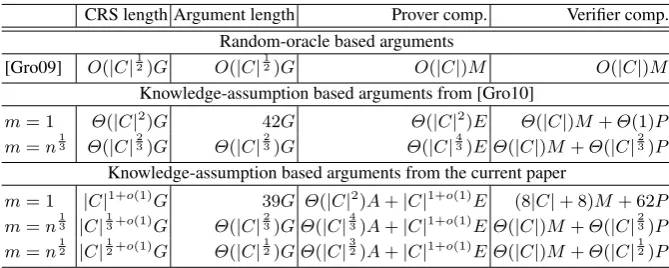
One related research direction is to construct efficient NIZK proofs forNP-complete languages. Given an efficient NIZK proof for aNP-complete language, one can hope to construct NIZK proofs of similar complexity for the wholeNPeither by reduction or implicitly or explicitly using the developed techniques. In some NIZK proofs for theNP-complete problem circuit satisfiability (Circuit-SAT), see Tbl. 1, the communication complexity is sublinear in the circuit size. Micali [Mic94] proposed polylogarithmic-communication NIZKargumentsfor all NP-languages, but they are based on the PCP theorem (making them computationally unattractive) and on the random oracle model. Another NIZK argument for Circuit-SAT, proposed by Groth in 2009 [Gro09], is also based on the random oracle model. (Without random oracles, this argument takeslog2|C|+ 5rounds, where|C|is the circuit size. Seo [Seo11] somewhat reduced the number of rounds in this argument.) It is well-known [CGH98] that some functionalities are secure in the random oracle model and insecure in the plain model. In particular, Goldwasser and Kalai [GK03] designed a signature scheme, built by using the Fiat-Shamir heuristics (which is predominant in the construction of NIZK arguments in the random oracle model), that is secure in the random oracle model but insecure when instantiated with any “real” hash function. As a safeguard, it is important to design efficient NIZK proofs and arguments that do not rely on the random oracles. Given a fully-homomorphic cryptosystem [Gen09], one can construct efficient NIZKproofsfor allNP-languages in communication that is linear to the witness size [Gro11]. However, since the witness size can be linear in the circuit size, in the worst case the corresponding NIZK proofs are not sublinear.
In 2010, Groth [Gro10] proposed the first (worst-case) sublinear-communication NIZK Circuit-SAT argument in the CRS model. First, he constructed two basic arguments for Hadamard product (the prover knows how to open commitmentsA,B andCto three tuplesa,bandcof dimensionn, such thataibi =cifori ∈ [n]) and
permutation (the prover knows how to open commitmentsAandBto two tuplesaandbof dimensionn, such that a%(i)=bi fori∈[n]). Groth’s Circuit-SAT argument can then be seen as a program in a program language that
CRS length Argument length Prover comp. Verifier comp. Random-oracle based arguments
[Gro09] O(|C|12)G O(|C| 1
2)G O(|C|)M O(|C|)M
Knowledge-assumption based arguments from [Gro10] m= 1 Θ(|C|2
)G 42G Θ(|C|2
)E Θ(|C|)M+Θ(1)P m=n13 Θ(|C|23)G Θ(|C|23)G Θ(|C|43)E Θ(|C|)M+Θ(|C|23)P
Knowledge-assumption based arguments from the current paper m= 1 |C|1+o(1)
G 39G Θ(|C|2
)A+|C|1+o(1)
E (8|C|+ 8)M+ 62P m=n13 |C|13+o(1)G Θ(|C|23)G Θ(|C|43)A+|C|1+o(1)E Θ(|C|)M+Θ(|C|23)P
m=n12 |C| 1
2+o(1)G Θ(|C| 1
2)G Θ(|C| 3
2)A+|C|1+o(1)E Θ(|C|)M+Θ(|C| 1 2)P
Table 1.Comparison of NIZK Circuit-SAT arguments with (worst-case) sublinear argument size. Note that the summary length of the CRS and the argument corresponds to the zap length.|C|is the size of circuit, Gcorresponds to1group element and A/M/E/Pcorresponds to1addition/multiplication/exponentiation/pairing
on the circuit, while the secret input tuples of the basic arguments depend on the values, assigned to the input and output wires of all gates according to a satisfying assignment. The basic arguments then show that this wire assignment is internally consistent and corresponds indeed to an satisfying input assignment. For example, Groth used one permutation argument to verify that all input wires of all gates have been assigned the same values as the corresponding output values of their predecessor gates.
In the basic variant of Groth’s pairing-based Circuit-SAT argument, see Tbl. 1, the argument hasΘ(1)group elements, but on the other hand the CRS hasΘ(|C|)2group elements, and the prover’s computational complexity is dominated byΘ(|C|2)bilinear-group exponentiations. A balanced version of Groth’s argument has the CRS and argument ofΘ(|C|2/3)group elements and prover’s computational complexity dominated byΘ(|C|4/3) ex-ponentiations. (See [Gro10] for more details on balancing. Basically, one applies basic arguments on length-m inputs,m < n,n/mtimes in parallel.)
We propose a new Circuit-SAT argument (see Sect. 3 for a description of the new techniques, and subsequent sections for the actual argument) that is strongly related to Groth’s argument, but improves upon every step. We first propose more efficient basic arguments. We then use them to construct a (slightly shorter) new Circuit-SAT argument. In the basic variant, while the argument is again Θ(1)group elements, it is one commitment and one Hadamard product argument shorter. Moreover, in Groth’s argument, every commitment consisted of
3group elements while every basic argument consisted of 2group elements. In the new argument, most of the commitments consist of2 group elements. Thus, we saved3group elements, reducing the argument size from
42to39group elements, even taking into account that the new permutation argument has higher communication complexity (12instead of5group elements) than that of [Gro10].
A balanced version of the new argument achieves the combined CRS and argument ofΘ(|C|1/2+o(1))group elements. In App. M, we describe a zap [DN00] for Circuit-SAT that has communication complexity of|C|1/2+o(1) group elements, while Groth’s zap from [Gro10] has the communication complexity ofΘ(|C|2/3)group elements. We also use much more efficient asymmetric pairings instead of symmetric ones, a (presumably) weaker security assumption (Power Symmetric Discrete Logarithm instead of Power Computational Diffie-Hellman), and have more precise security reductions. The basic version of the new Circuit-SAT argument is more communication-efficient than any prior-art random-oracle based NIZK argument, and it also has a smaller prover’s computational complexity than [Mic94].
Our main contribution is to note that the complexity of Groth’s basic arguments is correlated to the number of monomials of a certain polynomial. In [Gro10], this polynomial hasΘ(n2)monomials, wheren= 2|C|+ 1. We show that one can “collapse” theΘ(n2)monomials to Θ(N)monomials, whereN is such that[N]has a progression-free subset (that is, a subset that does not contain arithmetic progressions of length3) of odd integers of cardinalityn. By a recent breakthrough of Elkin [Elk11],N =O(n·22√2(2+log2n)) =n1+o(1). See Sect. 3
for further elaboration on our techniques.
design a new basic argument to construct a non-interactive shuffle. (See [CLs10] for a previous use of additive combinatorics in the construction of zero-knowledge proofs.)
2
Preliminaries
Let[n] = {1,2, . . . , n}. LetSn be the set of permutations from[n] to[n]. Leta = (a1, . . . , an). Leta◦b
denote the Hadamard (entry-wise) product of a andb, that is, if c = a◦b, then ci = aibi for i ∈ [n]. If
y =hx, thenloghy :=x. Letκbe the security parameter. If0< λ1 <· · · < λi <· · · < λn = poly(κ). then
Λ= (λ1, . . . , λn)⊂Zis an(n, κ)-nice tuple. We abbreviate probabilistic polynomial-time as PPT. IfΛ1andΛ2 are subsets of some additive group (ZorZp in this paper), thenΛ1+Λ2 = {λ1+λ2 :λ1 ∈Λ1∧λ2 ∈Λ2}
is theirsum setandΛ1−Λ2 ={λ1−λ2 : λ1 ∈ Λ1∧λ2 ∈ Λ2}is theirdifference set[TV06]. IfΛis a set, thenkΛ = {λ1+· · ·+λk : λi ∈ Λ} is aniterated sumset,k·Λ = {kλ : λ ∈ Λ} is adilationof Λ, and
2bΛ={λ1+λ2:λ1∈λ∧λ2∈Λ∧λ16=λ2} ⊆Λ+Λis arestricted sumset. (See [TV06].)
Let Gbp(1κ) be a bilinear group generator that outputs a description of a bilinear group gk := (p,G1,G2,GT,ˆe)← Gbp(1κ), such thatpis aκ-bit prime,G1,G2andGT are multiplicative cyclic groups of
orderp,eˆ:G1×G2→GT is a bilinear map (pairing) such that∀a, b∈Zandgt∈Gt,ˆe(g1a, g
b
2) = ˆe(g1, g2)
ab.
Ifgt generates Gt fort ∈ {1,2}, theneˆ(g1, g2)generates GT. Deciding the membership inG1,G2 andGT,
group operations, the pairing ˆe, and sampling the generators are efficient, and the descriptions of the groups and group elements areO(κ) bit long each. Well-chosen asymmetric pairings (with no efficient isomorphism betweenG1andG2) are much more efficient than symmetric pairings (whereG1 =G2). Forκ= 128, the cur-rent recommendation is to use an optimal (asymmetric) Ate pairing [HSV06] over a subclass of Barreto-Naehrig curves [BN05,PSNB11]. In that case, at security level ofκ= 128, an element ofG1/G2/GT can be represented in
respectively512/256/3072bits.
A (tuple) commitment scheme(Gcom,Com)in a bilinear group consists of two PPT algorithms: a randomized CRS generation algorithmGcom, and a randomized commitment algorithmCom. Here,Gcomt (1κ, n),t ∈ {1,2}, produces a CRSckt, andComt(ckt;a;r), witha= (a1, . . . , an), outputs a commitment valueAinGt(or inGbt
for someb >1). We openComt(ck
t;a;r)by outputtingaandr.
A commitment scheme(Gcom,Com)iscomputationally binding in groupGt, if for every non-uniform PPT
adversaryAand positive integern= poly(κ), the probability
Pr
"
ckt← Gcomt (1
κ, n),(a
1, r1,a2, r2)← A(ckt) :
(a1, r1)6= (a2, r2)∧ Comt(ckt;a1;r1) =Comt(ckt;a2;r2)
#
is negligible inκ. A commitment scheme (Gcom,Com)isperfectly hiding in groupGt, if for any positive
inte-gern = poly(κ)andckt ∈ Gcomt (1κ, n)and any two messagesa1,a2, the distributionsComt(ckt;a1;·)and
Comt(ck
t;a2;·)are equal.
A trapdoor commitment scheme has three additional efficient algorithms: (a) A trapdoor CRS generation algorithm inputst,nand1κ, and outputs a CRSck∗(that has the same distribution asGt
com(1κ, n)) and a trapdoor td, (b) a randomized trapdoor commitment that takes ck∗ and a randomizer ras inputs and outputs the value Comt(ck∗;0;r)
, and (c) a trapdoor opening algorithm that takesck∗,td,aandras an input and outputs anr0 such thatComt(ck∗;0;r) =Comt(ck∗;a;r0).
Let R = {(C, w)} be an efficiently computable binary relation such that |w| = poly(|C|). Here, C is a statement, andwis a witness. LetL ={C : ∃w,(C, w) ∈ R}be anNP-language. Letnbe some fixed input lengthn=|C|. For fixedn, we have a relationRnand a languageLn. Anon-interactive argumentforRconsists
of the following PPT algorithms: a common reference string (CRS) generatorGcrs, a proverP, and a verifierV. Forcrs ← Gcrs(1κ, n),P(crs;C, w)produces an argumentψ. The verifierV(crs;C, ψ)outputs either1(accept) or0(reject).
A non-interactive argument(Gcrs,P,V)isperfectly complete, if∀n= poly(κ),
Pr[crs← Gcrs(1κ, n),(C, w)← Rn :V(crs;C,P(crs;C, w)) = 1] = 1 .
A non-interactive argument (Gcrs,P,V)is (adaptively) computationally sound, if for all non-uniform PPT adversariesAand alln= poly(κ), the probability
is negligible inκ. The soundness is adaptive, that is, the adversary sees the CRS before producing the statement C. A non-interactive argument(Gcrs,P,V)isperfectly witness-indistinguishable, if for alln= poly(κ), ifcrs∈ Gcrs(1κ, n)and((C, w0),(C, w1))∈ Rn2, then the distributionsP(crs;C, w0)andP(crs;C, w1)are equal.
A non-interactive argument (Gcrs,P,V)is perfectly zero-knowledge, if there exists a PPT simulator S = (S1,S2), such that for all stateful non-uniform PPT adversariesAandn= poly(κ)(withtdbeing thesimulation
trapdoor),
Pr
crs← Gcrs(1κ, n),
(C, w)← A(crs),
ψ← P(crs;C, w) :
(C, w)∈ Rn∧ A(ψ) = 1
= Pr
(crs;td)← S1(1κ, n),
(C, w)← A(crs),
ψ← S2(crs;C,td) :
(C, w)∈ Rn∧ A(ψ) = 1
.
3
Our Techniques
We will first give a more precise overview of Groth’s Hadamard product and permutation arguments [Gro10], followed by a short description of our own main contribution. For the sake of simplicity, we will make several simplifications (like the use of symmetric pairings) during this discussion.
Groth uses an additively homomorphic tuple commitment scheme that allows one to commit to a long tuple, while the commitment itself is short. The best known such commitment scheme is the extended Pedersen com-mitment scheme in a multiplicative cyclic group of orderpand a generatorg, where the commitment of a tuple
a= (a1, . . . , an)with randomnessrais equal toCom(a;ra) :=gra·Qgaii. Here, one usually choosesnrandom
secretsxi ← Zp, and then setsgi ← gxi. Following [GJM02], Groth [Gro10] chooses a single random secret
x←Zpand then setsgi ←gx
i
. In this case, the commitment
Com(a;ra) :=gra· n
Y
i=1 gai
i =g
ra+Pni=1aixi
can be seen as a lifted polynomialra+P n
i=1aixiinx, that the committer (who does not knowx) computes from
ngiven valuesgi = gx
i
. The first obvious benefit of this commitment scheme is that it has a shorter secret (1
element instead ofnelements).
Groth’s Hadamard product argument, where the prover aims to convince the verifier that the opening ofC=
Com(c;rc)is equal to the Hadamard product of the openings ofA =Com(a;ra)andB =Com(b;rb)(that is,
aibi ≡ ci (modp)fori ∈ [n]), is constructed as follows. Let A =gra ·Qni=1gaii be a commitment ofaand
B=grb·Qn
i=1g
bi
i be a commitment ofbby using the generator tuple(g1, . . . , gn). LetC=grc·Q n i=1g
ci
i(n+1) be a commitment ofbandD =Qn
i=1gi(n+1)be a commitment of1= (1, . . . ,1)by using a different generator tuple(gn+1, . . . , gn(n+1)).
Groth’s Hadamard product argument is based around the verification equation
ˆ
e(A, B) = ˆe(C, D)·eˆ(ψ, g) (1)
that (analogously to the Groth-Sahai proofs [GS08], though the latter only considers the much simpler casen= 1) can be seen as a mapping of the required equalitya◦b=c◦1to another algebraic domain, withψcompensating for the use of a randomized commitment scheme. One gets thateˆ(A, B)/eˆ(C, D)is equal toˆe(g, g)F(x), where F(x) = (ra+P
n
i=1aixi)·(rb+P n
i=1bixi(n+1))−(rc+P n
i=1cixi)·(P n i=1x
i(n+1))is the sum of two formal polynomials inx,F(x) =Fcon(x) +Fψ(x), whereFcon(x) =P
n
i=1(aibi−ci)xi(n+2)is aconstraint polynomial,
spanned by the powers ofxfromΛcon={i(n+ 2) :i∈[n]}, and
Fψ(x) =rarb+rb n
X
i=1 aixi+
n
X
i=1
(rabi−rc)xi(n+1)+ n
X
i=1
n
X
j=1
j6=i
(aibj−ci)xi+j(n+1)
is anargument polynomial, spanned by the powers ofxfromΛψ={0}∪[n]∪{i(n+1) :i∈[n]}∪{i+j(n+1) :
i, j∈[n]∧i6=j}. One coefficient ofFcon(x)corresponds to one constraintaibi=cithat the honest prover has
to satisfy, and is0if this constraint is true. Thus, all coefficients ofFconare equal to0iff the prover is honest. By using homomorphic properties of the commitment scheme, the prover constructs the argumentψ=gFψ(x) asψ=grarb· · · · ·Qn
i=1 Qn
j=1:i6=jg aibj−ci
commitments but does not know the secretx— knows all coefficientsrarb,. . .,aibj−ci. He also knows the
generatorsg,. . .,gi+j(n+1)if theΘ(n2)generatorsg`, for`∈Λψ, are included to the CRS. Thus, the CRS has
Θ(n2)group elements and the computational complexity of the prover isΘ(n2)bilinear-group exponentiations. On the other hand, the verifier’s computational complexity isΘ(1)pairings, since she only has to check Eq. (1).
For the soundness, one needs that whenaibi 6=cifor somei∈[n], then a satisfyingψcannot be computed
from the elementsgx` that are in the CRS; otherwise, a dishonest prover would be able to compute a satisfying
argument. This means that fori∈[n],gxi(n+2) should not belong to the CRS. To be certain that this is true, one
needs
(a) thatgx` is in the CRS for values`∈Λ
ψbut if`∈Λcon, thengx
`
does not belong to the CRS (elements from
2·Λ\Λˆare allowed),
(b) an appropriate security assumption that states that computinggFψforF
ψ =P`∈Λψµ`x
`is only possible if
one knows all valuesgx`for`∈Λψ, and
(c) thatΛcon∩Λψ=∅. (This is also a prerequisite for (a).)
One can guarantee (a) by the choice of the CRS. But also (c) is clearly true, sinceΛconandΛψdo not intersect.
To finish off the whole argument, one has to define an appropriate security assumption for (b). Since con-structing sublinear NIZK arguments is known to be impossible under standard assumptions (see Sect. 2), one of the underlying assumptions is a knowledge assumption (PKE assumption, as in [Gro10], see Sect. 5). The whole argument will become (slightly!) more complex since all commitments and arguments also have to include a knowledge component.
Groth’s permutation argument is based on a very similar idea and has basically the same complexities. The only major difference is that if the permutation is a part of the prover’s statement, then the verifier also has to perform Θ(n)bilinear-group multiplications. Since Groth’s Circuit-SAT argument consists of a very small (<10) number of Hadamard product and permutation arguments, then it just inherits the complexities of the basic arguments, as also seen from Tbl. 1, where, in the basic variation,|C|=nand thus the CRS hasΘ(|C|2)group elements, the argument length is42group elements, the prover’s computational complexity isΘ(|C|2)exponentiations, and the prover’s computational complexity is dominated byΘ(|C|)bilinear-group multiplications.
Groth’s Circuit-SAT argument has several sub-optimal properties that are all inherited from the basic argu-ments. While it has succinct communication and efficient verification, its CRS ofΘ(|C|2)group elements and prover’s computation ofΘ(|C|2)exponentiations (in the basic variant) seriously limit applicability. Recall that heren = 2|C|+ 1. A smaller problem is the use of different generators(g1, . . . , gn)and(gn+1, . . . , gn(n+1)) while committing to different elements.
We note that Fcon has nmonomials (1 per every constraintaibi = ci that a honest prover must satisfy).
On the other hand,FψhasΘ(n2)distinct — sincei1+j1(n+ 1) 6= i2+j2(n+ 1)ifi1, j1, i2, j2 ∈ [n]and
(i1, j1) 6= (i2, j2)— monomials. The number of those monomials is the only reason why the CRS hasΘ(n2) group elements and the prover has to performΘ(n2)bilinear-group exponentiations.
We now show how to collapse many of the unnecessary monomials into one, so that the full argument still re-mains secure, obtaining a polynomialFψ(x)that has onlyn1+o(1)monomials. First, we generalize the underlying
commitment scheme. We still choose a singlex←Zpand setgi←gx
i
, but we allow the indexes ofngenerators
(gλ1, . . . , gλn), that are used to commit, to actually depend on the concrete argument — with the main purpose to be able to obtain as smallΛψas possible, while still guaranteeing thatFcon = 0iff the prover is honest, and that Λcon∩Λψ =∅. Assume thatΛ= (λ1, . . . , λn)is an(n, κ)-nice tuple of integers, soλn= maxiλi. Thus,
Com(a;ra) :=gra n
Y
i=1 gai
λi=g
ra+Pni=1aixλi .
The polynomialra+P n
i=1aixλi has degree (up to)λn, but it only has (up to)n+ 1non-zero monomials. We
now start again with the verification equation Eq. (1), but this time we assume that allA,B,C andD have been committed by using the same set of generators(gλ1, . . . , gλn). Since F(x) = (ra +
Pn
Pn
i=1bixλi)−(rc+P n
i=1cixλi)(P n i=1x
λi), we get thatF(x) =F
con(x) +Fψ(x), where
Fcon(x) =
n
X
i=1
(aibi−ci)x2λi , (2)
Fψ(x) =rarb+ n
X
i=1
(rabi+rbai−rc)xλi+ n
X
i=1
n
X
j=1
j6=i
(aibj−ci)xλi+λj . (3)
Here, the powers corresponding to nonzero coefficients belong either to the setΛcon= 2·Λ:={2λi:i∈[n]}or
to the setΛψ= ˆΛ:={0} ∪Λ∪2bΛ, where2bΛ:={λi+λj :i, j∈[n]∧i6=j}.
If the prover is honest (that is,aibi−ci = 0for alli), then the coefficientsaibi−ci corresponding to the
powers in the set2·Λare equal to0. Therefore, an honest prover can compute the argumentψ = gFψ(x)as gP`∈Λˆµ`x` =Q
`∈Λˆ(gx `
)µ`, where the coefficientsµ
`are known to the prover. This means that all elementsgx
` , ` ∈ Λ, have to belong to the CRS, and thus the CRS contains at leastˆ |Λ|ˆ < 2λn group elements. Recall that
in [Gro10], one had to specifyΘ(n2)elements in the CRS.
For the soundness, we again need (a–c), as in the case of Groth’s argument, to be true. One can again guarantee (a) by the choice of the CRS, and one has to define a reasonable security assumption (PKE assumption) for (b). Finally, achieving (c) is also relatively easy. Namely, one can guarantee that06∈2·ΛandΛ∩2·Λ=∅by choosing Λto be a set of odd1integers. It is almost as easy to guarantee that2·Λ∩2bΛ=∅as soon as one rewrites this condition as2λk 6=λi+λjfori6=j, and notices that this is equivalent to requiring that no3elements ofΛare
in an arithmetic progression. That is,Λis a progression-free set [TV06]. Thus, it is sufficient to assume thatΛis a progression-free set of odd integers.
Recall that the CRS length (and the prover’s computational complexity) depend on|Λ|ˆ and thus it is beneficial to have as small|Λ|ˆ <2λnpossible. This can be guaranteed by upper boundingλn, that is, by finding as small
λn as possible such that[λn]contains a progression-free subset of odd integers of cardinalityn. To boundλn,
we show in Sect. 4 (following a recent breakthrough of Elkin [Elk11]) that any range[N] ={1, . . . , N}contains a progression-free set of odd integers of sizen =Θ(N(log2N)1/4/22√2 log2N) =N1−o(1), and thus one can assume thatλn=n1+o(1). (One can obtainλn=O(n·22
√
2(2+log2n))by inverting a weaker version of Elkin’s result.) In App. B, we give another proof of this result that, while based on Green and Wolf’s exposition [GW10] of [Elk11], provides more details and is slightly sharper. In particular, Elkin’s progression-free set is efficiently constructible.
Groth’s permutation argument uses similar ideas for a different choice of A,B,C, and D, and thus also for a different set Λψ. Unfortunately, if we use it with the new generalized commitment scheme (that is, with
generalΛ), we obtain the guaranteea%(i)=bionly ifΛis a part of the Moser-de Bruijn sequence [Mos62,dB64].
But thenλn = Θ(n2)and one ends up with a CRS of Θ(n2) group elements. We use the following idea to
get the same guarantees when Λ is an arbitrary progression-free set of odd integers. We show that if Λ is a progression-free set of odd integers, then Groth’s permutation argument guarantees thata%(i) = TΛ(i, %)·bi,
whereTΛ(i, %)≥1is an easily computable and public integer. We use this result to show that for some separately
committed tuplea∗,a∗%(i)=TΛ(i, %)·bifori∈[n]. We then employ an additional product argument to show that
a∗i =TΛ(%−1(i), %)·aifori∈[n]. Thus,a%(i)=bifori∈[n].
We obtain basic arguments that only useΘ(λn) = n1+o(1) generators{gx
`
: ` ∈ Λ}. This means that theˆ CRS hasn1+o(1) group elements and notΘ(n2)as in [Gro10]. In both basic arguments, the prover has to com-puteψ(which takesΘ(n2)scalar multiplications or additions inZpandn1+o(1)bilinear-group exponentiations).
As in [Gro10], the prover’s computation can be optimized even further by using efficient multi-exponentiation algorithms [Str64,Pip80]. The verifier has to only performΘ(1)bilinear pairings. In the case of the permutation argument, she also has to computeΘ(n)bilinear-group multiplications, though the multiplications can be done offline if the permutation is fixed. Thus, the new basic arguments are considerably more efficient than Groth’s.
The soundness of the new product argument is based on two assumptions, a computational assumption (Λ-ˆ PSDL, see Sect. 5) and a knowledge assumption (Λ-PKE, see Sect. 5). Groth [Gro10] used[an2]-PKE (for a constanta) and[an2]-CPDH (which is a presumably stronger assumption than PSDL, see App. A). SinceΛ, Λ
ψ
are small subsets of[an2], then our assumptions can be expected to be somewhat weaker in general. Finally, the
security reduction in the proof of the product argument takes timeΘ(t(λn))in our case andΘ(t(an2))in Groth’s
case, wheret(m)is the time to factor a degree-mpolynomial. See Sect. K for a detailed comparison.
4
Progression-Free Sets
A set of positive integers Λ = {λ1, . . . , λn} is progression-free[TV06], if no three elements of Λ are in an
arithmetic progression, that is,λi+λj= 2λkonly ifi=j=k, or equivalently,2bΛ∩2·Λ=∅.
Let r3(N)denote the cardinality of the largest progression-free set that belongs to [N]. For anyN > 1, the set of integers in [N] that have no ternary digit equal to 2 is progression-free [ET36]. If N = 3k, then
there are 2N −1 such integers, and thus r3(N) = Ω(Nlog32) = Ω(N0.63). Clearly, this set can be
effi-ciently constructed. As shown by Behrend in 1946 [Beh46], this idea can be generalized to non-ternary bases, with r3(N) = Ω(N/(22
√
2 log2N · log1/4
2 N)). Behrend’s result was improved in a recent breakthrough by Elkin [Elk11], who showed thatr3(N) = Ω(N ·log
1/4 2 N/2
2√2 log2N)
. We have included a proof of Elkin’s result in App. B. Our proof is closely based on [GW10] but it has a sharper constant insideΩ. Moreover, our proof is much more detailed than that given in [GW10]. While both constructions employ the pigeonhole prin-ciple, Elkin’s methodology can be used to compute his progression-free set in quasi-linear timeN·2O(√logN), see [Elk11]. On the other hand, Bourgain [Bou98] showed thatr3(N) =O(N ·(logN/log logN)1/2), and re-cently Sanders [San11] showed thatr3(N) =O(N·(log logN)5/logN). Thus, according to Behrend and Elkin, the minimalNsuch thatr3(N) =nisN =n1+o(1), while according to Sanders,N =ω(n).
We need the progression-free subset to also consist of odd integers. For this, one can take Elkin’s setΛ =
{λ1, . . . , λn} ⊂[N], and then use the set2·Λ+ 1 ={2λ1+ 1, . . . ,2λn+ 1}. Clearly, ifΛ∈[n1+o(1)]then also
2·Λ+ 1∈[n1+o(1)]. We provide an expository proof of the following result in App. B.
Theorem 1. Letrodd
3 (N)be the size of the largest progression-free set in[N]that only consists of odd integers.
For anyn, there existsN =n1+o(1), such thatrodd
3 (N) =n.
5
Cryptographic Tools
In this section, we generalize the PKE assumption from [Gro10] and then define two new cryptographic assump-tions, PDL and PSDL, and prove that PSDL is secure in the generic group model. After that, we proceed to describe a generalization of Groth’s knowledge commitment scheme from [Gro10] and prove that it is computationally binding under the PDL assumption. Groth proved in [Gro10] that his commitment scheme is computationally binding under the (potentially stronger) CPDH assumption.
Λ-Power (Symmetric) Discrete Logarithm Assumption. LetΛbe an(n, κ)-nice tuple for somen= poly(κ). We say that a bilinear group generatorGbpis(n, κ)-PDL secure in groupGtfort∈ {1,2}, if for any non-uniform
PPT adversaryA,Pr[gk:= (p,G1,G2,GT,eˆ)← Gbp(1κ), gt←Gt\ {1}, x←Zp :A(gk; (gx
`
t )`∈{0}∪Λ) =x]
is negligible inκ. Similarly, we say that a bilinear group generatorGbpisΛ-PSDL secure, if for any non-uniform PPT adversaryA,
Pr
"
gk:= (p,G1,G2,GT,eˆ)← Gbp(1κ), g1←G1\ {1},
g2←G2\ {1}, x←Zp:A(gk; (gx
` 1 , g
x`
2 )`∈{0}∪Λ) =x
#
is negligible inκ. A version of P(S)DL assumption in a non pairing-based group was defined in [GJM02]. Cheon showed in [Che06] that ifnis a prime divisor ofp−1orp+ 1, then the[n]-PDL assumption can be broken by a generic adversary inO((pp/n+√n) logp)group operations. Clearly, if theΛ-PSDL assumption is hard, then theΛ-PDL assumption is hard in bothG1andG2. Moreover, if the bilinear group generator is CPDH secure, then it is also P(S)DL secure. Therefore, by the results of [Gro10], P(S)DL holds in the generic group model. We give a direct proof of the next result in App. D.
Theorem 2. The Λ-PSDL assumption holds in the generic group model for any(n, κ)-nice tupleΛgiven that
n = poly(κ). Any successful generic adversary forΛ-PSDL requires timeΩ(pp/λn)whereλn is the largest
Λ-Power Knowledge of Exponent Assumption (Λ-PKE). Abe and Fehr showed in [AF07] that no statistically zero-knowledge non-interactive argument for anNP-complete language can have a “direct black-box” security reduction to a standard cryptographic assumption unlessNP⊆P/poly. (See also [GW11].) In fact, the soundness of NIZK arguments (for example, of an argument that a perfectly hiding commitment scheme commits to0) is often unfalsifiable by itself. Similarly to Groth [Gro10], we will base our NIZK argument for circuit satisfiability onΛ-PKE, an explicit knowledge assumption. This assumption was proposed by Groth [Gro10] (though only for Λ= [n]) as a generalization of the KEA assumption of Damg˚ard [Dam91] and of the KEA3 assumption of Bellare and Palacio [BP04].
Lett ∈ {1,2}. For two algorithmsAandXA, we write(y;z) ← (A||XA)(x)ifAon inputxoutputsy,
andXAon the same input (including the random tape ofA) outputsz. LetΛbe an(n, κ)-nice tuple for some
n= poly(κ). The bilinear group generatorGbpisΛ-PKE secure in groupGtif for any non-uniform PPT adversary
Athere exists a non-uniform PPT extractorXA, such that
Pr
gk:= (p,G1,G2,GT,ˆe)← Gbp(1κ), gt←Gt\ {1},( ˆα, x)←Z2p,
crs←(gk; (gtx`, g
ˆ
αx`
t )`∈{0}∪Λ),(c,ˆc;r,(a`)`∈Λ)←(A||XA)(crs) :
ˆ
c=cαˆ∧c6=grt·Y
`∈Λ
ga`x`
t
is negligible inκ. That is, ifA(given access tocrsthat for a randomαˆcontains bothgx`
t andgαxˆ
`
t iff`∈ {0} ∪Λ)
can producecandˆcsuch thatˆc=cαˆ, thenX
A(given access tocrsand to the random coins ofA) can produce a
tuple(r,(a`)`∈Λ)such thatc=grt·
Q
`∈Λg a`x`
t . Groth [Gro10] proved that the[n]-PKE assumption holds in the
generic group model; his proof can be straightforwardly modified to the general case.
New Commitment Scheme. We use the following variant of theknowledge commitment schemefrom [Gro10] with a generalized choice of generators, defined as follows:
CRS generation: Let Λ be an (n, κ)-nice tuple with n = poly(κ). Define λ0 = 0. Given a bilinear group generatorGbp, setgk:= (p,G1,G2,GT,ˆe)← Gbp(1κ). Letg1←G1\ {1},g2←G2\ {1}, andα, xˆ ←Zp.
Lett∈ {1,2}. The CRS isckt←(gk; (gt,λi,gˆt,λi)i∈{0,...,n}), wheregt`=g
x`
t andˆgt`=gαxˆ
`
t .
Commitment: To commit toa = (a1, . . . , an) ∈ Znp, the committing party chooses a randomr ← Zp, and
defines
Comt(ck
t;a;r) := (gtr· n
Y
i=1 gai
t,λi,ˆg
r t·
n
Y
i=1
ˆ
gai
t,λi) .
Importantly, we allowΛ to depend on the concrete application. Lett = 1. Fix a commitment keyck1 that in particular specifiesg2,ˆg2 ∈G2. A commitment(A,Aˆ)∈ G21isvalidifeˆ(A,g2ˆ ) = ˆe( ˆA, g2). The caset= 2is dual.
Theorem 3. Lett ∈ {1,2}. The knowledge commitment scheme is perfectly hiding inGt, and computationally
binding inGtunder theΛ-PDL assumption inGt. If theΛ-PKE assumption holds inGt, then for any non-uniform
PPTAthat outputs some valid knowledge commitments, there exists a non-uniform PPT extractorXAthat, given
the input ofAtogether withA’s random coins, extracts the contents of these commitments.
The proof of this theorem is given in App. E. In the case of all security reductions in this paper, the tightness of the security reduction depends on the valueλn. Clearly, the knowledge commitment scheme is also trapdoor, with
the trapdoor beingtd=x: after trapdoor-committingA← Comt(ck;0;r) =gr
t forr←Zp, the committer can
open it to(a;r−Pn
i=1aix
λi)for anya.
6
New Hadamard Product Argument
Assume that(Gcom,Com)is the knowledge commitment scheme. In anHadamard product argument(in group G1, the case ofG2 is dual), the prover aims to convince the verifier that given commitmentsA,B andC, he can open them as A = Com1(ck;a;r
a),B = Com1(ck;b;rb), andC = Com1(ck;c;rc), s.t.cj = ajbj for
System parameters: Letn= poly(κ). LetΛ={λi :i∈[n]}be a progression-free set of odd integers, such thatλi+1>
λi>0. Denoteλ0:= 0. LetΛˆbe as in Eq. (4).
CRS generationGcrs(1κ): Letgk := (p,G1,G2,GT,ˆe) ← Gbp(1κ). Let α, xˆ ← Zp. Let g1 ← G1 \ {1}andg2 ← G2\ {1}. Denotegt` ← gx
`
t andˆgt` ← gαxˆ `
t fort ∈ {1,2}and`∈ {0} ∪Λ. Letˆ D ←
Qn
i=1g2,λi. The CRS is crs←(gk; (g1`,gˆ1`)`∈{0}∪Λ,(g2`,gˆ2`)`∈Λˆ, D). Letckb1←(gk; (g1`,ˆg1`)`∈{0}∪Λ).
Common inputs: (A,A, B,ˆ B, Bˆ 2, C,C), whereˆ (A,A)ˆ ← Com1(ckb1;a;ra),(B,B)ˆ ← Com1(ckb1;b;rb),B2 ← g2rb· Qn
i=1g
bi
2,λi,(C, ˆ
C)← Com1(ckb1;c;rc), s.t.aibi=cifori∈[n].
Argument generationP×(crs; (A,A, B,ˆ B, Bˆ 2, C,C),ˆ (a, ra,b, rb,c, rc)): LetI1(`) := {(i, j) : i, j ∈ [n]∧j 6= i∧
λi+λj=`}. For`∈2bΛ, the prover setsµ`← P
(i,j)∈I1(`)(aibj−ci). He setsψ←g
rarb
2 ·
Qn i=1g
rabi+rbai−rc
2,λi ·
Q
`∈2bΛ
gµ`
2`, andψˆ←gˆ rarb
2 ·
Qn i=1gˆ
rabi+rbai−rc
2,λi ·
Q
`∈2bΛ
ˆ gµ`
2`. He sendsψ
× ←
(ψ,ψ)ˆ ∈G22to the verifier as the
argument.
VerificationV×(crs; (A,A, B,ˆ B, Bˆ 2, C,C), ψˆ ×): accept iffe(A, Bˆ 2)/ˆe(C, D) = ˆe(g1, ψ)ande(gˆ 1,ψ) = ˆˆ e(ˆg1, ψ). Protocol 1:New Hadamard product argument[[(A,Aˆ)]]◦[[(B,B, Bˆ 2)]] = [[(C,Cˆ)]]
verifier’s computationΘ(n), prover’s computation ofΘ(n2)exponentiations and the CRS ofΘ(n2)group ele-ments. We present a more efficient argument in Prot. 1. Intuitively, the discrete logarithm on basish= ˆe(g1, g2)of
ˆ
e(A, B2)/eˆ(C, D) = ˆe(g1, ψ)is a degree-nformal polynomial inX, which is spanned by{X`}
`∈2·Λ∪Λˆ, where
ˆ
Λ:={0} ∪Λ∪2bΛ . (4)
We need that2·ΛandΛˆdo not intersect. The next lemma is straightforward to prove.
Lemma 1. 1) IfΛis a progression-free set of odd integers, then2·Λ∩Λˆ=∅. 2) If2·Λ∩Λˆ=∅, thenΛis a progression-free set.
Moreover, sinceΛˆ∈ {0, . . . ,2λn}, then by Thm. 1,
Lemma 2. For any valuenthere exists a choice ofΛsuch that|Λ|ˆ =n1+o(1).
We are now ready to state the security of the new Hadamard product argument for the knowledge commitment scheme. The (knowledge) commitments are(A,Aˆ),(B,Bˆ)and(C,Cˆ). For efficiency reasons, we include another elementB2to the Hadamard product language. We denote the argument in Prot. 1 by[[(A,Aˆ)]]◦[[(B,B, Bˆ 2)]] =
[[(C,Cˆ)]]. Since(C,Cˆ)is always a commitment of(a1b1, . . . , anbn)forsomevalue ofrc, we cannot claim that
Prot. 1 is computationally sound (even under a knowledge assumption). Instead, analogously to [Gro10], we prove a somewhat weaker version of soundness that is however sufficient to achieve soundness of the Circuit-SAT argument. Note that the last statement of the theorem basically says that no efficient adversary can output an input to the Hadamard product argument together with an accepting argument and openings to all commitments and all other pairs of type(y,yˆ)that are present in the argument, such thataibi 6=ci for somei ∈ [n]. Intuitively, the
theorem statement includesf`0only for`∈Λˆ(resp.,a`for`∈ Λtogether withr) sinceˆg2`(resp.,g1ˆ`) belongs
to the CRS only for`∈Λˆ(resp.,`∈ {0} ∪Λ). This “weak” soundness is similar to the co-soundness as defined in [GL07]. However, in the case of co-soundness, the adversary would not be required to open the argument (by presenting valuesf`0as in the theorem statement). One could define the corresponding formal security notion, but in our opinion, it would not increase readability.
Theorem 4. Prot. 1 is perfectly complete and perfectly witness-indistinguishable. IfGbp isΛˆ-PSDL secure, then a non-uniform PPT adversary has negligible chance of outputtinginp× ← (A,A, B,ˆ B, Bˆ 2, C,Cˆ)and an
ac-cepting argument ψ× ← (ψ,ψˆ) together with a witness w× ← (a, ra,b, rb,c, rc,(f`0)`∈Λˆ), s.t. (A,Aˆ) = Com1(ck1b ;a;ra),(B,Bˆ) = Com1(ck1b ;b;rb),B2 = gr2b ·
Qn
i=1g
bi 2,λi, (C,
ˆ
C) = Com1(ck1b ;c;rc),(ψ,ψˆ) =
(g P
`∈Λˆf
0
`x `
2 ,ˆg
P `∈Λˆf
0
`x `
2 ), and for somei∈[n],aibi6=ci.
The commitment scheme is defined as in Sect. 5 with respect to the setΛ. The following proof will make the intuition of Sect. 3 more formal. Note that the tightness of the reduction depends on the time it takes to factor a degree(2λn+ 1)-polynomial.
PERFECT COMPLETENESS. Assume that the prover is honest. The second verification is straightforward. For the first one, due to discussion in Sect. 3,F(x) = Fcon(x) +Fψ(x), where Fcon(x)andFψ(x)are as defined
by Eq. (2) and Eq. (3). Considerxto be a formal variable, thenF(X)is a formal polynomial ofX. This formal polynomial is spanned by{X`}
`∈2·Λ∪Λˆ. If the prover is honest, thenci =ai·bifori∈ [n], and thusF(X) =
Fψ(X)is spanned by{X`}`∈Λˆ. Denotingψ←g2rarb· Qn
i=1g
rabi+rbai−rc 2,λi ·
Qn
i=1 Qn
j=1:j6=ig aibj−ci 2,λi+λj =g
rarb 2 · Qn
i=1g
rabi+rbai−rc 2,λi ·
Q
`∈2bΛg µ`
2`, we see that clearlye(g1, ψ) =h. Thus, the first verification succeeds.
WEAKER VERSION OF SOUNDNESS. Assume thatAis an adversary that can break the last statement of the theorem. We construct an adversaryA0 against theΛ-PSDL assumption. Letˆ gk ← Gbp(1κ),x ←
Zp,g1 ← G1\ {1}, andg2←G2\ {1}. The adversaryA0receivescrs←(gk; (gx
` 1 , gx
`
2 )`∈Λˆ)as her input, and her task is to outputx. She setsαˆ ← Zp,crs0 ← (gk; (gx
` 1 , gαxˆ
`
1 )`∈{0}∪Λ,(gx
` 2 , gαxˆ
` 2 )`∈Λˆ,
Qn
i=1g
xλi
2 ), and then sendscrs0 toA. Clearly,crs0 has the same distribution asGcrs(1κ). BothAandA0setckt ← (gk; (gx
`
t , g
ˆ
αx`
t )`∈{0}∪Λ)for
t ∈ {1,2}. Assume thatAreturns(inp×, w×, ψ×)such that the conditions in the theorem statement hold, and V(crs0;inp×, ψ×)accepts. Here,inp× = (A,A, B,ˆ B, B2, C,ˆ Cˆ)andw× = (a, ra,b, rb,c, rc,(f`0)`∈Λˆ).
IfAis successful,(A,Aˆ) =Com1( b
ck1;a;ra),(B,Bˆ) =Com1(ckb1;b;rb),B2=g2rb· Qn
i=1g
bi 2,λi,(C,
ˆ
C) =
Com1( b
ck1;c;rc), and for somei∈[n],ci6=aibi. Since2·Λ∩Λˆ=∅,A0has thus expressedF(X)as a polynomial
f(X)where at least for some`∈2·Λ,X`has a non-zero coefficienta ibi−ci.
On the other hand,Aalso outputs(f`0)`∈Λˆ, s.t.F(x) = logg2ψ =f
0(x), where all non-zero coefficients of
f0(X) :=P
`∈Λˆf`0X`correspond toX`for some`∈Λ. Sinceˆ Λis a progression-free set of odd integers and all
elements of2·Λare distinct, then by Lem. 1,`6∈2·Λ. Thus, all coefficients off0(X)corresponding to anyX`,
` ∈2·Λ, are equal to0. Thusf(X) = P
`∈Λ∪ˆ (2·Λ)f`X`andf0(X) =P`∈Λˆf`0X
` are different polynomials
withf(x) =f0(x) =F(x). Thus,A0has succeeded in creating a non-zero polynomiald(X) =f(X)−f0(X),
such thatd(x) =P
`∈Λ∪ˆ (2·Λ)d`x`= 0.
Next,A0 uses an efficient polynomial factorization algorithm [vHN10] in
Zp[X]to efficiently compute all
<2λn+ 1roots ofd(X). For some rooty,gx
` 1 =g
y`
1 . The adversaryA0 setsx←y, thus violating theΛ-PSDLˆ
assumption. ut
The Hadamard product argument is not perfectly zero-knowledge. The problem is that the simulator knows td = ( ˆα, x), but giventdand the common input she will not be able to generateψ×. E.g., she has to compute ψ = grarb
2 ·
Qn
i=1g
rabi+rbai−rc 2,λi ·
Qn
i=1 Qn
j=1g
aibj−ci
2,λi+λj based on the input,αˆ andx, but without knowing the witness. This seems to be impossible. Technically, the problem is that due to the knowledge of the trapdoor, the simulator can, knowing one opening(a, r), produce an opening(a0, r0)to any othera0. However, here she does not know any openings. Similarly, the permutation argument of Sect. 7 is not zero-knowledge. On the other hand, in the final circuit satisfiability argument of Sect. 8, the simulator creates all commitments by herself and can thus properly simulate the argument. By the same reason, the subarguments of [Gro10] are not zero-knowledge but the final argument (for circuit satisfiability) is.
Theorem 5. LetΛbe as described in Thm. 1. The communication (argument size) of Prot. 1 is2elements fromG2.
The prover’s computational complexity isΘ(n2)scalar multiplications in
Zpandn1+o(1)exponentiations inG2.
The verifier’s computational complexity is dominated by5bilinear pairings and1bilinear-group multiplication. The CRS consists ofn1+o(1) group elements, with the verifier’s part of the CRS consisting of only the bilinear
group description plus5group elements.
The proof of this theorem is given in App. F.
In the Circuit-SAT argument, allai,biandciare Boolean, and thus alln1+o(1)valuesµ`can be computed in
n(n−1) =Θ(n2)scalar additions (the server also needs to use other operations like comparisonsj6=i, but they can be eliminated by using loop unrolling, andλiandλjcan be computed by using table lookups), as follows:
1. For`∈2bΛdo:µ`←0
2. Fori= 1tondo:
– Ifai= 0then forj= 1tondo: ifj6=ithenµλi+λj ←µλi+λj−ci
7
New Permutation Argument
In apermutation argument, the prover aims to convince the verifier that for given permutation% ∈ Snand two
commitmentsAandB, he knows how to open them asA=Com1(ck;a;r
a)andB=Com1(ck;b;rb), such that
bj =a%(j)forj ∈[n]. We assume that%is a part of the statement. In [Gro10], Groth constructed a permutation argument, where the prover’s computation isΘ(n2)exponentiations and the CRS hasΘ(n2)group elements. We now propose a new argument with the CRS ofn1+o(1) group elements. We also improve the prover’s concrete computation, and the argument is based on a (probably) weaker assumption.
The new permutation argument%([[(A,A˜)]]) = [[(B,B˜)]], see Prot. 2, uses (almost) the same high-level ideas as the Hadamard product argument from Sect. 6. However, the situation is more complicated. Consider the
verifi-cation equationˆe(g1, ψ%) = ˆe(A, g Pn
i=1xλi
2 )/eˆ(B, g Pn
i=1x 2λ%i−λi
2 )from [Gro10]. (See App. H for why this defi-nition ofD=g
Pn i=1xλi
2 andE%=g
Pn i=1x
2λ%i−λi
2 may make sense.) Lettingh= ˆe(g1, g2),F%(x) := logg2ψ
%=
P
i(a%(i)−bi)x2λ%(i)+raPix λi−r
bPix
2λ%(i)−λi+P
ia%(i)·Pj6=ix
λ%(i)+λ%(j)−P ibi·P
n j6=ix
λi+2λ%(j)−λj.
Following Sect. 6, we require thatΛ˜=Λ∪ {2λk−λi} ∪2bΛ∪ {λi+ 2λk−λj :i6=j}and2·Λdo not intersect. Since%is a part of the statement, we replaced%(i)and%(j)with a new elementk.
Assume thatΛis a progression-free set of odd integers. SinceΛconsists of odd integers,(Λ∪ {2λk−λi})∩
2·Λ=∅. SinceΛis a progression-free set,2bΛ∩2·Λ=∅. However, we also need that2λk∗6= 2λk+λi−λj
fori6=j. That is, one can uniquely represent any non-negative integeraasa= 2λk∗+λj. (It is only required
that any non-negative integerahas at most one representation asa = 2λk∗+λj. As we show in App. J, this
does not help our case.) The unique sequenceΛ = (λi)i∈Z+(theMoser-de Bruijn sequence[Mos62,dB64]) that
satisfies this property is the sequence of all non-negative integers that have only0or1as their radix-4digits. Since λn=Θ(n2), this sequence is not good enough.
Fortunately, we can overcome this problem as follows. Fori∈[n]and a permutation%, letTΛ(i, %) :=|{j ∈
[n] : 2λ%(i)+λj = 2λ%(j)+λi}|. Note that1 ≤ TΛ(i, %) ≤ n, and that for fixed Λ and%, the whole tuple
TΛ(%):= (TΛ(1, %), . . . , TΛ(n, %))can be computed inΘ(n)simple arithmetic operations. We can then rewrite
F%(x)as
F%(x) = n
X
i=1
(a%(i)−TΛ(i, %)·bi)x2λ%(i)+ra n
X
i=1 xλi−r
b n
X
i=1
x2λ%(i)−λi+
n
X
i=1 a%(i)
n
X
j=1
j6=i
xλ%(i)+λ%(j)− n
X
i=1 bi
n
X
j=1
j6=i
2λ%(i)+λj6=λi+2λ%(j)
xλi+2λ%(j)−λj , (5)
withΛ˜being redefined as
˜
Λ=Λ∪ {2λk−λi} ∪2bΛ∪({λi+ 2λk−λj :i6=j} \2·Λ) . (6)
SinceΛ˜∩2·Λ=∅,eˆ(A, D)/eˆ(B, E%) = ˆe(g1, ψ%)(withD=g
Pn i=1xλi
2 andE=E%=g
Pn i=1x
2λ%(i)−λi
2 , as it
follows from Eq. (8) and (9)) convinces the verifier thata%(i)=TΛ(i, %)·bifori∈[n]. To finish the permutation
argument, we let(A∗,Aˆ∗)to be a commitment to(a∗1, . . . , a∗n) := (TΛ(%−1(1), %)·a1, . . . , TΛ(%−1(n), %)·an),
use an Hadamard product argument to show thata∗i =TΛ(%−1(i), %)·ai (and thusa∗%(i) =TΛ(i, %)·a%(i)) for
i∈[n], and an argument as described above in this section to show thata∗%(i)=TΛ(i, %)·bifori∈[n]. Therefore,
a%(i)=bifori∈[n].
ClearlyΛˆ∪Λ˜={0} ∪Λ. Since˜ Λ˜⊂ {−λn+ 1, . . . ,3λn}, then by Thm. 1
Lemma 3. For anynthere exists a choice ofΛsuch that|Λ|˜ =n1+o(1).
We are now ready to state the security of the new permutation argument. The (weaker version of) soundness of this argument is based on exactly the same ideas as that of the Hadamard product argument.
Theorem 6. Prot. 2 is perfectly complete and perfectly witness-indistinguishable. IfGbp isΛ˜-PSDL secure, then a non-uniform PPT adversary has negligible chance of outputtinginpperm ← (A,A, B,˜ B,ˆ B, %˜ ) and an ac-ceptingψperm← (A∗,Aˆ∗, ψ×,ψˆ×, ψ%,ψ˜%)together with a witnesswperm← (a, r
a,b, rb,a∗, ra∗,(f0
(×,`))`∈Λˆ,
(f(0%,`))`∈Λ˜), s.t.(A,A˜) =Com 1(
e
System parameters: Same as in Prot. 1, but letΛ˜be as in Eq. (6).
CRS generationGcrs(1κ): Letgk := (p,G1,G2,GT,e)ˆ ← Gbp(1κ). Letα,ˆ α, x˜ ← Zp. Letg1 ← G1\ {1}andg2 ← G2\ {1}. Letgˆt←ˆgtαˆand˜gt ←g˜αt˜ fort∈ {1,2}. Denotegt`←gx
`
t ,gˆt`←ˆgx `
t , andg˜t`←g˜x `
t fort∈ {1,2}and `∈ {0} ∪Λ. Let˜ (D,D)˜ ←(Qn
i=1g2,λi,
Qn
i=1˜g2,λi). The CRS is
crs←(gk; (g1`,ˆg1`,g˜1`)`∈{0}∪Λ,(g2`)`∈{0}∪Λ˜,(ˆg2`)`∈Λˆ,(˜g2`)`∈Λ˜, D,D)˜ .
Letckb1←(gk; (g1`,gˆ1`)`∈{0}∪Λ),cke1←(gk; (g1`,g˜1`)`∈{0}∪Λ).
Common inputs: (A,A, B,˜ B,ˆ B, %), where˜ % ∈ Sn, (A,A)˜ ← Com1(cke1;a;ra), (B,B)ˆ ← Com1(ckb1;b;rb), and (B,B)˜ ← Com1(cke1;b;rb), s.t.bj=a%(j)forj∈[n].
Argument generationPperm(crs; (A,A, B,˜ B,ˆ B, %),˜ (a, ra,b, rb)): 1. Let(T∗,Tˆ∗, T2∗)←(
Qn i=1g
TΛ(%−1(i),%)
1,λi ,
Qn i=1ˆg
TΛ(%−1(i),%)
1,λi ,
Qn i=1g
TΛ(%−1(i),%)
2,λi ).
2. Letra∗ ←Zp,(A∗,Aˆ∗)← Com1(ckb1;TΛ(%−1(1), %)·a1, . . . , TΛ(%−1(n), %)·an;ra∗). Create an argumentψ×
for[[(A,A)]]ˆ ◦[[(T∗,Tˆ∗, T2∗)]] = [[(A ∗
,Aˆ∗)]].
3. LetΛ˜0%:= 2bΛ∪({2λ%(j)+λi−λj:i, j∈[n]∧i6=j} \2·Λ)⊂ {−λn+ 1, . . . ,3λn}.
4. For`∈Λ˜0
%,I1(`)as in Prot. 1, andI2(`) :={(i, j) :i, j∈[n]∧j6=i∧2λ%(i)+λj6=λi+2λ%(j)∧2λ%(j)+λi−λj= `}, set
µ%,`←
X
(i,j)∈I1(`)
a∗i −
X
(i,j)∈I2(`)
bi .
5. Let(E%,E˜%)←(Qni=1g2,2λ%(i)−λi,
Qn
i=1˜g2,2λ%(i)−λi). 6. Letψ%←Dr∗a·E−rb
% ·Q`∈Λ˜0
%g µ%,`
2` ,ψ˜ %← ˜
Dr∗a·E˜−rb % ·Q`∈Λ˜0
%g˜ µ%,`
2` , Sendψperm←(A∗,Aˆ∗, ψ×, ψ%,ψ˜%)∈G21×G42to the verifier as the argument.
VerificationVperm(crs; (A,A, B,˜ B,ˆ B, %), ψ˜ perm): Let E% and (T∗,Tˆ∗, T2∗) be computed as in Pperm. If ψ× verifies,
ˆ
e(A∗, D)/ˆe(B, E%) = ˆe(g1, ψ%),e(Aˆ ∗,ˆg2) = ˆe( ˆA∗, g2), andˆe(g1,ψ˜%) = ˆe(˜g1, ψ%), thenVpermaccepts. Otherwise,
Vpermrejects.
Protocol 2:New permutation argument%([[(A,A˜)]]) = [[(B,B˜)]]
Com1(ckb1;a∗;ra∗),(ψ×,ψˆ×) = (g
P `∈Λˆf
0
(×,`)
2 , gˆ
P `∈Λˆf
0
(×,`)
2 ), (ψ%,ψˆ%) = (g P
`∈Λ˜f
0
(%,`)
2 ,˜g
P `∈Λ˜f
0
(%,`)
2 ), a∗i =
TΛ(%−1(i), %)·ai(fori∈[n]), and for somei∈[n],a%(i)6=bi.
Proof. Denote h ← eˆ(g1, g2) and F%(x) := logh(ˆe(A∗, D)/eˆ(B, E%)). WITNESS-INDISTINGUISHABILITY:
since argumentψpermthat satisfies the verification equations is unique, all witnesses result in the same argument, and therefore the permutation argument is witness-indistinguishable.
PERFECT COMPLETENESS. Completeness ofψ× follows from the completeness of the Hadamard product argument. The third and the fourth verifications are straightforward. For the verificationeˆ(A∗, D)/ˆe(B, E%) =
ˆ
e(g1, ψ%), considerF
%(x)in Eq. (5). ConsiderX as a formal variable, then the right-hand side (and thus also
F%(X)) is a formal polynomial of X, spanned by {X`}`∈2·Λ∪Λ˜. If the prover is honest, then bi = a%(i) for i ∈ [n], and thusF%(X)is spanned by{X`}`∈Λ˜. Defining ψ% ← (Qni=1g2,λi)
ra∗ ·(Qn
i=1g2,2λ%(i)−λi)
−rb ·
Qn
i=1( Qn
j=1:j6=ig2,λi+λj)
a∗i·Qn
i=1( Q
j∈I∗
2(i,`)g2,λi+2λ%(j)−λj)
−bi =Dra∗·E−rb
% ·
Q
`∈Λ˜0
%g
µ%,`
2` , whereI ∗
2(i, `) := {j ∈[n] :j 6=i∧2λ%(i)+λj6=λi+ 2λ%(j)}, we see that the second verification holds.
WEAKER VERSION OF SOUNDNESS. Assume that A is an adversary that can break the last statement of the theorem. We construct an adversary A0 against the Λ-PSDL assumption. Let˜ gk ← Gbp(1κ), x ←
Zp, g1 ← G1 \ {1}, and g2 ← G2 \ {1}. The adversary A0 receives crs ← (gk; (gx ` 1 , g
x`
2 )`∈{0}∪Λ˜) as her input, and her task is to output x. She sets αˆ ← Zp, α˜ ← Zp, and crs0 ← (gk;
(gx1`, gαxˆ ` 1 , gαx˜
`
1 )`∈{0}∪Λ,(gx
`
2 )`∈{0}∪Λ˜,(g ˆ
αx` 2 )`∈Λˆ,(g
˜
αx` 2 )`∈Λ˜,
Qn
i=1g
xλi 2 ,
Qn
i=1˜g
xλi
2 ), and forwardscrs0 toA. Clearly,crs0 has the same distribution as Gcrs(1κ). Both parties also set ckˆ1 ← (gk; (gx
` 1 , gαxˆ
`
1 )`∈{0}∪Λ)and
e
ck1←(gk; (gx ` 1 , gαx˜
`
1 )`∈{0}∪Λ).
Assume that A returns (inpperm, wperm, ψperm) such that the conditions in the theorem state-ment hold, and V(crs0;inpperm, ψperm) accepts. Here, inpperm = (A,A, B,˜ B,ˆ B, %˜ ) and wperm = (a, ra,b, rb,a∗, ra∗,(f0
(×,`))`∈Λˆ,(f(0%,`))`∈Λ˜). IfAis successful,(A,A˜) =Com1(
e
ck1;a;ra),(B,Bˆ) =Com1(ck1b ;b;rb),(B,B˜) =Com1(ck1e ;b;rb),ψ×
(weakly) sound, we have that(A∗,Aˆ∗)commits to(TΛ(%−1(1), %)·a1, . . . , TΛ(%−1(n), %)·an). (Otherwise, we
have broken the PSDL assumption.) Since2·Λ∩Λ˜=∅,A0 has expressedF
%(X)as a polynomialf(X)where
at least for some`∈2·Λ,X`has a non-zero coefficient.
On the other hand,Aalso outputs(f0
(%,`))`∈Λ˜, s.t.F%(x) = logg2ψ=f 0
%(x), where all non-zero coefficients of
f%0(X) :=P
`∈Λ˜f(0%,`)X`correspond toX`for some`∈Λ. Since˜ Λis a progression-free set of odd integers and all elements of2·Λare distinct, then by the discussion in the beginning of Sect. 7,`6∈2·Λ. Thus, all coefficients off%0(X)corresponding to anyX`,` ∈ 2·Λ, are equal to0. Thus,f(X)·Xλn = P
`∈Λ∪˜ (2·Λ)f`X`+λn and
f%0(X) =P
`∈Λ˜f(0%,`)X`+λnare different polynomials withf(x) =f%0(x) =F%(x). Thus,A0 has succeeded in
creating a nonzero polynomiald%(X) =f(X)·Xλn−f%0(X), such thatd%(x) =P`∈Λ˜d`x`= 0.
Next,A0can use an efficient polynomial factorization algorithm [vHN10] in
Zp[X]to efficiently compute all
≤4λn+ 1roots ofd%(X). For some rooty,gx
` 1 =g
y`
1 . The adversaryA0setsx←y, thus violating theΛ-PSDL˜
assumption. ut
Note that in an upper level argument, the verifier must check thateˆ(A,˜g2) = ˆe( ˜A, g2),eˆ(B,ˆg2) = ˆe( ˆB, g2), and
ˆ
e(B,g˜2) = ˆe( ˜B, g2).
Theorem 7. LetΛbe as described in Thm. 1. The CRS consists ofn1+o(1)group elements. The argument size of
Prot. 2 is2elements fromG1and4elements fromG2. The prover’s computational complexity is dominated by Θ(n2)scalar additions in
Zp and byn1+o(1) exponentiations inG2. The verifier’s computational complexity is
dominated by12bilinear pairings and4n−2bilinear-group multiplications.
The proof of this theorem can be found in App. I.
8
New NIZK Argument for Circuit Satisfiability
In aNIZK argument for circuit satisfiability(Circuit-SAT, well-known to be anNP-complete language), the prover and the verifier share a circuitC. The prover aims to prove in non-interactive zero-knowledge that she knows an assignment of input values that makes the circuit output1. As in [Gro10], the Circuit-SAT argument will use the Hadamard product argument, the permutation argument and a trivial argument for element-wise sum of two tuples — in our case, all operating in parallel on(2|C|+ 1)-dimensional tuples, where|C|is the circuit size. Those three arguments can be seen as basic operations in an NIZK “programming language” for all languages inNP. We show that a small constant number of such basic operations is sufficient for Circuit-SAT. The full argument then contains additional cryptographic sugar: a precise definition of the used CRS, computational/communication optimizations, etc.
To make it easier to read the following (and to construct future protocols based on this “programming lan-guage”), we give first a high-level description of the resulting argument. The first task is to express the underlying argument as a parallel composition of some addition, permutation and Hadamard product arguments. These ar-guments may include intermediate variables (that will be committed to by the prover) and constants (that can be online committed to by both of the parties separately). When choosing the arguments, one has to keep in mind that we work in an asymmetric setting. This may mean that for some of the inputs to the circuit satisfiability argument, one has to commit to them both inG1andG2(and the verifier has to check that this is done correctly).
The CRS is basically the CRS of the permutation argument. The total argument consists of commitments to intermediate variables and of all arguments in the program of this “programming language”. Finally, the verifier has to check that all commitments are internally consistent, and then verify all used arguments.
Let us now turn to the concrete case of circuit satisfiability. For the sake of simplicity, assume that the circuit Cis only composed of NAND gates. LetChavengates. Assume that the output gate of the circuit isn, andUn
is the output of the circuit. For every gatej ∈ [n]ofC, let the input wires of itsjth gate beLj andRj, and let
Uj be one of its output wires. We also define an extra valueRn+1 = 1. We letXj be other “output” wires that
correspond to someLkorRk that were not already covered byUk (that is, inputs to the circuit, or duplicates of
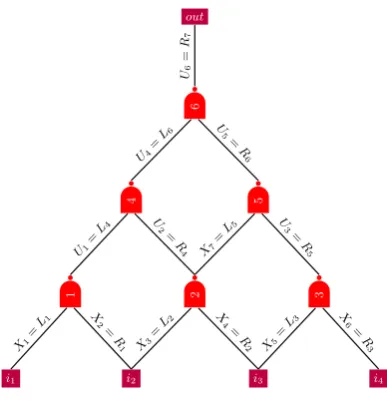
output wires). That is,(U1, . . . , Un, X1, . . . , Xn+1)is chosen so that for some permutationζ,(U,X, Xn+1)is a ζ-permutation of(L,R, Rn+1), whereY = (Y1, . . . , Yn)forY ∈ {L, R, U, X}. (See Fig. 1 in appendix for an
example circuit with valuesRi,Li,UiandXi.)
System parameters: DefineΛandΛˆas in Prot. 1 andΛ˜as in Prot. 2, but in all cases withnreplaced by2|C|+1. Permutation swap.
CRS generationGcrs(1κ): Let all other variables (including the secret ones) be defined as in the CRS generation of Prot. 2, but let crsperm be the CRS of Prot. 2. In addition, let ( ˆD, D
2) ← (Qni=1gˆ1,λi,
Qn
i=1g2,λi). The CRS is crs←(crsperm,D, Dˆ 2). Letck1←(gk; (g1`,gˆ1`,g˜1`)`∈{0}∪Λ).
Common inputs: A satisfiable circuit C, and permutations τ and ζ generated based on C, such that (L,R, Rn+1,U,X, Xn+1)is a “satisfying assignment”.
Argument generationP(crs;C,(L,R, Rn+1,U,X)): DenoteY := (Y1, . . . , Yn) forY ∈ {L, R, U, X}. The prover does the following.
1. Set r1, . . . , r4 ← Zp, and then compute (lr,blr,elr) ← Com1(ck1;L,R, Rn+1;r1), lr2 ← gr21 · Qn
i=1g
Li
2,λi ·
Qn+1
i=1 g
Ri
2,λi+n, (rl,erl) ← Com
1( e
ck1;R,L, Rn+1;r1), (rz,rzb) ← Com 1(
b
ck1;R,0, . . . ,0,0;r2), (uz,uzb) ←
Com1(ckb1;U,0, . . . ,0,0;r3),(ux,uxb,uxe)← Com 1
(ck1;U,X, Xn+1;r4).
2. Create an argument ψ1 for [[(lr,blr)]] ◦ [[(lr,blr,lr2)]] = [[(lr,blr)]], ψ2 for swap([[(rl,rle)]]) = [[(lr,blr,elr)]],
ψ3 for [[(rl,erl)]] ◦ [[(D,D, Dˆ 2)]] = [[(rz,rzb)]], ψ4 for [[(ux,uxb)]] ◦ [[(D,D, Dˆ 2)/(g1,λn,ˆg1,λn, g1,λn)]] = [[(uz,uzb)/(g1,λn,gˆ1,λn, g1,λn)]],ψ5for[[(rz,rzb)]]◦[[(lr,blr,lr2)]] = [[(D,D)ˆ ·(uz
−1, b
uz−1)]],ψ6 forτ([[(lr,elr)]]) =
[[(lr,blr,lre)]], andψ7forζ−1([[(ux,uxe)]]) = [[(lr,lrb,elr)]].
3. Sendψ←(lr,blr,lre,lr2,rl,erl,rz,rzb,uz,uzb,ux,uxb,uxe, ψ1, . . . , ψ7)to the verifier.
VerificationV(crs;C, ψ): The verifier does the following: – ForA∈ {lr,rz,uz,ux}check thate( ˆˆA, g2) = ˆe(A,ˆg2).
– Check thate(gˆ 1,lr2) = ˆe(lr, g2).
– ForA∈ {lr,rl,ux}check thate( ˜ˆA, g2) = ˆe(A,˜g2).
– Verify all7argumentsψ1, . . . , ψ7with corresponding inputs.
Protocol 3:New NIZK argument for Circuit-SAT
out
6
4 5
1 2 3
i1 i2 i3 i4
X1 =L
1 X2 =
R 1 X3
=L 2 X4
= R
2 X5=
L3 X6
= R
3 U1=
L4 U2= R
4 X7=
L5 U3= R
5 U4=
L6 U5
= R
6 U6
=
R7
· · · → jt+n → i1. For unique wiresi,τ(i) = i. Second,ζ ∈ S2n+1 is a permutation that for every input wire (eitherLi orRi−n), outputs an indexj ←ζ(i), such that the output wireUj orXj−n is equal to that
in-put wire. Third,swap ∈ S2n+1is a permutation, with swap(i) =i+nandswap(i+n) =ifori ∈ [n], and swap(2n+ 1) = 2n+ 1. Note thatswap=swap−1.
The argument is given by Prot. 3. In every subargument used in Prot. 3, the prover and the verifier use a substring of crs as the CRS. The corresponding substrings are easy to compute, and in what follows, we do not mention this issue. Instead of computing two different commitmentsComt(
b
ckt;a;r) = (grt ·
Q gai
t,λi,gˆ
r t ·
Qˆgai
t,λi) andCom
t(
e
ckt;a;r) = (grt ·
Qgai
t,λi,g˜
r t ·
Qg˜ai
t,λi), we sometimes compute a composed commitment Comt(ck
t;a;r) = (grt·
Qgai
t,λi,gˆ
r t
Qˆgai
t,λi,g˜
r t ·
Q˜gai
t,λi). We assume that the same valueαˆis used when creating product arguments and permutation arguments.
Theorem 8. Let Gbp be Λ˜-PSDL secure, and Λ-PKE secure in both G1 and G2. Then Prot. 3 is a perfectly
complete, computationally adaptively sound and perfectly zero-knowledge non-interactive Circuit-SAT argument.
Proof. PERFECT COMPLETENESS: follows from the perfect completeness of the Hadamard product and permu-tation arguments.
ADAPTIVE COMPUTATIONAL SOUNDNESS: LetAbe a non-uniform PPT adversary that creates a circuitC and an accepting NIZK argumentψ. By theΛ-PKE assumption, there exists a non-uniform PPT extractorXA
that, running on the same input and seeing A’s random tape, extracts all openings. From the (weaker version of) soundness of the product and permutation arguments and by theΛ-PSDL assumption, it follows that the˜ corresponding relations are satisfied between the opened values. Moreover, by theΛ-PSDL assumption, the opened˜ values belong to corresponding setsΛˆandΛ. Let˜ (L,R, Rn+1)be the opening of(lr,blr), whereL= (L1, . . . , Ln)
andR= (R1, . . . , Rn), and let(U1, . . . , Un, X1, . . . , Xn, Xn+1)be the opening of(ux,uxb). We now analyze the effect of every subargument in Prot. 3. See Fig. 1 for a visual reference.
The successful verification of ˆe(g1,lr2) = ˆe(lr, g2) shows thatlr2 is correctly formed. The first argument ψ1shows thatLi, Ri ∈ {0,1}. The second argumentψ2shows that(rl,erl)commits to(R,L, Rn+1). The third argumentψ3shows that(rz,rzb)commits to(R,0, . . . ,0,0)and is thus consistent with the opening of(lr,blr). The fourth argumentψ4 shows that(uz,uzb)commits to(U1, . . . , Un−1, Un0,0, . . . ,0,0)for someUn0. It also shows
thatUn·0 =Un0 −1, and thusUn0 = 1. (The value ofUnis not important to get soundness, since it is not used in
any other argument.)
The fifth argument showsψ5that the NAND gates are followed. That is,¬(Li∧Ri) =Uifori∈[n−1]. It
also shows that the circuit outputs1. Really, since(uz,uzb)commits to(U1, . . . , Un−1, Un0 = 1,0, . . . ,0,0), then
(D,Dˆ)·(uz−1, b
uz−1)commits to(1−U1, . . . ,1−Un−1,1−1 = 0,0, . . . ,0,0). Thus, the Hadamard product argument verifies only ifLi·Ri= 1−Uifori∈[n−1], andLn·Rn = 0, that is,¬(Ln∧Rn) = 1.
The sixth argumentψ6shows that ifi1, . . . , is, j1+n, . . . , jt+ncorrespond to the same wire, thenLi1 =
· · · = Lis = Rj1 = · · · = Rjt, that is, the values are internally consistent with the wires. As an example, in Fig. 1, the permutationτcontains cyclesR1 →L2→R1,R2 →L3→R2, andR4→L5 →R4. The seventh argumentψ7shows that the “input wires” and “output” wires are consistent. In Fig. 1,ζ(L1) =X1,ζ(R1) =X2, etc.
PERFECT ZERO-KNOWLEDGE: we construct the next simulatorS = (S1,S2). The simulatorS1(1κ, n)creates a correctly formed CRS together with a simulation trapdoortd = ( ˆα,α, x˜ )∈ Z3p. The adversary then outputs a
statementC(a circuit) together with a witness (a satisfying assignment)w. The simulatorS2(crs;C,td)creates
(lr,lr,b elr,lr2),(rl,erl),(rz,rzb),(uz,uzb)and(ux,uxb)as commitments to(0, . . . ,0). Due to the knowledge of trapdoor td, the simulator can simulate all product and permutation arguments. More precisely, he usesLi =Ri =Ui =
U0
n = 1to simulate all product and permutation arguments, except in the case ofψ5where he usesUi=Un0 = 0
instead. (Obviously,(rz,rzb)and(uz,uzb)commit to consistent tuples.)
To show that this argumentψ00simulates the real argumentψ, note thatψis perfectly indistinguishable from the simulated NIZK argumentψ0where one makes trapdoor commitments but opens them torealwitnessesLi, Ri
when making product and permutation arguments. On the other hand, alsoψ0andψ00are perfectly
indistinguish-able, and thus so areψandψ00. ut
Theorem 9. LetΛbe chosen as in Thm. 1. The CRS consists of|C|1+o(1)group elements. The communication
(argument length) of the argument in Prot. 3 is18elements fromG1and21elements fromG2. The prover’s
compu-tational complexity is dominated byΘ(|C|2)simple arithmetical operations in
Zpand|C|1+o(1)exponentiations
inG. The verifier’s computational complexity is dominated by72bilinear pairings and8|C|+ 8bilinear-group