A New Approach to Secure Logging
Di Ma and Gene Tsudik Computer Science Department, University of California, Irvine
{dma1,gts}@ics.uci.edu
Abstract. The need for secure logging is well-understood by the security pro-fessionals, including both researchers and practitioners. The ability to efficiently verify all (or some) log entries is important to any application employing secure logging techniques. In this paper, we begin by examining state-of-the-art in se-cure logging and identify some problems inherent to systems based on trusted third-party servers. We then propose a different approach to secure logging based upon recently developed Forward-Secure Sequential Aggregate (FssAgg) authen-tication techniques. Our approach offers both space-efficiency and provable secu-rity. We illustrate two concrete schemes – one private-verifiable and one public-verifiable – that offer practical secure logging without any reliance on on-line trusted third parties or secure hardware. We also investigate the concept of im-mutability in the context of forward secure sequential aggregate authentication to provide finer grained verification. Finally, we report on some experience with a prototype built upon a popular code version control system.
KEYWORDS:secure logging, MACs, signatures, forward secure stream integrity, truncation attack
1 Introduction
System logs are an important part of any secure IT system. They record noteworthy events happened in the past such as user activity, program execution status, system re-source usage, data changes, etc. They provide a valuable view of the past and current states of almost any type of complex system. In conjunction with appropriate tools and procedures, audit logs can be used to enforce individual accountability, reconstruct events, detect intrusions and identify problems. Keeping system audit trails and review-ing them in a consistent manner is recommended by NIST as one of the good principles and practices for securing computer systems [1]. Most modern software servers include some sort of logging mechanisms.
Audit data must be protected from modification and unauthorized
destruction to permit detection and after-the-fact investigation of
security violations.
In addition to the traditional meaning ofdata integritywhich stipulates no insertion of fake data and no modification or deletion of existing data, the integrity of a log file requires, in addition, no re-ordering of log entries. That is, we requirestream integrity
for securing audit logs.
In many real-world applications, a log file is generated and stored on an untrusted logging machine which is not physically secure enough to guarantee that it cannot be compromised [5]. Compromise of a logging machine can happen as long as the Trusted Computing Base (TCB) – the system component responsible for logging – is not to-tally bug-free, which is unfortunately always the case. In systems usingremote logging
(which send audit data to a remote trusted server), if the server is not available, the log has to be buffered and stored temporarily at the local machine. Once an attacker obtains the current secret key of the compromised logging machine, she can modify
post-compromisedata at will. In this case, one important issue isforward integrity: how to ensure thatpre-compromisedata cannot be manipulated. That is, even if the attacker obtains the current secret key, she must be unable to modify audit data generated before compromise.
No security measure can protect log entries created after an attacker gains con-trol of a logging machine, unless keys are periodically updated with the help of a re-mote trusted server or a local trusted hardware component (e.g., using key-insulated and intrusion-resilient authentication schemes [6–8]). We focus on the security of log entries made before the compromise of a logging machine. Consequently, we require
forward-secure stream integrity, i.e., resistance against post-compromise insertion, al-teration, deletion and re-ordering of pre-compromise log entries.
Traditional log integrity techniques include using special write-only hard disks or remote logging where copies of log entries are sent to several geographically differ-ent remote machines. Recdiffer-ently a number of cryptographic approaches have been pro-posed to address log integrity security that are generated and stored on the local logging server [2, 3, 5, 9]. Bellare and Yee were the first to define theforward-secure stream in-tegrity property required in an audit log system and proposed to use forward-secure MACs and index log entries [2, 3]. Schneier and Kelsey proposed a similar system based on forward-secure MACs and one-way hash chain [5]. Holt extended Schneier and Yee’s system to the public key setting [9]. Unfortunately, all these schemes do not defend against truncation attack - a special kind of deletion attack whereby the attacker deletes a contiguous subset of tail-end log entries. Furthermore, private key based schemes like Schneier-Kelsey and Bellare-Yee also suffers fromdelayed detec-tion attack1since they needs a trusted server to aid users in verifying the integrity of
the audit log; modifications can not be detected until the entire log data is uploaded to the trusted server. Also all prior schemes are inefficient in terms of both storage and
communication costs which make them impractical to be used on devices with com-mensurately meager resources such as an implantable medical device [10]. We present a detailed analysis of prior schemes in Section 2.
In order to mitigate aforementioned bad features of prior schemes, we propose a new scheme which providesforward-secure stream integrity for audit logs generated and stored on untrusted logging machines. Our scheme is based on a new cryptographic technique calledforward-secure aggregate(FssAgg) authentication recently proposed in [11, 12]. In a FssAgg authentication scheme, forward-secure signatures (or MACs) generated by the same signer are combined sequentially into a single aggregate sig-nature. Successful verification of an aggregate signature is equivalent to that of each component signature. (However, as discussed later, failed verification of an aggregate signature only implies that at least one component signature is invalid.) Thus, a secure FssAgg signature scheme is a good match for secure logging applications – it resists truncation attacks due to its all-or-nothing (aggregate and forward-secure) signature verification. In our scheme, users themselves can verify the log – without relying on a trusted server – which obviates delayed detection attacks. Our scheme offers storage and bandwidth efficiency inherited from the underlying FssAgg scheme. Also, depending on the specific FssAgg scheme used, our scheme can be either private- or public-verifiable. In a FssAgg scheme, individual signatures are erased once they are folded into the aggregate signature. Subsequent validity of individual log entries is implied by the va-lidity of the aggregated signature computed over all log entries. This indirect verifica-tion process is costly if the verifier is only interested in the validity of one specific log entry. The need to provide finer-grained verification in certain applications motivates us to keep individual log entry signatures in the log file. However since the aggregation function is public, revealing individual signatures enables anyone to truncate log entries and create new aggregate signature based on existing ones. To prevent this truncation attack (even when individual component signatures are revealed) we extend the FssAgg authentication scheme to be immutable. (Informally, immutability means the difficulty of computing new valid aggregated signatures from existing signatures.)
1.1 Contributions
Our contributions are as follows:
1. We identify some fundamental security issues and architectural limitations in prior secure logging schemes.
2. We propose new secure logging schemes based on recently proposed FssAgg au-thentication techniques. Our schemes provideforward-secure stream integrityfor audit logs generated and stored on untrusted logging machines and avoid the unde-sirable features of prior schemes. Our schemes inherit the provable security of the underlying FssAgg schemes.
3. We study immutability in the context of FssAgg authentication and extend existing FssAgg MAC/signature schemes to support immutability and provide finer-grained verification.
shows that our schemes offer better security and incur less computation and com-munication overhead.
5. We implement existing FssAgg signature schemes and compare their performance in the context of secure logging systems.
Organization:We begin with the analysis of the state-of-the-art in Section 2, followed by introduction of forward-secure aggregate authentication in Section 3. We then show how to use FssAgg schemes in logging applications: we propose a private-verifiable scheme in Section 4 and a public-verifiable scheme in Section 5. Next, we present immutable FssAgg schemes in 6. We evaluate our schemes in Section 7 and report on some experience with a prototype implementation in Section 8. Section 9 overviews related work and Section 10 concludes the paper.
2 Current Approach Analysis
In this section, we examine the state-of-the-art represented by Schneier-Kelsey scheme [5]. It has been used as a foundation by many subsequently proposed secure logging sys-tems. Readers interested in further details of the Schneier-Kelsey scheme are referred to [5].
2.1 Overview of Schneier-Kelsey Scheme
In the Schneier-Kelsey scheme, a logging machine U opening a new audit log first establishes a shared secret key A0 with a trusted remote server T. After each audit
entry is generated, the current secret keyAiis evolved into Ai+1 through a one-way
function. Log entries are linked using a hash chain. Each log entryLi contains three parts:
1. log entry data2Mi;
2. elementYiin the hash chain where3:
Yi=H(Mi||Yi−1) and Y0=H(M0)
3. forward-secure MAC denoted asZi, computed overYiwith the current secret key: Zi=M ACAi(Yi).
U closes the log file by writing a special final-record message,Df and erasingAf as well as other secrets, if any.
There is no constant high-bandwidth channel betweenU andT. It is assumed that U communicates log entries infrequently toT. At times, a moderately-trusted person or machine, calledV, may need to verify or read the audit log, while it is still onU.V
2 [5] also provides access control to audit log. Each log entryL
icontains a log entry typeWi
andCi=EKi(Di): the actual log dataDiencrypted under an access control keyKi. As we
only focus on integrity of audit log, in this paper, we replace the two elementsWiandCias Mito make our explanation clearer.
3In the Schneier-Kelsey scheme,Y
receives fromU a copy of the audit log,[L0, L1,· · · , Lf], wheref is the index value of
the last record, fromU.Vgoes through the hash chain in the log entries (theYivalues), verifying that each entry in the hash chain is correct.V then sendsYf andZftoT.T knowsA0 so he can calculateAf; this allows him to verify thatZf = M ACAf(Yf).
T informsVabout the verification result andVdiscovers whether the received copy of the log has any problems.
2.2 Analysis
We observe that the Schneier-Kelsey scheme has two security-related drawbacks: Truncation Attack:a kind of deletion attack whereby the attacker erases a contigu-ous subset of tail-end log messages. The truncation attack represents a real danger and is valuable to an attacker. After breaking in, a natural goal for an attacker is to modify the audit log by deleting the most recent log entries generated right before the break-in. The Schneier-Kelsey scheme uses a hash chain to link log entries such that that un-detectable log (link) deletion is impossible. This pertains to log entries already farmed out toT. However, log entries still residing onU are vulnerable to the truncation at-tack since there is no single authentication tag protecting the integrity of the entire log file. A hash chain elementYionly protects data records generated before timei. Thus, truncating log entries generated after timeiwill not be detected byT, unless there is a synchronization betweenU andT and the latter knows the current value off. Without a continuous communication channel, synchronization betweenU andT would require Uto generate log entries at a fixed rate. But, most logging systems are event-driven and events are unevenly spaced. Logging events at a fixed rate hinders the logging machine’s ability to fully utilize its computation and storage resources.
Delayed Detection:Recall that, in the Schneier-Kelsey scheme,Vis unable to ver-ify a log file by itself and needs to ask for help fromT. If this occurs beforeT has received a copy of the most up-to-date log fromU, and beforeUhas closed the log file, an attacker can modify pre-compromise records without being detected. Albeit, such modification will eventually be detected later, afterT receives the updated version of a log file.
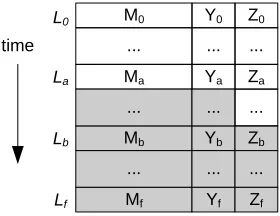
We illustrate the delayed detection attack in Figure 1. Suppose that, at timea(≥ 0), U has transmitted log entries[L0,· · ·, La]toT. At timeb (> a), an attacker breaks
intoU and obtains the current secret keyAb. Even though the attacker can not recover secret keys used in time intervals[a+1, b−1], she can modify the values ofMiand their correspondingYiin this interval without touching the values ofZi. At timef (≥b),V receives a copy of log entriesL0,· · ·, Lf.VsendsYf andZf toT. Since the attacker
knowsAbat break-in, she can generate valid MACs from timeb. The verification ofYf withZf atT will succeed. The modified log file will translate false information toV and activities conducted within interval[a+ 1, f]will eludeV’s detection. In Figure 1, values in the shaded area (MandY values in time interval[a+1, b−1], all values within
Since the attacker is unable to fake any valuesZi (for i ∈ [a+ 1, b−1]), any manipulation in this period can be detected whenever the corresponding log entries are uploaded toT andT scan-verifies all individual MACs.4
M0
L0 Y0 Z0
... ... ...
Ma Ya Za
Mb Yb Zb
Mf Yf Zf
... ... ...
... ... ...
La
Lb
Lf
time
Fig. 1.Log file under delayed detection attack. Data in shaded area can be controlled by an at-tacker.a: time at which log entries are uploaded toT;b: break-in time;f: index value of last log entry as well as time whenVreceives a copy of log file fromU.
The two drawbacks of the Schneier-Kelsey scheme seem to be quite fundamental. However, it is rather surprising that they have not been addressed by any later work. In addition to the security issues discussed above, the Schneier-Kelsey scheme has some architectural limitations:
Online Server. As mentioned earlier, the Schneier-Kelsey scheme employs a server-assisted verification process and a trusted serverT must be present wheneverVwants to pose an integrity query. In other words, the scheme requires a continuous channel (not necessarily high-width in case of the integrity check) betweenV andT. As with any centralized solution, the Schneier-Kelsey scheme has the single point of failure. Fur-thermore, the overall security of the Schneier-Kelsey scheme relies on the frequency of communication betweenU andT. Basically, the need for the on-line server can be avoided by using a public key based approach as in [9].
Storage Inefficiency. Each log entry contains a hash valueYiand a MACZi. To provide reasonable long-term security guarantees, a minimum security overhead 512 bits per log entry would be incurred in order to accommodate a 256-bit hash and a 256-bit MAC. We point out that storing two authentication tags per log entry in the Schneier-Kelsey scheme leads to storage inefficiency which makes it improper to be used on devices with commensurately meager resources such as sensors, implantable medical devices which need a light-weight secure logging system [10]. Leaving mul-tiple authentication tags on the log file and lacking a unique authentication tag to pro-vide integrity of the whole message body are also the causes of the Schneier-Kelsey scheme being vulnerable to truncation attacks. This motivates us to explore the recently
4Actually, the authors of the Schneier-Kelsey scheme do not mention any scan-verification
(ver-ification of individual MACs) in the paper. They only claim that ver(ver-ification ofZf equals to
proposed FssAgg authentication scheme to address both forward-secure integrity and storage efficiency.
The same set of vulnerabilities/limitations are also applicable to the Bellare-Yee private key based scheme [2,3]. The Holt scheme [9] uses a public key based approach. Therefor it avoids using a online server and also the delayed detection attack. However it still suffers from truncation attack and storage inefficiency.
3 Forward Secure Sequential Aggregate Authentication
In this section, we briefly introduce the components of a FssAgg scheme as they will be used in our secure logging system. We refer to [11, 12] for a more formal definition of a FssAgg scheme. We next show how a FssAgg scheme can provideforward-secure stream integrity.
An FssAgg scheme includes the following components:
[FssAgg.Kg] – key generation algorithm used to generate public/private key-pairs. It also takes as inputT– the maximum number of time periods (key evolvements). [FssAgg.Asig] – sign-and-aggregate algorithm which takes as input a private key, a message to be signed and a signature-so-far (an aggregated signature computed up to this point). It computes a new signature on the input message and combines it with the signature-so-far to produce a new aggregate signature. The final step in
FssAgg.Asigis a key update procedureFssAgg.Updwhich takes as input the signing key for the current period and returns the new signing key for the next period (not exceeding T). We make key update part of the sign-and-aggregate algorithm in order to obtain stronger security guarantees (see below).
[FssAgg.Aver] – verification algorithm, which, on input of a putative aggregate sig-nature, a set of presumably signed distinct messages, and a public key, outputs a binary value indicating whether the signature is valid.
A secure FssAgg scheme must satisfy the following properties:
1. Correctness:Any aggregated signature produced with FssAgg.Asig must be ac-cepted byFssAgg.Aver.
2. Forward secure aggregate unforgeability:No one, even knowing the current sign-ing key, can make a valid FssAgg forgery.
The forward secure aggregate unforgeability implies two things. First, it is append-only - no one can change any message generated before the compromise, which further implies a FssAgg signature can provide integrity protection for the whole message body. An attacker who compromises a signer has two choices: either it includes the intact so-far signature in future aggregated signatures, or it ignores the aggregate-so-far signature completely and start a brand new aggregated signature. What it cannot do is selectively deleting components of an already-generated aggregate signature. This append-only property resembles the property of special write-only disk used in tradi-tional log systems. Second it is hard to remove a component signature without knowing it - so it is resistant to deletion (including truncation) attack. They are two very useful properties and we will exploit them in our applications.
Forward Security:In a FssAgg scheme, secret signing key is updated through a one-way function. An attacker is thus unable to recover previous keys from the current (compromised) key and therefore unable to forge signatures from prior intervals.5 Stream Security.The sequential aggregation process in an FssAgg scheme pre-serves the order of messages so that it provides stream security; thus, re-ordering of messages is impossible.
Integrity.Any insertion of new messages as well as modification and deletion of existing messages will render the final aggregate unverifiable.
Armed with this implication, we can now construct a secure logging system from any FssAgg authentication scheme.
4 Private-Verifiable Scheme
We now describe a private-verifiable scheme that providesforward-secure stream in-tegrityfor audit logs. In a private-verifiable scheme, verifiers are drawn from a small “private” group. Our scheme is based on the FssAgg MAC scheme proposed in [11].
Forward-secure stream integrityis inherited from the FssAgg MAC scheme. To avoid an online server, two FssAgg MACs are computed over the log file with different initial signing keys. A semi-trusted verifier can only verify one of them. The other MAC is used by the trusted server to finally validate the log file. No one – including the semi-trusted verifier – can alter the contents of the log file without being detected.
Below, we present the trust model and our system assumption. Next we give details of the system operations. On top offorward-secure stream integrity, we add operations to start/open and close a log file such that total deletion and abnormal stop attacks can be detected. We then evaluate the proposed scheme.
4.1 Security and System Model
There are three types of players in our scheme:
1. U is anuntrustedlog generator. By “untrusted”, we mean it is not physically se-cure, bug-free, or sufficiently tamper-resistant to guarantee that it can not be taken over by an attacker.U itself does not behave maliciously unless controlled by the attacker. It generates log entries and replies toV’s query. It only interacts withT to start a log file or after a log file is closed.
2. Vis asemi-trustedverifier that reads and verifies the log file onU. Usually, audit logs can only be accessed by a small group of people, such as system administra-tors, security personnel and auditors. Therefore,Vis drawn from a small group of authorized entities; it can obtain and verify a copy of the audit log fromU, when necessary. However,Vis not trusted as far as the integrity of the log file.
3. T is atrustedmachine in a secure location. It has secure storage ample enough to hold audit logs fromU. It can authorize a legitimate verifierV to get access to the audit log and givesV the verification key. It also finally validates the log file. T does not interfere the verification process.
5Assuming, of course, that the plain signature scheme – upon which the FssAgg scheme is built
As in [5], we assume that there is no constantly available reliable high-bandwidth chan-nel betweenU and trusted storage onT. Consequently,U andT communicate infre-quently.
The attacker’s goal is to tamper with the log file by deleting, modifying, inserting or re-ordering log entries. Clearly, the attacker who compromisesUobtains the signing key used at the time of compromise. We consider two types of attackers: outsiders and insiders. An outsider is an attacker that knows none ofU’s secrets before compromising U. A maliciousVis considered to be an insider attacker as it knows some ofU’s secrets. An insider is obviously more powerful as far as its ability to tamper with the integrity of the log file. Our scheme is designed to detect both insider and outsider attacks.
4.2 Description of the Scheme
We use the following notation from here onwards:
– Li: i-th message, i.e., the i-th log entry. (We assume that log entries are time-stamped and generally have a well-defined format).
– F:k-bit full-domain hash function with strong collision resistanceF:{0,1}k → {0,1}k.
– H: one-way hash function with strong collision resistance and arbitrarily long in-put:H:{0,1}∗ → {0,1}k.
– mac: secure MAC functionmac:{0,1}k× {0,1}∗→ {0,1}tthat, on input of a k-bit keyxand an arbitrary messagem, outputs at-bitmacx(m).
– UPD: key update frequency (see below).
At any given time, an authenticated log file in this scheme consists of two parts: (1) log entries:[L1,· · ·, Li]and (2) two authentication tags (forward-secure aggregate MACs):
µT,iandµV,ithat are defined below.
Log File InitializationBefore the logging system starts, we requireT to be ac-cessible toU and assume that U is not compromised (yet).U generates two random symmetric keys, A1 andB1. Then, it commits these keys toT along with the other
information about the specific log file and the key update interval UPD. We are not concerned with the details of the commitment process. Suffice it to say that, after the commitment process,T can go off-line andU can be deployed in an adversarial and unattended environment.6
Meanwhile,U creates the initial “dummy” log entryL1which commits to a fixed
message (e.g., set to ”START”) and computes two MACs onL1with keysA1andB1,
respectively:µT,1 = macA1(L1)andµV,1 = macB1(L1). Next, U evolves its keys
through a one-way functionF:A2=F(A1), andB2=F(B1).
Through the initial interaction,T knows thatU has started a log file at timetwith initial secretsA1 andB1.T stores these values in its database and thereafter knows
that a valid log must exist onU and that that log must contain at least one log entryL1.
The purpose of this initial commitment step is to prevent a total deletion attack, i.e.,
6We also assume that the initial commitment as well as each subsequent log entry contains a
an attacker breaking intoU at a later time cannot delete the whole log file and simply claim that no such log file has started yet.
Update FrequencyWe make no assumptions about key update frequency except that it must be fixed at log initialization time byT orU(or both). Moreover, it must be encoded in the first message fromU toT. UPD can be based on time (e.g., every hour), volume of activity (e.g., every 10 log entries) or some combination thereof. However, to simplify our discussion below, we assume that keys are updated for each log entry.
Generating Log EntriesBefore thei-th log entry is generated, the log file contains L1,· · ·, Li−1and two FssAgg MACsµT,i−1,µV,i−1. Current keys ofUare:AiandBi. Now, a newi-th event occurs andU creates a corresponding log entryLi.U updates7
authentication tags as follows:
U first generates a MAC forV as:macAi(Li). It then computesµV,i as:µV,i =
H(µV,i−1||macAi(Li)). Here, Hacts as the aggregation function. Note thatµV,i
can be represented (un-rolled) as:
µV,i=H(H(· · · H(µV,1||macA1(L1))· · ·)||macAi(Li)) (1)
Uupdates the second FssAgg MAC (forT) in the same manner:µT,i=H(µT,i−1||macBi(Li))
Finally,U evolves both keys:Ai+1 =F(Ai), andBi+1 = F(Bi). Prior keysAi
andBiand MACsmacAi(Li)andmacBi(Li)are immediately and securely erased
(e.g., from disk and RAM).
Log File ClosureU officially closes the log file by creating a special closing mes-sage as the final log entry (Lf), updating the two authentication tags (µV,f andµT,f) and securely erasing the remaining keys (Af andBf).
The closing step is necessary in order to inform users that the log file is closed properly and no longer accepts any new data. Consider that an attacker might prevent the logging system from functioning after gaining control of the logging machine. Without the explicit closing step, we can not determine whether the log file has been closed normally or the logging process has been impeded by an attacker. Once the log file has been properly closed, an attacker who breaks intoU cannot modify the log file since no keys are available.
Log File ValidationAn authorized verifierV starts the log file validation process by obtainingA1 – one of the two initial signing keys – from T. Next, V queries U
and obtains a copy of log entriesL1,· · · , Lfas well asµV,f.VcomputesA2,· · ·, Af
through the key update function, computesµ0
V,f and checks that it matchesµV,f. Veri-fier’s computation costs amount tofinvocations ofF,Handmac.
WhenT receives the complete and closed log file, it can independently validate it usingB1andµT,f. The validation mimics that performed byV. Note that, a malicious
verifierV, knowingA1, has full control and can modify any log entries by generating
its own version ofµV,f. However, it can not forgeµT,f.
7We use the term “updates”, since, at all times, there are only two authentication tags in the
4.3 Discussion
The private-verifiable scheme described above is simple and very computation-efficient, since it involves fast hashing and symmetric key operations. V can verify a log file without consultingT; thus, no on-line trusted party is needed. Furthermore, it is very storage-efficient: compared with previous schemes – which require either f or2∗f storage units to store authentication incurred values – our scheme only needs two stor-age units for two FssAgg MACs. Considering that log files tend to be very large and often contain many thousands of log entries, the benefit of a storage-efficient scheme is quite apparent.
Our scheme providesforward-secure stream integrity through the use of a single FssAgg MAC that covers all log entries. An attacker can not forge such a MAC without knowing any pre-compromise MAC keys. Deletion and truncation attacks can be de-tected by any verifier. Furthermore, our scheme can detect a total deletion attack since we use an explicit commitment process when starting a log file. By explicitly closing the log file, our scheme can detect certain DoS attacks that aim to incapacitate the logging system.
However, a malicious verifierVcan tamper with the log without being detected by other verifiers. This tampering can only be detected with the help ofT. It is thus possible for a malicious insider to mount a delayed detection attack. This is a definite drawback which leads us to construct an alternative scheme based on public key techniques.
5 A Public-Verifiable Scheme
We now describe a public-verifiable scheme. It can be based on either the BLS-F ssAgg scheme proposed in [11] or the BM-F ssAgg scheme we proposed in Section 3. A public-verifiable scheme allows auditors outside the system to make sure no tampering takes place within the system. Therefore, it can be used for systems which need to be publicly audited, such as financial records for public companies and voting systems in democratic countries. A public-verifiable scheme also avoids the shortcoming of a private-verifiable scheme which still suffers from delayed detection attacks whenever a private verifierVbehaves maliciously.
As in the last section, we begin with the trust model and system assumptions. Next, we describe the scheme evaluating it. For the sake of brevity, we focus on the difference between private- and public-verifiable schemes.
5.1 Trust Model
5.2 Scheme Description
An authenticated log file in the present scheme consists of two parts: log entries[L1,· · ·, Lf] and a single FssAgg signature,σ1,f.
Log File InitializationTo initiate a log file,U usesF ssAgg.Kgto generate the initial secret keysk1and the public keypk. Then it registerspkwith a public CA.U’s
certificate for log file should contains at least these essential information such as the log creator, the log ID, starting time and the public key. For example, CA’s signature inU’s certificate for log fileIDlogmay look like:
CERT(IDlog) =SIGNCA(U, IDlog, t, T, pk,timestamp,· · ·)
U keepssk1. Next, it creates the initial log entryL1 which it sets to the certificate
CERT(IDlog). Then, U generates a signatureσ1,1 onL1 withF ssAgg.Asig using
the initial private key sk1. Finally,U updates its key from sk1 to sk2 and securely
erases any and all copies ofsk1.
Generating Log EntriesBefore thei-th entry occurs, the log file contains[L1,· · · , Li−1]
and a FssAgg signatureσ1,i−1.U’s current secret key isski. Now, a new event occurs
and triggersU to creates a new log entry Li.U updates the FssAgg signature by in-putting functionF ssAgg.Asigwith parameters:Li,σ1,i−1and the current keyski.
Fi-nally,Uevolves its private key through the update functionF ssAgg.U pdand securely erasesski. (In our context, the key update is invoked immediately after the aggregate signature is generated.)
As the log file grows – since the maximum number of key update periodsT is fixed
a priori– the number of updates might need to exceed T. To address this issue we can dynamically extend the scheme to support additional key update periods without sacrificing security. One straightforward way is to generate a public key for the nextT number of time periods and to use the last (initially certified) secret keyskT to, in turn, certify a new set of public keys to be used subsequently. In fact, the certification of the next batch of public keys should be treated as a special log entryLT.
Log File ClosureAs in the private-verifiable scheme,Ucloses the log file by creat-ing a special closcreat-ing message as the final log entryLf, updating the FssAgg signature accordingly, and securely erasing its secret key.
Validating Log FileAfter receiving a copy of the log file,V extracts public keys fromCERT(IDlog)contained in the initial log entryL1andVverifies CA’s signature
onCERT(IDlog). Then,V validates the actual log file using the aggregate function F ssAgg.Aver.
5.3 Discussion
6 Immutable Forward-Secure Aggregate Authentication
In Section 4 and 5, we proposed secure logging systems that are very efficient in term of storage and communication - only ONE aggregate tag is kept in the audit log and individual tags are erased once they are folded into the aggregate. So they are very suitable to be used on devices with meager resources, especially storage, as such devices require a light-weight audit log system. Verification of individual log entry is implied by the verification of the entire log file.
However, this indirect verification is very costly if only one particular log entry is interested. For example, users of a versioning file system might be only interested in one particular version [13]. Verifying all versions is computationally expensive (especially, in a public-verifiable scheme) and involves transferring unwanted data (i.e., all other versions) to the user. Furthermore aggregate verification failure does not tell the user anything about the authenticity of this particular version - there might be something wrong with other versions. It is also desirable to keep individual authentication tags in some applications. For example, in outsourced audit log applications [14, 15] where audit logs from different log servers are submitted to a third party repository, an auditor may want to search log entries satisfying certain properties, such as destination address or port number. Log entries in the query result set may come from different log servers. In this scenario, we need individual signatures so that the untrusted repository can use the techniques proposed in [16] to answer queries.
This motivates us to keep individual signatures in the log file - in applications where storage is not a problem - to provide finer grained verification. The aggregate signature is used to protect the integrity of the whole log file while individual signatures are used for individual log entry verification. However, the aggregation functions in all aforementioned FssAgg schemes are public. Thus, revealing individual signatures or MACs allows anyone to create new authentic aggregate signatures or MACs.
For example, suppose an attacker obtains a copy of log entries[L1,· · · , Lf], their
corresponding individual authentication tags as well as the aggregate authentication tag. In our private-verifiable scheme, the attacker can truncate the log file from(i+ 1) -st log entry and then compute a new valid aggregate tags µT,i andµV,i using Eq. 1 for log entries[L1,· · ·, Li](i < f). In our public-verifiable scheme, the attacker can
similarly generate a new aggregate signature by removing[σi+1,· · ·, σf]fromσ1,f by computing:σ1,i=σ1,f/
Qf j=i+1σj.
To prevent truncation attacks when individual component signatures are revealed, we need immutable FssAgg authentication schemes. We note that mutability is not a flaw of the underlying FssAgg signature schemes but rather an issue with some spe-cific audit log applications. The immutability of an immutable FssAgg authentication scheme in our specific log scenario means the difficulty of computing new valid FssAgg signatures from a set of other aggregate signatures (an individual signatureσican be regarded as an aggregate signatureσi,i). We note the difference between a FssAgg sig-nature and a normal aggregate sigsig-nature: a FssAgg sigsig-nature for a log file is bound to a unique initial public key and covers a set of continuous log entries starting fromL1,
while an aggregate signature may cover isolated log entries. For example,σ1·σ2·σ3
file containing three log entries, whileσ2·σ3is just an aggregate signature of the last
two log entries.
Immutable aggregate signatures have been previously considered in [17] to prevent computation of a new aggregate signatureσj,kwhen one “sees” bothσi,jandσi,kwhere i < j < k. However this is not a problem in our envisaged log applications since such a signature, although it might be a valid aggregate signature for log entries fromLjtoLk, is no longer a valid FssAgg signature for a log file bound to a fixed initial verification key.
6.1 Immutable FssAgg MAC Scheme
The immutability extension for the private-verifiable FssAgg MAC scheme is very sim-ple:U generates a “phantom” MAC and places it as the first component into the aggre-gate when the system starts; this “phantom” MAC is then erased right after aggregation. We modify the log file initialization (in Section 4) as follows:
1. U computesµ1 = macA1(L1)over a fixed (well-known) initialization message
L1;
2. UevolvesA1intoA2;
3. When the first real log entryL2occurs,U generatesµ2=macA2(L2)and
aggre-gates:µV,2=H(µ1||µ2);
4. U stores bothµ2andµV,2in the log file, evolvesA2intoA3, securely erasesµ1
andA2, and officially moves to next time period.
Note that we do not change anything involving the use ofB1and subsequent keysBi involved in the generation of MACs forT. In other words, only the computation of V-verifiable values is altered.
The resulting format of the log file supporting both immutability and (efficient) individual log entry verification is:
{[L0,(L1, µ1),(L2, µ2),· · ·,(Lf, µf)], µV,f, µT,f}
IfV is only interested in verifying a particular log entryLi, it usesµidirectly without involving the aggregateµV,f. However, note that, to verifyLi,V still needs to recom-puteAiwhich requiresihash operations.
An attacker who obtains all log entries with theirexposedMACs:[µ1,· · ·, µf]and the FssAgg MAC µV,f is unable to compute a new valid FssAgg MAC without the knowledge ofµ0. The security of this extension relies on the pre-image resistance of
the underlying hash function.
6.2 Immutable FssAgg Signature Scheme
“umbrella” signature. This “umbrella” signature is never revealed to public. It is im-possible to remove such a signature since it is hard to remove a component signature without knowing it - a property of aggregate signature schemes.
In our context, we still exploit this property and use the same idea by folding into the aggregate an “umbrella” signature generated over all current log entries. However, since our security model assumes eventual compromise ofU we must fold umbrella signatures into the aggregate before an attacker breaks in. We define the time period at which an umbrella signature is generated and aggregated as ananchor pointand the corresponding log entry generated in this time period is called as ananchor log entry.
For each anchor log entryLj,Ucomputes two signatures: a normal individual sig-natureσjoverLj, and an umbrella signatureσ∗
j overk+1log entries ofLj−k,· · ·, Lj. The umbrella signatureσ∗
j is aggregated with the aggregate-so-far signature. After the aggregation, σ∗
j is securely erased. σj is kept in the log file for individual log entry verification. For non-anchor-log entries,Uproceeds as usual except that now individual signatures are stored in the log file (instead of being deleted after aggregation). LetL denote the set of normal log entries andL∗the set of anchor log entries. An immutable FssAgg signature can be represented as:
σ1,f =
Y
Li∈L
σi Y Lj∈L∗
σj∗ (2)
So far, three FssAgg signature schemes, the BLS-F ssAggscheme [11], the BM-F ssAggscheme and the AR-F ssAggscheme [12], have been proposed. Now we show how to extend them to provide immutability.
It is easy to modify the BLS-F ssAggscheme to support immutability.σj is now computed as:
σj=H1(index||Lj)xj
andσ∗
j is computed as: σ∗
j =H1(index||Lj−k||Lj−k+1|| · · · ||Lj)xj
Constructing an immutable version of BM-F ssAggis a little more involved. First, during the key generation stage, we select two random valuesr0,r0∗and generate two
common commitments: y = (r0)2
T+1
andy∗ = (r∗
0)2
T+1
. We userj to generate a normal signature (σj) andr∗
j to generate an umbrella signature (σ∗j) .σjis computed as:
σj =rj l
Y
i=1
sci
i,j (c1· · ·cl←H(t, y, Lj))
andσ∗
j is computed as:
σ∗ j =r∗j
l
Y
i=1
sci
i,j (c1· · ·cl←H(t, y, Lj−k,· · · , Lj))
An authenticated log file supporting immutability and individual log entry verification has the following format:
whereσ1,f is computed as in Eq. 2. The security of the modified schemes is implied by the property of aggregate signature scheme: it is computationally hard to remove a component signature without knowing it.
We can use the same idea to construct an immutable version of AR-F ssAgg signa-ture scheme. We omit the details because of page limitation.
7 Evaluation
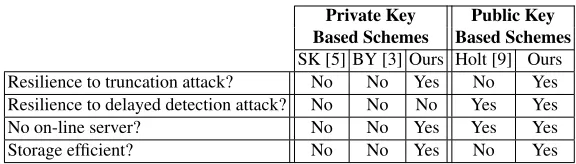
We evaluate our secure logging scheme by comparing it with the existing schemes. We compare our private verifiable scheme with two existing private-key-based schemes: Schneier-Kelsey [5] and Bellare-Yee [3]. We also compare our public-verifiable scheme with Holt’s scheme [9]. Our comparison is based on four factors: 1) resilience to trun-cation attacks; 2) resilience to delayed detection attacks; 3) on-line server requirements; 4) storage efficiency. The comparison results are summarized in Table 7.
Table 1.Comparisons of Various Schemes.
Private Key Public Key Based Schemes Based Schemes SK [5] BY [3] Ours Holt [9] Ours Resilience to truncation attack? No No Yes No Yes Resilience to delayed detection attack? No No No Yes Yes No on-line server? No No Yes Yes Yes Storage efficient? No No Yes No Yes
Compared with Schneier-Kelsey and Bellare-Yee, our private scheme is resilient to truncation attacks, more storage-efficient and requires no on-line server. However, it is still vulnerable to delayed detection attacks. Compared with Holt’s scheme, our public scheme is resilient to truncation attacks and more storage-efficient.
8 Implementation
We investigated the viability of our proposed schemes on a Intel dual-core 1.73GHz Laptop with 1GB RAM running Linux. We used the NTL library [18] and the PBC library [19] as the underlying cryptographic libraries.
Software repository
checker access control
Audit trail U
V
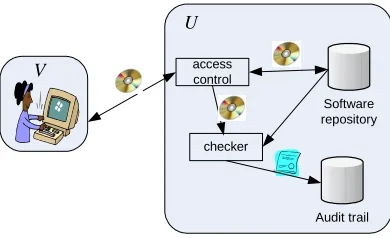
Fig. 2.Secure Version Control System.
any changes between the new and old versions and then creates a log entry record-ing the modification into a log file. Our schemes are incorporated into the server-side component in order to provide accountable verification of the audit trail.
In the implementation of our private-verifiable scheme, there is no separate physical T component to whichU transmits its closed log file. Instead, a logicalT, periodically validates the audit trail directly onU.T does not hold a copy of the audit trail.
We prototyped all the three FssAgg signature schemes to provide heuristics for choosing among them in practice. For the BM-F ssAgg and AR-F ssAgg schemes, we selected security parametersk= 1024andl= 160. For the BLS-F ssAggscheme, we used a singular curveY2 = X3+X defined on a fieldFq for|q| = 512and the
group order|p| = 160, wherepis a Solinas prime. Such a group has the fastest pair-ing operations [19]. We measured signer’s computation cost by signature generation and key update on a per-log-entry basis. We measured verifier’s computation cost over an aggregate signatureσ1,twhent = 100,1,000and10,000which corresponds to a small, medium, and large log file, respectively. Experimental results shown in Table 8 show that the BM-F ssAggscheme is the most efficient one in terms of computation (for both signer and verifier). Its signature generation is approximately 2 times faster than that of the AR-F ssAggand5.5times faster than that of the BLS-F ssAgg. Its signature verification is 4 times faster than that of the AR-F ssAggand16times faster than that of the BLS-F ssAgg. However, it incurs the most storage overhead.
We also investigated storage overhead incurred by each scheme. LetIa denote the amount of storage needed to to store the secret key and the aggregate signature - the overhead incurred by authentication. Let|S|denote the size of a signature or a key. Let Idenote the number of log entries and|L|denote the average size of a log entry. We measure storage efficiency byIa∗|S|
Table 2.Comparisons of FssAgg Signature Schemes. (Operation Timing inmsecs.)
BLS-F ssAggBM-F ssAggAR-F ssAgg
Signer Computation CostAsig 30 2.09 4.39 (per log entry) U pd 0.002 3.46 7.27
total 30.00 5.55 11.66
Signer Storage Cost
t= 100 2% 162% 3%
t= 1000 0.2% 16.2% 0.3%
t= 10000 0.02% 1.62% 0.03%
Verifier Cost
t= 100 3.30×10³ 211.97 810.88 t= 1000 29.3×10³ 2.13×10³ 8.16×10³ t= 10000 330.72×10³ 21.35×10³ 80.84×10³
9 Related Work
10 Conclusion
In this paper, we identified some issues in current secure logging techniques. We then proposed two concrete schemes to provideforward-secure stream integrityfor logs gen-erated on untrusted machines. Our approach supports forward security and compact ag-gregation of authentication tags (MACs or signatures). Both of our proposed schemes offer practical secure logging without reliance on trusted third parties or secure hard-ware. Our schemes are based on the recent proposed FssAgg authentication schemes where a unique authentication tag is used to protect the integrity of underlying message body. We then considered the notion of immutability that is needed to facilitate faster verification of individual log entries. We evaluated the performance of our schemes and report on experience with a prototype implementation within a public domain version-ing control system.
Although the security of proposed schemes rests entirely on previously proposed techniques (i.e., [11,12] and [17]), we need to construct separate security proofs for each scheme. Furthermore, we have to conduct extensive experiments, and perhaps trace-driven simulations, to better understand the performance of our schemes. Finally, we intend to investigate alternative signature schemes that might be used for constructing more efficient public-verifiable techniques.
References
1. Swanson, M., Guttman, B.: Generally accepted principles and practices for securing infor-mation technology systems. In: NIST 800-14. (1996)
2. Bellare, M., Yee, B.: Forward integrity for secure audit logs. In: Technical Report, Computer Science and Engineering Department, University of San Diego. (November 1997)
3. Bellare, M., Yee, B.: Forward-security in private-key cryptography. In: Proc. of CT-RSA’03. (2003)
4. U.S. Department of Defense, C.S.C.: Trusted computer system evaluation criteria (December 1985)
5. Schneier, B., Kelsey, J.: Cryptographic support for secure logs on untrusted machines. Pro-ceedings of the 7th USENIX Security Symposium (Jan. 1998)
6. Bellare, M., Palacio, A.: Protecting against key exposure: strongly key-insulated encryption with optimal threshold. In: Cryptology ePrint Archive, Report 2002/64. (2002)
7. Dodis, Y., Katz, J., Xu, S., Yung, M.: Key-insulated public key cryptosystems. In: Euro-crypt’02. (May 2002) 65–82
8. Dodis, Y., Katz, J., Xu, S., Yung, M.: Strong key-insulated public key cryptosystems. In: Public Key Cryptography (PKC 2003). (April 2003) 130–144
9. Holt, J.E.: Logcrypt: forward security and public verification for secure audit logs. In: ACSW Frontiers ’06: Proceedings of the 2006 Australasian workshops on Grid computing and e-research, Darlinghurst, Australia, Australian Computer Society, Inc. (2006) 203–211 10. Halperin, D., Kohno, T., Heydt-Benjamin, T., Fu, K., Maisel, W.: Security and privacy for
implantable medical devices.7(1) (January 2008)
11. Ma, D., Tsudik, G.: Forward-secure sequentical aggregate authentication. In: Proceedings of IEEE Symposium on Security and Privacy 2007. (May 2007)
13. Burns, R., Gentry, C., Lynn, B., Shacham, H.: Verifiable audit trails for a versioning file system. In: StorageSS’05. (Nov 2005) 416–432
14. Symantec: Symantec deepsight threat management system technology brief https://tms.symantec.com/.
15. : The dshield project. http://www.dshield.org
16. Mykletun, E., Narasimha, M., Tsudik, G.: Authentication and integrity in outsourced databases. In: NDSS 2004. (February 2004)
17. Mykletun, E., Narasimha, M., Tsudik, G.: Signature bouquets: immutability for aggrea-gated/codensed signatures. In: ESORICS’04. (2004) 160–176
18. Shoup, V.: Ntl: a library for doing number theory. http://www.shoup.net/ntl/ 19. : Pbc library benchmarks. http://crypto.stanford.edu/pbc/times.html 20. : Opencm project. http://www.opencm.org
21. Berliner, B.: Cvs ii: parallelizing software development. In: Proc. of the USENIX Winter 1990 Technical Conference. (1990) 341–351
22. Schneier, B., Kelsey, J.: Secure audit logs to support computer forensics. ACM Transactions on Information and System Security (1999) 159–176
23. Kelsey, J., Schneier, B.: Minimizing bandwidth for remote access to cryptographically pro-tected audit logs. In: Recent Advances in Intrusion Detection (RAID99). (Sep. 1999) 24. Chong, C., Peng, Z., Hartel, P.: Secure audit logging with tamper resistant hardware. In:
Technical report TR-CTIT-02-29, Centre for Telematics and Information Technology, Univ. Twente, The Netherlands. (August 2002)