Available online: http://edupediapublications.org/journals/index.php/IJR/ P a g e | 695
Distribution of Employees according to the Job specialization and
its impact on Work Performance
SAJID RASHID HASHIM AL-BATTAT
MBA
University College Of Commerce And Business Management
Osmania University, India
Abstract
Job specialization, also known as the division of labor, occurs when workers learn how to perform specific tasks very well rather than focusing on doing many different tasks. Job specialization is one of the key facets of the modern capitalist economy and offers a range of potential advantages for workers and the companies
that employ them. Specialization is
rewarded later in officers’ careers because of the skills they acquire by specializing. Earlier in their careers, skills are less important; it appears that specialization benefits officers because it is a signal of general ability. These results contradict studies that find that specialization helps early in careers but fades with experience, but they also call into question the idea that specialization always reflects accumulated skill. Our results support both types of theories but suggest important scope conditions for when one mechanism or the other is likely to dominate. In past
management systems of traditional
industries, job rotation was adopted to address employees' feelings of monotony, boredom and fatigue as a result of job simplification and specialization. However, with the advancement of technology,
shortening of technical life cycles and
changes in job characteristics, the
relationship between job rotation, job specialization and job burnout is now different from in the past. Therefore, this paper seeks to examine the impact of job specialization on the worker's interest and reduce boredom.
Keywords: Job specialization, organization, performance, work and training.
Introduction
The evolvement of jobs in the past was not planned. The practice was for the supervisor or foreman to assign workers to tasks and to randomly group tasks into jobs. For example, like carpentry, iron bending, electrical work, etc the content of each trade evolved through tradition and by initiation.
However, psychological literature on
employee motivation contains claims that the design of work, its content, and structure, affect both productivity and employee motivation and morale. There have therefore been many approaches and theories to the design of works.
Available online: http://edupediapublications.org/journals/index.php/IJR/ P a g e | 696
needs in the work environment while doing little about the nature of the work itself. However, with the increasing recognition of the complexity of human motivation, many
modern theorists have argued that
specialized and simplified work, leads to
monotony, boredom and general
dissatisfaction, which as a consequence, manifest themselves in various forms of undesirable work behavior in terms of absenteeism, lateness and frequent job changes. The application of these theories to the design of work has produced a number of measures concerned with altering the content of work and its organization, thus reversing the job specialization trend by adding more varied tasks and broader responsibilities (Hepworth 1982).
Division of labour has been
described as a process whereby a single operation is split or divided into many parts
and different individuals or groups
concentrate on the performance of each part, in such a manner that the entire operation is completed much more quickly, efficiently and conveniently than if one person alone had performed the whole operation from beginning to end (Abifarin, 2008). Division of labour occurs in a library and information center where separate processes like acquisition, processing, organizing, and dissemination are undertaken by separate workers in each case. More so, a division of labour can be undertaken by individuals in an organization as indicated earlier on; it can be undertaken by several firms in an industry. This concept which is now universally accepted as an indispensable part of everyday life was first stressed by a classical economist and the father of
economic thought, Adam Smith, in his “Inquiry into the nature and causes of the wealth of nations”, published in 1776. He illustrated this theory with the example of pin-making and from this illustration, the principle gained universal recognition and acceptability. The theory is said to be a derivative of three basic features of life namely,
No individual and no nation is self-sufficient enough to produce the good and services necessary to satisfy its wants;
Individuals and nations are unequally endowed by nature with skills, talents, natural resources and climate;
The presence of an exchange system gives room for individuals and nations to specialize in the production of those things which they can produce more cheaply, efficiently and conveniently than others.
Job specialization
The purpose of job specialization is to split up the process of work into individual tasks that are necessary for the organization or business and that cannot be handled by one person. Definition of job specialization, in other words, it is actually a division of labour wherein it is realized that by giving more emphasis on the scope of activities, productivity increases. Hence, once the recruitment process is initiated everyone would be looking out for the positions advertised which indicates the specialization they are experts in.
Available online: http://edupediapublications.org/journals/index.php/IJR/ P a g e | 697
different category of work in individual production unit to be done by the workers. Besides, if the job gets complicated then it needs to be broken down into the simpler process so that each task can be handled by people expert in that work.
The method of job specialization involves breaking down a task to its lowest level and designing jobs around each part. This creates a specialization, expertise, and improved quality. Job specialization design in the workplace is frequently seen where a worker focuses on one specific task and ability during the entire work shift. The task frequently repeats all day long. Because of job specialization allows significant expertise build-up in a specific task, the learning and speed of production happen faster. The job does not involve complex processes, so it can be taught faster to new workers. In theory, this approach reduces
quality control costs and improves
production efficiency (Thibodaux, 2012).
The downside of job specialization tends to be that people can only do one task. They aren’t trained to multitask or handle multiple areas of a workplace. As a result, when a critical expertise is lost, the process can suffer. Additionally, workers under job specialization don’t have a wide array of applicable skills, so it becomes hard for them to adapt to a new function or need in the organization. As a result, unemployment is a significant problem when a company has to shut down a factory or assembly line. Many of the laid-off workers usually have a hard time adjusting to new occupations.
Specialization refers to individuals and organizations focusing on the limited range of production tasks they perform best. This specialization requires workers to give up performing other tasks at which they are not as skilled, leaving those jobs to others who are better suited for them. An assembly line, where individual workers perform specific tasks in the production process, is the best example of specialization.
Specialization is related to another management concept, a division of labour, discussed at great length by Adam Smith, the 18th-century Scottish economist and author of "The Wealth of Nations." Smith famously illustrated the benefits of specialization and a division of labour when describing a pin factory, in which each worker performs a single specialized task. One worker measures wire, another cuts it, one point to it, others make the head and so on. Through this the process, workers produced thousands of more pins than if
each worker made whole pins
independently. Specialization, as illustrated by Adam Smith's example of the pin factory, allows workers to develop more skill in their specific tasks. Specialization increases output because workers do not lose time shifting among different tasks. Smith also believed that workers with specialties were more likely to innovate, to create tools or machinery to make their task seven more efficient.
Available online: http://edupediapublications.org/journals/index.php/IJR/ P a g e | 698
from the sale of those goods to buy needed goods produced by other workers and companies. While Adam Smith saw the advantages of specialization and division of labour, he also saw a downside to them as well. He feared that monotonous assembly lines in which workers performed single tasks throughout the day could sap their creativity and spirit. He saw education as a remedy and believed that education fostered creativity and innovation in workers. Karl Marx seized on Smith's concerns. He saw monotonous production tasks, coupled with subsistence wages that do not represent the full value of labour, as factors that increase worker alienation, eventually resulting in a worker-led uprising against the capitalist class.
The division of labour according to Niederhoffer (2011) is the separation of a job up into parts usually performed by different individuals. The division of labour is so common in our society, and so much good comes from it, that we often take its benefits for granted and forget about the harms from not following it. It seems good to gain perspective by starting with some scholarly work from the field so that basic principles can be considered. He observed that the first division of labor in society came from the separation of work between men and women, where men did work that required larger frames and more strength. If the woman were to do the childbearing, and men to do the heavy hunting, then it also became less frictional for women to handle household chores like cooking, while men made the tools for hunting.
Job specialization is the degree to which the overall task of the organization is broken down into smaller component parts. It evolved from the concept of division of
labour. There are four benefits of
pecialization: workers will become
proficient at their task because it is small and simple, transfer time between tasks may decrease, the more narrowly defined the job is, the easier it is to develop specialized equipment to assist with the job and training costs should be relatively low. Conversely, the main problem with specialization is that workers can become bored and dissatisfied. This can lead to higher absenteeism and lower quality of work. It is also possible to overspecialize.
Literature Review
Durkheim (2009) points out that people specialize in different occupations in a society, and this tends to bind them all together, as they depend on each other, but at the same time creates a sense of helplessness, or anomie, because no one person is responsible for the whole job. That is the reason that, often, the division of labor is not carried as far as it should be. However, Fowler (2012) concluded that most traders lose. And the reason is that people with abilities in one field feel that their success is transferable from their own field to trading. In his words:
They come to Wall Street and do not realize it is a world of its own, with its own
mechanisms for survival, and
Available online: http://edupediapublications.org/journals/index.php/IJR/ P a g e | 699
down from first class positions to
subordinate posts is an everyday occurrence in New York. In almost every case, these reverses result from outside trading and meddling with matters foreign to one's legitimate business.
He further emphasized that the attempt of a given person to move from one field of specialization to another should be considered also as a major source of disaster. There are too many specialized rules involved, too many abilities needed to change willy-nilly without a lengthy training period, careful study, and practice trading on a very small scale. The feeling that one can transfer skills from one field to another is closely related to hubris, a lack of humility in realizing the importance of specialization and individual differences.
According to Thibodeaux (2012), all companies initially have to decide upon an overall organizational structure - that is, they have to decide how many jobs they will have and what the exact responsibilities of each job will be. This means using job specialization, which is just one of the
processes, human resources use to
categorize employees. Job specialization, also called work specialization or division of labour is the process of separating all the activities necessary for the business or the organization into individual tasks. As part of this process, management, working with the human resources department, takes each task and assigns them to specific people / positions. The job descriptions human resources provide when they advertise open positions and hire new employees reflects job specialization. Job specialization
becomes more necessary the larger an organization is. Organizations turn to job specialization any time activities are so complex that the business cannot rely on other employees to do a co-worker's job.
When an organization uses job specialization, every worker is an expert to some degree. Employees are able to refine the task for which they are responsible, resulting in increased efficiency and
increased production. Because each
employee concentrates on just a portion of all activities, quality control costs also decrease in theory. All these factors mean a higher revenue and profit potential for the business. They also sometimes allow workers to take greater pride in their work, as their jobs require specific skills others may not be able to do. Even though job specialization creates experts, the experts cannot multitask. Specialization restricts them from filling in for someone who is gone. Subsequently, any organization’s activity connected to what the absent expert does may suffer. Additionally, specialized workers have a smaller skill set in some cases than non-specialized workers. With fewer skills, many employees find it harder to adapt and find other employment later.
Job specialization, also known as the division of labour, occurs when workers learn how to perform specific tasks very well rather than focusing on doing many different tasks. Job specialization is one of the key facets of the modern capitalist economy and offers a range of potential
advantages for workers and the
Available online: http://edupediapublications.org/journals/index.php/IJR/ P a g e | 700
job specialization are its potential to increase worker productivity and output. While productivity tends to benefit the employer of workers, specialization can also be advantageous to workers in that it may improve employment prospects. Workers with specialized skills are often more desirable than those with only general skills. Many jobs even require workers to have specific knowledge and skills just to be
considered. For instance, most of
the organizations dealing in a computer often require that workers are versed in a specific software language. This is one of the primary reasons education is important: It allows workers to learn specialized skills. Job security is another potential advantage that specialized workers are likely to enjoy. A worker with a specialized skill that no one else knows is difficult for a company to replace. An employee with a tech support company, who is the only one that knows how to recover data from crashed hard drives, is more valuable to the company than someone with no special job skills. If the company is forced to lay someone off, they will likely fire the person without the specialized skill.
Hamel (2008) observed that
although specialization can be
advantageous, workers are often expected to have certain general skills as well. A worker with specialized skills that do not have general skills might be at a disadvantage when searching for a job. For instance, an expert in real estate law might not be as desirable to employers as someone with less experience if he doesn't know how to use basic computer programs. According to London (2012), specialization allows every
person to be a professional in what he does. Specialization involves giving workers individual job roles to remove the responsibility for other jobs and reducing the worker's capacity to one task in particular. There are many advantages and disadvantages to specialization, which became commonplace during the industrial revolution with the creation of factories. Factory owners would not simply hire one worker who produces all the goods. The work is divided among many different workers and each employee becomes a cog in a large machine. Perhaps the biggest advantage of specialization, emphasized by Karl Marx, is an increase in efficiency as workers become more skilled in the specific jobs they do. Workers in a factory who is responsible for only one part of the process become as skilled as they possibly can in that process without the distraction of learning other skills.
Available online: http://edupediapublications.org/journals/index.php/IJR/ P a g e | 701
London (2012) also noted that specialization changed people's roles in society. In the past, people were involved in the whole process from the beginning to the end and they gained a sense of satisfaction from being useful to other people. With specialization, people rarely meet the end users of the products they produce and are merely selling their labour for a price as if it were a commodity. They become identical to other workers, job satisfaction decreases and a "just doing my job" work ethic reduces the quality of job performance.
Both advantages and disadvantages exist to employee specialization in the workplace. Rojas (2012) asserted that when employees specialize in specific tasks of production, they develop an expertise in the work performed. This development in expertise enhances efficiency and reduces the costs of production. Specialization also has some drawbacks. Due to the repetitive nature of the work performed, employees can be subject to boredom and burnout. Units of specialized workers also have a tendency to be insular and may refrain from collaborating with other units. The biggest benefit derived from job specialization is the expertise employees develop over time in their chosen task. As employees become better at their jobs, they perform more efficiently and produce products with fewer defects and higher quality. The increase in worker output results in a greater number of products available for sale to the consumer. If workers use technology in the production process, they may be able to develop expertise in several production tasks. As employees perform more efficiently, Rojas (2012) noted that the costs of production
decrease. Efficient production results in greater worker output in less time and at a
lower cost. These savings and
enhancements pass on to consumers in the form of lower priced, higher quality products. These goods will likely generate higher profits since production is operating at an optimum level. Since specialization involves the performance of repetitive production tasks, the work the employees perform may become boring.
Depending on the demands of the
production cycle on employees,
specialization can also lead to job burnout if the company overworks the employees for long periods. Both boredom and burnout can lead to job dissatisfaction and low employee morale. The use of multitasking can prevent this by increasing employee control over the work performed and the opportunity to learn new skills. Production settings with units of specialized employees can also cause each unit to turn inward and focus exclusively on its unit goals while losing sight of overall production goals. This lack of communication between units can hinder production goals and create problems in the production cycle and in the products produced. The use of technology can assist in creating more collaboration among units by facilitating the formation of work groups and breaking down the boundaries that can isolate production units.
In addition, a business may incur
Available online: http://edupediapublications.org/journals/index.php/IJR/ P a g e | 702
members have control over each worker’s duties.
Job satisfaction has been the most
frequently investigated variable in
organizational behaviour (Spector, 1997). It is an area of particular interest to organizational managers and those who work for them (Cranny, Smith, & Stone, 1992). In the academia, individuals such as directors, deans, and others involved in the administration and supervision of members
should be
concerned with the job satisfaction of employees. Organizations measure job
satisfaction because
of the relationship with the organizations’ short-term goals of increasing individual productivity, reducing absences, lethargy, and other related issues (Smith, 1992).The level of individuals’ job satisfaction can
lead to behaviours that affect the
functioning of the organization (Spector, 1997). Individuals with a greater sense of job satisfaction tend to be happier and have a greater sense of trust with management (Smith, 1992). Unfortunately, there is not one organization where all workers will be completely and consistently satisfied with all facets of job satisfaction (Judge, Hanisch & Drankoski, 1995). Therefore, it is imperative to continuously measure the level of job satisfaction among employees for managers to know what can and should change in the work the environment in order to improve employee job satisfaction (Cranny, et al 1992). Employees possessing a greater sense of job satisfaction are likely to have a better quality of life, greater physical and mental health, more job
stability, and exhibit greater cooperativeness with supervisors (Cranny, et al 1992).
Jaramillo (1996) defined a cross-functional team as a group of individuals from a variety of functions whose efforts are combined to achieve a common purpose; these teams may include professional and paraprofessional staff. In a study of job advertisements conducted by Lynch and Smith (2001), they noted a prevalence of jobs combining roles or skills, jobs integrating a multitude of library tasks, and this observation was validated by other researchers who indicated that “job sharing” was increasing.
Allen’s (2001) review of several articles in the business management literature revealed certain elements that are required for a cross-functional team to be successful. The article by Parker (2001) summed up these essentials well. They include clear and
problem-based team goals that are
integrated with departmental goals, the importance of communication, a team’s authority to make and implement decisions on its own, and a team leader who is knowledgeable, willing to change, and is skilled at facilitation and developing relationships. Parker also mentioned that the ideal number of team members is four to seven.
Available online: http://edupediapublications.org/journals/index.php/IJR/ P a g e | 703
mission including the team’s purpose,
problem or opportunity, outcomes,
resources, and roles. In addition, these desired outcomes had to be data-driven, as successful team decisions were based on
research and learning rather than
“groupthink.” As would be expected, there are several challenges to implementing a cross-functional team.
Parker (2001) states that the diversity inherent in cross-functional collaboration makes such teams susceptible to poor interpersonal relationships, conflict, and lack of trust and honesty, although he asserts that training, such as in conflict resolution, can help to overcome such obstacles. In addition, Athanasaw (2003) also noted that cross-functional teams provide for interpersonal and cross-cultural learning; as a result, employees can become comfortable in working with a diverse group of colleagues, as validated by a recent study in the public administration sector. This diversity can lead to a new culture that exemplifies the familiar adage: “the whole is greater than the sum of its parts.” In addition to these cultural benefits, there are other benefits of utilizing cross-functional teams by recognizing that such a structure can foster new opportunities to collaborate, contribute one’s own expertise, and discover “affinities” among functions not present in the traditional, functional organizational. Cross-functional integration and employee participation can also lead to a more flexible, agile organization.
Parker (2001) focused on the benefits related to problem-solving, creativity,
customer focus, and organizational
learning, as did Osif and Harwood (2000) in their review of this management technique through the writings of several authors in non-library management. Parker (2001) also asserts, for example, that the use of cross-functional teams improves an organization’s ability to solve complex problems, as these problems transcend traditional functions.
Commenting on the factors that hinder specialization, Abifarin (2008) noted that limitations to the concept of division of labour or specialization include the following:
The extent of the market, that is, the extent of effective demand for the commodity. A large output would be unnecessary where demand is relatively small. People and countries specialize because they discover that they can exchange their surplus products for the other products they need. The inability to of producers to sell their surplus and buy the other things they want in exchange
would definitely discourage
specialization;
Exchange and physical distribution
facilities e.g. transport and banking system becomes necessary if the product of the division of labour is to be exchanged effectively;
Available online: http://edupediapublications.org/journals/index.php/IJR/ P a g e | 704
processes and undertaken by different people;
Unique talent: This factor concerns such areas like creative arts where individual talents are important and such jobs cannot be mass-produced;
Another prominent factor is political and strategic considerations. The fear of political crisis or advent of wars would cut off supplies and countries would want to aim at relative self-sufficiency;
Finally, the level of technology may limit or hinder specialization.
Division of labour and job
specialization have been vested with such strengths as time-saving, this is possible since each worker concentrates on one process, and time is saved as there is no need to change tools; increased output because it gives room for specialization, increases technical knowledge and saves time; reduction in unit cost of output, increased output brings about a reduction of cost per unit and therefore lowers price. At a lower price, demand may increase, which again leads to increase in output and greater
skill, through repetition of the
same job, the workers develop greater skill, and that is, increased knowledge of the particular job is obtained as a result of constant practice. Other strengths of the division of labour and job specialization include less fatigue; a worker performs the same task as a routine and may not have to strain himself mentally or physically.
Specialization encourages to a large extent the invention of special tools and equipment in order to perform a particular functions more efficiently, doing the work expected of men were every man would do
everything himself, he would need all the tools required for the process, but with the division of labour, only the specialist in each process needs to have a set of tools. In
fact, specialization has certain
overwhelming advantages, these
notwithstanding, the concept is fraught with many dangers. The division of labour may be of less interest to workers where monotony resulting from repetitive tasks causes strain and fatigue. The workers’ initiative, inventiveness, and craftsmanship are checked. The interdependence of each service unit or section may lead to increased difficulties where there is no proper coordination. The more highly specialized labour requires greater skill and it is subjected to the risk of unemployment following changes in demand for the products or services, and industrial relations deteriorate as relations between employers and employees become impersonal.
The positive impact of job specialization
It is believed that the job
Available online: http://edupediapublications.org/journals/index.php/IJR/ P a g e | 705
the quantity of productivity and task
completion since each employee is
performing only a small part of the task and the fewer mistakes made when workers perform simple routine jobs. According to the research, the result from 304 valid samples of job specialization in the high-tech industry, in fact, raises professional efficacy and reduces employee's feeling of job burnout, which is opposed to the benefits of job design purposed in past management systems. (Hsieh, A & Chao H 2004) Performing a method of job simplification in the high-tech industry is more appropriate for employers to improve their psychological aspect, such as feeling if meaningfulness, feelings of responsibility and knowledge of result, as well as the positive outcomes from technical training can be improved, which will reduce employees job burnout. Thus, the benefits of using job specialization are considerable for the organization since it can improve the productivity and reduce the labor cost.
The negative impact of job specialization
Is job specialization an effective way to design a job? I believe this question has been discussed by many organizations. It is undeniable that the method of job
specialization also brought some
disadvantages to the organization;
especially the condition of the job design isn’t implementing perfectly. An assistant professor of management at Florida State University Stephen E Humphrey has stated that various efforts to increase efficiency by simplifying workers' job responsibilities may, in fact, be leading to lower employee job satisfaction and productivity over time. (Stephen, E 2007) According to the recent
study we have found that the job simplification may cause many problems on the employee's attitude and productivity.
Available online: http://edupediapublications.org/journals/index.php/IJR/ P a g e | 706
the job may also increase the cost of the company. Thus, organizations apply the simplification method of job design and independent completion of work will be discovered that the employees will be dissatisfied with their work and will perform at a lower level over time with the higher level of stress.
Uses of the job specialization in practice
Since many negative impacts may be caused by the organization, so, the organization has to take an action try to prevent and control those problems. Especially the high levels of managerial control and surveillance become necessary. The other key factors to design a work by job specialization are minimized the job skill requirement and time to perform the job. Since the employee may feel bored, less motivation and dissatisfied with their work environment, so what company needs to do is to offer them a flexibility job environment and give them a freedom to socialize each other in the organization and to improve the
interpersonal relations between the
colleagues. As well as the performance appraisals are necessary for the employee to give feedback on each other performance, which will improve and motivate them to work harder.
Research Questions
The following research questions were raised in this paper:
1. Does job specialization make work easier and faster?
2. Does specialization enhance the
worker's interest and reduce boredom?
3. Does job specialization advance
knowledge base among working
professionals?
Research Objectives
This paper sets out to achieve the following objectives:
1. To understand the concept of division of labour and job specialization.
2. To ascertain whether the division of labour and job specialization makes work easier and faster
3. To investigate the impact of job specialization on the worker's interest and reduce boredom.
4. To investigate if the division of labour
and job specialization result in
monotony.
Research Methodology
A descriptive research design was used in this study. A survey method was employed to elicit information from the respondents. A questionnaire was designed with 10 structured questions related to the job specialization. One hundred twenty
(120) copies of questionnaires were
distributed among the staff of XXXXX and one hundred (100) were returned. This
represents 90% of the distributed
questionnaires. The questionnaires were analyzed and used for the study. Percentage and simple average calculation were used to analyze the data collected and later presented in a tabular form.
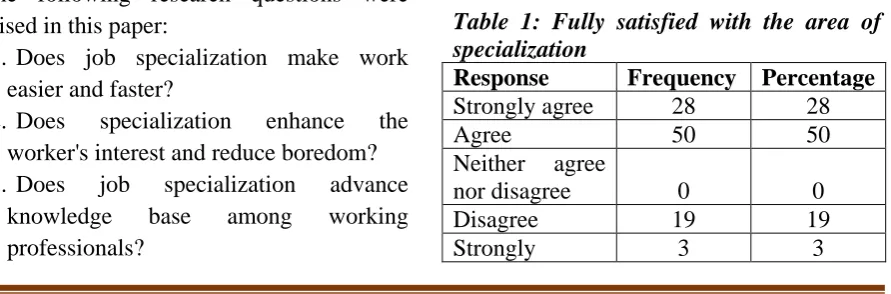
Table 1: Fully satisfied with the area of specialization
Response Frequency Percentage
Strongly agree 28 28
Agree 50 50
Neither agree
nor disagree 0 0
Disagree 19 19
Available online: http://edupediapublications.org/journals/index.php/IJR/ P a g e | 707
disagree
The Table 1 points out that out of 100 employees, 28 employees strongly agreed that they are fully satisfied with the area of specialization in which 50 employees agreed, 19 employees disagreed and 3 employees strongly disagreed with the area of specialization.
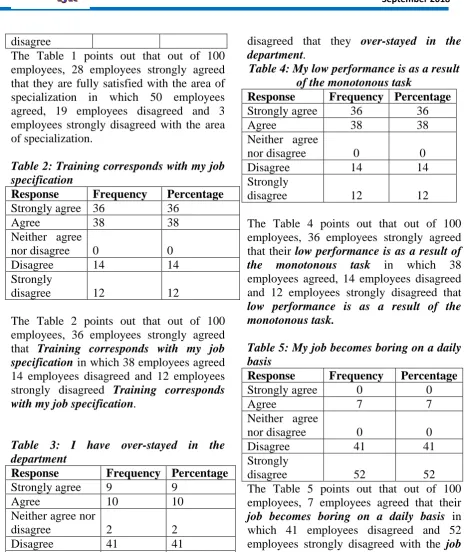
Table 2: Training corresponds with my job specification
Response Frequency Percentage
Strongly agree 36 36
Agree 38 38
Neither agree
nor disagree 0 0
Disagree 14 14
Strongly
disagree 12 12
The Table 2 points out that out of 100 employees, 36 employees strongly agreed that Training corresponds with my job specification in which 38 employees agreed 14 employees disagreed and 12 employees strongly disagreed Training corresponds with my job specification.
Table 3: I have over-stayed in the department
Response Frequency Percentage
Strongly agree 9 9
Agree 10 10
Neither agree nor
disagree 2 2
Disagree 41 41
Strongly disagree 38 38
The Table 3 points out that out of 100 employees, 9 employees strongly agreed that they over-stayed in the department in which 10 employees agreed, 2 employees neither agreed nor disagreed, 41 employees disagreed and 38 employees strongly
disagreed that they over-stayed in the department.
Table 4: My low performance is as a result of the monotonous task
Response Frequency Percentage
Strongly agree 36 36
Agree 38 38
Neither agree
nor disagree 0 0
Disagree 14 14
Strongly
disagree 12 12
The Table 4 points out that out of 100 employees, 36 employees strongly agreed that their low performance is as a result of the monotonous task in which 38 employees agreed, 14 employees disagreed and 12 employees strongly disagreed that
low performance is as a result of the monotonous task.
Table 5: My job becomes boring on a daily basis
Response Frequency Percentage
Strongly agree 0 0
Agree 7 7
Neither agree
nor disagree 0 0
Disagree 41 41
Strongly
disagree 52 52
The Table 5 points out that out of 100 employees, 7 employees agreed that their
job becomes boring on a daily basis in which 41 employees disagreed and 52 employees strongly disagreed with the job becomes boring on daily basis.
Table 6: I am fully trained to perform my present tasks
Response Frequency Percentage
Strongly agree 31 31
Agree 36 36
Neither agree
Available online: http://edupediapublications.org/journals/index.php/IJR/ P a g e | 708
Disagree 14 14
Strongly
disagree 10 10
The Table 6 points out that out of 100 employees, 31 employees strongly agreed that they are fully trained to perform the present tasks in which 36 employees agreed, 9 employees neither agreed nor disagreed, 14 employees disagreed and 10 employees strongly disagreed with the fully trained to perform the present tasks.
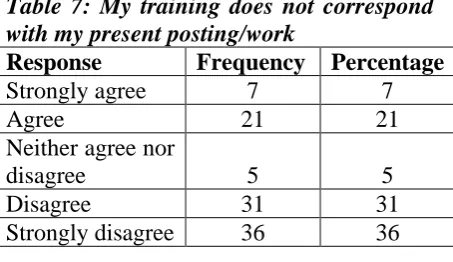
Table 7: My training does not correspond with my present posting/work
Response Frequency Percentage
Strongly agree 7 7
Agree 21 21
Neither agree nor
disagree 5 5
Disagree 31 31
Strongly disagree 36 36
The Table 7 points out that out of 100 employees, 7 employees strongly agreed that training does not correspond with the present posting in which 21 employees agreed, 5 employees neither agreed nor disagreed, 31 employees disagreed and 36 employees strongly disagreed with the
training does not correspond with the present posting/work.
Table 8: Job specialization makes my work easier
Response Frequency Percentage
Strongly agree 57 57
Agree 38 38
Neither agree
nor disagree 5 5
Disagree 0 0
Strongly
disagree 0 0
The Table 8 points out that out of 100 employees, 57 employees strongly agreed that Job specialization makes my work easier in which 38 employees agreed, and 5 employees neither agreed nor disagreed with the Job specialization.
Table 9: Job specialization makes my job performance better
Response Frequency Percentage
Strongly agree 60 60
Agree 35 35
Neither agree
nor disagree 5 5
Disagree 0 0
Strongly
disagree 0 0
The Table 9 points out that out of 100 employees, 60 employees strongly agreed that Job specialization makes my job performance better in which 35 employees agreed, and 5 employees neither agreed nor disagreed that Job specialization makes my job performance better.
Table 10: Job Specialization makes my job faster
Response Frequency Percentage
Strongly agree 38 38
Agree 43 43
Neither agree
nor disagree 7 7
Disagree 9 9
Strongly
disagree 3 3
The Table 10 points out that out of 100 employees, 38 employees strongly agreed that Job Specialization makes my job faster in which 43 employees agreed, 7 employees neither agreed nor disagreed, 9 employees disagreed and 3 employees strongly disagreed that Job Specialization makes the job faster.
Available online: http://edupediapublications.org/journals/index.php/IJR/ P a g e | 709
28 employees strongly agreed that
they are fully satisfied with the area of specialization in which 50 employees agreed, 19 employees disagreed and 3 employees strongly disagreed with the area of specialization.
36 employees strongly agreed that
Training corresponds with my job specification in which 38 employees agreed 14 employees disagreed and 12
employees strongly disagreed
Training corresponds with my job specification.
9 employees strongly agreed that they
over-stayed in the department in which 10 employees agreed, 2
employees neither agreed nor
disagreed, 41 employees disagreed and 38 employees strongly disagreed
that they over-stayed in the
department.
36 employees strongly agreed that
their low performance is as a result of the monotonous task in which 38 employees agreed, 14 employees disagreed and 12 employees strongly disagreed that low performance is as a result of the monotonous task.
7 employees agreed that their job becomes boring on a daily basis in which 41 employees disagreed and 52 employees strongly disagreed with the
job becomes boring on daily basis. 31 employees strongly agreed that they
are fully trained to perform the present tasks in which 36 employees agreed, 9
employees neither agreed nor
disagreed, 14 employees disagreed and 10 employees strongly disagreed with the fully trained to perform the present tasks.
7 employees strongly agreed that
training does not correspond with the present posting in which 21 employees agreed, 5 employees neither agreed nor disagreed, 31 employees disagreed and 36 employees strongly disagreed with the training does not correspond with the present posting/work.
57 employees strongly agreed that Job specialization makes my work easier in which 38 employees agreed, and 5 employees neither agreed nor disagreed with the Job specialization.
60 employees strongly agreed that Job
specialization makes my job
performance better in which 35 employees agreed, and 5 employees neither agreed nor disagreed that Job
specialization makes my job
performance better.
38 employees strongly agreed that Job Specialization makes my job faster in
which 43 employees agreed, 7
employees neither agreed nor
disagreed, 9 employees disagreed and 3 employees strongly disagreed that Job Specialization makes the job faster.
Conclusion
Based on the findings, this study concludes that majority of the employees of the sample were
Available online: http://edupediapublications.org/journals/index.php/IJR/ P a g e | 710
challenge. The application of job
characteristics model acts as a means of increasing the motivation levels in the company so that employees can work harder and become more proactive and productive. Through the adoption of the five dimensions of Job Characteristic Model (JCM) JCM, the organization is able to transform the job structure of the employee, which could present new and more challenging roles and responsibilities for the employees. Such would work towards alleviating boredom and job dissatisfaction.
References
Athanasaw, Y. (2003). “Team
Characteristics and Team Member
Knowledge, Skills, and Ability
Relationships to the Effectiveness of Cross-Functional Teams in the Public Sector,” IJPA. 4:3
Beer, M. The Technology of OD
(Dunnette Ed.) Handbook of Industrial
and Organizational Psychology,
Chicago, 1976.
Blum, F. A. towards a Democratic
Work Process, New York, Harper, 1953.
Cordery, L.J, Wall, D.T and Parker, K.S, 2001, ‘’Future work design research and practice towards an elaborate model of work design,’’
Journal of occupational and
organizational psychology, 74, 413-440.
Cranny, C. J., Smith, P. C., & Stone, E. F. (1992). Job satisfaction: How people feel about their jobs and how it affects
their performance. New York:
Lexington Books.
Dan Ondrack and Stuart Timperley. The
Humanisation of Work. Armstrong Publishing, London, 1982.
Davis, L. E. and Trist, E. L. Improving the quality of work life. Socio technical case studies. Cambridge, Mass. MIT Press, 1974.
Do Tien Long (2008). Foundations of Organizational Structure. Slideshare.net. Droussiotis, A. (2004).The profile of high performing employee in Cyprus. The Journal of Business in Developing Nations 8, 39-64.
Durkheim, D. E. (2009). The division of Labour and society. Encyclopædia Britannica.
Encyclopædia Britannica Online.
Retrieved 14-06-2013.
Ernest J. McCormick and Daniel R. ILeg Industrial Psychology. George Allen. UK.
Evans, M. The effects of supervisory behavior on the path-goal relationship – Organizational behavior and Human Performance, NS, 1970.
Glube, R. H. and Margerison, G. J. – Work satisfaction and motivation what influence do leaders have on these factors? JET, Vol. 5 (2) 1976
Griffin, R.W. and Moorhead, G. (2010). Organisational behaviour: Managing
people and
organisation.
Hackman and Oldham. Motivation
through design of work test of a theory. Behavioural and Human performance, 1976.
Hackman J. R. and Lawler, E. E.
Available online: http://edupediapublications.org/journals/index.php/IJR/ P a g e | 711
characteristics, Journal of applied psychology, Monograph, 1971
Hackman, J.R. On the coming demise of
job a enrichment. In Man and Work in Society, N.Y., Van Nastrand Rheinhald, 1975.
Hamel, G. (2008). The Advantages of Job Specialization. E-How Electronic Magazine.
Hanisch, K. (1992). The Job Description Index Revisited: Questions about the
Question Mark, Journal of Applied
Psychology 77 (3), 377-382.
Hellriegel, D., Slocum J. & Woodman R. (1998). Organizational Behavior, 8th ed., Cincinnati, Ohio: South-Western College Publishing.
Hepworth, A. The Humanisation of
Staurt Timperley L. Business School,
London, 1982.
Schapps, R. H. Twenty- two arguments against job enrichment – Personnel Journal, February 1974.
James McGrath and Bab Bates The Little Book of Big Management theories 2013. Judge, T. A., Hanisch, K. A. &
Drankoski, R. D. (1995). Human resource management and employee attitudes. Handbook of human resource management. Eds. G. R. Ferris, S D. Rosen, and D. T. Barnum. Cambridge, MA: Blackwell Publishers, 574-596. Lawler, E. E. Job Design and Employee
Motivation, Personnel Psychology, Vol. 22, 1969.
Lennick, D. (1995). American Express executive, quoted in Fortune, April 3, 92 Niederhoffer, V. (2012). Specialization
and the Division of Labour.
Ostroff, C. (1992). The Relationship between Satisfaction, Attitudes, and Performance: An Organizational Level Analysis, Journal of Applied Psychology 77 (6), 963-974.
Parker, M. (1994) “Cross-Functional
Collaboration”, Training &
Development: 50–51, 53.
Phipps, E. (2004). “The System Design
Approach to Organizational
Development: The University of Arizona Model,” Library Trends: 109.
Pugh, D. S. (ad.) Organisation Theory, Penguin Books, 1984
Robbins, S. P. (2003). Organizational Behavior, 10th ed., Upper Saddle River, New Jersey: Prentice-Hall, Inc.
Scroten, D. and Wolfson, .D. Job
enrichment. Surmounting the Obstacles. Personnel, 1972
Smith, P. C. (1992). In pursuit of happiness: Why study general job satisfaction. Job satisfaction: How people feel about their jobs and how it affects their performance. New York: Lexington Books. 5-19.
Spector, P. E. (1997). Job satisfaction: Application, assessment, causes, and consequences. Thousand Oaks, CA: Sage publication.
The Free Dictionary (2011). Division of Labor.
Thibodeaux (2012). What is job
specialization? E-How Electronic
Magazine. Williams, R.J. (1979). Free and Unequal: The Biological Basis of Individual Liberty. Liberty Press.
Weiss, G. (2002). The nature and causes of job satisfaction, In M. Dunnette, (ed.)
Available online: http://edupediapublications.org/journals/index.php/IJR/ P a g e | 712
Organizational Psychology, Rand