Computational Models of Event Type Classification in Context
Alessandra Zarcone
1,2Alessandro Lenci
11Universit`a di Pisa - Dipartimento di Linguistica “T. Bolelli”
Via S. Maria 36 - 56126 - Pisa, Italy
2Scuola Normale Superiore, Laboratorio di Linguistica
Piazza dei Cavalieri 7 - 56126 - Pisa, Italy
[email protected], [email protected]
Abstract
Verb lexical semantic properties are only one of the factors that contribute to the determination of the event type expressed by a sentence, which is instead the result of a complex interplay between the verb meaning and its linguistic context. We report on two computational models for the automatic identification of event type in Italian. Both models use linguistically-motivated features extracted from Italian corpora. The main goal of our experiments is to evaluate the contribution of different types of linguistic indicators to identify the event type of a sentence, as well as to model various cases of context-driven event type shift. In the first model, event type identification has been modelled as a supervised classification task, performed with Maximum Entropy classifiers. In the second model, Self-Organizing Maps have been used to define and identify event types in an unsupervised way. The interaction of various contextual factors in determining the event type expressed by a sentence makes event type identification a highly challenging task. Computational models can help us to shed new light on the real structure of event type classes as well as to gain a better understanding of context-driven semantic shifts.
1.
Introduction
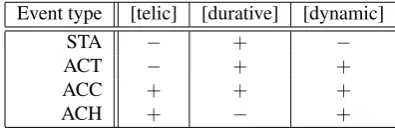
The event type(aka Aktionsart) expressed by a predicate is a crucial component of the sentence temporal constitu-tion. By event type we refer here to the standard Vendler’s classification of predicates intostate(STA),activity(ACT), accomplishment(ACC) andachievement(ACH) (Vendler, 1967). These four categories are further cross-classified with respect to the dimensions of telicity and durativ-ity. Accomplishment and achievement predicates aretelic, while states and activities are atelic. On the other hand, states, activities and accomplishments are durative, and achievements arenon durative(see table 1).
Event type [telic] [durative] [dynamic]
STA − + −
ACT − + +
ACC + + +
ACH + − +
Table 1: The features of Vendler’s event types
Semantic literature reports well-known linguistic diagnos-tics, typically used to classify the event type of a predicate (Dowty, 1979; Bertinetto, 1986; Pustejovsky, 1995; Roth-stein, 2004).
Although the event type is often referred to as “lexical as-pect”, the semantic features of the verb are only one of the factors contributing to determine the event type expressed by a sentence, which is instead the result of a complex in-terplay between the verb meaning and its linguistic con-text. Actually, various contextual factors (such as argu-ments, their definiteness, their animacy, temporal adver-bials, verb’s morphology, etc.) canshiftthe verb event type to a new class.
Consider the following examples:
1. (a) John has been reading for the whole day(atelic, durative)
(b) John has read “The Great Gatsby” in an hour (telic, durative)
(c) John has been reading papers for the whole day (atelic, durative)
2. (a) John has been pushing the chart(atelic, durative)
(b) John has pushed the chart to the checkout line (telic, durative)
3. (a) The train arrived at 5 o’clock(telic, non durative)
(b) Europeans had been arriving sporadically, some-times with long intervals between arrivals(atelic, durative)
4. (a) The path goes from the street into the forest (state)
(b) The cat is going to the door(dynamic)
5. (a) John has hung the picture on the wall(telic, dy-namic)
(b) The picture hangs on the wall(state)
Verbs OCCURR. STA ACT ACC ACH
28 3129 583 430 822 1294
Table 2: The composition of the corpus for the supervised model
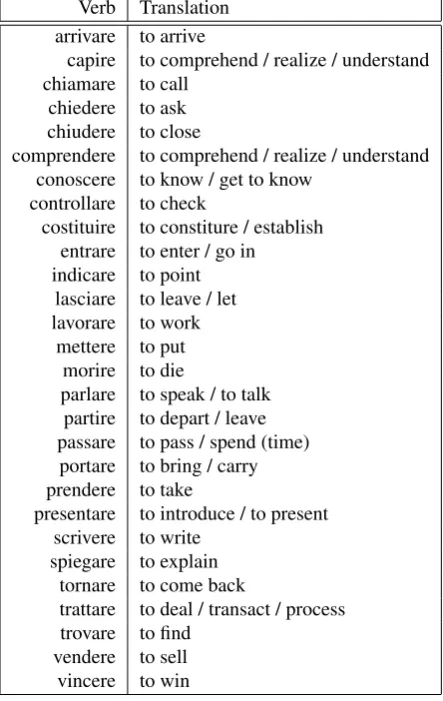
Verb Translation
arrivare to arrive
capire to comprehend / realize / understand chiamare to call
chiedere to ask chiudere to close
comprendere to comprehend / realize / understand conoscere to know / get to know
controllare to check
costituire to constiture / establish entrare to enter / go in
indicare to point lasciare to leave / let lavorare to work
mettere to put morire to die
parlare to speak / to talk partire to depart / leave passare to pass / spend (time)
portare to bring / carry prendere to take
presentare to introduce / to present scrivere to write
spiegare to explain tornare to come back
trattare to deal / transact / process trovare to find
vendere to sell vincere to win
Table 3: The verbs in the corpus for the supervised model
can be turned into a durative event by a plural subject (3b). Other factors possibly affecting the sentence event type are the subject’s animacy or the verb’s morphology (4a vs. 4b, 5a vs. 5b).
Verbs like those shown in the examples, are usually referred to as actionally polysemousor hybrid (Bertinetto, 1986), because they can exhibit different event type values in dif-ferent contexts. Context-drivenevent type shifts raise the question of how the sentence event type can be recognized, and how the contribution of different aspects of the linguis-tic context to its identification can be properly modelled. Moreover, contextual features do not act as necessary and sufficient conditions in determining a certain event type. In fact, for each event type class it is impossible to define a set of linguistic contextual elements univocally associated with it.
2.
Goal of the paper
Though event types lie at the centre of a long tradition of re-search in formal semantics, their computational modelling
has received little attention. Notable exceptions are Siegel and McKeown (2000) and Palmer et al. (2007). However, Siegel and McKeown (2000) do not deal with the problem of context-driven event type shifts. They rather use differ-ent types of machine learning methods to recognize what they call “the fundamental aspectual category”. Moreover, they only train binary classifiers to distinguish states from events, and culminated (telic) from non culminated (atelic) clauses. On the other hand, Palmer et al. (2007) do not specifically focus their automatic classification experiments on Aktionsart, and are instead more concerned with a wider notion of “situation type”, encompassing also speech-act types, abstract entities (e.g. facts, propositions), generics, etc.
In this paper, we report on two computational models for the automatic identification of event type in Italian. We assume that the event type expressed by a clause is deter-mined by the complex interaction among different features, such as the verb’s arguments, their definiteness, tense-aspectual morphology, adverbials, etc. Our models use linguistically-motivated features extracted from Italian cor-pora to evaluate the neat contribution of different types of linguistic indicators to the event type identification task, as well as to model various cases of context-driven event type shift.
Section 3. reports on the first model, that formalizes event type identification as a supervised classification task performed with Maximum Entropy classifiers (MaxEnt; Berger et al. (1996)). Section 4. reports on the second model, which uses Self-Organizing Maps (SOMs; Koho-nen (1997)) to define and identify event types in an unsu-pervised way.
3.
The supervised model (MaxEnt)
3.1. Training dataNo corpora annotated with event type information were available for Italian. Therefore, 3129 occurrences of 28 Italian verb predicates from the Italian Syntactic-Semantic Treebank Montemagni et al. (2003) were manually anno-tated by one of the authors with their event type. We used 4 classes:state,process,achievementandaccomplishment. Table 2 shows the distributions of the verb occurrences in the training set with respect to the four event types. It is worth remarking that the class assigned to each verb token corresponds to its contextually determined event type. In fact, event type assignment was decided on the ground of the whole set of linguistic features available at the sentence level. Therefore, the same verb type may be associated with different event types in the training corpus.
Since Italian verb predicates can vary with respect to their degree of hybridism, the corpus was further divided accord-ing to the verb predicates ambiguity.
the verbs whose most frequent event type covers less than 60% of their tokens;
70% group - it includes the verbs of the previous group, plus those verbs whose most frequent event type cov-ers less than 70% of their tokens;
80% group - it includes the verbs of the previous group, plus those verbs whose most frequent event type cov-ers less than 80% of their tokens;
90% group - it includes the verbs of the previous group, plus those verbs whose most frequent event type cov-ers less than 90% of their tokens.
3.2. The MaxEnt model
In the first model, event type classification has been per-formed with Maximum Entropy classifiers (Berger et al., 1996), trained on a corpus annotated with the proper event type of the predicate. Given a linguistic contextc, and a categorya ∈ Adependent onc, the conditional probabil-ityp(a|c)is found assuming that the distributions of a set of relevant featuresfi(a, c)ofcare the only probabilistic constraints involved (whose distributions are learned from the training corpus). It can be proved that the only prob-ability distributionpthat is coherent with this assumption is the one with the maximum entropy, that is (Berger et al., 1996):
p(a|c) = 1 Zc
k
Y
i=1
aifi(a,c)
wherefi(a, c)are values ofkfeatures of(a, c),a1...akare the features weights andZcis a normalization factor. In the training phase, feature weights were estimated by using the GIS (Generalized Iterative Scaling) algorithm, in its AMIS software implementation (Miyao, 2002). During the test phase, for each new contextcthe model combines the estimated weights to computep(a|c)for everya∈ A. The category a, given the contextc, is the one with the highest probability (argmax(p(a|c))).
Experiments were carried out with a 10-fold cross-validation method applied both on the whole corpus and on each of the polysemy grous defined above. As evaluation measures we used:
• accuracy, i.e. the percentage of correctly classified verbs occurrences. The baseline for the whole corpus and for each polysemy group was calculated by as-signing to every verb its most frequent event type in the corpus (group).
• precision(P) andrecall(R) for each event type, which were then combined into thef-measure(2P R/P+R).
3.3. Feature selection
Both models use linguistically-motivated features extracted from Italian corpora. These features, which are very well-known in the linguistic literature for being (positively or negatively) correlated with particular event types (Dowty, 1979; Bertinetto, 1986; Pustejovsky, 1995; Rothstein, 2004), include:
adverbial features - in the literature they are among the main “event type” diagnostics, but they are not very frequent in corpora data. They include various types of adverbials as:
• temporal adverbs (“in X time”, “for X time”, etc.);
• intentional adverbs (“deliberately”, “intention-ally”, etc.);
• frequency adverbs (“rarely”, “often”, etc.);
• iterative adverbs (“X times”);
morphological features - although actionality and aspect are independent categories, it is possible to observe typical correlations between some event types and spe-cific aspectual values (Comrie, 1976). This set of fea-tures includes verb morphological tense-aspectual val-ues, such as:
• present tense;
• imperfect tense;
• future tense;
• simple past;
• perfect tenses;
• progressive periphrasis;
syntactic and argument structure features - they in-clude verb morphosyntactic, syntactic and semantic features of verb arguments, which are typically held responsible for event type shifts (see examples 1a-5b in section 1):
• absence of arguments besides the subject;
• presence of direct object;
• presence of indirect object;
• presence of a locative argument;
• presence of a complement sentence;
• passive diatesis;
• subject and direct object, number, animacy and definiteness.
All the features were extracted from the corpus in a semi-automatic way.
3.4. The experiments
3.4.1. Experiment 1: complete feature set
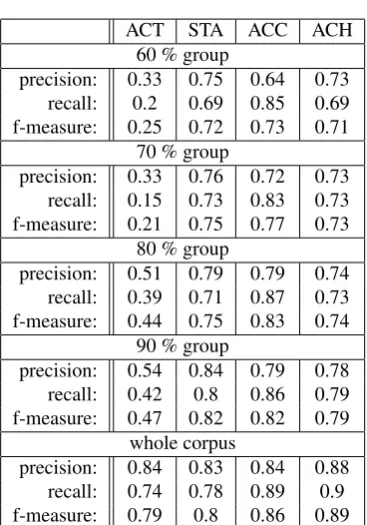
The first model was built by using the whole set of features. See the results in table 4 and 5. The model is able to outper-form the baseline, showing that contextual features play an important role in event type classification and can therefore be interpreted as statistic cues to guide this task.
A deeper analysis of the system mistakes has revealed that they mostly concern cases in which the verb either appears in a non-finite clause (i.e. infinitive, participle and gerund structures) or is used with an idiomatic sense. Consider the following examples from our corpus:
• Umberto Eco ha potuto divertirsi a prendere un po’ tuttiper il bavero.
Umberto Eco has been able to pull everybody’s sleeve.
• Questa `e una fetta di Croazia dove fino a ieri sera noi non potevamo neppuremettere piede.
This is a part of Croatia where up to yesterday evening we weren’t even allowed to set foot in.
Sentences like these represent very hard cases for our model, because their event type meaning is completely id-iosyncratic.
Baseline Exp 1
60 % group 56.1% 69.3% 70 % group 60% 72.8% 80 % group 64.6% 75.5% 90 % group 69.6% 78.4% Whole corpus 79.8% 85.4%
Table 4: model accuracy
ACT STA ACC ACH
60 % group
precision: 0.33 0.75 0.64 0.73 recall: 0.2 0.69 0.85 0.69 f-measure: 0.25 0.72 0.73 0.71
70 % group
precision: 0.33 0.76 0.72 0.73 recall: 0.15 0.73 0.83 0.73 f-measure: 0.21 0.75 0.77 0.73
80 % group
precision: 0.51 0.79 0.79 0.74 recall: 0.39 0.71 0.87 0.73 f-measure: 0.44 0.75 0.83 0.74
90 % group
precision: 0.54 0.84 0.79 0.78 recall: 0.42 0.8 0.86 0.79 f-measure: 0.47 0.82 0.82 0.79
whole corpus
precision: 0.84 0.83 0.84 0.88 recall: 0.74 0.78 0.89 0.9 f-measure: 0.79 0.8 0.86 0.89
Table 5: Precision and recall results from experiment 1
ACT STA ACC ACH
adverbial features
precision: 0.49 0.35 0.29 0.66 recall: 0.05 0.1 0 0.14 f-measure: 0.09 0.15 0 0.24
morphological features
precision: 0.36 0.38 0.15 0.53 recall: 0.08 0.62 0 0.49 f-measure: 0.13 0.47 0 0.51 syntactic and argument structure features precision: 0.89 0.79 0.78 0.86
recall: 0.66 0.7 0.92 0.88 f-measure: 0.76 0.75 0.84 0.87
whole set of features
precision: 0.84 0.83 0.84 0.88 recall: 0.74 0.78 0.89 0.9 f-measure: 0.79 0.8 0.86 0.89
Table 6: Precision and recall results from experiment 2
3.4.2. Experiment 2: feature subsets
The aim of the second battery of experiments is to show the contribution to event type classification offered by feature subsets corresponding to specific types of linguistic infor-mation (e.g. morphology, temporal adverbs, etc.). Preci-sion and recall values are reported in table 6.
Adverbial features are very good in providing high-precision event type classifications (they are particularly useful to identify activities and accomplishments), but re-call values are low because those features are very sparse. In fact, they appear just in 16% of the sentences in the training corpus. Morphological features are much more fre-quent, but less precise. They mostly help to identify states and achievements. Conversely, the distinction between ac-tivities and accomplishments improves only when syntactic features are added to the model, significantly raising preci-sion and recall values.
Note that the highest precision and recall values are never-theless those obtained in experiment 1, in which we used the complete feature set was used. This proves that no spe-cific type or level of linguistic information is singularly able to determine the event type of a sentence, but it is rather the complex interaction of different linguistic cluses that can achieve the optimal level of event type discrimination.
3.4.3. Experiment 3: 2-way classifications
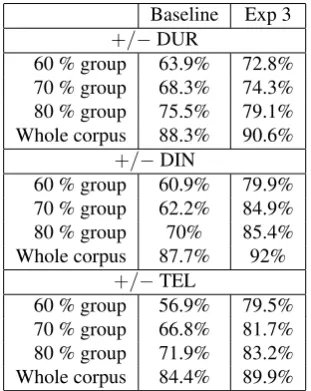
In experiment 3 we built 3 different models, and we trained each of them to perform a 2-way classification. Instead of using the 4 categories we had been using so far, we used the distinctive features in table 1: the first model was trained to distinguishdurativeevent types fromnon-durativeones, the second one to distinguish dynamic event types from non-dynamic ones, and the third one to distinguish telic event types fromnon-telicones. This experiment was per-formed with the model trained with the complete feature set.
baseline in every polysemy group and in the whole cor-pus as well. It is worth observing that MaxEnt more easily distinguish between dynamic and non-dynamic events, and then between telic and non-telic ones. Conversely, durativ-ity appears to be the hardest feature to discriminate.
Baseline Exp 3
+/−DUR
60 % group 63.9% 72.8% 70 % group 68.3% 74.3% 80 % group 75.5% 79.1% Whole corpus 88.3% 90.6%
+/−DIN
60 % group 60.9% 79.9% 70 % group 62.2% 84.9% 80 % group 70% 85.4% Whole corpus 87.7% 92%
+/−TEL
60 % group 56.9% 79.5% 70 % group 66.8% 81.7% 80 % group 71.9% 83.2% Whole corpus 84.4% 89.9%
Table 7: model accuracy in 2-way classification
3.5. Establishing an upper-bound for event type identification
One could argue how an upper-bound for the performance of our systems can be defined. Actually, event type iden-tification seems to be a highly challenging task even for humans.
In order to investigate this issue, we randomly selected 100 sentences from the annotated corpus, containing verbs from the 70% polysemy group. Three subjects were asked to tag each sentence by choosing only one class out of the four event types used in the MaxEnt experiments. All tag-gers were trained linguists, with a long experience with ac-tionality. There was no temporal limit for the annotation. Table 8 reports the accuracy of the three annotators (T1, T2, T3) – together with the score achieved by the MaxEnt model – calculated with respect to the gold standard rep-resented by the annotated corpus we introduced in Section 3.1.. Not only is the human accuracy well below 100%, but that it is also totally comparable with the MaxEnt model performances. These results show the inherent complexity of event type identification, especially when applied to real corpus data, which are far from being as clear-cut as the standard examples typically reported in the literature.
Accuracy
T1 73%
T2 44%
T3 67%
MaxEnt 76%
Table 8: Results of the human tagging experiment
4.
The unsupervised model (SOM)
4.1. Data for the unsupervised modelA sample of 40 Italian verbs have been selected for their high degree of prototipicality with respect to the four event types in table 1 (10 verbs for each category). Following the approach in Lagus and Airola (2005), every verb has been represented as a distributional vector, recording its co-occurrence frequency with a certain number of context features. Consistently with the “distributional hypothesis” (Harris, 1968), we assume that two verbs have similar Ak-tionsart values if they have similar context feature distri-butions. 28 features correspond to those selected for the MaxEnt model, because of their high correlation with event types. We added 40 extra features to encode the lexical en-try of each verb. Thus, the verb vectors are orthogonal with respect to the 40 extra features.
Feature frequency was estimated from “La Repubblica” (Baroni et al., 2004), a large corpus of Italian newspaper texts of about 450 million tokens. The corpus was automat-ically PoS tagged, lemmatized and shallow-parsed. Vectors were weighted using the following global weight function (Dumais, 1990), so that features more uniformly distributed among the verbs have a smaller weight:
wf= 1−
X
v
pf vlog2(pf v)
log2(#totv)
pf v=p(v|f) =
#fv
#f
where#totvis the number of vectors andpf vis the prob-ability to observe a given vector v and a given feature f
together. All the vectors have been weighted and then nor-malized before every experiment.
4.2. The SOM model
Self-Organizing Maps (SOM; Kohonen (1997)) are a par-ticular kind of unsupervised neural network, used to project
n-dimensional vectors into a 2-dimensional space (map) preserving the topological properties of the input space. Their tipical architecture is composed of a honeycomb net-work ofnnodes. Every node represents ak-dimensional vector (wherek > n), and the input nodes are randomly inizialized. When the map receives an input vector, it ac-tivates in parallel all its nodes: node activation is propor-tional to its similarity with the input vector. The node with the highest activation (best matching unit) is selected, and its vector – together with the ones of the units close to it – is modified to become more similar to the input vector.
4.3. The experiments
4.3.1. Experiment 4: building a SOM for event type The SOM we trained with the first 40 verbs was a honey-comb map of 100 nodes and it was developed using the software Matlab 7.3.0 with the SOM package. The map is shown in figure 1.
Verb Translation ascoltare to listen aggiustare to fix
amare to love appartenere to belong
aprire to open arrivare to arrive
cadere to fall camminare to walk
cantare to sing credere to believe cucinare to cook dimostrare to prove
disegnare to draw dormire to sleep
elaborare to compute / work out lavorare to work
leggere to read lottare to struggle mancare to miss
morire to die navigare to sail
parlare to speak / talk partire to depart / leave piangere to cry
possedere to own preparare to prepare
pulire to clean raggiungere to reach risiedere to reside risolvere to solve
ritenere to deem / reckon / retain rompere to break
sapere to know scoprire to find out
scrivere to write
sembrare to appear / look / seem temere to fear
tracciare to draw / trace vendere to sell
vincere to win
Table 9: The verbs in the corpus for the unsupervised model
mainly because it often depends on the pragmatic context rather than on overt linguistic clues.
4.3.2. Experiment 5: an IR-like model
In order to go beyond the qualitative evaluation of the SOM built in Experiment 4, we have tried to evaluate our unsu-pervised model for event type classification in analogy with the vector space model in Information Retrieval.
In the training phase, the SOM has been trained with the 40 verbs of Experiment 4. Recall that those 40 vectors describe the behaviour of 40 verbs in all the context they have been found. Then, the SOM has been used to model context-driven event type shifts. Test items are very sparse vector representing verbs specific context types. In each vector there is a small number of active dimensions,
cor-Figure 1: Experiment 4: the SOM
responding to the linguistic features available in a certain context. When specific context features shift the event type value of a verb to a new class (e.g. by turning an activ-ity into an accomplishment), we expect this verb to change its position in the “Aktionsart semantic space”, getting near to the cluster of verbs belonging to the new class. There-fore, every vector in the test set has been used as a sort of “query vector” and given in input to the verb semantic map to identify the verb cluster in the SOM corresponding to the best-matching unit activated by the query vector. If the best-matching unit for the query vector was labelled in the training phase, the answer for the query vector was the cate-gory of that label. Otherwise we have selected the catecate-gory of the nearest labelled unit.
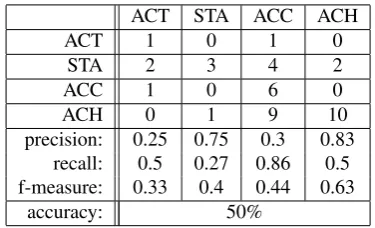
This experiment was carried out with a test set of 40 new contexts, which were weighted with the same feature weighting scheme we used with the training set. Results are shown in table 9. Not surprisingly, a large part of the mistakes is found in discriminating between the two telic categories (ACC and ACC).
ACT STA ACC ACH
ACT 1 0 1 0
STA 2 3 4 2
ACC 1 0 6 0
ACH 0 1 9 10
precision: 0.25 0.75 0.3 0.83 recall: 0.5 0.27 0.86 0.5 f-measure: 0.33 0.4 0.44 0.63
accuracy: 50%
Table 10: Precision and recall results from experiment 5, with 4 categories
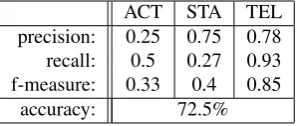
telic events (TEL), results (table 10) show a significative improvement.
ACT STA TEL precision: 0.25 0.75 0.78 recall: 0.5 0.27 0.93 f-measure: 0.33 0.4 0.85
accuracy: 72.5%
Table 11: Precision and recall results from experiment 5, with 3 categories
5.
Conclusions
Event type represents a key element of verb semantics. The interaction of various contextual factors in determining the event type expressed by a sentence makes event type iden-tification a highly challenging task.
We have reported on two different models of event type classification, that have shown how both supervised and un-supervised approaches can account for the contribution of contextual features in identifying the sentence event type. Moreover, a human tagging experiment has shown how the task of event type identification is not trivial even for hu-mans. This makes the performance achieved by the models reported above even more significant, if compared with hu-man tagging accuracy.
Computational models can help us to shed new light on the real structure of event type classes as well as to gain a better understanding of context-driven semantic shifts. Stochas-tic algorithms appear to be a new and interesting way to model event types in a dynamic way, because they are able to grasp the complex interaction of contextual features by representing them as probabilistic cues to determine event types.
6.
References
M. Baroni, S. Bernardini, F. Comastri, L. Piccioni, A. Volpi, G. Aston, and M. Mazzoleni. 2004. Introduc-ing the la repubblica corpus: a large, annotated, tei(xml)-compliant corpus of newspaper italian. In F. Ferreira R. Costa R. Silva M. Lino, M. Xavier, editor,Proceedings of LREC 2004, pages 1771–1774, Lisbona. ELDA. A. Berger, S. Della Pietra, and V. Della Pietra. 1996. A
maximum entropy approach to natural language process-ing.Computational Linguistics, 22(1):39–71.
P. M. Bertinetto. 1986. Tempo, Aspetto e Azione nel verbo italiano. Il sistema dell’indicativo. Accademia della Cr-usca, Firenze.
B. Comrie. 1976. Aspect: An Introduction to Verbal Aspect and Related Problems. Cambridge University Press. D. Dowty. 1979. Word meaning and Montague Grammar.
The semantics of verbs and times in generative semantics and in Montague’s PTQ. Reidel, Dordrecht.
S. T. Dumais. 1990. Enhancing performance in latent se-mantic indexing. TM-ARH 017527, Bellcore.
Z. S. Harris. 1968. Mathematical Structures of Language. Wiley, New York.
T. Kohonen. 1997. Self-organizing Maps. Springer, New York.
K. Lagus and A. Airola. 2005. Semantic clustering of verbs - analysis of morphosyntactic contexts using the som algorithm. In A. Lenci, S. Montemagni, and V. Pir-relli, editors, Acquisition and Representation of Word Meaning: Theoretical and computational perspectives, Linguistica Computazionale XXII-XXIII. IEPI, Pisa-Roma.
Y. Miyao. 2002. Maximum entropy estimation for feature forests. InProceedings of HLT2002.
S. Montemagni, F. Barsotti, M. Battista, N. Calzolari, O. Corazzari, A. Lenci, A. Zampolli, F. Fanciulli, M. Massetani, R. Raffaelli, R. Basili, M. T. Pazienza, D. Saracino, F. Zanzotto, N. Mana, F. Pianesi, and R. Delmonte. 2003. Building the italian syntactic-semantic treebank. In A. Abeill´e, editor, Treebanks. Building and Using Parsed Corpora, pages 189–210. Kluwer, Dortrecht.
A. Palmer, E. Ponvert, J. Baldridge, and C. Smith. 2007. A sequencing model for situation entity classification. In Proceedings of the 45th Annual Meeting of the As-sociation of Computational Linguistics, pages 896–903, Prague.
J. Pustejovsky. 1995. The Generative Lexicon. MIT Press, Cambridge MA.
S. Rothstein. 2004. Structuring Events - A Study in the Se-mantics of Lexical Aspect. Blackwell Publishing. R. Siegel and K. R. McKeown. 2000. Learning methods
to combine linguistic indicators: improving aspectual classification and revealing linguistic insights. Compu-tational Linguistics, 26(4):595–628.