Definition extraction using a sequential combination of baseline grammars
and machine learning classifiers
Łukasz Degórski
1, Michał Marci ´nczuk
3, Adam Przepiórkowski
1,21Institute of Computer Science, Polish Academy of Sciences, Warsaw 2Institute of Informatics, University of Warsaw
3Institute of Applied Informatics, Wrocław University of Technology
[email protected], [email protected], [email protected]
Abstract
The paper deals with the task of definition extraction from a small and noisy corpus of instructive texts. Three approaches are presented: Partial Parsing, Machine Learning and a sequential combination of both. We show that applying ML methods with the support of a trivial grammar gives results better than a relatively complicated partial grammar, and much better than pure ML approach.
1.
Introduction
The aim of this paper is to contrast two approaches to the task of extracting definitions from relatively un-structured instructive texts (textbooks, learning materials in eLearning, etc.) in a morphologically rich, relatively free word order, determinerless language (Polish). The task is a part of a larger EU project, Language Technology for eLearning (LT4eL;http://www.lt4el.eu/), focus-ing on facilitatfocus-ing the construction and retrieval of learnfocus-ing objects (LOs) in eLearning with the help of language tech-nology; the results of definition extraction are presented to the author or the maintainer of a LO as candidates for the glossary of this LO. Since it is easier to reject wrong definition candidates than to go back to the text and search for missed definitions manually, recall is more important than precision in the evaluation of the results.
Previous work (Przepiórkowski et al., 2007a; Przepiórkowski et al., 2007b) approached this task via the manual construction of partial (or shallow) gram-mars finding fragments of definition sentences. In this paper we attempt to quantify the extent to which the same task may be accomplished with the automatically trained machine learning classifiers, without the need to construct sophisticated manual grammars.
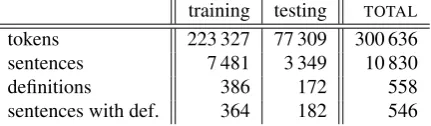
For the experiments described below, a corpus of instruc-tive texts of over 300K tokens (with over 550 definitions) was automatically annotated morphosyntactically and then manually annotated for definitions. The corpus was split into two main parts: a training corpus (combined of what Przepiórkowski et al. (2007b) call a training corpus and a held-out corpus) and a testing corpus. The quantitative characteristics of these corpora is given in Table 1.
training testing TOTAL
tokens 223 327 77 309 300 636 sentences 7 481 3 349 10 830 definitions 386 172 558 sentences with def. 364 182 546
Table 1: Corpora used in the experiments
2.
Partial Parsing Experiments
Partial parsing experiments are most fully described in (Przepiórkowski et al., 2007b). Since the input texts were XML-encoded1, the XML-aware efficientlxtransduce
tool (Tobin, 2005) was used for the implementation of the grammar. The grammar, essentially a cascade of regular grammars, was developed within about 10 work-ing days in over 100 iterations, where in each iteration the grammar was improved and the results were evalu-ated (on portions of the training corpus only) both quan-titatively (automatically) and qualitatively (manually). The final grammar, called PG2 (partial grammar), contains 13 top level rules (with 48 rules in total, in a 16K file, 12.5 lines for a rule, on the average).
For the evaluation, three baseline grammars were con-structed: from the trivial B1 grammar, which marks all sen-tences as definition sensen-tences, through B2, which marks as definitory all sentences containing a possible Polish cop-ula (jest,s ˛a,to), the abbreviationtj.‘i.e.’, or the wordczyli ‘that is’, ‘namely’, to B3, a very permissive grammar mark-ing as definitions all sentences containmark-ing any of the 27 very simple patterns (in most cases, single-token keywords) manually identified on the basis of manually annotated def-initions (these patterns include all patterns in B2, as well as various definitor verbs, apparent acronym specifications, the equal sign ‘=’, etc.).
For all grammars, a sentence was classified as a definition sentence if the grammar found a match in this sentence (not necessarily spanning the whole sentence).
All grammars were applied to the testing corpus, unseen during the development of the grammars; the results are given in Table 2. Apart from precision (P) and recall (R), also the usual F-measure is given (F1), as well as F2used
by Przepiórkowski et al. (2007a) and F5(apparently) used
by Saggion (2004).3 Note that for the task at hand, where
1More precisely, the input adheres to the XML Corpus
Encod-ing Standard (Ide et al., 2000).
2This is the GR’ grammar of Przepiórkowski et al. (2007b)
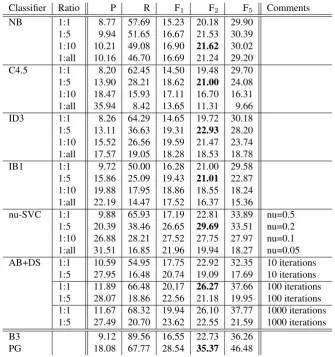
mea-Classifier Ratio P R F1 F2 F5 Comments
NB 1:1 8.77 57.69 15.23 20.18 29.90 1:5 9.94 51.65 16.67 21.53 30.39 1:10 10.21 49.08 16.90 21.62 30.02 1:all 10.16 46.70 16.69 21.24 29.20 C4.5 1:1 8.20 62.45 14.50 19.48 29.70 1:5 13.90 28.21 18.62 21.00 24.08 1:10 18.47 15.93 17.11 16.70 16.31 1:all 35.94 8.42 13.65 11.31 9.66 ID3 1:1 8.26 64.29 14.65 19.72 30.18 1:5 13.11 36.63 19.31 22.93 28.20 1:10 15.52 26.56 19.59 21.47 23.74 1:all 17.57 19.05 18.28 18.53 18.78 IB1 1:1 9.72 50.00 16.28 21.00 29.58 1:5 15.86 25.09 19.43 21.01 22.87 1:10 19.88 17.95 18.86 18.55 18.24 1:all 22.19 14.47 17.52 16.37 15.36
nu-SVC 1:1 9.88 65.93 17.19 22.81 33.89 nu=0.5 1:5 20.39 38.46 26.65 29.69 33.51 nu=0.2 1:10 26.88 28.21 27.52 27.75 27.97 nu=0.1 1:all 31.51 16.85 21.96 19.94 18.27 nu=0.05 AB+DS 1:1 10.59 54.95 17.75 22.92 32.35 10 iterations
1:5 27.95 16.48 20.74 19.09 17.69 10 iterations 1:1 11.89 66.48 20.17 26.27 37.66 100 iterations 1:5 28.07 18.86 22.56 21.18 19.95 100 iterations 1:1 11.67 68.32 19.94 26.10 37.77 1000 iterations 1:5 27.49 20.70 23.62 22.55 21.59 1000 iterations
B3 9.12 89.56 16.55 22.73 36.26 PG 18.08 67.77 28.54 35.37 46.48
Table 4: Performance of the classifiers for different ratio of positive to negative examples evaluated using 10-fold cross-validation on the whole corpus with balanced random split, and evaluation of the grammars on the same (whole) corpus for comparison
marked as non-definitions, and only sentences accepted by B3 are passed to the ML stage, where their status is deter-mined.
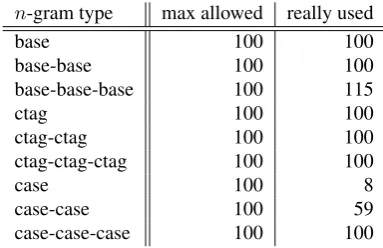
In these experiments the classifiers were trained on the training corpus and evaluated on the testing corpus. It effectively takes almost 10 times less time than cross-validation on the whole corpus, so an augmented set of features could be used. Apart from 1, 2 and 3-grams of single features, mixed combinations of attributes were added — see Table 5 for details.
4.1. Single classifiers
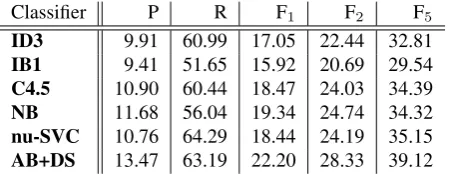
As the grammar in the preliminary stage takes some care of precision, classifier configurations with high re-call turned out to be optimal, as they are complementary to the grammar. Thus, for all types of classifiers, the 1:1 subsampling ratio ensured the best results. The evaluation on the testing corpus for single classifiers with subsampling 1:1 is presented in Table 6.
Note that the best of these results, especially, B3 com-bined with the AdaBoost classifier, approach the results of the grammar PG, but still do not exceed them in terms of F2.
n-gram type max allowed really taken
base 400 404
base-base 100 100
base-base-base 100 101
ctag 100 106
ctag-ctag 100 100
ctag-ctag-ctag 100 100
case 100 8
case-case 100 59
case-case-case 100 101
base-case 100 100
case-base 100 100
base-ctag 100 100
ctag-base-ctag 50 50
ctag-base-base-ctag 50 50
case-base-case 50 50
Table 5: Feature set used in filtering experiments
4.2. Ensembles of classifiers
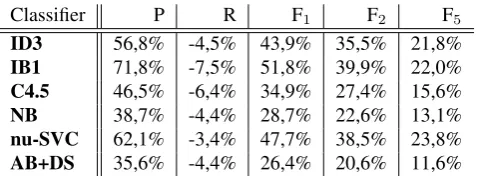
Classifier P R F1 F2 F5
ID3 56,8% -4,5% 43,9% 35,5% 21,8%
IB1 71,8% -7,5% 51,8% 39,9% 22,0%
C4.5 46,5% -6,4% 34,9% 27,4% 15,6%
NB 38,7% -4,4% 28,7% 22,6% 13,1%
nu-SVC 62,1% -3,4% 47,7% 38,5% 23,8%
AB+DS 35,6% -4,4% 26,4% 20,6% 11,6%
Table 9: Relative gain of applying B3 before the classifiers (for single classifiers, 1:1 subsampling ratio)
significantly better than — the results of the application of manually constructed partial grammars, and much higher than the results of ML classifiers alone. Two corollaries of this result are: 1) even if only a small amount of noisy training data is available, the application of automatic ma-chine learning methods may exceed pure grammar-based approaches, 2) but the clear improvement is observed only when such ML algorithms are supported by some — rela-tively trivial —a priorilinguistic knowledge.
6.
References
Yasser EL-Manzalawy and Vasant Honavar, 2005. WLSVM: Integrating LibSVM into Weka Environment.
http://www.cs.iastate.edu/~yasser/ wlsvm.
Nancy Ide, Patrice Bonhomme, and Laurent Romary. 2000. XCES: An XML-based standard for linguistic corpora. InProceedings of the Third International Conference on Language Resources and Evaluation, LREC 2000, pages 825–830, Athens. ELRA.
Adam Przepiórkowski, Łukasz Degórski, Miroslav Spousta, Kiril Simov, Petya Osenova, Lothar Lemnitzer, Vladislav Kuboˇn, and Beata Wójtowicz. 2007a. To-wards the automatic extraction of definitions in Slavic. In Jakub Piskorski, Bruno Pouliquen, Ralf Steinberger, and Hristo Tanev, editors,Proceedings of the Workshop on Balto-Slavonic Natural Language Processing at ACL 2007, pages 43–50, Prague.
Adam Przepiórkowski, Łukasz Degórski, and Beata Wój-towicz. 2007b. On the evaluation of Polish definition extraction grammars. In Zygmunt Vetulani, editor, Pro-ceedings of the 3rd Language & Technology Conference, pages 473–477, Pozna´n, Poland.
Horacio Saggion. 2004. Identifying definitions in text col-lections for question answering. In Proceedings of the Fourth International Conference on Language Resources and Evaluation, LREC 2004, Lisbon. ELRA.
Richard Tobin, 2005. Lxtransduce, a replace-ment for fsgmatch. University of Edinburgh.
http://www.cogsci.ed.ac.uk/~richard/
ltxml2/lxtransduce-manual.html.
Ian H. Witten and Eibe Frank. 2005. Data Mining: Prac-tical machine learning tools and techniques. Morgan Kaufmann, San Francisco, 2nd edition. http://www.