A Unified Database of Dependency Treebanks.
Integrating, Quantifying & Evaluating Dependency Data.
Olga Pustylnikov, Alexander Mehler, R ¨udiger Gleim
University of Bielefeld
Universit¨atsstrasse 25, D-33615 Bielefeld, Germany [email protected] [email protected] [email protected]
Abstract
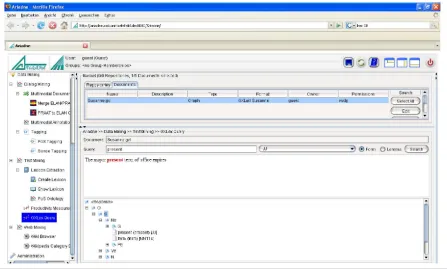
This paper describes a database of 11 dependency treebanks which were unified by means of a two-dimensional graph format. The format was evaluated with respect to storage-complexity on the one hand, and efficiency of data access on the other hand. An example of how the treebanks can be integrated within a unique interface is given by means of the DTDB interface.
1. Introduction
In this paper we present a database of dependency tree-banks which covers 11 languages (see Table 1). The treebanks differ with respect to the underlying depen-dency grammar (making, for example, different assump-tions about candidate vertices and their relaassump-tions). They also differ with respect to the annotation format in use. We transformed all 11 treebanks into a single annotation for-mat using an XML-based graph representation language (see Section 2.) in order to abstract from the latter diver-gence. This format provides interoperability on the level of annotation of dependency data. It makes the treebanks ac-cessible to various tools in the field of syntactic analysis by means of a unique interface.
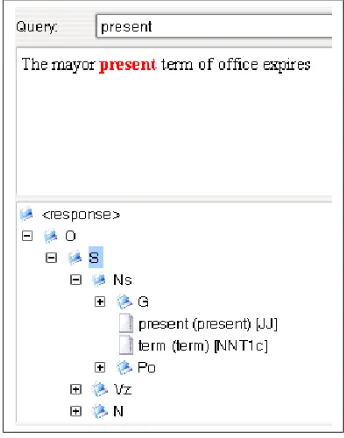
In order to provide database functionality within this frame-work we made the data accessible by an XML database calledDependency Treebank DataBase(DTDB) (see Sec-tion 2.4.). The DTDB is based on the HyGraphDB (Gleim et al., 2007) which provides a data definition and data mani-pulation language to store, retrieve and manipulate depen-dency tree data. To the best of our knowledge, the DTDB is the largest resource of this kind in the field of syntactic analysis. It is of interest for all researchers developing and evaluating dependency treebanks. Further, we describe a data definition language for mapping newly provided de-pendency treebanks onto our representation format and for integrating them into the DTDB.
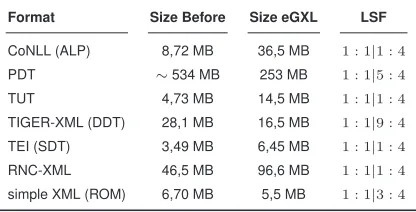
The paper is organized as follows: Section 2. gives an overview of the DTDB and introduces its data model used to model dependency treebanks. Subsections 2.1. and 2.2. describe the treebanks and the format used for the unifi-cation. Subsection 2.3. presents the evaluation of the for-mat with respect to the initial forfor-mats used to annotate the treebanks. Subsections 2.4. and 2.5. describe the database functionality of the DTDB with an emphasis on querying and data definition. Section 3. summarizes the results.
2. The Dependency Treebank Data Base
The lack of collaboration between the projects developing treebanks (Kakkonen (2005)) caused the establishment of a variety of co-existing annotation formats (e.g., the Penn Treebank (Marcus et al., 1993), TUT (Bosco et al., 2000b),
NEGRA (Skut et al., 1998), CoNNL-X (Sang and Buch-holz, 2000) or SUSANNE (Sampson, 1995)). Some effort in unification of annotations was done e.g. by Pustejovsky et al. (2005) for four English treebanks or by Buchholz (2006) for treebanks of different languages. Pustejovsky et al. (2005) show that the unification of formats even for the same language within the same linguistic field can be a hard task.
2.1. Treebanks
In our case, we deal not only with treebanks of different languages; the dependency grammar used for annotation is also slightly different. We can see that from Table 1, where the divergence of grammars is exemplified by means of the role of punctuation. Italian, Romanian and Russian do not consider punctuation marks as nuclei of dependency trees, whereas the other eight languages do. Obviously, unifica-tion of treebanks is more than a simple mapping from one notation of a grammatical relation onto an other. It requires an understanding of what the grammatical relation means for the particular language. However, some parts of the grammar can be appropriate to the one language but have a different or no meaning in an other language. The conse-quence from the above considerations should be to reana-lyze the treebanks in the following way:
1. to identify grammatical relations shared by the tree-banks and to identify those whose meanings diverge among grammars (or languages)
2. to define the unified grammar based on relations in-duced in step 1.
3. to re-annotate the treebanks by means of the new cu-mulative grammar.
Treebank Language Punctuation included Reference Format used
Alpino Treebank v. 1.2 Dutch yes van der Beek et al. (2002) CoNLL Danish Dependency Treebank v. 1.0 Danish yes Kromann (2003) TIGER-XML Sample of sentences of the http://www.phobos.ro/
Dependency Grammar Annotator Romanian no roric/DGA/dga.html simple XML Russian National Corpus Russian no Boguslavsky et al. (2002) RNC-XML A sample of the Slovene
Dependency Treebank v. 0.4 Slovene yes Dˇzeroski et al. (2006) TEI Talkbanken05 v. 1.1 Swedish yes Nivre et al. (2006) TIGER-XML Turin University Treebank v. 0.1 Italian no Bosco et al. (2000a) TUT format CESS - Catalan Dependency Treebank Catalan yes Civit et al. (2004) CoNLL Cast3LB - Spanish Dependency Treebank Spanish yes Civit and Mart´ı (2005) CoNLL Prague Dependency Treebank 2.0 Czech yes Hajiˇc (1998) PDT BulTreeBank Bulgarian yes Osenova and Simov (2004) CoNLL
Table 1: The Treebank Database. General Properties.
general make sense since languages and grammars used to describe a language are initially different.
In this paper we give up the idea of unifying treebanks on the level1of linguistic theory. Instead, we develop a format, which is general enough to cover the diversity of particular languages and grammars.
2.2. eGXL - Towards a unified format for Treebank Representation
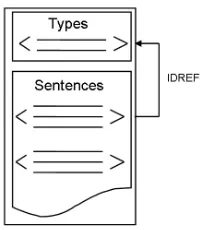
In order to find a unique representation for treebanks, we focus on a “least common denominator” all treebanks share - namely the dependency (tree) structure and make it the core structure of the new representation. Since trees are but a special case of (directed) graphs, we choose the graph modelGXL2as a base of unification. That means, treebank elements (words) are represented as nodes (or vertices) and dependency relations as edges (or arcs) in the graph theoret-ical sense. But how to account for the variation among tree-banks concerning e.g. different types of node attributes? This is done by means of the‘Types’graph separating, so to speak, thesecondary (e.g. morphological, parts-of-spreech) information from thecore(i.g. dependency / con-stituent phrase) structure. This results in a two dimensional data model which we calleGXL(extended GXL) consist-ing of a‘Types’graph and a‘Sentences’graph (see Figure 1).
Each instance of the secondary information, e.g. a POS (parts-of-speech) attribute, is given a unique identifier in the‘Types’graph. These attributes are listed only once in the head part of the document and accessed further on viaIDREFattributes (i.g. references to the corresponding
id) from the‘Sentences’graph. The‘Sentences’
graph expresses the dependency structure of a sentence by means of node (=words) and rel (=dependency re-lations) elements (see Figure 2 for an overview). Thus, the
1See (Pustylnikov and Mehler, 2008) for an overview of levels along whose treebanks can be compared.
2Graph eXchange Language (Holt et al. (2006)) which has
been recently used to deal with different types of corpora: Mehler and Gleim (2005), Mehler et al. (2007), Ferrer i Cancho et al. (2007), Pustylnikov and Mehler (2008).
Figure 1: The two-dimensional model ofeGXL.
‘Sentences’part preserves its structure among differ-ent treebanks whereas the‘Types’graph can vary allow-ing the integration of specific corpus details. This repre-sentation3 circumvents the need to unify all particular fea-tures of treebanks, however it allows to treat the treebanks as parts of a whole sharing a single structure.
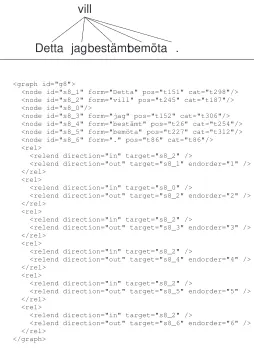
Figure 2: The basic structure ofeGXL.
The basic structure of eGXL is visualized in Figure 2. Square objeckts represent eGXL elements, down-arcs
il-3See http://ariadne.coli.uni-bielefeld.de/
wikis/treebankwiki/ for a detailed documentation on
Buchholz, S. (2006). CoNLL-X shared task on multilingual de-pendency parsing. InProc. of the 10th Conference on Compu-tational Natural Language Learning, page 149164.
Civit, M., i, N. B., and Valverde, P. (2004). CAT3LB: a Treebank for Catalan with Word Sense Annotation. InTLT2004, pages 27–38. Tubingen University.
Civit, M. and Mart´ı, M. (2005). Building Cast3LB: A Spanish Treebank, a Research on Language and Computation.Springer Verlag, pages 549–574.
Dˇzeroski, S., Erjavec, T., Ledinek, N., Pajas, P., ˇZabokrtsk´y, Z., and ˇZele, A. (2006). Towards a Slovene dependency treebank. InProc. of LREC 2006.
Ferrer i Cancho, R., Mehler, A., Pustylnikov, O., and D´ıaz-Guilera, A. (2007). Correlations in the organization of large-scale syntactic dependency networks. InTextGraphs-2: Graph-Based Algorithms for Natural Language Processing, pages 65– 72.
Gleim, R., Mehler, A., and Eikmeyer, H.-J. (2007). Representing and Maintaining Large Corpora. InProceedings of the Corpus Linguistics 2007 conference.
Hajiˇc, J. (1998). ”Building a Syntactically Annotated Corpus: The PragueDependency Treebank”. In Hajiˇcov´a, E., editor,
Issues of Valency and Meaning. Studies in Honour of Jarmi-laPanevov´a, pages 106–132. Karolinum, Charles University Press, Prague, Czech Republic.
Holt, R. C., Sch¨urr, A., Elliott Sim, S., and Winter, A. (2006). GXL: A graph-based standard exchange format for reengineer-ing.Science of Computer Programming, 60(2):149–170.
Kakkonen, T. (2005). Dependency Treebanks: Methods, Anno-tation Schemes and Tools. InProceedings of the 15th Nordic Conference of Computational Linguistics (NODALIDA 2005), pages 94–104, Joensuu, Finland.
Kromann, M. T. (2003). The danish dependency treebank and the underlying linguistic theory. In Nivre, J. and Hinrichs, E., editors,Proc. of TLT 2003. V¨axj¨o University Press.
Marcus, M., Santorini, B., and Marcinkiewicz, M. A. (1993). Building a large annotated corpus of English: the Penn Tree-bank. InComputational Linguistics 19.
Mehler, A., Geibel, P., and Pustylnikov, O. (2007). Structural Classifiers of Text Types: Towards a Novel Model of Text Rep-resentation.To appear in: LDV Forum.
Mehler, A. and Gleim, R. (2005). The net for the graphs – to-wards webgenre representation for corpus linguistic studies. In Baroni, M. and Bernardini, S., editors,WaCky! Working papers on the Web as corpus, pages 191–224. Gedit, Bologna, Italy.
Nivre, J., Nilsson, J., and Hall, J. (2006). Talbanken05: A swedish treebank with phrase structure and dependency annotation. In
Proc. of LREC 2006.
Osenova, P. and Simov, K. (2004). BTB-TR05: BulTree-Bank Stylebook. BulTreeBulTree-Bank Project Technical Report Nr. 05. Technical report, Linguistic Modelling Laboratory, Bulgarian Academy of Sciences.
Pustejovsky, J., Meyers, A., Palmer, M., and Poesio, M. (2005). Merging PropBank, NomBank, TimeBank, Penn Discourse Treebank and coreference. InProceedings of the Workshop on Frontiers in Corpus Annotations II: Pie in the Sky, pages 5–12, Ann Arbor, Michigan. Association for Computational Linguis-tics.
Pustylnikov, O. and Mehler, A. (2008). Towards a Uniform Repre-sentation of Treebanks: Providing Interoperability for Depen-dency Tree Data. InProc. ICGL 2008.
Sampson, G. (1995).English for the Computer. Clarendon Press, Oxford.
Sang, E. F. T. K. and Buchholz, S. (2000). Introduction to the conll-2000 shared task: Chunking.
Skut, W., Brants, T., Krenn, B., and Uszkoreit, H. (1998). A Lin-guistically Interpreted Corpus of German Newspaper Text. In
Proceedings of the ESSLLI Workshop on Recent Advances in Corpus Annotation, Saarbr¨ucken, Germany.
SoftwareAG (2006). Tamino xml server. http://www. softwareag.com/de/Images/FS\_Tamino_ ServerTech\_100506\_e\_tcm17-5580.pdf (downloaded 2007-11-06).
van der Beek, L., Bouma, G., Malouf, R., and van Noord, G. (2002). The Alpino dependency treebank. InComputational Linguistics in the Netherlands CLIN, Radopi.
Wong, C. (2003). An introduction to sql/xml func-tions in db2 udb and the db2 xml extender. http: //www.ibm.com/developerworks/db2/library/
techarticle/dm-0311wong/index.html
Appendix
<sentence id="8" user="" date="">
<word id="1" form="Detta" postag="POOP" head="2" deprel="OO"/> <word id="2" form="vill" postag="WVPS" head="0" deprel="ROOT"/> <word id="3" form="jag" postag="POPPHH" head="2" deprel="SS"/> <word id="4" form="best¨amt" postag="AJ" head="2" deprel="AA"/> <word id="5" form="bem¨ota" postag="VVIV" head="2" deprel="VG"/> <word id="6" form="." postag="IP" head="2" deprel="IP"/> </sentence>
vill
wwww wwwww
¾¾¾¾ ¾¾
A A A A A A A A
Q Q Q Q Q Q Q Q Q Q Q Q Q
V V V V V V V V V V V V V V V V V V V
Detta jagbest ¨amtbem ¨ota .
<graph id="g8">
<node id="s8_1" form="Detta" pos="t151" cat="t298"/> <node id="s8_2" form="vill" pos="t245" cat="t187"/> <node id="s8_0"/>
<node id="s8_3" form="jag" pos="t152" cat="t306"/> <node id="s8_4" form="best¨amt" pos="t26" cat="t254"/> <node id="s8_5" form="bem¨ota" pos="t227" cat="t312"/> <node id="s8_6" form="." pos="t86" cat="t86"/> <rel>
<relend direction="in" target="s8_2" />
<relend direction="out" target="s8_1" endorder="1" /> </rel>
<rel>
<relend direction="in" target="s8_0" />
<relend direction="out" target="s8_2" endorder="2" /> </rel>
<rel>
<relend direction="in" target="s8_2" />
<relend direction="out" target="s8_3" endorder="3" /> </rel>
<rel>
<relend direction="in" target="s8_2" />
<relend direction="out" target="s8_4" endorder="4" /> </rel>
<rel>
<relend direction="in" target="s8_2" />
<relend direction="out" target="s8_5" endorder="5" /> </rel>
<rel>
<relend direction="in" target="s8_2" />
<relend direction="out" target="s8_6" endorder="6" /> </rel>
</graph>