There’s no Data like More Data? Revisiting the Impact of Data Size on a
Classification Task
Ines Rehbein, Josef Ruppenhofer
Saarland University Saarbr¨ucken, Germany
{rehbein,josefr}@coli.uni-sb.de
Abstract
In the paper we investigate the impact of data size on a Word Sense Disambiguation task (WSD). We question the assumption that the knowledge acquisition bottleneck, which is known as one of the major challenges for WSD, can be solved by simply obtaining more and more training data. Our case study on 1,000 manually annotated instances of the German verbdrohen(threaten) shows that the best performance is not obtained when training on the full data set, but by carefully selecting new training instances with regard to their informativeness for the learning process (Active Learning). We present a thorough evaluation of the impact of different sampling methods on the data sets and propose an improved method for uncertainty sampling which dynamically adapts the selection of new instances to the learning progress of the classifier, resulting in more robust results during the initial stages of learning. A qualitative error analysis identifies problems for automatic WSD and discusses the reasons for the great gap in performance between human annotators and our automatic WSD system.
1.
Introduction
Nowadays, supervised ML-based approaches are the main-stay of many NLP applications, relying on a reasonably sized amount of manually annotated training data. The cre-ation of high quality language resources, however, is time-consuming and costly. Recently, two different approaches have been used successfully to minimise the problem. The first applies semi-supervised techniques to bootstrap more training data from unannotated text (Yarowsky, 1995). The second, referred to asActive Learning (AL) (Cohn et al., 1996), tries to minimise human annotation effort by care-fully selecting the most informative training instances, thus reducing the size of the training data while preserving ac-curacy.
Bootstrapping assumes that adding enough (even noisy) training data can solve most of the classification problems in NLP. By contrast, AL assumes that more training data does not always improve results, and that a smaller number of high-quality training instances reduces the time and cost of annotation. In the paper we address whether NLP clas-sification systems can be improved by simply enlarging the amount of training data, or if there is an upper bound that we cannot exceed with sheer size. We chose Word Sense Disambiguation as a typical classification task in NLP, and present experiments in an AL setting.
The contribution of the paper is two-fold: we present MaJo, a new toolkit for WSD using AL which combines an easy-to-use graphical user interface with support for feature ex-ploration.1 We propose an improved method for uncer-tainty sampling, taking into account what the classifier has learned so far, increasing the performance of AL in the early training stages. On a theoretical level, we contribute to the ongoing discussion on the impact of training size on classification tasks, arguing that quality is better than quantity, and that further improvements in WSD cannot be
1MaJo is freely available for research purposes (http://
www.coli.uni-saarland.de/projects/salsa).
gained by using ever more training data. We show that a large amount of training data for a verb whose senses are very easy to distinguish for humans still does not allow the classifier to discriminate between the word senses, and dis-cuss the main reasons for the gap in performance between our WSD system and human annotators.
The paper is structured as follows. Section 2. gives a brief overview of the Active Learning paradigm and discusses related work investigating the impact of training size on a classification task. Section 3. describes the AL process with MaJo. In Section 4. we present experiments on WSD, using a simulated AL approach, and describe our improved sam-pling method based on uncertainty samsam-pling. In Section 5. we discuss our results and their impact on the question of the appropriate size of training data. The last section con-cludes and outlines future work.
2.
Active Learning
The basic idea in AL is to reduce the amount of human annotation by selecting new training instances according to their informativeness for the machine learning classifier. Selected instances are passed to a human annotator, the or-acle, who assigns the correct label. Instead of annotating a large number of instances, Active Learning seeks to select those instances from a large pool of sentences which pro-vide important information for the machine learner. Thus guiding the learning process by providing the information the classifier still needs to learn, a smaller number of in-stances should suffice to achieve the same accuracy as on a larger training set of randomly selected training examples.
2.1. Related Work
when to end the AL process (e.g. Vlachos (2008), Blood-good and Shanker (2009)). Other key issues include the grain size of sense distinctions and the distribution of word senses in the data. It is not yet clear whether AL works only for coarse-grained sense distinctions (Dang, 2004) or also for fine-grained ones (Chan and Ng, 2007).
3.
MaJo - A Graphical User Interface for
WSD using Active Learning
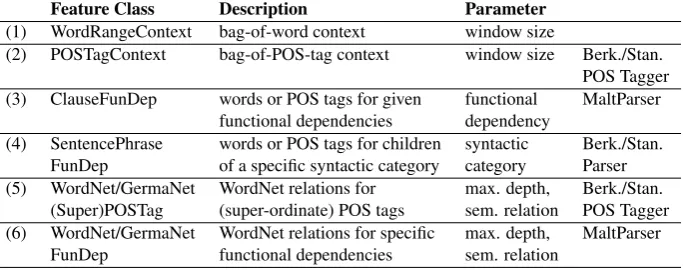
The MaJo toolkit for supervised Word Sense Disambigua-tion (WSD) provides a testing environment for exploring the questions outlined in Section 2.1. Its graphical user in-terface allows users with little or no programming skills to investigate the interaction between different feature sets and settings for sampling and to systematically explore the im-pact of the different parameters on the Active Learning task. MaJo features a flexible plugin architecture which imple-ments a number of interfaces to off-the-shelf NLP tools and linguistic resources for extracting training data from the web (Yahoo! search API), for preprocessing (Stan-ford POS Tagger (Toutanova et al., 2003), Stan(Stan-ford Parser (Klein and Manning, 2003), Berkeley Parser (Petrov and Klein, 2007), MaltParser (Nivre et al., 2006)), for extract-ing semantic features (WordNet (Fellbaum, 1998), Ger-maNet (Kunze and Lemnitzer, 2002)) and for classification (OpenNLP MaxEnt 2.52). The architecture can easily be
extended to incorporate additional components for prepro-cessing and feature extraction, or to implement new ma-chine learning algorithms for training. At the moment the system provides working interfaces for English and Ger-man, but it can easily be extended to other languages. The graphical user interface guides the user through the learning process and enables the user to systematically ex-plore the benefit gained from different feature types for WSD. The toolkit supports manual annotation of selected instances and re-trains the system on the extended data set. MaJo also provides the means to evaluate the performance of the system against a gold standard.
The approach to AL with MaJo is as follows (Figure 1): First the system is trained on a small seed data set con-taining sentences with disambiguated instances of a specific target word. In the AL phase, users can either load unan-notated sentences from a text file, enter new instances by hand, or generate new example sentences from the WWW. Users can specify a threshold for uncertainty sampling (Lewis and Gale, 1994): all sentences for which the confi-dence of the prediction by the classifier is below the thresh-old are presented to the user for annotation. The idea be-hind this sampling method is that the classifier’s low con-fidence shows that it has yet to learn how to treat these ex-amples, and by adding them to the training set we allow the classifier to just do that. After having been assigned the correct word sense, the new instances are added to the seed data and a new model is trained on the combined data set. The process can be repeated, adding more and more new in-stances to the training set. For a more detailed description of the MaJo toolkit see Rehbein et al. (2009).
2http://maxent.sourceforge.net
4.
Experiments
4.1. Data
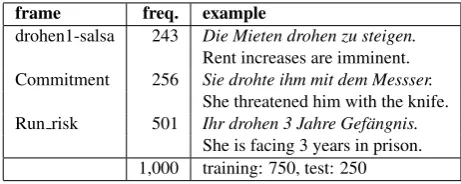
We selected 1,000 newspaper sentences containing the Ger-man verbdrohen(threaten). The data was annotated man-ually by two expert annotators, following the annotation scheme of the German Salsa Corpus (Burchardt et al., 2006), a newspaper corpus annotated within the framework of frame semantics (Baker et al., 1998) . We selected dro-henbecause it has only 3 different word senses which can be easily distinguished by human annotators (Table 2). The three word senses, or frames, are RUN RISK-SALSA, COM -MITMENTand the proto-frameDROHEN1-SALSA.3 While there is a dominant frame which accounts for the ma-jority of occurences of drohen (threaten) in our data set (RUN RISK-SALSAcaptures around 50% of all word senses ofdrohenin our data), the distribution is not unduly skewed and still provides us with a large number of examples for the other two word senses ofdrohen.
frame freq. example
drohen1-salsa 243 Die Mieten drohen zu steigen. Rent increases are imminent. Commitment 256 Sie drohte ihm mit dem Messser.
She threatened him with the knife. Run risk 501 Ihr drohen 3 Jahre Gef¨angnis.
She is facing 3 years in prison. 1,000 training: 750, test: 250
Table 2: Word senses (frames) fordrohen(threaten)
The three word senses (or frames) are defined as follows.
1. The RUN RISK frame describes a situation where a Protagonistis exposed to a potentially dangerous sit-uation that may end in aBad outcomefor him- or her-self. Please note that the original FrameNet RUN RISK frame does not include the verbthreaten. RUN RISK -SALSA(hence called RUN RISK) is an enhanced ver-sion of the FrameNet RUN RISKframe with the three core frame elementsAction,Bad outcomeand Endan-gered entity. In German,Endangered entityis usually filled by a dative NP.
(1) IhrEndangered entity Her
drohen threathen 3 Jahre Gef¨angnisBad outcome 3 years prison.
”She is facing 3 years in prison.”
2. The COMMITMENT frame is defined as follows: “A Speakermakes a commitment to anAddresseeto carry out some future action.” The two core frame elements, addressee and speaker, are constrained to the seman-tic typesentient. The announced action includes de-sirable as well as less dede-sirable events. Often these sentences include a mit-PP (with-PP) expressing the messageor an instrument.
3Proto-frames are created to capture those meanings in
Start
Seed
Pool Select Oracle
Train
f
Feature Selection/ Preprocess
Add to seed and retrain
Figure 1: Active Learning loop with MaJo
Feature Class Description Parameter (1) WordRangeContext bag-of-word context window size
(2) POSTagContext bag-of-POS-tag context window size Berk./Stan. POS Tagger (3) ClauseFunDep words or POS tags for given functional MaltParser
functional dependencies dependency
(4) SentencePhrase words or POS tags for children syntactic Berk./Stan. FunDep of a specific syntactic category category Parser (5) WordNet/GermaNet WordNet relations for max. depth, Berk./Stan.
(Super)POSTag (super-ordinate) POS tags sem. relation POS Tagger (6) WordNet/GermaNet WordNet relations for specific max. depth, MaltParser
FunDep functional dependencies sem. relation
Table 1: Off-the-shelf software components implemented in MaJo
(2) SieSpeaker She
droht threatens
ihmAddressee him
(PP (PP
mit with
dem the Messer)
knife).
”She threatens him with the knife”
(3) SieSpeaker She
droht threatens
ihmAddressee him
(PP (PP
mit with Vergeltung).
revenge).
”She threatens to take revenge on him”
3. The third frame,DROHEN1-SALSA, shows strong se-mantic similarity to RUN RISK-SALSA while being syntactically distinct. Is is realised by an infinite verb form with zu(to) and comprises the two core frame elementsBad outcomeandCause.
(4) Die KriseCause The crisis
droht threatens
Arbeitspl¨atze zu vernichtenBad outcome jobs to eliminate.
”The crisis threatens to eliminate jobs.”
Human annotators do not have problems to distinguish these frames. We computed Inter-Annotator Agreement on 100 sentences annotated by both annotators. The two an-notators agreed on 99% of the data. This means that our
data set does not include annotation noise resulting from controversial cases which could mislead the classifier. In the experiment we want to investigate the following questions: (1) How many training instances do we need to get a reasonable performance for an automatic WSD sys-tem? (2) For an easy verb likedrohen, can we get results comparable to human judgments when having access to a large amount of training data?
4.2. Feature Tuning
We used MaJo for tuning the features for the verbdrohen and afterwards extracted the features from the training set (750 sentences). We kept the remaining 250 sentences for evaluation, running our experiments in a 5-fold cross vali-dation setting. Our tuned feature set includes the following feature classes and settings:
1. bag-of-word context (5 words to the left/right)
2. bag-of-POS-tag context (3 POS tags to the left/right)
4. POS tags for all children of VZ phrases (VPs with zu-marked infinitives).
To our surprise we found that the features based on Ger-maNet did not perform well (Table 3). Best performance was obtained by lexical context features (bag-of-word con-text (0.705) and word forms for token with selected gram-matical functions (0.700)). Somewhat lower were results for POS context (0.635), while features based on GermaNet hypernyms extracted for all nouns, adjectives and verbs only achieved an accuracy of 0.575, and the feature set based on GermaNet hypernyms for arguments did not per-form well at all (0.475).
There are two possible explanations. First, the grammatical functions used for identifying the candidates for the Ger-maNetMalt feature plugin have been assigned by the statis-tical parser and thus are error-prone. Results for the Malt parser in the PaGe shared task on parsing German (K¨ubler, 2008) report an f-score of 90.2% for subjects and 80.0% for accusative objects, while for dative objects the MaltParser achieves 49.7% f-score only. This explains the better per-formance for the GermaNet features based on superordinate POS tags (Table 3). A second reason for the poor perfor-mance of the semantic GermaNet based features is founded in the more syntactically motivated frame distinctions. The DROHEN1-SALSA frame can be identified by looking for an infinite verb withzu(to), while RUN RISK-SALSA usu-ally has an indirect object. As we mentioned above, the automatic identification of dative NPs in German does not work very well. However, the protagonist in the COMMIT -MENTframe is often realised by a personal pronoun. While case syncretism certainly is a problem for German, at least the masculine personal pronounihm(him) is unambiguous. Unfortunately, personal pronouns are not useful for extract-ing informative features from GermaNet.
feature plugin settings accuracy WordRangeContext 5 words left/right 0.705 ClauseFunDep ROOT, SUBJ, OBJA,
OBJP, PART, ATTR,
AUX, AVZ 0.700
POSTagContext 3 words left/right,
ignore punctuation 0.635 GermaNetSuperPOS Noun, Adj., Verb,
hyperonymy, depth=4 0.575 GermaNetMalt SUBJ, OBJA,
OBJD, OBJG
hyperonymy, depth=3 0.475
Table 3: Accuracy for individual feature types (all results on fold 5)
Note that our tuned feature set outperforms the performance of Shalmaneser, a state-of-the-art WSD system (Erk and Pad´o, 2006) trained on the same data set.
We divided the 1,000 instances into a training set (750 in-stances) and a test set (250 inin-stances). The initial seed data set contained 9 sentences (3 instances for each word sense) taken from the SALSA corpus.
4.3. Results
As a baseline we randomly selectednnew instances from the pool of training data (random sampling). For uncer-tainty sampling we used the confidence score of a maxi-mum entropy classifier.4
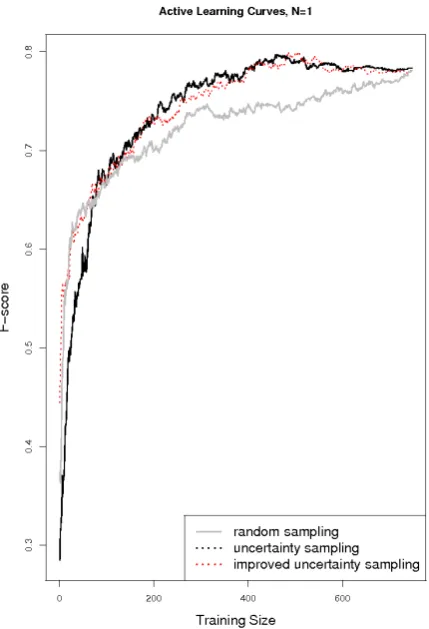
Figure 2: Learning curves for random sampling, uncer-tainty sampling and improved unceruncer-tainty sampling (5-fold cross validation)
Figure 2 shows learning curves for our experiments. We experimented with a varying number of training instances (1, 2, 3, 5, 10) added in each iteration to the training set (Table 4). Results for our WSD system are far below the results of our human annotators. Comparing the curve for AL with uncertainty sampling to the learning curve for ran-dom sampling, we see that in the beginning the ranran-domly selected training instances yield better results. After adding approximately 75 new training instances, however, the AL approach outperforms random sampling.
4.4. Improved Uncertainty Sampling
The results suggest that early in the learning process when our classifier is trained on a very small seed data set, it is not beneficial to add the instances with the lowest classi-fier confidence. Instead, we propose a dynamic version of uncertainty sampling, taking into account how much the classifier has learned so far. When trained on a small seed set only, many of the predictions made by the classifier are made with low confidence. During training, the minimum confidence score for predicting word senses for unseen text
inst./iteration RAND UNC IMP UNC N=1 78.1 (747) 79.7 (464) 80.0 (508) N=2 78.2 (746) 79.1 (536) 79.0 (500) N=3 78.6 (744) 79.5 (465) 79.0 (504) N=5 78.3 (705) 78.9 (565) 79.3 (530) N=10 78.1 (670) 78.8 (500) 79.4 (490)
Table 4: Best F-score and number of training instances added to the seed data for each AL setting (5-fold cross validation)
increases, and the gap between minimum and maximum confidence scores closes. We make use of this and, instead of adding theninstances with the lowest confidence score, we compute a threshold as follows:
threshold=maxConfidence−minConfidence (1)
Then we sort all instances in the pool according to the con-fidence score for the classifier prediction and add the next
n instances with a confidence score below the threshold. As training proceeds, the threshold drops. If there are no instances with a confidence value below the threshold, we select theninstances with the lowest confidence predicted by the classifier. Figure 2 shows the learning curves for our baseline (random sampling, RAN), for uncertainty sam-pling (UNC) and for our improved method (IMP UNC). The improved uncertainty sampling shows comparable per-formance to UNC when trained on more data, while in the beginning the learning curve is steeper.
5.
Discussion
We achieved our best result of 80% F-score for automat-ically disambiguating between the three senses of dro-hen using the improved uncertainty sampling (N=1, 508 instances added). Trained on the same number of in-stances, the basic uncertainty setting yields 78.8% F-score, while for random sampling on an equally sized data set we achieve 74.9% F-score. When training on all 750 in-stances, results get worse (78.1%). This shows that some sentences in the training set are not informative enough to improve the classifier, or even add noise to the data and so harm the learning process. There are only marginal dif-ferences between the best results for UNC and IMP UNC (Figure 2). While the careful selection of new training instances (UNC, IMP UNC) does improve results for all settings (N=1,2,3,5,10), performance remains nearly 20% lower than that of human annotators. This shows that sim-ply adding more instances to the training set does not solve the knowledge acquisition bottleneck.
The results outlined above raise the following questions:
1. What is the reason for the great gap in performance between human annotators and our automatic WSD system?
2. Which are the instances the system gets wrong?
3. What is the impact of the different sampling methods on the learning process?
In Section 5.1. we give a qualitative error analysis, outlin-ing reasons for the difference in accuracy between human annotation and the WSD system. In Section 5.2. we com-pare the different sampling methods and their impact on the training sets at different stages of the training process.
5.1. Error Analysis
How can we explain that the task of word sense disam-biguation fordrohen, being that easy for human annotators, cannot be solved sufficiently by the machine learning clas-sifier?
To answer this question, we looked at the errors made by the classifier (Table 5). Results for our Active Learning approaches after 500 iterations are considerably higher than for random sampling (78.9 (UNC) and 79.6 (IMP) versus 74.2 (RAND)).
f1 f2 f3 f4 f5 avg. sd RAND 76.0 74.0 71.2 76.8 72.8 74.2 2.3 UNC 79.2 77.2 79.6 79.6 78.8 78.9 1.0 IMP 79.2 78.0 78.8 80.4 81.6 79.6 1.4
Table 5: F-scores for different sampling methods and for individual folds after 500 iterations
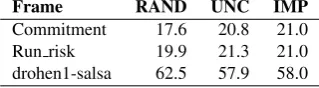
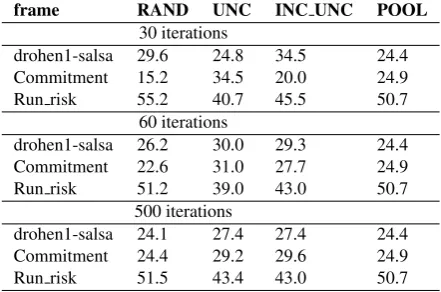
The most common mistake made by the classifier is to as-sign RUN RISKinstead of the COMMITMENTframe. This is one of the typical problems for Machine Learning and re-flects the class imbalance problem (Japkowicz and Stephen, 2002; Zhu and Hovy, 2007), where a highly skewed distri-bution of classes in the data causes the classifier to overuse the dominant class. In fact, the frames assigned by the clas-sifier show a strong bias towards RUN RISK, which is the most frequent frame in our data set. The classifier trained on the random selection of training data has the strongest bias and assignes the RUN RISK frame to 62.5% of the instances in the test set. For basic and improved uncer-tainty sampling, the bias is less strong, but they still over-generalise and assign the dominant frame to around 58% of all instances in the test set (Table 6), while the ”real” dis-tribution in the pool data shows a frequency of around 50% (Table 8) for the RUN RISKframe. The ranking of differ-ent error types is the same for all three sampling methods (Table 7).
Frame RAND UNC IMP Commitment 17.6 20.8 21.0 Run risk 19.9 21.3 21.0 drohen1-salsa 62.5 57.9 58.0
Table 6: Avg. frame distribution in classifier output
frame RAND UNC INC UNC POOL 30 iterations
drohen1-salsa 29.6 24.8 34.5 24.4 Commitment 15.2 34.5 20.0 24.9
Run risk 55.2 40.7 45.5 50.7
60 iterations
drohen1-salsa 26.2 30.0 29.3 24.4 Commitment 22.6 31.0 27.7 24.9
Run risk 51.2 39.0 43.0 50.7
500 iterations
drohen1-salsa 24.1 27.4 27.4 24.4 Commitment 24.4 29.2 29.6 24.9
Run risk 51.5 43.4 43.0 50.7
Table 8: Avg. distribution of frames (%) in training sets for different sampling methods after 30, 60 and 500 iterations of training
for the classifier. As a result, the benefit we get from Active Learning becomes noticable only after adding a sufficient number of new instances. In our setting this is after around 60 iterations.
Improved uncertainty sampling is a compromise between random sampling and basic uncertainty sampling. It still re-flects the frame distribution in the pool data, but also takes the actual learning process into consideration. Therefore it overcomes the weakness of basic uncertainty sampling during early training. Unfortunately, selecting better in-stances during the first iterations does not seem to improve results in the later training phases. After 500 training iter-ations random sampling perfectly mirrors the distribution in the pool data, while the proportion of frames in the data sets created by basic and improved uncertainty sampling is nearly identical, explaining the similar performance of both methods after the initial phases of training. There is a lingering suspicion that the size of our pool is not yet big enough to allow the difference between basic uncertainty sampling and the improved uncertainty sampling to become visible. This, however, can only be tested on a larger data set and therefore must await further investigation.
Another important difference between the training sets gen-erated by the three sampling methods concerns the variance in the different folds of our training sets. The Active Learn-ing approaches create more homogeneous data sets where results obtained on the individual folds show a much lower standard deviation than the ones for the different folds for random sampling (Table 5). This observation is in line with (Ertekin et al., 2007), who showed that SVM based Active Learning, where the most informative instances are consid-ered to be the ones closest to the hyperplane, can provide the learner with more balanced data sets. As a result the AL approaches produce more reliable data sets for training, yielding more consistent results.
6.
Conclusions and Future Work
We presented an environment for Active Learning in a WSD task, providing a user friendly GUI which supports processing steps like feature selection, sampling methods for selecting new training instances from the pool, and an interface for manually adding correct labels to the selected
training instances. At present, MaJo implements a basic en-vironment for AL, using uncertainty sampling and a maxi-mum entropy classifier. We plan to integrate other ML al-gorithms as well as more sophisticated sampling methods. We also intend to expand the feature set used for WSD. In the paper we questioned the assumption that the knowl-edge acquisition bottleneck, which has been described as the major impediment to solving the WSD problem (Gon-zalo and Verdejo, 2006), can be solved by simply obtaining more and more data. While the size of the training set cer-tainly has a crucial impact on the performance of WSD sys-tems, we showed that the claim “There’s no data like more data” is not entirely true.
Our case study on the German verb drohen (threaten) showed that an increase in size for the training set does not always correspond to an increase in performance. Less, but carefully selected examples can not only yield comparable performance and thus reduce costs for human annotation, they can even outperform classifier performance on a ran-domly selected data set, as Active Learning improves the quality of the data itself, resulting in more reliable and con-sistent training sets.
7.
Acknowledgements
We would like to thank Marcel K¨oster and Jonas Sunde who implemented the MaJo toolkit. This work has partly been funded by the German Research Foundation DFG (grant PI 154/9-3).
8.
References
C.F. Baker, C.J. Fillmore, and J.B. Lowe. 1998. The berke-ley framenet project. InProceedings of the 17th interna-tional conference on Computainterna-tional linguistics, Morris-town, NJ, USA. Association for Computational Linguis-tics.
M. Bloodgood and V. Shanker. 2009. A method for stop-ping active learning based on stabilizing predictions and the need for user-adjustable stopping. InProceedings of CoNLL-2009, Boulder, Colorado.
A. Burchardt, K. Erk, A. Frank, A. Kowalski, S. Pad´o, and M. Pinkal. 2006. The salsa corpus: a german corpus resource for lexical semantics. InProceedings of LREC-2006, Genoa, Italy.
Y.S. Chan and H.T. Ng. 2007. Domain adaptation with ac-tive learning for word sense disambiguation. In Proceed-ings of ACL-2007.
J. Chen and M. Palmer. 2005. Towards robust high perfor-mance word sense disambiguation of english verbs using rich linguistic features. InIJCNLP.
J. Chen, A. Schein, L. Ungar, and M. Palmer. 2006. An empirical study of the behavior of active learning for word sense disambiguation. InProceedings of NAACL-2006, New York, NY.
David A. Cohn, Zoubin Ghahramani, and Michael I. Jor-dan. 1996. Active learning with statistical models. Jour-nal of Artificial Intelligence Research, 4:129–145. H.T. Dang. 2004. Investigations into the role of lexical
K. Erk and S. Pad´o. 2006. Shalmaneser - a flexible toolbox for semantic role assignment. InProceedings of LREC-2006, Genoa, Italy.
S¸eyda Ertekin, Jian Huang, L’eon Bottou, and Lee Giles. 2007. Learning on the border: active learning in im-balanced data classification. InCIKM ’07: Proceedings of the sixteenth ACM conference on Conference on in-formation and knowledge management, pages 127–136, New York, NY, USA. ACM.
Christiane Fellbaum, editor. 1998. WordNet: An Electronic Lexical Database (ISBN: 0-262-06197-X). MIT Press, first edition.
Julio Gonzalo and Felisa Verdejo, 2006. Automatic Acqui-sition of Lexical Information and Examples, chapter 9. Kluwer.
Nathalie Japkowicz and Shaju Stephen. 2002. The class imbalance problem: A systematic study.Intelligent Data Analysis, 6(5):429–449.
Dan Klein and Chris Manning. 2003. Accurate unlexical-ized parsing. In 41st Annual Meeting of the Associa-tion for ComputaAssocia-tional Linguistics (ACL-03), Sapporo, Japan.
Sandra K¨ubler. 2008. The page 2008 shared task on parsing german. InACL Workshop on Parsing German (PaGe-08), Columbus, OH.
Claudia Kunze and Lothar Lemnitzer. 2002. Germanet -representation, visualization, application. In Proceed-ings of the 3rd International Conference on Language Resources and Evaluation (LREC-02).
D.D. Lewis and W.A. Gale. 1994. A sequential algorithm for training text classifiers. In Proceedings of ACM-SIGIR, Dublin, Ireland.
Joakim Nivre, Johan Hall, and Jens Nilsson. 2006. Malt-parser: A data-driven parser-generator for dependency parsing. In Proceedings of the 5th International Con-ference on Language Resources and Evaluation (LREC-06), Genoa, Italy.
Slav Petrov and Dan Klein. 2007. Improved inference for unlexicalized parsing. InProceedings of the Human Language Technology Conference and the 7 th Annual Meeting of the North American Chapter of the Associ-ation for Computati onal Linguistics (HLT-NAACL-07), Rochester, NY.
Ines Rehbein, Josef Ruppenhofer, and Jonas Sunde. 2009. Majo - a toolkit for supervised word sense disambigua-tion and active learning. InProceedings of the 8th Work-shop on Treebanks and Linguistic Theories (TLT-8), Mi-lano, Italy.
Kristina Toutanova, Dan Klein, Christopher D. Manning, and Yoram Singer. 2003. Feature-rich part-of-speech tagging with a cyclic dependency network. In Proceed-ings of the 2003 Conference of the North American Chapter of the Association for Computational Linguis-tics on Human Language Technology (NAACL-03), Mor-ristown, NJ, USA. Association for Computational Lin-guistics.
A. Vlachos. 2008. A stopping criterion for active learning. Compututer Speech and Language, 22(3).
D. Yarowsky. 1995. Unsupervised word sense
disam-biguation rivaling supervised methods. In Proceedings of ACL-1995, Cambridge, MA.