Creating glossaries using pattern-based and machine learning techniques
Eline Westerhout, Paola Monachesi
Utrecht University
Trans 10, 3512 JK, Utrecht, The Netherlands [email protected], [email protected]
Abstract
One of the aims of the Language Technology for eLearning project is to show that Natural Language Processing techniques can be employed to enhance the learning process. To this end, one of the functionalities that has been developed is a pattern-based glossary candidate detector which is capable of extracting definitions in eight languages. In order to improve the results obtained with the pattern-based approach, machine learning techniques are applied on the Dutch results to filter out incorrectly extracted definitions. In this paper, we discuss the machine learning techniques used and we present the results of the quantitative evaluation. We also discuss the integration of the tool into the Learning Management System ILIAS.
1.
Introduction
One of the aims of the European project Language Tech-nology for eLearning (LT4eL)1 is to show that Language Technology can provide a solution to the task of creat-ing appropriate glossaries by developcreat-ing a glossary can-didate detector. More generally, the goal is to show that the integration of Language Technology based functionali-ties and Semantic Web techniques will enhance Learning Management Systems (LMS) and thus the learning pro-cess (Monachesi et al., 2006b; Monachesi et al., 2006a; Lemnitzer et al., 2007). Definition extraction is the topic of much current research and techniques have been devel-oped to this end within the Natural Language Processing and the Information Extraction communities mainly based on grammars that detect the relevant patterns and machine learning methods: in the LT4eL project, we adapt these techniques for eLearning purposes.
Glossaries can play an important role within eLearning since they support the learner in decoding the learning ob-ject he is confronted with and in understanding the central concepts which are being conveyed in the learning material. Therefore, existing glossaries or wikipidias can be linked to learning objects, but an obvious shortcoming of this ap-proach is that the learner would be confronted with many definitions for the term he is looking for and not only with the definition which is appropriate in the given context. A better alternative is to build glossaries based on the defini-tions of the relevant terms which are attested in the learning objects. By doing so, the exact definition that the author of a certain document uses is captured; in many cases, this def-inition overrides a more general defdef-inition of the term. By providing the most appropriate definition to the learner for the concept he is not familiar with, we facilitate the learning process.
The glossary candidate detector we developed, extracts def-initions in the eight languages represented in our consor-tium, that is, Bulgarian, Czech, Dutch, English, German, Polish, Portuguese and Romanian (cf. Lemnitzer (2007)). In this paper, we focus only on the definitory contexts at-tested in the Dutch learning objects and the approach we
1
http://www.lt4el.eu
have used to identify them. First, a substantial amount of definitions is selected and annotated manually in the learn-ing objects which are the asset of this project. On the basis of these examples a grammar is developed in order to ex-tract possible definitions (cf. Muresan and Klavans (2002) for a similar approach). After the extraction of the def-inition patterns, machine learning techniques are applied on the extracted definitions to improve precision (cf. also Fahmi and Bouma (2006) for Dutch).
The rest of the paper is organized as follows. Section 2. introduces related work on the area of definition extrac-tion. The details of our approach are presented in section 3., in particular we discuss the corpus we have assembled, the grammar we have developed to detect definitions from our corpus of learning objects and the machine learning techniques employed to narrow down the set of definitions. Section 4. evaluates the results obtained. In section 5., we discuss the embedding of the glossary candidate detector within the Learning Management System ILIAS2 and its function within an eLearning context while section 6. con-tains our conclusions and suggestions for future work.
2.
Previous work
Research on the detection of definitions has been pursued in the context of automatic building of dictionaries from text, question-answering and recently also within ontology learning.
In the area of automatic glossary creation, the DEFINDER system (Muresan and Klavans, 2002) combines shallow natural language processing with deep grammatical anal-ysis to identify and extract definitions and the terms they define from on-line consumer health literature. The system is based on two modules, the former one uses cue-phrases and text markers in conjunction with a finite state grammar to extract definitions while the latter one uses a grammar analysis module based on a statistical parser in order to ac-count for several linguistic phenomena used for definition writing. Their approach relies entirely on manually crafted patterns.
2
Research on definition extraction has been pursued very ac-tively also in the area of Question-Answering. The answers to ‘What is’-questions are usually definitions of concepts. A common approach in this area is to search the corpus for sentences consisting of a subject, a copular verb and a predicative phrase. If the concept matches the subject, the predicative phrase is returned as answer. Also in this case research relied initially almost totally on pattern iden-tification and extraction and only later, machine learning techniques have been employed.
In Tjong Kim Sang et al. (2005), both the analysis of docu-ment structure as well as dependency parsing are explored. Definitions of the type mentioned above are extracted from Dutch texts in order to provide answers to questions in the medical domain. The texts used are often encyclopedias and wikipidias which are well structured and thus layout information is a reliable feature to detect definitions in a text, this is however not the case for other types of texts. Therefore, for texts that are not well structured the pars-ing approach is more promispars-ing. However, medical ques-tions often require answers which are larger than a single sentence while parsing techniques are typically applied to sentences.
Thus, a better alternative might be to combine the two ap-proaches and Fahmi and Bouma (2006) is an attempt in that direction. They propose an approach to definition extrac-tion which operates on fully parsed text and machine learn-ing techniques (cf. also Blair-Goldensohn et al. (2004), Miliaraki and Androutsopoulos (2004) for the use of ma-chine learning methods in definition extraction). Also in this case, a rather well structured corpus is employed such as the medical pages of the Dutch version of Wikipedia. Therefore, first candidate definitions which consist of a sub-ject, a copular verb and a predicative phrase are extracted from a fully parsed text by using their syntactic proper-ties. Second, machine learning methods are applied to dis-tinguish definitions from non-definitions and to this end a combination of attributes have been exploited which refer to text properties, document properties, and syntactic prop-erties of the sentences. They show that the application of machine learning methods improve considerably the accu-racy of definition extraction based only on syntactic pat-terns.
Research on definition extraction has been carried out also in the area of ontology learning. For example, within the German HyTex project (Storrer and Wellinghof, 2006), 19 verbs that typically appear in definitions were distinguished and search patterns have been specified based on the va-lency frames of these definitor verbs in order to extract definitions. Furthermore, semantic relations have been ex-tracted from these definitions. Even though this informa-tion has been employed for the automatic generainforma-tion of hypertext views that support both reading and browsing of technical documents, one could imagine employing the same technique to actually update and enlarge existing for-malized ontologies.
Work in this direction is that of Walter and Pinkal (2006) that proposes a rule-based method for extracting and ana-lyzing definitions from parsed text on the basis of a seman-tically oriented parsing system. The results are then
em-ployed to improve the quality of text-based ontology learn-ing. Also this approach relies on pattern extraction tech-niques to detect definitions and doesn’t employ machine learning. A difference with respect to previous systems is its use of semantic information in the identification of pat-terns.
3.
The glossary candidate detector
The extraction of definitions for glossary creation for eLearning purposes constitutes a novel application of cur-rent techniques which present some interesting challenges. The most relevant one is constituted by the corpus of learn-ing objects which includes a variety of text genres and also a variety of authors writing styles that pose a real chal-lenge to computational techniques for automatic identifi-cation and extraction of definitions together with the head-words. Our texts are not as structured as those employed for the extraction of definitions in question-answering tasks which include encyclopedias and wikipedias, thus layout information plays in our context a marginal role.
Furthermore, some of our learning objects are relatively small in size, thus our approach has not only to favor pre-cision as is often the case in the approaches discussed in the previous section but also recall, that is we want to make sure that all possible definitions present in a text are pro-posed to the user for the creation of the relevant glossary. Therefore, the extraction of definitions cannot be limited to sentences consisting of a subject, a copular verb and a pred-icative phrase, as is often the case in question-answering tasks, but a much richer typology of patterns needs to be identified than in current research on definition extraction. Despite the challenges that the eLearning application in-volves, we believe that the techniques for the extraction of definitions developed within the Natural Language Pro-cessing and the Information Extraction communities can be adapted and extended for our purposes. In particular, our approach is similar to that of Muresan and Klavans (2002) since we employ deep grammatical analysis to iden-tify a wide variety of possible definition patterns. How-ever, we follow Fahmi and Bouma (2006) in applying ma-chine learning techniques to improve the precision of the definition extracted and distinguish definitions from non-definitions.
Finally, the glossary candidate detector has been integrated in the Learning Management System ILIAS. More infor-mation on how this has been done and some screenshots can be found in section 5.. This functionality plays thus a relevant role in the learning path facilitating certain learn-ing activities of the students.
3.1. The grammar component
As already mentioned, the first step in the detection process of definitions is the development of a grammar which is able to identify the relevant patterns.
Type Example sentence
to be Gnuplot is een programma om grafieken te maken
‘Gnuplot is a program for drawing graphs’
verb E-learning omvat hulpmiddelen en toepassingen die via het internet beschikbaar zijn en creatieve mogelijkheden bieden om de leerervaring te verbeteren .
‘eLearning comprises resources and application that are available via the internet and provide creative possibilities to improve the learning experi-ence’
punctuation Passen: plastic kaarten voorzien van een magnetische strip, die door een gleuf gehaald worden, waardoor de gebruiker zich kan identificeren en toegang krijgt tot bepaalde faciliteiten.
‘Passes: plastic cards equipped with a magnetic strip, that can be swiped through a card reader, by means of which the identity of the user can be verified and the user gets access to certain facilities. ’
layout RABE
Een samenwerkingsverband van een aantal Duitse bibliotheken, die gezamenlijk een Internet inlichtingendienst bieden, gevestigd bij de gemeen-schappelijke catalogus, HBZ, in Keulen.
‘RABE
Cooperation of a number of German libraries, that together provide an Internet information service, residing at the common catalogue, HBZ, in Cologne’
pronoun Dedicated readers. Dit zijn speciale apparaten, ontwikkeld met het exclusieve doel e-boeken te kunnen lezen.
‘Dedicated readers. These are special devices, developed with the exclusive goal to make it possible to read e-books.’
Table 1: Examples for each of the definition types
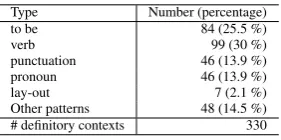
The first category (i.e. to be) are the definitory contexts in which a form of the verbzijn(‘to be’) is used as connector verb. These are the most straightforward definitions. The second group (i.e. verb) is formed by the definitory contexts in which other verbs are used as connector (e.g. betekenen (‘to mean’), wordt ... genoemd (‘is called’), wordt gebruikt om(‘is used to’)). Together with the first group, the second group comprises over 50 % of our defi-nitions.
The third type (i.e.punctuation) are the definitory contexts having specific punctuation features (e.g.:,(..)).
In the fourth group (i.e. layout) are the definitory contexts in which the layout plays an important role (e.g. in tables, defined term in margin, defined term in heading).
The last category (i.e.pronoun) contains the definitory con-texts in which relative and demonstrative pronouns (e.g.dit (‘this’),dat(‘that’),deze(‘these’)) and words likehiermee (‘with this’),hierdoor(‘because of this’) are used to point back to a defined term that is mentioned in a preceding sen-tence. The definition of the term then follows after the pro-noun, so these are often multisentence definitory contexts. Table 1 shows for each of the categories an example defi-nition and table 2 shows how often they are represented in our corpus.
Type Number (percentage)
to be 84 (25.5 %)
verb 99 (30 %)
punctuation 46 (13.9 %) pronoun 46 (13.9 %)
lay-out 7 (2.1 %)
Other patterns 48 (14.5 %) # definitory contexts 330
Table 2: Division of the definitory contexts into types
Grammar rules have been developed to detect all definition types, except for the layout definitions. The reason for this is that not many examples have been found of this type of definitions (i.e. only 7 definitions, that is 2.1 % of all defi-nitions) and in addition grammar rules are not the best way to detect them.
Given the variety of definition patterns present in our learn-ing objects, we believe that the rule-based approach is the most appropriate to use to detect them. Previous research has shown that grammars that match the syntactic
struc-tures of the definitory contexts are the most successful approaches when deep syntactic and semantic analysis of texts is not available (Muresan and Klavans, 2002; Liu et al., 2003).
We have extracted definitions from a corpus of learning ma-terial which has different formats, such as HTML, PDF or DOC. All these formats are converted into XML con-forming to the LT4eLAna DTD, which is an adapted ver-sion of the XCES DTD for linguistically annotated cor-pora (Ide and Suderman, 2002). Besides the content of the original files (that is, information about layout and the text itself), the DTD allows encoding information about part-of-speech, morphosyntactic features and lemmas. The Wotan tagger presented in Daelemans et al. (1996) has been used for the annotation of the Dutch learning ob-jects with part-of-speech information and morphosyntactic features whereas the CGN lemmatizer discussed in Bosch and Daelemans (1999) was used for the lemmatization. It should be noticed that the rules of the grammar for the ex-traction of the definitory context patterns make use also of the information encoded in the LT4ELAna format. The XML transducer lxtransduce developed by Tobin (2005) is used to match the grammar against files in the LT4eLAna format. Lxtransduce is an XML transducer, especially intended for use in NLP applications. It sup-plies a format for the development of grammars which are matched against either pure text or XML documents. The grammars must be XML documents which conform to a DTD (lxtransduce.dtd, which is part of the software). In each grammar, there is one ‘main’ rule which calls other rules by referring to them. The XPath-based rules are matched against elements in the input document. When a match is found, a corresponding rewrite is done.
com-plete definitory contexts are matched. The rules were made as general as possible to prevent overfitting to our training corpus. In total, the grammar consists of 67 rules (part 1: 24 rules; part 2: 5 rules; part 3: 20 rules and part 4: 18 rules) in a 35K file.
An alternative approach could have been to parse the corpus syntactically with Alpino, a robust wide-coverage parser for Dutch (Bouma et al., 2001), as proposed in Fahmi and Bouma (2006). However, we believe that we don’t need the level of deep syntactic representation produced by Alpino and that a shallower representation, as that produced by our grammar suffices for our purposes. Furthermore, since parsers (and chunkers) are not available for all the lan-guages for which we have developed the glossary candidate detector, a shallow approach was the most promising one.
3.2. The machine learning component
The grammar was used to identify definition patterns and extracts all sentences that match the patterns described in it. The result of applying the grammar to our corpus is a set of 1098 sentences which all have a definition struc-ture. However, it is not always the case that a given pattern will univocally identify the desired definition. Therefore, machine learning has been applied as a filtering step using the Naive Bayes machine learning algorithm. The Naive Bayes classifier is a fast and easy applicable classifier based on the probabilistic model of text (Mitchell, 1997). It has often been used in text classification tasks (Lewis, 1998; Lewis and Gale, 1994). It is also one of the classifiers used in Fahmi and Bouma (2006) for the classification of defi-nitions. Because our data set is relatively small, we used 10-fold cross validation for better reliability of the classi-fier results. In 10-fold cross validation, the original sample is partitioned into 10 subsamples. One of the 10 subsam-ples is retained as the validation data for testing the model, and the remaining 9 subsamples are used as training data. The cross-validation process is then repeated 10 times (the folds), with each of the 10 subsamples used exactly once as the validation data. The 10 results from the folds then are averaged to produce a single estimation.
We aim at finding the best attributes for classifying defini-tion sentences. We experimented with combinadefini-tions of the following attributes (cf. also Fahmi and Bouma (2006)). Text properties: bag-of-words, bigrams, and bigram pre-ceding the definition. Punctuation is included as Klavans and Muresan (2000) observe that it can be used to recog-nize definitions (i.e. definitions tend to contain parentheses more often than non-definitions). We include all bigrams in a sentence as feature. The use of the bigram preceding the definition is similar to the use of n-grams by Androut-sopoulos and Galanis (2005) who add n-grams (n being 1, 2 or 3) occurring frequently either directly before or after a target term.
Syntactic properties: type of determiner within the de-fined term (definite, indefinite, no determiner). Fahmi and Bouma (2006) investigated the use of determiners in def-inition sentences. They found out that for their data the majority of subjects in definition sentences have no de-terminer (62 %), e.g. Paracetamol is een pijnstillend en koortsverlagend middel (‘Paracetamol is an pain
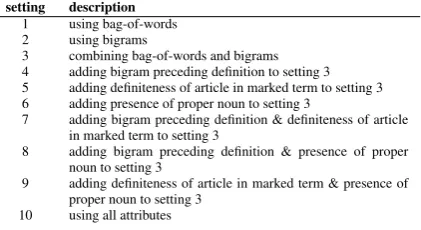
alleviat-setting description
1 using bag-of-words 2 using bigrams
3 combining bag-of-words and bigrams 4 adding bigram preceding definition to setting 3 5 adding definiteness of article in marked term to setting 3 6 adding presence of proper noun to setting 3
7 adding bigram preceding definition & definiteness of article in marked term to setting 3
8 adding bigram preceding definition & presence of proper noun to setting 3
9 adding definiteness of article in marked term & presence of proper noun to setting 3
10 using all attributes
Table 3: Configurations used for the Machine Learning ex-periment
ing and a fever reducing medicine’), while in non-definition sentences subject determiners tend to be definite (50 %), e.g. De werkzame stof is acetylsalicylzuur (‘The operative substance is acetylsalicylacid’).
Proper nouns: presence of a proper noun in the defined term, e.g. location, person, organization, or no-class. Fahmi and Bouma (2006) observed a significant difference in the distribution of this feature between definition and non-definition sentences. Definition sentences tend to have more proper nouns in their subjects (40.63 %) compared to non-definition sentences (11.58 %).
Fahmi and Bouma (2006) also used the document property of the position of a sentence in the document. For their type of texts (i.e. Wikipedia) this is a relevant feature, however, for our texts which are of a totally different structure this is not relevant. Another feature they used, which is difficult to simulate in our experiment, is the position of the subject in the sentence because we do not have the syntactic structure of sentences but only the part-of-speech information. We experimented with 10 combinations of these attributes. In the first setting, only a bag-of-words has been used by the classifier and in the second setting only bigrams are used. The third setting combines unigrams and bigrams. All other settings (4 - 10) use bigrams and the bag-of-words together, in combination with one or more other attributes. Table 3 summarizes the 10 settings. Weka, a collection of machine learning algorithms for data mining tasks, was used to per-form the experiments (Witten and Frank, 2005).
4.
Evaluation
4.1. First step: using the grammar
As already mentioned, the grammar was used to detect def-initions on the basis of syntactic patterns and we have cal-culated precision, recall and F-score for each of the types identified by the grammar to evaluate its performance. The sentence was identified as the most appropriate unit to eval-uate the performance and therefore we report the results ob-tained when using the sentence as a unit (Przepi´orkowski et al., 2007).
We did not only calculate the usual F-score, but also the F2-score. In this score, recall is weighted twice as much as precision3. For the task at hand, where recall is more important than precision, the latter measure in which recall
3F
α= (1 +α)·(precision·recall)/(α·precision + recall).
gets more weight seems appropriate (Przepi´orkowski et al., 2007). The performance of the grammar has been evalu-ated not only on the corpus on which the grammar has been based (‘used’), but also on a new data set which also has been annotated manually and contained around 150 defini-tions (‘new’).
type data P R F1 F2
is def used 28.10 86.52 42.41 51.11 new 20.97 91.80 34.15 43.19 verb def used 44.64 75.76 56.18 61.48 new 25.76 41.46 31.78 34.46 punct def used 9.91 68.18 17.31 23.04 new 2.58 76.92 4.99 7.25 pron def used 9.18 41.30 15.02 19.06 new 6.15 40.74 10.68 14.16
Table 4: Performance of the grammar
For theto be-patterns, we had a recall of 86.52, a precision of 28.10 and an F2-score of 51.11 on the training corpus; for the test set the results were 91.80, 20.97 and 43.18 re-spectively (Table 4).
For the verbpatterns, for the training corpus, recall was 74.76, precision was 44.46 and the F2-score was 61.48. For the test corpus, both recall and precision were remarkably lower, namely 41.46 and 25.76. The F2-score on the test corpus was 34.46.
The main problem with the third pattern type, that is, the punctuation patterns, is that this pattern also occurs very often in non-definitory contexts. The precision is therefore very low (9.91 on training corpus and 2.58 on the test cor-pus). Recall is higher for the test corpus than it is for the training corpus (76.92 and 68.18 respectively), but the F-score is higher for the training corpus.
Within the last type of patterns, thepronounpatterns, two groups can be distinguished. The first group contains def-initions starting withdit(‘this’) and the second group con-tains definitions starting with words such ashiermee(‘with this’). The first group has roughly the same pattern as the type 2 definitions, whereas within the second group other patterns are used. All scores are higher for the training cor-pus: precision is 41.30 on the training corpus and 40.74 on the test corpus. Recall is respectively 9.18 and 6.15, and the F-scores are also higher for the training corpus. We refer to Westerhout and Monachesi (2007) for more de-tails on the performance of the grammar.
4.2. Second step: filtering the results using machine learning methods
The precision of the results obtained with the grammar is low, which means that a user which wants to use the glos-sary candidate detector to create a dictionary is presented with many incorrect definitions. In order to increase preci-sion, we trained a Naive Bayes classifier and applied it on the results obtained with the grammar.
The ten attribute settings were tested for the two most fre-quent definition types: theto be-patterns and the punctu-ation patterns extracted by the grammar. There were 274 to be-patterns extracted, of which 77 were real definitions. This means that we have a precision of 28.1 %. For the punctuation patterns, there were even more incorrect
sen-tences contained. This set includes 454 sensen-tences, of which 45 are correct definitions (precision of 9.9 %).
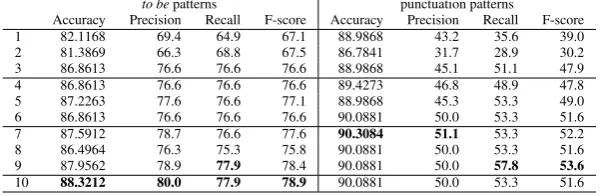
In classification experiments, often only the accuracy is re-ported. However, for our purposes the recall and precision of the definitions are more important than the precision and recall of the non-definitory contexts. It is possible, that the accuracy is high, whilst the recall of the definitions is very low; this occurs when the classifier categorizes a large num-ber of non-definitions correctly. Such a large difference be-tween accuracy and recall is clearly present in the results for the punctuation patterns. Therefore, table 5 reports also the precision, recall and F-score for the definitory contexts. For theto be-patterns, the accuracy is highest when all at-tributes are used. The precision, recall and F-score give also best results with this configuration. However, the dif-ferences between the settings are small for settings 3 to 10. Only for the first two settings, the scores are remarkably lower.
The accuracy and precision are highest for the punctuation patterns when configuration 7 is used for training the clas-sifier. In this setting, the bigram directly appearing before the defining text and the definiteness of the article are taken into consideration. Recall and F-score are best for setting 9, the setting in which the definiteness of the article and the presence of a proper noun in the marked term are used as attributes.
Although the accuracy scores of theto be-patterns and the punctuation patterns are comparable (both around 90), pre-cision, recall and F-score for the classification of definitory contexts are remarkably lower for the punctuation patterns. This has to do with the fact that there are far more non-definitions for the punctuation patterns whereas we are in-terested in the classification of the definitions.
4.3. Discussion
It should be noticed that the recall values reported in the previous section are calculated in relation to the number of correct definitions extracted by the grammar. In order to identify the final recall values, it is necessary to calcu-late the scores in relation to the manually annotated set of definitions, thus the final recall values calculated after applying the grammar and the machine learning classifier differ from the recall values reported in the previous sec-tion. The precision obtained after the machine learning fil-tering already represents the final precision values, because it shows the proportion of correctly classified definitions in relation to the total number of sentences classified as def-inition. Therefore, the final precision values are already reported in table 5. In table 6 the final results are reported.
P R F F2
to be 80.00 67.42 73.17 71.15 punctuation 50.00 36.36 42.11 40.00
Table 6: Final results for theto bepatterns and the punctu-ation patterns (using all attributes for both types)
to bepatterns punctuation patterns
Accuracy Precision Recall F-score Accuracy Precision Recall F-score 1 82.1168 69.4 64.9 67.1 88.9868 43.2 35.6 39.0 2 81.3869 66.3 68.8 67.5 86.7841 31.7 28.9 30.2 3 86.8613 76.6 76.6 76.6 88.9868 45.1 51.1 47.9 4 86.8613 76.6 76.6 76.6 89.4273 46.8 48.9 47.8 5 87.2263 77.6 76.6 77.1 88.9868 45.3 53.3 49.0 6 86.8613 76.6 76.6 76.6 90.0881 50.0 53.3 51.6 7 87.5912 78.7 76.6 77.6 90.3084 51.1 53.3 52.2 8 86.4964 76.3 75.3 75.8 90.0881 50.0 53.3 51.6 9 87.9562 78.9 77.9 78.4 90.0881 50.0 57.8 53.6
10 88.3212 80.0 77.9 78.9 90.0881 50.0 53.3 51.6
Table 5: Performance of Naive Bayes classifier on theto bepatterns and the punctuation patterns
use these results as input. Correct definitions not detected by the grammar are definitively lost. As a consequence, it is inevitable that the recall decreases. However, the better the classifier performs, the smaller the loss will be. For the to be-patterns, using the Naive Bayes classifier leads to an improvement of precision of 51.9 % for the best setting (setting 10). Recall drops for this same setting with 19.1 %, which means that 14 correct definitions are lost during the classification step.
For the punctuation patterns, the precision increases with maximal 41.15 %. The recall decreases with 31.82 %, which means that 21 definitions are lost during the classifi-cation step. However, the F1and the F2score both increase, respectively 26.76 and 19.34 %.
There is a trade-off between precision and recall. Before using the classifier, the recall was better whereas after us-ing the classifier the precision was much better. For the 21 files we used, 1098 definitions were extracted by the gram-mar of which 209 were correct (19.03 %). This means that on average 52 definitions are proposed for a file of which only 10 are correct. For the user who wants to generate a glossary related to a learning object, this means that he has to check the proposed sentences very carefully and that 80 % of them have to be thrown away, if we rely only on pattern-based methods to identify correct definitions. At the moment, we have only employed machine learn-ing methods to filter out results for theto be-patterns and the punctuation patterns. For these categories the gram-mar extracted 728 sentences of which only 122 were cor-rect (16.75 %). After using the Naive Bayes classifier, the number of definitions presented to the user has decreased to 127 of which 86 are correct (67.7 %). This means that the user uploading a file is presented with on average 6 possi-ble definitions per file which have to be checked for these two categories. Out of these 6 definitions, 4 are real ones. However, the counter effect of using machine learning after applying the grammar to detect definition patterns is that on average 2 correct definitions per file are lost for these cat-egories. Given that our goal is the automatic development of glossaries for eLearning purposes, it remains to be eval-uated whether a pure pattern-based approach for definition extraction might be more appropriate than one in which it is combined with machine learning techniques, as discussed in more detail in the section below.
It is difficult to compare our results with those achieved in the area of definition extraction for automatic building of dictionaries, question-answering and within ontology learning given the different setup, languages involved,
ap-plications and aims. Perhaps, the only work we could com-pare our results with is that of Fahmi and Bouma (2006) given the similarity of tasks, methodology and language. Their results with respect to accuracy are slightly better than ours since their best accuracy is 90.26% for the Naive Bayes classifier with respect to the to be-pattern while in our case the best result is 88.32%.However, it should be noticed that they have employed a much bigger and more structured corpus than ours. On the other hand, Fahmi and Bouma (2006) could not measure the effect of using ma-chine learning on recall, because they did not annotate the definitions in their corpus manually and could therefore not compare the results obtained to the set of manually anno-tated definitions. Thus, we cannot evaluate how we com-pare to them in this respect.
5.
Embedding into ILIAS and qualitative
evaluation
The glossary candidate detector we have presented, is one of the functionalities which have been integrated in the IL-IAS LMS. One of the aims of the LT4eL project is to show that the automatic development of glossaries, on the basis of definitions attested in the learning objects, should help the student in its learning process. Even though the glos-sary candidate detector has been integrated into ILIAS, it should be possible to enhance other LMSs with it since it has been offered as web service.
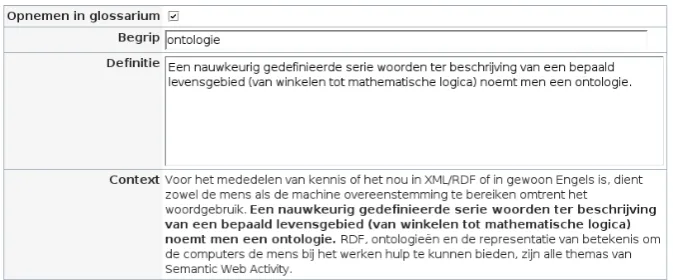
It is very easy for a user to generate a glossary on the ba-sis of a file. First, the user selects the option to generate a glossary for the learning object he has uploaded, this im-plies that the glossary candidate detector will become ac-tive and a list with terms and associated definitions will be produced. One of the definitions produced is shown in fig-ure 5., a definition for the termontologie(‘ontology’). As a second step, the user can then select all appropriate def-initions from the list, and adapt the context or term when necessary. As a last step, the glossary is created on the ba-sis of the definitions selected by the user. The possibility of adding additional definitions is also envisaged. It should be noticed that glossary generation is an interactive task, since the user can decide which definitions are appropriate and which should be removed.
Figure 1: Definition proposed by the GCD integrated into ILIAS
evaluation of the glossary candidate detector has been car-ried out. Given the eLearning context in which we oper-ate, it might be thus more relevant to evaluate the degree of satisfaction of the users. These are both the tutors who will exploit this functionality in order to develop glossaries semi-automatically as well as the learners who will have glossaries at their disposal produced with this functionality that should facilitate their learning process.
The increased focus on eLearning in universities has cre-ated the need for tutors to make content available electron-ically, by developing and storing learning objects in Learn-ing Management Systems. DurLearn-ing the design of learnLearn-ing material, it is important that working definitions of tech-nical vocabulary are available to tutors and students alike, particularly when material is re-used, so that it can be veri-fied that technical terminology is used consistently through-out the material, and to aid in the construction of glossaries. Therefore, we have developed a scenario centered on a tutor dealing with the creation of new content to be uploaded in a Learning Management System. Our hypothesis was that the definition extractor we have developed should facilitate the role of the tutor in creating a glossary of terms. Tutors were thus asked whether the definition extractor is a useful tool for the task they had to carry out and 27 tutors agreed that this was the case (6 of which strongly agreed) while 1 disagreed and 5 didn’t have an opinion. Tutors said that the tool saves time and gives a good base to start from and it is a good way to store relevant terms and definitions.
Two scenarios were also developed to assess the usefulness of the definition extractor for students. In the first sce-nario, students were given a copy of a paper and asked to prepare a summary within a limited time scale. The stu-dents were split into two groups, a control group that car-ried out the preparation of the synopsis without additional help and a target group that was supplied with a list of (key-words and) definitions previously extracted from the docu-ment by means of the relevant tools. The target group was asked about the quality and usefulness of the list of (key-words and) definitions in supporting the task of preparing the summary. They were also asked to express their views on whether they considered that using these tools for other content in their studies would be helpful. The control group was asked about its experience and the difficulty of the task. Students were also asked whether they felt a list of
(key-words and) definitions would have been useful and whether they would find it useful to be able to generate these for other documents to use in their studies. The results show that 39 of the 43 students in the target group agreed that the definitions given were correctly extracted from the text. The majority of the students also agreed that the list of def-initions was useful in preparing the summary and that it would be useful for them to have the definition extractor at their disposal to be able to extract definitions from other texts used in their study. As for the control group, 27 of the 37 students agreed that having a list of definitions would help them in the preparation of the summary while 5 dis-agreed and 5 didn’t have an opinion. In addition, 27 of the 37 students agreed that the automatic extraction of defini-tions from documents finalized to the creation of glossaries linked to learning material would be useful for their studies. In the second scenario, students had the task of finding rel-evant material within the LMS that they could employ to find answers to some quiz questions. They had at their disposal various search methods including the definition search based on the definitions present in the various glos-saries automatically developed. This scenario involved a much more limited number of students but showed equally positive results. In particular, 5 of the 6 students agreed that the glossaries were useful for preparing for the quiz with one not having an opinion, the same result was ob-tained for the question on whether the students would want to use the glossary candidate detector in their studies and whether they found it a useful tool to help them answer the quiz.
6.
Conclusions
One of the functionalities developed within the LT4eL project is the possibility to derive glossaries automatically on the basis of the definitory contexts identified within the learning objects.
(Lemnitzer, 2007). To improve precision, for Dutch, ma-chine learning techniques have been employed which have shown that precision can be improved considerably, with the consequence that recall decreases.
Improvements can be envisaged to find a better balance be-tween precision and recall. To this end, we plan to evaluate other classifiers and to include additional features, includ-ing semantic ones. Furthermore, we plan to extend the use of machine learning techniques to all types of definitions and not only to the most frequent ones. We will also exper-iment with using only machine learning and combining a basic grammar with machine learning. This basic grammar will contain very basic rules, e.g. simply matching all sen-tences containing a certain connector verb without taking any context into consideration.
7.
References
I. Androutsopoulos and D. Galanis. 2005. A practically unsupervised learning method to identify single-snippet answers to definition questions on the web. In Proceed-ings of Human Language Technology Conference and Conference on Empirical Methods in Natural Language Processing (HLT/EMNLP), pages 323–330.
S. Blair-Goldensohn, K. R. McKeown, and A. Hazen Schlaikjer, 2004. New Directions In Question Answering, chapter Answering Definitional Questions: A Hybrid Approach. AAAI Press.
A. van den Bosch and W. Daelemans. 1999. Memory-based morphological analysis. In Proceedings of the 37th Annual Meeting of the Association for Computa-tional Linguistics, ACL ’99, pages 285–292.
G. Bouma, G. van Noord, and R. Malouf. 2001. Alpino: Wide coverage computational analysis of Dutch. In W. Daelemans, K. Sima’an, J. Veenstra, and J. Zavrel, editors, Computational Linguistics in the Netherlands 2000, pages 45–59.
W. Daelemans, J. Zavrel, P. Berck, and S. Gillis. 1996. Mbt: A memory-based part of speech tagger generator. In E. Ejerhed and I. Dagan, editors,Proceedings of the Fourth Workshop on Very Large Corpora, pages 14–27. I. Fahmi and G. Bouma. 2006. Learning to identify
defini-tions using syntactic features. In R. Basili and A. Mos-chitti, editors, Proceedings of the EACL workshop on Learning Structured Information in Natural Language Applications.
N. Ide and K. Suderman. 2002. XML Corpus Encod-ing Standard, document XCES 0.2. Technical report, Department of Computer Science, Vassar College, and Equipe Langue et Dialogue, New York, USA and LO-RIA/CNRS, Vandoeuvre-l´es-Nancy, France,. http://
www.cs.vassar.edu/XCES/.
J. J. Klavans and S. Muresan. 2000. Definder: Rule-based methods for the extraction of medical terminology and their associated denitions from on-line text. American Medical Informatics Association.
L. Lemnitzer, C. Vertan, A. Killing, K. Simov, D. Evans, D. Cristea, and P. Monachesi. 2007. Improving the search for learning objects with keywords and ontolo-gies. InProceedings of ECTEL 2007.
L. Lemnitzer. 2007. D2.3b validated glossary candidate detector – first cycle. Deliverable LT4eL-project. D. D. Lewis and W. A. Gale. 1994. A sequential
algo-rithm for training text classifiers. In W. B. Croft and C. J. van Rijsbergen, editors,Proceedings of the 17th Annual International ACM-SIGIR Conference on Research and Development in Information Retrieval. Dublin, Ireland, 3-6 July 1994 (Special Issue of the SIGIR Forum), pages 3–12. ACM/Springer.
D. D. Lewis. 1998. Naive (Bayes) at forty: The inde-pendence assumption in information retrieval. In Claire N´edellec and C´eline Rouveirol, editors, Proceedings of ECML-98, 10th European Conference on Machine Learning, number 1398, pages 4–15, Chemnitz, DE. Springer Verlag, Heidelberg, DE.
B. Liu, C. W. Chin, and H. T. Ng. 2003. Mining topic-specific concepts and definitions on the web. In Proceed-ings of WWW-2003.
S. Miliaraki and I. Androutsopoulos. 2004. Learning to identify single-snippet answers to definition questions. InProceedings of COLING 2004, pages 1360–1366. T. M. Mitchell. 1997.Machine learning. McGraw-Hill. P. Monachesi, D. Cristea, D. Evans, A. Killing, L.
Lem-nitzer, K. Simov, and C. Vertan. 2006a. Integrating language technology and semantic web techniques in elearning. InProceedings of ICL 2006.
P. Monachesi, L. Lemnitzer, and K. Simov. 2006b. Language technology for elearning. In W. Nejdl and K. Tochtermann, editors,Proceedings of EC-TEL 2006, pages 667–672. Springer LNCS.
S. Muresan and J. Klavans. 2002. A method for automat-ically building and evaluating dictionary resources. In Proceedings of the Language Resources and Evaluation Conference (LREC 2002).
A. Przepi´orkowski, L. Deg´orski, M. Spousta, K. Simov, P. Osenova, L. Lemnitzer, V. Kubon, and B. W´ojtowicz. 2007. Towards the automatic extraction of denitions in Slavic. InProceedings of BSNLP workshop at ACL. A. Storrer and S. Wellinghof. 2006. Automated detection
and annotation of term definitions in German text cor-pora. InProceedings of LREC 2006.
E. Tjong Kim Sang, G. Bouma, and M. de Rijke. 2005. De-veloping offline strategies for answering medical ques-tions. In D. Moll´a and J. L. Vicedo, editors, Proceed-ings AAAI 2005 Workshop on Question Answering in Re-stricted Domains.
R. Tobin. 2005. Lxtransduce, a replacement for fsgmatch.
http://www.ltg.ed.ac.uk/∼richard/
ltxml2/lxtransduce-manual.html.
S. Walter and M. Pinkal. 2006. Automatic extraction of definitions from German court decisions. In Proceed-ings of the workshop on information extraction beyond the document, pages 20–28.
E. N. Westerhout and P. Monachesi. 2007. Extraction of Dutch definitory contexts for elearning purposes. In Pro-ceedings of CLIN 2006.