Tools for collocation extraction:
preferences for active vs. passive
Ulrich Heid, Marion Weller
Institute for Natural Language Processing University of Stuttgart, Germany {heid,wellermn}@ims.uni-stuttgart.de
Abstract
We present and partially evaluate procedures for the extraction of noun+verb collocation candidates from German text corpora, along with their morphosyntactic preferences, especially for the active vs. passive voice. We start from tokenized, tagged, lemmatized and chunked text, and we use extraction patterns formulated in the CQP corpus query language. We discuss the results of a precision evaluation, on administrative texts from the European Union: we find a considerable amount of specialized collocations, as well as general ones and complex predicates; overall the precision is considerably higher than that of a statistical extractor used as a baseline.
1.
Introduction
1.1. The notion of collocation underlying this study
This paper is concerned with German noun+verb-collocations (NVCs), their extraction from corpus data and the analysis and semi-automatic description of their mor-phosyntactic properties, in particular their preferences for the active vs. passive voice.
Our view on collocations is a lexicographic one, in line with e.g. the Oxford Collocations Dictionary for Students of English, or with the tentative definition given by (Bartsch 2004): 76:
[...] collocations are lexically and/or pragmat-ically constrained recurrent cooccurrences of at least two lexical items which are in a direct syn-tactic relation with each other.
Our work on collocation candidate extraction from text cor-pora is intended as a first step in lexicographic work, i.e. in the creation of collocationally rich dictionary entries for both NLP and human users (cf. e.g. (Heid et al. 2007)). To this end, we extract more than just word cooccurrence data; in our view, to describe a collocation, also an account of its morphosyntactic preferences has to be given, if it has such preferences; otherwise, it has to be shown that the only idiosyncratic element is the lexical selection.
1.2. Choices with respect to corpus preprocessing
There exist many approaches to collocation extraction, some of which are based on statistical measures only, while others rely on morphosyntactic and syntactic annotation of corpus data or on a combination of both, statistical and symbolic devices. Approaches that make use of symbolic extraction procedures (corpus query, analysis of parsing re-sults, etc.) may require more or less deep preprocessing of the corpora. Depending on the degree of detail present in the annotation, more or less linguistic knowledge needs to go into the extraction procedures and/or into later inter-pretation steps. For example, one may use a full parser to identify and annotate relations between e.g. verbs and their subjects, verbs and their objects, extract these pairs from the corpus and then analyze them further, with respect to their frequency and significance of association.
In our work, we start from much less detailed preprocess-ing, in fact from a flat annotation of the corpora: our German texts are tokenized, POS-tagged with Schmid’s TreeTagger (cf. (Schmid 1994)), using the STTS tagset, and chunked with YAC, a recursive chunker (cf. (Kermes 2003)), which identifies adjective, noun and prepositional chunks grouping all pre-head material together with the head of a given phrase. It does not account for post-head modifiers, nor for attachment, but it provides the start and end points of the German verbal complex (main verb and auxiliaries). We assume that this amount of annotation is sufficient for our task; it can be provided for very large cor-pora.
1.3. Problems in the extraction of German noun+verb collocations from text
The extraction of noun+verb collocations of a language like English does not pose a particular problem, as regular ex-pressions over parts of speech and possibly start and end points of chunks may suffice to get both an acceptable re-call and a good precision.
For German, the situation is somewhat different, due to three types of problems. First, German has three differ-ent models of verb placemdiffer-ent which need to be taken into account. In addition, German is not a configurational lan-guage. Thus, its constituent order is relatively free, at least in the ’Mittelfeld’, the topologically central part of the Ger-man sentence. Thirdly, GerGer-man does not fully compensate the lack of configurationality with its morphological case; only 21 % of the noun phrases contained in the Negra tree-bank and analyzed by (Evert 2004) are indeed unambiguous with respect to case. These facts have an incidence on the architecture of our extraction tools.
Type Model VF LK MF RK NF Question v-1 Löst der Mitarbeiter [...] das Problem?
Conditl. v-1 Löst der Mitarbeiter [...] das Problem, so ... Decl. sent. v-2 Der Mitarb. löst [...] das Problem
Subclause vlast weil der Mitarbeiter [...] das Problem löst
Table 1: Models of verb placement in German: examples
VF LK MF RK
v-1 (Es) wird die Frage dann gestellt
Kann die Frage gestellt werden? v-2 Die Frage wird dann gestellt
Die Frage kann hier wohl gestellt werden vlast weil die Frage dann gestellt wird
daß die Frage dann gestellt werden kann
Table 2: German verb placement models for passives and constructions with modal verbs
Acquis Communautaire. The juridical texts show ca. 7 %
of passive occurrences. We thus look at relatively rare oc-currences. It is then all the more significant, at least of the administrative style of the Acquis corpus, to find combina-tions like Beihilfe + zahlen (pay financial aid), Präsident
+ ermächtigen (entrust + the president) overwhelmingly in
the passive.
3.2. Morphosyntactic preferences of collocations
In table 3, we show some results5 for the noun Rechnung (account) as used in the Acquis Communautaire Corpus: there is a burst with Rechnung tragen (keep track), which always shows up without article and in the singular. The other word pairs use the meaning of ’bill’, i.e.
Rech-nung ausstellen, erstellen (make out), bezahlen (pay). The data for Rechnung ausstellen show variability with re-spect to number, determination and voice, which points to-wards a compositional interpretation, as suggested by e.g. (Fazly/Stevenson 2006) while the figures for Rechnung
tra-gen are a clear sign of fixedness and idiomaticity.
3.3. Word order preferences of collocations in the passive
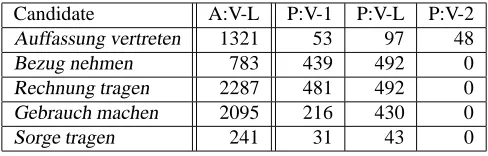
Passives show roughly the same distribution over the three word order models as actives. Verb-second cases make up for roughly half of all occurrences, verb-final for more than one third, and verb-first for about 10-12 %. One would thus expect passive forms of individual collocation candi-dates to be accordingly distributed over the three word or-der models. However, a subset of rather frequent candidates (cf. table 4) do not or very rarely appear in the verb-second model.
In the cases listed in table 4, the noun is not the true direct object of the verb, but rather a part of a complex predicate,
5
Table columns: f absolute frequency, det_type type of determiner, num number, order word order models. Cells: det_type: def definite, indef indefinite, null no art icle, dem demonstrative, poss possessive, quant quantify-ing; num: sg singular, pl plural; for word order types, see above.
Candidate A:V-L P:V-1 P:V-L P:V-2
Auffassung vertreten 1321 53 97 48
Bezug nehmen 783 439 492 0
Rechnung tragen 2287 481 492 0
Gebrauch machen 2095 216 430 0
Sorge tragen 241 31 43 0
Table 4: Collocations which do not appear in the verb-second passive: idiomatized collocations (complex predi-cates)
cf. Bezug nehmen (make reference). The Vorfeld po-sition, to the left of the finite verb in av2sentence, seems not to accept certain non-topical constituents; the nouns of lexicalized support verb constructinos seem to be equally in that position. In fact, most occurrences in table 4 are id-iomatic6; Auffassung vertreten (voice + opinion) has been
added to exemplify the behaviour of non-idiomatized col-locations. The instances which lack a v-2 passive are com-plex predicates. Similarly, they can neither be separated by a verbal element (er hat auf X Bezug genommen, but not *Bezug hat er auf X genommen). The only contexts where a verb second passive can occur are either contrastive ones (e.g. with a negated quantifier under emphasis: kéin Bezug
wird auf X genommen, or cases where the finite verb is a
modal auxiliary. This property can be used to detect these lexicalized SVCs, at least frequent ones.
4.
Evaluation
4.1. Work towards a gold standard for noun+verb collocation candidates
As with any linguistic data extraction task, a complete eval-uation implies both an assessment of precision and of re-call; for collocation extraction, (Evert/Krenn 2001) and (Evert 2005) have shown in detail how a full evaluation of lexical cooccurrence data can be carried out. Such an
6
Bezug nehmen (make reference), Rechnung tragen (take
MACRO passive_verb-final(0)
1 (
2 [pos = "(KOU(S|I)|PRELS)"] 3 []*
4 <np>
5 @[!pp & !ap & _.np_f not contains "ne" & _.np_f not contains "pron" 6 & _.np_f not contains "meas" & _.np_h != "@card@"]
7 [!pp & !ap & _.np_f not contains "ne" & _.np_f not contains "pron" 8 & _.np_f not contains "meas" & _.np_h != "@card@"]*
9 </np>
10 [!np & pos != "(\$.|KOUS|VMFIN)"]* 11 [pos = "V.*"]*
12 [pos = "VVPP"]
13 [lemma = "(werden|sein)"] 14 [pos = "V.*"]*
15 [pos = "(\$.|KON)"] 16 )
17 within s
Figure 1: Sample query for the extraction of noun+verb collocation candidates in passive subclauses
f | n_lemma | v_lemma | det_type | num |active_passive | order
---+---+---+---+---+---+---5 | Rechnung | ausstellen | def | Sg | passive | vlast 4 | Rechnung | ausstellen | indef | Sg | active | vlast 4 | Rechnung | ausstellen | def | Sg | active | vlast 1 | Rechnung | ausstellen | def | Pl | active | vlast 1 | Rechnung | bezahlen | indef | Sg | passive | vlast 1 | Rechnung | erstellen | def | Sg | active | vlast 1 | Rechnung | erstellen | def | Sg | passive | vlast 1387 | Rechnung | tragen | null | Sg | active | vlast
262 | Rechnung | tragen | null | Sg | passive | v-1 136 | Rechnung | tragen | null | Sg | passive | vlast
10 | Rechnung | tragen | def | Sg | active | vlast
Table 3: Collocation candidates withRechnung(account) and their morphosyntactic preferences
evaluation necessarily has to rely on a gold standard cor-pus; for (adjacent) pairs of attributive adjectives and nouns, (Evert/Krenn 2001) used manually annotated lists of can-didate data. For verb+complement pairs, a detailed recall analysis would require a full (manually corrected) parse. As we are in addition interested in the morphosyntactic properties of the collocation candidates extracted, a gold standard corpus should also include annotations of this kind. We are working on the creation of a data set of this kind, which should contain the following types of annota-tions:
Collocation: yes or no (coll=+
-);
Base lemma, collocate lemma: annotated to ease the comparison with the database of results (bs=..., ct=...);
Active/passive (ap=a
prespart
ps
pw
pzu
hzu
perfpart): active, active/present participle, “haben ... zu”; pas-sive/sein, passive/werden, passive/zu, past participle;
Syntactic function of NP/PP (na
nd
nn
np
nrefl
nil): object, indirect object (dat), subject, PP (with prep), reflexive, nil.
Individual annotations are given as features of the XML en-coding as shown in (1). We expect a first set of ca. 1000 annotated sentences to be available by mid-2008. Ad in-terim, we can only evaluate the precision of our tools.
(1) s snum=3 vn=na ap=a coll=+
bs=Taetigkeit ct=ausueben
Die Agentur übt ihre Tätigkeit
ausschließlich im Hinblick auf das Gemeinwohl aus. /s
4.2. Evaluating morphosyntactic property extraction As the tools consist of several components and are con-ceived to identify not only significant lexical cooccur-rences, but also their morphosyntactic properties, it makes sense to evaluate both these functions, separately.
We have evaluated the following components:
Identification of active vs. passive under the verb-second and verb-final word order model (’a/p’);
Identification of the correct chunk size to determine noun+verb collocation candidates (’chu’);
Identification of syntactically well-formed verb+complement groups (with accusative or da-tive complements, ’v+c.’).
For the evaluation we used small samples of three times fifty sentences randomly picked from our results database; the results were created from the 1992/93 issue of the
Frankfurter Rundschau. The three subsets concern
sen-tences classified as follows by our system:
verb-second, passive;
verb-final, active;
verb-final, passive.
The results are given in percentages, in table 5.
context type w.o. a/p. chu. v+c. verb-second, passive 100.0 100.0 96.0 96.0 verb-final, active 56.0 98.0 100.0 88.0 verb-final, passive 100.0 84.0 100.0 80.0 complete set, average 85.3 94.0 98.7 81.3
Table 5: Precision values for the identification of word or-der, active/passive, chunk size and verb+complement can-didates, for selected result subsets
A first observation is that actives seem to cause more prob-lems than passives. With respect to the word order classifi-cation, this is due to the fact that the tools mistakenly count many constructions with a verb-second modal or tense aux-iliary into the verb final class (example: er wird nicht nur das Umweltamt übernehmen, ’he will not only take over the office for environmental affairs’); this does not affect the correctness of the extraction of the verb+complement pairs, but it leads to a misclassification with respect to word order.
The relatively low figures for the identification of verb+complement pairs are due to two types of phenom-ena which are rather hard to cover in a setup without full parsing and detailed lexical resources, and which show the limitations of our approach based on flat annotations and slim preprocessing:
complex nominal phrases with embedded preposi-tional phrases the attachment of which can not be cal-culated in the tool setup: for example, in the sentence
[...] ob er Funktionen in einer der DDR-Parteien oder Massenorganisationen innegehabt hatte(’whether he had had a function in one of the DDR parties or mass organizations’), the verb+complement pair Funktio-nen innehaben(’have functions’) should be identified. Due to a chunking problem with the coordinated PP, the tool identifies Massenorganisation innehabenas a candidate.
complex predicates which are part of verb+complement groups: the sentence das Ar-beitsleben wird anhand unzähliger Utensilien in Erinnerung gerufen (’countless objects remind of workers’ life’, lit. ’workers’ life is with countless ob-jects brought-into-remembrance’) should produce the verb+complement pair Arbeitsleben + in Erinnerung rufen; as there is no lexical information about the multiwordin Erinnerung rufen, we get Arbeitsleben rufen as a result. The same phenomenon occurs with predicative constructions like gerecht werden
(’satisfy’), höher schrauben (’increase’), where only the verbal part of the construction is presented as part of the verb+complement group.
Our figures are somewhat lower than those reported by (Ritz 2006) for the identification of morphosyntactic fea-tures in prenominal participles. She reports a chunking quality of 96 to 99.5 % for this specific construction, and 99% precision in the identification of singular/plural, deter-mination etc. within noun groups in prenominal participles. Ritz’ work concentrated on a construction from which it is possible to extract these data with a very high precision, as much less variation is to be expected than in full sentences.
4.3. Evaluating the extraction of collocation candidates
We also have carried out a precision evaluation of the ex-traction of collocation candidates. This evaluation was done in the framework of the projectCollocations en Con-texte, on data extracted from the Acquis Communautaire
corpus.
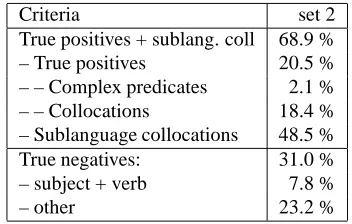
We analyzed two samples:
1. the 500 and the 774 most frequent verb+complement candidates (by lexical types);
2. the 2338 verb+complement candidate types for the 619 most frequent nouns of the Acquis Communau-tairecorpus, with a cooccurrence frequency of at least 47.
The candidates were evaluated according to the following classification:
true positives:
– complex predicates (e.g. Bezug nehmen(’make reference’));
– collocations (e.g. Zeugnis ausstellen(’make out + certificate’)) which are regularly used in gen-eral language;
syntactically valid verb + complement groups with a sublanguage-specific meaning (conceptual colloca-tions): e.g.pH-Wert einstellen(’set pH value’);
true negatives: irrelevant ad hoc combinations and misclassified verb + subject cooccurrences.
7We took the 1000 most frequent nouns and extracted all
Julia Ritz: “Collocation Extraction: Needs, Feeds and Re-sults of an Extraction System for German” , in: EACL 2006 Workshop on Multi-word-expressions in a multi-lingual context, (Trento: EACL) 2006
Julia Ritz, Ulrich Heid: “Extraction tools for collocations and their morphosyntactic specificities”, in:Proceedings of the Linguistic Resources and Evaluation Conference, LREC-2006, Genova, Italia, 2006 [CD-ROM]
Helmut Schmid: “Probabilistic Part-of-Speech Tagging Us-ing Decision Trees”. InProceedings of the International Conference on New Methods in Language Processing (NeMLaP). Manchester, UK, 1994
Violeta Sere¸tan, Eric Wehrli: “Multilingual collocation ex-traction: Issues and solutions”, in: Multilingual Lan-guage Resources and Interoperability. Proceedings of the COLING/ACL 2006 post-conference workshop., (Syd-ney/New Brunswick: COLING/ACL) 2006: 57 – 66 Frank Smadja: “Retrieving Collocations from Text:
Xtract”, in:Computational Linguistics, Vol. 19.1 (1993): 143 – 177 [= Special Issue on Using Large Corpora I] Ralf Steinberger et al.: “The JRC ACquis: A multilingual
aligned parallel corpus with 20+ languages”, in: Pro-ceedings of the 5th LREC Conference, Genova, 2006: 2142 – 2147