Improving the Inference of Implicit Discourse Relations via Classifying
Explicit Discourse Connectives
Attapol T. Rutherford
Department of Computer Science
Brandeis University
Waltham, MA 02453, USA
Nianwen Xue
Department of Computer Science
Brandeis University
Waltham, MA 02453, USA
Abstract
Discourse relation classification is an im-portant component for automatic discourse parsing and natural language understanding. The performance bottleneck of a discourse parser comes from implicit discourse rela-tions, whose discourse connectives are not overtly present. Explicit discourse connec-tives can potentially be exploited to collect more training data to collect more data and boost the performance. However, using them indiscriminately has been shown to hurt the performance because not all discourse con-nectives can be dropped arbitrarily. Based on this insight, we investigate the interaction be-tween discourse connectives and the discourse relations and propose the criteria for selecting the discourse connectives that can be dropped independently of the context without chang-ing the interpretation of the discourse. Extra training data collected only by the freely omis-sible connectives improve the performance of the system without additional features.
1 Introduction
The analysis of discourse-level structure has
re-ceived increasing attention from the field in recent
years (Feng and Hirst, 2012; Patterson and Kehler,
2013; Li et al., 2014). Discourse-level analysis is
typically concerned with relations between clauses
and sentences, linguistic units that go beyond
sen-tence boundaries. There are a few conceptions of
the discourse structure representation of a text such
as a tree (Mann and Thompson, 1988), or a graph
(Wolf et al., 2005). In the work we describe here,
we adopt the view of the Penn Discourse Treebank
(PDTB) (Prasad et al., 2008), which views a text as
a series of local discourse relations, each of which
consists of a discourse connective as a predicate
tak-ing two arguments. Syntactically, these two
argu-ments are typically realized as clauses or sentences.
The discourse connective (underlined) can either be
explicit
, as in (1), or
implicit
, as in (2):
(1)
[
The city’s Campaign Finance Board has
re-fused to pay Mr Dinkins $95,142 in matching
funds
]
Arg1because
[
his campaign records are
incomplete
]
Arg2.
(2)
[
So much of the stuff poured into its Austin,
Texas, offices that its mail rooms there simply
stopped delivering it
]
Arg1. Implicit=so
[
Now,
thousands of mailers, catalogs and sales pitches
go straight into the trash
]
Arg2.
Determining the sense of an explicit discourse
re-lation such as (1) is straightforward since “because”
is a strong indicator that the relation between the
two arguments is C
ONTINGENCY.C
AUSE. This task
effectively amounts to disambiguating the sense of
discourse connective, which can be done with high
accuracy (Pitler et al., 2008).
However, in the absence of an explicit discourse
connective, inferring the sense of a discourse
rela-tion has proved to a very challenging task (Park and
Cardie, 2012; Rutherford and Xue, 2014). The sense
is no longer localized on one or two discourse
con-nectives and must now be inferred solely based on
its two textual arguments. Given the limited amount
of annotated data in comparison to the number of
features needed, the process of building a
classi-fier is plagued by the data sparsity problem (Li and
Nenkova, 2014). As a result, the classification
ac-curacy of implicit discourse relations remains much
lower than that of explicit discourse relations (Pitler
et al., 2008).
One potential method for reducing the data
spar-sity problem is through a distantly supervised
learn-ing paradigm, which is the direction we take in
this work. Distant supervision approaches make
use of prior knowledge or heuristics to cheaply
ob-tain
weakly labeled data
, which potentially contain
a small number of false labels. Weakly labeled data
can be collected from unannotated data and
incor-porated in the model training process to supplement
manually labeled data. For our task, we can collect
instances of explicit discourse relations from
unan-notated data by some simple heuristics. After
drop-ping the discourse connectives, we should be able to
treat them as additional implicit discourse relations.
The approach assumes that when the discourse
connective is omitted, the discourse relation remains
the same, which is a popular assumption in discourse
analysis (Fraser, 2006; Schourup, 1999). This
as-sumption turns out to be too strong in many cases as
illustrated in (3):
(3)
[
I want to go home for the holiday
]
Arg1.
Nonetheless,
[
I will book a flight to
Hawaii
]
Arg2.
If “Nonetheless” is dropped in (3), one can no
longer infer the C
OMPARISONrelation. Instead,
one would naturally infer a C
ONTINGENCYrelation.
Dropping the connective and adding the relation as a
training sample adds noise to the training set and can
only hurt the performance. In addition, certain types
of explicit discourse relations have no corresponding
implicit discourse relations. For example, discourse
relations of the type C
ONTINGENY.C
ONDITIONare
almost always expressed with an explicit discourse
connective and do not exist in implicit relations. We
believe this also explains the lack of success in
pre-vious attempts to boost the performance of implicit
discourse relation detection with this approach.
(Bi-ran and McKeown, 2013; Pitler et al., 2009). This
suggests that in order for this approach to work, we
need to identify instances of explicit discourse
re-lations that closely match the characteristics of
im-plicit discourse relations.
In this paper, we propose two criteria for selecting
such explicit discourse relation instances:
omission
rate
and
context differential
. Our selection criteria
first classify discourse connectives by their
distribu-tional properties and suggest that not all discourse
connectives are truly optional and not all implicit
and explicit discourse relations are equivalent,
con-trary to commonly held beliefs in previous studies
of discourse connectives. We show that only the
freely omissible discourse connectives gather
addi-tional training instances that lead to significant
per-formance gain against a strong baseline. Our
ap-proach improves the performance of implicit
dis-course relations without additional feature
engineer-ing in many settengineer-ings and opens doors to more
so-phisticated models that require more training data.
The rest of the paper is structured as follows. In
Section 2, we describe the discourse connective
se-lection criteria. In Section 3, we present our
dis-course connective classification method and
experi-mental results that demonstrate its impact on
infer-ring implicit discourse relations. We discuss related
work and conclude our findings in Section 4 and 5
respectively.
2 Discourse Connective Classification and
Discourse Relation Extraction
2.1 Datasets used for selection
We use two datasets for the purposes of extracting
and selecting weakly labeled explicit discourse
re-lation instances: the Penn Discourse Treebank 2.0
(Prasad et al., 2008) and the English Gigaword
cor-pus version 3 (Graff et al., 2007).
The Penn Discourse Treebank (PDTB) is the
largest manually annotated corpus of discourse
re-lations on top of one million word tokens from the
Wall Street Journal (Prasad et al., 2008; Prasad et
al., 2007). Each discourse relation in the PDTB is
annotated with a semantic sense in the PDTB sense
hierarchy, which has three levels: C
LASS, T
YPEand
S
UBTYPE. In this work, we are primarily concerned
with the four top-level C
LASSsenses: E
XPANSION,
C
OMPARISON, C
ONTINGENCY, and T
EMPORAL.
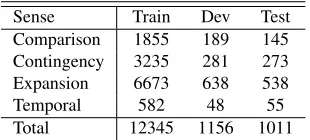
The distribution of top-level senses of implicit
dis-course relations is shown in Table 2. The spans
of text that participate in the discourse relation are
also explicitly annotated. These are called A
RG1 or
A
RG2, depending on its relationship with the
dis-course connective.
groundedness. The existence of a discourse relation
must be linked or grounded to a discourse
connec-tive. More importantly, this applies to not only
ex-plicit discourse connectives that occur naturally as
part of the text but also to implicit discourse
rela-tions where a discourse connective is added by
an-notators during the annotation process. This is
cru-cial to the work reported here in that it allows us to
compare the distribution of the same connective in
explicit and implicit discourse relations. In the next
subsection, we will explain in detail how we
com-pute the comparison measures and apply them to the
selection of explicit discourse connectives that can
be used for collecting good weakly labeled data.
We use the Gigaword corpus, a large unannotated
newswire corpus, to extract and select instances of
explicit discourse discourse relations to supplement
the manually annotated instances from the PDTB.
The Gigaword corpus is used for its large size of
2.9 billion words and its similarity to the Wall Street
Journal data from the PDTB. The source of the
cor-pus is drawn from six distinct international sources
of English newswire dating from 1994 - 2006. We
use this corpus to extract weakly labeled data for the
experiment.
2.2 Discourse relation extraction pattern
We extract instances of explicit discourse relations
from the Gigaword Corpus that have the same
pat-terns as the implicit discourse relations in the PDTB,
using simple regular expressions. We first
sentence-segment the Gigaword Corpus using the NLTK
sen-tence segmenter (Bird, 2006). We then write a set of
rules to prevent some common erroneous cases such
as
because
vs
because of
from being included.
If a discourse connective is a subordinating
con-junction, then we use the following pattern:
(Clause 1) (connective) (clause 2). Clause 1 and capitalized clause 2 are then used asArg1 andArg2respectively.
If a discourse connective is a coordinating conjunction or discourse adverbial, we use the following pattern: (Sentence 1). (Connective),(clause 2).
Sentence 1 and Clause 2 with the first word capitalized are used asArg1andArg2respectively.
Although there are obviously many other syntactic pat-terns associated with explicit discourse connectives, we use these two patterns because these are the only patterns
that are also observed in the implicit discourse relations. We want to select instances of explicit discourse relations that match the argument patterns of implicit discourse re-lations as much as possible. As restrictive as this may seem, these two patterns along with the set of rules allow us to extract more than 200,000 relation instances from the Gigaword corpus, so the coverage is not an issue.
2.3 Discourse connective selection and
classification criteria
We hypothesize that connectives that are omitted often and in a way that is insensitive to the semantic context are our ideal candidates for extracting good weakly la-beled data. We call this type of connectivesfreely omissi-ble discourse connectives. To search for this class of con-nectives, we need to characterize connectives by the rate at which they are omitted and by the similarity between their context, in this case their arguments, in explicit and implicit discourse relations. This is possible because im-plicit discourse connectives are inserted during annota-tion in the PDTB. For each discourse connective, we can computeomission rateandcontext differentialfrom an-notated explicit and implicit discourse relation instances in the PDTB and use those measures to classify and select discourse connectives.
2.3.1 Omission rate (OR)
We use omission rates (OR) to measure the level of optionality of a discourse connective. The omission rate of a type of discourse connective (DC) is defined as:
# occurrences of DC in implicit relations # total occurrences of DC
Our intuition is that the discourse connectives that have a high level of omission rate are more suitable as sup-plemental training data to infer the sense of implicit dis-course relations.
2.3.2 Context differential
The omission of a freely omissible discourse connec-tive should also be context-independent. If the omission of a discourse connective leads to a different interpreta-tion of the discourse relainterpreta-tion, this means that the explicit and implicit discourse relations bound by this discourse connective are not equivalent, and the explicit discourse relation instance cannot be used to help infer the sense of the implicit discourse relation. Conversely, if the con-texts for the discourse connective in explicit and implicit discourse relations do not significantly differ, then the ex-plicit discourse relation instance can be used as weakly labeled data.
semantic context of a discourse connective through a un-igram distribution over words in its two arguments, with Arg1 and Arg2 combined. We use Jensen-Shannon Di-vergence (JSD) as a metric for measuring the difference between the contexts of a discourse connective in implicit and explicit discourse relations. Computing a context dif-ferential of the discourse connective therefore involves fitting a unigram distribution from all implicit discourse relations bound by that discourse connective and fitting another from all explicit discourse relations bound by the same discourse connective. We choose this method be-cause it has been shown to be exceptionally effective in capturing similarities of discourse connectives (Hutchin-son, 2005) and statistical language analysis in general (Lee, 2001; Ljubesic et al., 2008).
The Jensen-Shannon Divergence (JSD) metric for dif-ference betweenPo, the semantic environments (unigram
distribution of words in Arg1 and Arg2 combined) in im-plicit discourse relations, andPr, the semantic
environ-ments in explicit discourse relations, is defined as:
JSD(Po||Pr) =12D(Po||M) +12D(Pr||M)
whereM = 1
2(Po+Pr)is a mixture of the two distribu-tions andD(.||.)is Kullback-Leibler divergence function for discrete probability distributions:
D(P||Q) =X
i
ln(PQ((ii)))P(i)
2.4 Discourse Connective Classification
Using the two metrics, we can classify discourse connec-tives into the following classes:
1. Freely omissible: High OR and low JSD 2. Omissible: Low non-zero OR and low JSD. 3. Alternating I: High OR and high JSD.
4. Alternating II: Low non-zero OR and high JSD. 5. Non-omissible: Zero OR. JSD cannot be computed
because the connectives are never found in any im-plicit discourse relations.
Classifying the connectives into these classes allow us to empirically investigate which explicit discourse rela-tions are useful as supplemental training data for deter-mining the sense of implicit discourse relations. We dis-cuss each type of connectives below.
2.4.1 Freely omissible discourse connectives
These are connectives whose usage in implicit and ex-plicit discourse relations is indistinguishable and there-fore suitable as a source of supplemental training data. These connectives are defined as having high omission rate and low context differential. This definition impliesthat the omission is frequent and insensitive to the con-text. “Because” and “in particular” in (4) and (5) are such connectives. Dropping them has minimal impact on the understanding the discourse relation between their two arguments and one might argue they even make the sen-tences sound more natural.
(4) We cleared up questions and inconsistencies very quickly because the people who had the skills and perspective required to resolve them were part of the task team. (WSJ0562)
(5) Both companies are conservative marketers that rely on extensive market research. P&G, in particular, rarely rolls out a product nationally before extensive test-marketing. (WSJ0589)
2.4.2 Omissible discourse connectives
They are connectives whose usage in implicit and ex-plicit discourse relations is indistinguishable, yet they are not often omitted because the discourse relation might be hard to interpret without them. These connectives are de-fined as having low omission rate and low context differ-ential. For example,
(6) Such problems will require considerable skill to re-solve. However, neither Mr. Baum nor Mr. Harper has much international experience. (WSJ0109) One can infer from the discourse that the problems re-quire international experience, but Mr. Baum and Mr. Harper don’t have that experience even without the dis-course connective “however”. In other words, the truth value of this proposition is not affected by the presence or absence of this discourse connective. The sentence might sound a bit less natural, and the discourse relation seems a bit more difficult to infer if “however” is omitted.
2.4.3 Alternating discourse connectives
They are connectives whose usage in implicit and ex-plicit discourse relations is substantially different and they are defined as having high context differential. Hav-ing high context differential means that the two argu-ments of an explicit discourse connective differ substan-tially from those of an implicit discourse. An example of such discourse connectives is “nevertheless” in (7). If the discourse connective is dropped, one might infer EXPAN -SION or CONTINGENCY relation instead of COMPARI -SONindicated by the connective.
We hypothesize that this type of explicit discourse re-lations would not be useful as extra training instances for inferring implicit discourse relations because they will only add noise to the training set.
2.4.4 Non-omissible discourse connectives
They are defined as discourse connectives whose omis-sion rate is close to zero as they are never found in im-plicit discourse relations. For example, conditionals can not be easily expressed without the use of an explicit discourse connective like “if”. We hypothesize that in-stances of explicit discourse relations with such discourse connectives would not be useful as additional training data for inferring implicit discourse relations because they represent discourse relation senses that do not exist in the implicit discourse relations.3 Experiments
3.1 Partitioning the discourse connectives
We only include the discourse connectives that appear in both explicit and implicit discourse connectives in the PDTB to make the comparison and classification possi-ble. As a result, we only analyze 69 out of 134 connec-tives for the purpose of classification. We also leave out 15 connectives whose most frequent sense acccounts for less than 90% of their instances. For example,sincecan indicate a TEMPORALsense or a CONTINGENCYsenseof almost equal chance, so it is not readily useful for gath-ering weakly labeled data. Ultimately, we have 54 con-nectives as our candidates for freely omissible discourse connectives.
We first classify the discourse connectives based on their omission rates and context differentials as discussed in the previous section and partition all of the explicit dis-course connective instances based on this classification. The distributions of omission rates and context differen-tials show substantial amount of variation among differ-ent connectives. Many connectives are rarely omitted and naturally form its own class of non-omissible discourse connectives (Figure 1). We run the agglomerative hier-chical clustering algorithm using Euclidean distance on the rest of the connectives to divide them into two groups: high omission and low omission rates. The boundary be-tween the two groups is around 0.65.
The distribution of discourse connectives with respect to the context differential suggests two distinct groups across the two corpora (Figure 2). The analysis only in-cludes connectives that are omitted at least twenty times in the PDTB corpus, so that JSD can be computed. The hierarchical clustering algorithm divides the connectives into two groups with the boundary at around 0.32, as should be apparent from the histogram. The JSD’s com-puted from the explicit discourse relations from the two
0 10 20 30 40
0.00 0.25 0.50 0.75 1.00
Omission rate
Count
Figure 1: Omission rates of the discourse connective types vary drastically, suggesting that connectives vary in their optionality. Some connectives are never omitted.
Explicit PDTB Weakly Labeled Explicit Gigaword
0 5 10 15
0.1 0.2 0.3 0.4 0.5 0.6 0.1 0.2 0.3 0.4 0.5 0.6
Context Differential (Jensen−Shannon Divergence)
Count
Figure 2: The distributions of Jensen-Shannon Diver-gence from both corpora shows two potential distinct clusters of discourse connectives.
corpora are highly correlated (ρ= 0.80,p <0.05), so we can safely use the Gigaword corpus for the analysis and evaluation.
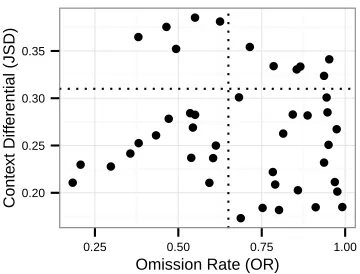
The omission rate boundary and context differential boundary together classify the discourse connectives into four classes in addition to the non-omissible connectives. When plotted against each other, omission rates and con-text differential together group the discourse connectives nicely into clusters (Figure 3). For the purpose of eval-uation, we combine Alternating I and II into one class because each individual class is too sparse on its own. The complete discourse connective classification result is displayed in Table 1.
Sense Train Dev Test
Comparison 1855 189 145 Contingency 3235 281 273 Expansion 6673 638 538
Temporal 582 48 55
Total 12345 1156 1011
Class Name OR JSD Connectives
0.25 0.50 0.75 1.00
●
● ●
● ● ● ●
●
● ●
● ●
● ●
● ● ● ●
●
0.54 0.55
0 5000 10000 15000 20000
Number of samples from distant supervision
Mean accur
acy r
ate
Discourse Connective Type ●
All Non−omissible High JSD
Low OR. Low JSD High OR. Low JSD
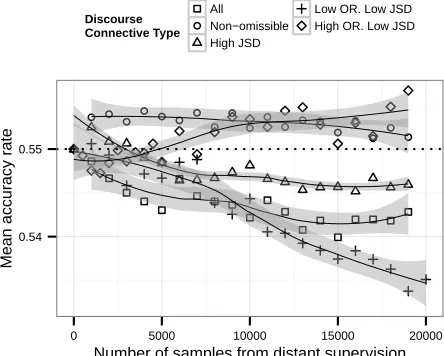
Figure 4: Discourse connectives with high omission rates and low context differentials lead to highest performance boost over the state-of-the-art baseline (dotted line). Each point is an average over multiple trials. The solid lines are LOESS smoothing curves.
connectives are used. In addition, it shows that on av-erage, the system with weakly labeled data from freely omissible discourse connectives continues to rise as we increase the number of samples unlike the other classes of discourse connectives, which show the opposite trend. This suggests that discourse connectives must have both high omission rates and low context differential between implicit and explicit use of the connectives in order to be helpful to the inference of implicit discourse relations.
Table 3 presents results that show, overall, our best per-forming system, the one using distant supervision from freely omissible discourse connectives, raises the accu-racy rate from 0.550 to 0.571 (p < 0.05; bootstrap test) and the macro-average F1 score from 0.384 to 0.405. We achieve such performance after we tune the subset of weakly labeled data to maximize the performance on the development set. Our distant supervision approach im-proves the performance by adding more weakly labeled data and no additional features.
For a more direct comparison with previous results, we also replicated the state-of-the-art system described in Rutherford and Xue (2014), who follows the practice of the first work on this topic (Pitler et al., 2009) in setting up the task as four binary one vs. other classifiers. The results are presented in Table 4. The results show that the extra data extracted from the Gigaword Corpus is particu-larly helpful for minority classes such asComparison vs. OthersandTemporal vs Others, where our current sys-tem significantly outperforms that of Rutherford and Xue (2014). Interestingly, theExpansion vs. Othersclassifier
Baseline Baseline features + extra data Expansion Precision 0.608 0.614
Recall 0.751 0.788
F1 0.672 0.691
Comparison Precision 0.398 0.449 Recall 0.228 0.276
F1 0.290 0.342
Contingency Precision 0.465 0.493 Recall 0.418 0.396
F1 0.440 0.439
Temporal Precision 0.263 0.385 Recall 0.091 0.091
F1 0.135 0.147
Accuracy 0.550 0.571
Macro-AverageF1 0.384 0.405
Table 3: Our current 4-way classification system outper-forms the baseline overall. The difference in accuracy is statistically significant (p <0.05; bootstrap test).
R&X Baseline Baseline (2014) + extra data
Comparison vs Others 0.397 0.410 0.380 Contingency vs Others 0.544 0.538 0.539 Expansion vs Others 0.702 0.694 0.679 Temporal vs Others 0.287 0.333 0.246
Table 4: The performance of our approach on the binary classification task formulation.
did not improve as theExpansion class in the four-way classification (Table 3).
3.3 Just how good is the weakly labeled data?
We performed additional experiments to get a sense of just how good the weakly labeled data extracted from an unlabeled corpus are. Table 5 presents four-way classifi-cation results using just the weakly labeled data from the Gigaword Corpus. The results show that the same trend holds when the implicit relations from the PDTB are not included in the training process. The freely omissible dis-course connectives achieves the accuracy rate of 0.505, which is significantly higher than the other classes, but they are weaker than the manually labeled data, which achieves the accuracy rate of 0.550 for the same number of training instances.Gigaword Gigaword Class only + Implicit PDTB Freely omissible 0.505 0.571
Omissible 0.313 0.527
Alternating I + II 0.399 0.546 Non-Omissible 0.449 0.554 All of above 0.490 0.547
Table 5: The accuracy rates for the freely omissible class are higher than the ones for the other classes both when using the Gigaword data alone and when using it in con-junction with the implicit relations in the PDTB.
0.550 0.555 0.560 0.565 0.570
2500 3000 3500 4000 Optimized
Number of samples from distant supervision
Mean accur
acy r
ate
Corpus
Gigaword
PDTB Explicit
Figure 5: The PDTB corpus leads to more improvement for the same amount of the data. However, Gigaword cor-pus achieves significantly better performance (p <0.05; bootstrap test) when both models are tuned on the devel-opement set.
and bootstrap test) for the same number of training in-stances combined with the implicit discourse relations. However, when the number of introduced weakly labeled data exceeds a certain threshold of around 12,000 in-stances, the performance of the Gigaword corpus rises significantly above the baseline and the explicit PDTB (Figure 4).
The relative superiority of our approach derives pre-cisely from the two selection criteria that we propose. The performance gain does not come from the fact that freely omissible discourse connectives have better cov-erage of all four senses (Table 6). When all classes are combined equally, the system performs worse as we add more samples although all four senses are covered. The coverage of all four senses is not sufficient for a class of discourse connectives to boost the performance. The two selection criteria are both necessary for the success of this paradigm.
4 Related work
Previous work on implicit discourse relation classifica-tion have focused on supervised learning approaches (Lin et al., 2010; Rutherford and Xue, 2014), and the distantly supervised approach using explicit discourse relations
Sense
Class Comp. Cont. Exp. Temp.
Freely omissible 2 6 10 1
Omissible 4 2 5 3
Alternating I 1 0 5 0
Alternating II 2 0 0 3
Non-omissible 0 3 3 2
Table 6: The sense distribution by connective class.
has not shown satisfactory results (Pitler et al., 2009; Park and Cardie, 2012; Wang et al., 2012; Sporleder and Las-carides, 2008) Explicit discourse relations have been used to remedy the sparsity problem or gain extra features with limited success (Biran and McKeown, 2013; Pitler et al., 2009). Our heuristics for extracting discourse relations has been explored in the unsupervised setting (Marcu and Echihabi, 2002), but it has never been evaluated on the gold standard data to show its true efficacy. Our distant supervision approach chooses only certain types of dis-course connectives to extract weakly labeled data and is the first of its kind to improve the performance in this task tested on the manually annotated data.
Distant supervision approaches have recently been ex-plored in the context of natural language processing due to the recent capability to process large amount of data. These approaches are known to be particularly useful for relation extraction tasks because training data pro-vided do not suffice for the task and are difficult to ob-tain (Riloff et al., 1999; Yao et al., 2010). For example, Mintz et al. (2009) acquire a large amount of weakly la-beled data based on the Freebase knowledge base and im-proves the performance of relation extraction. Distantly supervised learning has also recently been demonstrated to be useful for text classification problems (Speriosu et al., 2011; Marchetti-Bowick and Chambers, 2012). For example, Thamrongrattanarit et al. (2013) use simple heuristics to gather weakly labeled data to perform text classification with no manually annotated training data.
Discourse connectives have been studied and classi-fied based on their syntactic properties such subordinat-ing conjunction, adverbials, etc. (Fraser, 2006; Fraser, 1996). While providing a useful insight into how dis-course connectives fit into utterances, the syntactic clas-sification does not seem suitable for selecting useful dis-course connectives for our purposes of distant supervi-sion for our task.
5 Conclusion and Future Directions
dis-course connectives based on their distributional semantic properties and found that certain classes of discourse con-nectives cannot be omitted in every context, which plague the weakly labeled data used in previous studies. Our dis-course connective classification allows for the better se-lection of data points for distant supervision.
More importantly, this work presents a new direction in distantly supervised learning paradigm for implicit dis-course relation classification. This virtual dramatic in-crease in the training set size allows for more feature en-gineering and more sophisticated models. Implicit dis-course relation classification is now no longer limited to strictly supervised learning approaches.
Acknowledgments
This work was funded partially by the National Science Foundation via Grant No. 0910532 entitled “Richer Rep-resentations for Machine Translation”. All views ex-pressed in this paper are those of the authors and do not necessarily represent the view of the National Science Foundation. We also would like to thank Karl Pichotta and Gary Patterson for feedback on the manuscript and the three anonymous reviewers for their suggestions and comments.
References
Or Biran and Kathleen McKeown. 2013. Aggregated word pair features for implicit discourse relation dis-ambiguation. InProceedings of the 51st Annual Meet-ing of the Association for Computational LMeet-inguistics, pages 69–73. The Association for Computational Lin-guistics.
Steven Bird. 2006. Nltk: the natural language toolkit. In Proceedings of the COLING/ACL on Interactive pre-sentation sessions, pages 69–72. Association for Com-putational Linguistics.
Vanessa Wei Feng and Graeme Hirst. 2012. Text-level discourse parsing with rich linguistic features. In Pro-ceedings of the 50th Annual Meeting of the Association for Computational Linguistics: Long Papers-Volume 1, pages 60–68. Association for Computational Lin-guistics.
Bruce Fraser. 1996. Pragmatic markers. Pragmatics, 6:167–190.
Bruce Fraser. 2006. Towards a theory of discourse mark-ers. Approaches to discourse particles, 1:189–204. D Graff, J Kong, K Chen, and K Maeda. 2007. English
gigaword third edition, 2007, ldc 2007t07.
Ben Hutchinson. 2005. Modelling the similarity of discourse connectives. In Proceedings of the the 27th Annual Meeting of the Cognitive Science Society (CogSci2005).
Lillian Lee. 2001. On the effectiveness of the skew di-vergence for statistical language analysis. InArtificial Intelligence and Statistics, volume 2001, pages 65–72. Junyi Jessy Li and Ani Nenkova. 2014. Reducing spar-sity improves the recognition of implicit discourse re-lations. InProceedings of the 15th Annual Meeting of the Special Interest Group on Discourse and Dialogue (SIGDIAL), pages 199–207, Philadelphia, PA, U.S.A., June. Association for Computational Linguistics. Jiwei Li, Rumeng Li, and Eduard Hovy. 2014. Recursive
deep models for discourse parsing. InProceedings of the 2014 Conference on Empirical Methods in Natural Language Processing (EMNLP), pages 2061–2069. Ziheng Lin, Hwee Tou Ng, and Min-Yen Kan.
2010. A PDTB-Styled End-to-End Discourse Parser. arXiv.org, November.
N Ljubesic, Damir Boras, Nikola Bakaric, and Jasmina Njavro. 2008. Comparing measures of semantic simi-larity. InInformation Technology Interfaces, 2008. ITI 2008. 30th International Conference on, pages 675– 682. IEEE.
William C Mann and Sandra A Thompson. 1988. Rhetorical structure theory: Toward a functional the-ory of text organization.Text, 8(3):243–281.
Micol Marchetti-Bowick and Nathanael Chambers. 2012. Learning for microblogs with distant supervi-sion: Political forecasting with twitter. InProceedings of the 13th Conference of the European Chapter of the Association for Computational Linguistics, pages 603–612. Association for Computational Linguistics. Daniel Marcu and Abdessamad Echihabi. 2002. An
unsupervised approach to recognizing discourse rela-tions. In Proceedings of the 40th Annual Meeting on Association for Computational Linguistics, pages 368–375. Association for Computational Linguistics.
Andrew Kachites McCallum. 2002.
Mal-let: A machine learning for language toolkit. http://www.cs.umass.edu/ mccallum/mallet.
Mike Mintz, Steven Bills, Rion Snow, and Dan Jurafsky. 2009. Distant supervision for relation extraction with-out labeled data. InProceedings of the Joint Confer-ence of the 47th Annual Meeting of the ACL and the 4th International Joint Conference on Natural Lan-guage Processing of the AFNLP: Volume 2-Volume 2, pages 1003–1011. Association for Computational Lin-guistics.
Joonsuk Park and Claire Cardie. 2012. Improving im-plicit discourse relation recognition through feature set optimization. InProceedings of the 13th Annual Meet-ing of the Special Interest Group on Discourse and Dialogue, pages 108–112. Association for Computa-tional Linguistics.
of the Conference on Empirical Methods in Natural Language Processing. Association for Computational Linguistics.
Emily Pitler, Mridhula Raghupathy, Hena Mehta, Ani Nenkova, Alan Lee, and Aravind K Joshi. 2008. Eas-ily identifiable discourse relations. Technical Reports (CIS), page 884.
Emily Pitler, Annie Louis, and Ani Nenkova. 2009. Au-tomatic sense prediction for implicit discourse rela-tions in text. InProceedings of the Joint Conference of the 47th Annual Meeting of the ACL and the 4th International Joint Conference on Natural Language Processing of the AFNLP: Volume 2-Volume 2, pages 683–691. Association for Computational Linguistics. Rashmi Prasad, Eleni Miltsakaki, Nikhil Dinesh, Alan
Lee, Aravind Joshi, Livio Robaldo, and Bonnie L Webber. 2007. The penn discourse treebank 2.0 an-notation manual.
Rashmi Prasad, Nikhil Dinesh, Alan Lee, Eleni Milt-sakaki, Livio Robaldo, Aravind K Joshi, and Bonnie L Webber. 2008. The penn discourse treebank 2.0. In LREC. Citeseer.
Ellen Riloff, Rosie Jones, et al. 1999. Learning dictio-naries for information extraction by multi-level boot-strapping. InAAAI/IAAI, pages 474–479.
Attapol T. Rutherford and Nianwen Xue. 2014. Discov-ering implicit discourse relations through brown clus-ter pair representation and coreference patclus-terns. In Proceedings of the 14th Conference of the European Chapter of the Association for Computational Linguis-tics (EACL 2014), Gothenburg, Sweden, April. Lawrence Schourup. 1999. Discourse markers. Lingua,
107(3):227–265.
Michael Speriosu, Nikita Sudan, Sid Upadhyay, and Ja-son Baldridge. 2011. Twitter polarity classification with label propagation over lexical links and the fol-lower graph. InProceedings of the First workshop on Unsupervised Learning in NLP, pages 53–63. Associ-ation for ComputAssoci-ational Linguistics.
Caroline Sporleder and Alex Lascarides. 2008. Using automatically labelled examples to classify rhetorical relations: An assessment. Natural Language Engi-neering, 14(03):369–416.
Attapol Thamrongrattanarit, Colin Pollock, Benjamin Goldenberg, and Jason Fennell. 2013. A distant su-pervision approach for identifying perspectives in un-structured user-generated text. InProceedings of the Sixth International Joint Conference on Natural Lan-guage Processing, pages 922–926, Nagoya, Japan, Oc-tober. Asian Federation of Natural Language Process-ing.
Xun Wang, Sujian Li, Jiwei Li, and Wenjie Li. 2012. Im-plicit discourse relation recognition by selecting typ-ical training examples. In Proceedings of COLING
2012, pages 2757–2772, Mumbai, India, December. The COLING 2012 Organizing Committee.
Florian Wolf, Edward Gibson, Amy Fisher, and Meredith Knight. 2005. The discourse graphbank: A database of texts annotated with coherence relations.Linguistic Data Consortium.