CSEIT172342 | Received : 10 May 2017 | Accepted : 17 May 2017 | May-June-2017 [(2)3: 315-321]
International Journal of Scientific Research in Computer Science, Engineering and Information Technology © 2017 IJSRCSEIT | Volume 2 | Issue 3 | ISSN : 2456-3307
315
Implementation of RFID in Library Management System Based
On Internet of Things (IOT)
Md Tarique, Priya Rani, Vandana C.P.
Department ISE, New Horizon College of Engineering, Bangalore, Karnataka, India
ABSTRACT
Radio Frequency Identification (RFID) is better than barcodes as it provides applications that provide batch access, storage mass data and reprogramming. The cost of RFID is one of the major areas of concern to whether use it or not.
Keywords: RFID, Tags, Library management, sensors
I.
INTRODUCTION
The RFID technology is not something new. In 1948, Harry Stockman published a paper entitled ―Communication by means of reflected power‖ that discussed the theory and implementation of RFID. Other papers entitled ―Application of the microwave homodyne‖ and ―Radio transmission systems with Modula table passive responder‖ were published by Vernon and Harris, respectively (Vernon, 1952; Harris, 1960).
In solving the problem of insufficient storage in barcodes, one of the better solutions is the IC chip, such as a memory card or a smartcard, to store and identify information. These kinds of IC cards must utilize a contact to a power supply and must transmit data by way of a reader.
The contactless IC card technique transmits data between card and reader through radio waves. The power also can be converted from a radio wave or built-in batteries in cards. Because of the transport of power and information through radio waves, contactless auto-IDs are called radiofrequency identification (RFID) systems.
1.1 Architecture of IoT
Figure 1. Architecture of IoT 1.2 Elements of Iot
Iot has defined itself by the distinct elements contained within an IoT deployment, and the IEEE gives five main elements of an IoT setup as shown in the image below.
Figure 2. Elements of Iot
Identification plays a crucial role in naming as well as matching services with their demand. Examples of identification methods used for the IoT are electronic product codes and ubiquitous codes, etc.
Sensing is for collecting various data from related objects and sending it to a database, data warehouse or data center. The collected data is further analyzed to perform specific actions based on required services. The sensors can be of many types, either it can be humidity sensors, temperature sensors, wearable sensing devices, or mobile phones and many others.
Communication technologies connect different objects together to offer specific services. The communication protocols available for the IoT are: Wi-Fi, Bluetooth, IEEE 802.15.4, Z-wave, LTE-Advanced, Near Field Communication, ultra-wide bandwidth, Low-Power Wide-Area Network and emerging standards.
Computation, the hardware processing units, like microcontrollers, microprocessors, system on chips (SoCs), and software applications perform this task. Many hardware platforms like Arduino or Raspberry PI are developed and various software platforms are used. The cloud platform is a particularly a very important computational part of IoT, since it is very powerful in processing various data in real time as well as extracting all kinds of valuable information from the collected data. The services in IoT can be categorized into four
sections: identity-related services, information aggregation services, collaborative-aware services and ubiquitous services. Identity-related services
lay the foundation for other types of services, since every application mapping real-world objects into the virtual world needs to identify the objects first. Information aggregation services gather and summarize the raw information, which needs to be processed and reported. The obtained data are further utilized by the collaborative-aware services to make decisions and react accordingly.
Semantic means the ability to extract knowledge so as to provide the required services. This process usually includes: discovering resources, utilizing resources, modeling information, and recognizing and analyzing data. The commonly used semantic technologies are: resource description framework, web ontology language, efficient XML interchange, etc.
1.3 IoT Layers
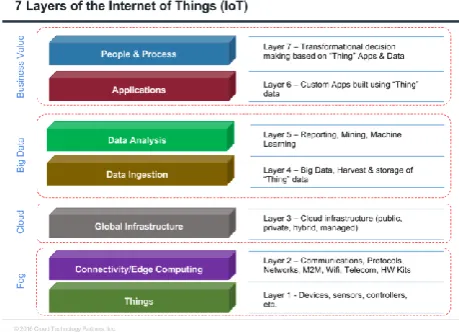
The Internet is used to send and receive information quickly between devices and people all around the world. While the Internet of Everything—or the concept that interconnects people, data, things and processes—is projected to play a rather large part in the future of technology, it still lacks development in terms of utility and security. There are mainly Seven layers for an Iot as shown in the image below.
1.4 IoT in Library Management
The librarian of many Universities, containing more than 5000 books, faces various challenges. Some of them may be:
library record is maintained in Excel sheets, making it difficult to manage and is prone to loss. In case of new arrival, it is very difficult to inform students and faculty about new books of their particular interests.
Searching a book: It’s a difficult task locate a book or literature which normally needs maintenance of their location in excel sheets subsequently searching themin those sheets.
Issuance of books: The issuance of book is managed
by hand. The librarian has to enter the book details in excel sheets to issue a book.
Late arrivals: Late arrivals are also managed herself by the librarian. There is no mechanism to automatically contact or inform the defaulter in case of getting late.
The use of Management system in Libraries may avoid these problems by providing it with certain functionalities, such as:
Automation of library management system: It provides a smart and convenient approach to automate library management at Indus University. Different tasks such as Add book, issue book, late return, book tracking etc. are automated using RFID tags.
Context awareness: The user’s past history is
logged in the form of session records. A clustering algorithm is applied on the user’s history to determine his preferences and interests. Using the preferences, the system helps the end user to accurately get the information they desire.
Tracking: The library books are identified with RFID tags. It helps in tracking the current location of books in the library i.e. where the books are located Alerts: The system keeps end users updated about the new arrivals in library based on their preferences determined using clustering algorithm.
2. Technology
RFID is radio frequency identification. RFID are thought of as an advance of barcode. RFID can be used to identify, track, sort or detect library holdings at the circulation desk and in the daily stock maintenance. Radio Frequency Identifier (RFID) systems consist of two types of components:-
a) RFID tags b) RFID readers
RFID tags are comprised of a small integrated circuit for storing information and an antenna used for communication. There are tags - Active RFID tags have a transmitter and their own power source (typically a battery). The power source is used to run the circuit and to broadcast a signal to a reader. Passive tags have no battery. Instead, they draw power from the reader, which sends out electromagnetic waves that induce a current in the tag's antenna. RFID readers are capable of reading the information stored at non line-of-sight RFID tags placed in their vicinity and communicate it through a wired or wireless interface to a central database.
The RFID based library system consist of smart RFID labels, hardware and software which provides libraries with more effective way of managing their collections while providing greater customer service to their patrons.
The technology works through paper - flexible and thin smart labels, approximately 2‖X2‖ in size, which allows it to be placed on the inside cover of each book in a library. The tag consists of an antenna and a tiny chip which stores data including a unique number to identify each item.
With a barcode label, this does not store any information. These smart labels are applied directly on library books and can be read with an RFID interrogator/scanner.
The information contained on microchips in the tags affixed to library materials is read using radio frequency technology regardless of item orientation or alignment. It provides a contact less data link, without need for line of sight.
The staff checkout station is used when patrons prefer staff assistance. The book drop allows returned books to be processed instantly by updating the database the moment the items pass through the chute. The shelving station speeds the process of sorting the returned books for re-shelving. The shelf scanner allows library staff to take inventory and find wrongly shelved books without having to pull the books off the stacks.
Benefits of using RFID: With RFID, Line of sight is not essential for reading the tags with the scanner, therefore, the books require much less human handling to be read and processed. A middleware or Server software integrates the reader hardware with the existing Library Automation Software for seamless functioning of circulation.
RFID has no concerns about harsh environments that restrict other auto ID technologies such as bar codes. Tags have a discrete memory capacity that varies from 96 bits to 2kbytes.
RASPBERRY PI:
A Raspberry Pi is a credit card-sized computer originally designed for education. Goal was to create a low-cost device that would improve programming skills and hardware understanding. It may be operated with any generic USB computer keyword and mouse. The first generation (Raspberry Pi 1 Model B) was released in February 2012. It was followed by a simpler and inexpensive model Model A. In 2014, the foundation released a board with an improved design in Raspberry Pi 1 Model B+. These boards are approximately credit-card sized and represent the standard mainline form-factor. Improved A+ and B+ models were released a year later. A cut down computer module was released in April 2014, and a Raspberry Pi Zero with smaller size and reduced input/output (I/O) and general purpose input output (GPIO) capabilities was released in November 2015 for US$5. The Raspberry Pi 2 which added more RAM was released in February 2015. Raspberry Pi 3 Model B released in February 2016 is bundled with bluetooth and wifi. As of January 2017, Raspberry Pi 3 Model B is the newest mainline Raspberry Pi. RPi boards
ARDUINO:
Arduino is an open-source platform used for building electronics projects. Arduino consists of both a physical programmable circuit board (referred as a microcontroller) and a piece of software, or IDE (Integrated Development Environment) that runs on your computer. Arduino used to write and upload computer code to the physical board.
The Arduino does not need a separate piece of hardware (called a programmer) in order to load new code onto the board – simply use a USB cable. Additionally, the Arduino IDE uses a simplified version of C++, making it easier to learn to program. Finally, Arduino provides a standard form factor that breaks out the functions of the micro-controller into a more accessible package.
SENSOR:
A sensor is a device that detects and responds to some input from the physical environment. The input could be light, heat, motion, moisture, pressure, or any one of a great number of other environmental phenomena. The output is generally a signal that is converted to human-readable display at the sensor location or transmitted electronically over a network for reading or further processing.
Related Works
In [1] it is mentioned that an integrated module that monitors books stored in the shelves, easy circulation, theft control, etc.
off by center by 60mm towards the front edge suppresses EMI further.
To check SAR three different Human models were used a child, a pregnant women & an adult man. After different observations it is found that the Maximum SAR values for child 0.58 w/kg, for women 0.38w/kg for man 0.51 w/kg and max SAR in body part is the arm, the most used body part near the cabinet. Wooden cabinet SAR values reduced by a factor of 10 as compared to those obtained for the metallic cabinet.
In[2] The idea was to use the passive RFID technology at UTF frequencies in order to develop an intelligent low-cost library management system is to reduce running cost & improve productivity. Objectives for this technology are self check in and out, automated stock taking process, Improve productivity at workplace by eliminating tedious & paper bond process, Reduce cost due to high productivity & efficient working environment and Theft control.
In order to achieve the general objectives of the project, the tasks has been undertaken to design and build: A check-out counter where the library user can check out, A book return counter or a drop box where a library user can return books without the help of librarian and A portable RFID - enable system which is activated when a non-properly checked out books are about to exit the library entrance. Using passive UHF RFID system interfaced with computer technology via a user friendly and portable GUI. An antenna is installed on each shelf of the cabinet with maximum readability of RFID tag on the books.
An antenna can be Far field and Near field. Far field has larger range which allows reading tags from a relatively large distance (4-7m) depending on the tag type, readers sensitivity, antenna input power and environment. The disadvantage is spill over energy to nearby shelf and radiation to users. While Near field has shorter range of 10cm in with difficulty to design and read. Two types of antenna are used in this analysis. A simple Microstrip line terminated by a matched load and a patch antenna printed on the FR-4 substrate were designed as an isolated radiated element using the HFSS. It is possible to design a smart library cabinet considering both efficiency in book scanning as well as its compliance with environment factor like human exposure. Microstrip antennas used to reduce spill over
electric field to other shelf while Patch antenna is for best exposure to human. But the exposure to human for Microstrip is lower than the exposure guideline (2w/kg) so acceptable.
In [2] an ongoing pilot project where RFID technology finds a useful and potentially promising application in the field of library science. Attempt to replace the barcode system with an intelligent library management system to improve productivity and reduce labor cost. Goals of this proposed system is concaving books on shelves with push of a button theft control and time efficient. The barcode or magnetic tape used today requires line of sight and time consuming circulation processing of each individual book. Also delay in work for both library staff and users. Also barcode technology has a limited read range is inappropriate for automated stock taking or for quick locating misplaced items- declared cost resulting in significant replacement costs. We can use RFID with multiplexer to overcome all those problems.
The GUI was developed for the betterment of library staff and on a daily basis. GUI fully interfaces with hardware & database server which provides flexibility and transparency to the library IT administrator. A Nearfield antenna is use for check in checkout for cabinet shelf avoiding false identification.. The antenna design should be optimized both in terms of tag readability and reduced SAR thus the antennas are simulated using SEMCAD-X to calculate SAR. The antenna is 50-ohm microchip line built on foam which is terminated by a 50-ohm resistive load. The microstrip was excited by an N-type female connector perpendicular to the strip. The length of the microstrip was 96cm: The return interest was high and the highest power level that could be applied to the antenna input was 27 dbm. The tags were placed both horizontally and then vertically inside the cover of each book in three different position bottoms, middle & top, the input power was set to 27dBm- the effectiveness of the near field antenna to detect and identify the books in all the possible orientation.
The result showed that the microstrip used could be improved by adding a second output port terminated with a matched load whereas the microstrip width was reduced from 5cm to 3.8cm
used to develop an intelligent low-cost library management system, reduces labor, running cost & improves productivity at work plan. Goals of this can be cost effectiveness, improved management, and reduction of labor. A smart RFID bookshelf with computer technology via a user-friendly & portability & versatile GUI: Shelf check out for library user , book drop box whenever user is willing to return the book and theft control. Focuses on smart cabinet using passive UHF RFID system interfaced with computer tech via casing a user friendly & portable GUI . An antenna installed in each shelf for max readability of the RFID tags in the books.
Either far field or near field antenna can be used. Using passive UHF RFID system interfaced with computer technology via a user friendly and portable GUI. An antenna is installed on each shelf of the cabinet with maximum readability of RFID tag on the books. An antenna can be Far field or Near field. Far field provides larger range is there which allows reading tags from a relatively large distance (4-7m) .The disadvantage is spill over energy to nearby shelf and radiation to users. Near field provides shorter range of 10cm with difficulty to design and read. Antenna can be present either at the bottom of the shelf or back of the shelf or the side wall. It is possible to design a smart library cabinet considering both efficiency in book scanning as well as its compliance with environment factor like human exposure. Different human model of different gender, age and BMI was used to check SAR for both the antennas. The resolution of the models was 1mm*1mm*1mm. Microstrip antennas used to reduce spill over electric field to other shelf. Patch antenna is for best exposure to human. But the exposure to human for Microstrip is lower than the exposure guideline (2w/kg) so acceptable.
In[5] RFID systems are divided into different frequency system, high frequency system, ultra high frequency system, microwave system etc. Their identification distance, R/W character, tag size, anti-collision character, propagation character etc. The general identification distance is 3m, since there are many tag on the same zone, it is fitted to adopt LF system. Character of passive microwave tag is close to UTF tag, but it has higher cost. Active microwave electric tag has distant identification distances but it has larger volume and higher cost & identification distance
gradually shorter with the consumption of electric change of battery.
Tags of two types can be used Active and Passive, Active comes with battery energy so reaches more distance - but limited life and high price, while Passive has no battery. It receives R/W electromagnetic signal to communicate, no maintenance required, its light weight, small volume, long life & cheap but limited transmitting distance.
The four principles of information identification: 1) Efficiency - within short time store & access info. 2) Economy - limited interested, low cost aggregation cost.
3) Reliability - secure & authenticated access & storage. 4) Actionability – does not disturb other operations and be compatible.
The tag can contain info like, bookid , book information, id of library, information of bookshelf, information of borrower, date of borrowing , other content. Library management system based on RFID realizes organic connection RFID tech & library management methods, which provides effective techniques for the management of library, automated so easy for staff as well as for users. Library intelligent management system can function independently which reflects intelligence.
PROPOSED SYSTEM:
A smart library system using Internet of things (IOT) Controls and monitors the following components a) Temperature and humidity.
b) Motion detection.
The Arduino Ethernet is used to eliminate the use of a personal concept keeping the cost of the overall system to a minimum. Devices such as light switches, temperature sensors, humidity sensors, intrusion detection sensors, smoke/gas sensors and sirens have been integrated in the system. This system helps to do complete monitoring and control functionalities of the library environment using wireless sensors and actuators modules. Multiple appliances can be controlled and monitored using IOT in proposed system.
system, high frequency system, ultra high frequency system, microwave system etc. Their identification distance, R/W character, tag size, anti-collision character, propagation character etc. The general identification distance is 3m, since there are many tag on the same zone, it is fitted to adopt LF system. A 50 ohm microchip line terminated by a 50 ohm resistive load can be the antenna used in this system with a Graphic User Interface (GUI) for the betterment of library staff and on a daily basis. GUI fully interfaces with hardware & database server which provides flexibility and transparency to the library IT administrator.
The system will also contain motion and temperature sensor to trigger the outlets as programmed. The Arduino will be instructed using Assembly language programming while SQL will be used for the Database. All of these connected together using a centralized processor and a common Graphic User Interface.
II.
CONCLUSION
RFID tags provided with the characteristics of batch access, storage mass data, and the capability to be reprogrammed are better than barcodes. RFID can help the libraries to manage book collections accurately and to extend their services.
RFID involves various techniques that over-exceed the ability of librarians andlibrary factories. Replacing barcodes and magnetic strips withRFID has the advantages of self-check-in/out, theft detection, rapid inventory, andfinding incorrectly shelved materials. Not only will RFID realize precise collections management, but will also achieve real-time services.RFID tags include the characteristics of storage mass data, batch access, and the capabilities to be reprogrammed.
III.
REFERENCES
[1]. PBhuptani, M. and Moradpour, S. (2005), RFID Field Guide: Deploying Radio Frequency Identification Systems, Sun Microsystems/Prentice-Hall, Upper Saddle River, NJ.
[2]. Chachra, V. (2003), ―Experiences in implementing the VTLS RFID solution in a multi-vendor environment‖, paper presented at
World Library and Information Congress: 69th IFLA General Conference and Council.
[3]. Kleist, R.A., Chapman, T., Sakai, D. and Jarvis, B. (2004), RFID Labeling: Smart Labeling Concepts & Applications for the Consumer Packaged Goods Supply Chain, Printronix, Irvine, CA.