Computing Thresholds of Linguistic Saliency
*Siaw-Fong Chunga , Kathleen Ahrensa Chung-Ping Chengb, Chu-Ren Huangc , Petr Šimonc,d
a
Graduate Institute of Linguistics, National Taiwan University, No.1, Roosevelt Road, Section 4, Taipei 106, Taiwan.
bDepartment of Psychology, National Chengchi University, No. 64, ZhiNan Road, Section 2, Taipei
11605, Taiwan.
cInstitute of Linguistics, Academia Sinica, No. 128, Academia Road, Section 2, Nangang, Taipei 115,
Taiwan.
dTIGP-CLCLP, Institute of Linguistics, Academia Sinica, No. 128, Academia Road, Section 2,
Nangang, Taipei 115, Taiwan.
[email protected], [email protected], [email protected], [email protected],[email protected]
Abstract. We propose and test several computational methods to automatically determine possible saliency cut-off points in Sketch Engine (Kilgarriff and Tugwell, 2001). Sketch Engine currently displays collocations in descending importance, as well as according to grammatical relations. However, Sketch Engine does not provide suggestions for a cut-off point such that any items above this cut-off point may be considered significantly salient. This proposal suggests improvement to the present Sketch Engine interface by calculating three different cut-off point methods, so that the presentation of results can be made more meaningful to users. In addition, our findings also contribute to linguistic analyses based on empirical data.
Keywords: saliency, cut-off point, threshold, collocations
1.
Introduction
All lexical resources, at the point of their design, will take into consideration whether the resources are useful to a target group. For example, WordNet (Fellbaum, 1998) was originally designed for psychologists, but later was used extensively by computational linguists. Similarly, corpora such as British National Corpus (BNC), the Academia Sinica Corpus of Mandarin Chinese (Chen et al., 1996) and the Gigaword corpus were also designed for the use of target groups such as lexicographers, linguists, language teachers, language learners, etc. These corpora usually provide some forms of statistical analyses so that users will be able to summarize their research results quickly. For example, many corpora provide collocational measures such as Mutual Information values (Church and Hanks, 1989) so that collocated words can be sorted according to their frequency of co-occurrence. Sketch Engine (Kilgarriff and Tugwell, 2001) is a powerful resource which displays search summary in collocated patterns, as well as according to grammatical relations. However, like many other resources, Sketch Engine is unable to determine which of the results in the list are meaningful linguistically.
information regarding which of the collocational patterns are significantly different from the bottom words. In this paper, a research question is asked, i.e., whether or not one can select top rankings from linguistic results using principled measures. This selection of top rankings is useful because it will provide an automatic identification of significant linguistic results from the data. This also involves deciding which significant results are likely to be prototypically used in certain linguistic environments (Rosch and Mervis, 1975). In this paper, we propose three methods in which the threshold of linguistic listings can be extracted. In the following section, data presentation in Sketch Engine is first discussed.
2.
Data Presentation in the Sketch Engine
Sketch Engine is a system that provides the collocations of words according to grammatical relations. It has been used to analyze large scale corpora data such as the British National Corpus (BNC) and the Chinese Gigaword corpus. The Chinese Sketch Engine was created by Kilgarriff, Huang, Rychly et al. (2005). It has the same function as the English Sketch Engine, which also arranges collocates for query words in grammatical relations. For example, when a query word is searched in Sketch Engine, the system will return with the collocates for this query word. Sketch Engine then arranges them in grammatical relations such as ‘objects of the query word,’ ‘subjects of the query word,’ ‘modifiers of the query word,’ etc.
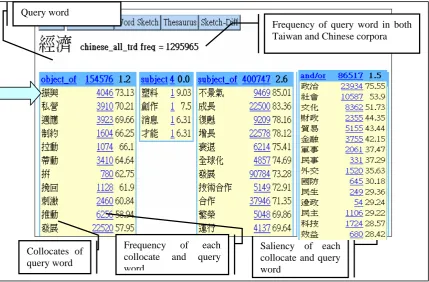
The following Figure 1 shows an example of the search result for 經濟jing1ji4 ‘economy’ in the Chinese Sketch Engine.
Saliency of each collocate and query word
Frequency of query word in both Taiwan and Chinese corpora Query word
Collocates of query word
Frequency of each collocate and query word
Figure 1: Collocates for the Query Word 經濟 jing1ji4 ‘Economy’ in the Chinese Sketch
In Figure 1, the query word and its frequency in the entire Gigaword corpus are shown (i.e. 1,295,965 instances). The frequency for pair of collocates such as 經濟jing1ji4 ‘economy’ and
振興zheng4xing4 ‘to give life to’ under the ‘object-of’ relation (arrow in Figure 1) is given. In
this case, it is 4,046 (in the second column for each relation), indicating that 經濟 jing1ji4
‘economy’ appears as the ‘object of’ the verb 振興zheng4xing4 ‘to give life to’ 4046 times in the whole Gigaword corpus.
In addition to frequency, Sketch Engine provides an additional score for the ranking of saliency of collocates. This is because Kilgarriff and Tugwell (2001) suggest that frequency alone may not be a reliable score because frequency of the collocates are relative to the number of both words in the whole corpus. Therefore, they suggest using a more reliable account to standardize all frequencies for the collocations based on the overall performance of the collocates in a particular condition. However, while the presentation of saliency in Sketch Engine is robust and useful, it does not indicate which of the collocates in each relation are meaningfully salient.
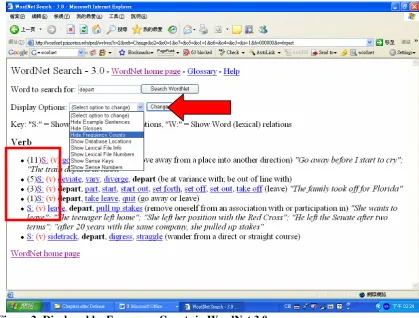
WordNet (http://wordnet.princeton.edu/) can also display search results based on a “high frequency count” (see Figure 2).
Figure 2: Displayed by Frequency Counts in WordNet 3.0
This frequency count is ordered from the most frequent sense to the least frequent sense (Tengi, 1999) that is computed using a semantic concordance created by Landes, Leacock and Tengi (1999) based on two corpora – the Brown corpus and Stephen Crane’s novella entitled
The Red Badge of Courage.1
senses. Therefore, there is possibly a threshold after the first sense to make the first sense more distinctive in use than the others. Therefore, this paper suggests that there should be some objective methods which can help determine the threshold of linguistic listings as such. This paper suggests three methods to find out how many of the top few results should be considered significant in Sketch Engine. These methods are elaborated below.
3.
Computing Thresholds of Linguistic Listings
This paper will discuss three methods. Methods One and Two are based on the characteristics of the distributional listings, which usually follow Zipf’s law (Zipf, 1932). Therefore, these two methods will be discussed together in section 3.1 below. Section 3.2 will discuss Method Three, which is different from both methods one and two. Section 4 will present results from all three methods.
3.1.Methods One and Two
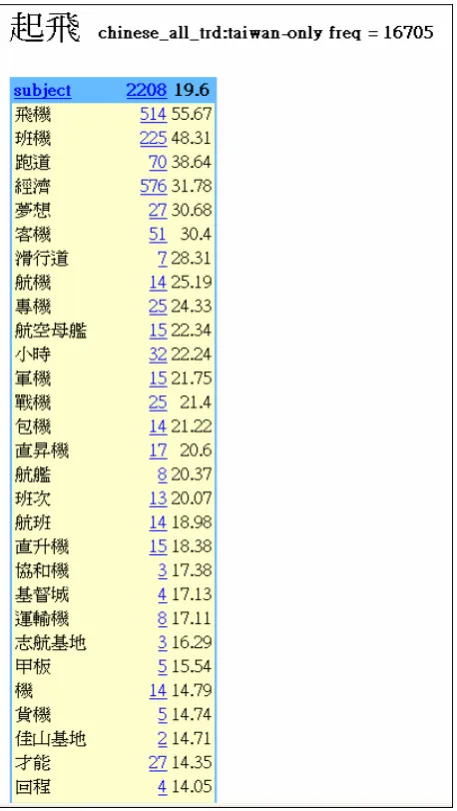
Zipf’s law states that the most frequent value is most likely to be twice as much as the second most frequent value. For example, when a sample size is large enough, the result of a frequency listing is likely to be in a distributional pattern. For instance, the expression 起飛 qi3fei1
‘takeoff’ in (1) below, has the following collocates from the Sketch Engine (Figure 3).
(1) 但 在 台灣 經濟 起飛 後 (Central News Agency of Taiwan)
dan4 zai4 tai2wan1 jing1ji4 qi3fei2 hou4
but at Taiwan economy takeoff after “But after the economy of Taiwan takeoffs…”
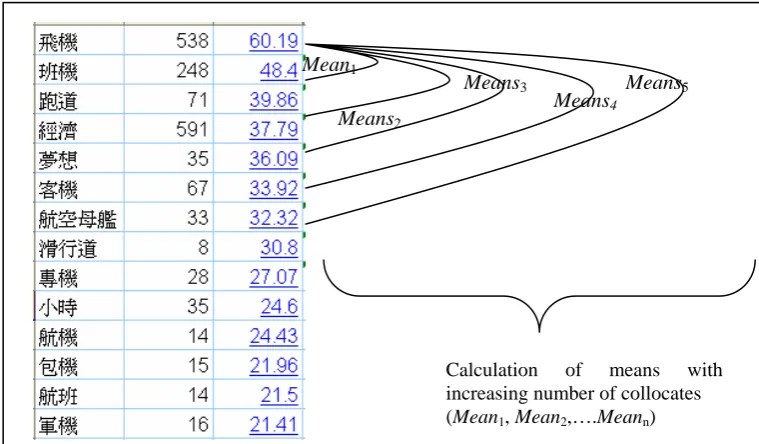
The collocates for起飛 qi3fei1 ‘takeoff’ which have similar grammatical relations with 經濟
jing1ji4 ‘economy’ (the ‘subject’ relation) can be seen in Figure 3 (such as 飛機 fei1ji1
Figure 3: Collocates of ‘Subjects’ of 起飛 qi3fei1 ‘takeoff’ in the CNA in the Sketch Engine
Figure 4: Pattern of Distributional Data for 起飛qi3fei1 ‘takeoff’ following Zipf’s Law
The function for the type of graph in Figure 4 is such that in (2), where any point in the graph will be (x, f(x)). x is the rank of Chinese subjects on the x-axis and f(x) is the function to calculate the value on the y-axis.
) ( )
(x b xa
f = (2)
Using this formula, Methods One and Two will find a point that separates any distributional listing into two lists, i.e., significant and insignificant lists. The purpose of doing this is to find out which among the list should be considered significant and which to be insignificant.
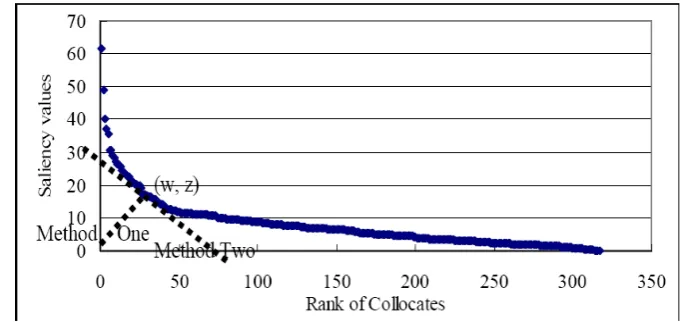
Figure 5: Three Ways to find Threshold Values
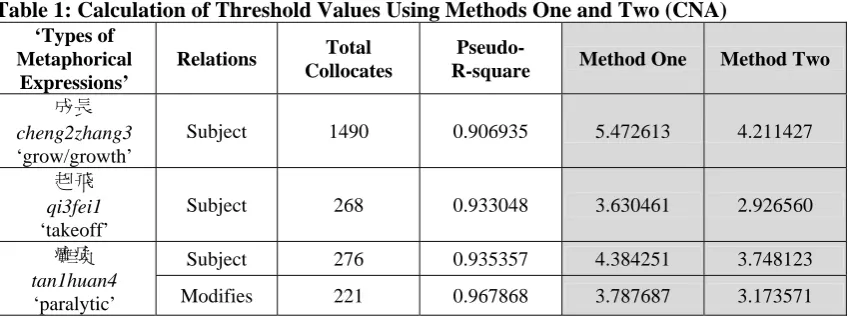
Methods One and Two are based on the assumption that there is a point where the curve changes the most when it goes down the y-axis to the x-axis. Methods One calculates the position of (w, z) where it is of shortest distance from (0, 0). This is because when every line departs from the starting point of (0,0), there will be a line that is the shortest distance from the curve. The point where this line touches the curve is the point where the curve changes the most from the y-axis to the x-axis.
5.
Conclusion
In this paper we have proposed three methods to help linguists ascertain which distributional patterns are linguistically meaningful. We suggest calculating a cut-off point for the saliency listings in Sketch Engine, since most empirical studies do not know where to stop when listing results. Most studies tend to list the top few items, and the number of the top few depends on the choice of the researchers. If there are criterion-based methods to find out the thresholds for the linguistic listings, subjectivity will be reduced in terms of choosing which collocational patterns are selected. Furthermore, most lexical resources provide wordlists according to different criteria such as frequency, Mutual Information values, collocation, saliency values, etc. However, a cut-off point for any one of these lists has yet to be suggested. This paper, therefore, deals with the general problems of these listings and suggests three possible ways to solve the problem.
Future work suggests incorporation of the calculation of threshold values in lexical resources such as Sinica Corpus, the English and Chinese Sketch Engine, etc. This proposed idea should contribute to computational linguistic research, linguistic research that relies on statistical methods to analyze linguistic data, and researchers who need to run psycholinguistic experiments related to word meaning.
References
Chen, K.-J. and C.-R. Huang. 1996. SINICA CORPUS: Design Methodology for Balanced Corpora. Proceedings of the Eleventh Pacific Asia Conference on Language, Information
and Computation, 167-176.
Church, K. W. and P. Hanks. 1989. Word Association Norms, Mutual Information and Lexicography. In the Proceedings of the. 27th Annual Meeting of ACL, Vancouver, 76-83 Fellbaum, C. ed., 1998. WordNet: An Electronic Lexical Database. MIT Press.
Kilgarriff, A. and D. Tugwell. 2001. WORD SKETCH: Extraction and Display of Significant Collocations for Lexicography. In the Proceedings of the ACL Workshop on
COLLOCATION: Computational Extraction, Analysis and Exploitation, 32-38.
Kilgarriff, A., C.-R. Huang, P. Rychly, S. Smith, D. Tugwell. 2005. Chinese Word Sketches. In
the Proceedings of Asialex, Singapore.
Landes, S., C. Leacock, and R. I. Tengi. 1999. Building Semantic Concordance. In C. Fellbaum. Ed., WordNet: An Electronic Lexical Database. MIT: Cambridge, Mass. and London, England, 199-216.
Rosch, E. and C. B. Mervis. 1975. Family Resemblances: Studies in the Internal Structure of Categories. Cognitive Psychology, 7, 573-605.
Tengi, Randee I. 1999. “Design and Implementation of the WordNet Lexical Database and Searching Software.” In Christiane Fellbaum. Ed., WordNet: An Electronic Lexical
Database. MIT: Cambridge, Mass. and London, England, 105-127.
Zipf, George Kingsley. 1932. Selected Studies of the Principle of Relative Frequency in