Saxon: An Extensible Multimedia Annotator
Mark A. Greenwood, Jos´e Iria, Fabio Ciravegna
Department of Computer Science University of Sheffield Sheffield, S1 4DP, UK
{m.greenwood, j.iria, f.ciravegna}@dcs.shef.ac.uk Abstract
This paper introduces Saxon, a rule based document annotator that is capable of processing and annotating several document formats and media, both within and across documents. Furthermore, Saxon is readily extensible to support other input formats due to both it’s flexible rule formalism and the modular plugin architecture of the Runes framework upon which it is built. In this paper we introduce the Saxon rule formalism through examples aimed at highlighting it’s power and flexibility.
1.
Introduction
The application of natural language processing (NLP) to real-world data and tasks is complex, and has become sig-nificantly more so since web and multimedia data became commonplace. Novel, more complex tasks have emerged that: 1) work on different kinds of text (e.g. web peo-ple disambiguation (Artiles et al., 2007), sentiment anal-ysis (Strapparava and Mihalcea, 2007)), 2) require taking into account not only linguistic features but also the un-derlying structure of the data (see, for instance, Minkov et al. (2006) and Zhu et al. (2007)), and 3) require han-dling large volumes (Popov et al., 2004a) and heterogene-ity (Arasu and Garcia-Molina, 2003) of documents coming from third party controlled sources.
One of the issues encountered, as the amount of available data increases, is the choice of algorithms to extract use-ful information. Very large datasets exclude the possibil-ity of exhaustive annotation. This has led to a rise in the number of unsupervised and semi-supervised methods be-ing reported in the literature. Other related work includes numerous methods that employ manually developed rules to a wide range of natural language processing problems. Such methods, hereafter referred to as rule based meth-ods, rely on experts of the problem domain for the manual elicitation of declarative rules that are capable of capturing patterns in the textual data and to take some action on the matched text fragments. Despite the costs associated with manually creating and maintaining these rules, such meth-ods still constitute the best or, sometimes, only viable so-lution in many applications, where they replace or comple-ment other methods, most notably machine learning-based methods that are capable of learning from examples marked in the text by non-expert users. Recent examples of applica-tion domains where systems that employ rule based meth-ods have been used include market monitoring and tech-nology watch (Maynard et al., 2005), semantic annotation of documents (Reeve and Han, 2005; Popov et al., 2004b), query answering (Buitelaar et al., 2006) and biomedical text mining (Hirschman et al., 2005).
The application of rule based systems to new application domains presents, generally, two main challenges: making sure the rules are expressive enough to capture the patterns of interest in the text, and coping with new document
for-mats and media. These two aspects are intimately related, as the expressiveness power of rules depends not only on the grammar defined to enable their declarative specifition, but also on the information which the system is ca-pable of accessing from the underlying textual data. For instance, in order to capture text fragments that are marked as italic in a OpenDocument file, both grammar and access mechanism must support such style elements. A more com-plex example would concern rules that work across media, e.g. capturing text fragments surrounding images depicting cars in the corpus.
As application domains become more and more demand-ing, recent interest has moved to handling documents con-taining different formats and media types, e.g. plain text, HTML, and OpenDocument. Unfortunately, the majority of the current systems are not able to represent or make use of the information in these different format and media types. To address this issue we have designed and devel-oped Saxon, an extensible rule based system built upon the Runes framework. Saxon combines the following key fea-tures:
• handles multimedia data (via the underlying frame-work);
• matches patterns across documents and media;
• features an expressive rule formalism;
• it is readily extensible to support new input formats and media.
Due to its expressive rule formalism, Saxon can be used to perform several tasks including automated document pro-cessing (conversion, segmentation, etc.) and classification tasks such as text categorization and entity and relation ex-traction. Conversely, due to its multimedia handling and extensibility features, Saxon can be easily ported to new application domains.
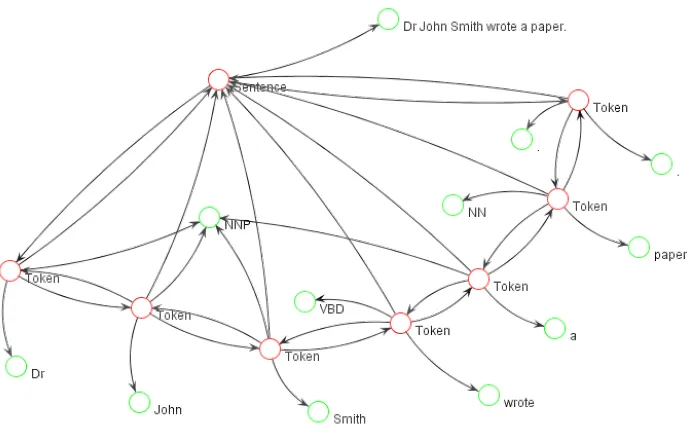
Figure 2: Example graph representation of the sentence ‘Dr John Smith wrote a paper.’.
1. (next token{token has string{˜Mr|Dr|Mrs|Miss}})
2. (next token{token has part of speech{=NNP}})+
Figure 3: Breakdown of LHS from Example Rule
Rule:Person (
(next_token{token_has_string{˜Mr|Dr|Mrs|Miss}}) (next_token{token_has_part_of_speech{=NNP}})+ )
Figure 4: Basic Saxon rule for recognising the names of people.
Rule:Person (
(next_token{token_has_string{˜Mr|Dr|Mrs|Miss}}) (next_token{token_has_part_of_speech{=NNP}})+ )
=> {
try {
java.net.URI edge = builder.getModel().getTypeFrom("token_string"); int type = builder.getModel().getIndexOf(edge);
for (Path path : paths) {
for (RepresentationNode node : path.getNodes()) { System.out.print(node.follow(type)+" "); }
System.out.println();
addSaxonNode(builder,"Person",path); }
}
catch (Exception e) { e.printStackTrace() }
}
D. Maynard, M. Yankova, A. Kourakis, and A. Kokossis. 2005. Ontology-based information extraction for mar-ket monitoring and technology watch. In ESWC Work-shop on End User Apects of the Semantic Web, Herak-lion, Crete.
Einat Minkov, William W. Cohen, and Andrew Y. Ng. 2006. Contextual search and name disambiguation in email using graphs. In 29th Annual International ACM SIGIR Conference, Seattle, August.
Borislav Popov, Atanas Kiryakov, Damyan Ognyanoff, Dimitar Manov, and Angel Kirilov. 2004a. Kim - a se-mantic platform for information extraction and retrieval. Natural Language Engineering, 10(3-4):375–392. Borislav Popov, Atanas Kiryakov, Damyan Ognyanoff,
Dimitar Manov, and Angel Kirilov. 2004b. Kim a se-mantic platform for information extraction and retrieval. Natural Language Engineering, 10(3-4):375–392. Lawrence Reeve and Hyoil Han. 2005. Survey of
seman-tic annotation platforms. In SAC ’05: Proceedings of the 2005 ACM symposium on Applied computing, pages 1634–1638, New York, NY, USA. ACM Press.
Carlo Strapparava and Rada Mihalcea. 2007. Semeval-2007 task 14: Affective text. In Proceedings of 4th International Workshop on Semantic Evaluations (Se-mEval’07), Prague, Czech Republic, June.