Corpus-based Evaluation of a French Spelling and Grammar Checker
Marianne Starlander and Andrei Popescu-Belis
ISSCO/TIM, University of Geneva, École de Traduction et d’Interprétation
40 Bvd. du Pont d’Arve CH-1211 Geneva 4 – Switzerland [email protected] [email protected]
Abstract
This article describes an evaluation method for spelling and grammar checkers and gives the results of its application to two French checkers. The evaluation process follows closely the ISO/IEC and EAGLES guidelines, and defines precisely the evaluation metrics, so that they can be easily reproduced. The choice of professional translators as user profile entails the use of a corpus of spelling mistakes, which was collected and annotated. The metrics are divided into three sets: classification of perfect vs. imperfect sentences; detection of mistakes; correction of mistakes. The results show in which respect the two systems are the most adapted to the user needs, and the points on which they could be improved.
1. Introduction
The methodology of evaluation in Natural Language Processing (NLP) has witnessed considerable standardization efforts in the past decade. Even if programs addressing complex NLP tasks are still hard to evaluate, lower-level programs can now be evaluated following a standard methodology, which enables one to tailor evaluation to the intended context of use, as well as compare results through different evaluations.
The present article has two objectives. First, we aim at applying a standard evaluation process to spelling and grammar checker (SGC) programs, producing an evaluation specification that will help future evaluations. Given the increasing number of spelling and grammar checkers, it is indeed necessary to evaluate them impartially. Second, we show how the evaluation process is adapted to a specific type of user, namely a professional translator, in particular through the collection of a corpus of spelling mistakes. Two existing systems for French are evaluated and compared from the point of view of such a user.
The article is organized as follows. The rest of section 1 situates our evaluation in the framework of several standards (ISO/IEC, EAGLES) and previous spell checker evaluations (TEMAA). Section 2 outlines the first stage in the evaluation process, namely the definition of the quality requirements, based on the user profile and the description of the corpus and its annotation. Section 3 completely specifies the evaluation metrics, so that they can be reused by other evaluators. Section 4 provides the evaluation results and discussion of them, before the final conclusion (Section 5).
1.1. Principles of Evaluation: Generic Software, NLP Software, Spelling Checkers
The International Organization for Standardization (ISO), together with the International Electrotechnical Commission (IEC) have defined several standards for software evaluation, in two series: ISO/IEC 9126 (1 to 3) and ISO/IEC 14958 (1 to 6), some being still in press. We cannot summarize here the numerous aspects that are dealt
with by these standards, but the first series is concerned with quality models, and the second with the evaluation process. Most important for us is that, according to ISO/IEC 14598-5 (1998), the evaluation process is divided into five stages:
• establishment of the quality requirements (the list of required quality characteristics);
• specification of the evaluation (mapping measurements to requirements);
• design of the evaluation (documenting procedures used to perform measurements);
• execution of the evaluation;
• conclusion of the evaluation (and reporting). Regarding the quality characteristics, ISO/IEC 9126-1 (2001) states that they must belong to the following six top-level classes: functionality, reliability, usability, efficiency, maintainability, and portability.
The European EAGLES initiative aimed at developing standards for NLP software evaluation (EAGLES (Expert Advisory Group on Language Engineering Standards : Evaluation Working Group, 1993-1999). There was strong commitment towards applying the ISO/IEC standards to NLP (ISO/IEC 9126 was first published in 1991), and also towards giving a central place to the user throughout the evaluation design. The two phases of EAGLES produced guidelines for NLP software evaluation (cf. the “EAGLES
Seven Step Recipe”, http://www.issco.unige.ch/projects/ eagles/ewg99/7steps.html), including the definition of a quality model, then studied their application to case studies: spell checkers (cf. TEMAA) and machine translation (in the ISLE follow-up project).
1.2. Our Contribution to the Methodology of Spelling and Grammar Checker Evaluation
With respect to the TEMAA project, which already dealt with authoring assistant tools, our contribution is innovative with respect to at least two points. First, the choice of a human translator as the user model, while still general enough, lead us to use as test data a corpus of spelling mistakes, and no longer a test suite that was artificially built. As discussed in Section 2, we believe that this choice brings us closer to capturing user needs. Second, we define our metrics transparently, using formulae, whereas it seems no directly applicable formulae were ever published for TEMAA. We hope thus to provide ready-made metrics for use by future evaluators, and in particular by non professional evaluators who are interested in setting up their own evaluation process.
These innovations are applied to the evaluation of two spelling and grammar checkers for texts written in French. Since these are commercial products (their names will not be disclosed), we had to design a black-box type evaluation (as opposed to glass-box), which relies mainly on test data. The numeric results enable us to draw eloquent conclusions about the adequacy of these tools with respect to our user profile, as well as point out at not-so-performant features. A more detailed version of these results can be found in (Starlander, 2002).
2. Quality Requirements: User Profile
and Test Corpus
2.1. Description of the User
As we concentrated on a specific user population, translators, it is important to describe them by setting out their particularities:
• Translators produce very varied texts, style and register as well as content wise.
• Although they usually possess a good command of their working language, they are still likely to make mechanical mistakes, due for instance to copying and pasting text or to typing errors.
• They usually produce a "thought of" text, as the translation process in itself needs some thinking. This implies that the text is not spontaneously produced, as in the case of emails.
• They use a SGC if they can rely on it, meaning that the system is able to detect errors and to correct them, although the second requirement is less important as translators are language skilled enough to find the adequate correction if the mistake is being pointed out.
• Finally, translators, being language professionals, are less tolerant to false alarms than other users, so they would dismiss the use of a weak SGC as time-consuming.
2.2. A Corpus of Spelling Mistakes
2.2.1. Corpus vs. Test Suites
Facing the question of whether to use test suites or a corpus as test material, we decided to choose the latter because we wanted the test material to be representative of a particular type of user. Test suites are best suited to test specific aspects, for example to find out how a system would treat a specific error type such as the past participle agreement. Furthermore, with respect to test suites,
corpora take less time to build, and account more precisely for the actual frequency of mistakes, provided they have a reasonable size.
2.2.2. Collecting the Corpus
As we decided to build a user-specific corpora, we collected a corpus of 27 translations (1-3 pages long), produced by French mother tongue students at the Translation and Interpretation School of the University of Geneva. These were written as training exercises, during the academic year 2001.
Most translated texts are general topic articles from the German, English, Italian or Spanish press.
The students were told not to correct their text while producing their translation and not to reread it before sending it. We guaranteed the students a total anonymity in order to keep the mistakes as close to a real situation as possible.
Statistically speaking, the corpus counts a total of approximatively 15,000 words, which is equivalent to around 30 typed pages. The total number of sentences is 637. The corpus is indeed not very large, but it is targeted towards a special population, and we believe it is representative enough for our evaluation. Furthermore, the reduced size allows us to process the corpus manually, as we will see now.
2.3. Annotation of Spelling Mistakes
The raw corpus has been annotated in order to reflect accurately all the mistakes present in it. This implies a human correction, detecting all the errors and subsequently marking them using predefined tags (see below).
In a second phase, the same corpus has been submitted to each SGC system and, using the same tags, we marked the detected mistakes and encoded the suggested correction. In order to encode certain information such as the ranking of the suggestions for correction, we introduced slight changes to the tags used (e.g. we added a number beside the tag reflecting the position of the right correction suggestion).
In general, the annotating of the text should ideally follow encoding directives such as TEI (Text Encoding Initiative) or CES (Corpus Encoding Standard) in order to be reused for other purposes.
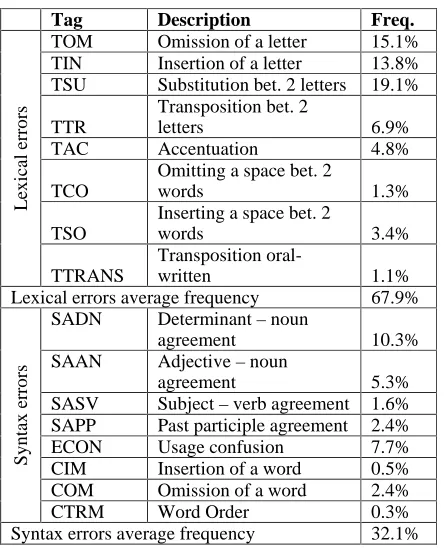
Let us see now how the tags were chosen and designed following an error typology which we are now going to describe.
2.3.1. Typology of the Errors
Classifying errors is sometimes difficult as the same error could be classified in various categories; for example in French a missing "s" at the end of a word could be tagged as a typographic error due to omission or as a syntactic one, being caused by a lack of agreement between a noun and its determinant. Thus different types of classification are possible: according to the origin of the error, complexity of error (real word error, long distance error) or type of techniques required to treat them.
among a small set of suggestions, we count as a correct suggestion the case when the correct one is present among the set of suggestions (in case there are several), but not necessarily in the first position.
3.3.2. How to Compute Scores
The scores are then quite straightforward to compute: percentage of right suggestions (BS), percentage of false suggestions (FS) and percentage of absent suggestions (AS).
3.4. Integration of the scores
The three sets of metrics defined above provide a multitude of scores. The first set yields (here) two recall/precision couples, one for correct sentences, one for wrong ones. The second yields one recall/precision couple per type of error. The third one yields three percentages of suggestions (correct, false, absent) per type of error. Should all these scores be integrated to provide a single number ?
We believe that reducing all scores to one is not particularly eloquent, even for comparing two systems as in the present case. It seems more relevant to analyze each of the three sets separately, draw conclusions, then integrate these conclusions. Therefore, we will provide below detailed scores for the three sets, and integrate each set separately—that is, average scores across all types of errors.
4. Results
4.1. Execution of the Evaluation
There is nothing much to say about the execution of the evaluation. In our particular case, there was no API available to the two checkers, therefore the results had to be collected manually. The corpus of mistakes was submitted to each of the checkers (without the markup, of course), and the responses were manually annotated on the corpus using similar markup. The correctness of the suggestion was also annotated manually from the graphical response of each checker. The various numbers defined above were then counted, by extracting the tagged portions into tables. The scores were then computed using the above definitions. We provide them hereafter, referring to the two checkers as S1 and S2.
4.2. Scores for the Three Measures
We are going to present the results for detection followed by those for correction.
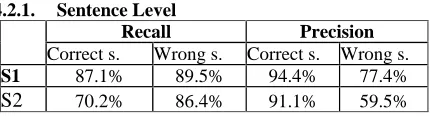
4.2.1. Sentence Level
Recall Precision Correct s. Wrong s. Correct s. Wrong s.
S1 87.1% 89.5% 94.4% 77.4%
S2 70.2% 86.4% 91.1% 59.5%
Table 2. Precision and recall for the detection at sentence level (system S1 vs. S2).
At sentence level, S2 seems to perform worse than S1, but remember that this measure is only very indicative of accuracy, as sentences marked as incorrect can include varying amounts of errors. For S2, the recall for wrong sentences is quite similar to the one obtained by S1 but the
precision rate varies considerably. According to these figures, S1 and S2 are quite comparable on the recall level, but S2 appears to be far less accurate, as S2 counts almost 17 points less for precision on wrong sentences. It will be interesting to see if these first impressions are going to be confirmed by the precision and recall rates on error level.
4.2.2. Error Detection
Here are the results by category of error, first for lexical errors and second for syntax errors:
Lexical Errors
System 1 System 2 Error
types Recall Precision R P
TOM 78.9% 95.7% 82.5% 95.9%
TIN 76.9% 95.2% 88.5% 80.7%
TSU 79.2% 100.0% 88.9% 98.5%
TTR 84.6% 100.0% 84.6% 100.0%
TAC 84.2% 94.1% 83.3% 88.2%
TCO 100.0% 100.0% 40.0% 66.7%
TSO 80.0% 100.0% 100.0% 100.0%
TTRANS 100.0% 100.0% 100.0% 100.0%
Total 80.2% 97.5% 86.2% 92.6%
Table 3. Recall and precision for error detection (per category of error): lexical errors.
S1 performs quite well on lexical errors, with an average recall of 80.2% and a precision of 97,5%. The difference between these two figures is quite high. Compared to that, S2, although showing lower figures, is far more balanced. Generally speaking, the scores are quite high, as they are all are above 75%, there is not one category of errors scoring particularly low.
Syntax Errors
System 1 System 2 Error
types Recall Precision R P
SADN 87.2% 81.0% 97.4% 92.7%
SAAN 65.0% 40.6% 90.0% 36.7%
SASV 66.7% 33.3% 66.7% 20.0%
SAPP 11.1% 11.1% 88.9% 72.7%
ECON 34.5% 27.8% 34.5% 22.2%
CIM 0.0% 0.0% 100.0% 100.0%
COM 11.1% 25.0% 55.6% 62.5%
CTRM 0.0% 0.0% 0.0% 0.0%
Total 54.8% 46.7% 73.9% 48.3%
Table 4. Recall and precision for error detection (per category of error): syntax errors.
4.2.3. Error Correction
In the table bellow, we reproduced only the rate of good correction, that is, when the system, once a mistake detected was able to propose the right correction.
S 1 S 2
TOM 72.7% 74.0%
TIN 75.6% 75.5%
TSU 51.7% 53.0%
TTR 91.3% 72.7%
TAC 100.0% 94.4%
TCO 80.0% 0.0%
TSO 83.3% 15.4%
TTRANS 100.0% 75.0% Average 72.6% 65.6%
SADN 87.9% 100.0%
SAAN 78.6% 100.0%
SASV 100.0% 100.0%
SAPP 100.0% 85.7%
ECON 85.7% 91.7%
CIM 0.0% 0.0%
COM 100.0% 100.0%
CTRM 0.0% 0.0% Average 87.0% 69.2%
Total 77.0% 73.9%
Table 5. Percentage of good correction per category of errors for S1 and S2
On average, S1 performs better both on lexical and syntax errors than S2.
The error types which are corrected worse by S2 are the pasting and cutting of two words (TSO and TCO), while S1’s worse performances are letter substitution errors (TSU).
The scores are astonishingly high for S2 on syntax errors due to agreement (100%) except past participle agreement presenting a lower rate (SAPP, 85.7%). On the contrary, SAPP has the highest score for S1.
The scores for errors of usage which were really low on detection level, are much better on correction level for both systems. This means, that once such an error is detected, it is well corrected, although this type of error often implies semantic elements.
4.2.4. Overall scores
The overall scores are given here, in the two following tables.
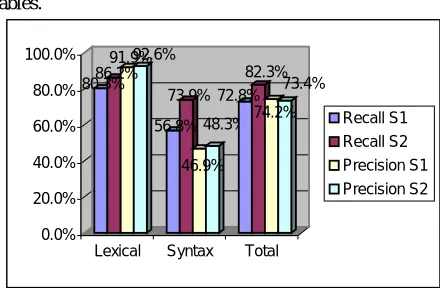
Figure 1. Average recall and precision for detection, system 1 (S1) and system 2 (S2).
We described our user to be specially annoyed by false alarms; the score obtained for precision is thus significant, if the figure is below 75% we estimate that the system is not accurate enough.
On average, precision for S1 amounts to 74.2% while S2 obtains 73.4%. The difference between the lexical and the syntax average are quite significantly high, specially for S1. This points out again, that the average figure, is not enough to evaluate a system, as the two systems appear quite equal on a general average level, while as the detailed results, indeed point out that S1 performs better.
Figure 2. Average percentage of good suggestions for S1 and S2
The same comment could be made about the average percentages for correction. Regarding only the total, which some up the percentages of all errors, the difference between the systems does not appear clearly, although again, the detailed scores are clearly higher for S1.
5. Conclusion and Further Work
The point of the evaluation methodology is to enable a translator to be able himself to determine which system would suit him best. The average scores obtained by the systems are quite close to each other, so that it is not possible to decide on one system or the other on this base. The user would have to determine according to the type of mistakes he is more likely to commit.The scores given on sentence level gave the accurate impression of S1 performing better. But the other measures are absolutely necessary in order to have a more nuanced and accurate image of the systems performance.
The methodology could be improved through the following changes:
(1) automating the counting phase would increase objectivity and certainly accuracy of the results. This would also make it possible to treat a larger corpus in a reasonable time. (2) enlarging the corpus or maybe including some
test suites in order to study more profoundly certain observations made from the corpus. (3) unfortunately automating the annotation seems
difficult, but if possible, a certain flexibility in the tag setting should be provided to the user, as the systems do not treat or present the corrections in a uniform or even analogous fashion.
This study was limited on French SGCs systems. It would be interesting to gather a similar corpus in different languages, so that the method could be applied to other
80.3%86.2% 91.9%92.6%
56.8% 73.9%
46.9% 48.3%
72.8% 82.3%
74.2% 73.4%
0.0% 20.0% 40.0% 60.0% 80.0% 100.0%
Lexical Syntax Total
Recall S1 Recall S2 Precision S1 Precision S2
0.0% 10.0% 20.0% 30.0% 40.0% 50.0% 60.0% 70.0% 80.0% 90.0%
lexical s yntax T otal
languages. Of course this also implies adjusting the error typology to the language treated. In any case, the metrics described in this paper can be used as they are, independently of the language treated.
6. References
Eagles evaluation work group, 1996. EAGLES Evaluation of Natural Language Processing Systems, Final report, Center for Sprogteknologi, Denmark.
ISO/IEC 9126-1, 2001. ISO/IEC 9126-1:2001 (E) Standard – Software engineering - Product quality - Part 1: Quality model, Geneva: International Organization for Standardization / International Electrotechnical Commission.
ISO/IEC 14598-5, 1998. ISO/IEC 14598-5:1998 (E) Standard – Information technology --- Software product evaluation --- Part 5: Process for evaluators, Geneva: International Organization for Standardization / International Electrotechnical Commission.
Kukich, K., 1992. "Techniques of Automatically Correcting Words in Text", in ACM Computing Surveys, 24(4):377-438.
Starlander, M. 2002. Evaluation d'un correcteur d'orthographe et de grammaire : L'utilité de Cordial 7 pour le traducteur. ETI, Université de Genève, janvier 2002.
TEMAA, 1996. TEMAA Final Report - A Testbed Study of Evaluation Methodologies: Authoring Aids. Technical Report LRE-62-070 (March 1996), Center for Sprogteknologi, Copenhagen, Denmark.