Constructing a corpus that indicates patterns of modification
between draft and final translations by human translators
Takeshi Abekawa and Kyo Kageura
Library and Information Science Course Graduate School of Education, University of Tokyo
{abekawa,kyo}@p.u-tokyo.ac.jp
Abstract
In human translation, translators first make draft translations and then modify and edit them. In the case of experienced translators, this process involves the use of wide-ranging expert knowledge, which has mostly remained implicit so far. Describing the difference between draft and final translations, therefore, should contribute to making this knowledge explicit. If we could clarify the expert knowledge of translators, hopefully in a computationally tractable way, we would be able to contribute to the automatic notification of awkward translations to assist inexperienced translators, improving the quality of MT output, etc. Against this backdrop, we have started constructing a corpus that indicates patterns of modification between draft and final translations made by human translators. This paper reports on our progress to date.
1.
Introduction
In accordance with the rapid growth of information avail-able on the Internet in an increasing numbers of languages, overcoming language barriers has become a keen concern all over the world (Cronin, 2003). Accordingly, the ac-tivity of volunteer translators is gaining in prominence. For instance, in an English-to-Japanese context, Translators United for Peace (TUP), which consists of about a 20 vol-unteer translators, won the Civic Media Award of the Japan Congress of Journalists in 2004 for its role in distributing important information online about the US attack on Iraq (TUP, 2008). In a more multilingual setting, PaxHumana provides news and information related to peace and war in French, German, Spanish and English (PaxHumana, 2008). Global Voices, an originally Harvard-based project, relies on volunteer translators to multilingualise blog texts writ-ten in a variety of languages (Global Voices, 2008). Many projects like these exist all over the world. In a different arena, localisation of open source software such as Mozilla or Wiki is also supported by volunteers.
Within this context, we are currently developing a trans-lation aid system aimed at assisting volunteer translators working online, focusing on English-to-Japanese trans-lation (Abekawa and Kageura, 2007a; Abekawa and Kageura, 2007b). One of the important requirements for such a system is to incorporate a mechanism that helps inexperienced translators put together high-quality trans-lations. In addition, there is a necessity to attract more people to translation work, and the number of inexperi-enced translators working voluntarily is expected to grow. We have consulted with some 20 volunteer translators, and found that about half are professional or highly experienced translators devoting their free time to voluntary translation, while the other half have little experience in translation. These inexperienced translators have a sufficient command of the source (English) and target (Japanese) language, but lack specialized knowledge of translation. Given this sit-uation, a crucial factor in realising a system that helps in-experienced translators is to clarify the gap between
inex-perienced and exinex-perienced translators and to describe the knowledge of experienced translators.
Though there are translation textbooks and practical guide books describing how to make good translations (Baker, 1992; Anzai, 1995; Kawamoto and Inoue, 1997), the de-scriptions in those books, though very useful as a guide-line, assume a substantial amount of human knowledge and are not formalised in such a way that this knowledge can be transformed straightforwardly into a computationally tractable descriptions. For our ultimate aim of developing a system that notifies inexperienced translators of awkward translations, further information is required . Fortunately, in the process of translation, translators first make draft trans-lations and then examine and edit them, often repeatedly. Thus there are normally at least two versions of the trans-lation of a given text, i.e. the draft and the final transla-tions. In commercial translation environments, it is some-times the case that texts are first translated by inexperienced translators and then edited by experienced translators. We have thus obtained translation data (a triplet consisting of original English texts, draft Japanese translations and final Japanese translations) for several books from commercial publishers and are currently constructing a corpus that indi-cates patterns of modification between draft and final lations (the POMDAF corpus), in consultation with trans-lators. As there is no corpus of this type as far as we know, and as the implicit knowledge of experienced translators has not been clarified so far, the first stage of corpus con-struction has been devoted to defining the basic types of information to be included in the corpus, which involves the clarifying translators’ implicit knowledge. The work re-ported in this paper is work from this stage. We believe that the corpus, when completed, will provide the translation re-search community with a corpus that indicates patterns of modification by highly skilled human translators, and will constitute an important language resource for exploiting the implicit knowledge of translators.
be defined. In section 3, we describe the basic framework within which modification patterns are recognised and de-scribed. In section 4, we report the actual modification patterns we defined using the data. Section 5 is devoted to a discussion of the theoretical status of the work, which has become clear through our consultations with translators during the process of corpus construction.
2.
The data
The data for the POMDAF corpus consists of triplets of the English original, draft Japanese translation and final Japanese translation of books and online articles, which were provided by two publishers and several translators. We currently have this three-part data for seven books (con-sisting in total of about 40,000 sentences) and six online ar-ticles (consisting of about 800 sentences). Among these, we selected three books (Leggett, 2005; Chomsky, 2004; Har-vey, 2005) for the initial stage of the corpus construction. These books have a common feature, i.e. they were first translated by less-experienced translators and then checked and corrected by experienced translators. Table 1 shows the size of each book in terms of the number of sentences, for the English original , the draft Japanese translation and the final Japanese translation.
Table 1: Size of the three books Leggett Chomsky Harvey
Original 4,515 1,615 3,072
Draft 4,622 2,374 3,121
Final 4,644 2,468 3,155
We extracted 50 sentences (based on the final Japanese) from the data, as the first step in analysing patterns of modification between the draft and final translations. The amount of data currently analysed is very small, because it is critical to carry out an in-depth analysis of modification patterns in order to properly reflect translators’ implicit and explicit knowledge in the corpus. In the analysis, we en-listed the help of a linguist and a translator, and examined the nature of modifications observed in the data.
3.
The basic framework
Sentences are used as the basic unit of analysis. There are a small number of cases in which there is not an exact one-to-one correspondence between the sentences in the three texts (for example, a single English sentence being trans-lated into two sentences in the Japanese draft and/or fi-nal). In these cases, we take the longest sentence among the triplet as the basic unit. Though most experienced tors judge the smoothness or awkwardness of draft transla-tions in the context of paragraphs or larger discoursal units, the actual unit whose smoothness or awkwardness is judged is the sentence. In other words, expert translators mod-ify draft translations basically sentence by sentence, while judging their smoothness or awkwardness within the con-text of a paragraph or several paragraphs. There can be more than one units of modification in one sentence. An interesting and important point related to the data we are dealing with is its duality: while the data can be considered
a “gold standard” in the sense that it consists of translations that have already been published and well accepted, it is not a gold standard in the sense of being on “average” that all translators aim to achieve, because each translation is unique and singular and could have turned out rather dif-ferently if it had been put together by a different translator. This point can be easily appreciated of one considers the fact that there are sometimes more than one high-quality translation for a source text, especially in the area of liter-ary translations. We delve deeper into this topic in section 5.
After consulting the translator and the linguist, we distin-guished the following four levels at which modification pat-terns are identified and described.
1. Reasons for modification: The reason that translators have in mind when making a modification. At the broadest level, we identified six reasons, which will be elaborated on in the next section. In addition, we asked the translator and the linguist to freely describe the reasons for the modification. This level corresponds to the judgement of draft translations by translators. Thus the reasons for modification are essentially at-tributed to the draft, conditioned by the English origi-nal. We identified this level as separate from the next level for two reasons: (i) though there is a logical rela-tion between the judgment of the draft and the direc-tion for modificadirec-tions, the reladirec-tion is not necessarily one-to-one or fixed; (ii) translators sometimes use dif-ferent words for describing the reasons for modifica-tions and the aims of linguistic operation, which may reflect different levels of implicit knowledge.
2. Aims of linguistic operations: This level was intro-duced to connect the reasons for modification and the description of linguistic operations applied to make the final translation. As such, the aims of linguistic operations are essentially an attribute of the relation between the draft translation and the final translation. About twenty categories were introduced, which will be elaborated on in the next section. This level is of critical importance in clarifying the implicit knowl-edge translators make use of when modifying the draft and making good translations. More than one aim of linguistic operation can correspond to one reason for modification and vice versa, both typewise and token-wise.
3. Linguistic operations: This level is defined by means of linguistic or grammatical terms, such as “change of tense”, etc. More than one linguistic operation may constitute an aim of linguistic operations. We tried to define linguistic operations in a sufficiently formal manner for two reasons: (i) to distinguish the interde-pendent or superimposed operations while at the same time identifying their relationships, and (ii) to enable further breakdown of modification phenomena to the surface primitive operations.
is twofold: (i) to define operation patterns in as de-tailed and formal a manner as possible so that they can be defined in a computationally tractable manner, and (ii) to enable human and computational analysis of the relevant features at work in the human modification process. More than one primitive operation may con-stitute a linguistic operation.
In addition to these, we are planning to add information concerning the necessity of modifications, because some translators see that some modifications are not really neces-sary. The three levels of necessity are “obligatory,” “prefer-able,” and “optional”.
4.
Patterns of modification
This section elaborates the four levels of information we are currently assigning to the corpus.
4.1. Reasons for modification
In the modification process, the translator first recognises one of a number ofstatesin a draft translation, which may or may not trigger modifications. This is often carried out unconsciously. When the draft translation is modified, we can observe thereasons for modificationthat correspond to the states. We take the unit in which a single reason for modification is identified by a translator as the basicunit of modification. So in our corpus construction process, one reason for modification correspond to one unit of modifi-cation. At the broadest level, we classified the reasons for modification into six categories. These are shown in Ta-ble 2 shows them. Although these reasons are conceptually clear and thus can be used as a guide for further analysis of the data, it is not necessarily the case that translators can judge the reasons for a particular modification clearly and consistently, because judging a sentence as being “natural” or “confusing”, for instance, is not a binary process but a graded one, and the distinction among different reasons is often not immediately clear in actual translations.
Table 2: Reasons for modification 1. Mistranslation
2. Translation is confusing and the original meaning is not clearly expressed.
3. Translation is unnatural or awkward. 4. Against the overall style and guidelines
5. Against the taste of the translator who modifies the draft
6. Others
All in all we identified 181 reasons for modification. These correspond to the basic unit of modification. For each basic unit of modification, more than one linguistic operation is applied.
4.2. Aims of linguistic operations
As was discussed in the previous section, while the rea-sons for modification are defined on the basis of the draft translation from the translators’ point of view, the aims of linguistic operations are defined on the basis of linguistic operations applied to the draft to make the final. Table 3
shows these aims. Note that some of the aims listed in Ta-ble 3 are not mutually exclusive. As we are in the prelimi-nary and experimental stage of constructing the POMDAF corpus, we deliberately left room for these ambiguities, be-cause these are the expressions that most straightforwardly come out of translators looking at the data.
Table 3: Aims of linguistic operations 1. To make the expressions more fluent 2. To use more suitable expressions 3. To reduce the complexity of a sentence 4. Orthographic changes
5. To add information (content words) 6. To change the focus of topicalisation 7. To make expressions less complicated 8. To add or delete subjective expressions
9. To delete redundant expressions (content words) 10. To change the temporal relation between the
speaker and the event that is talked about (tense, aspect)
11. To clarify the relation between two elements 12. To avoid repetition of the same element
13. To replace an anaphoric expression with a con-crete expression
14. To add or delete zero pronouns 15. Balancing phrases
16. To make expressions more formal 17. Balancing clauses
18. Removing ambiguous structures 19. Others
20. None (in the case of mistranslation)
4.3. Linguistic operations
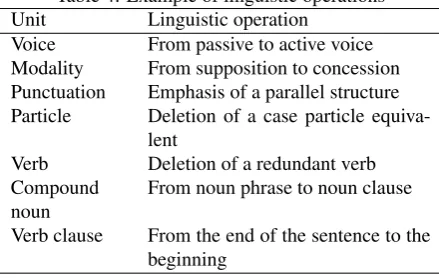
At the level of linguistic expression, the most natural way to classify modification patterns is by means of basic lin-guistic labels such as “change of voice” or “change from nominal modification to adverbial modification”. In fact, many translation textbooks give translation tips by explain-ing reasons for modification, aims of lexplain-inguistic operations and linguistic operations at the same time. Table 4 shows examples of linguistic operations. From the point of view of NLP, these modification patterns consist of one or more
basic operations. For instance, a “change of voice” may consist of such primitive operations as “changing the case-marker of the subject,” “swapping the position of subject and object,” etc. We therefore defined linguistic operations hierarchically, in accordance with the hierarchy of the lin-guistic units involved.
4.4. Primitive operations
Table 4: Example of linguistic operations
Unit Linguistic operation
Voice From passive to active voice Modality From supposition to concession Punctuation Emphasis of a parallel structure Particle Deletion of a case particle
equiva-lent
Verb Deletion of a redundant verb Compound
noun
From noun phrase to noun clause
Verb clause From the end of the sentence to the beginning
the reasons for modification (translators’ judgement) to the actual concrete modifications (target of linguistic process-ing). Table 5 shows a small part of the corpus, to which all the four levels of information are assigned.
5.
Theoretical position of the work
In the process of corpus construction, some important and interesting points have become clearer in relation to the na-ture of translation. Though they still remain abstract and are not necessarily reflected in the corpus in a concrete manner, we summarise what we have found to be important points here.5.1. The nature of translation activity
One of the most important points we found is that trans-lation as perceived by experienced translators has little to do with the language that linguists and computational lin-guists see (Kageura, 2006). Translation is concerned first and foremost with individual texts. This fact introduces a historical dimension into the translation. If we adopt the distinction between the study of language and the study of
enonc´eas postulated by Foucault (1968),
La question que pose l’analyse de la langue, `a propos d’un fait de discours quelconque, est tou-jours: selon quelles r`egles tel ´enonc´e a-t-il ´et´e construit, et par cons´equent selon quelles r´egles d’autres ´enonc´es semblables pourrairent-ils ˆetre construits? La description du discours pose une tout autre question: comment se fait-il que tel ´enonc´e soit apparu et nul autre `a sa place?
Translation is first and foremost concerned with ´enonc´e as is dealt with in the study of ´enonc´e, not the study of language. We can define a chain of concepts; “texts” – “´enonc´e” – “archive” – “monument”. This is distinguished from the chain of concepts in linguistics, i.e. “texts” – “lan-guage” – “corpus” – “example”. The task of translators is to give a position to the translated text within a given set of ´enonc´e, which constitutes an archive in the target language, a position that is equivalent to the position of the original text, which is perceived as a singular monument within the archive of all other historical monuments to which the text is related. Put differently, translation is concerned with the range ofsocially acceptable or preferable expressions(i.e. those that are realistically possible) while linguistics is con-cerned with the range of well-formed utterances. Within
this framework, linguistic operations are necessary as a pre-requisite for but not the core of translation.
As both the source text and its translation are singular and occur only once in history, the translation calls for individ-ual decision making. This is most typically observed in lit-erary translations. For instance, Suzuki (2006), who trans-lated Proust’sA la recherche du temps perdu´ into Japanese, depicted translation as a process of constructing language, trying to arrive at the place that the author aimed at in the original. For this type of task, each step involves making a new decision (cf. Munday, 2001; Venuti, 2004).
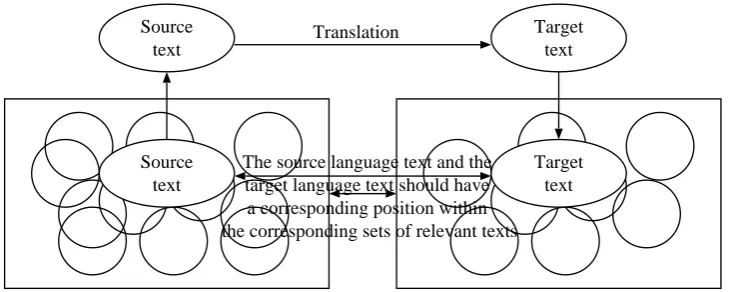
To end the discussion here, however, world be a grave mis-take, because at the other extreme of translation, i.e. pro-fessional translation of highly technical documents, we find substantial convergence among translations made by differ-ent translators or translations made at differdiffer-ent times by the same translator, which proves that the translation process can be, to a substantial extent, reduced to a standard pro-cedure or computation in its broader sense. It should be emphasised again here that, for translators, this procedure is defined not as a linguistic operation but as a textual op-eration of assigning a position to the translation that is iso-morphic to the position of the original. Figure 1, taken from Kageura (2007), illustrates this.
We therefore have at least the following three operational spheres in translation activity:
1. The linguistic sphere, as dealt with by linguists and computational linguists. Regarding textual data as cor-pora representing some aspects of language phenom-ena is included here.
2. The textual sphere, in which texts are perceived as his-torical products. Regarding texts as monuments and language expressions as an archive is included here.
3. The decision making sphere, which is dependent on individual translators who are singular and unique.
Within these three spheres, what we are trying to explore is the nature of operations in the textual sphere as reflected in the linguistic sphere, because after all what are immedi-ately available to us are the given translation triplets, and not the archive within which the texts are situated. To what extent we can explore information inherently belonging to the textual sphere at the level of a given text depends on the extent to which textual sphere operations are projected on to phenomena in the linguistic sphere, which can only be revealed through the construction of this type of corpus.
5.2. Agreement of judgements among translators
Table 5: Example of the POMDAF corpus English: They are, to some degree, whistleblowers.
Draft : Final :
Modification 1
<1></1> <1> </1>
Reason 3. Translation is unnatural or awkward.
Aim of linguistic operation To make the expression more fluent
Linguistic operation <1>Punctuation : The emphasis of topicalisation Primitive operation <1>Insertion : “ ”
Modification 2
<1> </1><2></2> <1> </1><2> </2>
Reason 3. Translation is unnatural or awkward.
Aim of linguistic operation To make the expressions more fluent Linguistic operations <1>Adverb phrase : Decomposition
<2>Punctuation : Inserted after adverbial form. Primitive operations <1>Replacement : “ ”(to some degree)
→“ ”(much) + “ ”(less)
<2>Insertion : “ ”
Modification 3
<1> </1>
<1> </1>
Reason 1. Mistranslation
Aim of linguistic operation Modification of mistranslation Linguistic operation <1>Noun phrase: Mistranslation Primitive operation <1>Replacement : “ ”(admonitor)
→“ ”(whistleblower)
The problem with dealing with the translation process is that this is often not the case. Just like in research, the “av-erage” product of the “average person” is not necessarily highly praised. Therefore the greater ability the translator has, the more individualistic the translation becomes; and the more individualistic the translation is, the higher it is valued. The corollary: disagreement among translators or annotators may not necessarily be a procedural problem but an essential aspect of dealing with the translation process.
Although we have so far analysed only a small amount of data, we have a rough idea that translators may agree to a substantial extent about the reasons for modifications or the problems in draft translations, because many of these are identified at the linguistic level. It seems more difficult for translators to reach the same conclusions about how they modified the draft. Though the corpus is given and thus for each instance the modification is fixed, similar instances may undergo different sorts of modifications, and the same modification may be judged by translators as having dif-ferent aims. This is related to the fact that modifications as well as judgments about modifications are made vis-`a-vis the textual sphere, which assumes an existing relevant set of documents that is in translators’ heads but is external to the corpus. We optimistically assume that the disagree-ments among different translators and differences in
judge-ment about the same part of a text made at different times by the same translator will not become too far-reaching, be-cause if the judgment is done vis-`a-vis the textual sphere, which can be huge and varied but is by definition finite, it is not unreasonable to assume that the judgment process in the textual sphere can be categorised to a substantial extent, which will limit the range of judgements made about given texts. With this in mind, we consciously try not to exclude different judgement by translators as something problem-atic at the moment.
6.
Conclusions
The set of texts to which the source language text is anchored
The corresponding set of texts in the target language to which the target language text is to be anchored Translation
The source language text and the target language text should have
a corresponding position within the corresponding sets of relevant texts Source
text
Source text
Target text
Target text
Figure 1: The framework of translation
three interrelated areas:
1. Further clarifying and elaborating on translators’ im-plicit knowledge through construction of the corpus;
2. Increasing the amount of basic data and the size of the tagged corpus, while at the same time examining the validity of the general framework of the information we established for tagging;
3. Formalising the tagset and the format of the corpus.
In parallel with the construction of the POMDAF corpus, we are developing an experimental system that notifies in-experienced translators of awkward translations (Abekawa and Kageura, 2008).
Acknowledgements
This research is supported by a Hakuhodo “Language and Culture/Education” research grant. It is also partly sup-ported by grant-in-aid (A) 17200018 “Construction of on-line multilingual reference tools for aiding translators” for the Japan Society for the Promotion of Sciences (JSPS). We would like to thank anonymous reviewers for their useful comments.
7.
References
Abekawa, T. and Kageura, K. 2007a. QRedit: An inte-grated editor system to support online volunteer transla-tors. InDigital Humanities 2007, p. 3–5.
Abekawa, T. and Kageura, K. 2007b. A translation aid sys-tem with a stratified lookup interface. InProceedings of ACL 2007 Demos and Poster Sessions, p. 5–8.
Abekawa, T. and Kageura, K. 2008. What prompts trans-lators to modify draft translations? An analysis of basic modification patterns for use in the automatic notifica-tion of awkwardly translated text. InProceedings of the 3rd International Joint Conference on Natural Language Processing, p. 241–248.
Anzai, T. 1995. Eibun Hon’yaku Jutu (in Japanese). Tokyo: Chikuma.
Baker, M. 1992.In Other Words: A Coursebook on Trans-lation. London: Routledge.
Chomsky, N. 2004. Chomsky on Miseducation. Lanham, MD: Rowman & Littlefield Pub Inc. [Terashima, T. et. al. trans. 2006. Tokyo: Akashi Syoten.]
Cronin, M. 2003. Translation and Globalization. London: Routledge.
Foucault, M. 1968. Sur l’arch´eologie des sciences: R´eponse au cercle d’´epist´emologie. Cahiers peur l’Analyse, 9 p. 9–40.
Global Voices. http://www.globalvoicesonline.org/ Harvey, D. 2005. A Brief History of Neoliberalism. New
York: Oxford University Press, USA. [Morita, N. et. al. trans. 2007. Tokyo: Sakuhinsya.]
Kageura, K. 2006. The status of corpora in human transla-tion. InProceedings of the 12th Annual Meeting of the Association for Natural Language Processing, p. 452– 455.
Kageura, K. 2007. Terminological lexicons and terms in context: The translator’s perspective. InProceedings of the 7th Conference of Terminology and Artificial Intelli-gence, p. 1–10.
Kawamoto, K. and Inoue, K. 1997. The Art and Craft of Translation(in Japanese). Tokyo: University of Tokyo Press.
Leggett, J. 2005. Half Gone. London: Portobello. [Ma-suoka, K. et. al. trans. 2006. Peak Oil Panic. Tokyo: Sakuhinsha.]
Munday, J. 2001. Introducing Translation Studies. Lon-don: Routledge.
PaxHumana. http://paxhumana.info/fr.php3
Suzuki, M. 2006. There is no national border for stupid-ity. In Iwanami, ed. The work of translators, Tokyo: Iwanami, p. 209–214.
TUP. http://groups.yahoo.co.jp/group/TUP-Bulletin/ Venuti, L. 2004. The Translation Studies Reader. 2nd. ed.