A Methodology for Developing Multilingual Resources for Terminology
Marie-Claude L’Homme, Hee Sook Bae
Observatoire de linguistique Sens-Texte (OLST)Université de Montréal C.P. 6128, succ. Centre-ville
Montréal (Québec) H3C 3J7
{mc.lhomme, hee.sook.bae}@umontreal.ca
Abstract
This paper presents a project that aims at building lexical resources for terminology. By lexical resources, we mean dictionaries that
provide detailed lexico-semantic information on terms, i.e. lexical units the sense of which can be related to a special subject field. In terminology, there is a lack of such resources. The specific dictionaries we are currently developing describe basic French and Korean terms that belong to the fields of computer science and the Internet (e.g. computer, configure, user-friendly, Web, browse, spam). This
paper presents the structure of the French and Korean articles: each component is examined and illustrated with examples. We then describe the corpus-based methodology and the different computer applications used for developing the articles. Our methodology comprises five steps: design of the corpora, selection of terms; sense distinction; definition of actantial structures and listing of semantic relations. Details on the current state of each database are also given.
1. Background and Motivations
This paper presents a project that aims at building lexical resources for terminology. By lexical resources,
we mean dictionaries that provide detailed lexico-semantic information on terms, i.e. lexical units the sense of which can be related to a special subject field. In terminology, there is a lack of such resources since, typically, terminological dictionaries (and even more recent resources such as ontologies) focus on the knowledge structure of specialized subject fields, thereby ignoring important linguistic properties of terms. Furthermore, we cannot entirely rely on general resources (such as WordNet or other general dictionaries in electronic form), even if they have a good coverage of terms, since they do not always capture subtle semantic distinctions that appear in specific fields of knowledge. The specific dictionaries we are currently developing describe basic French and Korean terms that belong to the fields of computer science and the Internet (e.g.
computer, configure, user-friendly, Web, browse, spam).
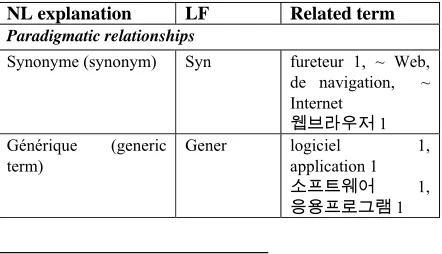
Part of the French dictionary can be accessed on the Internet (DiCoInfo, Dictionnaire fondamental de l’informatique et de l’Internet: http://olst.ling.umontreal.ca/dicoinfo/). Both dictionaries take into account: a) four different parts of speech (nouns, verbs, adjectives and adverbs); b) the polysemy of terms; c) describe their actantial structure in terms of actantial roles; d) list the terms that can fill an actantial position, and, finally, list all the terms that are semantically related to a term being described. Our descriptions are based on Explanatory Combinatorial Lexicology (ECL) (Mel’čuk et al. 1984-1999, 1995).1
1 Other details on why this framework is useful for terminology
can be found in L’Homme (2002, 2003).
Section 2 of the paper presents the structure of the articles contained in the dictionary. Each component is examined and illustrated with French and Korean examples. In section 3, we describe the corpus-based methodology used in both languages. Section 4 gives details on the current state of each database. Finally, we will conclude with a short list of forthcoming projects.
2. Structure of the Dictionary
As was said above, the dictionary provides a description of various lexico-semantic properties of terms. More specifically, the articles take into account:
A) The polysemy of terms: For example, three different meanings for adresse (address) have
been identified. In the dictionary, separate meanings are distinguished with a numbering system. Similarly, the meanings of the Korean form주소(address) are disambiguated.
adresse 1: ‘address in a storage device’ adresse 2: ‘address of a computer in a network’
adresse 3: ‘address of a user’ (e.g. an email address)’ 주소 1: 기억장치내의주소 (adresse 1)
주소 2: 통신망에서단말기의주소 (adresse 2) 주소 3: 사용자의전자메일주소 (adresse 3)
B) The actantial structures of terms: Each separate meaning is accompanied by its actantial structure, which gives the position of actants and explains them in terms of actantial roles. In addition, linguistic realizations of actants are provided. We reproduced below the actantial structure and the the actants of the term naviguer
same stage, since the French project started in 2002, whereas the Korean project started in 2004.
Our methodology is divided into five steps, namely 1) compilation of the corpora; 2) selection of terms; 3) sense distinction; 4) definition of the actantial structure; 5) listing of semantic relationships. Each step is further described in the following subsections.
3.1 Corpora
The development of our resources relies heavily and at all stages on specialized corpora. The French corpus amounts to approximately one million words and contains texts published between 1996 and 2004. Texts deal with micro-computing, networks, the Internet, operating systems, hardware, software and programming. The corpus was tagged morpho-syntactically and lemmatized with TreeTagger (Schmid 1994).
The Korean domain-specific corpus comprises 4,230,000 eojeols and is subdivided into various subfields (such as hardware, software, Internet, program, operating systems). The corpora are partly comparable: the Korean corpus contains more texts on telecommunications than the French corpus; in contrast, the French corpus contains more texts dealing with the Internet. This will have an impact on the list of candidate-terms (refer to the table 4). The Korean corpus was tagged using a Korean tagger supplied by the research center KAIST.
Corpora must be updated regularly in order to provide occurrences of new terms. A first update has been performed in 2004 for the French corpus and another one is currently taking place.
3.2 Selection of Terms
Terms are selected using an automatic technique combined with an analysis performed by the terminologist. First, a list of candidate single-word terms is produced using an extractor called TermoStat
developed by Drouin (2003). TermoStat compares a specialized corpus (called an analysis corpus) to a general
corpus (referred to as the reference corpus) and ranks
candidates according to their specificity. The French domain-specific corpus has been compared to the corpus
Le Monde (30 million words); the Korean corpus was
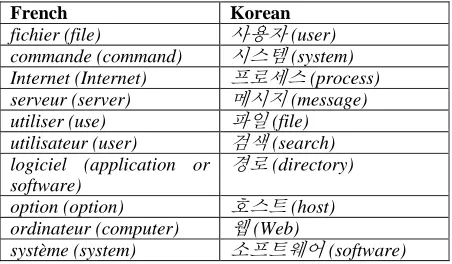
compared to a general corpus of 40,000,000 eojeols composed of different types of texts on literature, society, health, culture, history, etc. Table 4 presents the ten most specific terms identified by TermoStat in French in Korean.
TermoStat can identify both single-word and multi-word terms, but in this project, only single-words terms were identified. This decision is justified by the approach taken to compile the dictionary. Since the focus is on semantic properties of terms and not the knowledge organization of specialized fields, the only multi-word units analyzed do not have a compositional meaning (e.g. système d’exploitation ‘operating system’, traitement de texte ‘word processor’).
French Korean
fichier (file) 사용자 (user)
commande (command) 시스템 (system)
Internet (Internet) 프로세스 (process)
serveur (server) 메시지 (message)
utiliser (use) 파일 (file)
utilisateur (user) 검색 (search)
logiciel (application or software)
경로 (directory)
option (option) 호스트 (host)
ordinateur (computer) 웹 (Web)
système (system) 소프트웨어 (software)
Table 4: Ten most specific terms in French and Korean
Once terms have been extracted automatically, terminologists analyze the lists produced to retain those terms that will appear in the dictionaries. To assist them in this task, they use four different lexico-semantic criteria:
a) Lexical units selected should refer to entities related to computing: hardware (e.g. carte
‘board’, ordinateur ‘computer’; 시스템
‘system’), software (e.g. compilateur ‘compiler’, programme ‘program’), representational entities
(e.g. fichier ‘file’, données ‘data’; 데이터 ‘data’), units of measure (e.g. octet ‘byte’, mégahertz ‘megahertz’), animates (e.g. pirate
‘hacker’, programmeur ‘programmer’; 사용자
‘user’).
b) If lexical units are predicative — verbs, nominalizations, adjectives, etc. — they are selected if their actants are entities accepted according to criterion a. (e.g. l’utilisateur charge un programme en mémoire ‘the user loads the program into the memory’). However, the lexical
unit must convey a specific meaning when combined with specialized actants (e.g. specify
will not be considered a term since it conveys the same meaning with a wide variety of actants (specialized and non-specialized)).
This criterion can also be used to identify Korean terms. For example, 접근 ‘access’ is considered
to be a valid term since it is used with its arguments 사용자 ‘user’ and 네트워크 ‘network’ that convey the meanings specific to
this domain (e.g. 사용자의 네트워크 접근이
용이하지않은상태이다. ‘access to the network
by the user is difficult’).
c) If the lexical unit is a derivative, it is selected if it is semantically related to a term selected according to criteria a. or b. (e.g. bogue: déboguer, dégogage ‘bug: debug, debigging’).
In the Korean corpus, we found series such as
입력, 접근, 사용자: 입력 ‘input’) / 입력하다
‘to input’ /입력키 ‘input key’, 접근하다
not accessible’, 사용자 ‘user’, 사용 ‘use’,
사용하다 ‘to use’, 사용성 ‘usability’.
d) Any lexical unit sharing a paradigmatic relationship with a term selected according to criteria a., b. or c. is selected. For example, if
serveur‘server’ and ordinateur ‘computer’ are
selected according to a., then client ‘client’ and portable ‘portable computer’ must be selected.
Similarly, if coller ‘paste’ is selected according
to b., then couper ‘cut’ and copier ‘copy’ must
be considered. In Korean, this criterion helped select terms such as 입력 ‘input’ and its
antonym 출력 ‘output’. Similarly, 접속 ‘connection’ and its near synonym 접근 ‘access’
were considered according to this criterion. Once applied to the list of candidate-terms extracted by TermoStat, evaluations of the French output (Lemay et al. 2005; L’Homme 2005) have shown that precision is fair (approx. 50 %). In Korean, precision was evaluated at approximately 50% as well.
3.3 Sense Distinction
Once, terms are selected, each lexical form is treated separately in order to distinguish different senses some of them convey. This step is carried out manually, again by applying lexico-semantic criteria:
a) Compatible and differential cooccurrence (Mel’čuk et al. 1995: 64-65): When cooccurrents can be combined and produce an acceptable sentence, a single meaning is identified. In contrast, when cooccurrents are combined and produce an unacceptable sentence, different meanings are identified. For exemple, the verb
exécuter ‘execute’ can be found with installation ‘installation’. It can also be found with logiciel
‘application’. However, both cooccurrents
cannot be combined (e.g. *exécuter une
installation et un logiciel ‘*execute an
application and an installation’). In Korean, this
criterion allows us to disambiguate the senses of
저장하다 ‘save’. The verb can be combined
with 파일 ‘file’ and 디스크 ‘disk’. It can also be
found with 값 ‘value’ and 변수 ‘variable’.
However, when these cooccurrents are combined, the sentence is not acceptable in Korean (e.g.
*이 파일과 이 값을 변수 X 에 저장하다
‘*Save this file and this value in the variable X’).
b) Synonymy: If a synonym can be substituted in a first set of occurrences, but not in a second set, then two different meanings are identified. This criterion helped confirm that exécuter ‘execute’
is polysemic. Exécuter une tâche ‘execute a task’
can be replaced by accomplir une tâche ‘accomplish a task’. However, in exécuter un logiciel, the replacement is no longer possible.
Similarly, in Korean, 파일을 삭제하다 ‘delete
the file’ can be replaced by 파일을 지우다
‘erase the file’. However, in 삭제 프로그램을
이용해서 소프트웨어를 삭제하다 ‘uninstall the application using an uninstall program’,
삭제하다‘delete’ cannot be replaced by 지우다
‘erase’. So, two different meanings can be
identified for 삭제하다.
c) Differential derivation: When lexical units can be linked to different series of derivatives, then separate meanings are identified. This criterion will help validate two different meanings for the verb programmer ‘to program’. The first
meaning can be linked to derivatives such as
programmable ‘programmable’ and
rreprogrammer ‘reprogram (e.g. mémoire
programmable ‘programmable memory’, reprogrammer la mémoire ‘reprogram the memory’). A second meaning cannot be linked to
these derivatives (e.g. programmer une application ‘program an application’,
application programmable ‘programmable
application’).
In Korean, this criterion is of limited usefulness since few derivatives can be observed. However, by grouping series of compound terms, we can obtain valuable information. For example, two groups of compound terms, in which this term is comprised as a constituent, are found:
삭제 가능 광디스크 ‘erasable optical storage’ / 널 삭제 ‘null suppression’
자외선 삭제 가능 프롬 ‘ultraviolet erasable PROM’, etc.
프로그램삭제 ‘unistall’/
프로그램추가삭제 ‘ install-uninstall’
d) Other paradigmatic relationships: This criterion is similar to the previous one. However, it applies to lexical units that are not morphologically related. When lexical units can be linked to different series of semantically related terms, then different meanings are identified. For example, page can be linked to (at least) two different series of lexical units: 1.
page: Web, link, portal, address; 2. page: document, page down, page up. The same can be
said about the noun address: 1. address: memory; 2. address: URL, Web site. In Korean,
사용자 ‘user’ has two different series of
semantically related terms: 사용자 1 ‘user’:
그룹 ‘group’, 인터넷 ‘internet’, 컴퓨터
‘computer’, 인증 ‘authentification’; 사용자 2
‘end-user’: 개발자 ‘developer’, 제공자
‘provider’, 응용프로그램 ‘application’.
3.4 Definition of the Actantial Structure
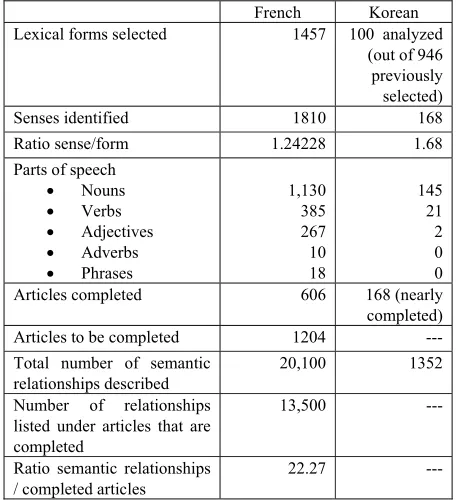
lexical functions, on the one hand, and a natural language explanation, on the other. Hence, on average, 22.27 semantic relationships appear in each article. The total of semantic relationships described amounts to 20,100.
In Korean, the first 100 candidates among 1022 terms correspond to 168 different senses (1.68). In Korean, 1352 related terms are listed under the first 100 terms (168 meanings) that have been described.
Table 5 summarizes the figures given in this section and provides other details on the descriptions. In Korean module, we have been working on the first 100 lexical forms (168 articles) and are just beginning to analyze the following 514 lexical forms, so that we cannot provide all the information given for French.
5. Future Work
Presently, most of the work carried out aims at completing the articles which are still under construction. In French, this represents approximately 1,800 articles. Based on the ratio obtained for the first 606 articles we have completed, we expect to find an additional 30,000 list of relationships. We would also like to extend the coverage of the dictionary to other terms, perhaps add more technical terms than those that have been included up to now.
Regarding the Korean dictionary, we would like to complete the descriptions of the selected terms. Also, since the listing of semantic relationships is not as developed as in the French dictionary, we would like to enrich this component. Secondly, the phenomena and the difficulties found in the process should be systemized in order to display rules regarding the similarities and differences between the two languages. For example, we are interested in the relation between French derivational morphemes and Korean corresponding forms. This kind of systematization will us allow to implement efficient bilingual systems.
Also, two extensions of this work are currently being developed (for English and Spanish) using the methodology described in this paper.
Acknowledgements
This research work was financially supported by the Quebec organization Fonds québécois de la recherche sur la Société et la culture (FQRSC).
References
Claveau, V. & M.C. L'Homme (2005). Terminology by Analogy-Based Machine Learning, In Proceedings of the 7thInternational Conference on Terminology and
Knowledge Engineering (TKE 2005), Copenhagen
(Denmark), 301-312.
Claveau, V. & M.C., L'Homme (2006, forthcoming). Discovering and Organizing Noun-Verb Collocations.
In Specialized Corpora Using Inductive Logic
Programming. International Journal of Corpus Linguistics, 11(2).
Drouin, P. (2003). Term Extraction Using Non-technical Corpora as a Point of Leverage. Terminology 9(1),
99-117.
Lemay, C., M.C. L'Homme & P. Drouin (2005). Two Methods for Extracting "Specific" Single-word Terms from Specialized Corpora: Experimentation and Evaluation, International Journal of Corpus Linguistics 10(2), 227-255.
L’Homme, M.C. (2002). Fonctions lexicales pour représenter les relations sémantiques entre termes.
Traitement automatique des langues (TAL), 43(1),
19-41.
L’Homme, M.C. (2003). Capturing the Lexical Structure in Special Subject Fields with Verbs and Verbal Derivatives: A model for specialized lexicography.
International Journal of Lexicography,16(4), 403-422.
L’Homme, M.C. (2004). La terminologie : principes et techniques. Montréal : Les Presses de l’Université de
Montréal.
Mel’čuk, I. et al. (1984-1999). Dictionnaire explicatif et combinatoire du français contemporain. Recherches lexico-sémantiques, 1-IV, Montréal: Les Presses de
l’Université de Montréal.
Mel’čuk, I., A. Clas & A. Polguère (1995). Introduction à la lexicologie explicative et combinatoire,
Louvain-la-Neuve (Belgique): Duculot / Aupelf - UREF.