Preprocessing and Tokenisation Standards in DELPH-IN Tools
Benjamin Waldron
∗, Ann Copestake
∗, Ulrich Sch¨afer
†, Bernd Kiefer
†∗University of Cambridge Computer Laboratory
15 JJ Thomson Avenue Cambridge CB3 0FD, UK
{bmw20, aac10}@cl.cam.ac.uk
†Language Technology Lab
German Research Center for Artificial Intelligence (DFKI) GmbH Stuhlsatzenhausweg 3
D-66123 Saarbr¨ucken, Germany
{ulrich.schaefer, bernd.kiefer}@dfki.de Abstract
We discuss preprocessing and tokenisation standards within DELPH-IN, a large scale open-source collaboration providing multiple independent multilingual shallow and deep processors. We discuss (i) a component-specific XML interface format which has been used for some time to interface preprocessor results to the PET parser, and (ii) our implementation of a more generic XML interface format influenced heavily by the (ISO working draft) Morphosyntactic Annotation Framework (MAF). Our generic format encapsulates the information which may be passed from the preprocessing stage to a parser: it uses standoff-annotation, a lattice for the representation of structural ambiguity, intra-annotation dependencies and allows for highly structured annotation content. This work builds on the existing Heart of Gold middleware system, and previous work on Robust Minimal Recursion Semantics (RMRS) as part of an inter-component interface. We give examples of usage with a number of the DELPH-IN processing components and deep grammars.
1.
Introduction
The standard assumption about natural language parsing is that input data must be initially divided into chunks suit-able for analysis (generally sentences) with each chunk fur-ther split into tokens. The tokenization step is generally defined to return a sequence of strings. There are sev-eral complications to this simple story when we consider processing real documents. Data which we wish to parse comes in many formats, possibly textual (e.g., raw text, HTML, SGML or XML markup, PDF), but possibly audio or video. Markup on the original input which is irrelevant for sentence parsing may nevertheless be useful for further processing (e.g., paragraph boundaries) and thus should be preserved so that it is available alongside the information extracted from parsing. Furthermore, it may be impossible in general for tokenization to produce a unique correct out-put without access to information usually associated with deeper processing. Finally, the assumption that tokens are strings does not allow for preprocessing which returns fur-ther information (e.g., named entity recognition, POS tag-ging or morphological analysis). Thus a general text inter-face should:
1. take into account document markup (e.g., via markup-aware tokenizer rules which provide the possibility to strip and recover markup as needed)
2. provide grounding in the text document under consid-eration (e.g., via standoff pointers)
3. provide an adequate representation for token ambigu-ity (e.g., a lattice)
4. provide a representation of adequate power for de-scription of token content (e.g., feature structures).
Obviously it is also desirable to adopt commonly accepted standards such as Unicode and XML. Ideally, it should be possible to use the tokenization component in generation as well as for analysis, although we will not discuss that further here.
In this paper, we present a preprocessing and tokenization standoff-annotation standard which has been designed for use in DELPH-IN1, a loose international collaboration of researchers developing open-source software components for language processing. DELPH-IN components include deep parsers (currently the LKB (Copestake, 2002) and PET (Callmeier, 2000)) which run deep grammars for var-ious natural languages (e.g., the English Resource Gram-mar (Flickinger, 2002), JACY2, NorSource3) and a range of tools for shallower processing. In previous work asso-ciated with DELPH-IN, in the Deep Thought project, the Heart of Gold system (Callmeier et al., 2004) for the inte-gration of shallow and deep linguistic processors was devel-oped along with the Pet Input Chart (PIC) XML interface format. Our current work extends this to provide a more general approach.
2.
Standoff Annotation
Linguistic annotation may be generated automatically (the situation we are interested in here) or manually. Annota-tions may be inline or standoff (Thompson and McKelvie, 1997). Inline annotation is simpler and provides a con-venient and straightforward way to annotate many docu-ments. It is particularly suitable to unambiguous manual annotation. However, in the case of XML documents, it
1
http://www.delph-in.net/
2
http://wiki.delph-in.net/moin/JacyTop
presupposes that the annotated output can be treated as tree-structured, which may be inconvenient or impossible. In contrast, in standoff annotation, each layer of annotations is kept in a separate space; the original data is left unaltered and the standoff document contains structures which are grounded via pointers into the original document. In such a framework, complex annotations with non-tree structure are possible, and a clear distinction exists between markup found in the original document and annotations in the sep-arate standoff document. If parsing is treated as providing standoff annotation, document markup remains available to discourse-level processing.
Standoff annotations have been used successfully in other work: e.g., NITE (Carletta et al., 2003); GATE (Cun-ningham et al., 2002); WHITEBOARD (Frank et al., 2003); TEI (Sperberg-McQueen and Burnard, 2004). The Deep Thought project, which used and developed various DELPH-IN technology, experimented with a limited form of standoff annotation in the form of character position in-formation encoded as part of RMRS (Copestake, 2003). The appropriate pointer scheme for standoff annotation de-pends on the data format of the original input. For example, annotations over an audio file may use frame (or time) off-sets; annotations over text might use character pointers into the source. In this paper, our primary focus is standoff an-notation over XML documents — we assume that other text formats will mapped to XML in a prior stage. In the next section, we discuss XML standoff pointers in more detail.
2.1. Choice Of Standoff Pointer Implementation
A variety of approaches to standoff pointers in XML have been investigated and have different strengths and weak-nesses: XML ID tags are coarse-grained, requiring that the source document contain markup elements around every-thing of interest (and crucially they cannot overlap); byte offsets are fine-grained but not robust to changes in the character encoding; character offsets are simple to use, al-though not robust to changes elsewhere in the document; XPointer4is very powerful, but its full machinery unneces-sary for our purposes.
We take a hybrid approach to choice of standoff pointer: existing non-XML-aware processing components can often easily be converted to produce character pointers, but for XML-aware components, it is easier to work with a pointer scheme aware of the XML tree structure. A mapping be-tween the two pointer schemes provides the necessary in-terconversion.
An XML text document may be considered at a num-ber of levels: (i) at one level, the document consists of a sequence of bytes, to be interpreted with respect to some coding scheme (specified in the XML header; e.g.,
encoding=’ISO-8859-1’); (ii) at a higher level, an XML document is considered a sequence of Unicode char-acters; (iii) at an even higher level, the document is a collec-tion of abstract nodes forming a tree structure (in which cer-tain distinctions in the input, such as sequences of whites-pace, have been collapsed). Non-XML-aware processing components consider an input document as a sequence of
4http://www.w3.org/TR/WD-xptr
Raw Text: ”<p>Come <i>here</i>!</p>”
Unicode character points:
.<.p.>.C.o.m.e.∆.<.i.>.h.e.r .e .<./ .i .>.! .<./ .p .>.
Figure 1: character pointers (points shown as ‘.’ and num-bered from the left, starting from 0)
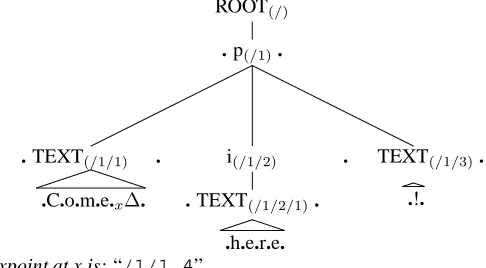
ROOT(/)
. p(/1).
. TEXT(/1/1) .
.C.o.m.e.x∆.
i(/1/2)
. TEXT(/1/2/1).
.h.e.r.e.
. TEXT(/1/3).
.!.
xpoint at x is: “/1/1.4”
Figure 2: xpoint-based pointers (points shown as ‘.’)
bytes or characters. XML-aware processing components work with the XML tree.
We use ‘character’ pointers refer to points between the se-quence of Unicode characters (see fig. 1); ‘xpoint-based’ pointers refer to points in the abstract XML tree (see fig. 2). Our xpoint-based pointers are derived from the xpoint scheme detailed in the XPointer specification. Any point may be uniquely referenced by specifying an XML node (via XPath) paired with an offset (Unicode charac-ter offset inside a text node; XML node offset otherwise). Points within XML attribute values can also be specified in this way. XPath allows multiple expressions to refer to the same node in a particular document; by appropriate choice of XPath expression, it is possible to trade simplicity of pointer scheme against robustness. For example, suppose the<p>element in fig. 2 contained attributeid=’p23’. Point x could be specified by one of: “/1/1.4” or “/p/text()[1].4” or “//[@id=’p23’]/1.4” (in order of robustness to changes to the raw document).
3.
Interface formats within DELPH-IN
for specific purposes; (iii) a lattice; (iv) intra-annotation de-pendencies; (v) a range of representations for the content of individual annotations. The mapping from annotation con-tents into grammar data structures is specified in grammar-specific configuration files. SMAF is designed for the situa-tion where multiple processors are to be flexibly integrated, as, for instance, in the SciBorg project5. It allows for lev-els of interface other than tokenization and morphology, al-though these will not be discussed further here.
3.1. PIC implementation
The PIC (PET XML Input Chart) format has been used with the deep HPSG parser PET within the Heart of Gold system (Callmeier et al., 2004; Sch¨afer, 2005). Heart of Gold is a middleware for the integration of deep and shallow natural language processors on the basis of XML standoff annota-tion that can be flexibly configured and easily accessed by applications.
Heart of Gold uses XSLT (Clark, 1999) for combining and integrating XML markup. The general idea has been pre-sented and motivated in (Sch¨afer, 2003). XSLT can be used to convert between the various XML formats, and to com-bine and query standoff annotations. In particular, XSLT stylesheets may also be used to resolve conflicts resulting from multi-dimensional markup, choose among alternative readings, follow standoff links, or decide which markup source to give higher preference.
The PIC format contains the original input text to be parsed, the character span information of the words, optional part-of-speech information (e.g., to allow guessing of the type of unknown words) with weights in case of multiple readings, and a construct for combining simple items to complex ones, e.g., multi-words named entities or chunks. Further-more, types and, more generally, typed feature structures can be ‘injected’ via PIC directly into the deep parsers’ chart by specifying feature paths with associated values. In the following, we give an example (for sentence ’When will LREC 2006 take place?’) of two preprocessing compo-nents, a PoS tagger and a named entity recognition (NER) component. Their output triggers generic entries of words unknown to the HPSG lexicon to increase robustness. Both preprocessing components independently produce standoff markup from the input text. The markup is transformed and combined into a single PIC markup document which is then passed to the deep HPSG parser running the English Resource Grammar.
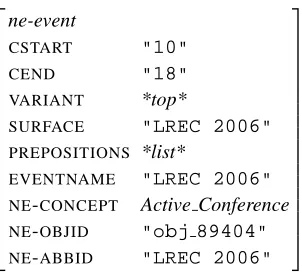
Similar setups as for English have also been implemented for German, modern Greek and Japanese preprocessing components and HPSG grammars in the Heart of Gold. SProUT (Dro˙zd˙zy ´nski et al., 2004), the NER component used for these languages, produces typed feature structure markup (Lee et al., 2004) (Figure 3), and transforms it to the PET input chart format using XSLT stylesheets that are automatically generated offline from the SProUT out-put feature structure specifications (Sch¨afer, 2005). The various PoS taggers either directly produce the PIC format or use small, manually developed transformation stylesheets. Figure 6 shows the PET input chart generated
5http://www.sciborg.org.uk/
ne-event
CSTART "10"
CEND "18"
VARIANT *top*
SURFACE "LREC 2006"
PREPOSITIONS *list*
EVENTNAME "LREC 2006"
NE-CONCEPT Active Conference NE-OBJID "obj 89404"
NE-ABBID "LREC 2006"
Figure 3: SProUT named entity recognition output.
by combining PoS tagger output (<w>elements) and NER (in element<ne>).
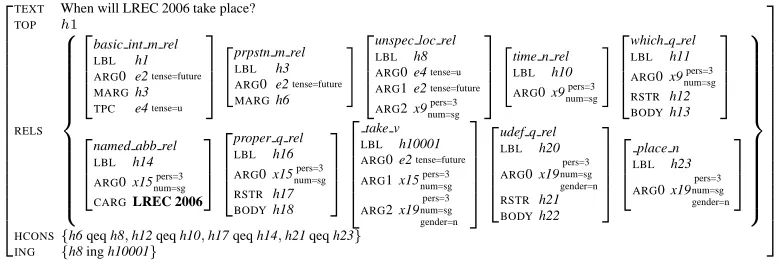
Finer-grained information (e.g., gained from integrating ontology information in the NER resources as described in (Sch¨afer, 2006)) that is not relevant for robust HPSG pars-ing, can be by-passed as an RMRS structure. The RMRS (Figure 4) is generated from the SProUT output using an-other automatically generated stylesheet, and can be com-bined with the deep RMRS (Figure 5) in a post-parsing transformation.
3.2. SMAF implementation
A SMAF document describes a segment (generally, sen-tence) of the raw input document packaged in a manner suitable for input to a parser. Relevant annotation levels for such a description include simple token strings, part-of-speech tags over simple tokens, complex named-entity to-kens and morphological descriptions of toto-kens (when these are provided by a component external to the parser). The format borrows from MAF and PIC. It incorporates RMRS-XML as a possible annotation content.
The following properties are global to a SMAF document:
• document points to the original document (optionally, the raw data may be embedded in the text property);
• optionally, the standoff pointer addressing scheme may be specified (defaults to character pointers);
• a collection of OLAC-compatible metadata (including an identifier);
• a global span (standoff pointers cfrom and cto);
• a lattice containing the annotations themselves as edges (with special initial and final nodes).
The following properties are applicable to an edge annota-tion:
• an identifier;
• a type (one of token, pos, namedEntity, morphology);
incorporating a light-weight named entity component) pro-vides a simple preprocessor sufficient for many contexts. It produces SMAF documents natively. Other components have been written from scratch, or adapted (the RASP (Briscoe and Carroll, 2002) sentence splitter, the ChaSen preprocessor for Japanese) to produce this XML inter-face format. Components previously adapted to produce PIC within the Heart of Gold system are converted via a PIC2SMAF XSLT stylesheet as an interim solution. Crucially, grounding in the source document (via standoff pointers) is preserved throughout processing and hence the link between system output and the processed text is never broken. These standoff pointers are preserved in the RMRS semantic analyses output by the deep parsers.
4.
Summary
This paper has described the use in DELPH-IN of a standoff-annotation interface format between the level of preprocessing (consisting of an obligatory tokenizer mod-ule plus optional additional modmod-ules) and the deep parser module (consisting of a deep grammar for a particular nat-ural language running on a DELPH-IN deep processor) of the DELPH-IN tools. The role of interface format is played by SMAF, a fairly general XML serialization loosely based on the MAF ISO working draft. Configuration files define the mapping from this format to the specific data structures required by particular deep processor implementations and the type systems of particular grammars.
5.
Acknowledgements
We would like to thank the reviewers for valuable com-ments. We wish to thank Dan Flickinger, Stephan Oepen and other colleagues within the DELPH-IN collaboration for many informative discussions. This work was partly funded by a grant from Boeing to Cambridge University, partly by EPSRC project EP/C010035/1, and partly by a grant from the German Federal Ministry of Education and Research (FKZ 01IWC02).
6.
References
M. Asahara and Y. Matsumoto. 2000. Extended Mod-els and Tools for High-performance Part-of-Speech Tag-ger. In Proceedings of COLING 2000, Saarbr¨ucken, Ger-many.
E. Briscoe and J. Carroll. 2002. Robust accurate statis-tical annotation of general text. In Proceedings of the Third International Conference on Language Resources and Evaluation, Las Palmas, Gran Canaria.
U. Callmeier, A. Eisele, U. Sch¨afer, and M. Siegel. 2004. The DeepThought core architecture framework. In Pro-ceedings of LREC-2004, Lisbon, Portugal.
U. Callmeier. 2000. PET – A platform for experimenta-tion with efficient HPSG processing techniques. Natural Language Engineering, 6(1):99–108.
J. Carletta, J. Kilgour, T. O’Donnell, S. Evert, and H. Voor-mann. 2003. The NITE Object Model Library for Han-dling Structured Linguistic Annotation on Multimodal Data Sets. In Proceedings of 3rd Workshop on NLP and XML, NLPXML-2003.
J. Clark, 1999. XSL Transformations (XSLT). World Wide Web Consortium, http://w3c.org/TR/xslt.
L. Clement and E. de la Clergerie. 2005. MAF: a mor-phosyntactic annotation framework. In Proceedings of the 2nd Language and Technology Conference, Poznan, Poland.
A. Copestake. 2002. Implementing Typed Feature Struc-ture Grammars. CSLI Publications, Stanford.
A. Copestake. 2003. Report on the Design of RMRS. Technical Report D1.1a, University of Cambridge, UK. H. Cunningham, D. Maynard, K. Bontcheva, and V. Tablan.
2002. GATE: A Framework and Graphical Develop-ment EnvironDevelop-ment for Robust NLP Tools and Applica-tions. In Proceedings of the 40th Anniversary Meeting of the Association for Computational Linguistics (ACL’02), Philadelphia.
W. Dro˙zd˙zy´nski, H.-U. Krieger, J. Piskorski, U. Sch¨afer, and F. Xu. 2004. Shallow processing with unification and typed feature structures — foundations and applica-tions. K¨unstliche Intelligenz, 2004(1):17–23.
D. Flickinger. 2002. On building a more efficient gram-mar by exploiting types. In D. Flickinger, S. Oepen, H. Uszkoreit, and J. Tsujii, editors, Collaborative Lan-guage Engineering. A Case Study in Efficient Grammar-based Processing. CSLI Publications.
A. Frank, M. Becker, B. Crysmann, B. Kiefer, and U. Sch¨afer. 2003. Integrated shallow and deep parsing: TopP meets HPSG. In Proceedings of ACL-2003, Sap-poro, Japan.
K. Lee, L. Burnard, L. Romary, E. de la Clerg-erie, U. Sch¨afer, T. Declerck, S. Bauman, H. Bunt, L. Cl´ement, T. Erjavec, A. Roussanaly, and C. Roux. 2004. Towards an international standard on feature structure representation (2). In Proceedings of the LREC-2004 workshop on A Registry of Linguistic Data Categories within an Integrated Language Resources Repository Area, Lisbon, Portugal.
U. Sch¨afer. 2003. WHAT: An XSLT-based infrastructure for the integration of natural language processing com-ponents. In Proceedings of the HLT-NAACL Workshop on the Software Engineering and Architecture of Lan-guage Technology Systems, Edmonton, Canada.
U. Sch¨afer, 2005. Heart of Gold – an XML-based
middleware for the integration of deep and shal-low natural language processing components, User and Developer Documentation. DFKI
Lan-guage Technology Lab, Saarbr¨ucken, Germany.
http://heartofgold.dfki.de/doc/heartofgolddoc.pdf. U. Sch¨afer. 2006. OntoNERdIE—mapping and linking
ontologies to named entity recognition and information extraction resources. In Proceedings of LREC-2006, Genoa, Italy.
C. Sperberg-McQueen and L. Burnard, 2004. TEI P4: Guidelines for Electronic Text Encoding and Inter-change. http://www.tei-c.org/P4X/.
<?xml version=’1.0’?> <!DOCTYPE pet-input-chart [
<!ELEMENT pet-input-chart ( w | ne )* >
<!ELEMENT w ( surface, path*, pos*, typeinfo* ) > <!ATTLIST w id ID #REQUIRED
cstart NMTOKEN #REQUIRED cend NMTOKEN #REQUIRED prio CDATA #IMPLIED constant (yes | no) "no" > <!ELEMENT surface ( #PCDATA ) >
<!ELEMENT path EMPTY >
<!ATTLIST path num NMTOKEN #REQUIRED > <!ELEMENT typeinfo ( stem, infl*, fsmod* ) > <!ATTLIST typeinfo id ID #REQUIRED
prio CDATA #IMPLIED baseform (yes | no) "yes" > <!ELEMENT stem ( #PCDATA ) >
<!ELEMENT infl EMPTY >
<!ATTLIST infl name CDATA #REQUIRED > <!ELEMENT fsmod EMPTY >
<!ATTLIST fsmod path CDATA #REQUIRED value CDATA #REQUIRED > <!ELEMENT pos EMPTY >
<!ATTLIST pos tag CDATA #REQUIRED prio CDATA #IMPLIED > <!ELEMENT ne ( ref+, pos*, typeinfo+ ) > <!ATTLIST ne id ID #REQUIRED
prio CDATA #IMPLIED > <!ELEMENT ref EMPTY >
<!ATTLIST ref dtr IDREF #REQUIRED > ]>
<pet-input-chart>
<w id="TNT0" cstart="0" cend="3"> <surface>When</surface>
<pos tag="WRB" prio="1.000000e+00"/> </w>
<w id="TNT1" cstart="5" cend="8"> <surface>will</surface>
<pos tag="MD" prio="1.000000e+00"/> </w>
<w id="TNT2" cstart="10" cend="13"> <surface>LREC</surface>
<pos tag="NNP" prio="1.000000e+00"/> </w>
<w id="TNT3" cstart="15" cend="18"> <surface>2006</surface>
<pos tag="CD" prio="1.000000e+00"/> <typeinfo id="TYI3" baseform="no">
<stem>$generic_number</stem> </typeinfo>
</w>
<w id="TNT4" cstart="20" cend="23"> <surface>take</surface>
<pos tag="VB" prio="8.349828e-01"/> <pos tag="NN" prio="8.672786e-02"/> <pos tag="VBP" prio="7.828936e-02"/> </w>
<w id="TNT5" cstart="25" cend="29"> <surface>place</surface>
<pos tag="NN" prio="1.000000e+00"/> </w>
<w id="TNT6" cstart="30" cend="30" constant="yes"> <surface>?</surface>
<pos tag="?" prio="1.0"/> </w>
<ne id="SPR1" prio="1.0"> <ref dtr="TNT2"/> <ref dtr="TNT3"/>
<surface>LREC 2006</surface> <pos tag="PN" prio="1.0"/> <typeinfo id="TIN2" baseform="no">
<stem>$generic_name</stem> </typeinfo>
</ne>
</pet-input-chart>
Figure 6: PET input chart generated from PoS tagger and named entity recognition component output.
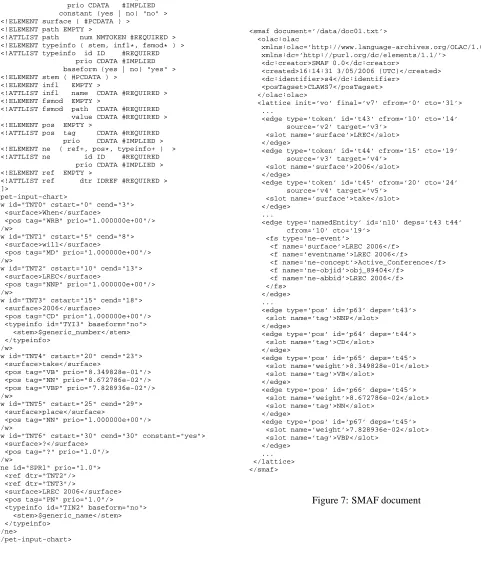
<smaf document=’/data/doc01.txt’> <olac:olac
xmlns:olac=’http://www.language-archives.org/OLAC/1.0/’ xmlns:dc=’http://purl.org/dc/elements/1.1/’>
<dc:creator>SMAF 0.0</dc:creator>
<created>16:14:31 3/05/2006 (UTC)</created> <dc:identifier>s4</dc:identifier>
<posTagset>CLAWS7</posTagset> </olac:olac>
<lattice init=’vo’ final=’v7’ cfrom=’0’ cto=’31’> ...
<edge type=’token’ id=’t43’ cfrom=’10’ cto=’14’ source=’v2’ target=’v3’>
<slot name=’surface’>LREC</slot> </edge>
<edge type=’token’ id=’t44’ cfrom=’15’ cto=’19’ source=’v3’ target=’v4’>
<slot name=’surface’>2006</slot> </edge>
<edge type=’token’ id=’t45’ cfrom=’20’ cto=’24’ source=’v4’ target=’v5’>
<slot name=’surface’>take</slot> </edge>
...
<edge type=’namedEntity’ id=’n10’ deps=’t43 t44’ cfrom=’10’ cto=’19’>
<fs type=’ne-event’>
<f name=’surface’>LREC 2006</f> <f name=’eventname’>LREC 2006</f>
<f name=’ne-concept’>Active_Conference</f> <f name=’ne-objid’>obj_89404</f>
<f name=’ne-abbid’>LREC 2006</f> </fs>
</edge> ...
<edge type=’pos’ id=’p63’ deps=’t43’> <slot name=’tag’>NNP</slot>
</edge>
<edge type=’pos’ id=’p64’ deps=’t44’> <slot name=’tag’>CD</slot>
</edge>
<edge type=’pos’ id=’p65’ deps=’t45’> <slot name=’weight’>8.349828e-01</slot> <slot name=’tag’>VB</slot>
</edge>
<edge type=’pos’ id=’p66’ deps=’t45’> <slot name=’weight’>8.672786e-02</slot> <slot name=’tag’>NN</slot>
</edge>
<edge type=’pos’ id=’p67’ deps=’t45’> <slot name=’weight’>7.828936e-02</slot> <slot name=’tag’>VBP</slot>
</edge> ... </lattice> </smaf>