Greek Named Entity Recognition using Support Vector Machines, Maximum
Entropy and Onetime
Ionas Michailidis
†*, Konstantinos Diamantaras
†, Spiros Vasileiadis
†, Yannick Frère
‡† Department of Informatics
Alexander Technological Education Institute of Thessaloniki 57400 Sindos, Greece
* Laboratoire d’Informatique
Ecole Polytechnique de l’Université “François Rabelais” de Tours 64 avenue Jean Portalis,
37200 Tours, France
‡ Haute École de la Province de Liège “Rennequin Sualem”
Quai Gloesener, 6 4020 Liège, Belgium
[email protected], [email protected], [email protected], [email protected]
Abstract
We describe our work on Greek Named Entity Recognition using comparatively three different machine learning techniques: (i) Support Vector Machines (SVM), (ii) Maximum Entropy and (iii) Onetime, a shortcut method based on previous work of one of the authors. The majority of our system’s features use linguistic knowledge provided by: morphology, punctuation, position of the lexical units within a sentence and within a text, electronic dictionaries, and the outputs of external tools (a tokenizer, a sentence splitter, and a Hellenic version of Brill’s Part of Speech Tagger). After testing we observed that the application of a few simple Post Testing Classification Correction (PTCC) rules created after the observation of output errors, improved the results of the SVM and the Maximum Entropy systems output. We achieved very good results with the three methods. Our best configurations (Support Vector Machines with a second degree polynomial kernel and Maximum Entropy) achieved both after the application of PTCC rules an overall F-measure of 91.06.
1.
Introduction
Named Entity Recognition (NER) can be described as the task of recognizing and classifying single and multi-word expressions within a document that act as proper names of any kind (person names, location names, organization names, etc.). For example, in the text: “Ο πρόεδρος της Ευρωπαϊκής Επιτροπής κ. Ζακ Σαντέρ συναντήθηκε στις Βρυξέλλες µε τον πρωθυπουργό της Μ. Βρετανίας κ. Μπλερ.” a NER system should recognize
“Ζακ Σαντέρ” (Jacques Santer) and “Μπλερ” (Blair) as Person Named Entities, “Βρυξέλλες” (Brussels) and “Μ. Βρετανίας” (Great Britain) as Location Named Entities, and “ΕυρωπαϊκήςΕπιτροπής” (European Commission) as an Organization Named Entity.
NER systems are essential components of Information Extraction and Question Answering systems. NER is also used for text indexing and classification (Friburger & Maurel, 2002), as well as in parallel corpora alignment (Steinberger et al., 2004).
The benchmarks of the NER domain are considered to be those established by four major international conferences that took place in the form of competitions of NER systems: MUC-61 (Chinchor, 1995) (in 1995),
MUC-72 (Chinchor, 1998) (in 1997) CoNLL-2002 shared
task3 (Tjong Kim Sang, 2002) and CoNLL-2003 shared
task4 (Tjong Kim Sang & De Meulder, 2003). During the
1 http://www.cs.nyu.edu/cs/faculty/grishman/muc6.html 2 http://www.itl.nist.gov/iaui/894.02/related_projects/
muc/proceedings/muc_7_toc.html
3 http://www.cnts.ua.ac.be/conll2002/ner/ 4
first two conferences (MUC) the participating systems where asked to recognize and classify person, location, and organization proper names as well as date, time, percentage, and monetary value expressions. The target language was English. In the latest two conferences (CoNLL shared task conferences) the participating systems had to recognize and classify person, location, and organization entities, as well as miscellaneous entities that do not belong to the three previous groups like for example names of artifacts, book and film titles etc. The target languages where: Dutch and Spanish for the 2002 edition, and English and German for the 2003 edition. The different teams had to participate in both language evaluations, since the goal of the conferences was the creation of language independent systems.
In the past, various methods have been used by NER systems. Depending on the method, we can classify these systems into three general categories:
• Systems using hand-crafted recognition grammars, like the New York University’s system (Grishman, 1995) involved in MUC-6;
• Systems using “machine learning” techniques, like all the systems used in the CoNLL shared task conferences. Some of them did very well on both languages;
• Hybrid systems using both approaches, for example, the very successful system of the Language Technology Group at the University of Edinburgh (Mikheev et al., 1998) presented in MUC-7.
ressources. Petasis et al. (2002) use the C4.5 machine learning algorithm to update NER grammars. Boutsis et al. (2000) use a collection of 110 hand-crafted grammars. Lucarelli (2005) uses Support Vector Machines to recognize person Named Entities and semi-automatically created patterns to recognize temporal expressions.
Our experiment concerns “CoNLL-2002 shared task”- style, Greek NER using comparatively three machine learning approaches: (i) Support Vector Machines (Vapnik, 1995), (ii) Maximum Entropy (Berger et al., 1996) and (iii) Onetime (Diamantaras et al. 2005). In the following sections we will make a description of the corpora we used (section 2) and the features we extracted for every token of the corpora (section 3). Follows, a discussion on how to approach NER as a machine learning problem (section 4) and a short presentation of the three machine learning techniques we used (sections 5, 6 and 7). Finally we present our experiment (section 8), a method for improving our system’s output (section 9), the experimental results and a discussion on these results (section 10).
2.
The corpus
The Greek corpus we have used comes from the newspaper “TA NEA”. It is a selection of 400 articles from the year 1997 covering diverse columns of the newspaper («Γνώµες – Σχόλια» (Opinions), «Πολιτική» and «Μικροπολιτικός» (Politics News), «Κοινωνία»
(Society), «Κόσµος» (International News), «Οικονοµία»
(Economic News), «Πανόραµα» (Art News), «Οµάδα»
(Sport News), «Επιστολές» (Letters from the readers), «Θεάµατα» (Spectacles). The corpus measures approximately 172,000 tokens and is divided into 400 different files (400 articles). According to Ellogon Components Specifications (Afantenos et al., 2002) we consider as tokens all character sequences in a text which are separated by blank spaces or punctuation marks. Additionally punctuation marks are also considered to be tokens. Similarly to Boutsis et al. (2000) the selected articles contain a high percentage of tokens beginning with a capital letter.
We have divided the corpus into two parts: the first part (approximately 138,000 tokens) is used for training our system, while the second (approximately 34,000 tokens) is used for testing it. The criterion we used for dividing the corpus is the author of the article. The authors of the articles of the training corpus are different from the ones of the test corpus. We did this in order to evaluate our system with articles that may have a different writing style from the articles of the training corpus and thus increase the degree of difficulty of the task. We then used the tools provided with the Ellogon Text Engineering Platform (Petasis et al., 2002b) in order to:
• split the two corpora into sentences and tokens (use of a Sentence Splitter and a Tokenizer) without manual correction
• obtain Part of Speech (PoS) tags for all tokens of the two corpora (use of the Hellenic version of Brill’s PoS Tagger (Brill, 1992; Afantenos et al., 2002)) without manual correction
• manually tag the Named Entities in the two corpora following CoNLL-2002 annotation guidelines (use of a corpus annotation tool)
• create the input of the feature extraction tool for both corpora (one file where each line contains: the token, its Named Entity tag according to CoNLL-2002 shared task guidelines, a binary information indicating if the current token is the first token of a sentence, its PoS tag as it is provided by Brill’s PoS Tagger, and the name of the article the token belongs to)
According to the CoNLL-2002 shared task annotation guidelines every Named Entity token is associated with a Named Entity tag encoding its Named Entity category (Person, Location, Organization, Miscellaneous) and its position in the Named Entity (whether it is the first token of a Named Entity or not). Tokens tagged with O are
Outside of Named Entities. The B-X tag is used for the token at the Beginning of a Named Entity of type X while the I-X tag is used for all other tokens Inside the Named Entity of type X. The X Entities are of four types: persons (PER), locations (LOC), organizations (ORG), and miscellaneous (MISC). This tagging scheme is a variant of the IOB scheme originally proposed by Ramshaw and Marcus (1995). An example of the input of the feature extraction tool is given on figure 1.
TOKEN TAG NE
FIRST TOKEN OF
A SENTENCE
PoS
TAG NAME
FILE-Ο O YES DDT File1.txt
κ. O NO NNF File1.txt
Ζακ B-PER NO NNPM File1.txt
Σαντέρ I-PER NO NNPM File1.txt συναντήθηκε O NO VBD File1.txt
στις O NO DDT File1.txt
Βρυξέλλες B-LOC NO NNPSF File1.txt
µε O NO IN File1.txt
τον O NO DDT File1.txt
κ. O NO NNF File1.txt
Μπλερ B-PER NO NNPM File1.txt
. O NO . File1.txt
Figure 1. Input of the feature extraction tool
The PoS tags are the ones attributed by the Hellenic Version of the Brill’s PoS tagger. They are further described in (Afantenos et al. 2002). During the annotation process Named Entities where assumed to be non-recursive and non-overlapping. In case of a Named Entity embedded in another Named Entity only the top level Entity was marked.
3.
The Features
The features we used for both training and evaluating the system where mainly inspired by Chieu and Ng (2003). The features, which are all binary (they respond to questions about a token with “Yes” → ”1” or “No” → ”0”), result in an array of zeros and ones. The array size is M×N where M is the number of tokens of the corpus and N is the total number of features.
total number of features in our system is 91 (89 local and 2 global).
3.1. Local features
The local features can be grouped into features that concern the current token, the previous, the previous two, the next, and the next two tokens. Local features use information relating to morphology, punctuation, PoS, dictionary membership and list membership. Below we describe the features according to these groups.
3.1.1. Morphological features
The morphological features relate to morphological observations about the current token. They correspond to the following binary tests:
• Token begins with a capital letter (Yes / No)
• All letters of the token are capital (Yes / No)
• Token is composed of only one capital letter (Yes/No)
• Token contains at least one digit (Yes / No)
• Token has only Latin characters (Yes / No)
3.1.2. Punctuation features
The punctuation features relate to observations about the current token in relation with punctuation and the position of the token in the sentence and the article. They correspond to the following binary tests:
• Token is the first token of a sentence (Yes / No)
• Token is the first token of an article (Yes / No)
• Token follows an opening parenthesis (Yes / No)
• Token precedes a closing parenthesis (Yes / No)
• Token follows an opening («) or an ASCII (") quote (Yes /No) (2 different features)
• Token precedes a closing (») or an ASCII (") quote (Yes / No) (2 different features)
3.1.3. PoS features
The PoS features are related to observations about the current, the previous and the next token’s PoS tag attributed by the Hellenic version of the Brill’s PoS tagger. We use a reduced tag set (16 different tags) of the different PoS tags attributed by the Hellenic version of the Brill’s PoS tagger. The features correspond to the following binary tests:
• Token has a V5 PoS tag (Yes / No) (16 different
features)
• Token follows a token with a V PoS tag (Yes / No) (16 different features)
• Token precedes a token with a V PoS tag (Yes / No) (16 different features)
3.1.4. Dictionary features
The dictionary features concern the current and the previous token in relation to their membership in electronic dictionaries containing all the inflected forms of some word classes. The features correspond to the following binary tests:
• Token is a part of a dictionary of person first names (Yes / No) (Mavropoulos & Bakoura, 2002)
• Token is a part of a dictionary of location names (Yes / No) (Bakoura, 2003)
• Token follows a token which is part of a dictionary of profession names (Yes / No) (Foufi, 2004)
5
• Token ends with a family name suffix contained in a dictionary of family name suffixes (Yes / No)
3.1.5. List features
The list features are concerned with the current and the previous two tokens in relation to some lists of tokens derived from the training corpus. The features correspond to the following binary tests:
• Token is a part of a list containing non-capitalized tokens found at least 2 times in the training corpus tagged with the Y6 Named Entity tag (Yes / No) (8
different features). For example in the text «Τράπεζα της Ελλάδος» (Bank of Greece), «της» (of) is a non-capitalized token tagged as I-ORG.
• Token is a part of a list containing tokens found at least 2 times in the training corpus tagged with the Y Named Entity tag (Yes / No) (8 different features)
• Previous token is a part of a list containing tokens in the training corpus preceding at least 2 times a Named Entity token of the Z7 category (Yes / No) (4 different
features). For example in the text «στην Ιταλία» (in Italy), «στην» (in) is a token preceding a LOC Named Entity.
• Previous 2 tokens are a part of a list containing sequences of 2 consecutive tokens in the training corpus preceding at least 2 times a Named Entity token of the Z category (Yes / No) (4 different features). For example in the text «µε τον Κώστα Βουτσά» (with Kostas Voutsas), «µετον» (with) is a sequence of two tokens preceding a PER Named Entity.
3.2. Global features
The global features are the two following:
• We search the capitalized first token of a sentence elsewhere in the same article. If this token is found, is not the first token of a sentence, and is capitalized, this feature is set to “Yes” → ”1”. This feature helps identifying tokens that begin with a capital letter independently of their position in the sentence.
• If the token is made up of all capitalized letters we look in the same article for sequences of tokens whose capitalized initials match the token in question. If found, this feature is set to “Yes” → ”1”. This feature helps identifying acronyms.
4.
NER and machine learning
The NER problem using the CoNLL-2002 shared task scheme is the automatic assignment of a Named Entity tag to every token of a text. This problem can be seen as a classification task where every token of the text must be classified in one of the nine Named Entity tag classes (B-PER, (B-PER, B-LOC, LOC, B-ORG, ORG, B-MISC, I-MISC and O for tokens not belonging to Named Entities). In order to solve a classification problem we use a classification algorithm. Classification algorithms can be grouped, depending on the number of classes they can handle, into multi-class like Maximum Entropy and binary like Support Vector Machine and Onetime. Our NER
6 Y = each one of the possible Named Entity tags, i.e. B-PER,
I-PER, B-LOC, I-LOC, B-ORG, I-ORG, B-MISC, I-MISC (excluding the non Named Entity tag “O”)
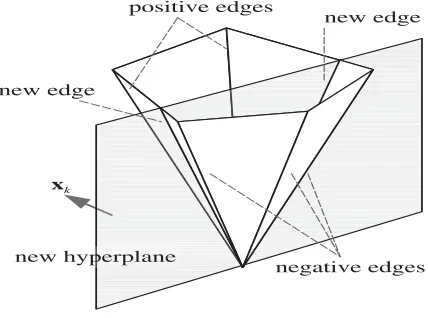
negative edges new hyperplane
positive edges
xk
new edge
new edge problem involves nine classes while SVM and Onetime
are binary classification algorithms. How to solve a multi-class problem using a binary multi-classification algorithm?
We can face this issue by transforming the single nine class problem into several binary class problems (solved by several classifiers) and using an appropriate strategy to combine the outputs of all the classifiers into a unique decision for every token. Our previous work (Michailidis et al. 2005) showed that the transformation of a Greek NER multi-class problem into several binary class ones is done better using the “one versus one” (Fuernkranz, 2002) method (also called “Round Robin” or “pair-wise”).
The “one versus one” method uses a binary classifier for each combination pair of the given output classes of the training set. If we have i output classes we need
i*(i−1)/2 binary classifiers. In our case i=9 so there are 36 classifiers. For each combined pair, only the samples which represent the two current output classes are considered during the training process. In order to combine the decisions from the multiple classifiers we applied simple voting.
5.
Support Vector Machines
The Support Vector Machines (SVM) is a binary classification technique (Vapnik, 1995). SVM faces the problem of the two class separation of the input space of M dimensional samples (training set) using an N-dimensional hyperplane, by mapping with a kernel function the input space into a high-dimensional space F, where the optimal separation hyperplane can be easily calculated. The SVM performs classification on the high dimensional space F by choosing the optimal hyperplane which maximizes the margin of any point in the training set. Statistical learning theory suggests that, for well-behaved classes, the choice of the maximum margin hyperplane will lead to maximal generalization when predicting the class membership of previously unseen samples. For more detailed discussion about this algorithm please refer to Vapnik (1995) and Burges (1998). Our system uses the Support Vector Machines implementation “SVM light”8 written by Joachims (1999).
We trained and tested our SVM system using three different kernel functions. Those were: (i) the Linear, (ii) the Polynomial and (iii) the Gaussian or Radial Basis Function (RBF) kernel.
6.
Maximum Entropy
According to Chieu and Ng (2004), the Maximum Entropy method estimates probabilities based on the principle of making as few assumptions as possible, other than the constraints imposed. Such constraints are derived by training data, expressing some relationship between features and outcome. The probability distribution which satisfies the above property is the one with the highest entropy. It is unique, agrees with the maximum-likelihood distribution, and has the exponential form:
p(o|h) =
) , (
1
)
(
1
k f hoj j
j
h
Z
∏
=α
where o refers to the outcome, h the history (or context), and Z(h) is a normalization function to ensure that
8 http://svmlight.joachims.org/
Σop(o|h)=1. In addition, each feature function fj(h,o) is a binary function. An example of a feature function is:
1 if o=B-PER, token starts with capital letter
fj(h,o)=
0otherwise
The parameters αj can be estimated by a procedure called Generalized Iterative Scaling (GIS) (Darroch & Ratcliff, 1972). The Maximum Entropy method is further described by Berger et al. (1996). In our experiment we used the Maximum Entropy toolkit named “MaxEnt”9 written by
Zangh Le (2004).
7.
Onetime
The Onetime algorithm (Diamantaras et al., 2005) is a shortcut method for binary linear classification based on previous work of one of the authors (Diamantaras & Strintzis 1998).
Figure 2. The solution cone
This earlier work focused on the description of the solution cone (see fig. 2) through a set of edges and it proposed a recursive algorithm for updating those edges. Onetime is an extension of that idea based on the fact that we do not need the exact description of the solution cone, but only one solution vector inside it. The learning algorithm leaves intact the solution vector when it is inside the new solution cone defined by the positive part of the old solution cone and the new hyperplane (corresponding to the new pattern xk). The solution vector is updated when it is not inside the new solution cone. The update is done by finding a new solution vector which is “barely” inside the new solution cone.
8.
Experiment
Our training corpus featured ca 138,000 data samples. The test corpus counted ca 34,000 test samples. The number of features was 91. Our experiment used comparatively the above corpora for training and testing three systems based on the machine learning approaches of: (i) Support Vector Machines, (ii) Maximum Entropy and (iii) Onetime.
9.
Post Testing Classification Correction
Studying the output results of our tests, we observed several repeating misclassification patterns. More
Transactions on Neural Networks. vol. 9, no 3. pp 436-447.
Farmakiotou, D., Karkaletsis, V., Koutsias, J., Sigletos, G., Spyropoulos, C.D., and Stamatopoulos, P. (2000). “Rule-based Named Entity recognition for Greek Financial Texts”. In Proceedings of the Workshop on Computational lexicography and Multimedia Dictionaries (COMPLEX 2000). pp. 75-78.
Foufi, V. (2004). “Electronic Dictionary of Greek profession names”, in Proceedings of the 25th annual meeting of the Linguistics Section of the Department of Philology at the Aristotle University of Thessaloniki. Thessaloniki, Greece.
Friburger, N. and Maurel, D. (2002). “Textual similarity based on Proper Names”. In Proceedings of the workshop Mathematical / Formal methods in Information Retrieval (MFIR ‘2002) at the 25th ACM SIGIR Conference. Tampere, Finland. pp. 155-167. Fuernkranz, J. (2002). “Round Robin Classification”, The
Journal of Machine Learning Research. vol.2. pp. 721-747.
Grishman, R. (1995). “The NYU system for MUC-6 or where is the syntax?”. In Proceedings of the 6th Message Understanding Conference (MUC-6). Columbia, Maryland. Morgan-Kaufmann,
Joachims, T. (1999). “Making large-Scale SVM Learning Practical”. Advances in Kernel Methods - Support Vector Learning. Schölkopf, B., Burges, C. and Smola, A. (ed.), MIT Press. Cambridge, USA.
Karkaletsis, V., Paliouras, G., Petasis, G., Manousopoulou, N. and Spyropoulos, C.D. (1999). “Named-Entity Recognition from Greek and English Texts”. Journal of Intelligent and Robotic Systems. pp. 123-135.
Lucarelli, G. (2005). “Αναγνώριση και κατάταξη ονοµάτων οντοτήτων σε ελληνικά κείµενα”. ∆ιπλωµατική εργασία Προγράµµατος Μεταπτυχιακών Σπουδών στην Επιστήµη των Υπολογιστών, ΟικονοµικόΠανεπιστήµιοΑθηνών.
Mavropoulos, A. and Bakoura, S. (2002). “Ηλεκτρονικό λεξικότηςνέαςελληνικής: Αναπαράστασητωνκυρίων ονοµάτωνκαιουσιαστικώνκαιεπιθέτωνπουδηλώνουν εθνικότητα.”. In Proceedings of the 23rd annual meeting of the Linguistics Section of the Department of Philology at the Aristotle University of Thessaloniki. Thessaloniki, Greece.
Michailidis, I., Diamantaras, K. and Vasileiadis, S. (2005). “Greek Named Entity Recognition using Support Vector Machines”. 7th International Conference on Greek Linguistics (ICGL-7). York, UK.
Mikheev, A., Grover, C. and Moens, M. (1998). “Description of the LTG System Used for MUC-7”. In
Proceedings of the 7th Message Understanding Conference (MUC-7). Fairfax, VA.
Petasis, G., Karkaletsis, V., Paliouras, G., Androutsopoulos, I. and Spyropoulos, C.D. (2002b). “Ellogon: A New Text Engineering Platform”. In
Proceedings of the 3rd International Conference on Language Resources and Evaluation (LREC-2002). Las Palmas, Canary Islands, Spain. pp. 72-78.
Petasis, G., Vichot, F., Wolinski, F., Paliouras, G., Karkaletsis, V. and Spyropoulos, C. (2002). “Using Machine Learning to maintain rule-based Named-Entity Recognition and Classification Systems”. Meeting of the Association for Computational Linguistics (ACL). Ramshaw, L.A., and Marcus, M.P. (1995). “Text
chunking using transformation-based learning”. In
Proceedings of the Third ACL Workshop on Very Large Corpora. Cambridge, MA, USA. pp. 82-94.
Steinberger, R., Pouliquen, B. and Ignat, C. (2004). “Exploiting multilingual nomenclatures and language-independent text features as an interlingua for cross-lingual text analysis applications”. In Proceedings of the 4th Slovenian Language Technology Conference. Information Society 2004 (IS'2004). Ljubljana, Slovenia.
Tjong Kim Sang, E.F. (2002). “Introduction to the CoNLL-2002 Shared Task: Language-Independent Named Entity Recognition”. In Proceedings of CoNLL-2002. Taipei, Taiwan. pp. 155-158.
Tjong Kim Sang, E.F. and De Meulder, F. (2003). “Introduction to the CoNLL-2003 Shared Task: Language-Independent Named Entity Recognition”. In
Proceedings of CoNLL-2003. Edmonton, Canada. pp. 142-147.
Vapnik, V.N. (1995). “The Nature of Statistical Learning Theory”, Springer-Verlag.
Viterbi, A.J. (1967). Error bounds for convolutional codes and an asymptotically optimum decoding algorithm.
IEEE Transactions on Information Theory 13(2). pp. 260–267.
Zangh Le. (2004). Maximum Entropy Modeling Toolkit for Python and C++.
Table 2. Experimental results
PERSON LOCATION ORGANIZATION MISCELLANEOUS OVERALL
METHOD Precision Recall F
β=1 Precision Recall Fβ=1 Precision Recall Fβ=1 Precision Recall Fβ=1 Precision Recall Fβ=1
SVM linear 95.7 96.18 95.94 88.71 88.58 88.64 83.84 74.29 78.78 88.9 59.44 71.25 91.39 83.75 87.4
SVM linear + PTCC 95.7 97.15 96.42 88.96 88.58 88.77 83.9 75.53 79.49 91.02 76.26 82.99 91.71 87.62 89.61
SVM polynomial 96.46 96.61 96.53 89.56 89.3 89.43 85.76 79.32 82.42 90.57 60.83 72.78 92.46 85.36 88.77
SVM polynomial
+ PTCC 96.46 97.7 97.07 90.08 89.3 89.69 85.95 81.62 83.73 92.3 77.15 84.05 92.78 89.41 91.06 SVM RBF 98.46 72.28 83.36 94.24 42.63 58.70 88.72 53.53 66.77 92.54 39.26 55.13 95.28 58.38 72.40
SVM RBF + PTCC 98.41 72.55 83.53 94.24 42.63 58.70 88.85 54.94 67.90 93.29 45.40 61.07 95.32 59.95 73.61
Maximum Entropy 96.57 95.25 95.90 90.04 87.57 88.79 83.93 76.15 79.85 88.80 55.69 68.45 91.99 82.86 87.19
Maximum Entropy