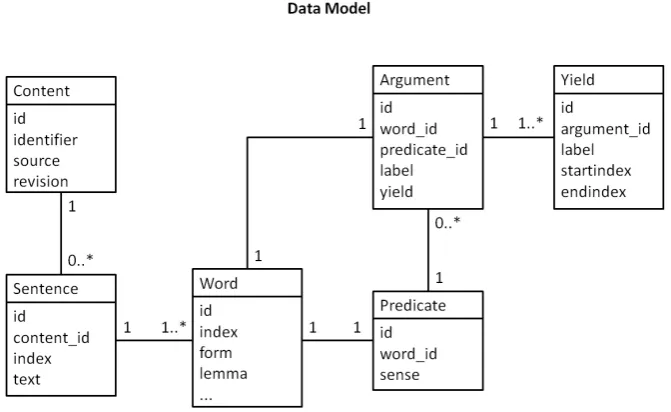
Figure 2: An overview of the data model
trieving propositions. The API makes good use of trans-actions, ensuring data integrity by making sure that parsed content is stored in its entirety.
The database aggregator assembles the many smaller databases created by the parsing jobs into one large database. The smaller databases are read one by one from a folder and added to the final database. This large database is more suitable for data processing tasks such as retrieving statistics and building the Lucene index.
For distribution purposes, we also store the parsed articles in individual files using CoNLL 2008 annotation. Since the CoNLL 2008 annotation has a large recognition and use in NLP tools, we believe that by providing the parsed Wikipedia articles in this format we encourage and facili-tate the reuse of data.
6.
Ranking Algorithm
The occurrence of erroneous extractions is a problem found in all extraction systems. In order to filter out less likely propositions, we have developed a ranking algorithm based on the redundant occurrences of propositions in text. Our ranking algorithm assigns a score to propositions based on their redundancy. Propositions are considered to be re-dundant if more than one proposition has the same predi-cate and its arguments have the same headword. We create the score by dividing the number of redundant propositions by the total number of propositions for a certain predicate. This score is then assigned to the propositions having that predicate.
As an example, consider the data shown in Table 2. We have two tuples with redundancy #1 and #2, together they have (5+2) = 7 propositions. In all, there are (5+2+1) = 8 propositions for the predicate,describe. This gives a redun-dancy score of 7 / 8 = 87.5%.
This algorithm can be used for ranking semantic searches and also to create new corpora containing higher quality propositions. An overview of the types and number of
# Argument 1 Predicate Argument 2 Count
1 equations describe.01 laws 5
2 methods describe.01 approach 2 3 papers describe.01 algorithm 1
Table 2: An example of predicate argument distribution where #1 and #2 are redundant and #3 is a hapax.
redundant propositions created by our ranking algorithm based on 10% of parsed data can be seen in Table 3 Although our algorithm assigns a score to only a small subset of propositions, we believe a higher yield can be achieved through the use of a coreference solver and other lexical databases.
Type Distribution
All propositions with two arguments 54.9% Propositions with redundancy 29.2% All (Noun, Verb, Noun) Propositions 7.8% (Noun, Verb, Noun) Propositions without
redundancy
6.0%
(Noun, Verb, Noun) Propositions with re-dundancy
1.7%
(Noun, Verb, Noun) Unique propositions with redundancy
0.4%
Table 3: The number of propositions grouped by proposi-tion type, based on 10% of parsed data.
7.
Querying Interface
Figure 3: Searching the proposition database.