SMALLWorlds – Multilingual Content-Controlled Monologues
Peter Juel Henrichsen, Marcus Uneson
Center for Computational Modelling of Language, Centre for Languages and Literature, Copenhagen Business School,Lund University
[email protected],[email protected]
Abstract
We present the speech corpusSMALLWorlds(Spoken Multilingual Accounts of Logically Limited Worlds), newly established and still growing. SMALLWorlds contains monologic descriptions of scenes or worlds which are simple enough to be formally describable. The descriptions are instances ofcontent-controlled monologue: semantically “pre-specified” but still bearing most hallmarks of spontaneous speech (hesitations and filled pauses, relaxed syntax, repetitions, self-corrections, incomplete constituents, irrelevant or redundant information, etc.) as well as idiosyncratic speaker traits. In the paper, we discuss the pros and cons of data so elicited. Following that, we present a typical SMALLWorlds task: the description of a simple drawing with differently coloured circles, squares, and triangles, with no hints given as to which description strategy or language style to use. We conclude with an example on how SMALLWorlds may be used: unsupervised lexical learning from phonetic transcription. At the time of writing, SMALLWorlds consists of more than 250 recordings in a wide range of typologically diverse languages from many parts of the world, some unwritten and endangered.
Keywords:content-controlled monologue, spontaneous speech, multilingual
1.
Introduction
Most linguistic corpora, whatever other dimensions they may keep constant, collect data with no restriction on se-mantics (except perhaps what the domain may suggest, on a general level). To be sure, this is very reasonable. The ul-timate goal of corpus processing is often to build a system which can make statements about the meaning of unknown language samples – clearly, with that aim, semantics cannot be treated as a given.
Nevertheless, there are interesting applications, and also research methodologies, which make good use of exhaus-tively pre-specified semantics. More specifically, they may take as point of departure a formal descriptionFof a scene
Sand (some representation of) a natural-language descrip-tionLof the same scene, and exploit (or explore) mappings between linguistic labels inLand meanings inF. Some-times finding the mappings themselves is the main interest; sometimes taking them as given help in answering questions about one linguistic aspect or another ofL.
In this paper, we present the growing corpus SMALL-Worlds(Spoken Multilingual Accounts of Logically Lim-ited Worlds), built on this premise. “Exhaustively specified semantics” is admittedly a mouthful, and it should be clear that the worlds we refer to are toy-sized – indeed, “logically limited”. However, along with the details of the corpus, we will give an example of an interesting question one might seek to answer using such a data set, and we will leave sev-eral other suggestions for the future.
Corpora containing natural-language descriptions of such formally describable microcosmoses are unusual, but not entirely unheard of. In the early eighties, Levelt let Dutch speakers describe a number of “spatial grid networks”, sim-ple figures consisting of differently coloured dots connected by lines on a grid, to investigate aspects of the linearization order in self-paced monologues (Levelt, 1989). Swerts and Collier (Swerts and Collier, 1992) used a slightly more com-plex network to study prosodic correlates of discourse units
in spontaneous speech, again eliciting self-paced mono-logues. Rather than the prosodic findings, their main point is actually the methodper se: given a network like that in Figure 1, the linearization principles suggested by Levelt (Levelt, 1989) enable experimenters to predict the speak-ers’ path through it, their chaining of statements, and the predicative content of these statements; and by judiciously contrasting shape or colour or both between current and next shape, experimenters gain control over new and given in-formation at any point, with only very general instructions given. The same or a similar setup is well suited for test-ing other hypotheses on spontaneous speech – say, pho-netic, syntactic, or lexical correlates of the distinction be-tween new and given, or of that bebe-tween content and func-tion words (Swerts and Collier, 1992).
First, the descriptions refer to scenes which are easily for-malizable. This is highly desirable for any automatic pro-cessing. Second, the scenes are composed of abstract, ge-ometric shapes, carrying few or no extra-figural connota-tions and associaconnota-tions,1and thus do not encourage idiosyn-cratic digressions. Third (somewhat related to the previ-ous two), the scenes are simple enough that any description in human language need only use a small number of con-tent morphemes (perhaps 20-30). The small vocabulary in-volved makes studies on even a single description feasible (and rewarding). Fourth, the scenes are reasonably culture-independent; they should be describable in any human lan-guage using only a small set of concepts (but see also Sec-tion 2.3.).
Subsections of SMALLWorlds have been used in research reported elsewhere (Henrichsen, 2011; Henrichsen and Christiansen, 2011). However, the current paper is the first one to present the corpus in its entirety, and under that name.
2.
The SMALLWorlds Corpus
In this section, we describe the details of SMALLWorlds as of January 2012. More experimental ideas are not covered here, although we mention a few of them in Section 4..
2.1. Technical details
The majority (around 210) of the SMALLWorlds record-ings were made by Uneson in 2010. These were all recorded with a Neumann U87 microphone in the anechoic chamber of the Humanities Lab at Centre for Languages and Litera-ture, Lund University. The rest of the recordings were made by Henrichsen in a more experimental spirit, with irregular intervals during 2005-2011. These were made with portable high-quality sound equipment in quiet surroundings. Most are in mono, some in stereo (two microphones, one sta-tionary and one chin-mounted). All data files, whether recorded in the field or not, are stored as wav-files, sam-pled at 44.1kHz, 16 bit or better. Currently, there are about nine hours worth of recordings (minimal duration 43”, me-dian 137”, max 614”). Video files are available for a few sessions.
2.2. Participants
We deliberately designed the task set of the SMALLWorlds sessions to be lightweight enough (a typical session last-ing around 20 minutes) that it would be feasible to find volunteers without necessarily having made previous ap-pointments. This strategy has worked well. Thanks to the light demands on both informant and instructor, we have been able to set up recording sessions with little or no pre-planning: during coffee breaks, in waiting rooms, between lessons, etc. In addition, we have been able to record also in remote mountain villages and sparsely populated rural areas.
For the Lund recordings, the vast majority of the partici-pants were international students aged 20-30. The rest of the participants have a larger spread. With few exceptions, speakers were recorded in their first language (or in one
1
Even hardcore cat or dog persons will have a hard time pro-jecting strong likings or aversions onto a blue square.
of them, in cases of multilinguals with self-assessed na-tive competence in more than one language). In addition, a few self-assessed bilinguals performed the task in both languages.
2.3. Tasks and stimuli
All SMALLWorlds sessions referred to in this section con-tain a description of the network in Figure 1 (or, in early sessions, a hand-drawn equivalent).2 This particular net-work was originally used in the DanPASS corpus (Grøn-num, 2009) (and thus these subtasks are compatible in the two corpora). The informants received oral instructions along these lines: “Please describe the drawing, so that it can be later reconstructed according to your description. You should mention all the coloured objects, and also their distribution on the paper. Begin with the figure to which the arrow points”.
On increasing the typological coverage, some cross-linguistic issues arose. For instance, the well-known lin-guistic fact (Berlin and Kay, 1969) that not all languages have lexicalized labels (monolexemic or not) to cover all the colour contrasts became apparent. Thus, ’red’ and ’brown’ may in most contexts translate to the same lexeme, just as Russian голубой goluboy’light blue’ and синийsiniy
’(dark) blue’ are often rendered simply as ’blue’ in English. Similarly, in languages with little use in educational set-tings, there may be no names for mathematical concepts such as circles or squares.
This is not really a problem in a functional sense – what we require of the labels is that they solve the task at hand, not that they are monolexemic, known to all speakers, or non-loans. Thus, the speakers were encouraged to solve the problems as they would in ordinary conversation – perhaps by a loan from another language which could be assumed familiar, or by a paraphrase such as “coffee-coloured” for brown.
Nevertheless, in later sessions, we constructed an addi-tional network with target words chosen from the Swadesh list (Swadesh, 1971), a set of culture-independent concepts which can be expected to have labels in all languages (sun, water, ear, etc.). The shapes chosen to represent these meanings were intended to be readily recognizable proto-types, stylized enough not to elicit irrelevant details (Fig-ure 2). At the time of writing, we have about 140 descrip-tions of the Swadesh network.
2.4. Composition of the corpus
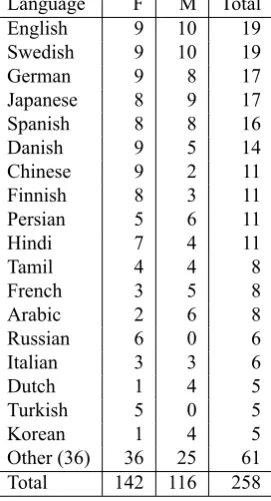
An overview of the corpus composition of SMALLWorlds is given in Table 1. For a set of selected languages (more or less the ones in Table 1), our aim is to get 15-20 speakers, roughly balanced for sex, which should be enough for most tasks where inter-speaker comparisons are important. This particular selection of prioritized languages is of course partly a convenience sample, a compromise between typological spread and expected availability of subjects, an-notation expertise, and other external resources. In parallel, however, we have also followed the “rare butterfly” policy of recording a few speakers of all languages we could get
2
Figure 1: The geometrical network
Figure 2: The Swadesh network
hold of. Many of these recordings may for practical reasons never be annotated, but they still make interesting compar-ison. As we argue above, several interesting questions can be asked from a single description.
Finally, and along more experimental dimensions, we have included recordings by children (aged 6-9), speech impaired adults, L2 speakers of badly broken English, and illiterates. We even sport a whispering gallery of sessions with voice-less phonation, and occasional recordings in semi-shouted style. These deviant styles represent challenges that are of-ten ignored or under-estimated in, for instance, speech tech-nology projects.
Language F M Total
English 9 10 19
Swedish 9 10 19
German 9 8 17
Japanese 8 9 17
Spanish 8 8 16
Danish 9 5 14
Chinese 9 2 11
Finnish 8 3 11
Persian 5 6 11
Hindi 7 4 11
Tamil 4 4 8
French 3 5 8
Arabic 2 6 8
Russian 6 0 6
Italian 3 3 6
Dutch 1 4 5
Turkish 5 0 5
Korean 1 4 5
Other (36) 36 25 61
Total 142 116 258
Table 1: SMALLWorlds subjects, as of January 2012. “Other”, with 4 speakers or less, includes Albanian, Az-eri, Bengali, Bosnian, Bulgarian, Cantonese, Catalan, Croa-tian, Czech, Flemish, Greek, Hebrew, Hungarian, Icelandic, Igbo, Irish, Kammu, Khmer, Latvian, Lithuanian, Luxem-burgisch, Nepali, Newari, Norwegian, Polish, Portuguese, Pulaar, Punjabi, Romanian, Swiss German, Thai, Toda, Ukrainian, Urdu, Vietnamese, Wu Chinese
2.5. Annotation
SMALLWorlds is available as Praat TextGrids.3 The an-notation depth is quite heterogeneous. At the extremes, some recordings are very fully annotated (syllable-level time coding, orthographic and phonetic transcription, fine-grained PoS, acoustic measurements, prosodic features, meta-linguistic commentary, detailed background informa-tion) whereas most of the third-world recordings are much more sparsely annotated (coarse time-coding, lexical lists of colour/shape/location/direction terms, and meta-linguistic commentary only).
The majority of the recordings, including those in En-glish, German, Spanish, Swedish, Dutch, Finnish, Arabic, French, and Turkish (Table 1), are somewhere in between, typically including pause-based time coding, orthographic (or pseudo-orthographic) transcription, acoustic measure-ments, and some meta-linguistic information.
For every recording, irrespective of annotation level, we have been very particular about registering the naming se-quence, i.e. the order in which the coloured objects were introduced by the informant. Also the central lexical terms (in the task shown, the names of the colours, shapes, spa-tial relations, and directions) are on file in almost all cases.
3
prop(colour,blue,[e1,e10,e12]).
prop(colour,green,[e2,e6,e9,e13]).
prop(colour,red,[e4,e8]).
prop(colour,yellow,[e5,e7]).
prop(colour,purple,[e3]).
prop(colour,brown,[e11]).
prop(shape,square,[e1,e4,e7,e11]).
prop(shape,circle,[e2,e6,e9,e10,e13]).
prop(shape,triangle,[e3,e5,e8,e12]).
Figure 4: A formal model of the colours and shapes of the network in Figure 1, expressed as Prolog clauses.
set of logical facts, shown in Figure 4 as clauses in the pro-gramming language Prolog.
In this experiment, object names e1toe13were used for the thirteen coloured objects,e1referring to the lower blue square, ande2 ... e13applied ”clockwise”. Observe how the colour ”blue” is represented semantically as in first or-der models of classical predicate logic, viz. as the complete set of objects [e1,e10,e12] sharing that property. Apart from the formal model, the learning device did not con-tain any lexical, morphological or semantic categories, in short, no language knowledge. The main inference engine had to figure out which lexical mappings of the continuous speech stream (represented by the unsegmented transcrip-tion) could match a well-formed description of the illustra-tion (represented by the formal model).
When used as experimental data, the string of phones (ex-cluding marking of stress and vowel length) is processed in three stages:
1. all frequently occurring n-grams, such as[ililinjɪ], are identified;
2. the n-grams are arranged in sets of three based on dis-tributional similarity, such as [[f i ʁ k a],[i l i l i n j ɪ],
[t ʀ æ k a n d]];
3. the triplets are piped to the inference module as lexical hypotheses.
For identification and arrangement of n-grams (steps 1 and 2), we employed the algorithm Siblings & Cousins (Hen-richsen, 2004). This algorithm exploits the fact that two words with complementary semantics (like two distinct colour terms, sayblueandgreen) tend to prefer similar con-texts at their right and left edges. For instance, consider a pair of corpus instancesa blue circleanda green circle, both quite frequent in the descriptions. In this case, of course the colour terms share the contexta _ circle. Quantifying over all n-gram candidates and all their respective context func-tions, the Siblings & Cousins algorithm produces analyses as the one shown in Figure 5.
Based on their left and right context selection functions, the n-grams [t ʀ æ k a n ʔ d] and[t ʀ æ k a n ʔ d] are thus – not surprisingly – judged to be similar to a degree of 100%. More interestingly, the n-grams[t ʀ æ k a n ʔ d]
#93 n-gram analysed: [t ʀ æ k a n ʔ d] 1.000000[t ʀ æ k a n ʔ d]
0.837132[f i ʁ k a n ʔ d] 0.727861[l e l a t ʀ æ k a n ʔ d] 0.646050[s i ʁ g l]
0.629778[t ʀ æ k a n ʔ t] 0.625563[d ɛ n ʔ] 0.614339[f i ʁ k a n ʔ t]
Figure 5: Sample from Siblings & Cousins log (stage 1 and 2, see text). Analysed n-gram #93: [t ʀ æ k a n ʔ d] (the Danish word for triangle). Listed: high-scoring n-grams, sorted by context selectional similarity with[t ʀ æ k a n ʔ d]. Male speaker, session ID m_014g
triangle:[t ʀ æ k a n] square:[f i ʁ k a n] circle: [s i ʁ g l̩]
blue:[b l ɔ] green: [g ʀ ɶ n] red: [e n ʀ œ ð] yellow:[g u l]
brown :[s,ɔ,a,d,ʊ,e,n,b,r,u,n] purple :[a,d,ʊ,n,l,e,l,a]
PATH : [e1,e2,e3,e10,e11,e12,e13,e4,e5,e6,e7,e8,e9]
Figure 6: Sample from learning log (stage 3, see text; cf. also Fig. 5), showing the deduced lexemes and the associ-ated path
and[f i ʁ k a n ʔ d]score 83.7%, meaning that these two n-grams do indeed prefer the same contexts to a high degree. This is satisfactory, the two n-grams representing the Dan-ish words for triangle and square, respectively. As can be seen, some semantically neutral variation in pronunciation is also detected (e.g. the t/d allophones).
Note in Figure 5 the n-gram[l e l a t ʀ æ k a n ʔ d]. This n-gram corresponds to a compound expression (purple tri-angle), but was nevertheless picked by the algorithm as a possible semantic atom (based on its contextual similarity with a shape term proper). This judgment is actually not surprising, given the fact that colour[lela]’purple’, is rep-resented (Figure 1) by one object only, creating a strong cohesion effect. This interplay between atomic and compo-sitional semantic readings of compound words is of course well-known in human discourse too: the termred herring
may occasionally be used to refer to a herring which hap-pens to be red; but usually its meaning is atomic.
The particular learning session that the figures refer to used data from a recording from 2011, of an eight-year old Dan-ish boy (dk008). The path was correctly identified by the learning device: informant dk008 did name the thirteen ob-jects in the order shown. Concerning the deduced vocabu-lary, several unusual phonetic forms are encountered. Per-haps most surprising are the very long terms derived for coloursbrownandpurplein comparison to their dictionary forms[b,r,u,n]and[l,e,l,a]. With a bit of reflection, though, it is easy to understand why the inference engine, with each of these colours occuring only once in the described pic-ture, has too sparse data to determine their standard lexi-cal forms. Since the learning algorithm build on a more-is-better strategy, the inference engine instead expands the terms as far as the logical constaints allow, arriving at the unusual, but entirely natural conclusion. In the same vein,
red translated to[e,n,r,œ,ð]rather than the expected form
[rœð]since the latter, in all its occurrences in the dk008 ses-sion, is preceded by[e,n]. Across all Danish learning ses-sions we have performed, we have encountered five differ-ent renderings of colour yellow:[e,n,g,u,l], [n,g,u,l], [g,u,l],
[ŋ,g,u,l], [d,ɔ,e,n,g,u,l]; the dictionary form[g,u,l] is not even the most frequent one.
For a larger-scale verification of this result, we borrowed 18 of the sessions from the corresponding subtask of the DanPASS corpus (Grønnum, 2009), which as pointed out above is compatible with the SMALLWorlds corpus. Very briefly, the learning experiments for this larger set (n=22) were successful in the sense that all results reported by the learning device were in agreement with the human judg-ments. The central lexemes (colour and shape terms) were thus correctly identified (allowing skewed delimitations) in 16 out of 22 sessions. The remaining 6 cases all contained factual errors (e.g. informants referring to a yellow square as a ”yellow triangle”, or failing to specify the colour of one of the objects). In other words, for this subcorpus the learning device was 100% successful with regards to the experimental premises. Further details on the practical and computational installments are found in Henrichsen (2011).
4.
Future directions
The SMALLWorlds corpus presented here is an early ver-sion – practically all informants have faced tasks identical or very similar to the one in Figure 1. Currently, we are exploring new dimensions of this basic design, allowing for controlled variations of the complexity of the stimulus while keeping the main idea of exhaustively describable se-mantics. For instance, we aim to present individual infor-mants with a series of description tasks, varying systemati-cally the diversity of colours, shapes, and spatial relations. Such description data will allow us to study in more detail the relations between the formal properties of the scene de-scribed and the typological, individual, and situational vari-ation. Another interesting variation involves using shapes with inherent orientation, such as stylized images of cars, buildings, or trees, to study the effects on perspective cho-sen.
We are also considering on-screen networks which evolve dynamically, interactively steered by the informant’s mouse-clicks. On a more dialogical note, we are taking the
first steps towards an experimental design with a two-way spoken interface between man (informant) and machine (in-ference engine). In the not so distant future, we intend to perform interactive dialogue-style experiments where terms and relations are negotiated on-the-fly rather than inferred
post festum.
Turning to usage rather than content, we conclude with a non-exhaustive list of suggestions for linguistic (or cross-linguistic, where appropriate) explorations, which we be-lieve the data lends itself to:
• speech planning and linearization (cf. (Levelt, 1989; Levelt, 1982b; Levelt, 1996))
• cognitive styles in spatial descriptions (cf. (Levelt, 1982a))
• situational, individual and typological variation in choice of frame-of-reference (cf. (Levinson, 2003))
• inference-based learning of lexical items (cf. (Hen-richsen, 2011))
• prosodic modulation as a marker of information struc-ture (cf. (Swerts and Collier, 1992; Swerts, 1994; Hen-richsen and Christiansen, 2011))
• relations between rhetorical structure and information structure
Even more experimentally, we believe the data can be a good companion when setting foot on less traveled roads: unsupervised models for machine translation in restricted domains; self-learning speech recognition in restricted do-mains; early-stage L1 acquisition models.
We will soon establish a dedicated website for the SMALL-Worlds corpus including contact and download information, terms of use of the corpus data, references to dedicated and secondary literature, links to the test materials, and more. Just google ”SMALLWorlds” to keep updated.
5.
Acknowledgements
Marcus Uneson wishes to acknowledge the support of the Humanities Lab at Centre for Languages and Literature, Lund University.
6.
References
Brent Berlin and Paul Kay. 1969.Basic color terms: Their universality and evolution. Univ of California Press. Nina Grønnum. 2009. A Danish phonetically annotated
spontaneous speech corpus (DanPASS).Speech Commu-nication, 51:594–603.
Peter Juel Henrichsen and Thomas Ulrich Christiansen. 2011. Information based speech transduction. In Pro-ceedings of International Symposium on Auditory and Audiological Research, ISAAR 2011.
Peter Juel Henrichsen. 2004. Siblings and cousins: statisti-cal methods for spoken language analysis. Acta Linguis-tica Hafniensia, 36:7–33.
Willem Levelt. 1982a. Cognitive styles in the use of spa-tial direction terms. Speech, place, and action, pages 251–268.
Willem Levelt. 1982b. Linearization in describing spa-tial networks. pages 199–220. D. Reidel Dordrecht„ The Netherlands.
Willem Levelt. 1989. Speaking: From Intention to Articu-lation. MIT Press, Cambridge, MA.
Willem Levelt. 1996. Perspective taking and ellipsis in spa-tial descriptions. In P. Bloom, M. Peterson, L. Nadel, and M. Garrett, editors,Language and space, pages 77–108. Cambridge, MA: MIT Press.
Stephen Levinson. 2003. Space in language and cognition. Number 5 in Language, culture, and cognition. Cam-bridge University Press.
Fernando. Pereira and David Warren. 1980. Definite clause grammars for language analysis–a survey of the formal-ism and a comparison with augmented transition net-works. Artificial intelligence, 13(3):231–278.
Morris Swadesh. 1971. The origin and diversification of language. Chicago: Aldine. Contains final Swadesh 100-word list.
Marc Swerts and René Collier. 1992. On the controlled elicitation of spontaneous speech. Speech Communica-tion, Volume 11(4-5):463–468.
Marc Swerts. 1994. Prosodic features of discourse units. Ph.D. thesis.