Joint Segmentation and POS Tagging for Arabic Using a CRF-based Classifier
Souhir Gahbiche-Braham
1,2, H´el`ene Bonneau-Maynard
1,2, Thomas Lavergne
1, Franc¸ois Yvon
1,2(1) LIMSI-CNRS, (2) Universit´e Paris-Sud 11 91403 Orsay, France
{souhir,hbm,lavergne,yvon}@limsi.fr
Abstract
Arabic is a morphologically rich language, and Arabic texts abound of complex word forms built by concatenation of multiple subparts, corresponding for instance to prepositions, articles, roots prefixes, or suffixes. The development of Arabic Natural Language Processing applications, such as Machine Translation (MT) tools, thus requires some kind of morphological analysis. In this paper, we compare various strategies for performing such preprocessing, using generic machine learning techniques. The resulting tool is compared with two open domain alternatives in the context of a statistical MT task and is shown to be faster than its competitors, with no significant difference in MT quality.
Keywords:Arabic Segmentation, Arabic POS Tagging, Arabic preprocessing, Conditional Random Fields
1.
Introduction
The peculiarities of the Arabic language make the auto-matic processing of Arabic texts challenging. In particu-lar, the Arabic language has a complex morphology and an ambiguous writing system. Furthermore, the clitic aggluti-nation phenomenon results in a considerable variability of surface forms. For instance, the analysis of a parallel cor-pora (Nguyen and Vogel, 2008) reports that while the En-glish side contains 6.2M tokens and 68K types, the 5.2M Arabic tokens correspond to approximately 155K different types. Therefore, data driven NLP methods, when applied to Arabic, need to be complemented with sophisticated pre-processing techniques aimed at computing a morphological decomposition for Arabic words, in order to mitigate data sparseness and the correlated estimation problems. As pos-sible combinations of affixes and roots depend on the main category of the word, morphological decomposition and part-of-speech (POS) tagging have to be performed jointly, a combined task that has been approached in many different ways in the literature. In this study, an additional concern is speed : Statistical Machine Translation (SMT) being our main target application, it is crucial to be able to rapidly process large amounts of Arabic texts.
In this paper, we propose to perform this joint prediction task using Conditional Random Fields (CRFs), which have proven to deliver state-of-the art results in many sequence labelling tasks. Taking advantage of the ability of our CRF package, Wapiti (Lavergne et al., 2010), to cope with large label sets and extremely large sets of features, while keep-ing the computational cost minimum, we consider and com-pare various ways to perform POS tagging and clitic split-ting. These strategies are evaluated both on intermediate tasks, but also on the final MT application.
The rest of this paper is organized as follows: in Section 2., we present some existing approaches for arabic segmen-tation. Section 3. describe the Wapiti toolkit. In Section 4., we present our approach based on CRFs, and give some results in Section 5. Finally, Section 6. concludes the paper.
2.
Related work
2.1. Analyzing Arabic words
Many studies have focused on Arabic word segmentation and tagging. The most popular tool is probably MADA (Nizar Habash and Roth, 2009), which implements a two-stage process to select the best possible morphological decomposition/analysis among the ones proposed by the BAMA (Buckwalter, 2004) tool. MADA is described in section 2.2.
AMIRA (Diab, 2009) implements a different approach, where the clitic splitting is performed independently from POS tagging, using a Support Vector Machine (SVM) ap-plied to an IOB annotation scheme on every Arabic char-acter. Also noteworthy is the work of Marsi et al. (2005), in which memory-based learning is used for morphologi-cal analysis and part-of-speech tagging of Arabic. The au-thors use k-nearest neighbor classification and show that the tagger can be used to select the appropriate morpholog-ical analysis.
Mansour (2010) presents MorphTagger, a Hidden-Markov-Model segmentation tool for Arabic and compares it with MADA (Nizar Habash and Roth, 2009) and with the earlier and simpler work of El Isbihani et al. (2006). A more detailed description of this tool is given in section 2.3. In (Kulick, 2010), affix-splitting and part-of-speech tagging are performed simultaneously with a simple classifier, with-out using morphological analysis. In a more recent work (Kulick, 2011), this approach is extended, using a distinc-tion between open-class (such as preposidistinc-tion, relative pro-noun, etc.) and closed-class (such as pro-noun, verb, proper nouns, etc.) tokens, which differ in their possible mor-phological affixations and in their frequencies. A list of proper nouns extracted from the SAMA-v3.1 (Maamouri et al., 2010) database is also used as feature.
2.2. MADA
mor-phological analysis and generation system Almorgeana1to produce a list of potential analyses for each word in the text without considering the word context of occurrence. All the possible segmentations of the input into prefix-stem-suffix and bilateral compatibility are checked with respect to the BAMA database. Only valid triples will be further consid-ered by MADA.
MADA then makes use of up to 19 features to rank the list of possible analyses. Five features use the SRILM toolkit2 to give information about morphological disambiguation such as spelling variations andn-gram statistics. The four-teen remaining morphological features correspond to mor-phological information (Habash et al., 2010) such as part-of-speech, presence/absence of proclitics or enclitics, as-pect, case, gender, mood, number, person, etc. Four of them are represented in the analyses returned by BAMA (Habash and Rambow, 2005) while the ten other morphological fea-tures are predicted independently using the SVMTool clas-sifier (Gim´enez and M`arquez, 2004); each clasclas-sifier tion is then weighted and the collection of feature predic-tions is compared with the list of potential complete anal-yses. These are then ranked and the highest scoring one is finally selected, providing the predicted value for all mor-phological features. Based on this mormor-phological analysis, words can be segmented according to predefined, determin-istic, segmentation schemes.
In the specific context of SMT applications, using MADA and its a very precise morphological description, is proba-bly an overkill, especially when all is needed is to split a small subset of affixes. The associated computational cost is indeed rather high: it requires to run, for each token, mul-tiple SVM classifiers before combining results to take de-cisions. Processing large texts is then only possible by dis-tributing the computation on several machines and typically takes a very substantial amount of the total system building time.
2.3. MorphTagger
MorphTagger is a Hidden-Markov-Model segmenter for Arabic. Since this tool has also been designed to quickly compute coarse morphological analyses in the context of MT applications, it will be another interesting point of com-parison. MorphTagger was first applied for the task of POS tagging in Hebrew and then adapted to the Arabic language (Mansour et al., 2007). A segmenter level and few normal-ization rules were then added to the tool. The architecture is similar to MADA, as it uses BAMA database. Therefore, in the first step, Arabic text goes through the BAMA morpho-logical analyzer, which outputs for each word all possible analyses including the corresponding POS tag. At the other end of the pipe-line, MorphTagger outputs the most proba-ble tag sequence according to the model. Subsequently, the choice of the correct analysis is made by choosing the most probable morpheme given the tag. The SRILM toolkit is used for disambiguation.
Once the morphological analysis is performed, preposi-tions (excluding the Arabic determiner) and possessive and objective pronouns are splitted using several hand-crafted
1
Almorgeana uses the BAMA database (Buckwalter, 2004).
2http://www.speech.sri.com/projects/srilm.
rules. The segmenter also performs few normalization steps, the most noticeable of which being (i) Alif maksura, reverted to the original form when a word, splitted from a suffix, ends with Alif maksura (yX→Y+X); (ii) feminine marker: reverted to its original form when a noun is split from a suffix (tX→p+X) and (iii) the definite articleAlis reverted to the original form, after splitting, when preceded bylprefix (llX→l+Al+X).
(Mansour et al., 2007) compared MorphTagger to MADA and to the FST-based segmenter originally introduced in (El Isbihani et al., 2006) and shows that MorphTagger gives better translation results on different translation con-ditions and different test sets.
3.
Wapiti
For the purpose of these experiments, we use the Wapiti3 toolkit developed within our group (Lavergne et al., 2010). Using CRFs to (partially) reproduce the analysis performed by MADA requires to simultaneously predict several char-acteristics for each words. A typical setup for this kind of tasks is a cascade of predictors, each of them relying on the predictions made by the previous one(s). If the order is cho-sen with care, this setup can be very effective; in particular, if some predictors do not rely on the others, they can be run in parallel. However, when predicting closely related char-acteristics, join prediction ofcomposite labelscan prove to be a more effective strategy.
The join prediction setup however implies to manipulate larger labels set, which can be computationally challenging: recall that the training of CRFs has a quadratic complexity with respect to the size of the label set. Wapiti was designed for such tasks and can easily handle sets of several hundred of labels. Using`1regularization (Gao et al., 2007), the dif-ferent training algorithms can build highly sparse models and take advantage of this sparsity to speed-up the compu-tations. This allows us to jointly predict some of the closely related characteristics, ensuring that only valid combina-tions are predicted and thus delivering better performances. Working with large labels sets also poses estimation prob-lems, due to the data-sparsity that naturally arises in such situation. As each label occurs less frequently in the train-ing data, the related feature weights are more difficult to estimate accurately. In the problem considered here, as it is often the case in NLP applications, these sets of composite labels have a structure, which can be used to smooth the estimates. We therefore use the ability of Wapiti to define features which only test on sub-parts of the observations; in fact, it is possible to define feature using arbitrary regular expressions over the observation sequence.
4.
Our approach: Part-of-Speech tagging
and Arabic segmentation
Recall that our main goal is to tokenize Arabic texts so as to strip off prefixes and reproduce the behavior of MADA for segmentation purposes, as in i.e. (Habash and Sadat, 2006), but to do so at a much greater speed and using as few resources as possible. This is because morphological analysis is only a preprocessing step, which must be applied
تﺎﺑﺎﺨﺘﻧﻺﻟو
wll<ntxAbAt NOUN+CONJ+PREP+DET wll<ntxAbAt NOUN+CONJ+PREP+DET wllAntxAbAt w+ l+ AlAntxAbAt
Input
Translitera=on
POS and prefixes
Predic=on
Normaliza=on
Segmenta=on
Figure 1: Overview of the segmentation process.
to large amount of parallel texts when developing statistical machine translation systems.
In this context, we only aim at predicting features that are directly related to word segmentation, in addition to the main part-of-speech tag. In principle, this would require to encode the CRF output composite label as: POS+pr1+pr2+pr3, where POS is the main part-of-speech tag, and the labels pr1, pr2 and pr3 respectively encode the absence/presence and types of possible prefixes (see Ta-ble 1). The first one concerns the conjunctionsw+andf+; pr2 deals with the prefixesb+,l+,k+ands+, which can appear together with conjunctions; the last label indicates the presence of the definite articleAl+. The value of pr1 is CONJ for conjunctions ornone; pr2 is equal to PREP if the prefix corresponds to a preposition, to SUB if pr2 corre-sponds to a subordinating conjunction, to FUT to indicate the future mark, or tonone; finally pr3 can be DET ornone.
Prefix Label/Value
pr1 CONJ/w+,f+ornone
pr2 PREP/b+,l+,k+or SUB/l+ or FUT/s+ornone
pr3 DET/Al+ornone
Table 1: Prefixes, labels and values
Using this scheme, the word
HA K.A
jJ KC
Ëð
(and for the votes) would, for instance, be tagged NOUN+CONJ+PREP+DET.
Regarding syntactic categories, we used the list of the main 24 POS tags of the Arabic Treebank (Maamouri et al., 2005a; Maamouri et al., 2005b). Note however that some prefixes can only appear with words carrying a specific POS. An example is the prefixs+, which can only be asso-ciated with verbs, to indicate the future tense. This means that the effective number of labels is much less than the total number of possible labels (384).
Figure 1 displays the various steps of the segmentation pro-cess. In our approach, Arabic texts are transliterated using
Buckwater transliteration scheme4. Segmentation predic-tion is then performed, followed by a normalizapredic-tion step and finally by the splitting process itself, which is based on a handful of simple rules.
4.1. Models and feature selection
A Part-Of-Speech and segmentation prediction model makes its prediction based on simple descriptors of the in-put word sequences. In Wapiti, these features are described via generic patterns that simultaneously test unigram and bigram of labels and arbitrary features of the observation sequence. In our experiments, these tests on the input are defined as follows: (1)unigram tests, which evaluate the presence/absence of individual words in a sliding window of 7 words around the word in focus (2)bigram testswhich evaluate the presence/absence of word bigrams in a sliding window of 5 words, and (3)trigram tests, which consider a sliding window of 3 words. We also used as features (4) prefixes and suffixes tests, which consider up to the 5 first (respectively last) characters within a sliding window of 3 words. Finally (5)punctuation and digitsfeatures test for the presence or absence punctuation marks and digits in a sliding window of 5 words.
4.2. Normalization
The next step concerns the normalization of four Arabic characters such as done in MADA (Habash, 2010).
The different written forms of Alif
@
,@
,@
,@
and@
arenormal-ized by
@
(in transliterated texts, respectively<,>,|,{,Aare replaced byA). The Yaa Maqsura
ø
(Y) and Yaaø
(y) are normalized toø
(y) , the Taa Marbutaè
(p) becomesè
(h) and the different forms of Hamza
ð
(&),ø
(}),Z
(’) arenormalized to
Z
(’).4.3. Segmentation rules
After normalization, segmentation is performed by apply-ing set of rules to check prefixes. This task can be sum-marized by four major rules. The first rule splits off in two
parts words containing only a pr1 prefix. The second rule checks whether a word containing both pr1 and pr2 prefixes is tagged as a preposition; if this is not the case, it splits off the word into three parts. The third rule verifies that a word contains only a pr2 prefix and is not a preposition. If these conditions are satisfied, the word is split into two parts. The last rule concerns the pr3 prefix: each word will be split according to the preceding rules, with an additional condition to change the words containinglprefix followed by the definite articleAl. This additional rule consists of adding theAcharacter of the definite articleAlwhich has been altered due to the agglutination phenomenon and Ara-bic morphosyntactic rules. For example, if the word begins withllor wllorfll, after applying segmentation, the word becomesl+ Al,w+ l+ Alorf+ l+ Al.
5.
Experiments and Results
5.1. DataTo train our POS-tagging and segmentation models, we used the POS tagged Arabic Treebank (ATB), which in-cludes 498,339 tokens (18,826 sentences).
Each token as it appears in the original Newspaper is companied in the Arabic treebank by its transliteration ac-cording to Buckwalter’s transliteration scheme and all its possible vocalizations, POS tag sequences and morpholog-ical analyses. The correct analysis is specified in the ATB with a preceding *. Figure 2 presents all the possible mor-phological analyses of the wordwhw
ñëð
according to the BAMA database.∗wa/CON J+huwa/P RON 3M S wa/CON J+huw/N OU N P ROP whw/N OU N P ROP
wa/CON J+hw/N OU N P ROP
Figure 2: Different segmentations proposed by BAMA for
the wordwhw(
ñëð
), which means”and he”. The correct segmentation is marked with a *).According to the Arabic Treebank, around 17% of the to-kens have to be segmented. Note that the number of ob-served combinations for POS+pr1+pr2+pr3 labels in the whole Arabic treebank is only 88, which is much less than the total number of composite tags (384).
For the segmentation task, we ran a series of experiments with feature sets of increasing complexity. We first eval-uated the POS tagger (section 5.2., which then extended to include the prediction of prefixes. Different approaches were explored and are described in section 5.3. All these models were evaluated using 10-fold cross-validation, with test sets of about 2000 sentences.
For the translation task, we evaluate the influence of vary-ing preprocessvary-ing tools usvary-ing the AFP5 Arabic-French news made available through the SAMAR project6. Stan-dard translation systems are trained on 145K phrase pairs extracted from a comparable corpora (Gahbiche-Braham et
5
AFP news agency
6http://www.samar.fr/
al., 2011). The original text contains 3.3M tokens, cor-responding to 106K types, while the number of tokens in thepreprocessedtext is 3.6M tokens, comprising only 75K types. The French side of the parallel corpus contains 4.2M tokens, which corresponds to 61K types. Performance is measured using automatic metrics such as BLEU (Papineni et al., 2002), METEOR (Banerjee and Lavie, 2005) and HTER (Snover et al., 2006).
5.2. Part-Of-Speech Tagging
Our ”small” POS tagger only includes unigram tests in a window of three words and limited prefix and suffix tests. This system achieves an error rate of 5.34%. By extending the context window to include the previous and next three words, and by using bigram and trigram tests on the obser-vation, we managed to improve this baseline by more than 1 point. Our best results to date are obtained with a large sys-tem comprising more than 210M features, out of which the
`1penalty term only selects 2.4M; the corresponding error rate is4.2%to be compared with MADA, which has a POS error rate of 3.77%7. It should be stressed that these results are obtainedwithout using BAMA. This means that we are in fact solving a more complex problem than MADA, as we do not use any prior morphological analyzer.
5.3. Segmentation Prediction
Three different schemes for segmentation are compared. In the first scheme (SEG), prefixes are predicted without us-ing any POS feature. In the second scheme (POS-then-SEG), the POS tags are first predicted, and then used as sup-plementary feature to predict prefixes. In the last scheme (POS+SEG), POS tags and prefixes are predicted simulta-neously.
5.3.1. Results
Table 2 reports the number of features according to the seg-mentation scheme as well as the number of active features which are selected by Wapiti for each model. For POS and SEG tasks, we used the largest possible number of patterns to build the models. As these patterns generate too many features for Wapiti to cope with, the number of patterns was reduced for the POS+SEG schemes (the sliding window for prefixes/suffixes is reduced to one), and accordingly for the POS-then-SEG condition. For this latter task, the number of features represents the sum of the active features for POS and for predicting the segmentation labels. Therefore the total number of possible features for the POS+SEG con-dition is 1,511M, generating more than 4M active features; with the same patterns, the total number of possible features is 245M for POS-then-SEG condition, with 3M active fea-tures (more than the active feafea-tures of SEG), since we used the POS feature which is not used for SEG scheme. Table 3 shows comparative results with the three schemes and reports error rates for (i) predicting the composite label pr1+pr2+pr3, (ii) predicting each prefix independently and (iii) after applying normalization and segmentation. This latter score only evaluates the output segmentation, which
7We reduced the 34 POStags of MADA to 24 to compare the
Scheme #features #active features
POS 195.6M 2,262.4K
SEG 64.3M 574K
POS-then-SEG 245.0M 3,024.4K
POS+SEG 1,511.5M 4,168.9K
Table 2: Total number of features and active features for each Scheme.
can be correct even when the predicted prefix category is erroneous.
P P
P P
P P
PP Scheme
SEG POS-then-SEG POS+SEG
pr1+pr2+pr3 0.78% 0.64% 0.60%
pr1 0.22% 0.18% 0.18%
pr2 0.46% 0.35% 0.34%
pr3 0.13% 0.13% 0.11%
POS - 4.20% 3.72%
After segmentation 0.55% 0.42% 0.40%
Table 3: Segmentation Error Rate of the different schemes
Even for the smaller model (SEG scheme), the error rate is less than 1% (only 0.78% for the joint prediction of the 3 proclitics). Taking into account the POS feature in a first step (POS-then-SEG scheme) allows to decrease error rate for both proclitic prediction and segmentation. Finally, the POS+SEG scheme yields the best results, with a 0.6% er-ror rate compared to 0.64% for POS-then-SEG . Note that jointly predicting proclitics and POS allows to even im-prove over the simpler POS tag prediction task, and also compared to MADA, with a POS error rate of3.72%to be compared to 4.2% when predicting POS alone. As may be observed, the POS tag is an important feature, as it allows to achieve a 0.18% improvement for predicting pr1+pr2+pr3. Finally, the segmentation error rate is 0.55% for SEG scheme and is reduced to 0.40% for the POS+SEG scheme. Since MADA D2 (Habash and Sadat, 2006) splits off the same prefixes as in our scheme, a comparison at the seg-mentation level method has been performed and has shown that our approach allows us to obtain better segmentation performance (the error rate for the POS+SEG scheme is 0.40%, slightly better than the 0.57% segmentation error rate obtained by MADA D2 on the same data). Such com-parison is not possible with MorphTagger, since it splits off prefixes and possessive and objective pronouns while in our reference only prefixes are split.
5.3.2. Error Analysis
More details regarding the generated errors by the various segmentation schemes are presented in Table 4. Most of the segmentation errors generated by pr1 and pr2 are words which are not segmented (seg- in the table) whereas for pr3, most of the errors are over-segmentations (seg+ in the ta-ble). These over-segmentations of the pr3 prefix are due, in addition to the fact that the definite articleAlcan exists attached to nouns, it can be a part of Arabic proper nouns.
For this reason, proper nouns containingAlcan be split er-roneously. According to these results, segmentation is done by splitting only pr1 and pr2 prefixes if they exist.
Scheme pr1 (%) pr2 (%) pr3 (%)
seg+ seg- seg+ seg- seg+ seg-POS+SEG 39.5 60.5 28.9 65.3 76.8 23.2
Table 4: Details for Segmentation Errors
As described in Section 4.3., the detection of the definite article Al is very helpful for segmentation, especially for words containing thelprefix followed byAl. For instance, the word
á £ñ Ê Ëð
(llwtn, which means for the home-land) would be tagged as NOUN+none+PREP+DET and becomes after segmentationl+ Alwtnaccording to the spec-ified rules. If the definite articleAlis not detected, this word would be erroneously analysed asl+lwtn(for for a home-land).Analysing more closely the segmentation errors, we no-tice that 6.70% of the errors are related to over-segmented named entities. For instance, the surname
ú
æ A
® Ê K.
(blqADy) was tagged as noun+none+PREP+none instead of noun prop+none+none+none and as a result the word will be segmented tob+ lqADysince it begins with the letterb.
5.4. Translation experiments
The last series of experiments aims at evaluating the effect of the segmentation process on Arabic to French transla-tion performance. Different SMT systems were trained us-ing the same data with the Arabic part of the bitext prepro-cessed by different tools (MADA, MorphTagger, and our segmenter) with a classical setup. The preprocessed Ara-bic and French data are aligned using MGiza++ (Gao and Vogel, 2008). The Moses toolkit (Koehn et al., 2007) is then used to make the alignments symmetric and to extract phrases with maximum length of 7 words. Feature weights are set by running MERT (Och, 2003). Two schemes were tested for MADA: MADA-D2, since it splits off the same prefixes as our segmenter (Habash and Sadat, 2006), and MADA-TB since, it is the recommanded segmentation scheme for Machine Translation applications (Kholy and Habash, 2012). BLEU scores on a are summarized in Table 5, along with METEOR and TER values.
BLEU METEOR TER
MADA D2 32.8 54.2 60.3
MADA TB 32.9 54.2 59.1
Morphtagger 33.2 54.5 58.8
SEG 32.8 53.4 59.6
POS-then-SEG 33.1 53.7 59.4
POS+SEG 33.3 54.0 59.1
Table 5: Machine Translation Results
MADA and 33.2 for MorphTagger). Improving the seg-mentation level using POS information yields small im-provements in translation results: POS+SEG scheme gives the best scores over our three segmentation schemes and over the three metrics. Therefore, it seems that predicting POS tagging and segmentation simultaneously is slightly better than predicting them separately, even for the MT task. Our POS+SEG scheme achieves improvements re-spectively of 0.5 BLEU and 0.4 BLEU relatively to MADA D2 and MADA TB schemes and gives the same perfor-mance as MorphTagger.
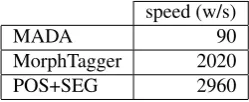
Table 6 presents a comparison of the speed - given in words per second (w/s)8 - of the different segmenters. The dif-ferences in speed performance are very significant: our segmenter is about 30 times faster than MADA and 30% faster than MorphTagger. As shown in Tables 5 and 6, our
speed (w/s)
MADA 90
MorphTagger 2020
POS+SEG 2960
Table 6: Preprocessing speed in words per second
segmenter is as efficient as MADA and MorphTagger to preprocess SMT input. The main advantage of our tool is that it is considerably faster than its competitors and does not require install any other additional resource. In fact, both MADA and MorphTagger require to install the SRILM toolkit (Stolcke, 2002) and to have access to the BAMA database. Using BAMA as a pre-processor is an obvious choice; but without using it, segmentation can be performed at a much faster pace. MADA uses also SVMTool to pre-dict some features (section 2.2.), and this is what makes it extremely slow.
By comparison, to use our tool, we just need to install the Wapiti toolkit together with the accompanying trained model and a couple of segmentation wrappers.
6.
Conclusion
In this paper, we proposed an efficient approach to perform the POS tagging and clitic splitting for Arabic language. For this purpose, we used the Wapiti toolkit based on CRFs which is able to cope with large label sets and very large sets of features. We have evaluated this Arabic preprocess-ing module as a stand alone module as well as a front-end to a standard statistical machine translation task, and have compared it to the MADA and MorphTagger toolkits. First results have shown that the Wapiti model is almost as good as MADA when used as a mere perform POS tagging. It also allows us to achieve a very low error rate on the prefix segmentation task. Furthermore, we have found that performing these two tasks in a joint fashion yield slightly improved performance: for instance, it allowed us to reduce POS error rate from 4.2% down to 3.72%.
We have also checked that using this tool in a complete SMT pipeline delivers results that are in the same ballpark
8For these experiments we used a 8 x 2.3Hz Xeon HT CPU
server.
as the results obtained with other preprocessing chains. As compared to existing alternatives, this tool is (i) able to pro-cess several thousands of words per second and (ii) is totally independant of any other resource, such as morphological analyzer or disambiguator. The results obtained so far are promising and suggests several perspectives for further im-proving the Arabic preprocessing chain. In particular, we intend to complement the preprocessing chain with named entity recognition using Wapiti as well; here again, various scenarios can be considered for performing this series of tasks.
7.
Acknowledgements
This work was partially supported by the CapDigital cluster under the SAMAR project and by OSEO under the Quaero program. The authors also wish to thank Nizar Habash and Saab Mansour for many helpful discussions.
8.
References
Satanjeev Banerjee and Alon Lavie. 2005. METEOR: An automatic metric for MT evaluation with improved cor-relation with human judgments. InProceedings of the ACL Workshop on Intrinsic and Extrinsic Evaluation Measures for Machine Translation, pages 65–72, Ann Arbor, Michigan.
Tim Buckwalter. 2004. Buckwalter Arabic Morphological Analyzer Version 2.0. LDC2004L02.
Mona Diab. 2009. Second generation tools (amira 2.0): Fast and robust tokenization, POS tagging, and base phrase chunking. In Khalid Choukri and Bente Mae-gaard, editors, Proc. of the Second International Con-ference on Arabic Language Resources and Tools, Cairo, Egypt, April. The MEDAR Consortium.
Anas El Isbihani, Shahram Khadivi, Oliver Bender, and Hermann Ney. 2006. Morpho-syntactic Arabic prepro-cessing for Arabic to English statistical machine trans-lation. In Human Language Technology Conf. / North American Chapter of the ACL Annual Meeting (HLT-NAACL), Workshop on SMT, pages 15–22, New York. Association for Computational Linguistics.
Souhir Gahbiche-Braham, H´el`ene Bonneau-Maynard, and Franc¸ois Yvon. 2011. Two ways to use a noisy paral-lel news corpus for improving statistical machine trans-lation. InProceedings of the 4th Workshop on Building and Using Comparable Corpora: Comparable Corpora and the Web, pages 44–51, Portland, Oregon, June. As-sociation for Computational Linguistics.
Qin Gao and Stephan Vogel. 2008. Parallel implementa-tions of word alignment tool. InSoftware Engineering, Testing, and Quality Assurance for Natural Language Processing, SETQA-NLP ’08, pages 49–57.
Jianfeng Gao, Galen Andrew, Mark Johnson, and Kristina Toutanova. 2007. A comparative study of parameter estimation methods for statistical natural language pro-cessing. InProc. of the 45th Annual Meeting of the As-sociation of Computational Linguistics, pages 824–831, Prague, Czech Republic, June. Association for Compu-tational Linguistics.
machines. InIn Proc. of the 4th International Confer-ence on Language Resources and Evaluation, pages 43– 46.
Nizar Habash and Owen Rambow. 2005. Arabic tokeniza-tion, part-of-speech tagging and morphological disam-biguation in one fell swoop. InProc. of the 43rd Annual Meeting on ACL, ACL ’05, pages 573–580, Stroudsburg, PA, USA. Association for Computational Linguistics. Nizar Habash and Fatiha Sadat. 2006. Arabic
preprocess-ing schemes for statistical machine translation. InProc. of the Human Language Technology Conference of the
NAACL, Companion Volume: Short Papers,
NAACL-Short ’06, pages 49–52, USA. ACL.
Nizar Habash, Owen Rambow, and Ryan Roth. 2010. Mada+tokan manual. Technical Report CCLS-07-01, Columbia University.
Nizar Habash. 2010. Introduction to Arabic Natural Lan-guage Processing. Synthesis Lectures on Human Lan-guage Technologies. Morgan & Claypool Publishers. Ahmed El Kholy and Nizar Habash. 2012. Orthographic
and morphological processing for english-arabic statis-tical machine translation. Machine Translation, 26(1-2):25–45.
Philipp Koehn, Hieu Hoang, Alexandra Birch, Chris Callison-Burch, Marcello Federico, Nicola Bertoldi, Brooke Cowan, Wade Shen, Christine Moran, Richard Zens, Chris Dyer, Ondˇrej Bojar, Alexandra Constantin, and Evan Herbst. 2007. Moses: open source toolkit for statistical machine translation. InProceedings of the 45th Annual Meeting of the ACL on Interactive Poster and Demonstration Sessions, ACL ’07, pages 177–180, Morristown, NJ, USA. Association for Computational Linguistics.
Seth Kulick. 2010. Simultaneous tokenization and part-of-speech tagging for Arabic without a morphological an-alyzer. InProc. of the ACL 2010 Conference Short Pa-pers, ACLShort ’10, pages 342–347, Stroudsburg, PA, USA. Association for Computational Linguistics. Seth Kulick. 2011. Exploiting separation of closed-class
categories for arabic tokenization and part-of-speech tag-ging. ACM Transactions on Asian Language Informa-tion Processing (TALIP), 10:4.
Thomas Lavergne, Olivier Capp´e, and Franc¸ois Yvon. 2010. Practical very large scale CRFs. InProc. the 48th ACL, pages 504–513.
Mohamed Maamouri, Ann Bies, Tim Buckwalter, Hubert Jin, and Wigdan Mekki. 2005a.Arabic Treebank: Part 3 (full corpus) v 2.0 (MPG + Syntactic Analysis). Number LDC2005T20. Linguistic Data Consortium.
Mohamed Maamouri, Ann Bies, Tim Buckwalter, Hubert Jin, and Wigdan Mekki. 2005b. Arabic Treebank: Part 4 v 1.0 (MPG Annotation). Number LDC2005T30. Lin-guistic Data Consortium.
Mohamed Maamouri, Dave Graff, Basma Bouziri, Son-dos Krouna, Ann Bies, and Seth Kulick. 2010. LDC Standard Arabic Morphological Analyzer (SAMA) Ver-sion 3.1. Number LDC2010L01. Linguistic Data Con-sortium.
Saab Mansour, Khalil Sima’an, and Yoad Winter. 2007.
Smoothing a lexicon-based pos tagger for arabic and he-brew. InProceedings of the 2007 Workshop on Compu-tational Approaches to Semitic Languages: Common Is-sues and Resources, Semitic ’07, pages 97–103, Strouds-burg, PA, USA. Association for Computational Linguis-tics.
Saab Mansour. 2010. Morphtagger: HMM-based Arabic segmentation for statistical machine translation. In In-ternational Workshop on Spoken Language Translation, pages 321–327, Paris, France, December.
Erwin Marsi, Antal van den Bosch, and Abdelhadi Soudi. 2005. Memory-based morphological analysis generation and part-of-speech tagging of Arabic. In Proc. of the ACL 2005 workshop on computational approaches to Semitic languages, pages 1–8, Ann Arbor, USA. ThuyLinh Nguyen and Stephan Vogel. 2008.
Context-based Arabic morphological analysis for machine trans-lation. InProc. of the 12th Conference on Computational Natural Language Learning, CoNLL ’08, pages 135– 142, Stroudsburg, PA, USA. ACL.
Owen Rambow Nizar Habash and Ryan Roth. 2009. Mada+tokan: A toolkit for Arabic tokenization, dia-critization, morphological disambiguation, POS tagging, stemming and lemmatization. In Khalid Choukri and Bente Maegaard, editors,Proc. of the 2nd International Conference on Arabic Language Resources and Tools, Cairo, Egypt, April. The MEDAR Consortium.
Franz Josef Och. 2003. Minimum error rate training in sta-tistical machine translation. InProceedings of the 41st Annual Meeting of the Association for Computational Linguistics, pages 160–167, Sapporo, Japan.
Kishore Papineni, Salim Roukos, Todd Ward, and Wei-Jing Zhu. 2002. BLEU: a method for automatic evaluation of machine translation. InProceedings of the 40th Annual Meeting on Association for Computational Linguistics, pages 311–318, Stroudsburg, PA, USA. Association for Computational Linguistics.
Matthew Snover, Bonnie Dorr, Richard Schwartz, Linnea Micciulla, and John Makhoul. 2006. A study of transla-tion edit rate with targeted human annotatransla-tion. In Pro-ceedings of the conference of the Association for Ma-chine Translation in the America (AMTA), pages 223– 231.