Irony and Sarcasm: Corpus Generation and Analysis Using Crowdsourcing
Elena Filatova
Computer and Information Science Department Fordham University
Abstract
The ability to reliably identify sarcasm and irony in text can improve the performance of many Natural Language Processing (NLP) systems including summarization, sentiment analysis, etc. The existing sarcasm detection systems have focused on identifying sarcasm on a sentence level or for a specific phrase. However, often it is impossible to identify a sentence containing sarcasm without knowing the context. In this paper we describe a corpus generation experiment where we collect regular and sarcastic Amazon product reviews. We perform qualitative and quantitative analysis of the corpus. The resulting corpus can be used for identifying sarcasm on two levels: a document and a text utterance (where a text utterance can be as short as a sentence and as long as a whole document).
Keywords: sarcasm, corpus, product reviews
1.
Introduction
The ability to identifying sarcasm and irony has got a lot of attention recently. The task of irony identification is not just interesting. Many systems, especially those that deal with opinion mining and sentiment analysis, can improve their performance given the correct identification of sar-castic utterances (Hu and Liu, 2004; Pang and Lee, 2008; Popescu and Etzioni, 2005; Sarmento et al., 2009; Wiebe et al., 2004).
One of the major issues within the task of irony identifica-tion is the absence of an agreement among researchers (lin-guists, psychologists, computer scientists) on how one can formally define irony or sarcasm and their structure. On the contrary, many theories that try to explain the phenomenon of irony and sarcasm agree that it is impossible to come up with a formal definition of these phenomena. Moreover, there exists a belief that these terms are not static but un-dergo changes (Nunberg, 2001) and that sarcasm even has regional variations (Dress et al., 2008). Thus, it is not pos-sible to create a definition of irony or sarcasm for training annotators to identify ironic utterances following a set of formal criteria. However, despite the absence of a formal definition for the terms irony and sarcasm, often human subjects have a common understanding of what these terms mean and can reliably identify text utterances containing irony or sarcasm.
There exist systems that target the task of automatic sar-casm identification (Carvalho et al., 2009; Davidov et al., 2010; Tsur et al., 2010; Gonz´alez-Ib´a˜nez et al., 2011). However, the focus of this research is on sarcasm detec-tion rather than on corpus generadetec-tion. Also, these systems focus on identifying sarcasm at the sentence level (Davi-dov et al., 2010; Tsur et al., 2010), or via analyzing a spe-cific phrase (Tepperman et al., 2006), or “exploring certain oral or gestural clues in user comments, such as emoticons, onomatopoeic expressions for laughter, heavy punctuation marks, quotation marks and positive interjections” (Car-valho et al., 2009).
It is agreed that many cases of sarcastic text utterances can be understood only when placed within a certain situation
or within a broader text context. Thus, we set up our data collection experiment so that the collected corpus can be used for in-depth study of different linguistic phenomena that make a text utterance sarcastic or ironic. We use prod-uct reviews posted on www.Amazon.com. In contrast to the existing corpora that are also collected using Amazon product reviews (Davidov et al., 2010; Tsur et al., 2010), our corpus consists of text documents rather than separate sentences. In some cases whole documents can be consid-ered sarcastic, in other cases only specific parts of docu-ments are sarcastic. We believe that providing a context is of tremendous use for learning patterns of text utterances containing sarcasm. To better understand the phenomenon of sarcasm we collect pairs of Amazon product reviews, where both reviews are written for the same product, and one of the reviews is identified as sarcastic and the other one as regular (without sarcasm).
The rest of the paper is structured as follows. In Section 2. we describe the related work on the topic of sarcasm and irony detection as well as several examples of corpora gen-erated for sarcasm detection. While discussing the related work we also provide the reasoning and examples that moti-vate us to create a new corpus with examples of documents containing sarcasm. In Section 3. we describe our proce-dure for collecting a set of documents that can be used for irony and sarcasm detection on two levels (document and sentences level). In Section 4. we analyze the collected corpus. Finally, in Section 5. we draw conclusions based on the collected corpus analysis and discuss the ways this corpus can be used within the task of sarcasm and irony detection. The corpus is available for downloading.1
2.
Related Work
Myers (1977) notices that “Irony is a little bit like the weather: we all know it’s there, but so far nobody has done much about it.” A substantial body of research has been done since then in the fields of Psychology, Linguistics,
1
phe-where they were extracted. Thus, the sentences in the Ama-zon corpus are analyzed outside their broader textual con-text.
However, it has been noted that in many cases a stand alone text utterance (e.g., sentence) cannot be reliably judged as ironic/sarcastic or not without the surrounding context. For example, the sentence “Where am I?” can be marked as ironic only if an annotator knows that this sentence comes from a review of a GPS device.3
Also, in many cases, only analyzing several sentences to-gether can reveal the presence of irony. In the below ex-ample, if the two sentences are analyzed separately, each of them is considered as non-ironic. The utterance becomes ironic only if the two sentences are analyzed together.
Gentlemen, you can’t fight in here! This is the War Room.
P. Sellers as President Muffley in Dr.
Strangelove or: How I Learned to Stop Worrying and Love the Bomb, 1964
In our work we describe the procedure for corpus genera-tion that contains examples of documents with and without irony. As noted above, in the absence of a strict definition of irony, it is impossible to train experts who could reliably identify irony, at the same time, the task of irony detec-tion seems to be quite intuitive. Thus, to create a corpus of reasonable size we use the Mechanical Turk service4 that allows to “crowdsource” labor intensive tasks and is now being used as a source of subjects for data collection and annotation in many fields (Paolacci et al., 2010), includ-ing NLP (Callison-Burch and Dredze, 2010). We use the studies conducted to assess the reliability of MTurk anno-tators (Ipeirotis et al., 2010) to ensure the quality of the collected data.
3.
Corpus Generation
As noted, often a stand alone sentence cannot be reliably judged as either ironic or non-ironic without the surround-ing context. Thus, we design our experiment to collect whole documents rather than sentences.
We use the reviews published on www.Amazon.com as the source of documents for our corpus. Amazon reviews are frequently used as the source of data for sentiment analy-sis (Ghose et al., 2007) and also have already been used for sarcasm detection (Tsur et al., 2010).
As discussed in the previous section, the current corpora dealing with sarcasm identification, consist of short text ut-terances (Tweets or sentences from Amazon reviews). To better understand the phenomenon of sarcasm we collect document (Amazon review) pairs describing the same prod-uct, where one review is judged as containing sarcasm and the other review is judged as a regular review (i.e., without sarcasm).
We collect a corpus that can be used for identifying sarcasm on macro (document) and micro (text utterance) level. To-gether with the product reviews we collect additional infor-mation that can be used by irony detection systems includ-ing the link to the product, the number of stars assigned
3
This example is from (Tsur et al., 2010). 4https://www.mturk.com
by the reviewer to the product under analysis, etc. Thus, this corpus can also be used to confirm the hypothesis that is frequently used in the definitions of irony, namely, that irony is often used to describe something negative. To collect Amazon product review pairs we use the Me-chanical Turk service which is now being widely used as a source of subjects for NLP data collection (Callison-Burch and Dredze, 2010). Our data collection experiment consists of two steps: a product review pairs collection step and a step that combines quality control and data analysis.
3.1. Step 1: Data Collection
First, we asked MTurkers to find pairs of Amazon reviews for the same product where one review contains sarcasm and the other - does not. Here are the instructions that we provided for this task:
• First review should be ironic or sarcastic. Together with this review you should
1. cut-and-paste the text snippet(s) from the review that makes this review ironic/sarcastic
2. select the review type: ironic, sarcastic or both (ironic and sarcastic)
• The other review should be a regular review (neither ironic nor sarcastic)
This task explanation was followed by a detailed outline of the review submission procedure. Thus, for each review that contains irony we obtained:
1. a permalink that can be used to retrieve the text of the product review together with many other useful infor-mation including, the number of stars assigned to the review;
2. ironic/sarcastic/both labeling that can be used to test our hypothesis on whether people can reliably distin-guish between irony and sarcasm.
We asked for 1000 pairs of Amazon product reviews. How-ever, some of the submitted data points missed the re-quested information and thus, were excluded from further consideration.
On purpose, we did not provide any guidelines regarding the size of the text snippet that makes a review sarcastic. By omitting the size restrictions we test whether it is possible to pinpoint in text the irony part. This information can also be used to analyze whether it is possible to localize irony in text as it has been done for opinion concentration (Brooke and Hurst, 2009). The size of the submitted text snippets varies from a phrase to the whole document.
According to Ipeirotis et al. (2010) and Paolacci et al. (2010), the data submitted by MTurkers can contain noise and spam. To ensure the quality of our corpus, eliminate questionable documents, and also test several hypothesis about the nature of irony, we ran a second experiment on MTurk (Step 2).
3.2. Step 2: Data Quality Control
During Step 2 we recruit a new set of MTurkers so that each document collected during Step 1 is annotated by five new annotators. This step is designed to serve several goals. First, it allows us to eliminate those product reviews that are submitted as sarcastic but are either submitted by spammers or not considered as clearly sarcastic by other annotators. Second, we check whether MTurkers can guess the number of stars assigned to the product by the review author. Our goal is to identify those documents that are clearly sar-castic or clearly regular (i.e., non-sarsar-castic). In the absence of a formal definition of sarcasm we use inter-annotator agreement to identify those documents that are considered as sarcastic by some annotators and as non-sarcastic by other and thus, should be eliminated from further consid-eration. We use two quality control procedures: simple ma-jority voting and the data quality control algorithm that is based on computing Krippendorff’s alpha coefficient to dis-tinguish between reliable annotators and unreliable annota-tors; the labels from reliable annotators get high weight in computing the final label for a data point (Ipeirotis et al., 2010).
First, we use simple majority voting and keep for fur-ther consideration only those documents whose initial label (sarcastic or regular) is supported by at least three out of five new annotators. The labels: ironic, sarcastic, and both are all considered to support the same type of documents (i.e., sarcastic). After computing majority votes and leav-ing only those documents whose initial type is supported by at least three new voters, we end up with 486 Amazon reviews containing irony, and 844 regular Amazon reviews. However, the labels submitted during Step 2 can contain noise as well. Thus, using simple majority voting might not be the ideal approach for identifying incorrectly submitted documents.
Therefore, we compute a second metric to ensure the quality of the documents in our corpus. We apply the quality control algorithm designed specifically for quality management on Amazon Mechanical Turk and described in (Ipeirotis et al., 2010). This algorithm computes the reli-ability of every annotator and allows to rate the annotators based on the quality of their work. Using this algorithm we find those annotators that submit good quality labels and then keep only those documents that are labeled by these annotators and where the majority (out of five) reliable an-notators agree that a document that was initially submitted as containing irony is indeed ironic, and a document that was initially submitted as regular indeed does not contain irony.
Thus, we use three-level quality control and keep in the fi-nal collection of documents only those whose initial type (sarcastic or regular) is supported by both majority voting using the labels obtained on Step 2 and the algorithm
de-scribed in (Ipeirotis et al., 2010).
After the completion of the two-step data collection exper-iment and application of the data quality control manage-ment algorithm, we end up with 437 sarcastic reviews and 817 regular reviews. Out of these reviews we get 331 pairs of sarcastic and regular reviews submitted for the same Amazon product as well as 106 sarcastic and 486 regular unpaired reviews.
The number of regular reviews is almost twice as high as the number of sarcastic reviews. However, this character-istic of the corpus does not reflect the real distribution of ironic and regular reviews among Amazon product reviews. Rather, it reflects the fact that it is more difficult for people to agree on whether a review is ironic or not rather than on whether the review has or does not have irony.
According to the manual analysis of several cases that are initially submitted as ironic but judged as regular by the spammer elimination software, we can say that the applied criteria for leaving reviews in the corpus is very strict. For example, the below review is submitted as ironic during Step 1, however, during Step 2 one MTurker considered this review ironic, one - sarcastic, and three other MTurk-ers considered this review to be a regular review. Thus, despite the fact that the authors of this paper believe that this review is sarcastic and that the utterance submitted for this review provides enough proof of the sarcastic nature of this review, nonetheless, this review is not included into our corpus.5
• Submitted review label: ironic
• Product: Moon (2009)
• Stars: 1 out of 5
• Review Title: Boring and unoriginal. I liked “District
9” much more.
• Review: This movie didn’t really do anything for me.
It was just a variation of the theme of a person isolated from other people. It didn’t even bring anything new about the theme to the table. This type of situation has been done so many times before (Castaway, Robinson Crusoe, I Am Legend, etc.)in ways that I thought were more interesting. Copying HAL from 2001 didn’t help in the originality department, either. I have to admit I couldn’t get into the movie from the beginning be-cause I couldn’t believe they would send ONE person into space for three years- ONE person! After that, I just couldn’t get into it (so I probably missed/forgot some things). I also think that a clone of someone wouldn’t have such a different personality from the original person if that clone had only been in that kind environment. If they can clone him, why don’t they just have a bunch of clones up there? They’d get things done in a lot shorter time than three years. Also, why did it take him almost three years to go nearly insane? I probably would have lost it after three days.
5
• Utterance that makes this review ironic: I have to
ad-mit I couldn’t get into the movie from the beginning because I couldn’t believe they would send ONE per-son into space for three years- ONE perper-son!
Interestingly, there is some level of disagreement not only regarding whether a review is ironic, but also some of the reviews that were initially submitted as regular were as-signed a higher probability of being ironic after Step 2. Most of such reviews are written for the type of Amazon products for which users write mainly sarcastic reviews such as uranium ore, Zenith watch that is sold at 40% dis-count price for mere $86,999.99, etc.
3.2.1. Guessing Star Rating
Finally, we check whether MTurkers can guess the num-ber of stars assigned to a product based on its review. On Step 2, we provide annotators with the plain text of a re-view (without its URL or the number of stars assigned by the review’s author to the product under analysis) and ask to submit the number of stars that this review is likely to give to the product. For each review we get five MTurkers guessing the number of stars assigned by this review to a product and compute the average of these five values. We then compute the correlation of this average with the initial number of stars assigned to the product based on the review under analysis. This correlation is quite high: 0.889 – for all reviews, 0.821 – for sarcastic reviews, and 0.841 – for regular reviews.
4.
Corpus Analysis
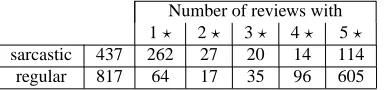
One of the key characteristics of sarcasm that is described by linguists and psychologists, and exploited by sarcasm identification system is the fact that a sarcastic reviews use positive words but express negative opinion. Negative opin-ion is captured on Amazon by low star ratings assigned by review authors. As expected, in the collected corpus, the majority of the sarcastic reviews are written by people who assign low scores to the reviewed products: 59.94% - one-star reviews. The majority of regular reviews (74%), on the other hand, assign 5 stars to the reviewed products. We explain this phenomenon by the fact that annotators who submit reviews for our corpus during Step 1 of the cor-pus collection experiment have a general understanding for the irony and sarcasm phenomena as figures of speech that change the positive literary meaning of a text utterance to negative. Thus, it is easier to find sarcastic reviews among those that assign low scores to products, and the chance of finding an ironic review among the reviews that assign high scores to a product is low. The distribution of the reviews according to how many stars are assigned to them is pre-sented in Table 1
Number of reviews with 1⋆ 2⋆ 3⋆ 4⋆ 5⋆
sarcastic 437 262 27 20 14 114 regular 817 64 17 35 96 605
Table 1: Distribution of stars assigned to reviews.
Many of the five-start sarcastic reviews are written for the products that the review authors consider strange/funny/odd and thus, these ironic reviews are mostly show cases of the review authors’ wits. Examples of products whose ironic reviews assigned five stars to these products include ura-nium ore, a herpes plush doll, and even a T-shirt with a certain print can be a reason for people to exercise her wit (see Figure 1):
Figure 1:The Mountain Three Wolf Moon Short Sleeve Tee.
• Submitted review label: ironic
• Product: The Mountain Three Wolf Moon Short Sleeve Tee.
• Stars: 5 out of 5
• Review Title: Three wolves is just two wolves plus
another wolf.
• Review: I had a two-wolf shirt for a while and I didn’t
think life could get any better. I was wrong. Life got 50% better, no lie.
4.1. What Makes an Sarcastic Review Sarcastic
During Step 1 of our data collection experiment we asked MTurkers to submit text utterances in support of the pres-ence of irony in the product review. The length of such utterances varies. For example, the presence of irony in the review of the Canada Green Grass Seed is supported by the following sentence: “Perhaps it grows in Canada but not
Washington State!!.” In some cases irony is supported by
several text utterances that can be consecutive or can be ex-tracted from different parts of the review. In other cases, a complete review text is submitted in support of its sarcastic nature.
5.
Conclusion
In this paper we describe a corpus generation experiment whose goal is to obtain Amazon product review pairs that can be used to analyze the notion of sarcasm in text and for training sarcasm detection system. Our corpus can be used for understanding sarcasm on two levels: document and text utterance level. Using this corpus we test and con-firm two hypothesis:
af-mention distinction. Radical pragmatics, pages 295– 318.
Joseph Tepperman, David Traum, and Shrikanth S. Narayanan. 2006. ”Yeah right”: Sarcasm recogni-tion for spoken dialogue systems. In Proceedings of
InterSpeech, pages 1838–1841, Pittsburgh, PA, USA,
September.
Oren Tsur, Dmitry Davidov, and Ari Rappoport. 2010. ICWSM - A great catchy name: Semi-supervised recog-nition of sarcastic sentences in product reviews. In
Pro-ceeding of AAAI Conference on Weblogs and Social Me-dia (ICWSM–10), Washington, DC, USA, May.
Akira Utsumi. 1996. A unified theory of irony and its com-putational formalization. In Proceedings of the 16th
con-ference on Computational linguistics (COLING 1996),
pages 962–967, Stroudsburg, PA, USA. Association for Computational Linguistics.
Janyce Wiebe, Theresa Wilson, Rebecca Bruce, Matthew Bell, and Melanie Martin. 2004. Learning subjective language. Computational Linguistics, 30:277–308. Deirdre Wilson and Dan Sperber. 2004. Relevance theory.
In L. R. Horn and G. Ward, editors, The Handbook of