Large-scale lexical analysis
Gr. Thurmair, V. Aleksić, Chr. Schwarz
Linguatec
Gottfried-Keller-Str. 12, 81245 Munich
E-mail: [email protected], [email protected], [email protected]
Abstract
The following paper presents a lexical analysis component as implemented in the PANACEA project. The goal is to automatically extract lexicon entries from crawled corpora, in an attempt to use corpus-based methods for high-quality linguistic text processing, and to focus on the quality of data without neglecting quantitative aspects.
Lexical analysis has the task to assign linguistic information (like: part of speech, inflectional class, gender, subcategorisation frame, semantic properties etc.) to all parts of the input text. If tokens are ambiguous, lexical analysis must provide all possible sets of annotation for later (syntactic) disambiguation, be it tagging, or full parsing.
The paper presents an approach for assigning part-of-speech tags for German and English to large input corpora (> 50 mio tokens), providing a workflow which takes as input crawled corpora and provides POS-tagged lemmata ready for lexicon integration. Tools include sentence splitting, lexicon lookup, decomposition, and POS defaulting. Evaluation shows that the overall error rate can be brought down to about 2% if language resources are properly designed.
The complete workflow is implemented as a sequence of web services integrated into the PANACEA platform.
Keywords: lexical analysis, morphology, information extraction
1.
Introduction
1Lexical Analysis is of central importance in computational language processing. The reason is that anything a machine ‚knows’ about a string must be coded in a lexicon. Therefore, mapping of strings (tokens) to the lexicon is a central task in language processing.
The following paper presents a lexical analysis component as implemented in the PANACEA project (Bel, 2010); it covers German and English text, and is intended to support the analysis of large corpora. The goal is to use corpus-based methods for high-quality linguistic text processing, and to focus on the quality of data without neglecting quantitative aspects.
In PANACEA, analysis starts from the result of text crawling: Relevant texts are identified in the internet, and prepared for linguistic analysis. Sentence splitting and tokenisation identify the units which can undergo lexical analysis.
Lexical analysis has the task to assign linguistic information (like: part of speech, inflectional class, gender, subcategorisation frame, semantic properties etc.) to all parts of the input text. If tokens are ambiguous, lexical analysis must provide all possible sets of annotation for later (syntactic) disambiguation, be it tagging, or full parsing.
2. Workflow
The workflow starts from crawled text. In PANACEA, a monolingual focused crawler is used (Pecina et al., 2011), starting from seed terms and seed URLs. It delivers texts in a basic format (called ‘Travelling Object’, following the XCES standard (Poch, Bel, 2011). All tools of the workflow read and write this format, this way enabling
1 This research has been supported by the EU research
program, project PANACEA, FP7-ICT-2009-4-248064
interoperability of the tools.
The crawler is responsible for producing a proper basic format; this includes document and paragraph markups, and all types of information which can be extracted from HTML documents, like titles, list elements, tables etc. This is valuable information, and provided to the workflow as annotations of the <doc> and <p> tags. A header element keeps track of the document source, and the status of processing.
2.1 Document and paragraph information
The first set of tools is responsible for providing global information, which will help in later analysis. These tools read documents and paragraphs, and write annotations into the <doc> and <p> tags that can later be used. The main tools in the workflow are:
a. Language Identification
This is needed to load the proper language resources. A word-based approach is used here (based on spell-checking dictionaries of different languages), as it is easier to adapt and to maintain than n-gram-based approaches, and more accurate in cases of closely related languages (like Farsi and Dari).
b. Topic Identification
Topics are detected on document and paragraph level (for multi-topic documents). Topic identification is a useful tool in cases where lexica are sensitive for readings belonging to certain topics. In the present workflow, the taxonomy is taken from standard Machine Translation domain classifications. Examples are ‘art’, ‘technology’, ‘wood processing’ as subtopic of ‘material’ etc.
Resources: The system knows about 60 topics, each described by at least 500 features; size of the feature files is around 40000 entries.
Evaluation: Assignment quality is about 80% correctness for unrestricted text (Thurmair, 2005).
c. Casing
A small component determines the global casing of a paragraph (headings tend to be all-uppercase). Casing information influences the further processing steps, it is communicated as a <p> annotation.
2.2 Preprocessing
The task of the preprocessing components is to prepare the text, and its single tokens, for lexical analysis: Preprocessing must provide strings which can be used for lexicon lookup. Preprocessing consists of the following steps:
a. Sentence Splitting
Sentences are the standard unit in language processing, although their embedding into paragraph contexts becomes more and more important.
Experiments with the WACKy corpus2 have shown that
70% of the documents are affected by different approaches towards sentence splitting, which makes a huge difference for later sentence alignment.
The naïve approach using periods and abbreviation lists fails in cases of German where periods have many more functions (e.g. they describe ordinals). Therefore, in the current workflow, sentence boundaries are detected using much more sophisticated resources.
Resources: The sentence splitter uses the following resources for each language:
lists of words which indicate a sentence beginning if capitalised (like ‘The’).
lists of words which frequently occur before a sentence-final punctuation (i.e. they indicate that a following period is really a sentence-end)
lists of abbreviations. Abbreviations are further subcategorised into such that can only occur in final position (like ‘etc.’), only in non-final position (like ‘Dr.’), and the others.
The startwords and endwords have been collected from a corpus analysis of the WACky corpus, and manually corrected. They comprise about 12,000 entries per language3 .
b. Tokenisation and Normalisation
It is an open issue what the definition of a token, in relation to words, may be. Challenges are agglutinations like clitics or compounds, multiword tokens like ‘parce que’, digits like ’40 million’, units like ‘200km/h’. Moreover, the definition is script-dependent, thinking of
2 Baroni et al., 2009
3 The strategy works even for cases in HTML texts where
no punctuations are available at sentence ends, with a precision of about 85%.
Arabic or Chinese scripts.
From the point of view of lexical analysis, a token is anything that can be looked up in the lexicon, or can be given a valid linguistic description (like cardinal numbers). Therefore, tokenisation must be in line with the lexicon lookup; the tokeniser prepares the lexicon lookup. Another relevant aspect here is that the lexicon contains design decision as to what the normal form of a lemma would be: If the lexicon decides to use British Spelling as its base then the tokeniser must deliver British English strings. The same holds for German old vs. new spelling; for hyphenation in English (‘arm rest’ vs. ‘arm-rest’ vs. ‘armrest’), and other such phenomena. Normalisation must map an incoming string to a canonical lexical representation. This is the more important the less standardised a language is. It is the task of the lexicon design to decide on the canonical form of entries; depending on this decision the tokeniser / normaliser must be designed.
The output of the tokeniser component is a list of tokens, i.e. strings which can undergo lexical analysis.
Resources: Tokeniser and Normaliser use rules and lists mapping ‘uncanonical’ to ‘canonical’ strings, several thousand entries per language.
2.3 Lexical Analysis
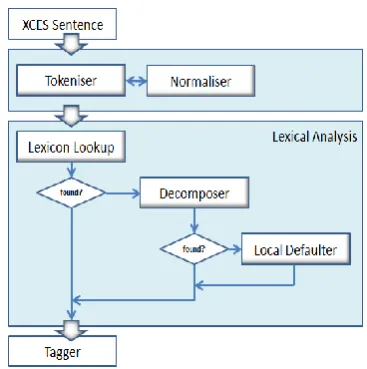
The task of lexical analysis is to assign information to tokens, usually as annotations in the form of feature value pairs. This information is the basis of further (syntactic / semantic) processing; strings without annotations are usually not usable in later steps.
Fig. 1: Lexical Analysis Architecture
a. Lexicon Lookup / Lemmatisation
Tokens first undergo lexicon lookup. The whole lexicon is organised as a two-part resource:
given the component error rate determined above; this way the overall number of incorrect entries can be determined.
Results for German, and for the main test set (Europarl/EMEA/JRC) and for the PANACEA control set are given in Tab. 1.
tokens (K)
coverage (%)
error rate (%)
wrong tokens (K) total tokens 65,568
lexicon
lookup found 57,772 88.1% 1,29 745 remaining 7,796
decomposition
found 5,807 74.4% 2,18 126 remaining 1,988
POS
defaulting for
1,988 100% 20,5 397
remaining 0 1,269
total correct
assignments 98.06%
Table 1: Workflow results for the Europarl/EMEA/JRC test set
It shows that the whole corpus of 65 mio tokens can undergo lexical analysis with an accuracy of 98.06%, taking into account the coverage and the error rates of the single tools. It should be noted that the corpus is not very clean12, which is reflected in the higher error rates of the
POS defaulter.
The same analysis was done for the PANACEA control corpus, and the following data were evaluated, cf. Tab. 2:
tokens
(K) coverage (%) error rate (%)
wrong tokens (K) total tokens 206.2
lexicon lookup
found 172.9 83.8% 1,29 2.2
remaining 33.2 decomposition
found 22.4 67.4% 3.4 0.7
remaining 10.8 POS defaulting
for 10.8 100% 20,2 2.1
remaining 0 5.0
total correct
assignments 97.48%
Table 2: Workflow results for PANACEA control test set
The two test sets show similar behavior, with a slightly worse performance of the decomposer in the PANACEA control set.
12It contains very many foreign language words, and lots of
unknown medical substances and product names from emea.
Conclusion
As a conclusion, it can be seen that the complete workflow of lexical analysis and POS assignment has an accuracy of around 98%, for large scale data.
The work reported here shows that it is quite possible, especially in the era of corpus linguistics and data driven approaches, to run linguistic analysis with high accuracy and sufficient speed, to serve as the basis for further knowledge-driven as well as improved data-driven applications. Of central importance is the availability of language resources, both in quantity and in quality.
4. Integration
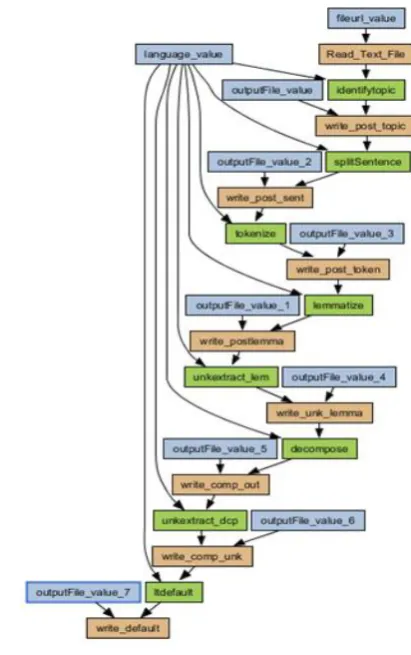
The whole workflow is implemented as a sequence of web services, following the PANACEA specifications, supporting the format of the Travelling Object specified there, and being implemented in the Taverna system as a workflow.
Fig. 2: Lexical analysis workflow in PANACEA
The workflow assumes a crawled file in XCES format as input, and includes the following web services (green boxes):
identifyTopic: Topic Identification splitSentence: Sentence Splitting tokenise: Tokeniser and Normaliser
lemmatise: Lexicon lookup and lemmatisation decompose: Decomposer
default: Local POS defaulting
It produces an output list of remaining unknown tokens, with POS proposals by the system.
The services are registered in the PANACEA registry as single web services, and combined into a Taverna workflow.
5. References
Aleksić / Thurmair 2011: Personal Translator at WMT 2011. Proc. WMT 2011, Edinburgh
Baroni, M., Bernardini, S., Ferraresi, A., Zanchetta, E., 2009: The WaCky wide web: a collection of very large linguistically processed web-crawled corpora. in: Language Resources and Evaluation 43,3
Bel, N., 2010: Platform for Automatic, Normalized Annotation and Cost-Effective Acquisition of Language Resources for Human Language Technologies: PANACEA. Proc. SEPLN, Valencia Koehn, Ph., 2005: Europarl: A parallel corpus for
Statistical Machine Translation. Proc. MT Summit, Phuket.
Pecina, P., Toral, A., Way, A., Papavassiliou, V., Prokopidis, Pr., Giagkou, M., 2011: Towards using web-crawled data for domain adaptation in statistical machine translation. Proc. 15th EAMT, Leuven
Poch, M.; Bel, N., 2011: "Interoperability and technology for a language resources factory”. Proc. Workshop on Language Resources, Technology and Services in the Sharing Paradigm at IJCNLP (Chiang Mai, Thailand). Steinberger, R., Pouliquen, B., Widiger, A., Ignat, C.,
Erjavec, T., Tufiş, D., Varga, D., 2006: The JRC-Acquis: A multilingual aligned parallel corpus with 20+ languages. Proc. 5th LREC'2006, Genova Thurmair, Gr., 2005: Improving machine translation
quality. Proc. MT Summit X, Phuket, Thailand Tiedemann, J., 2009: News from OPUS – A collection of
Multilingual Parallel Corpora with Tools and Interfaces. in: N. Nicolov and K. Bontcheva and G. Angelova and R. Mitkov (eds.) Recent Advances in Natural Language Processing (vol V) (Benjamins) Toral, A., Pecina, P., Way, A., & Poch, M., 2011: Towards