International Conference on Machine Learning and Computational Intelligence-2017 International Journal of Scientific Research in Computer Science, Engineering and Information Technology © 2017 IJSRCSEIT | Volume 2 | Issue 7 | ISSN : 2456-3307
Recent Trends in Background Subtraction Approach for Moving
Object Detection
Rudrika Kalsotra, Sakshi Arora
Department of Computer Science and Engineering Shri Mata Vaishno Devi University Katra, J&K, India
ABSTRACT
Background Subtraction has attained much attentiveness in recent years due to potential growth in the field of intelligent video analytics. It is widely used technique for detecting moving objects from videos because of its flexibility and reliability. This paper presents a comprehensive survey of background subtraction approach. It highlights various applications, challenges and methods of background subtraction. The recent developments in conventional as well as in deep-learning approaches in the field of background subtraction are presented in this paper. In addition to this, future research directions in background subtraction are also outlined in the end. Keywords : Intelligent Video Analytics; Moving Object Detection; Foreground Object; Background Subtraction; Deep-learning
I.
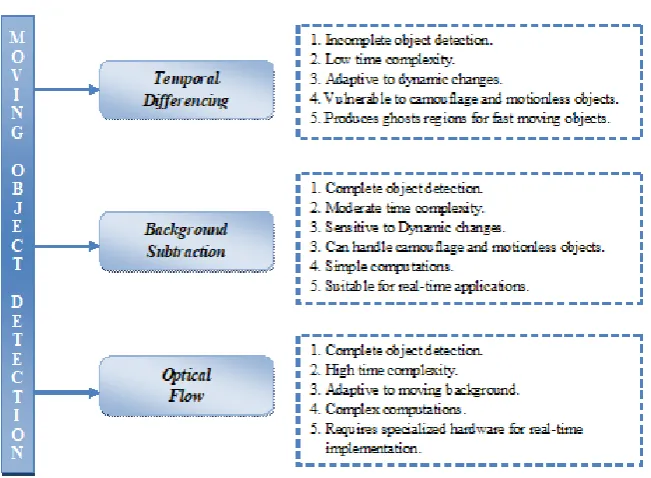
INTRODUCTIONThe problem of detecting moving objects from complex video scenes is of critical importance for the successful implementation of intelligent video analytical tasks. It is followed by object tracking, activity recognition or event analysis in high-level video analytics [1, 2]. Moving object detection is the process of extracting foreground of interests from the series of video frames based on either visual elements or motion information. There are many factors that impede the detection of complete and accurate moving objects such as dynamic video scenes, presence of shadows, video noise, motion of the camera, camouflage, challenging weather, speed and size of the object, varying light intensities and occlusion [3, 4]. Temporal differencing, Background subtraction and Optical flow are three broadly classified techniques of moving object detection from the video streams [5, 6]. The overview of moving object detection techniques are shown in Figure 1. The process of computing difference between
Background subtraction results into accurate and complete moving object detection for the videos captured with static cameras. It does not require complex computations, has moderate time complexity and is suitable for real-time applications. It is vulnerable to environmental changes and noise interfaces but a robust background model can handle these flaws [10]. It forms a basis of almost every
video analytics applications: traffic monitoring, automatic video surveillance (airport surveillance, road surveillance, and maritime surveillance), traffic flow statistics, pedestrian detection, digital composition, optical motion capture, post-event forensics, human-machine interaction and target tracking [11,12].
Figure 1. Overview of moving object detection techniques
The selection of features plays a significant role in detection of foreground from the series of video frames. In [13], features in object detection are broadly classified into two classes: (a) human-engineering based features or hand- crafted features (color features, gradient features, pattern features and shape features) (b) learning-based features (histogram of sparse codes and deep learning features). As pointed out in [11], color features, motion features, edge features, texture features, and stereo features are widely used features and have different characteristics that can deal with complex situations. Color features are vulnerable to shadows, illumination variations and camouflage. Edges are adapted to local illumination variations. The algorithms based on texture features are robust to
shadows and illumination changes [14]. The integration of different features allows us to alleviate many challenges. Conventional background subtraction algorithms are generally based on hand-crafted features and are universally adopted due to computational complexity of deep learning features [15]. The algorithms based on hand-crafted features are incapable to deal with complex video scenes [16]. Therefore, the researchers are resorting to deep-learning based background subtraction.
discussed in section IV. Conclusions and research directions are drawn in section V.
II.
BACKGROUND SUBTRACTIONThe preponderance of background subtraction algorithms has been proposed by researchers for
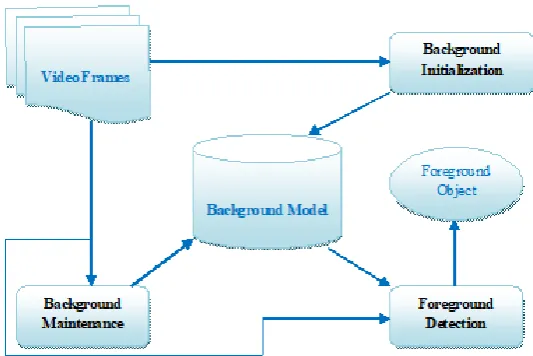
detecting moving objects from the video sequences. Figure 2 shows the background subtraction model. A general algorithm for background subtraction is shown in Figure 3. The steps of background subtraction and its challenges are explained in the following sub-sections.
Figure 2. The background subtraction model
Steps of Background Subtraction
Based on the extensive literature study, background subtraction can be divided into three important steps: Background initialization, Foreground detection and
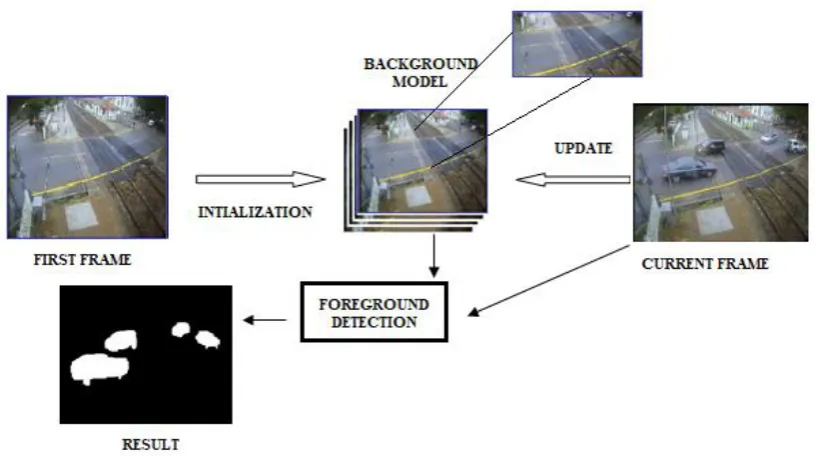
Background maintenance [17, 18]. A graphical workflow of background subtraction is shown in Figure 4.
Background Initialization: This is the first step of the background subtraction technique and the goal is to set up a background model by initializing a reference frame that is used by the other phases. There are two scenarios in a video frames while setting up a background model. First, when there is absence of foreground object in the initial video frames and second when there are one or more foreground objects present from the first video frame. Traditionally, the first frame of the video is initialized for background modeling or fixed number of video frames [11] is selected that do not have any foreground object. But it does not work with real-time applications where dynamic and complex background exists. Different initialization algorithms (neural-based, statistical, fuzzy, etc) are used depending upon complexity of the background model [17].
Foreground Detection: Each incoming frame of the input video is compared with the background model and this subtraction results into a foreground. This step is a segmentation phase that classifies pixels into either foreground pixels or background pixels. The segmentation can be done by various methods (threshold-based, region-based, clustering-based, edge-based, etc) [19]. Generally, a constant threshold is employed for segmentation. Global thresholding such as Otsu’s method is employed for automatic threshold value but it is vulnerable to strong illumination gradient [20] and detects noisy regions
as foreground. So there is a shift from global thresholding to adaptive thresholding [21, 31] which smoothly handles strong illumination gradient video frames. This phase outputs a binary video frame representing foreground in white and background in black or vice versa.
Figure 4. Graphical workflow of background subtraction
Challenges
The major challenges of background subtraction [11, 23] that lead to false detections are listed below:
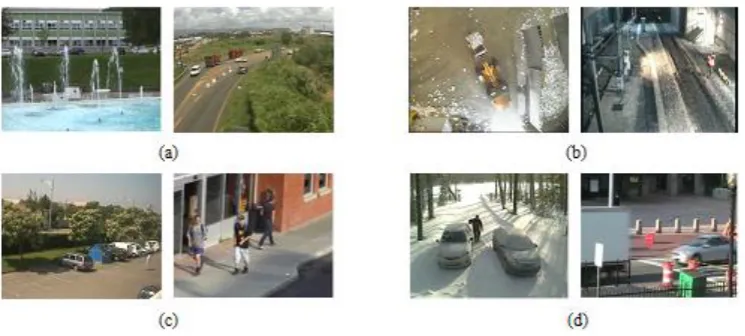
Dynamic Background: Most background subtraction algorithms assume static background but it is not possible in real-life scenarios. There are some periodical or irregular movements in an outdoor as well as indoor scene. Figure 5 (a) shows video scenes containing dynamic background. The background maintenance component should handle dynamic backgrounds such as floating clouds, raindrops, dangling leaves, swing fountains, swinging of pendulum, moving escalator and swaying curtains. Illumination Changes: The illumination changes affect the pixels in the video scene and interrupt background model. Video scenes with illumination changes are shown in Figure 5 (b). Switching on/off lights in an indoor scene causes sudden changes in illumination and produces fallacious detection. Gradual illumination changes such as the changeover from sunny days to clouds generates erroneous classification of pixels.
Camouflage: The correspondence between foreground pixels and background pixels create camouflaged regions that result into false detection of foreground objects as background [24].
Shadows: The detection of shadows is itself an active research area. Figure 5 (c) shows video scenes with shadows. The shadow casted by moving object interrupts the process of object detection. The presence of shadow has many consequences [25] such as distorted objects, merging of objects, specious foreground and overlapping shadows.
Partial or Full Occlusion: The occlusion complicates the computation of background model. There are many instances of occlusion in real-life such as moving car is occluded by sign boards, moving person may hide behind tree or pole and some regions of moving object may not be visible due to any fixed infrastructure.
Video Noise: Sensors and compressed videos may add noise to the video signals that degrade
Camera Jitter: Videos captured with unstable cameras result into jitter and may disrupt the motion of the moving object.
Intermittent Object Motion: Background subtraction algorithm requires effective background maintenance component to handle irregular movements of objects over time. Video scenes with intermittent object
motion are shown in Figure 5 (d). The foreground such as abandoned objects or cars in parking area that become motionless for a short period of time are incorporated into the background but it must be detected again as foreground.
Figure 5. Video scenes: (a) Dynamic Background (b) Illumination changes (c) Shadows and (d) Intermittent object motion. These video scenes are taken from standard datasets [37, 38]
III.
BACKGROUND SUBTRACTION METHODS
Background subtraction methods have achieved remarkable success in certain cases. The surveys presented in the literature categorized the background subtraction algorithms into various models [17, 23, and 26]:
Basic methods: These methods employ an average, a weighted mean, an adaptive median, pixel intensity, or a histogram for initialization and maintenance of background model. The classification of pixels as foreground or background is usually done by thresholding [21].
Statistical-based methods: Statistical methods are broadly classified into three categories [26]: gaussian methods (single or multiple), subspace learning methods and support vector methods. The advanced
statistical methods use color, edge or texture features and some methods fuse different features such as color and texture [27] for foreground detection in background subtraction process. These methods are robust to dynamic backgrounds and low illumination changes.
Neural-based methods: The weights of the networks are trained to model background and learn to stratify pixels into foreground class or background class. Self organizing neural network, regression neural networks, competitive neural network and multivalued neural networks come under this category. These methods are more efficient because of learning and adaptivity of neural networks [28].
foreground detection. Fuzzy-based methods can deal with dynamic backgrounds and illumination variations.
Cluster-based methods: Background modeling is based on clustering where each incoming pixel is matched against clusters and decides whether the pixel belongs to background or not. Codebooks, K-means, genetic K-means methods follow clustering approach. These methods are robust to video noise and dynamic backgrounds.
Deep-learning methods: These methods are broadly classified into two classes [15]: supervised models (e.g., Convolutional Neural Networks (CNNs), Deep Neural Networks (DNNs), and Recurrent Neural Networks (RNNs)) and unsupervised models (e.g., Deep Boltzmann Machines (DBMs), Deep Belief Networks (DBNs), and Auto-encoders).
Other methods: The methods based on tensor models, sparse models, matrices model, neuro-fuzzy models, eigen vectors, low-rank minimization methods, etc are also employed for background subtraction process [11].
IV.
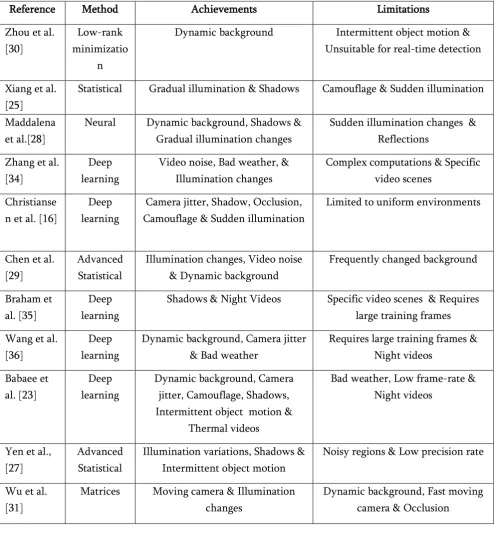
RECENT WORKS IN BACKGROUND SUBTRACTIONThis section introduced recent achievements of conventional and deep-learning techniques in the field of background subtraction. Table I summarizes the method, achievements and limitations of recent background subtraction algorithms.
Conventional Techniques
Xiang et al. [25] improved the detection of moving objects by combining local intensity ratio model (LIRM) with gaussian mixture model (GMM) that can handle gradual illumination variations and shadows robustly. The morphological operations are employed to handle noise, shadow spots and uneven silhouette.
This method does not work with camouflage and sudden illumination variations. Yen et al. [27] introduced a new moving object detection approach for video surveillance. The color and texture based background modeling is combined with hysteresis thresholding and result into an algorithm that restrained the effects of illumination variations, intermittent object motion and shadows. Motion compensation technique used in this method adds noisy regions and has low precision rate in certain cases. Maddalena and Petrosino [28] proposed a neural based background subtraction by implementing self-organizing algorithm. The proposed method is robust to gradual illumination changes, dynamic background and shadows casted by moving object. The performance degrades with sudden light changes and reflections in video scenes. Chen et al. [29] proposed an algorithm (MB-TALBP) for moving object detection. The authors combined background subtraction with edge detection to deal with illumination changes. Background modeling is done by modifying Local binary pattern (LBP) operator. The proposed method is robust to dynamic backgrounds and noisy videos. The performance of this method drops with frequently changed background. Zhou et al. [30] framed the detection of moving object as outlier detection and proposed a unified approach by integrating background learning with object detection. It outperforms other methods in handling dynamic backgrounds by employing low-rank modeling. The foreground is wrongly classified as background for motionless objects and untextured regions in video frames.
cameras, and pan-tilt-zoom cameras) and handles illumination changes effectively. But it can handle detection of moving objects in less video frames. The performance degrades with dynamic backgrounds, fast moving cameras and occlusion.
Deep-Learning Techniques:
Deep-learning techniques revolutionized the field of intelligent video analytics by processing and analyzing large amount of video data [32]. Deep CNN based supervised model has achieved excellent performance in object detection [33].
Christiansen et al. [16] proposed an algorithm by integrating background subtraction with supervised deep convolutional neural network (deep CNN) for detecting anomalies in agricultural fields. The proposed method has low computational time, less memory utilization, high accuracy and also mitigates issues with occlusion and distant objects. The drawback of this approach is it is limited to uniform environments and small occurrence of anomalies. Babaee et al. [23] introduced deep CNN based background subtraction algorithm with spatial- median filtering and global thresholding. It works well with dynamic background, camera jitter, shadows, intermittent object motion, camouflage and thermal videos. But performance drops with bad weather, low frame rate and night videos.
Zhang et al. [34] presented a fast unsupervised deep learning based algorithm that involves two modules for detecting moving objects. First, feature learning is done by deep stacked denoising auto-encoder (SDAE) and then block modeling of binary scenes is done by density analysis. A thresholding based on hash method is used for binarization. It is robust to video noise, bad weather and illumination variations. This method is limited to specific video scenes and requires complex computations.
Braham and Droogenbroeck [35] improved the background subtraction by learning spatial features using deep CNN model and temporal median operator for background modeling. The proposed algorithm deals with hard shadows and night videos. But it requires large number of video frames for training and is also limited to specific scenes. A semi-automatic approach based on cascade CNN model for foreground segmentation form video scenes is proposed by Wang et al. [36]. This algorithm requires little user interventions and handles dynamic background, camera jitter and bad weather. It requires large training frames for complex video scenes especially for night videos.
V.
CONCLUSIONThis paper clearly manifests the effectiveness and contributions of background subtraction approach for detecting moving objects by reviewing both conventional and deep-learning techniques. The conventional techniques are incapable to handle complex situations. Many statistical methods are reformed by combining different features (color + texture, texture + edge, color + texture + motion) to address complex video scene. Deep-learning techniques for background subtraction have showed remarkable outcomes and provided unified framework to deal with key challenges such as camera jitter, gradual and sudden illumination changes, shadows, camouflage, bad weather, intermittent object motion, and dynamic background. Some deep CNN methods are also robust to night videos and thermal videos. However, deep-learning methods are scenes specific and necessitate large training frames.
community. Future research should consider: recent advancements on deep-learning field, fusion of different techniques to address more complex
scenarios, automatic feature selection process and robustness of background model to moving camera.
Table 1. Recent Background Subtraction Algorithm
Reference Method Achievements Limitations
Zhou et al. [30]
Low-rank minimizatio
n
Dynamic background Intermittent object motion & Unsuitable for real-time detection
Xiang et al. [25]
Statistical Gradual illumination & Shadows Camouflage & Sudden illumination
Maddalena et al.[28]
Neural Dynamic background, Shadows & Gradual illumination changes
Sudden illumination changes & Reflections
Zhang et al. [34]
Deep learning
Video noise, Bad weather, & Illumination changes
Shadows & Night Videos Specific video scenes & Requires large training frames
Requires large training frames & Night videos Intermittent object motion &
Thermal videos
Bad weather, Low frame-rate & Night videos
Noisy regions & Low precision rate
Wu et al. [31]
Matrices Moving camera & Illumination changes
Dynamic background, Fast moving camera & Occlusion
VI.
REFERENCES
[1]. Liu, H., Chen, S., & Kubota, N. (2013). Intelligent video systems and analytics: A survey. IEEE
Transactions on Industrial Informatics, 9(3), 1222-1233.
[3]. Mishra, P. K., & Saroha, G. P. (2016, March). A study on video surveillance system for object detection and tracking. In Computing for Sustainable Global Development (INDIACom), 2016 3rd International Conference on (pp. 221-226). IEEE.
[4]. Shaikh, S. H., Saeed, K., & Chaki, N. (2014). Moving Object Detection Using Background Subtraction. In Moving Object Detection Using Background Subtraction (pp. 15-23). Springer International Publishing.
[5]. Hu, W., Tan, T., Wang, L., & Maybank, S. (2004). A survey on visual surveillance of object motion and behaviors. IEEE Transactions on Systems, Man, and Cybernetics, Part C (Applications and Reviews), 34(3), 334-352.
[6]. Tiwari, M., & Singhai, R. (2017). A Review of Detection and Tracking of Object from Image and Video Sequences. International Journal of Computational Intelligence Research, 13(5), 745-765.
[7]. Destalem, K., Cho, J., Lee, J., Park, J. H., & Yoo, J. (2015). Dynamic background updating for
lightweight moving object detection.
International Journal of Computer, Electrical,
Automation, Control and Information
Engineering, 9(8).
[8]. Zhang, H., & Zhang, H. (2013, April). A moving target detection algorithm based on dynamic scenes. In Computer Science & Education (ICCSE), 2013 8th International Conference on (pp. 995-998). IEEE.
[9]. Gang, L., Shangkun, N., Yugan, Y., Guanglei, W., & Siguo, Z. (2013, July). An improved moving objects detection algorithm. In Wavelet Analysis and Pattern Recognition (ICWAPR), 2013 International Conference on (pp. 96-102). IEEE. [10]. Cheng, F. C., & Ruan, S. J. (2012). Accurate
motion detection using a self-adaptive
background matching framework. IEEE
Transactions on Intelligent Transportation Systems, 13(2), 671-679.
[11]. Bouwmans, T. (2014). Traditional and recent
approaches in background modeling for
foreground detection: An overview. Computer Science Review, 11, 31-66.
[12]. Zhang, W., Wu, Q. J., & bing Yin, H. (2010). Moving vehicles detection based on adaptive motion histogram. Digital Signal Processing, 20(3), 793-805.
[13]. Li, Y., Wang, S., Tian, Q., & Ding, X. (2015). Feature representation for statistical-learning-based object detection: A review. Pattern Recognition, 48(11), 3542-3559.
[14]. Yeh, C. H., Lin, C. Y., Muchtar, K., & Kang, L. W. (2014). Real-time background modeling based on a multi-level texture description. Information Sciences, 269, 106-127.
[15]. Sargano, A. B., Angelov, P., & Habib, Z. (2017). A comprehensive review on handcrafted and learning-based action representation approaches for human activity recognition. Applied Sciences, 7(1), 110.
[16]. Christiansen, P., Nielsen, L. N., Steen, K. A., Jørgensen, R. N., & Karstoft, H. (2016).
DeepAnomaly: Combining Background
Subtraction and Deep Learning for Detecting Obstacles and Anomalies in an Agricultural Field. Sensors, 16(11), 1904.
[17]. Sobral, A., & Vacavant, A. (2014). A comprehensive review of background subtraction algorithms evaluated with synthetic and real
videos. Computer Vision and Image
Understanding, 122, 4-21.
[18]. Kamate, S., & Yilmazer, N. (2015). Application of object detection and tracking techniques for unmanned aerial vehicles. Procedia Computer Science, 61, 436-441.
[19]. Zaitoun, N. M., & Aqel, M. J. (2015). Survey on image segmentation techniques. Procedia Computer Science, 65, 797-806.
[21]. SG, A., Karibasappa, K., & Reddy, B. E. (2013).Video segmentation for moving object detection using local change & entropy based adaptive window thresholding. Computer Science & Information Technology, 3(9), 155-166.
[22]. Heikkila, J., & Silvén, O. (2004). A real-time system for monitoring of cyclists and pedestrians. Image and Vision Computing, 22(7), 563-570. [23]. Babaee, M., Dinh, D. T., & Rigoll, G. (2017). A
deep convolutional neural network for
background subtraction. arXiv preprint
arXiv:1702.01731.
[24]. Zhang, X., Zhu, C., Wang, S., Liu, Y., & Ye, M. (2016). A Bayesian Approach for Camouflaged Moving Object Detection. IEEE Transactions on Circuits and Systems for Video Technology. [25]. Xiang, J., Fan, H., Liao, H., Xu, J., Sun, W., & Yu,
S. (2014). Moving object detection and shadow removing under changing illumination condition. Mathematical Problems in Engineering, 2014. [26]. Bouwmans, T. (2011). Recent advanced statistical
background modeling for foreground detection-a systematic survey. Recent Patents on Computer Science, 4(3), 147-176.
[27]. Yeh, C. H., Lin, C. Y., Muchtar, K., Lai, H. E., & Sun, M. T. (2017). Three-Pronged Compensation and Hysteresis Thresholding for Moving Object Detection in Real-Time Video Surveillance. IEEE Transactions on Industrial Electronics, 64(6), 4945-4955.
[28]. Maddalena, L., & Petrosino, A. (2014). The 3dSOBS+ algorithm for moving object detection. Computer Vision and Image Understanding, 122, 65-73.
[29]. Chen, S., Xu, T., Li, D., Zhang, J., & Jiang, S. (2016). Moving object detection using scanning camera on a high-precision intelligent holder. Sensors, 16(10), 1758.
[30]. Zhou, X., Yang, C., & Yu, W. (2013). Moving object detection by detecting contiguous outliers
in the low-rank representation. IEEE
Transactions on Pattern Analysis and Machine Intelligence, 35(3), 597-610.
[31]. Wu, Y., He, X., & Nguyen, T. Q. (2017). Moving Object Detection With a Freely Moving Camera via Background Motion Subtraction. IEEE Transactions on Circuits and Systems for Video Technology, 27(2), 236-248.
[32]. Wang, L., & Sng, D. (2015). Deep Learning Algorithms with Applications to Video Analytics for A Smart City: A Survey. arXiv preprint arXiv:1512.03131.
[33]. Ouyang, W., Zeng, X., Wang, X., Qiu, S., Luo, P., Tian, Y., ... & Wang, K. (2017). DeepID-Net: Object Detection with Deformable Part Based
Convolutional Neural Networks. IEEE
transactions on pattern analysis and machine intelligence, 39(7), 1320-1334.
[34]. Zhang, Y., Li, X., Zhang, Z., Wu, F., & Zhao, L. (2015). Deep learning driven blockwise moving object detection with binary scene modeling. Neurocomputing, 168, 454-463.
[35]. Braham, M., & Van Droogenbroeck, M. (2016, May). Deep background subtraction with scene-specific convolutional neural networks. In Systems, Signals and Image Processing (IWSSIP), 2016 International Conference on(pp. 1-4). IEEE. [36]. Wang, Y., Luo, Z., & Jodoin, P. M. (2016).
Interactive deep learning method for segmenting moving objects. Pattern Recognition Letters. [37]. Wang, Y., Jodoin, P. M., Porikli, F., Konrad, J.,
Benezeth, Y., & Ishwar, P. (2014). CDnet 2014: an expanded change detection benchmark dataset. In Proceedings of the IEEE Conference on Computer Vision and Pattern Recognition Workshops (pp. 387-394).