31st Pacific Asia Conference on Language, Information and Computation (PACLIC 31), pages 241–248 Cebu City, Philippines, November 16-18, 2017
Word Learning by Young Bilinguals: Understanding the Denotation
and Connotation Differences of “Cut” Verbs in English and Chinese
Keng Hwee Neo
Helena Hong Gao
School of Humanities
School of Humanities
Nanyang Technological University
Nanyang Technological University
[email protected]
[email protected]
Abstract
This paper discusses the semantic differences of four “cut” verbs in Chinese
jiǎn, qiē, xīu, gē and their English counterparts cut (with scissors), slice/cut,
trim/prune (away/off) and cut (off/out) and challenges that young bilingual children may encounter in word learning. The fine differences of the verbs were first identified with references to usage notes in dictionaries and thesaurus and then represented with an approach for lexical differentiation adopted from DiMarco et al., (1992).The nuances and subtleties of the denotation and connotation of the “cut” verbs were illustrated accordingly for the understanding of bilingual word learning by young children.
1
Introduction
“Cut” verbs belong to a sub-class of physical action verbs (PA verbs) named “hand action verbs with instrument” (Gao, 2001, 2015). The basic conceptual knowledge that forms the semantics of the verbs include the information of body part, the hand(s) in this case, the cut action in a specific manner, a particular instrument used, degree of force applied, motion direction of the hand(s), and/or a causative result. Cut in English and qiē in Chinese are the basic verbs of “cut” verb class. English speaking children were found to be able to use the verb cut in a causative syntactic frame
around 3 years old (Sethuraman and Goodman, 2004). Chinese speaking children started to produce the first “cut” verbs qiē‘cut’ at 17 months old. This shows that children before 3 years old have had observations or even physically conducted cutting actions (e.g., cutting a cake or an apple, etc.). Other studies have shown that action words naming movable and manipulative objects that can be used when playing with hands or feet are among the first acquired vocabulary of young children (Tomasello 1992; Gao 2015; Ma et al. 2009; Tardif et al. 2009). Such action words are either PA verbs or verbs that indirectly denote certain physical actions. For example, in Gao’s (2001; 2015) studies, a total of 143 PA verbs in Mandarin were found to have been used by children between 1.9 and 2.3 years old. These verbs can be classified into 12 categories and close to half of them depict hand actions with or without an instrument. Mu’s (2009) study also found that PA verbs were the first and core vocabulary of Mandarin-speaking children between 1 to 2 years of age. Zhang’s (2010) corpus-based analysis of the Chinese language use by children between 3 to 6 years of age discovered that the frequencies of their noun and verb usage were comparable and highly dominant in their production. Out of the 100 mostly frequently produced words by the children, 31 were identified as verbs.
The above and other studies pertaining to lexical acquisition of Mandarin by 1-to-6-year olds have highlighted the fact that verb acquisition is the most dominant among other word classes and that PA verbs represent the core of domain-specific lexical development that occurs in parallel with
cognitive development in children during this age period.
Due to the fact that the PA verbs acquired by young children are mostly those that depict physical actions involving everyday activities, monolingual children may not find it difficult to acquire them. However, for children who are acquiring two languages at the same time in places like Singapore, bilingual lexical development may not occur easily, since it does not solely depends on natural input, familiarity or physical experience of the actions. In bilingual lexical development, when L1 words are in close proximity to the semantics of L2 words, “functional equivalence” (cf. Nida, 1964) mapping may easily occur. Thus, the proximity of equivalence in the process of mapping between two words from two languages being acquired plays a crucial role. In the case of lexical near-equivalents, particularly for a set of near-synonyms with subtle differences in the semantic meanings, understanding the non-equivalent semantic features of seemingly paired words between two languages becomes more important in the study of bilingual lexical development. We assume that employing usage notes from dictionaries and thesaurus would be the first step, or the basis for identifying the fine differences between paired words from two languages before asking or accounting for why bilingual children acquired or used this word in L1 at this age but its paired word in L2 at a different age and why their word choices of certain pairs are correct and appropriate but certain others are not. We believe that an analysis of such bilingual word pairs would enable us to understand the differences in the process of bilingual word learning.
This paper first analyses the semantic differences of the highly frequently used Chinese physical action verbs, jiǎn, qiē, xīu, gē and their English counterparts cut(with scissors), slice/cut, trim/prune(away/off) and cut (off/out) that may influence Chinese-English bilingual children’s acquisition of the lexical semantic meanings of the words from the two languages, and then discusses the acquisition challenges for bilingual children in associating words from L1 or L2 with words from L2 or L1 with the above four paired words as examples. Employing the usage notes of dictionaries and thesaurus as reliable resources for illustrating the fine differences of the verbs, we
adopted the approach of a two-part representation for lexical differentiation proposed by DiMarco et al. (1992) to demonstrate the nuances and subtleties of the denotation and connotation of the verbs that may explain why they can be challenges in bilingual word learning by bilingual children.
2
Chinese PA Verbs Acquired by Young
Chinese-English Bilingual Children
Physical action verbs (PA verbs) in Chinese that express single actions or events are monosyllabic words (e.g., ná ‘take’, hē ‘drink, etc.). According to Gao (2001), there are 494 monosyllabic PA verbs in Chinese that can be classified into seven categories based on the action features expressed by the lexical words, such as body part, contact, motion, motion direction, force, instrument, intention, patient object, and so on (Gao, 2001).
In this study, the 494 Chinese PA verbs in Gao’s list were selected to compile a PA verb database. They were first collated with three parameters to illustrate the possibility of a full or near conceptual equivalence mapping of one Chinese verb with one counterpart in English that expresses an identical action concept. When one counterpart failed to do so, partial translation equivalence mapping was applied to match one Chinese verb with two or more synonymous English verbs expressing a similar physical action concept. The collating procedure was as follows:
(a) Each monosyllabic hand action verb in Chinese and its collocations in the form of bi-syllabic words or phrases were identified based on the meaning definitions found in the Dictionary of Contemporary Mandarin (DOCM) and the Modern Chinese Database designed by the Centre for Chinese Linguistics, Peking University (CCL-PKU).
(b) Corresponding equivalents in English of the monosyllabic physical action verbs in Chinese and their collocations in the form of bi-syllabic words or phrases were identified based on the meaning definitions found in the translation dictionaries, such as the Dictionary of Mandarin-English (DOME) and Oxford Mandarin-English Dictionary (OED).
collocations found in CCL-PKU were identified accordingly.
(d) Remarks were added to those verbs in the database that have one of the following three types of translation equivalence:
(i) Type 1: Full or near translation equivalence mapping of one Chinese verb to one English verb
expressing a similar action concept. (ii) Type 2: Near or partial translation mapping of
one Chinese verb to several other synonymous English verbs expressing a similar action concept and vice versa.
(iii) Type 3: Near or partial translation mapping of several English verbs to several other synonymous Chinese verbs expressing a similar physical action concept and vice versa.
For the purpose of illustrating Type 3, another word-use frequency list of the meaning equivalence correspondence of the PA verbs from English to Mandarin were established on the basis of the above list to illustrate the degree of translation equivalence mapping of one English verb to several other synonymous Chinese ones expressing a similar action concept.
In order to identify a specific group of highly frequently used PA verbs in Chinese and their counterparts in English, the verbs produced by bilingual children aged from 1 to 6 years were selected for the lexical semantic analysis. The Chinese data were first drawn from Mu (2009)’s study on the early acquisition of verbs in young children aged from 1 to 2 years old and Zhang’s (2010) corpus-based analysis of the language use by children aged from 3 to 6 years old. The children’s productions of the various word classes in both studies were then examined and those PA verbs were selected for comparing with the Mandarin-speaking children’s word production for action in Tardif’s (2006) study. Twenty most frequently used action words were selected based on the above studies and the Mac-Arthur-Bates Communicative Development Inventory (CDI) for both English and Mandarin children aged 16 months old and Naigles’s (2009) study on infants’ learning of first verbs within the first two years of life. Subsequently, a specific group of highly frequently used verbs by children within the age range of 1 to 6 years old were found. Among them “cut” verbs jiǎn ‘cut (with scissors)’, qiē‘slice/cut’, xīu ‘trim/prune(away/off)’ and gē ‘cut (off/out)’ were found. After the frequently used verbs were
identified, the usage notes of dictionaries and thesarus demonstrating the fine differences of the verbs were employed in a two-part representation for lexical differentiation (DiMarco et al., 1992). The results are expected to reveal the nuances and subtleties of the denotation and connotation of words that belong to a same class and that are near-synonymous in Chinese and English.
3
Lexicons for Lexical Choice:
Synonymy and Plesionymy within and
between Languages
According to Dimarco and Hirst (1995), “the problem of lexical choice in text generation is to determine the word that conveys most precisely the denotation and connotation that are to be expressed.” (Dimarco and Hirst, 1995: 1). The key issue is thus to distinguish between lexical equivalents which may occur in the form of near-synonyms or plesionyms (Cruse, 1986). As opposed to absolute synonyms, near-synonyms or plesionyms differ in their nuances of denotation or connotation which result in their non-interchangeability depending on the situated context owing to their varying shades of meanings and of style or interpersonal emphasis.
We consider the two dimensions along which synonyms can differ in terms of semantically (denotative) and stylistically (connotative) both across and within English and Mandarin respectively. More specifically, while denotation represents the semantic meaning of the word, connotation often refers to the style and interpersonal emphasis of its usage in a specific context. However, the boundary between denotation and connotation may not be at times all that distinct owing to some overlap of meaning within the set of near-synonyms (See further explanations of this in Section 5). Our main purpose is then to locate and highlight the differences between near-synonyms or plesionyms both between and within English and Mandarin respectively for the highly frequent used “hand action verbs with instrument”, jiǎn ‘cut (with scissors)’, qiē ‘slice/cut’, xīu ‘trim/prune (away/off)’ and gē ‘cut (off/out)’ respectively.
4
Usage Notes: Structure, Content and
Table2. Usage notes for jiǎn, qiē, xīu and gē from DOCM and DOME
The above table explicitly distinguishes the differences in usage of the 4 “cut” verbs. Through examining the regularities within these explanations, the key factors in lexical differentiation could be determined. Referencing on the 26 dimensions for denotation and 12 for connotation described more fully by DiMarco et al., (1993), the lexical features for differentiation of
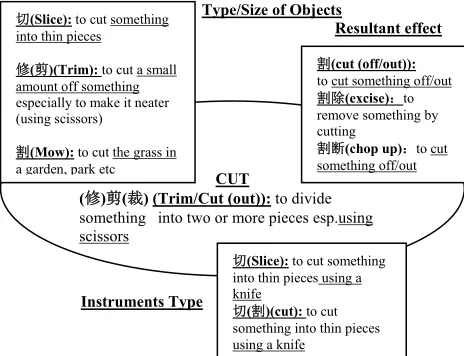
jiǎn, qiē, xīu and gē are illustrated in the following Figure 2.
Type/Size of Objects
Resultant effect
Instruments Type
Figure. 2. Dimensions for the concept of CUT in English
The above figure clearly highlighted the lexical features for differentiation of jiǎn, qiē, xīu and gē. The prototypical meaning of these synonymous verbs pertaining to the concept of the CUTTING ACT realized by the lexicon jiǎn is essentially to divide something into two or more pieces esp. using scissors. In terms of the denotation dimensions, there are 3 aspects: the resultant effect of cutting, the type of instrument for the cutting act and the type and or size of the object being cut which would differentiate the semantic meaning of each of these verbs. For example, qiē can only be used to denote the cutting of an object into thin pieces using a knife, which distinguish it from jiǎn
which refers to the use of scissors in the cutting of an object into mere pieces without any specification on its thickness. Additionally, though
jiǎn and xīu both share the same denotational dimension of using scissors in the act of cutting,
xīu specifically denotes the cutting of a small part off something especially to make it neat, which distinguishes it from jiǎn denoting the cutting of an
object into mere pieces without any specification on its sizes. Interestingly, owing to the bi-syllabic structure lexicon formation of Modern Chinese, both the monosyllabic lexicon xīu and jiǎn could combine into a bi-syllabic lexicon xīu jiǎn to denote specifically the cutting of a small part off something especially to make it neat using scissors.
Consequently, the above-mentioned 3 lexical features in the denotational dimension distinguish the subtle nuances of the semantic meaning of each of the synonymous verbs respectively, though with some occasional overlap among these features. For instance, the monosyllabic word gē in Chinese has the following denotational meanings:
1. Type/Sizes of Objects:
gē ‘mow’: to cut the grass in a garden, park etc.
2. Instrument Type:
qiē (gē) cut: to cut something into thin pieces using a knife
3. Resultant Effects:
gē ‘cut (off/out)’: to cut something off/out
gē chú ‘excise’:to remove something by cutting
gē duàn ‘chop up’: to cut something off/out
Firstly, in the lexical feature of the type or sizes of objects, gē ‘mow’ specifically denotes the cutting of the grass in a garden or a park, etc. Secondly, in the lexical feature of the type of instrument, when combined with the word qiē ‘slice’ to form the bi-syllabic Chinese lexicon qiē gē ‘cut’, it then denotes specifically the cutting of something into thin pieces using a knife, which emphasizes the original denotational meaning of qiē instead of gē. Thirdly, in the lexical feature of the resultant effects of the cutting act, gē ‘cut (off/out)’ denotes the act of cutting to render something off/out as the resultant effect which could also be denoted with a greater emphasis on the removal of something through the act of cutting by either combining the monosyllabic verb chú ‘remove’ and duàn ‘break’ to form gē chú ‘excise’ denoting the removal of something by cutting and gē duàn ‘chop up’
CUT
(修)剪(裁) (Trim/Cut (out)): to divide something into two or more pieces esp.using scissors
切(Slice): to cut something into thin pieces using a knife
切(割)(cut): to cut something into thin pieces using a knife
割(cut (off/out)): to cut something off/out
割除(excise):to remove something by cutting
割断(chop up):to cut something off/out
切(Slice): to cut something into thin pieces
修(剪)(Trim): to cut a small amount off something especially to make it neater (using scissors)
denoting the cutting off or out of something respectively.
Within the denotative differentiae, the connotative differentiae could also co-exist in the form of emphasis of one of the components of the semantic meaning of a word such as the pair of synonyms gē chú ‘excise’ and gē duàn ‘chop up’: while both denote the removal of something through the act of cutting possibly with a cutting instrument like a knife, gē chú ‘excise’ highlights the excising action which connotes the complete removal of something undesirable while gē duàn
‘chop up’ emphasizes the forceful act of chopping up or hacking of something for the purpose of breaking it.
5.2
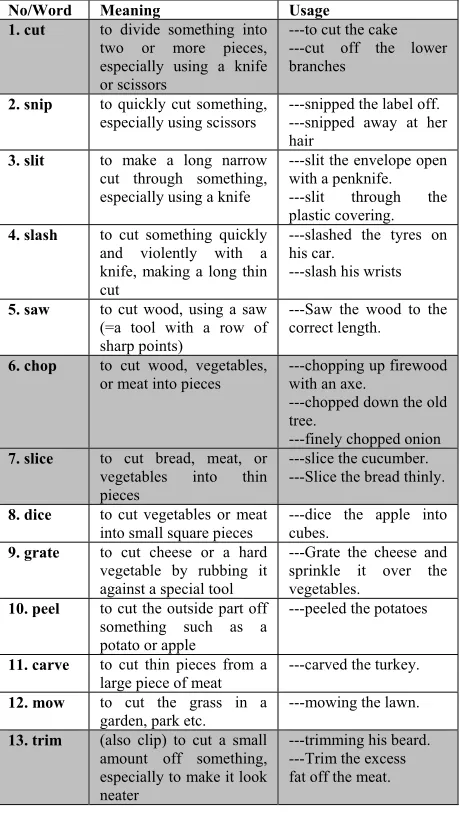
Challenges for Bilingual Children in “Cut” Verb LearningIn sections 4 and 5, the semantics of thirteen “cut” verbs in English and four “cut” verbs in Chinese that are frequently used in daily life were illustrated with usage notes. The illustrations show that the semantic differences between the words within and between the two languages are big enough to cause challenges for young bilingual children to acquire the verbs easily. For example, the manner distinctions and causative results of the different cut actions may not be easily acquired by young bilingual children through daily life
experience. To understand how the process of learning happens at an early age and whether there is an order of learning of the verbs within a PA verb class, an analysis of the semantics of the verbs from learners’ perspective becomes necessary. The semantic differences between the paired verbs in the two languages can also become evident through a comparative illustration of the verb semantics.
From the illustration of the denotation and connotation differences between the “cut” verbs in English and Chinese, we can see that it would require more linguistic and real-world knowledge for bilingual children to be able to acquire fully “cut” verbs, which explains why empirical studies of Chinese-English bilingual word learning have not shown any data of bilingual children’s full acquisition of all the “cut” verbs in their preschool years.
6
Conclusion
It This paper discusses the semantic and stylistic differences of the highly frequently used Chinese physical action verbs, such as jiǎn, qiē, xīu, gē and their English counterparts cut (with scissors),
slice/cut, trim/prune(away/off) and cut (off/out) that may influence Chinese-English bilingual chil-dren’s acquisition of these differences between the two languages. Employing the usage notes of dic-tionaries and thesaurus as a methodology, the fine differences of the verbs were demonstrated in a two-part representation for lexical differentiation (DiMarco et al., 1992). The nuances and subtleties of the denotation and connotation of the “cut” verbs were illustrated accordingly.
Acknowledgments
We acknowledge the support by the Academic Research Fund (AcRF) of Ministry of Education and Nanyang Technological University, Singapore. . We hope that this approach will be able to serve as a reference point in explaining why bilingual children tend to have preferences or make incorrect choices in their use of certain PA verbs that are commonly used and heard from a young age. The result of such a study could be applied to the study of other word classes
References
Aneta Pavlenko. 2009. The Bilingual Mental Lexicon: Interdisciplinary Approaches. Bristol, United Kingdom: Multilingual Matters.
Chang L. L. et al. 2000. A Lexical Semantic Analysis of Mandarin Chinese Verbs: Representation and Methodology. In Computa-tional Linguistics and Chinese Language Processing. 5(1): 1-18. Taiwan: The Association for Computational Linguistics and Chi-nese Language Processing.
Christina Gitsaki. 1999. Second Language Lexical Acquisition: A Study of the Development of Collocational Knowledge. San Fran-cisco: International Scholars Publications
David Singleton. 1999. Exploring the Second Language Mental Lexi-con. Cambridge, United Kingdom: Cambridge University Press.
Dictionary of Mandarin-English (吴光华编著《汉英大
词典(第 3 版)》(上海:上海译文出版社,
2010)。)
Dictionary of Contemporary Mandarin (中国社会科学
院语言研究所词典编辑室《现代汉语词典(第 6
版)》 (北京:商务印书馆出版社,2005。)
DiMarco, C. & Hirst, G. 1995. Usage Notes as the Basis for a Repre-sentation of Near-Synonyms for Lexical Choice.
DiMarco, C., Hirst, G. & Stede, M. 1992. The Semantic and Stylistic Differentiation of Synonyms and Near-Synonyms.
Eve V. Clark. 1993. The Lexicon in Acquisition. Cambridge, London: Cambridge University Press. Gao H. 2015. Chinese Children’s Production of
Physical Action Verbs. In C. F. Sun, W. S-Y Wang & Y. Tsai (ed.), Oxford Handbook of Chinese Linguistics. 641-653.Oxford, UK: Oxford University Press.
Gao H. 2001. The Physical Foundation of the Patterning of Physical Action Verbs: A Study of Chinese Verbs. Lund: Lund University Press.
Gao H. 2001. A Specification System for Measuring Relationship among Near-Synonyms of Physical Action Verbs. In Proceedings of the 2nd Chinese Lexical Semantics Workshop (第二届汉语词汇语义 学研讨会论文集). 45-51. Beijing, China.
Kong Lingda, Youyang Junlin, Chen Changhui, ding Lingyun, Wang Xiangrong, Zhu Wanxi, fu Manyi, Yao Wenbing. (孔令达, 胡德明, 欧阳俊林, 陈 长辉, 丁凌云, 王祥荣, 朱万喜, 傅满义, 姚 文兵). 2004. A Study of Concrete Word Acquisition By Chinese Children (汉 族 儿 童 实 词 习 得 研 究). Anhui University Press (安徽大学出版社).
Kroll, J. 1993. Accessing Conceptual Representations for Words in a Second Language. In R. Schreuder and B. Weltens (eds.). The Bi-lingual Lexicon: 53-81. Amsterdam: John Benjamins.
Kroll, J., and De Groot, A.M.B. 1997. Lexical and Conceptual Memory in the Bilingual: Mapping Form to Meaning in Two Lan-guages. In A.M.B. De Groot and J. Kroll (eds.). Tutorials in Bilin-gualism: Psycholinguistic Perspectives: 169-199. Mawhah, N.J.: Lawrence Erlbaum.
Kroll, J. and Sunderman, G. 2003. Cognitive Processes in Second Language Learners and Bilinguals: The Development of Lexical and Conceptual Representations. In C. Doughty and M. Long (eds.). The Handbook of Second Language Acquisition: 104-129. Malden, MA: Blackwell.
Letitia R. Naigles. 2009. A General Description of Early Verb Growth and Use. In Flexibility in Early Verb Use: Evidence from a Multi-ple-n Diary Study. Letitia R. Naigles, Erika Hoff, Donna Vea, Mi-chael Tomasello. Wiley-Blackwell.2009.
Longman Dictionary of Contemporary English
(LDOCE), 2017. http://www.ldoceonline.com/dictionary/cut/ 12
May2017.
Modern Chinese Database, Centre for Chinese Linguistics, Peking University (北京大学中国语言
学 研 究 中 心 现 代 汉 语 语 料 库 ), in
http://ccl.pku.edu.cn:8080/ccl_corpus/. 16 Jan 2017. Natasha Tokowicz. 2015. Lexical Processing and
Second Language Acquisition. New York: Taylor and Francis.
Oxford Advanced Learners Dictionary (OALD), 2017. http://www.oxfordlearnersdictionaries.com/definition /english/cut_1?q=cut/ 12 May 2017.
Oxford English Dictionary. Second Edition. CD-ROM (v. 4.0). Ox-ford University Press, 2009.
Sethuraman, N. and J.C. Goodman. 2004. Learning to Generalized Verbs to New Syntactic Environments. In E.V. Clark (Ed.), Proceedings of the 2004 Stanford Child Language Research Forum: Constructions and Acquisition. CSLI Publications, 78-87.
Twila Tardif. 2006. But Are They Really Verbs? Chinese Words for Action. In Action Meets Word: How Children learn verbs. Kathryn A. Hirsh-Pasek and Robert M. Golinkoff. Oxford Schol-arship Online.2010.