Between Reading Time and Information Structure
Masayuki Asahara
National Institute for Japanese Language and Linguistics, National Institutes for the Humanities, Japan
Abstract
This paper presents a contrastive analysis be-tween the reading time and information struc-ture in Japanese. We overlaid the reading time annotation BCCWJ-EyeTrack and an infor-mation structure annotation on the Balanced Corpus of Contemporary Written Japanese. Statistical analysis based on a mixed linear model showed that the “specificity,” “sen-tience,” and “commonness” of the Japanese information structure affect the reading time. These three characteristics produce different patterns of delay in the reading time. Espe-cially, the reading time patterns differ depend-ing on the commonness such as new informa-tion or bridging. The results suggest that new information and bridging can be classified by the reading time pattern.
1 Introduction
Information structures1 such as definiteness and
specificity affect the selection of articles. However, some languages such as Japanese and Russian do not have articles for noun phrases (NPs). The definite-ness and specificity in such languages are not overtly marked in their surface form.
Nagata et al. (Nagata et al., 2005) proposed a sta-tistical model to detect article errors made by En-glish learners. They constructed the model by using an enormous text produced by English native speak-ers. However, when we consider the choice of arti-cles in some languages by native speakers of a lan-guage with no articles, careful attention must be paid
1
We focus on the information status which is a fundamental notion to define the theme and rheme in the information struc-ture.
to the information structures in their NPs. Moreover, when texts in language without articles are trans-lated by humans or machine translation systems into a target language with articles, we should consider the information structure of the source language.
Other aspects of information structures are the
information status and commonness. The
infor-mation status indicates whether the co-referred
mention appears in the preceding discourse
(discourse-old) or not (discourse-new). Commonness is defined as whether the speaker assumes that the hearer already knows the
informa-tion (hearer-old), can estimate the information
(bridging), or does not know the information
hearer-new. Bridging reference cannot be resolved purely from the surface forms of written
texts. Previous research (Hou et al., 2013) tried
to resolve bridging references by using annotated corpora and world knowledge. However, bridging is an information structure for the language recipient
(hearer). It should incorporate recipient features
such as the reading time to estimate whether an
NP is bridging or not (i.e., hearer-new).
Moreover, identifying if readers can resolve a bridging reference with their own knowledge is important for user-oriented information extraction and document summarization.
These information structures are correlated with animacy, sentience, and agentivity. The features of information structures may affect the reading time; there are various ways to monitor the reading time, such as eye tracking to obtain gaze information.
This paper presents a contrastive analysis be-tween the reading time and information structures in Japanese in order to classify information struc-tures according to the gaze information. We
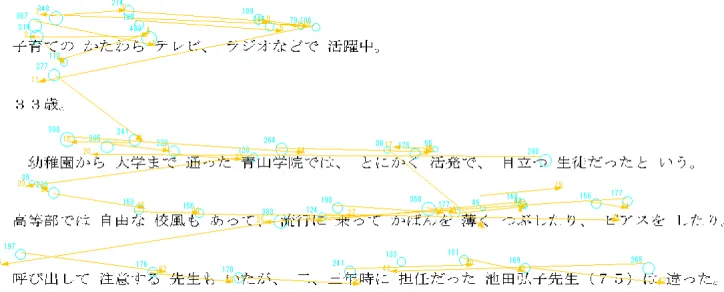
Figure 1: Screen Dump of the Eye Tracking Results
Table 2: Profile data for the participants
Age Females Males Gender Total
range not
(years) given
-20 1 1 2
21-25 2 2
26-30 2 2
31-35 3 3
36-40 9 1 10
41-45 3 3
46-50 1 1
51- 1 1
total 19 4 1 24
Table 3: Results for reading span test and vocabulary-size test
Vocab. Reading span test score
size 1.5 2.0 2.5 3.0 3.5 4.0 4.5 5.0 Total
36,000 - 1 1 2
38,000 - 4 1 5
40,000 - 1 1 2
42,000 - 1 1
44,000 - 1 1
46,000 - 0
48,000 - 1 1
50,000 - 4 1 1 1 7
52,000 - 1 1 2
54,000 - 1 1
56,000 - 0
58,000 - 1 1
60,000 - 1 1
Total 2 8 8 2 1 1 1 1 24
formed to the definition for bunsetsu units (a con-tent word followed by functional morphology, e.g., a noun with a case marker) in the BCCWJ as pre-scribed by the National Institute for Japanese
Lan-guage and Linguistics. Each participant was
as-signed to one of eight groups of three participants each. Each group was subjected to one of the eight experimental conditions with varying combinations of measurement methods and boundary marking for different datasets presented in different orders.
During the self-paced reading session, each seg-ment was displayed separately, and participants could not return to reread earlier parts of the text. Therefore, the latencies for the button presses are straightforward measures of the time spent on each segment.
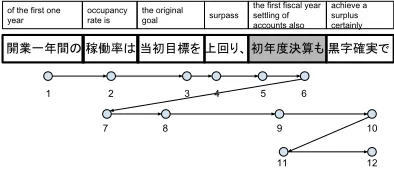
For the eye-tracking data, five types of
measure-Table 4: Data set sizes
Data set Segments Sentences Screens
A 470 66 19
B 455 67 21
C 355 44 16
D 363 41 15
ments were used: first fixation time (FFT), first pass time (FPT), regression path time (RPT), second pass time (SPT), and total time (TOTAL). These are ex-plained in Figure 2.
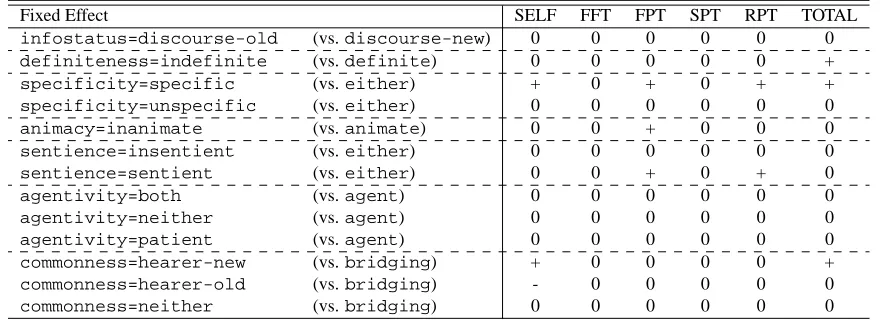
“ex-Table 10: Summary: reading time and information structures
Fixed Effect SELF FFT FPT SPT RPT TOTAL
infostatus=discourse-old (vs.discourse-new) 0 0 0 0 0 0
definiteness=indefinite (vs.definite) 0 0 0 0 0 +
specificity=specific (vs.either) + 0 + 0 + +
specificity=unspecific (vs.either) 0 0 0 0 0 0
animacy=inanimate (vs.animate) 0 0 + 0 0 0
sentience=insentient (vs.either) 0 0 0 0 0 0
sentience=sentient (vs.either) 0 0 + 0 + 0
agentivity=both (vs.agent) 0 0 0 0 0 0
agentivity=neither (vs.agent) 0 0 0 0 0 0
agentivity=patient (vs.agent) 0 0 0 0 0 0
commonness=hearer-new (vs.bridging) + 0 0 0 0 +
commonness=hearer-old (vs.bridging) - 0 0 0 0 0
commonness=neither (vs.bridging) 0 0 0 0 0 0
reading times of SELF and TOTAL may split for
hearer-newandbridging.
In sum, the reading time showed that differ-ent patterns of reading time to determine the
specificity, sentience and commonness
in the information structure.
6 Conclusions
This paper presents a contrastive analysis between the reading time and information structure. The re-sults showed the different patterns of promotion or interference of the reading time for the information structure of the NPs. They may lead to the possibil-ity of classifying information structures by the read-ing time pattern.
The previous co-reference resolution methods ad-dressed the issue of the information status based on whether or not an NP is mentioned in the pre-vious discourse. However, these methods cannot identify the information structure for a recipient,
such as the commonness (hearer-new, -old
or bridging). It is necessary to introduce a re-cipient reaction feature to identify the commonness. The results in this paper showed that the reading time is a potential feature that can be used to solve bridging.
Our future work will involve building a classifier
to splitbridgingandhearer-newbased on the
reading time for each subject participant. The classi-fier will be able to detect bridging that cannot be re-solved by the subject participant’s knowledge. This will enable us to develop user-oriented information
extraction or document summarization models that
incorporate presenthearer-newInformation.6
Acknowledgement
The work reported in this article was supported by the NINJAL research project of the Center for Cor-pus Development. This work was also supported by JSPS KAKENHI Grant Number JP25284083 and JP17H00917.
6
Martha Palmer, Daniel Gildea, and Paul Kingsbury. 2005. The proposition bank: An annotated corpus of semantic roles. Conputational Linguistics, 31(1):71– 105.
Rashmi Prasad, Bonnie Webber, Alan Lee, Sameer Prad-han, and Aravind Joshi. 2015. Bridging sentential and discourse-level semantics through clausal adjuncts. In
Proceedings of the First Workshop on Linking Compu-tational Models of Lexical, Sentential and Discourse-level Semantics, pages 64–69.
Douglas Roland, Gail Mauner, Carolyn O’Meara, and Hongoak Yun. 2012. Discourse expectations and rel-ative clause processing. Journal of Memory and
Lan-guage, 66(3):479–508.
Klaus von Heusinger. 2011. Specificity. In Klaus von Heusinger, Claudia Maienborn, and Paul Portner, edi-tors, Semantics: An International Handbook of
Natu-ral Language Meaning, volume 2, pages 1058–1087.