A Corpus-
B
ased Approach to Linguistic Function
Hengbin Yan and Jonathan Webster
The Halliday Centre for Intelligent Applications of Language Studies
Department of Chinese, Translation and Linguistics
City University of Hong Kong
{hbyan2, ctjjw}@cityu.edu.hk
Abstract
In this paper, we present our recent experience in constructing a first-of-its-kind functional corpus based on the theoretical framework of Systemic Functional Linguistics. Annotated on selected texts from the Penn Treebank, the corpus was built by a collaborative team on web-based annotation platform with several advanced features. After a discussion on the background and motivation of the project, we present our solutions to some of the challenges encountered in the collaborative annotation process. With fine-grained annotations of an initial corpus now available, the corpus can serve as a valuable linguistic resource that complements existing semantically annotated corpora and aid in the development of a larger-scale resource crucial for automated systems for analysis of linguistic function.
1
Introduction
Recent years have seen data-driven approaches to natural language processing successfully ap-plied to a wide range of problems including syn-tactic (Collins, 2003; Klein and Manning, 2003) semantic (Gildea and Jurafsky, 2002; Pradhan et al., 2004) and discourse (Hernault et al., 2010) analysis. Computational processing of functional aspects of linguistic data, on the other hand, is a relatively underexplored research area. In lin-guistics, functional analysis refers to the study of language use in context. Among the theories for analyzing the functions of language, Systemic Functional Linguistics (SFL, Halliday and Matthiessen, 2004) is a linguistic framework that is becoming increasing influential in recent years. SFL provides an ideal handle to exploring lan-guage as intentional acts of meaning, comple-menting more syntactically oriented approaches to linguistic study. Despite its power, traditional
analysis with SFL is done manually, a time- and effort- consuming process.
We are motivated in our study to extend the power of the framework to computational analy-sis. The difficulty in automating analysis of lin-guistic functions lies in both the fuzziness in the functional domain and a lack of relevant compu-tational resources. The most significant lack of resource is a high-quality reference corpus cru-cial to statistical analysis and modeling. In the following sections, we discuss our initial efforts in constructing such a resource on a collaborative annotation platform and present the initial results from the corpus. The corpus is our first step in bridging the gap between the linguistic theory and application of such theory including auto-mated analysis of language functions.
2
Related Works
Over the past decades, the construction of prom-inent linguistic corpora to account for the syntac-tic (Marcus, 1993), semansyntac-tic (Kingsbury et al., 2002) and discourse (Carlson and Okurowski, 2002; Prasad et al., 2008) structures of linguistic information has deepened our understanding in each layer and made possible automated data-driven analysis based on them. Although the ad-vantages of a functional-semantic orientation are apparent to text analysis, the complexity arising from annotation of multi-level functional-semantic information, such as that found in SFL, has led to a scarcity in large-scale, high-quality corpora annotated with such information (Honnibal and Curran, 2007). While the possibil-ity and suitabilpossibil-ity of SFL in its application to computational analysis have been duly discussed (Halliday and Webster, 2006) and successfully applied in a number of NLP applications, par-ticularly in Natural Language Generation (Teich, 1999) a lack of high-quality SFL-based computa-tional resources, especially a large-scale
3
Corpus Construction
3.1 Corpus Texts
To leverage existing resources, the new corpus is annotated on the Penn Treebank (Marcus, 1993) with texts taken from the Wall Street Journal sec-tion. The same raw texts form a common basis of three well established corpora: the Penn Tree-bank, the RST Discourse Treebank (Carlson and Okurowski, 2002), and the Penn Discourse Tree-bank (Prasad et al., 2008), making it possible for easy automatic alignment (establishing word-to-word correspondence) among the corpora. We align our functional-semantic features with each of these corpora to create a multilayered inter-linked information structure that can be used to explore the interactions and correlations of syn-tactic, discourse and functional information.
3.2 Annotation Infrastructure
The corpus is annotated using a web-based col-laborative Tagger that we recently developed (see Figure. 2). The Tagger aims at providing a theory-neutral annotation framework for annotat-ing heterogeneous (syntactic, semantic, function-al, discourse) layers of linguistic information, multimodal data (e.g. images, sounds, videos) and metadata (e.g. user management, access con-trol, time and geographical information).
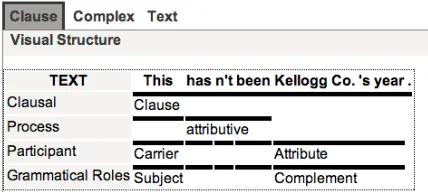
Figure 1: A structured view of a clause in the annotat-ed corpus, taken from the web-basannotat-ed interface.
The Tagger is built on a generic, multifunc-tional database framework compatible with the Annotation Graph (Bird and Liberman, 1999), an abstract annotation framework capable of repre-senting a wide range of common linguistic sig-nals (text, speech, image, video, multimodal in-teractions etc.), with properties particularly suit-ed for collaborative annotation. This generic lay-ered framework lends flexibility to alignment of noncontiguous words and other linguistic re-source, useful for the nonconventional segmenta-tion of funcsegmenta-tional components (such as the com-mon anticipatory ‘it’ as in “It is a good thing that he stepped down as President.”) in SFL.
The Tagger features immediate annotation feedback through visualization, a process known to improve the quality and efficiency of annota-tion. For instance, when tagging at a particular layer (e.g. syntactic structure), information of the other layers (e.g. semantic properties) is immedi-ately visible in a hierarchical structured format. This visualized information serves as additional references to the current layer being annotated, especially when they are closely related in terms of function or meaning. When annotation errors (e.g. misalignment, mismatched labeling) are made they are immediately visible from the an-notation interface for appropriate actions such as deletion or modification to be taken.
3.3 Quality assurance
Annotation quality and consistency are main-tained by standard measures such as online doc-umenting guidelines, trainings and tutorials, and multiple passes. In annotating functional-semantic features, we seek a balance by preserv-ing reasonable alternative interpretations, while striving to reduce annotation errors. A logging and tracking mechanism is introduced that tracks all online activities in real time, for supervisors to review annotation and provide real-time feed-back to annotators for correction and improve-ment.
The tool uses a Wiki-like message board for discussions between annotators and public users, a process known to improve quality of collabora-tive knowledge construction (Kittur and Kraut, 2010). Questions and feedback, along with a set of constantly updated guidelines, are recorded in a version-controlled database to be retrieved whenever needed and to guide new annotators and future annotations where similar scenarios arise. Each change made on the annotation tool is traceable, allowing for rollback at a later time (e.g. in case of a critical error).
functions. In annotating the functional corpus, the boundaries of some of the functional con-cepts are not always clear-cut. For example, apart from the three major functional types of process, material, mental and relational, there are three other types of processes that lie between the boundaries of any two of them: verbal, be-havioral and existential. With such indeterminate boundaries, classification of the process types
can often be difficult (see Section 4 for some examples). For the purpose of preserving alterna-tive interpretations that also reflect the functional diversity of the structure, we choose to preserve multiple annotations of the same components. The annotations are ordered in terms of the per-ceived plausibility, resulting in primary annota-tions and secondary annotaannota-tions that coexist.
Figure 2: A view of the web-based collaborative tagger for annotating the functional and discourse structures of multilingual texts. The web-based interface is divided into three operation panels, namely, the text panel (left),
annotation panel (top right) and visual structure panel (bottom right).
3.4 Corpus Details
We adopt Halliday's seminal works (Halliday, 1994) on the theory to provide standard reference due to the maturity and wide adoption of the works. Specific guidelines on the annotation task are designed in accordance with these reference materials.
In SFL-based analysis, three strata of meaning (called metafunctions) operate in parallel: the ideational, interpersonal, and textual metafunc-tions. As the other two layers are more syntacti-cally oriented and convertible from syntactisyntacti-cally parsed trees, we focus our annotation on the ideational metafunction, and more specifically a major subcategory, the experiential metafunction, whose categorization is largely functionally ori-ented and less lexically/syntactically dependent.
The experiential metafunction, as its name suggests, has to do with functions relating to world experience. Linguistically, it involves a configuration of processes and participants in-volved (such as Actor, Goal), and the accompa-nying circumstances (such as time, place, man-ner). Such configuration allows one to look be-yond the sentence surface to probe into the se-mantic aspect of the text.
The annotation was done in three successive layers, in which each of the following constitu-ents is annotated:
Clausal: clausal boundaries, including bound-aries of embedded clauses. The clause bounda-ries are aligned with the RST Treebank where clausal boundaries are also annotated, with fine-grained changes made to make it more suited for SFL's definitions of clauses.
# of Process Types 1 2 3 4 5 6
# of Verb Types 714 168 37 7 4 2
Table 4: Number of verb types and the number of process types that a verb type has.
We calculate the inter-annotator agreement sta-tistics on the three functional components: Pro-cess types, Participants and Circumstances. We consider agreement to be cases where both the boundaries and types of functional labels are the same. The agreement ratio is 93.78% for Process types, 87.47% for Participants, and 86.13% for Circumstances. The lower agreement in Partici-pants and Circumstances is due to the fact that sometimes the boundaries of the structure that represent these functional components are not universally agreed upon. Although there is defi-nitely still room for improvement, the agreement is already high considering the fact that function-al labels are often inherently more subjective than their lexical/syntactic counterparts.
5
Conclusion & Future work
In this paper, we discuss our work on con-structing a functional corpus based on an influen-tial theoretical framework. We present our iniinfluen-tial attempts at building the corpus on a collaborative annotation platform. Although the scale of the functional corpus is still relatively small, its con-struction has made it possible to study basic functional properties computationally.
As an experiment, a prototypical classification system is built based on the annotated results for automatically classifying the functional pro-cesses of clauses using machine-learning algo-rithms such as Support Vector Machine (Tong and Koller, 2002), results from which are to be presented in another paper. The potential use of the functional corpus is promising, with pro-spects of further developing into an important resource for carrying out fully automated func-tional analysis. The corpus and the experimental classifier will be further employed to build a large-scale functional corpus with substantially less effort. We plan to continue to expand the current corpus before releasing it to the commu-nity for researchers to further explore its poten-tial application in a wide range of areas.
References
Baker, C. F., Fillmore, C. J., & Lowe, J. B. (1998). The berkeley framenet project. In Proceedings of
the 17th international conference on Computa-tional linguistics-Volume 1 (pp. 86–90).
Bird, S., Klein, E., & Loper, E. (2009). Natural lan-guage processing with Python. O’reilly.
Bird, S., & Liberman, M. (1999). Annotation graphs as a framework for multidimensional linguistic data analysis. In Towards Standards and Tools for Discourse Tagging–Proceedings of the Workshop. Carlson, L., & Okurowski, M. (2002). RST discourse
treebank.
Collins, M. (2003). Head-driven statistical models for natural language parsing. Computational linguis-tics.
Gildea, D., & Jurafsky, D. (2002). Automatic Label-ing of Semantic Roles. Computational Linguistics, 28(3), 245–288.
Halliday, M., & Webster, J. (2006). Computational and quantitative studies.
Halliday, Michael A., & Matthiessen, C. M. (2004). An introduction to functional grammar.
Halliday, Michael AK. (1994). An Introduction to Functional Grammar. London: Edward Arnold. Hernault, H., Prendinger, H., DuVerle, D. A., &
Ishi-zuka, M. (2010). HILDA: A Discourse Parser Us-ing Support Vector Machine Classification. Dia-logue & Discourse, 1(3), 1–33.
Honnibal, M., & Curran, J. J. R. (2007). Creating a systemic functional grammar corpus from the Penn treebank. Proceedings of the Workshop on Deep Linguistic Processing - DeepLP ’07, (June 2005), 89.
Kingsbury, P, Palmer, M., & Marcus, M. (2002). Adding semantic annotation to the penn treebank. Proceedings of the Human Language Technology Conference.
Kingsbury, Paul, & Palmer, M. (2002). From Tree-Bank to PropTree-Bank. In LREC.
Kittur, A., & Kraut, R. E. (2010). Beyond Wikipedia: coordination and conflict in online production groups. In Proceedings of the 2010 ACM confer-ence on Computer supported cooperative work (pp. 215–224).
Klein, D., & Manning, C. D. C. (2003). Accurate un-lexicalized parsing. Proceedings of the 41st Annual Meeting on Association for Computational Lin-guistics ACL 03, 1(July), 423–430.
Levin, B. (1993). English verb classes and alterna-tions: A preliminary investigation (Vol. 348). Uni-versity of Chicago press Chicago.
Marcus, M. (1993). Building a large annotated corpus of English: The Penn Treebank. Computational linguistics.
O’Donnell, M. (2008). Demonstration of the UAM CorpusTool for text and image annotation. Pro-ceedings of the 46th Annual Meeting of the Associ-ation for ComputAssoci-ational Linguistics on Human Language Technologies Demo Session - HLT ’08, (June), 13–16.
Orasan, C. (2003). PALinkA: A highly customisable tool for discourse annotation. In Proceedings of the 4th SIGdial Workshop on Discourse and Dialog (pp. 39–43).
Pradhan, S., Ward, W., & Hacioglu, K. (2004). Shal-low semantic parsing using support vector ma-chines. Proceedings of HLT/NAACL, 233.
Prasad, R., Dinesh, N., & Lee, A. (2008). The penn discourse treebank 2.0. Proceedings of the 6th In-ternational Conference on Language Resources and Evaluation (LREC 2008), 2961–2968.
Schuler, K. K. (2005). VerbNet: A broad-coverage, comprehensive verb lexicon.
Teich, E. (1999). Systemic functional grammar in natural language generation: Linguistic description and computational representation.