Each example consists of a grammatical category, a Japanese sample sentence, its reference translation(s), and a yes/no question. Here, the yes/no questions are considered to be checked by human evaluators, not by computers.
Our first test set for Japanese-to-Chinese MT evaluation (AAMT 2008/2009, called “ver. 1” in this paper) was made based on the JEIDA test set (Japanese-to-English version) according to the following steps.
1. Translate the Japanese example sentences into Chinese (where a source sentence partially corresponds to two Chinese sentences).
2. Add a yes/no question checking the quality of the Chinese translation to each sample sentence, according to the grammatical point of the example.
3. Translate the yes/no questions into Chinese.
An example from test set ver. 1 is in Fig. 1.
Grammatical items
Chinese Sentence Sentence No.
Japanese Sentence
Questions (Chinese) Questions (Japanese)
Figure 1: Example of Japanese-to-Chinese test set ver. 1
2.2
Improvement of Test Set
Test set ver. 1 did not contain enough examples; several important Chinese grammatical phenomena could not be checked in the test set because the set was based on a Japanese-to-English test set. For example, the word “not” should be translated as “不 (“bu” in Chinese)” or “没 (“mei” in Chinese)”. Correctly selecting the two words “不” or “没” is important, but this point could not be checked using test set ver. 1. Thus, after review of the test set by Chinese linguists, 251 sentences for 39 newly defined grammatical check points were added to test set ver. 1. The resultant expanded test set is called ver. 2.
Table 1: Size of test set.
Test set Number of sentences Ver. 1 325
The answer to a question is either “Yes” or “No”, and this answer must be consistent. However, when two native Chinese speakers actually evaluate MT systems using the test set, 25.7% of their answers to the questions differ (AAMT 2008/2009). For this reason, most of the questions are considered to be composed of abstract terms. The question in test set ver. 1 “Is the translation of the idiomatic expression appropriate?” is an example of an abstract question. The answer to this type of question depends on the evaluator’s language skills. Thus, the questions newly added to test set ver. 2 were created based on pattern-matching questions such as “Is the expression xxxxx included in the translation?” When test set ver. 2 is applied, the rate of difference between the two evaluators is reduced to 16.1% from 25.7% (Nagase et al. 2009). This indicates that pattern-matching-based questions help to increase the objectivity of evaluations.
2.3
Expansion of Test Set for Automatic Evaluation
The test set we introduce in this section is an approximate test set with test set ver. 2 Thus, it is not logically ensured that the corresponding questions between an approximate test set and test set ver. 2 are completely consistent. As mentioned in section 2.2, the objectivity of evaluations could be increased through using questions that check whether certain words or phrases are included in the translated text. However, if compatible words (synonyms) are not included in the test set, the evaluators judge the text by their own standards. All synonyms and paraphrases must thus be prepared in advance, and they are added to each question in order to achieve a fully automatic evaluation. Examples of questions before and after rewriting are shown in Table 2.
Table 2: Examples of expanded questions.
Original questions Expanded questions
「病気で」が「因为生病」で訳され
ていますか?4
「 病 気 で 」 が 「 因为生 病 」 ま た は 「 由 于 生
病」または「因为毛病」または「由于毛病」
ま た は 「 因为病 」 ま た は 「 由 于 病 」 ま た は
「因病」で訳されていますか?5
「木で」が「用木头」で訳されてい
ますか?6
「木で」が「用木头」または「拿木头」で訳
されていますか?7
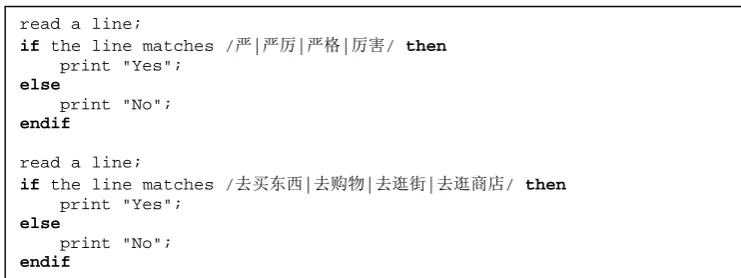
An example of a program (pseudo code) for automatic evaluation is shown in Fig. 2. It represents synonyms and phrases that should exist (or not exist) using regular expressions. Synonyms and paraphrases are exhaustively defined in the program so that an answer to a question is close to a human's evaluation.
One advantage of our method is that tokenization of Chinese sentences, which is required by conventional automatic evaluation methods, is not needed. Chinese word boundaries are very ambiguous and difficult to define, different from in western languages. Therefore, we segmented Chinese sentences by each character to calculate the scores of conventional evaluation metrics in our experiment.
4 Is the phrase “病気で” (byoki-de, [due to illness] ) in Japanese translated as “因为生病” (yin wai sheng bin) in Chinese?
5 Is the phrase “病気で” in Japanese translated as either “因为生病”, “由于生病” (you yu sheng bin), “因为毛病” (yin wai mao bin), “由于毛病” (you yu mao bin), “因为病” (in wai bin), “由于病” (you yu bin), or “因病”’(yin bin) in Chinese?
read a line;
if the line matches /严|严厉|严格|厉害/ then p
else pr endif
read a line;
if the line matches /去买东西|去购物|去逛街|去逛商店/ then p
else
rint "Yes";
pr endif
int "No"; int "No"; rint "Yes";
Figure 2: Pseudo codes for automatic evaluation.
3
Experiments and Discussion
3.1
Experimental Method
In this section, we describe the experiment carried out to verify the effectiveness of our automatic evaluation method proposed in section 2. In this experiment, we used the test set consisting of 251 examples (39 grammatical items) that were added for checking grammatical phenomena specific to Chinese. Using our experimental results, we discuss the performance of our automatic evaluation method from the perspective of correlation with a human's objective evaluations, in comparison with those of traditional automatic evaluation methods. Moreover, we discuss the degree of agreement between our proposed method and a human's evaluation (both being question-based). To discuss the above points, the experiment was carried out as follows.
(1) Manual evaluation by human:
- Manual evaluation by human: 2 people (native Chinese speakers) - Points of evaluation
Adequacy: rating on a 1–5 scale by referring to the source sentence and the translation result
Fluency: rating on a 1–5 scale by referring to the translation result
Question: answering “yes” or “no” to the question by referring to the translation result (2) Automatic evaluation by program:
Conventional automatic evaluation metrics based on characters: BLEU, NIST, WER, PER
Automatic evaluation answering the questions
The two evaluators were native Chinese speakers having linguistic knowledge who had achieved mastery of the Japanese language. Six Japanese-to-Chinese MT systems accessible on the Internet were used as the targets of the experiments. Four out of the six systems use a rule-based MT (RBMT), and two use a statistical MT (SMT).
3.2
Results and Discussion
The coefficients of correlation in every combination were very high (Table 3). The reason could be that the lengths of the source sentences were fairly short, in contrast to those in the normal test sets.
Table 3: Coefficients of correlation between automatic evaluations and conventional subjective evaluations.
Methods Adequacy Fluency
BLEU 0.9453 0.9588
NIST 0.9783 0.9123
WER -0.9801 -0.9267
PER -0.9707 -0.8986
Questions (human) 0.9793 0.9334
Questions (automatic) 0.9902 0.9208
As shown in Tables 3, 4, and 5, our question-based methods highly correlated with subjective evaluations from the viewpoints of fluency and adequacy. The results of a t-test indicate that the correlations between our method and subjective evaluation (fluency and adequacy) achieved statistical significance with a 1% significance level. The correlation coefficients obtained by our methods exceed those of the conventional automatic evaluations. Considering from the above results, our methods may supplement and be a possible alternative to current subjective evaluations. In addition, the performance of our methods compares favorably with that of the conventional automatic evaluations.
Table 4: Frequency distribution of answered pattern (Auto-Human1)
Same Yes-Yes 425 1181 0.784
No-No 756
Different Yes-No 222 325 0.216
No-Yes 103
Table 5: Frequency distribution of answered pattern (Auto-Human2)
Same Yes-Yes 473 1179 0.783
No-No 706
Different Yes-No 174 327 0.217
No-Yes 153
Table 6: Frequency distribution of answered pattern (Human1-Human2)
Same Yes-Yes 456 1264 0.839
No-No 808
Different Yes-No 170 242 0.161
No-Yes 72
Kappa coefficients calculated using the values in Tables 4, 5, and 6. They are all considerably high, exceeding 0.5.
Table 7: Kappa coefficients between automatic and human evaluation-based questions.
Methods Kappa coefficient
Automatic : Human (Evaluator-1) 0.5494 Automatic : Human (Evaluator-2) 0.5552 Human (Evaluator-1) : Human (Evaluator-2) 0.6616
The results of a t-test indicate that the agreement of yes/no answering between the automatic evaluation and human evaluation achieved statistical significance with a 1% significance level. This indicates that the automatic question-based method can be used on behalf of human question-based method although the questions of both methods are not exactly the same.
3.3
Evaluation of Grammatical Achievement of Japanese-to-Chinese MT
Systems
The question-based evaluation method not only enables MT quality to be quantified but also brings out the strengths and weaknesses of a MT system. The scores of the questions in six Japanese-to-Chinese MT systems (labeled A–F) were averaged, where the answers “Yes” and “No” correspond to the scores “1” and “0”, respectively. Figure 3 graphs the evaluation scores with the averages of the six systems according to each grammatical item.
The averages for each system greatly varied among the grammatical items shown in Table 8. For example, most systems were accurate for items No. 9(sentences including “有” (“you” in Chinese)) and No. 10 (adjectival predicates), while almost no systems worked well for items No. 31 (expressions of possibility) and No. 32 (expressions of voluntary) among others. From the low-scored items, there might be problems common among Japanese-to-Chinese MT systems. As a whole, the current Japanese-to-Chinese MT systems are considered to have much room for development because the averages exceeded 0.5 only in 10 items out of the 39.
Comparing the systems, a big difference exists between systems A–D and systems E and F. It is noteworthy that the first- and second-lowest scored systems (E and F) are Statistical MT systems, while the others are rule-based ones. The properties of SMT might limit the improvement of the translation quality. Fifteen and twelve items in systems E and F respectively scored zero, and eleven of these items were the same. In these eleven items, it is possible that the particularly badly scored items, such as No. 15 (expressions of desire), No. 22 (expressions of experience), No. 30 (passive sentences), and No. 37 (“越-越” (“yue-yue” in Chinese) according to “すればするほど” (“sureba suruhodo” in Japanese) phrases) contain characteristic problems of SMT.
From Fig. 3, we can see that system D obtained a high score for almost all the items, but for No. 34 (honorific) and No. 19 (“了” (“la”) and “着” (“zhe” in Chinese) according to “--てい
る”(“--teiru” in Japanese)), the scores were exceptionally below the average for the six systems. In contrast, the scores for systems E and F were relatively bad, but for items No. 16 (prepositions), No. 14 (expressions of permission), and No. 39 (idiomatic phrases), the scores exceeded the average for the six systems.
Table 8: Grammatical items.
1 “的” (de) according to “の” (no) 21 Expressions according to “--ている” (--teiru) 2 “的” (de) according to “Vた” (da) 22 Expressions of experience
3 “的” (de) according to “もの” (mono) 23 Transitive/Intransitive verbs
4 Location words 24 Particles
5 Interrogatives 25 Sentences ending with “のだ” (noda) 6 Negative sentences 26 Sentences including “把” (ba) 7 Selecting “不” (bu) and “没” (mei) 27 Complements
8 Sentences including “在” (zai) 28 Causative Sentences
9 Sentences including “有” (you) 29 Passive sentences using “被” (bei) 10 Adjectival predicates 30 Passive sentences not using “被” (bei) 11 Pivotal sentences 31 Expressions of possibility
12 Verb phrases with two objects 32 Expressions of voluntariness 13 Auxiliary verbs 33 Respectful phrases
14 Expressions of permission (“可以” (keyi)) 34 Honorific expressions
15 Expressions of wish 35 Sentences ending with “ようだ・そう
だ” (youda/souda) 16 Prepositions 36 Expressions of solicitation
17 Expressions of comparison 37 “越-越” (yue-yue) according to “すれば
するほど” (surebasuruhodo) 18 “刚刚” (gang gang) according to “--し
たばかり” (--shitabakari)
38 Prepositions
19 “着” (zhe) “了” (la) according to “ている” (--teiru)
39 Idiomatic phrases
20 Sentences including “了” (la)
4
Conclusion
and Future Work
We proposed a question-based automatic evaluation method that does not depends on languages, validated out our method in Japanese-to-Chinese translation, and showed its effectiveness by the error analysis of existing six translation systems. Our method has high correlation with subjective evaluations by humans, even when only our method is used (which is comparable to conventional automatic evaluation methods and question-based evaluation by humans). We verified that the results of our automatic evaluation method are consistent with that of human evaluation for each question, and clarified that our method can be used for error analysis of grammatical items. In particular, by visualizing the scores for each grammatical item on a graph, valuable information related to the characteristics of each MT system became visible. We are planning to provide a web service that automatically evaluates MT quality and to provide information on the strengths and weaknesses of an MT system through a cobweb chart and others.
The automatization of question-based evaluation yields not only increased efficiency due to the reduced number of evaluators, but also enhanced reliability of the evaluation by improving objectivity. In an evaluation using a question-based method, 16.1% of the answers of two evaluators differed. However, in the case of automatic evaluation, the answers are always the same. Our experiment indicated that a question-based automatic evaluation method could be closer to a human subjective evaluation than a question-based human evaluation.
dramatically enhanced. In addition, the grammatical items, which are useful for error analysis, are also defined by a human. In the future, a method for automatically preparing test sentences, the grammatical items, and their questions should be investigated.
References
AAMT Working Group. 2008. Toward Building of AAMT Test-sets for Quality Evaluation of Machine Translation. AAMT Journal No.42, 18-24.
AAMT Working Group. 2009. Toward Publication of AAMT Test-sets for Quality Evaluation of Machine Translation. AAMT Journal No.45, 29-30.
Banerjee, S. and A. Lavie. 2005. METEOR: An Automatic Metric for MT Evaluation with Improved Correlation with Human Judgments. Proc. of the ACL Workshop on Intrinsic and
Extrinsic Evaluation Measures for Machine Translation and/or Summarization, 65–72.
Birch,. A. and M. Osborne, Reordering Metrics for MT. 2011. Proc. of ACL-HLT, 1027–1035. Doddington G. 2002. Automatic Evaluation of Machine Translation Quality using N-gram
Co-occurrence Statistics. Proc. of HLT, 138–145.
Isahara, H. 1995. JEIDA’s Test-Sets for Quality Evaluation of MT Systems --Technical Evaluation from the Developer’s Point of View--. Proceedings of MT Summit V.
Isozaki, H., T. Hirao, K. Duh, K. Sudoh and H. Tsukada. 2010. Automatic Evaluation of Translation Quality for Distant Language Pairs. Proc. of EMNLP, 944–951.
Melamed, D., Green, R., and Turian, J. P. 2007. Precision and Recall of Machine Translation.
Proc. of NAACL-HLT, 61–63.
Nagase, T., K. Kotani, M. Nagata, N. Hatanaka, Y. Sakamoto, E. Sumita and K. Uchimoto. 2009. Evaliation of Japanese-Chinese MT System using AAMT’s Test-Set. Proc. Of The 5th
China Workshop on Machine Translation, 211-218.
Papineni K., S. Roukos, T. Ward, and W. Zhu. 2002. BLEU: A Method for Automatic Evaluation of Machine Translation. Proc. of ACL, 311–318.
Snover, Matthew., B. Dorr, R. Schwartz, L. Micciulla, and J. Makhoul. 2006. A Study of Translation Edit Rate with Targeted Human Annotation. Proc. of AMTA, 223–231.