Automatic conversion of sentence-end expressions for utterance
characterization of dialogue systems
Chiaki Miyazaki Toru Hirano Ryuichiro Higashinaka Toshiro Makino Yoshihiro Matsuo
NTT Media Intelligence Laboratories 1-1 Hikarinooka, Yokosuka, Kanagawa, Japan
{miyazaki.chiaki, hirano.tohru, higashinaka.ryuichiro, makino.toshiro, matsuo.yoshihiro}@lab.ntt.co.jp
Abstract
Building characters for dialogue agents is im-portant in making the agents more friendly and human-like. To build such characters, utterances suitable for the designated charac-ters are usually manually prepared. However, it is expensive to do this for a large num-ber of utterances for various types of char-acters. We propose a method for automati-cally converting system utterances into those that are characteristic of designated personal attributes, such as gender, age and area of res-idence, to characterize agents. In particular, we focus on converting sentence-end expres-sions, which are considered to greatly affect personal attributes in Japanese. Conversion is done by (i) automatically collecting con-version candidates from various utterances on the Web (e.g., Twitter postings), and (ii) us-ing syntactic and semantic filters to suppress the generation of ill-formed utterances. Ex-perimental results show that our method can convert approximately 95% of utterances into those that are grammatically and semantically acceptable and approximately 90% of utter-ances into those that are perceived to be ac-ceptable for designated personal attributes.
1 Introduction
Dialogue agents, which can carry out various tasks according to user demand, have been gaining in pop-ularity due to their convenience and potential in ca-sual conversations with humans. To make the agents more attractive as conversation partners, characteri-zation is important since it makes the agents more friendly and human-like. Characterization here
means adding particular personal characteristics to agent utterances; for example, adding the character-istics of a particular person (Mizukami et al., 2015), Big Five personalities (Mairesse and Walker, 2007), or personal attributes such as gender, age and area of residence (which is closely related to dialects). To characterize agents, utterances suitable for the desig-nated characteristics are usually manually prepared. However, it is expensive to do this for a large num-ber of utterances.
To reduce this cost, we propose a method for au-tomatically converting utterances into those that are suitable for various characters. In particular, the method automatically modifies ‘how to say it’ (i.e., linguistic expressions) without changing ‘what to say’ (i.e., contents of the utterances). Conversion is done by (i) collecting conversion candidates from various utterances on the Web (e.g., Twitter post-ings), which are annotated with their authors’ per-sonal attributes (this paper deals especially with gen-der, age, and area of residence), and (ii) using syn-tactic and semantic filters to suppress the generation of ill-formed utterances.
The rest of the paper is organized as follows. Section 2 introduces studies related to characteriza-tion, Section 3 discusses the features of Japanese sentence-end expressions, Section 4 presents our method for converting sentence-end expressions, Section 5 shows our experimental results, and Sec-tion 6 concludes the paper and refers to future work.
2 Related work
method for transforming individual characteristics in dialogue agent utterances (Mizukami et al., 2015) and a language generator that can control parame-ters related to speakers’ Big Five personalities (PER-SONAGE) (Mairesse and Walker, 2007) have been proposed. There is also a method for automati-cally adjusting the language generation parameters of PERSONAGE by using movie scripts (Walker et al., 2011) and a method for automatically adjusting the parameters so that they suit characters or stories of role playing games (Reed et al., 2011).
These studies, including ours, share the same mo-tivation to control personal characteristics of utter-ances. However, there have not been any studies on converting utterances from the viewpoint of personal attributes. This is mainly because there has been few resources containing utterances together with the personal attributes of interlocutors. The novelty of our work lies in using Twitter as such a resource to mine sentence-end expressions anchored to par-ticular personal attributes.
3 Sentence-end expressions in Japanese We focus on sentence-end expression since, in Japanese, it is a core element ofrole language (Kin-sui, 2003), which relates to stereotypical or char-acteristic wordings of particular personal attributes such asfeminine languageandyouth language. We assume that converting sentence-end expressions can be effective in modifying the characteristics of agent utterances. For example, though the utter-ances shown below differ only in sentence-end ex-pressions, Japanese native speakers can detect the differences in assumed writer/speaker personal at-tributes.
• gakkoo -ni iki-tai -no -kayo[masculine] • gakkoo -ni iki-tai -no -kashira[feminine] • gakkoo -ni iki-tai -n -kaina[western dialect-like]
In these utterances, function words are marked with ’-’ and those that correspond to sentence-end expressions are in bold. These utterances all convey the meaning that corresponds to ‘Do you want to go to school?’ in English.
We define a sentence-end expression as a se-quence of function words that occurs at the end of a sentence. Function words are those except for con-tent words, such as nouns, verbs, adjectives, and
ad-verbs. The basic role of function words is to de-note relations between words, phrases, and clauses, such as case markers (e.g., subject markers and ob-ject markers) and connectives (i.e., conjunctions and conjunctive particles).
Japanese sentence-end expressions also play an important role in interaction. Japanese sentence-end expressions contain interactional particles (May-nard, 1997), which express speaker judgment and attitude toward the message and the hearer. For instance, ‘ne’ (a marker of the speaker’s assump-tion that he/she has less informaassump-tion than the hearer; an English counterpart would be “isn’t it?”) oc-curs at the end of utterances. In addition, Japanese sentence-end expressions contain auxiliary verbs (e.g., ‘mitai’ (like) and ‘souda’ (it seems)), which express speaker attitudes.
4 Method for converting sentence-end expressions
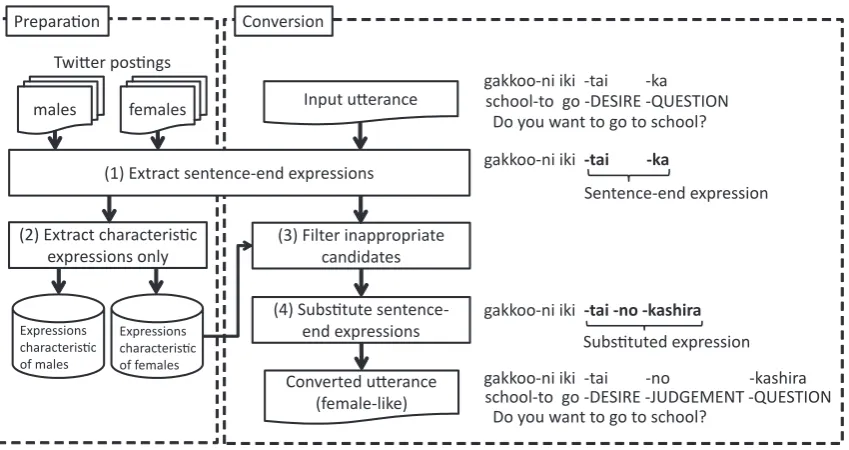
We propose a method for converting sentence-end expressions to characterize dialogue agent utter-ances. Figure 1 shows the process of the sentence-end expression conversion. First, as preparation, sentence-end expressions, which are characteristic of target characters, are collected through processes (1) and (2) shown in Figure 1 (details are given in Section 4.1). Second, each input utterance is processed in process (1) to find a sentence-end ex-pression to be converted. Here, sequences of func-tion words at the end of sentences are detected as sentence-end expressions according to the part-of-speech (POS) tags obtained using a morphological analyzer (Fuchi and Takagi, 1998). Third, through process (3), appropriate candidates to be substituted for the original sentence-end expression are selected using two filters: POS adjacency and semantic label. Finally, a converted utterance whose sentence-end expression is substituted with one of the candidates is generated as an output.
4.1 Extracting characteristic sentence-end
expressions
Figure 1: Flow of sentence-end conversion
Attribute Value # of authors
gender female 810
male 870
age under 40 1070
40 and over 610
area of residence eastern Japan 979 western Japan 701
Table 1: Author attributes and number
4.1.1 Twitter corpus
For collecting sentence-end expressions, which are characteristic of targeted characters, we use a corpus consisting of Twitter postings that are anno-tated with their authors’ personal attributes (Hirano et al., 2013). The corpus includes two million post-ings written by 1680 authors. The annotation of the authors’ personal attributes to the postings was done based on the self-declarations by the authors. The number of authors for each personal attribute-value is shown in Table 1.
4.1.2 Method for extracting characteristic
sentence-end expressions
From each posting of the Twitter corpus, we ex-tract the sequences of function words at the end of the sentences as sentence-end expressions (sen-tences are period-delimited sequences of words). Then, for each expression, we count the numbers of authors who used them. The numbers of authors
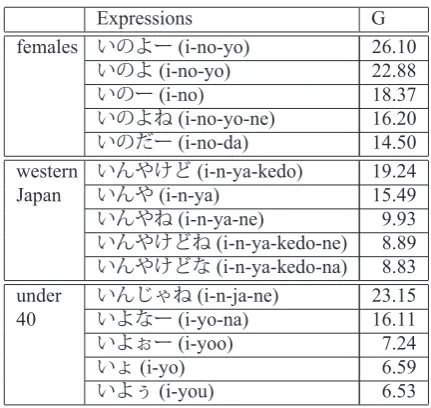
are counted separately according to their gender, age, and area of residence. Table 2 lists examples of sentence-end expressions and number of authors who used the corresponding expressions. Then, to extract characteristic sentence-end expressions, the numbers of authors who used each expression are compared. For example, when extracting expres-sions that are characteristic of female authors, the number of female and male authors who used the expression are compared. With our method, this comparison is done using the G-test. We regard a sentence-end expression as being characteristic of a specific attribute-value if (i) the p-value for the expression is less than a significance level of 5%, which means the number of authors who use the ex-pression is not independent of their attribute, and (ii) if the proportion of authors who used the expression for the specific attribute-value is larger than that for the other value. For example, the expression ‘
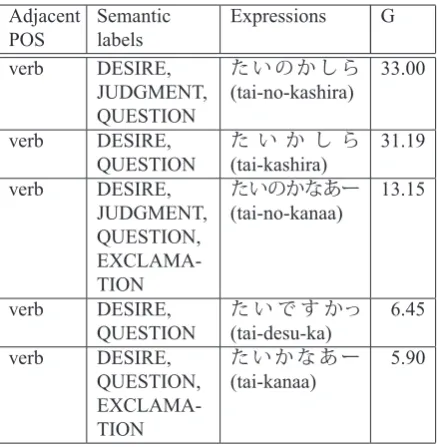
the candidates that are also capable of being adja-cent to verbs can pass the POS adjacency filter. In addition, the input sentence-end expression includes two kinds of semantic labels, DESIRE and QUES-TION. Therefore, only the candidates that also in-clude both labels can pass the semantic label filter. Table 6 lists the examples of the surviving candi-dates that are characteristic of the female attribute.
In the example in Table 6, there are some semantic labels that are not included in the original sentence-end expression, such as JUDGMENT and EXCLA-MATION. Since these labels are not considered with the semantic label filter, it does not matter if they are included in the candidates.
5 Experiments
We conducted two experiments to investigate the performance of our proposed method of converting sentence-end expressions. In particular, we asked a subject to score the converted utterances from the two perspectives of (i) grammatical and semantic ac-ceptability, and (ii) appropriateness for desired per-sonal attributes. The subject was a person who had been working as a linguistic annotator for more than three years. To evaluate inter-rater agreement, we also asked another subject to rate half the utterances.
5.1 Data for collecting conversion candidates
and testing
For collecting candidates to be used for conversion, we used the Twitter corpus introduced in Section 4.1.1. The target personal attributes (and values) were gender (male/female), age (under 40/40 and over), and area of residence (eastern/western Japan), and the number of authors for each attribute-value is shown in Table 1.
As input utterances, we used 100 Japanese ut-terances, which were randomly extracted from a database consisting of manually created utterances (in the form of text) for a dialogue system, which we created. Examples of input utterances are shown below.
suizokukan-ga daisuki-desu ’I like aquariums very much.’
uranai-tte shinji-masu-ka? ’Do you believe in astrology?’
anata-no heya-kara hoshi-ga mie-masu-ka? ’Can you see stars from your window?’
These utterances were converted so that they would be characterized with six different personal attributes, i.e., male, female, under 40, 40 and over, living in eastern Japan, and living in west-ern Japan. Though various sentence-end expressions were collected as the conversion candidates, we used only one expression whose G-value was the highest among the candidates.
5.2 Procedure and evaluation indices
We randomly presented the converted utterances and the original input utterances to the subjects and asked them to score the utterances regarding the fol-lowing two aspects.
Grammatical and semantic acceptability
Whether an utterance is acceptable in Japanese with respect to grammar and meaning (1: very unacceptable - 5: very acceptable).
Character acceptability Whether an utterance is
acceptable regarding a desired characteristic (1: very unacceptable - 5: very acceptable).
Since it is difficult to clearly separate acceptabil-ity of grammar from semantics, we evaluated them together. We calculated the inter-rater agreement rate as the percentage of utterances for which the two subjects gave identical judgments.
5.3 Results
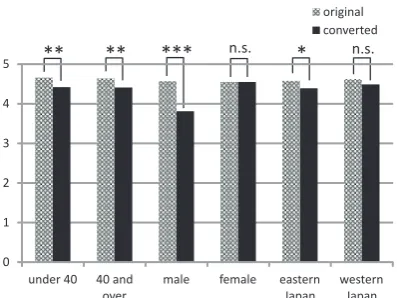
significantly higher than those of the original utter-ances (paired samples t-test; p<0.05) except for the case of 40 and over. In particular, the scores for the cases of under 40, male, female, and western Japan drastically improved (by approximately 0.8-2.0 points) due to the conversion.
Moreover, for the cases of female and western Japan, there were no significant differences in the average scores of grammatical and semantic accept-ability between before and after conversion accord-ing to paired samples t-test. For the cases of the other attributes, the average scores of grammati-cal and semantic acceptability of the converted ut-terances were significantly lower than those of the original utterances (paired samples t-test; p<0.05). However, the average scores exceeded 4 (accept-able) except for the case of male. Therefore, we argue that our proposed method can convert utter-ances without severe malformation of grammar and semantics.
Tables 7 and 8 show the breakdown of scores of the two evaluation indices. For the evaluation of grammatical and semantic acceptability, unaccept-able utterances scored 1 (very unacceptunaccept-able) or 2 (unacceptable) were only 5% or less (The inter-rater agreement rate was 95% when distinguishing un-acceptable utterances (2 or below) from un-acceptable ones) except for the case of male. For the evalua-tion of characteristic acceptability, the average per-centage of unacceptable utterances scored 1 or 2 was 10%, which we believe is good (the inter-rater agreement rate was 85% when distinguishing un-acceptable utterances (2 or below) from un-acceptable ones). However, unacceptable utterances of 40 and over and western Japan scored 1 or 2 exceeded 20%. Considering the practical use in dialogue systems, the results suggest that utterances that are not appro-priate for a designated attribute are generated in ap-proximately one in five utterances. Thus, we believe that the characterization is still not sufficient for cer-tain personal attributes, and further investigation and improvement are needed.
6 Conclusion and future work
To build characters for dialogue agents, we proposed a method for automatically converting sentence-end expressions. Our contributions are as follows:
Figure 2: Average scores of grammatical and semantic acceptability
Figure 3: Average scores of character acceptability
% of utts. for each score
1 2 3 4 5
under 40 3% 2% 1% 38% 56%
40 and over 2% 1% 8% 32% 57%
male 10% 13% 7% 26% 44%
female 2% 0% 4% 29% 65%
eastern Japan 3% 1% 7% 32% 57% western Japan 2% 3% 4% 26% 65%
Table 7: Breakdown of scores of grammatical and seman-tic acceptability
% of utts. for each score
1 2 3 4 5
under 40 1% 3% 9% 71% 16%
40 and over 2% 28% 31% 39% 0%
male 0% 2% 16% 41% 41%
female 0% 0% 21% 52% 27%
eastern Japan 0% 0% 3% 15% 82%
western Japan 12% 11% 34% 0% 43%