Fast and Large-scale Unsupervised Relation Extraction
Sho Takase† Naoaki Okazaki†‡ Kentaro Inui† Graduate School of Information Sciences, Tohoku University†
Japan Science and Technology Agency (JST)‡
{takase, okazaki, inui}@ecei.tohoku.ac.jp
Abstract
A common approach to unsupervised relation extraction builds clusters of patterns express-ing the same relation. In order to obtain clus-ters of relational patterns of good quality, we have two major challenges: the semantic rep-resentation of relational patterns and the scal-ability to large data. In this paper, we ex-plore various methods for modeling the mean-ing of a pattern and for computmean-ing the similar-ity of patterns mined from huge data. In order to achieve this goal, we apply algorithms for approximate frequency counting and efficient dimension reduction to unsupervised relation extraction. The experimental results show that approximate frequency counting and dimen-sion reduction not only speeds up similarity computation but also improves the quality of pattern vectors.
1 Introduction
Semantic relations between entities are essential for many NLP applications such as question an-swering, textual inference and information extrac-tion (Ravichandran and Hovy, 2002; Szpektor et al., 2004). Therefore, it is important to build a compre-hensive knowledge base consisting of instances of semantic relations (e.g., authorOf) such asauthorOf
⟨Franz Kafka, The Metamorphosis⟩. To recognize these instances in a corpus, we need to obtain pat-terns (e.g., “X write Y”) that signal instances of the semantic relations.
For a long time, many researches have targeted at extracting instances and patterns of specific rela-tions (Riloff, 1996; Pantel and Pennacchiotti, 2006;
De Saeger et al., 2009). In recent years, to acquire a wider range knowledge, Open Information Extrac-tion (Open IE) has received much attenExtrac-tion (Banko et al., 2007). Open IE identifies relational patterns and instances automatically without predefined tar-get relations (Banko et al., 2007; Wu and Weld, 2010; Fader et al., 2011; Mausam et al., 2012). In other words, Open IE acquires knowledge to han-dle open domains. In Open IE paradigm, it is nec-essary to enumerate semantic relations in open do-mains and to learn mappings between surface pat-terns and semantic relations. This task is called unsupervised relation extraction (Hasegawa et al., 2004; Shinyama and Sekine, 2006; Rosenfeld and Feldman, 2007).
We have two major challenges in computing the similarity of patterns. First, it is not clear how to represent the semantic meaning of a relational tern. Previous studies define a feature space for pat-terns, and express the meaning of patterns by using such as the co-occurrence statistics between a pat-tern and an entity pair, e.g., co-occurrence frequency and pointwise mutual information (PMI) (Lin and Pantel, 2001). Some studies employed vector repre-sentations of a fixed dimension, e.g., Principal Com-ponent Analysis (PCA) (Collins et al., 2002) and La-tent Dirichlet Allocation (LDA) (Yao et al., 2011; Riedel et al., 2013). However, the previous work did not compare the effectiveness of these represen-tations when applied to a collection of large-scaled unstructured texts.
Second, we need design a method scalable to a large data. In Open IE, we utilize a large amount of data in order to improve the quality of unsupervised relation extraction. For this reason, we cannot use a complex and inefficient algorithm that consumes the computation time and memory storage. In this paper, we explore methods for computing pattern similarity of good quality that are scalable to huge data, for example, with several billion sentences. In order to achieve this goal, we utilize approximate frequency counting and dimension reduction. Our contributions are threefold.
• We build a system for unsupervised relation ex-traction that is practical and scalable to large data.
• Even though the proposed system introduces approximations, we demonstrate that the sys-tem exhibits the performance comparable to the one without approximations.
• Comparing several representations of pattern vectors, we discuss a reasonable design for rep-resenting the meaning of a pattern.
2 Methods
2.1 Overview
As mentioned in Section 1, semantic representations of relational patterns is key to unsupervised rela-tion extracrela-tion. Based on the distriburela-tional hypoth-esis (Harris, 1954), we model the meaning of a
re-lational pattern with a distribution of entity pairs co-occurring with the pattern. For example, the mean-ing of a relational pattern “X write Y” is represented by the distribution of the entity pairs that fills the variables (X, Y) in a corpus. By using vector repre-sentations of relational patterns, we can compute the semantic similarity of two relational patterns; for ex-ample, we can infer that the patterns “X write Y” and “X is author of Y” present the similar meaning if the distribution of entity pairs for the pattern “X write Y” is similar to that for the pattern “X is author of Y”.
Researchers have explored various approaches to vector representations of relational patterns (Lin and Pantel, 2001; Rosenfeld and Feldman, 2007; Yao et al., 2011; Riedel et al., 2013). The simplest ap-proach is to define a vector of a relational pattern in which an element in the vector presents the co-occurrence frequency between a pattern and an en-tity pair. However, the use of raw frequency counts may be inappropriate when some entity pairs co-occur with a number of patterns. A solution to this problem is to use a refined co-occurrence measure such as PMI (Lin and Pantel, 2001). In addition, we may compress a vector representation with a dimen-sionality reduction method such as PCA because pattern vectors tend to be sparse and high dimen-sional (Yao et al., 2011; Riedel et al., 2013).
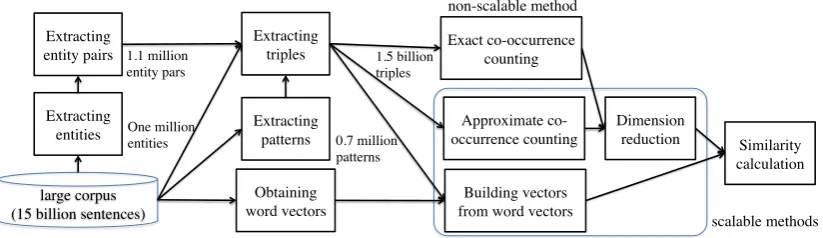
Meanwhile, it may be difficult to implement the above procedures that can handle a large amount of data. Consider the situation where we find 1.1 million entity pairs and 0.7 million relational pat-terns from a corpus with 15 billion sentences. Even though the vector space is sparse, we need to keep a huge number of frequency counts that record co-occurrences of the entity pairs and relational patterns in the corpus.
large corpus (15 billion sentences)
Extracting entities Extracting entity pairs
Extracting patterns
Obtaining word vectors
One million entities 1.1 million entity pars
0.7 million patterns
Extracting
triples 1.5 billion triples
Exact co-occurrence counting non-scalable method
Dimension
reduction Similarity calculation Approximate
co-occurrence counting
Building vectors from word vectors
scalable methods
Figure 1: Overview of the system for unsupervised relation extraction
Figure 1 illustrates the overview of the system of unsupervised relation extraction presented in this paper. We extract a collection of triples each of which consists of an entity pair and a relational pat-tern (Section 2.2). Because this step may extract meaningless triples, we identify entity pairs and re-lational patterns occurring frequently in the corpus. We compute co-occurrence statistics of entity pairs and relational patterns to obtain pattern vectors. Sec-tion 2.3 describes this process, followed by an on-line variant of PCA in Section 2.4. Furthermore, we present two approaches that improve the scalability to large data in Section 2.5.
2.2 Extracting triples
In this study, we define a triple as a combination of an entity pair and a relational pattern that con-nects the two entities. In order to extract meaningful triples from a corpus, we mine a set of entities and relational patterns in an unsupervised fashion.
2.2.1 Extracting entities
We define an entity mention as a sequence of nouns. Because quite entity mentions consist of two or more nouns (e.g., “Roadside station” and “Franz Kafka”), we adapt a simple statistical method (Mikolov et al., 2013) to recognize noun phrases. Equation 1 com-putes the score of a noun bigramwiwj,
score(wi, wj) = cor(wi, wj)∗dis(wi, wj), (1)
cor(wi, wj) = logff((wwi,wj)−δ
i)×f(wj), (2)
dis(wi, wj) = f(fw(wi,wj)
i,wj)+1
min{f(wi),f(wj)}
min{f(wi),f(wj)}+1.(3)
Here,f(wi) denotes the frequency of the nounwi,
and f(wi, wj) does the frequency of the noun
bi-gramwiwj. The parameterδ is a constant value to
remove infrequent noun sequences. Consequently,
cor(wi, wj)represents the degree of the connection
betweenwiandwj. However,cor(wi, wj)becomes
undesirably large if eitherf(wi)orf(wj) is small.
We introduce the functiondis(wi, wj)to ‘discount’
such sequences.
We form noun phrases whose scores are greater than a threshold. In order to obtain noun phrases longer than two words, we run the procedure four times, decreasing the threshold value1. In this way, we can find, for example, “Franz Kafka” as an en-tity in the first run and “Franz Kafka works” in the second run. After identifying a set of noun phrases, we count the frequency of the noun phrases in the corpus, and extract noun phrases occurring no less than 1,000 times as a set of entities.
2.2.2 Extracting entity pairs
After determining a set of entities, we discover en-tity pairs that may have semantic relationships in or-der to locate relational patterns. In this study, we extract a pair of entities if the entities co-occur in more than 5,000 sentences. We denote the set of en-tity pairs extracted by this procedureE.
2.2.3 Extracting patterns
As a relational pattern, this study employs the short-est path between two entities in a dependency tree, following the previous work (Wu and Weld, 2010; Mausam et al., 2012; Akbik et al., 2012). Here, we introduce a restriction that a relational pattern must include a predicate in order to reject
semantically-1The threshold values are 10 (first time), 5 (second time),
•
a
Metamorphosis
wrote The in Germany.
Kafka
nsubj
prep_in dobj
det
entity
X wrote Y
dobj nsubj
X wrote Y
prep_in nsubj
X wrote Y
prep_in dobj
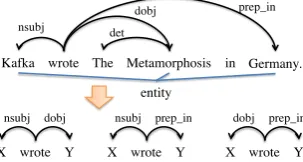
Figure 2: Example of parsed sentence and extracting pat-terns
ambiguous patterns such as “X of Y”. Addition-ally, we convert an entity into a variable (i.e., X or Y). Consider the sentence shown in Figure 2 as an example. An arrow between words expresses a dependency relationship. This sentence contains three entities: “Kafka”, “The Metamorphosis” and “German”. Therefore, we obtain three patterns, “X
nsubj
←−−−wrote−−→dobj Y”, “X←−−−nsubj wrote−−−−→prep in Y” and “X←−−dobj wrote−−−−→prep in Y”2. Counting the fre-quency of a pattern, we extract one appearing no less than 1,500 times in the corpus. We denote the set of relation patternsP hereafter.
2.3 Building pattern vectors
We define a vector of a relational pattern as the dis-tribution of entity pairs co-occurring with the pat-tern. Processing the whole collection of the corpus, we extract mentions of triples(p, e), p ∈ P, e ∈E. For example, we obtain a triple,
p= X←−−−nsubj wrote−−→dobj Y,
e= ⟨“Franz Kafka”,“The Metamorphosis”⟩,
from the sentence “Franz Kafka wrote The Meta-morphosis.” The meaning of the pattern p is rep-resented by the distribution of the entity pairs co-occurring with the pattern.
In this study, we compare two statistical measures of co-occurrence: the raw frequency (FREQ) and PMI (PMI). In FREQsetting, a relational pattern p is represented by a vector whose elements present the frequency of co-occurrencesf(p, e)of every
en-2In the experiments, we use a collection of Japanese Web
pages. However, we explain the procedure with an English sen-tence because the procedure for extracting patterns is universal to other languages.
tity pair e ∈ E. PMI refines the strength of co-occurrences with this equation,
PMI(p, e) = log
f(p,e)
M
Σi∈Pf(i,e)
M
Σj∈Ef(p,j)
M
×dis(p, e).
(4) Here, f(p, e) presents the frequency of co-occurrences between a pattern pand an entity pair e; and M = ∑Pi ∑Ej f(i, j). The discount factor
dis(p, e) is defined similarly to Equation 3. In PMI setting, we set zero to the value for an entity paire ifPMI(p, e)<0.
2.4 Dimensionality reduction for pattern vectors
The vector space defined in Section 2.3 is extremely high dimensional and sparse, encoding all entity pairs as separate dimensions. The space may be too sparse to represent the semantic meaning of re-lational patterns; for example, entity pairs (“Franz Kafka”, “the Metamorphosis”) and (“Kafka”, “the Metamorphosis”) present two different dimension even though “Franz Kafka” and “Kafka” refer to the same person. In addition, we need an associative ar-ray to compute the similarity of two sparse vectors.
In order to map the sparse and high dimensional space into a dense and compact space, we use Prin-cipal Component Analysis(PCA). In essence, PCA is a statistical procedure that finds principal compo-nents and scores of a matrix. PCA is closely related toSingular Value Decomposition(SVD), which fac-tors anm×nmatrixAwith,
A=UΣVt. (5) Here, U is an m ×m orthogonal matrix,V is an n×northogonal matrix andΣis anm×n diago-nal matrix storing singular values. Each column of
V corresponds to a principal component, and each column ofUΣcorresponds to a score of a principal component ofA.
Algorithm 1Space saving for each pattern
Input: N: counter size for each pattern
Input: D: a set of triples(p, e) Output: cp,e: counter for each patternp
1: for all(p, e)∈Ddo
2: ifTpdoes not existthen 3: Tp← ∅
4: end if
5: ife∈Tpthen 6: cp,e←cp,e+ 1 7: else if|Tp|< Nthen 8: Tp←T∪ {e} 9: cp,e←1 10: else
11: i←argmini∈Tpcp,i 12: cp,e←cp,i+ 1 13: Tp←T∪ {e} \ {i} 14: end if
15: end for
The goal of this algorithm is to find anr×nmatrix
Bstoring the compressed information of the rows of
A. We first draw ann×rGaussian random matrix
Ω. Next, we derive them×rmatrixY =AΩ. We next construct an m×r matrixQwhose columns form an orthonormal basis for the range ofY. Here,
QQtA≈Ais satisfied. Finally, we obtain the ma-trixB=QtA, in whichQtcompresses the rows of
A.
We compute principal component scores forr di-mensions by applying SVD toB. The computation is easy because r ≪ m. In this study, we used redsvd3, an implementation of Halko et al. (2011). We represents the meaning of a pattern with the scores ofrprinciple components.
2.5 Improving the scalability to large data
As described previously, it may be difficult and inef-ficient to count the exact numbers of co-occurrences from a large amount of data. In this study, we ex-plore two approaches: approximate counting (Sec-tion 2.5.1) and distributed representa(Sec-tions of words (Section 2.5.2).
2.5.1 Approximate counting
We may probably not need exact counts of co-occurrences for representing pattern vectors because a small amount of elements in a pattern vector
3https://code.google.com/p/redsvd/wiki/
English
greatly influence the similarity computation. In other words, it may be enough to find top-k entity pairs with larger counts of co-occurrences for each pattern, and to ignore other entity pairs with smaller counts. The task of finding top-kfrequent items has been studied extensively as approximate counting algorithms.
We employSpace Saving(Metwally et al., 2005), which is the most efficient algorithm to obtain top-k frequent items. Algorithm 1 outlines the Space Sav-ing algorithm adapted for countSav-ing frequencies of co-occurrences. The space saving algorithm main-tains at mostN counters of co-occurrences for each patternp.
For each triple(p, e), wherepandepresent a pat-tern and an entity pair, respectively, the algorithm checks if the co-occurrence count for the triple(p, e)
is available or not. If it is available (Line 5), we in-crement the counter as usual (Line 6). If it is unavail-able but the number of counters kept for the pattern is less thanN(Line 7), we initialize the counter with one (Lines 8 and 9). If the count is unavailable and if the pattern has already maintainedNcounters, the algorithm removes a countercp,iwith the least value,
and creates a new counter for the entity pairewith the approximated countcp,i+ 1(Lines 11–13).
This algorithm has the nice property that the error of the frequency count of a frequent triple is within a range specified by the number of countersN. In ad-dition, Metwally et al. (2005) describes a data struc-ture for finding the least frequent triple efficiently in Line 11. We can obtain the frequency counts of the top-k frequent triples if we set the number of countersN much larger thank. In this way, we can find the frequency count of the top-kfrequent triple f(p, e)approximately, and assume frequency counts of other triples zero.
2.5.2 Building pattern vectors from word vectors
A number of NLP researchers explored approaches to representing the meaning of a word with fixed-length vectors (Bengio et al., 2003; Mikolov et al., 2013). In particular, word2vec4, an implementation of Mikolov et al. (2013), received much attention in the NLP community.
4
Switching our attention to the pattern feature vec-tor, our goal is to express the semantic meaning of a relational pattern with a distribution of entity pairs. Here, we explore the use of low-dimensional word vectors learned by word2vec from the large corpus: the meaning of a pattern is represented by the distri-bution of entity vectors. Thus, we obtain the vector representation of a relational patternp,
p=∑
e∈E
f(p, e)
[
ve0
ve1
]
. (6)
Here,ve0 denotes the vector for an entitye0 in the
entity paire, andve1 does the vector for another
en-titye1in the paire.
3 Experiments 3.1 Data
For our experimental corpus, we collected 15 bil-lion Japanese sentences by crawling web pages. To remove noise such as spam and non-Japanese sen-tences, we apply a filter that checks the length of a sentence, determines whether the sentence contains a specific character in Japanese (hiragana), and then checks the number of symbols. As a result of fil-tering, we obtained 6.3 billion sentences. We then parsed these sentences using Cabocha5, a Japanese dependency parser. For preprocessing, we extracted 1 million entities, 1.1 million entity pairs, and 0.7 million patterns. Finally, we extracted about 1.5 bil-lion triples from the corpus.
We then manually checked some of the pattern pairs extracted from Wikipedia that were also con-tained within the 6.3 billion sentence corpus. Specif-ically, we first extracted frequent patterns from some domains in Wikipedia for obtaining the patterns rep-resenting a specific relation. We selected patterns re-ferring to an illness, an author, and an architecture as target domains. Next, we gathered patterns sharing many entity pairs because these patterns may rep-resent the same relation. We obtained 527 patterns and 4,531 pattern pairs. Four annotators classified these pairs into the same relation or not. We then randomly sampled 90 pairs and found an average of 0.63 for the Cohen’s kappa value for two annotators. We annotated the 4,531 pairs by two or more anno-tators. Therefore, if two or more annotators labeled
5
https://code.google.com/p/cabocha/
a pair with the same relation, we regarded the pair as the same relation. Finally, we acquired 720 pairs ex-pressing the same relation. We applied each method to 4,531 pairs and we identified patterns with higher than threshold. We investigated whether the pair is included in the same relation pairs.
3.2 Experimental settings
We evaluated the quality of pattern vectors build by the proposed approaches on the similarity calcula-tion. Concretely, we investigated the impact on ac-curacy and computation time. For the evaluation, we computed the cosine similarity based on the feature vectors obtained by each method. We compared the following methods.
Exact counting (baseline): We counted the co-occurrence frequency between an entity pair and a pattern in triples using a machine with 256GB of memory (EXACT-FREQ). In addition, we calcu-lated PMI defined in equation 4 based on the co-occurrence frequency (EXACT-PMI).
Exact counting + PCA: Using PCA, we converted EXACT-FREQ and EXACT-PMI into the fixed di-mensional vector FREQ+PCA and EXACT-PMI+PCA. We determined the number of dimen-sions as 1,024 based on comparisons6between 256, 512, 1,024, and 2,048.
Approximate counting: We counted the co-occurrence frequency using approximate counting explained in Section 2.5.1 (APPROX-FREQ). The counter size N was 10,240 and we used the top 5,120 frequent entity pairs as a feature. Moreover, we obtained PMI based on the result of approximate counting (APPROX-PMI).
Approximate counting + PCA: Using PCA, we converted APPROX-FREQ and APPROX-PMI into the fixed dimensional vector APPROX-FREQ+PCA and APPROX-PMI+PCA. Similar to Exact counting + PCA, we selected the dimension of feature vectors as 1,024.
Exact counting + word2vec: We obtained pat-tern feature vectors using the result of word2vec (EXACT-FREQ+WORD2VEC). Moreover, instead of calculating the feature vector by co-occurrence frequency, we weight the entity vector with PMI
6
Figure 3: Precision and recall of each method
(EXACT-PMI+WORD2VEC). We trained word2vec using all entities, verbs, and adverbs in the corpus on four AMD Opteron 6174 processors (12-core, 2.2GHz). It took about 130 hours to train word2vec (the number of threads was 42 and window size was 5). Similar to PCA, we selected the dimension of each word vector as 512: namely, the dimension of pattern vectors was 1,024 because of concatenating.
3.3 Evaluating accuracy of each method
Figure 3 shows the precision and recall of each method. We illustrated this graph by changing the threshold value. We focus attention on the difference between exact counting and approximate count-ing. These results of EXACT-FREQ and APPROX-FREQ were about the same. On the other hand, APPROX-PMI outperformed EXACT-PMI in most areas. These results demonstrated that approximate counting is enough to compute co-occurrence fre-quency between a pattern and an entity pair. The results also suggest that approximate counting pos-sibly improves the performance.
Comparing the results with PCA and without PCA, the figure shows that PCA does not always improve the performance. However, APPROX-PMI+PCA achieved the best performance in most areas. For computation time, we verify that PCA is important in this aspect.
In contrast, feature vectors based on word2vec worsened the performance against not only approxi-mate counting but also exact counting. Although we expected that the vector formed by word2vec was appropriate for representing the meaning of a pat-tern, EXACT-FREQ+WORD2VECwas worse than all the other methods in Figure 3. We suspect that this
Method 10k 100k all (664k)
EXACT-PMI 55m 121hr 8,499hr
APPROX-PMI 38m 110hr 7,441hr
APPROX-PMI+PCA 4m 7hr 785hr
Table 1: Similarity calculation time of each method with one thread
result was caused by separating entity pairs into en-tities in feature generation. Concretely, for obtaining pattern feature vectors using word2vec, we concate-nate the sum of vectors assigned to one side of entity pairs and the ones assigned to the other side. There-fore, there is a possibility that we obtain pattern pairs with a high similarity when both of the patterns con-tain one of the same entity types. In other words, we need to encode not entities separately but maintain-ing entity pair as a pattern feature vector.
From Figure 3, approximate counting is effective for the similarity calculation. In addition, PCA is useful for representing the meaning of a pattern in the compact space.
3.4 Evaluating computation time
Table 1 demonstrates the similarity calculation time of EXACT-PMI, PMI and APPROX-PMI+PCA for processing 10k patterns, 100k pat-terns, and 664k patterns (the maximum). We ex-ecuted a program written in C++ on four AMD Opteron 6174 processors (12-core, 2.2GHz) with 256GB of the memory. We measured the calculation time using a single thread. Note that, we split the calculation targets and predicted computation time based on the result of division and split number, be-cause much time is required to complete the calcu-lation for 100k and 664k patterns. For 100k pat-terns, we split the calculation targets into 48 groups. For 664k pattern, we split the calculation targets into 4,096 groups.
would take 7,441 hours (about a year) to calculate all pattern similarity with one thread. We conclude that it is necessary to prepare low dimensional fea-ture vectors using dimension reduction or word vec-tors for completing similarity calculation in a realis-tic time.
4 Related work
Unsupervised relation extraction poses three major challenges: extraction of relation instances, repre-senting the meaning of relational patterns, and ef-ficient similarity computation. A great number of studies proposed methods for extracting relation in-stances (Wu and Weld, 2010; Fader et al., 2011; Fader et al., 2011; Akbik et al., 2012). We do not describe the detail of these studies, which are out of the scope of this paper.
Previous studies explored various approaches to represent the meaning of relational patterns (Lin and Pantel, 2001; Yao et al., 2012; Mikolov et al., 2013). Lin and Pantel (2001) used co-occurrence statistics of PMI between an entity and a relational pattern. Even though the goal of their research is not on re-lation extraction but on paraphrase (inference rule) discovery, the work had a great impact to the re-search on unsupervised relation extraction. Yao et al. (2012) modeled sentence themes and document themes by using LDA, and represented the mean-ing of a pattern with the themes together with the co-occurrence statistics between patterns and enti-ties. Recently, methods inspired by neural language modeling received much attentions for representa-tion learning (Bengio et al., 2003; Mikolov et al., 2010; Mikolov et al., 2013). In this study, we com-pared the raw frequency counts, PMI, and word em-beddings (Mikolov et al., 2013).
In order to achieve efficient similarity computa-tion, some researchers used entity types, for exam-ple, “Franz Kafka” as a co-referent of writer(Min et al., 2012; Nakashole et al., 2012). Min et al. (2012) obtained entity types by clustering enti-ties in a corpus. When computing the similarity val-ues of patterns, they restricted target pattern pairs to the ones sharing the same entity types. In this way, they reduced the number of similarity compu-tations. Nakashole et al. (2012) also reduced the number of similarity computations by using entity
types obtained from existing knowledge bases such as Yago (Suchanek et al., 2007) and Freebase (Bol-lacker et al., 2008). However, it is not so straightfor-ward to determine the semantic type of an entity in advance because the semantic type may depends on the context. For example, “Woody Allen” stands for an actor, a movie director, or a writer depending on the context. Therefore, we think it is also important to reduce the computation time for pattern similar-ities by simplifying the semantic representation of relational patterns.
The closest work to ours is probably Goyal et al. (2012). Their paper proposes to use algorithms of count-min sketch (approximate counting) and ap-proximate nearest neighbor search for NLP tasks. They applied these techniques for obtaining feature vectors, reducing the dimension of the vector space, and searching similar items to a query. Even though they demonstrated the efficiency of the algorithms, they did not demonstrate the effectiveness of the ap-proach in a specific NLP task.
5 Conclusion
In this paper, we presented several approaches to unsupervised relation extraction on a large amount of data. In order to handle large data, we ex-plored three approaches: dimension reduction, ap-proximate counting, and vector representations of words. The experimental results showed that ap-proximate frequency counting and dimension reduc-tion not only speeds up similarity computareduc-tion but also improved the quality of pattern vectors.
The use of vector representation of words did not show an improvement. This is probably because we need to learn a vector representation specialized for patterns that encode the distributions of entity pairs. A future direction of this research is to es-tablish a method to learn the representations of pat-terns jointly with the representations of words. Fur-thermore, it would be interesting to incorporate the meaning of constituent words of a pattern into the representation.
Acknowledgments
Sebastian Riedel, Limin Yao, Andrew McCallum, and Benjamin M. Marlin. 2013. Relation extraction with matrix factorization and universal schemas. In Pro-ceedings of the Main Conference on Human Language Technology Conference of the North American Chap-ter of the Association of Computational Linguistics (HLT-NAACL2013), pages 74–84.
Ellen Riloff. 1996. Automatically generating extraction patterns from untagged text. In Proceedings of the 13th National Conference on Artificial Intelligence -Volume 2 (AAAI96), pages 1044–1049.
Benjamin Rosenfeld and Ronen Feldman. 2007. Clus-tering for unsupervised relation identification. In Pro-ceedings of the Sixteenth ACM Conference on Con-ference on Information and Knowledge Management (CIKM2007), pages 411–418.
Yusuke Shinyama and Satoshi Sekine. 2006. Preemp-tive information extraction using unrestricted relation discovery. In Proceedings of the Main Conference on Human Language Technology Conference of the North American Chapter of the Association of Com-putational Linguistics (HLT-NAACL2006), pages 304– 311.
Fabian M. Suchanek, Gjergji Kasneci, and Gerhard Weikum. 2007. Yago: A core of semantic knowledge. In Proceedings of the 16th International Conference on World Wide Web (WWW 2007), pages 697–706. Idan Szpektor, Hristo Tanev, Ido Dagan, and Bonaventura
Coppola. 2004. Scaling web-based acquisition of en-tailment relations. InProceedings of the 2004 Confer-ence on Empirical Methods in Natural Language Pro-cessing (EMNLP2004), pages 41–48.
Fei Wu and Daniel S. Weld. 2010. Open information extraction using wikipedia. InProceedings of the 48th Annual Meeting of the Association for Computational Linguistics (ACL2010), pages 118–127.
Limin Yao, Aria Haghighi, Sebastian Riedel, and Andrew McCallum. 2011. Structured relation discovery using generative models. InProceedings of the 2011 Confer-ence on Empirical Methods in Natural Language Pro-cessing (EMNLP2011), pages 1456–1466.