Annotating article errors in Spanish learner texts:
design and evaluation of an annotation scheme
Mar´ıa del Pilar Valverde Iba˜nez
Faculty of Foreign Languages
Aichi Prefectural University
1522-3 Ibaragasama, Nagakute-shi
Aichi, 480-1198, Japan
[email protected]
Akira Ohtani
Faculty of Informatics
Osaka Gakuin University
2-36-1 Kishibe-minami, Suita-shi
Osaka, 564-8511, Japan
[email protected]
Abstract
Annotating a corpus with error information is a challenging task. This paper describes the design, evaluation and refinement of an an-notation scheme for Spanish article errors in learner data, so that future work on corpus an-notation and automatic article error detection can progress. To evaluate reliability, 300 noun phrases with definite, indefinite and zero arti-cle have been tagged by four annotators. We analysed different types of disagreement, pre-sented suggestions to increase reliability and applied the refined annotation scheme to cre-ate a gold-standard annotation.
1 Introduction
The annotation of learner texts with error informa-tion is necessary for linguistic research as well as for the development of language learning applica-tions using natural language processing (NLP) tech-niques. While much efforts have concentrated on English, it is necessary to develop learner corpora and tools for other foreign languages like Spanish. This is the most commonly studied foreign language in the United States and the second most studied for-eign language -after English- in many other coun-tries. Overall, it is estimated that nearly 20 million people are studying Spanish as a foreign language (Instituto Cervantes, 2013). However, learner cor-pora and tools for this language are scarce (Lozano and Mendikoetxea, 2013; Nazar and Renau, 2012; del Pilar Valverde and Ohtani, 2012; Wanner et al., 2013). The goal of this paper is to define an annota-tion scheme that is suitable for reliable Spanish
ar-ticle error annotation, so that future work on corpus annotation and automatic article error detection can progress.
Automatic detection of errors has focused on function words such as articles (Izumi et al., 2004; Han et al., 2006; Felice and Pulman, 2008b; Gamon et al., 2008; Yi et al., 2008), prepositions (Felice and Pulman, 2008a) and particles (Dickinson, 2008; Oyama and Matsumoto, 2010). Function words are the most frequent words in any language, and they are also a very common source of mistakes for learn-ers.
As for error annotation, one of the main difficul-ties is reliability. For some learner errors, like num-ber and gender agreement, rules are clearly defined. Other kind of errors, like article or preposition pres-ence and choice, are harder to annotate because na-tive speakers differ widely with respect to what is acceptable usage. For article and noun number se-lection, for example, in Lee et al. (2009) raters found more than one valid construction for more than 18% of noun phrases.
2 Spanish articles
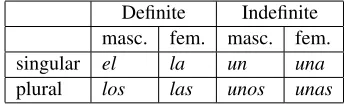
2.1 General overviewIn Spanish, articles can be definite (as in English the) or indefinite(in English a/an), and their form changes according to the gender and number of the noun they complement, as shown in Table 1.1
Definite Indefinite masc. fem. masc. fem.
singular el la un una
plural los las unos unas
Table 1: Spanish articles
Article usage is complex because it is the result of the interaction of pragmatic, semantic, syntactic and lexical factors. Taxonomies of article use are abundant in the literature, targeted towards learners (Butt and Benjamin, 2014) or linguists (Bosque and Demonte, 1999; RAE, 2009). Basically, the main function of articles is to indicate the relationship be-tween the nominal expressions and the entities to which the speakers refer by means of such expres-sions (Bosque and Demonte, 1999). For example, among other usages, we use the definite to general-ize, that is, to refer to a whole class of things or peo-ple, as in (1) and to refer to something that is iden-tifiable to the listener, as in (2). In (2), Maria’s son must be identifiable for the listener either because a) Maria has only one son, or b) we have talked about him before. We use the indefinite to refer to any ob-ject of a particular class, as in (3), and we use no ar-ticle when we are talking about an indefinite amount of something, as in (4) (examples from Alonso et al. (2013)).
(1) Los hijos dan muchos disgustos. ‘Children cause a great deal of trouble.’ (2) El hijo de Mar´ıa tiene dos a˜nos.
‘Maria’s son is two years old.’
(3) Tener un hijo es lo mejor que te puede pasar en esta vida.
‘Having a child is the best thing that can hap-pen in life.’
1Spanish also has a definite article with neuter gender (lo), but its usage is quite different from the rest, so it will not be considered in this paper.
(4) No tengo hijos pero tengo sobrinos. ‘I do not have children but I have nephews.’
With regard to syntactic factors, for example two or more coordinated nouns should have their own ar-ticle if they refer to different things: un gato y un perro, “a cat and dog” (un gato y perrosuggests a cross between a cat and a dog) (Butt and Benjamin, 2014).
As for semantic factors, there are many rules which require specific knowledge. For example, place names usually have no article (M´exico). For some of them the article is optional ((el) Per´u) or depends on the context (el M´exico de los mexi-canos, “Mexicans’ Mexico”), while the definite is obligatory for rivers, mountains, seas and oceans (el Mediterr´aneo). Other rules exist for numbers, proper nouns, names of languages, days of the week, etc.
Finally, there exist many set phrases and idioms which require definite (e.g. con el objetivo de‘with the objective of’), indefinite (por una parte, ‘on the one hand’) or zero article (e.g.a corto plazo, ‘in the short run’).
2.2 Difficulties for learners
Definite articles are the most frequent word in Span-ish. In Davies (2005) frequency list the definite arti-cle is the most frequenttypeand the indefinite article is the 7th most frequent. In 9 billion words Spanish TenTen corpus (Jakub´ıˇcek et al., 2013) the definite is also the most frequent type and the indefinite is the 6th. Approximately one out of every ten words in this corpus are articles.
Articles are also one of the most frequent gram-matical errors, specially for speakers of languages that do not have articles like Chinese, Japanese, Korean or Russian. For speakers of Japanese, Fern´andez (1997) found 2.2 article errors per 100 words in a 4433 words sample.2 In addition to
ers of English, since even proficient learners had not achieved the acquisition rate of 90%. Therefore, we decided to use Japanese learners’ texts to develop our annotation scheme.
3 Experiment
Annotation of learner errors is a challenging task for several reasons. First, learner sentences often con-tain interacting surrounding errors which can make the understanding of the meaning of the sentence quite difficult. Second, for some errors like num-ber and gender agreement there are clear-cut rules about what is grammatical. But for other kind of er-rors, like article or preposition presence and choice, rules are usually not clearly defined, so in some cases more than one article choice may be accept-able. And third, in some cases more textual context or world knowledge may be needed to be able to de-termine the correct article usage.
As a result, inter-annotator agreement for error annotations can be relatively low. This issue has been put forward by the NLP community, that has found difficulties for evaluating error detection sys-tems (Chodorow et al., 2012), but it has not received much attention in the learner corpus linguistic field. Several measures can be taken to address the vary-ing number of corrections and levels of acceptability a sentence can have.
With regard to the number of possible analysis a sentence can receive, most error-annotated learner corpora permit only one tag per error. However, the ”single correct construction” approach has been questioned and in recent annotation efforts there is a tendency to allow the inclusion of several alterna-tive codes for the same item (L¨udeling et al., 2005; Boyd, 2010; Lee et al., 2012; Rozovskaya and Roth, 2010). However, it is unattainable to list all possible interpretations for every error, so this is done only “when there is doubt”.
With regard to the level of confidence in the an-notators’ judgments, some projects include global measures of inter-annotator agreement (Rozovskaya and Roth, 2010; Lee et al., 2012) but annotated corpora do not explicitly provide confidence levels for every error. Only in some annotation experi-ments the annotators are asked to indicate their level of confidence for every item (as “low” or “high”)
(Tetreault and Chodorow, 2008).
We carry out an experiment on annotation of arti-cle errors with the following objectives:
1. Calculate inter-annotator agreement.
2. Analyse the types and sources of disagreement, to find out which are the main difficulties the annotators face when annotating article errors in learner texts.
3. Based on this experience, refine the guidelines and annotation scheme for error annotation.
3.1 Data collection
We used learners’ texts written by 4th grade Japanese students of Spanish with an intermediate level of proficiency, at Aichi Prefectural University. A teacher of Spanish as a Foreign Language ex-tracted sentences containing at least one article error from these texts, 50 sentences for each kind of arti-cle (definite, indefinite and zero artiarti-cle). The same number of sentences, but with at least one correct ar-ticle usage, was then collected from the same texts. In every sentence only one highlighted noun phrase had to be annotated. The distribution of the resulting 300 sentences is as Table 2 shows.
Definite Indefinite 0 article Total
Correct 50 50 50 150
Incorrect 50 50 50 150
Total 100 100 100 300
Table 2: Number of noun phrases and articles they con-tain
3.2 Preliminary annotation scheme
The 300 noun phrases were tagged by four annota-tors. The annotators were two experts (teachers of Spanish as a Foreign Language, who correct learn-ers’ texts on a regular basis), which we will call E1 and E2, and two non-experts (native speakers of Spanish with higher education but without experi-ence in corpus annotation), which we will call NE1 and NE2.
provided with the target sentence plus the preceding and the following sentence, which they could resort to if they needed more context. If the target sentence was at the beginning or end of paragraph or text in the original text, no context was provided (a “begin-ning or end of paragraph or text” mark was inserted instead).
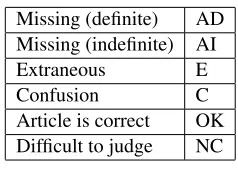
They were asked to classify the noun phrase into one of the categories shown in Table 3. We are only concerned with article presence and choice, so we did not tag malformation (e.g. spelling or agree-ment) and order errors.
Missing (definite) AD Missing (indefinite) AI
Extraneous E
Confusion C
Article is correct OK Difficult to judge NC
Table 3: Tags
Missing article (AD, AI) A missing error oc-curs when the learner does not use any article but the sentence should contain one: definite, as in (5) (AD|AD|AD|AD||AD)3 or indefinite as in (6) (AI|NC|AI|AI||AI).
(5) Originalmente el espa˜nol y el portugu´es son categorizados en mismo grupo ling¨u´ıstico, la lengua rom´anica.
‘Originally Spanish and Portuguese are cate-gorized in the same linguistic group, the ro-mance language.’
(6) Osu est´a cerca del barrio de Sakae que es centro comercial muy animado y moderno. ‘Osu is near Sakae area which is a very lively and modern commercial district.’
Extraneous article (E) An extraneous article er-ror occurs when the article used by the learner is not necessary (zero article should be used instead), as in (7) (E|E|E|E||E).
3For every example from the learner data, in parenthesis we indicate the tags by the four annotators, in the following or-der: E1|E2|NE1|NE2||gold standard. For more details about the gold standard version, see section 5.
(7) El objetivo de este trabajo es conocer c´omo propag´o el tomate como la verdura co-mestible desde el continente americano. ‘The goal of this paper is to know how tomato spreaded as an edible vegetable from the American continent.’
Confusion error (C) A confusion error occurs when the learner used a definite article instead of an indefinite, or vice versa. In (8) (C|C|C|C||CA) the article should be definite because “victoria” refers to the last -unique and therefore identifiable- victory which ended the war.
(8) Franco consigui´o una victoria en la Guerra Civil en 1939 y su dictadura comenz´o. ‘Franco pursued the victory in the Civil War in 1939 and his dictatorship began.’
Difficult to judge (NC) It was expected that the annotators would some times be unsure about the acceptability of article usage in a given sentence, or unable to determine the most likely correction.
We opted for allowing only one tag per sentence, but not forcing the annotators to mark the article us-age as “right” or “wrong” and instead gave the pos-sibility of marking sentences as “difficult to judge”, as Han et al. (2006). We we wanted the annotators to correct the sentences only when they were sure about their decision, and not forcing them to make a best guess, which could lower inter-annotator agree-ment. Later we could look at the sentences marked as problematic, as (14), and analyse what they have in common.
4 Inter-annotator agreement
Tables 4 and 5 show the confusion matrices for ex-pert and non-exex-pert annotations. Observed agree-ment4is 0.79 for expert annotators and 0.76 for non-experts.
E1:#E2:! AD AI C E NC OK Tot
AD 37 0 0 0 2 2 41
AI 0 5 0 0 2 0 7
C 0 0 30 3 2 1 36
E 0 0 3 39 7 1 50
NC 1 0 1 4 5 8 19
OK 4 0 4 7 10 122 147
Total 42 5 38 53 28 134 300
Table 4: Confusion matrix for E1 and E2 annotators.
NE1:#NE2:! AD AI C E NC OK Tot
AD 31 2 0 1 0 10 44
AI 2 5 0 0 0 2 9
C 1 0 23 2 2 6 34
E 0 0 4 57 2 10 73
NC 0 0 0 1 0 0 1
OK 5 1 5 7 2 119 139
Tot 39 8 32 68 6 147 300
Table 5: Confusion matrix for NE1 and NE2 annotators.
chance agreement would equate to 0. For the whole set of sentences (300, correct or incorrect), inter-annotator agreement for experts was found to be Kappa = 0.71 (p <0.001), 95% CI (0.65, 0.77), and for non-experts it was 0.68 (p < 0.001), 95% CI (0.62, 0.75), which indicates substantial agreement. If we exclude the 45 sentences marked as“difficult to judge” by at least one annotator, kappa is 0.85 and 0.73 respectively. If we exclude 97 sentences tagged as “correct” by the four of them, remaining only sen-tences where at least one annotator considers there is an error, kappa is 0.62 and 0.58. If we exclude both sentences marked as NC by at least one annotator and sentences marked as OK by four annotators (re-maining only 159 sentences) kappa is 0.79 and 0.61. In the following sections we examine different types of disagreement: disagreement due to the an-notators (4.1), due to the annotation scheme (4.2) and genuine disagreement (4.3), and propose some measures to reduce it.
4.1 Disagreement due to the annotators expertise: experts vs non-experts
The difference between experts and non-experts’ re-liability is due to the fact that non-experts make
more slips than experts, and they are also less con-servative when they correct texts.
In the data we find at least five mistakes (there can be more which we cannot detect), all by non-expert annotators: in four sentences they tag for a missing article a noun phrase which already contains one article, as (9) (C|C|AD|OK||OK), and in another one they tag for an extraneous article error a noun phrase without article.
(9) En Guatemala, la gente que tiene
alta ense˜nanza piensa que “voseo” es una norma culta.
‘In Guatemala, people who have
higher education think that ”voseo” is an educated norm.’
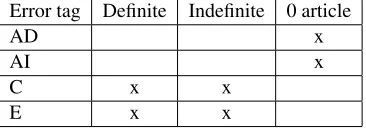
To prevent this kind of mistakes, any annotation project should automatically constrain the tags the annotators can use depending on the input (e.g. if there is already an article preceding a noun phrase, do not allow the ”missing” error tag). Table 6 shows the error tags a noun phrase can receive depending on the article it contains.
Error tag Definite Indefinite 0 article
AD x
AI x
C x x
E x x
Table 6: Error tags a noun phrase can receive depending on the type of article it contains
In addition to that, even though non-experts are supposed to be less confident about the acceptabil-ity of sentences because pointing out errors in a text is a task for which they have no previous experi-ence, in fact they are less cautious when they cor-rect texts. For example, in (10) (OK|OK|E|E||OK)) experts consider the article is acceptable, while non-experts classify it as an extraneous article.
(10) Segundo,ahora ya no es imprescindible usar
This bias explains why, for example, NE1 uses the tag “difficult to judge” only one time (0.3%), while E2 uses it almost once every 10 sentences (9.3%), and non-experts use the tag “extraneous arti-cle” (specially for definite articles) more frequently than experts (23.5% vs. 12.2% of times).
Principle of minimal change Part of the variabil-ity on annotators’ rigour could be reduced by giving clear guidelines about the optimum level of interven-tion in the texts. In this regard, we advocate for fol-lowing a principle of minimal change: so we should not mark as errors the sentences where the learner choice is acceptable, even if the learner choice is not the best choice, that is, the goal of the annota-tor should be to produce an acceptable rather than a perfect result (e.g. Hana et al. (2010)), When the input is incomprehensible and the annotator cannot make a decision, it should be left without annotation. In relation to that, annotators should be informed about the halo effect, by which the judgement of a sentence as acceptable or unacceptable is influenced by our overall impression of previous sentences. In other words, one is more likely to find errors in a text if this text already contains other errors. Experts (teachers of a foreign language) are trained on evalu-ation methods and they are aware of the importance of reliability in students’ evaluation. They know how external factors (e.g. the halo effect and con-trast effect) can have a negative impact and what can be done to reduce it. However, non-experts lack this training and are not aware of the challenges faced to perform a fair evaluation -annotation.
4.2 Disagreement due to the annotation scheme We find some disagreements are due to the design of the preliminary annotation scheme, specially con-cerning the tags “difficult to judge” (NC) and “con-fusion error” (C).
The tag “difficult to judge” With regard to the re-liability of the 6 tags used for annotation (Table 3), “difficult to judge” is the one that causes more dis-agreement: most of the times (67.7%) it is used by only one of the four annotators, and it is never used by three or four annotators in the same sentence. On the contrary, the rest of tags have a much higher agreement: on average, they are used by the four
annotators 63.2% of the times, by three 19.9%, by two 9.2% and by one 7.7% of times.
Therefore, this tag should at most be used to filter out problematic sentences, which annotators cannot comprehend, and not for proper annotation of sen-tences.
We advocate for not using this tag and instead set clear principles in the annotation guidelines specify-ing what the annotators should do when they are not confident about the error analysis of a sentence.
The tag ”confusion error” We found there was ambiguity in the guidelines about the meaning of this tag: in principle, it refers to the confusion be-tween definite and indefinite articles but annotators also use it to indicate the confusion between an arti-cle and another type of determiner.
Indeed, learners frequently confuse the indefinite article with the indefinite determineralguno‘some’, when they refer to an indefinite amount of things, as in (11) (C|C|OK|OK||CD).
(11) Los hispanos est´an aumentando r´apidamente y la poblaci´on est´a cen-trada en unos estados.
’Hispanics are increasing rapidly and the population is concentrated in some states.’
To include this kind of error in the annotation, we should break down the tag into two: confusion be-tween definite and indefinite article (CA) and confu-sion between article and another type of determiner (CD).
4.3 Genuine disagreement
As explained in section 2, article presence and choice can be determined by several factors. In our data, it mainly depends on pragmatic fac-tors (69.0% of noun phrases), followed by lexico-semantic (20.7%) and syntactic factors (10.3%).
makes the figures less reliable. Therefore, more care should be paid to pragmatic distinctions.
Specifically, disagreement is more likely in noun phrases where two pragmatic interpretations (and ar-ticle choices) are possible, and annotators choose one of the alternatives in an inconsistent manner (§4.3.1 and 4.3.2). Disagreement can also be due to a lack of the world knowledge that is needed to be able to determine the correct article usage (§4.3.3). As for syntactic and lexico-semantic fac-tors (§4.3.4), disagreement occurs because annota-tors do not have a good knowledge about the existing prescriptive rules about article usage.
4.3.1 Definite article or zero article
Frequently both definite and zero article are ac-ceptable for the same noun phrase. This happens when the noun phrase can refer to a whole class of things or people in general (definite article) or toan indefinite amount of something(zero article), as explained in 2. This distinction frequently does not change the meaning of the sentence significantly and in fact some languages with articles like English usually use the zero article in both cases.
When both pragmatic interpretations are possible for a given sentence, annotators unevenly choose one of them: some annotators tag the noun phrase for a missing article in (12) (OK|AD|AD|OK||OK) while they tag it for extraneous article in (13) (E|NC|OK|E||OK), even though in both sentences both the definite article and the zero article are ac-ceptable, so the learner’s choice should be left un-changed.
(12) Los pol´ıticos hablan en p´ublico y manifies-tan sus opiniones con el objeto de conseguir votos de ciudadanos [...]
‘Politicians talk in public and show their opinion with a view to get votes from the citizens [...].’
(13) Concretamente los cursos que con-siguieron participantes japoneses y que ofrecen los certificados oficiales como IMEC(Instituto de Medicina China) con-tinuar´an existiendo [...].
‘Specifically the courses which obtained Japanese participants and offer official certificates like IMEC (Chinese Medicine
Institute) will continue existing [...].’
This distinction is specially problematic with plu-ral nouns: in noun phrases with a pluplu-ral nomi-nal head, agreement by four annotators is less fre-quent (43.2%) than with singular nouns (66.7%) 2(2, N = 299) = 18.9, p < 0.001. Therefore,
more care should be paid in the annotation of plural nouns.
If the noun is singular and uncountable, we find the same ambiguous pragmatic distinction as with plural nouns, as in (14) (NC|NC|AD|E||OK), which is tagged as ”difficult to judge” by some annotators and ”extraneous” by others (the AD tag is a lapsus).
(14) El problema es demanda de la coca´ına. ‘The problem is demand of cocaine.’
In conclusion, according to the principle of mini-mal change, when both the definite and the zero ar-ticle are acceptable, we should leave the learners’ choice unchanged.
4.3.2 Indefinite article or zero article
Some times annotators agree in considering a noun phrase as unacceptable but they do not agree in the type of correction. This can happen when the learner wrongly uses a definite article, as in (15) (E|C|C|E||E/CA), and the annotators propose differ-ent corrections for it because the noun phrase can refer toan indefinite amount of something(zero ar-ticle) orany object of a particular class(indefinite).
(15) En cambio, la coca´ına tiene el efecto t´oxico.
‘On the contrary, cocaine has a toxic effect.’
Only in these cases, we allow adding two error tags (E/CA or E/CD) to the noun phrase.
4.3.3 World knowledge
(16) Sale cada treinta minutos aproximadamente desde la estaci´on de Nagoya y paran en los nueve sitios muy interesantes y tur´ısticos, por ejemplo El castillo de Nagoya.
‘It runs approximately every thirty min-utes from Nagoya station and stops in nine very interesting and touristy places, for example Nagoya Castle.’
If the learner’s choice is acceptable in some con-text, as in (16), we do not mark it as wrong. If the learner’s choice is not acceptable, we tag the noun phrase as usual.
4.3.4 Syntactic and lexico-semantic rules
Unlike article usage governed by pragmatic fac-tors, which is subject to interpretation by the anno-tator, for article usage determined by syntactic and lexico-semantic constraints there exist some linguis-tic norms about what is considered correct and in-correct.
However, native speakers -even experts- do not have a deep knowledge about these rules and some times do not follow them. For example, in (17)
(AD|AD|OK|OK||OK) experts marked as error an
article usage that is actually accepted, while non-experts tagged it right. It is the use of zero article
between the prepositiona(‘to’) and the relative
pro-nounque(‘which’) (RAE, 2006).
(17) [...] el cap´ıtulo 2 dice sobre el proceso del
portu˜nol y los problemas a que el portu˜nol se enfrenta actualmente.
‘[...] chapter 2 is about the portu˜nol
pro-cess and the problems that the portu˜nol con-fronts nowadays.’
Therefore, to determine the acceptability of article usage, annotators should not rely only on their in-tuition as native speakers but also consult existing rules and recommendations published in reference dictionaries and grammars as RAE (2006) and RAE (2009).
5 Suggestions for reliable annotation
After examining the sources of disagreement in the annotation experiment, we added the following prin-ciples to the annotation scheme:1. It is not recommended to use a tag like NC, “difficult to judge”, because it has the lowest reliability. Therefore, we recommend simply not annotating the noun phrase if it impossible to determine the acceptability of the article us-age. We did not find any case like that in our data from students with an intermediate level of Spanish.
2. Tags should inform us about the type of error
and about the correction. This was true for
the ”add definite”, ”add indefinite” and ”delete” tags, since we indicate which article we should add (definite or indefinite), and we know which article is deleted. The preliminary “confusion” error tag should be broken down into two tags to indicate confusion between definite and in-definite article (CA), and confusion between ar-ticle and another type of determiner (CD).
3. Follow the principle of minimal change: the sentences should be acceptable rather than per-fect. When more than one article choice includ-ing the learner’s one is acceptable, we leave the learner’s choice as correct. The pair defi-nite article-zero article is the most interchange-able (in many sentences both are correct), so annotators should pay attention not to change the learner choice when it is correct.
4. When the learner choice is not acceptable and there are two equally good corrections, we al-low double annotation. We found this mainly happens when the learner wrongly uses a defi-nite or indefidefi-nite, and the annotators doubt be-tween an extraneous error (zero article) and a confusion error. Only in this cases, we allow double annotation with E and CA or CD tags. There is usually no ambiguity in the appropri-ate correction for a missing article: annotators usually agree whether a definite or indefinite is necessary (probably for this reason the zero ar-ticle has a high inter-annotator agreement.)
6. When more world knowledge is needed to judge a sentence as correct or incorrect, we do not correct it if the learner’s choice is accept-able in some context.
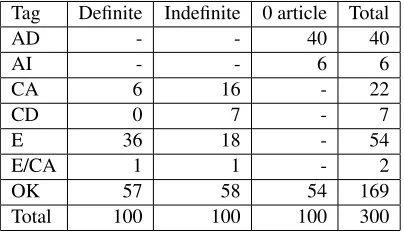
Following these criteria, we have revised the er-ror tags given by the annotators for every sentence and made a decision about the most acceptable tag. The articles in the resulting gold standard set are dis-tributed as Table 7 shows.
Tag Definite Indefinite 0 article Total
AD - - 40 40
AI - - 6 6
CA 6 16 - 22
CD 0 7 - 7
E 36 18 - 54
E/CA 1 1 - 2
OK 57 58 54 169
Total 100 100 100 300
Table 7: Frequency of error tags in the gold standard per type of article (absolute frequency or %)
Despite the small size of the corpus study, some tendencies are observed in the 300 noun phrases written by Japanese learners:
1. The most frequent error regarding the defi-nite article is extraneous use (83.7%): learners overuse it frequently probably because it is the most frequent article (and word) in Spanish.
2. When zero article is used, the most likely error is omission of the definite article (86.9%), for the same reason.
3. When learners use an indefinite article, the er-rors they commit are more evenly distributed. Confusion with a definite article or another type of determiner happens in 54.8% of cases and extraneous use in 42.9%.
6 Conclusions
Although article errors have been annotated in a number of small-scale studies, to date there has not been any study about article error annotation and inter-annotator agreement in Spanish learner texts. In this paper we have tested the results of an annota-tion scheme for article errors in a sample of learner
texts written by Japanese learners. We have cal-culated agreement among four annotators (two ex-perts and two non-exex-perts) and have found kappa values between 0.85 and 0.62 for expert annotators and from 0.73 to 0.58 for non-experts, depending on the collection of sentences considered. The analysis of the disagreement among annotators has served us to find which are the main difficulties for annotators and to refine the annotation scheme according to it. Following more articulated guidelines we have re-vised the data to create a gold-standard.
The data used for the experiment is available to all interested researchers upon request. We hope the work presented here will facilitate future corpus an-notation and development of automatic article error detection systems.
Acknowledgments
This research was partially supported by kakenhi
(25770207 and 24500189), Grant-in-Aid for Scien-tific Research from the Japan Society for the Promo-tion of Science.
We thank the students from Aichi Prefectural Uni-versity who gave their permission to use their texts for this research.
References
Rosario Alonso, Alejandro Casta˜neda, Pablo Mart´ınez, Lourdes Miguel, Jenaro Ortega, and Jos´e Ruiz. 2013. Students’ Basic Grammar of Spanish. Difusion. Ignacio Bosque and Violeta Demonte, editors. 1999.
Descriptive Grammar of Spanish Language. Espasa Calpe, (In Spanish: Gram´atica descriptiva de la lengua espa˜nola).
Adriane Boyd. 2010. EAGLE: an error-annotated
cor-pus of beginning learner German. InProceedings of
LREC-10, Malta.
John Butt and Carmen Benjamin. 2014. A New
Refer-ence Grammar of Modern Spanish. Routledge. Martin Chodorow, Markus Dickinson, Ross Israel, and
Joel Tetreault. 2012. Problems in evaluating
gram-matical error detection systems. In Proceedings of
COLING 2012, pages 611–628, Mumbai, Desember. Jacob Cohen. 1960. A coefficient of agreement for
nom-inal scales. Educational and Psychological
Measure-ment, 20(1):37–46.
Mark Davies. 2005.A Frequency Dictionary of Spanish: