Proceedings of Recent Advances in Natural Language Processing, pages 90–96,
Same same, but different:
Compositionality of Paraphrase Granularity Levels
Darina Benikova and Torsten Zesch
Language Technology Lab
Department of Computer Science and Applied Cognitive Science University of Duisburg-Essen, Germany
Abstract
Paraphrases exist on different granularity levels, the most frequently used one be-ing the sentential level. However, we ar-gue that working on the sentential level is not optimal for both machines and hu-mans, and that it would be easier and more efficient to work on sub-sentential levels. To prove this, we quantify and analyze the difference between paraphrases on both sentence and sub-sentence level in order to show the significance of the problem. First results on a preliminary dataset seem to confirm our hypotheses.
1 Introduction
Paraphrases are differently worded texts with ap-proximately same content, whose automatic de-tection is useful in tasks such as summarization, information extraction, plagiarism detection, ma-chine translation, question answering, and natural language generation (Bhagat and Hovy, 2013).
Most previous approaches work on the sentence level, but it is often hard to decide whether two sentences are indeed paraphrases due to only par-tially overlapping content as shown in the example below:
The decision of whether (a) and (b) are para-phrases is difficult, because only a part of (b) has the same content, whereas the rest is additional in-formation.
We thus propose to work on the event level, which we define as a predicate-argument structure, similarly to other researchers (Roth and Frank, 2012; Ritter et al., 2012; Li et al., 2010; Li and Ji, 2016; Shwartz et al., 2017). However, there
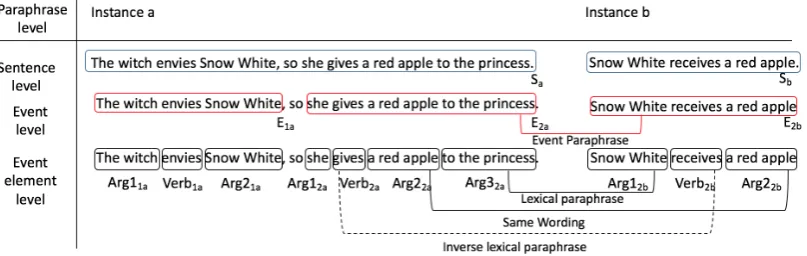
is no study analyzing and quantifying the differ-ence in performance on different paraphrase gran-ularity levels of clearly distinguishable linguistic units. The contribution of this paper is the anal-ysis and aligned annotation on different granular-ity levels – namely sentences, events, and event elements.1 This analysis will show whether it is beneficial to work on the event level and whether sentence paraphrases are composed of event para-phrases.
2 Granularity Levels of Paraphrases
Madnani and Dorr (2010) discuss that paraphrases exist on several granularity levels, namely sen-tences, phrases, and individual lexical items (or
words). To illustrate the difference between para-phrase detection on different levels, we provide a running example for each individual level.
2.1 Sentence Level
Paraphrase detection is mostly performed on the sentence level (Dolan and Brockett, 2005; Gane-san et al., 2010; Xu et al., 2014; White et al., 2015; Socher et al., 2011; Fernando and Steven-son, 2008). An exemplary sentential paraphrase would be the following:
However, in case of the partial overlap be-tween a sentence pair it is more difficult to decide whether this is a paraphrase, as shown in the next sentence:
Sentence (c) is possibly a paraphrase of (a) and (b), but contains more information which makes the decision more difficult.
1https://github.com/MeDarina/SameSame
2.2 Phrase Level
Depending on the exact definition, a phrase can range from single words to full sentences. Hence, we only regard a specific kind of phrase, namely predicate-argument structures, as these are syntac-tically delimited and more suited for automatic de-tection. Predicate-argument structures have been previously used in paraphrasing and closely re-lated tasks (Roth and Frank, 2012; Xu et al., 2014; Shwartz et al., 2017; Li and Ji, 2016), as they are considered to contain the most salient informa-tion in a form that is easier to process than full sentences. The structure consists of a predicate, which is most often a verb, and all its arguments.
To distinguish this specific use of phrase, we call it event. An event consists of several event elements, more specifically one verbal predicate and its arguments. We do not consider auxil-iary verbs, if they only add temporal information. Negations and other modifications to the seman-tics brought e.g. by modal verbs are considered as additional information. Events, similar to previous predicate-argument structures such as e.g. propo-sitions (Stanovsky et al., 2016), allow nesting, i.e. that an argument can also be another predicate-argument structure. For further information re-garding the handling of e.g. negations and modals, see our annotation guidelines.2
Exemplary event structures are the following:
In the case of sentence (c) shown in the previous section, the sentence contains two events:
By using a predicate-argument structure, the sen-tence is separated in two structures and thus it is easier to decide that the first part of the sentence does not convey the same information as examples (a) and (b), whereas the second part, does.
By regarding events we try to capture the amount of information overlap that composes a paraphrase. The example also shows that in our representation not all parts of the sentence are con-sidered, e.g. the conjunctionso.
2https://github.com/MeDarina/SameSame
2.3 Word Level
Similar to the phrase level, paraphrasing on the word level is mostly regarded in the context of the surrounding sentence. Within the sentence pair from the sentence level example, the word pair marked in bold is an example for a word para-phrase.3
(a) The [witch] gives a red apple to Snow White. (b) [She] gives an apple to Snow White.
Without context,witchandshewould not be con-sidered paraphrases, while witch and sorceress
probably would.
Cohn et al. (2008) annotated words and phrases in the context of sentences in order to analyze the nature of paraphrases and corresponding corpora. In our work, the lowest paraphrase level is the
event element level which are seen in context of their sentence. Event elements are verbal predi-cates and their arguments. The predicate is always one word. In general, arguments can span from lexical items to phrases, but have clear bound-aries with regard to the verb. In our work, only verb-verb and argument-argument paraphrases are considered. We do not consider words that are not arguments of a verbal predicate such as conjunc-tions (e.g.so,because,if) or interjections (e.g.oh,
wow,hello).
2.4 Annotatability
It is likely that annotation of paraphrases on the different levels is of different difficulty. However, a comparison is challenging, as there are few stud-ies and they are not comparable between levels.
On the SemEval 2015 Task 1 data (Xu et al., 2014), which is based on the Twitter Paraphrase Corpus (TPC) – this means the tweets are roughly equivalent to ‘sentences’ – the IAA measured in terms of F-measure is .82. For the phrase level, Cohn et al. (2008) report anF1 IAA between .71
and .76. They also report IAA on the word level, which is between .74 and .79. In line with our hy-pothesis, IAA is higher on the word level than on the phrase level, but they did not compare their re-sults to the sentence level. We also cannot directly compare with the results from the Twitter dataset. In this paper, we annotate a single dataset on all three levels in order to gain insights on which level works best and possibly also how to break down the task of paraphrase detection.
Figure 1: Paraphrase levels annotated in our model
3 Compositionality
In the trivial case of two identical sentences, they are paraphrases and so are all the events they con-sist of. The same holds for each of the identical events from the two sentences where each of the event elements has a perfect match on the other side. However, there certainly are sentence para-phrases, where there is no such perfect overlap. In those cases it is an open question whether the question of sentence paraphrases can be settled by only looking at the events or the question of event paraphrases by looking at the event elements.
Although many approaches in NLP are build on the assumption of semantic compositionality (Sammons et al., 2010), to our knowledge, there has been no explicit and empirical analysis of the paraphrase compositionality on different inde-pendently annotated levels. However, there have been several approaches where different granu-larity levels have been annotated in one corpus. Vila et al. (2015) and Cabrio and Magnini (2014) classified the paraphrases according to paraphrase classes and also classified lexically differing parts within the pairs according to the same classifica-tion. Similarly, Sammons et al. (2010) took exist-ing textual entailment corpora that are classified according to classes including paraphrases and classify the arguments according to paraphrase classes.4
Cohn et al. (2008) performed an annotation on all three levels in parallel, by using existing sen-tential paraphrase corpora such as the Microsoft Paraphrase Corpus (MSPC) and adding the other two layers upon those.
Our work differs from the previous efforts in
4Two sentences entailing each other are considered a para-phrase by many definitions (Rus et al., 2014; Hovy et al., 2013)
the following: we work on two sub-sentential levels: elements (individual predicates and argu-ments) and event elements (predicate-argument structures), as both are clearly separated and po-tentially compositional. Gold standard paraphrase annotations on the lower levels might thus also be helpful for higher levels. A level between the word and the sentence level, similar to the phrase level, might be the solution to issues in paraphrase detec-tion, as it contains more semantics than a word, but presents a reduced amount of information com-pared to a sentence.
4 Dataset Construction
We annotate paraphrases of verb-argument struc-tures based on existing sentential paraphrase cor-pora, such as the Microsoft Paraphrase Corpus (MSPC) (Dolan and Brockett, 2005) and the Twit-ter Paraphrase Corpus (TPC) (Xu et al., 2014). Our dataset is based on 41 sentence pairs from the MSPC and 47 tweet pairs from the TPC. We choose these corpora because, (i) they have been widely used, which makes our approach compara-ble to others, (ii) they contain many action verbs, which are more likely describe real-world events which fits our goal of finding similar descriptions of the same event, (iii) they also contain negative examples of paraphrases, and (iv) the Twitter cor-pus contains non-standard data which proves the robustness of our model.
Figure 2: Exemplary event element paraphrase
levels and to compare the annotatability between them. As a second step, they annotate the event paraphrases in each sentence pair and then as a third step the event element paraphrases in each event pair. The sub-sentential tasks can be basi-cally separated in two substasks: (i) finding the events and (ii) aligning paraphrased events and el-ements.
Finding Events We pre-annotate the first sen-tence of each pair with the Stanford Dependency Parser in the version provided by DKPro Core (Eckart de Castilho and Gurevych, 2014), using the RNN model with collapsed dependencies, as this parser worked best for our purpose. By using a dependency parser we simplify the task of find-ing the event with its verb-argument structure. Un-fortunately, the quality of the parsing output was insufficient and had to be manually corrected for both datasets. This was mainly due to arguments with very long spans in MSPC and large amounts of non-standard language in TPC. The event is then connected with its elements by marking the span between the elements. Thus, the annotators are shown the annotation of the event and the indi-vidual elements before performing the alignment annotation.
Aligning Events and Elements The annotation of paraphrases is performed by an alignment an-notation between two instances on the same granu-larity level in a sentence pair. The alignment anno-tation is performed on each level independently, in this way reducing the bias of annotating similarly on all levels on purpose. If there is no paraphrase, the annotators do not perform any alignment.
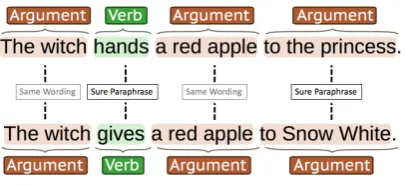
Figure 2 shows an exemplary annotation. There are special alignments for verbal antonyms, ver-bal negations, and modal verbs, as these change the semantics of the event. Furthermore, we dis-tinguish betweensame wording,sure paraphrase, andunsure paraphraseon all three levels.
Sentence Event Element
κ .61 .55 .73
F .91 .88 .93
Table 1: Inter-annotator agreement on the three granularity levels
5 Dataset Analysis
Our final corpus consists of 88 sentence pairs with 161 event pairs. We use this corpus to analyze the annotatability of each level as well as the compo-sitionality of the levels.
5.1 Annotatability
The results in Table 1 show that in general the inter-annotator agreement is rather high for a task of that difficulty. For the sake of comparabil-ity we also report F-measure, but using chance-uncorrected measures like Cohen’s Kappaκis cer-tainly more appropriate. F-measure is higher than in previous studies, but not directly comparable. For both measures, we do not observe the ex-pected result that smaller units get higher agree-ment. While elements are clearly easier than sen-tences, events are even worse than sentences. As our sample size is rather small, no definitive con-clusions should be drawn from these results.
5.2 Compositionality
Using our newly created paraphrase annotations on the three granularity levels, we can now turn towards the question of compositionality. In our analysis, we differentiate between sentences with one event only –single-event sentences– and tences with more than one event –multi-event sen-tences. We perform two analyses: first we check the compositionality between all three granular-ity pairings to empirically analyze whether para-phrases are compositional in general. Further-more, we compare the differences of the higher classes in more detail in order to show the advan-tages of working on lower granularity levels.
5.2.1 All Granularity Levels
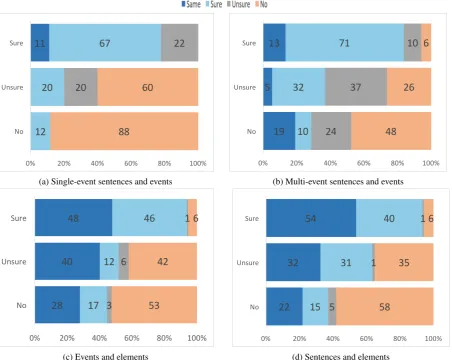
Figure 3 shows the results of the averaged percent-age values between the paraphrase classes of two granularity levels.
Figures 3a and 3b show 67%-71% ofSure Para-phrasesentence pairs consist ofSure Paraphrase
con-(a) Single-event sentences and events (b) Multi-event sentences and events
(c) Events and elements (d) Sentences and elements
Figure 3: Compositionality of the three granularity levels in percent
tain any Same Wordingsor Sure Paraphrases on the event level. Especially when looking at the compositionality between the higher levels and el-ements, it is clear that there is a big lexical overlap, asSure Paraphraseson the event level consist of 48% Same Wording element pairs. Furthermore, the figures show that event elements having the same wording are the most frequent label in each higher leveled paraphrase class. Although they are more often components ofSureparaphrases on the higher levels, they are also present in higher lev-eled instances that are not paraphrases.
This means that althoughSure Paraphrasesare composed of Sure Paraphrases or Same Word-ing, these two labels are also present in instances that are not paraphrases, which may be due to the highly lexically overlapping construction of the source datasets, as discussed by Rus et al. (2014). In any case, it means that only looking at the para-phrases on the lower levels is not sufficient to decide over paraphrases on the higher levels and
other features need to be also considered, as pairs that are not paraphrases on the sentence and event level also contain 22% or 28% of event elements that are of the labelSame Wording.
All figures show that bothSure Paraphraseand
No Paraphrase primarily consist of the identical labels on the lower levels, or in the case of Sure Paraphrase of Same Wording, meaning that if a paraphrase is surely existent or non-existent on the upper level, its lower-leveled components have the same paraphrase label. This shows that para-phrases are compositional in most cases, espe-cially when regarding single-event sentence pairs or pairs with a high lexical overlap.
5.2.2 Sentence Level vs. Event Level
To compare the differences of paraphrases on the upper two granularity levels, we consider three different cases, namely: 1) Same paraphrase label, 2) event paraphrase only, and 3) sentence para-phrase only.
Same paraphrase label This is the case of full compositionality, meaning that the paraphrase pair of the higher level consists of paraphrase pairs on the lower level that have the same label as the higher level.
The compositionality of sentences with one or with several events differs slightly, although most sentences consist of events with the same para-phrase label as the sentence. Figure 3a shows that sentences with only one event have paraphrase la-bels differing from that of their event in 33% of the cases, of which 11% areSame Wording, which means that 78% ofSure Paraphrasesconsist of ei-therSure ParaphraseorSame Wordingevent pairs. Sentence pairs that are labeled as No Paraphrase
in 88% of the cases consists of event pairs that are also labeled asNo Paraphrase.
Event Paraphrase Only Additionally to the finding of single-event sentences having homoge-neous labels with their events, Figure 3b, shows that sentences with multiple events also contain events with differing labels. This shift is espe-cially prominent in the case when multi-event sen-tences are No Paraphrase, but 10% of them are
Sure Paraphraseand 19% are of Same Wording, which is also the previously discussed case of par-tially overlapping information.
Sentence Paraphrase Only This means that the full sentences are paraphrases of each other, but the events mentioned in them are distinct. This may occur especially in cases were the informa-tion in the sentence is not expressed through verb-argument structures as considered in this work, as e.g.
• [The witch’s envy is the reason for giving Snow White a red apple]
• [The witch envies Snow White]so[she gives her a red apple]
In our dataset, there is no case of a sentence pair with only one event that is a paraphrase, but its event pair is not.
6 Summary and Future Work
In this work we have examined the composition-ality of paraphrases on different levels by analyz-ing our newly produced corpus which was man-ually annotated with paraphrases on three gran-ularity levels - namely the sentence, event, and event element level. Although we could not prove that human annotation performance is better on the event level, the compositionality analysis shows that this level is the way to go when trying to find more complex paraphrases on a sub-sentential level. However, we must admit that our sample size is quite small and thus our findings may not generalize.
We plan to improve existing paraphrase meth-ods on event paraphrases, especially by the use of clustered event representations (Benikova and Zesch, 2016). As many state-of-the-art sentence paraphrasing methods apply simple metrics such as lexical overlap or semantic word similarity, we plan to analyze their performance on event para-phrases. We also plan to explore event embed-dings, which may be more useful in paraphrasing than word or sentence embeddings.
Additionally, we plan to experiment with tex-tual entailment rules, similar to those proposed by Szpektor et al. (2004), Szpektor et al. (2007) and Shwartz et al. (2017) as there is a close connec-tion between paraphrasing and entailment and the entailment rules are based upon predicate-focused structures (Szpektor et al., 2007).
We also consider to additionally annotate entail-ment on the three levels and investigate whether our model is also helpful for this task.
We intend to enlarge the corpus with more Twit-ter data, especially with more complex negative examples, which we will try to find by search-ing for Tweets with the same entities and differsearch-ing verbs.
Acknowledgements
This work is supported by the German Research Foundation (DFG) under grant No. GRK 2167, Research Training Group “User-Centred Social Media”.
References