949
Know Your Graph. State-of-the-Art Knowledge-Based WSD
Alexander Popov and Kiril Simov and Petya Osenova IICT, Bulgarian Academy of Sciences
Sofia, Bulgaria
{alex.popov|kivs|petya}@bultreebank.org
Abstract
This paper introduces several improve-ments over the current state of the art in knowledge-based word sense disam-biguation. Those innovations are the re-sult of modifying and enriching a knowl-edge base created originally on the basis of WordNet. They reflect several sepa-rate but connected stsepa-rategies: manipulat-ing the shape and the content of the knowl-edge base, assigning weights over the rela-tions in the knowledge base, and the ad-dition of new relations to it. The main contribution of the paper is to demonstrate that the previously proposed knowledge bases organize linguistic and world knowl-edge suboptimally for the task of word sense disambiguation. In doing so, the pa-per also establishes a new state of the art for knowledge-based approaches. Its best models are competitive in the broader con-text of supervised systems as well.
1 Introduction
Word sense disambiguation (WSD) is a long-standing task in natural language processing (NLP), which has been approached through several broad families of computational tech-niques. While supervised learning models typi-cally achieve the highest accuracy scores, prob-lems related to the lack of gold corpora, data sparseness and suboptimal granularity of the com-putational lexicons have plagued the field and prevented significant breakthroughs. This paper presents results achieved with knowledge-based word sense disambiguation(KBWSD) algorithms as an alternative pathway. It builds on previ-ous work in the subfield and demonstrates that KBWSD can achieve accuracy scores near and
in some cases even at the state-of-the-art, as a rule dominated by supervised approaches. More-over, the experimental results indicate that in-depth analysis of knowledge representation and knowledge enrichment hold significant promises – both as an alternative to supervised WSD, able to sidestep data-related issues, and as a source of potentially powerful new training signals.
The contribution of the article is fourfold. Firstly, it presents a novel strategy for construct-ing knowledge bases used in KBWSD, showconstruct-ing that a structure centered on word senses rather than on synsets can be more effective for this partic-ular task. Secondly, another novel approach to structuring the graph is explored in using word and synset embedding models in order to assign weights to relation arcs in the knowledge graph. Thirdly, a number of avenues for the enrichment of the semantic network used for KBWSD are pur-sued, thus linking WordNet to external resources. Finally, a new state of the artfor KBWSDis estab-lished, which is competitive even when compared with supervised systems.
The paper is structured as follows: the next sec-tion presents related work; secsec-tion 3 deals with some preliminary experiments aimed at replicat-ing previous work described in the literature, but in a slightly modified setting; section 4 outlines several strategies for improving the structure of the knowledge base used for KBWSD; the penul-timate section reports on our core experimental work, and the final section concludes the paper.
2 Related Work
State-of-the-art results in the broader field of WSD have been recently summarized in the Uni-fied Evaluation Framework1 (UEF) by Raganato et al. (2017a), which focuses on the all-words
disambiguation task based on WordNet 3.0 (Fell-baum, 2012). The top-performing systems in UEF, across supervised and knowledge-based ones, are an SVM model – an extension of the popular IMS system (Zhong and Ng, 2010), and a recurrent neural network model – context2vec (Melamud et al., 2016), with F1 scores on the concatenation of all evaluation corpora ranging between 69% and 69.7%. The supervised models are trained ei-ther on the SemCor corpus (Miller et al., 1993) or jointly on SemCor and the semi-automatically constructed OMSTI corpus (Taghipour and Ng, 2015). Very recently deep learning approaches have produced results above the 70% threshold (Luo et al., 2018a,b).
KBWSD has attracted a lot of interest from re-searchers over the years, since, at least notionally, it does not require any training data or additional resources beyond a computational lexicon and in some cases a knowledge base (KB). Furthermore, if the latter resources are designed in such a way so as to be domain-independent, this could pro-vide a big advantage in dealing with data of het-erogeneous origins. One of the earliest popular KBWSD methods is due to Lesk (1986); it takes the dictionary definitions of word senses for tar-get words that occur totar-gether in a shared context and calculates the degree of overlap between them, seeking to maximise the latter metric. KBWSD systems, however, typically perform less well than supervised models, due to a number of hurdles, such as: the non-trivial issue of how to structure a KB and what to put inside it; how to explore a KB most effectively; how to integrate various pieces of knowledge into a holistic representation of meaning.
One of the most successful KBWSD ap-proaches has been to use algorithms from the Ran-dom Walks on Graph family in order to obtain sense representations over particular textual con-texts. For instance, Mihalcea (2005) constructs a subgraph with the possible word senses in a con-text and then runs PageRank (Page et al., 1999) over it in order to calculate the most prominent senses. Agirre and Soroa (2009) present an in-fluential update on this method, within the UKB tool for WSD2. In addition to the static version of PageRank (Spr; introduced in Agirre and Soroa (2008)), which also constructs a sub-graph from the WordNet semantic network as a preliminary
2
http://ixa2.si.ehu.es/ukb/
step, they put forwardPersonalized PageRank, in which the whole KB is used, with the context words serving to inject probability mass into all candidate word senses. The final state of the PageRank vector over the graph indicates which are the most relevant concepts in the particular context. Two variants are described: Ppr and Ppr_w2w, where the second one is modified so as to put additional emphasis on connected con-cepts and away from the target senses themselves. The second strategy is used to prevent competing but related word senses from bolstering each other inordinately, but also makes the algorithm signifi-cantly slower. Another related KBWSD system is Babelfy, which uses aRandom Walk with Restart algorithm (Moro et al., 2014).
Two discussion points regarding Random Walks on Graph approaches are central in the context of this article: knowledge base enrichmentand algo-rithm parametrization. Simov et al. (2016) have shown that the addition of new relation sets to the baseline WordNet 3.0 semantic network can have significant positive effects on the performance of the PageRank algorithm. Adding relations ex-tracted from the manually disambiguated word sense glosses, for instance, is a major improve-ment; including dependency-based relations be-tween manually disambiguated words from Sem-Cor has also led to big error reductions. There-fore the enrichment and structural optimization of the KBs is clearly one possible avenue for the im-provement of KBWSD accuracy. On the issue of optimal parameters selection, Agirre et al. (2018) have proposed an updated default parametrization for using the UKB system for PageRank KBWSD. They consider various possible changes: chang-ing the length of the context under consideration, the number of iterations, the value of the damping factor, the use of word sense frequency informa-tion from WordNet, etc. This new default config-uration yields much higher accuracy scores on the UEF evaluation data sets – in fact those are the best reported results for a KBWSD system that we are aware of. They are significantly above the chal-lenging most frequent sense (MFS) baseline, and are not very far even from the accuracy scores re-ported for supervised systems.
3 Preliminary Experiments
and the observations by Simov et al. (2016) that KB extension can lead to significant improve-ments over using just the baseline WordNet rela-tions, we undertook to combine the contributions of these two lines of research. In these preliminary experiments, version 3.2 of the UKB system has been used, which is set by default to the parame-ters described in Agirre et al. (2018). The imme-diate aim of the experimentation was to ascertain whether this optimized parametrization generates analogous positive effects when an extended KB is used in conjunction with the PageRank algorithm. We have performed an exhaustive combination and evaluation of the relation sets presented in Simov et al. (2016). In several cases we have been able to obtain improvements over the re-sults reported in Agirre et al. (2018). In addi-tion to reusing these sets of relaaddi-tions, we have de-cided to further enrich the knowledge graph by as-signing weights to the relation arcs, making use of a synset embedding model in order to calcu-late node similarities. We have constructed such a model following the methodology described in Goikoetxea et al. (2015): using the UKB sys-tem’s random walk function to produce an arti-ficial corpus of node sequences, then training a Skip-gram model (Mikolov et al., 2013) over it. Thus, for each relation in the KB of the kind
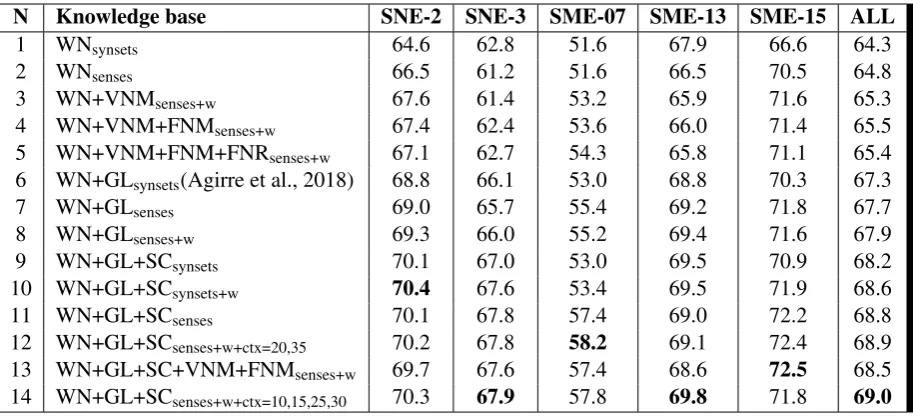
(synset_1, synset_2) its weight is set to the value of the cosine similarity function between the two synsets. The best results for the two types of setting – without and with weights – are re-ported in Table 1, in lines 9 and 10 respectively. Merely reusing the additional relation sets leads to an improvement of 0.9%. Setting the relation weights via the embedding model produces further gain of 0.4%.
4 Improving the Knowledge Base
In this section we present further changes to the knowledge base in order to improve accuracy. These modifications can be summed up as follows:
• Changing the shape of the graph by repre-senting nodes in terms of word senses
• Defining weights on the knowledge graph arcs via embedding models
• Extraction of new relations from different ex-ternal sources
We present each of these in turn.
4.1 Sense-Based vs. Synset-Based WSD
When constructing the KB, the UKB system gen-eralizes lexical meaning in a number of ways. One of these is the use of synset IDs as nodes in the se-mantic network. Here is an example of a relation as represented in the KB distributed together with the UKB system:
u:00007846-n v:04618781-n s:derivation
where u:00007846-n and v:04618781-n
represent two nodes in the KB and where there ex-ists a relation between them. The source of this connection is a derivational relation encoded in WordNet. 00007846-nis the identifier3 for the synset including the following senses4:
person%1:03:00::, individual%1:03:00::, someone%1:03:00::, somebody%1:03:00::, mortal%1:03:00::, soul%1:03:00::
The second node corresponds to the following synset:
personhood%1:07:00::
As made apparent by this example, the deriva-tional relation holds only between two of these senses5:
u:person%1:03:00::-n
v:personhood%1:07:00::-n s:derivation
We have exploited this original representation in order to construct the new KB format. The biggest open question we have been faced with is how to represent the synonymy relation. The first option considered was representing it in the same way as in the WordNet distribution:
00007846-n person%1:03:00::-n 00007846-n individual%1:03:00::-n 00007846-n someone%1:03:00::-n 00007846-n somebody%1:03:00::-n 00007846-n mortal%1:03:00::-n 00007846-n soul%1:03:00::-n
This approach was our first choice. The relation representation in the KB follows the distinction between lexical relations holding among senses and semantic relations holding among synsets. After several experiments with this new represen-tation of the KB it became clear that the novel for-mat does not lead to improved accuracy.
Subsequently, we have excluded the synset identifiers from the representation of the KB. In
3
This identifier is formed out of the original identifiers in WordNet. The original part-of-speech prefix is deleted and a part-of-speech suffix is added in its place.
4
A sense in WordNet is defined as a combination of a lemma and a concept represented by a synset.
also with lemma embeddings trained analogously to the synset embeddings (see Goikoetxea et al. (2015) on how to generate pseudo corpora from WordNet and subsequently train embedding mod-els on them).
For instance, for the sense
person%1:03:00::-n, the associated list of synset and lemma IDs includes 00007846-n
and person. In the case when only a lemma embedding is available, the corresponding vector is used. In the case of multi-word expressions like physical_object%1:03:00::-n, the average of the vectors for the different component words is calculated. In the case when there are both a synset and a lemma embedding available, the concatenation of the two vectors is considered. The following embeddings have been used in the current work:
• GoogleNews. A word embedding model trained over 100 billion running words. The vectors are of size 300.
• Glove.Word embeddings trained over global contexts, as described in Pennington et al. (2014).
• WN30WN30glConOne. Synset and lemma embeddings trained by Simov et al. (2017).
• WN30WN30glConOneWiki. In this case a lemmatized Wikipedia corpus has been added to the pseudo corpus, in order to bal-ance information from the knowledge graph with actual text data.
The weights associated with the different word senses in the new lexicon, which also play an im-portant role for the optimal performance of the UKB system, are the same as those associated with synset identifiers in the original lexicon in the UKB distribution. This is so because the frequen-cies have been originally determined on the ba-sis of sense occurencies in "various semantic con-cordance texts" (according to the documentation, quoted in Agirre et al. (2018)). Consequently, the conjunction of lemma and synset ID in the lexi-con provides a unique mapping to a singular word sense, regardless of the structure of the KB.
4.3 Linking WordNet to VerbNet and FrameNet
VerbNet (Schuler, 2005) and FrameNet (Baker et al., 1998) are structured lexical resources which
glove/
provide information that is, from a theoretical point of view, complementary to that within Word-Net. While the latter’s semantic network is a rich representation of lexical semantics, the for-mer give more insight into sentential semantics.
VerbNet classes bring together verbs that share the same syntactic subcategorization and semantic valency patterns. Membership in a VerbNet class does not necessarily indicate that the lexical items have a similar meaning (although that is often the case), but that they share some kind of structurally analogous behaviour, which is certainly a kind of information that is not present in WordNet. For instance, the verbbuyis in the same class ashire, lease, rent, but in the same class are also the verbs catch, choose, pluck, slaughter10.
FrameNet organizes lexical knowledge around particular procedural scenarios calledframes (Fill-more, 1968). An example of a FrameNet frame would beCommerce_buy11, which specifiesframe elements, i.e. participants and specifications of the situation, such as Buyer, Goods, Seller, Means, Money, etc. A frame is activated by certain lexi-cal units, in this casebuy, buyer, client, purchase (noun), purchase (verb), purchaser. Frames can be linked with one another, through relations like Inherits from, Is used by, etc.
As part of the effort to complement already ex-isting relation sets for KBWSD, the WordNet se-mantic network has been partially connected to those of VerbNet and FrameNet. The Predicate Matrix resource12(De Lacalle et al., 2014, 2016), which automatically maps the WordNet, VerbNet, FrameNet, PropBank and MCR indices, has been used to obtain most of the cross-mappings; in the case of VerbNet, some of the verbs have already been mapped to WordNet senses, but Predicate Matrix can be used to extend the coverage of the mapping. In this way all WordNet sense identi-fiers that could be mapped to predicates in Verb-Net classes and FrameVerb-Net frames have been orga-nized in structures that reflect this kind of member-ship in the external resources. This has been done in a way that is similar to the one described earlier in relation to graphically connecting the various word senses in a synset. That is, the word sense
10
http://verbs.colorado.edu/verb-index/ vn/get-13.5.1.php
11
The frame index is available athttps://framenet. icsi.berkeley.edu/fndrupal/frameIndex.
12http://adimen.si.ehu.es/web/
N Knowledge base SNE-2 SNE-3 SME-07 SME-13 SME-15 ALL
1 WNsynsets 64.6 62.8 51.6 67.9 66.6 64.3
2 WNsenses 66.5 61.2 51.6 66.5 70.5 64.8
3 WN+VNMsenses+w 67.6 61.4 53.2 65.9 71.6 65.3
4 WN+VNM+FNMsenses+w 67.4 62.4 53.6 66.0 71.4 65.5
5 WN+VNM+FNM+FNRsenses+w 67.1 62.7 54.3 65.8 71.1 65.4
6 WN+GLsynsets(Agirre et al., 2018) 68.8 66.1 53.0 68.8 70.3 67.3
7 WN+GLsenses 69.0 65.7 55.4 69.2 71.8 67.7
8 WN+GLsenses+w 69.3 66.0 55.2 69.4 71.6 67.9
9 WN+GL+SCsynsets 70.1 67.0 53.0 69.5 70.9 68.2
10 WN+GL+SCsynsets+w 70.4 67.6 53.4 69.5 71.9 68.6
11 WN+GL+SCsenses 70.1 67.8 57.4 69.0 72.2 68.8
12 WN+GL+SCsenses+w+ctx=20,35 70.2 67.8 58.2 69.1 72.4 68.9
13 WN+GL+SC+VNM+FNMsenses+w 69.7 67.6 57.4 68.6 72.5 68.5
14 WN+GL+SCsenses+w+ctx=10,15,25,30 70.3 67.9 57.8 69.8 71.8 69.0
Table 1: Accuracy scores on the UEF data sets with different KBs. Only the results for the Ppr_w2w mode of the PageRank algorithm are reported. The synset-based models use KBs where the nodes are represented by synset IDs in WordNet; sense-based models use the new KB configurations described in the paper; the+wsubscript means that a model takes into account relation weights. WNstands for the original WordNet relations;GL– the relations from the annotated gloss corpus;SC– the relations from the automatically parsed SemCor corpus;VNM– the sense groupings from VerbNet;FNM– the sense groupings from FrameNet; FNR– the links between FrameNet predicate senses and role-type senses. All experiments use the default parametrization from Agirre et al. (2018), with the exception of the cases marked with a subscriptctx=num, where the context windows have been changed to includenumwords. The best result (line 14) is achieved for contexts with 10, 15, 25 and 30 words.SNEstands forSenseval andSMEstands forSemEval.
WSD system SNE-2 SNE-3 SME-07 SME-13 SME-15 ALL Luo et al. (2018a) 72.8 70.3 —* 68.5 72.8 71.1 Luo et al. (2018b) 72.2 70.5 —* 67.2 72.6 70.6 Raganato et al. (2017b) 72.0 69.1 64.8* 66.9 71.5 69.9 Iacobacci et al. (2016)† 73.3 69.6 61.1 66.7 70.4 69.7 Melamud et al. (2016)† 72.3 68.2 61.5 67.2 71.7 69.4 Agirre et al. (2018)† 68.8 66.1 53.0 68.8 70.3 67.3 Moro et al. (2014)† 67.0 63.5 51.6 66.4 70.3 65.5 WN 1st sense† 66.8 66.2 55.2 63.0 67.8 65.2 This workbest 70.3 67.9 57.8 69.8 71.8 69.0
Table 2: The state of the art across WSD systems. The dagger symbol indicates that the result is reported in the UEF (Raganato et al., 2017a). * Luo et al. (2018a,b) do not report accuracy on SME07 since it is used as a development set; this is also true for Raganato et al. (2017b), which however does report the result. The KBWSD models in the table (ours and those by Agirre and Moro) are deterministic, i.e. they would always produce the same results with particular KBs, as no actual training is involved.
in a class/frame with the highest associated fre-quency of use is promoted to main node status that stands in for the whole structure, then all the rest of the senses are connected to it by setting a con-nection weight according to their respective fre-quencies (including a +1-count smoothing). The
verb class hierarchy and inter-frame connection relations are also included in the new subgraph.
Additionally, the automatically created FrameNet extension13by Bryl et al. (2012), which
13
https://dh.fbk.eu/technologies/
maps FrameNet roles to WordNet synsets, has been used to add links between predicate word senses grouped in frames and role-filling word senses. These new relations are weighted in accordance with the numbers provided by the generated sense repository, which correspond to frequencies of use in an automatically tagged corpus. The procedures described above should provide higher inter-predicate connection density (the class/frame membership relations) in the KB and also more syntagmatically oriented relations (the FrameNet role senses mapped to frame lexical unit senses).
5 Experiments
In this section we provide several empirical points of view to the currently presented project of ex-tending and optimizing the knowledge graph used for WSD. First we examine how the reconfigura-tion of the graph in terms of word senses compares with the synset-based graph and show that the new structure outperforms the previous one. In paral-lel with that we demonstrate that the introduced KB extensions lead to significant improvements over the baseline graphs. We also provide our own contribution to the optimal parametrization of the UKB system.
KB permutations Table 1 shows the various combinations of KB relations, KB structuring and parametrization of the UKB system. Several note-worthy observations come to the fore:
1. By comparing lines 1&2, 6&7, 9&11, it be-comes clear that the KBs structured around word senses perform better than those where nodes are represented by synset IDs.
2. The addition of relations extracted from the VerbNet-WordNet-FrameNet (gold and au-tomatic) mappings does improve the base-line results over the WN relations (base-lines 3-5). VNM builds over WN accuracy, FNM builds over WN+VNM, while FNR does not seem to decisively improve results (though on some data sets it does help – SNE-3 and SME-07). 3. The addition of the gloss and SemCor rela-tions has a very significant effect on accuracy when compared to using just the baseline WN relations (lines 6-14).
4. The VN-FN relations do not seem to reliably improve accuracy when added to the gloss and SemCor relations, in fact they improve
accuracy only on one data set (SME-15) and in the rest of the cases bring it down (line 13). 5. The default parameters from Agirre et al. (2018) are indeed a good optimization of the UKB system. We have been able to improve the result with the best KB only in one case, which we report here, and the improvement is not very big (0.1%; line 14). The result nevertheless indicates that there is space for optimizing the interaction between KB and algorithm.
Comparison with state-of-the-art models Ta-ble 2 situates our best result in the context of the state-of-the-art results in WSD at large. Again, several observations are worth pointing out:
1. The combination of UKB with our best-performing graph comfortably beats the WN 1st sense heuristic, which is not the case for many WSD systems.
2. The model significantly outperforms all KB-WSD models reported in the UEF, includ-ing the improved parametrization of Agirre et al. (2018), whose results we have improved upon with 1.7%.
3. Our result is at this point very close to the top-performing WSD systems, regardless of whether they are supervised or not. This has typically not been the case for KBWSD sys-tems. For one data set (SME-13) the present model achieves the highest result of all14and for another one (SME-15) it is better than all but the two leading supervised systems.
Improvements with static PageRank Finally, in table 3 we show the performance of three dif-ferent versions of the PageRank algorithm, as implemented in the UKB system and described in Agirre and Soroa (2009). The results with the static version have been very significantly improved in comparison to the results reported in Agirre et al. (2018). The static mode per-forms better than the WN 1st sense heuristic when used with the specified graphs. The difference between the w1 and w2 models is as follows: with w1 weights are set via a combination of WN30WN30glConOne embeddings for synsets and lemmas, and withw2– via a combination of
Knowledge base Spr Ppr Ppr_w2w WN+GLsynsets(Agirre et al., 2018) 57.7 65.6 67.3
WN+GL+SCsenses+w1 65.5 65.2 68.9
WN+GL+SCsenses+w2 66.5 65.1 68.0
WN+GL+SC+SCRsenses+w2 66.6 65.1 68.1
Table 3: Comparison between different PageRank versions (accuracy measured on all UEF test data sets). Spr stands for static mode, Ppr isPersonalized PageRank, Ppr_w2ris Ppr with emphasis on neighbouring concepts.w1denotes weights set via the combination ofWN30WN30glConOne embed-dings for synsets and lemmas;w2denotes the combination ofWN30WN30glConOneWikiembeddings.
WN30WN30glConOneWiki embeddings, again for synsets and for lemmas. TheSCRrelation set, which is built on the basis of co-occurrences of word senses in SemCor, contributes positively to the best static model. Compared with previous state-of-the-art results when using static PageR-ank, here we can see an improvement of nearly 9%.
Bearing in mind that the static version of the al-gorithm is much faster than the personalized ones, these results should also be interpreted as impor-tant, as they demonstrate that KB improvement might be even more beneficial for less sophisti-cated methods that nevertheless offer a good trade-off in terms of speed of execution.
6 Conslusion
We have presented results from a series of experi-ments with a KBWSD system with state-of-the-art default parametrization and have shown that accu-racy can be further improved through the manipu-lation and extension of the KB. The present mod-els achieve the highest reported accuracy scores for a KBWSD system that we are aware of; they also enter in the close orbit of the highest-scoring supervised systems, achieving a new state of the art on the Semeval-13 data set.
Further improvement to the content of the KB is certainly possible. Based on the reported ex-periments, an intuition emerges that the relation weighting schema has to have a dynamic charac-ter. This would correspond to the promotion and demotion of semantic features within context. The current implementation relies on the PageRank al-gorithms to maintain this kind of dynamics. The experiments also demonstrate that the different weighting schemata improve the performance of different algorithms, which suggests complex pat-terns of interaction between algorithm and graph structure. The current schemata do not distinguish
between different kinds of relations. The differ-ence between paradigmatic and syntagmatic rela-tions necessitates different weighting approaches. Using the cosine similarity measure over the entire embedding space seems to be a suboptimal blan-ket strategy. In our future research we plan to train relation embeddings, following the approach for generating pseudo corpora, as in the case of train-ing synset and lemma embeddtrain-ings.
Additionally, we plan on further investigating strategies for generalizing knowledge from exter-nal resources such as VerbNet and FrameNet, as well as other ones which can be mapped to Word-Net, such as PropBank (Kingsbury and Palmer, 2002) and the OntoNotes sense groupings (Snow et al., 2007). As has been demonstrated, struc-turing a lexico-semantic graph in an optimal way can make a big difference. Detailed error analysis and sophisticated linguistic theory should be em-ployed in order to capture the principles underly-ing a good knowledge base.
Acknowledgements
This research has been funded by the Bulgarian National Science Fund grant number 02/12/2016 — Deep Models of Semantic Knowledge (De-moSem). Alexander Popov’s contribution has been also supported by the Bulgarian Ministry of Edu-cation and Science under the National Research Programme “Young scientists and postdoctoral students" approved by DCM # 577 / 17.08.2018.
References
mul-Lawrence Page, Sergey Brin, Rajeev Motwani, and Terry Winograd. 1999. The PageRank Citation Ranking: Bringing Order to the Web. Technical Re-port 1999-66, Stanford InfoLab. Previous number = SIDL-WP-1999-0120.
Jeffrey Pennington, Richard Socher, and Christopher Manning. 2014. Glove: Global vectors for word representation. In Proceedings of the 2014 Con-ference on Empirical Methods in Natural Language Processing (EMNLP), pages 1532–1543. Associa-tion for ComputaAssocia-tional Linguistics.
Alessandro Raganato, Jose Camacho-Collados, and Roberto Navigli. 2017a. Word Sense Disambigua-tion: A unified evaluation framework and empirical comparison. InProceedings of the 15th Conference of the European Chapter of the Association for Com-putational Linguistics: Volume 1, Long Papers, vol-ume 1, pages 99–110.
Alessandro Raganato, Claudio Delli Bovi, and Roberto Navigli. 2017b. Neural Sequence Learning Mod-els for Word Sense Disambiguation. In Proceed-ings of the 2017 Conference on Empirical Methods in Natural Language Processing, pages 1156–1167, Copenhagen, Denmark. Association for Computa-tional Linguistics.
Karin Kipper Schuler. 2005. VerbNet: A broad-coverage, comprehensive verb lexicon. Ph.D. thesis, University of Pennsylvania.
Kiril Simov, Petya Osenova, and Alexander Popov. 2016. Using Context Information for Knowledge-Based Word Sense Disambiguation. InArtificial In-telligence: Methodology, Systems, and Applications, pages 130–139, Cham. Springer International Pub-lishing.
Kiril Simov, Petya Osenova, and Alexander Popov. 2017. Comparison of word embeddings from dif-ferent knowledge graphs. InLanguage, Data, and Knowledge, pages 213–221, Cham. Springer Inter-national Publishing.
Rion Snow, Sushant Prakash, Daniel Jurafsky, and An-drew Y. Ng. 2007. Learning to merge word senses. In Proceedings of the 2007 Joint Conference on Empirical Methods in Natural Language Process-ing and Computational Natural Language LearnProcess-ing (EMNLP-CoNLL), pages 1005–1014, Prague, Czech Republic. Association for Computational Linguis-tics.
Kaveh Taghipour and Hwee Tou Ng. 2015. One mil-lion sense-tagged instances for word sense disam-biguation and induction. InProceedings of the Nine-teenth Conference on Computational Natural Lan-guage Learning, pages 338–344, Beijing, China. Association for Computational Linguistics.
Zhi Zhong and Hwee Tou Ng. 2010. It makes sense: A wide-coverage word sense disambiguation system