Proceedings of Recent Advances in Natural Language Processing, pages 284–290,
Natural Language Processing Technologies for Document Profiling
Antonio Guillén, Yoan Gutiérrez and Rafael Muñoz Department of Software and Computing Systems
University of Alicante, San Vicente del Raspeig (Alicante), Spain {aguillen, ygutierrez, rafael}@dlsi.ua.es
Abstract
Nowadays, search for documents on the Internet is becoming increasingly difficult. The reason is the amount of content pub-lished by users (articles, comments, blogs, reviews). How to facilitate that the users can find their required documents? What would be necessary to provide useful doc-ument meta-data for supporting search en-gines? In this article, we present a study of some Natural Language Processing (NLP) technologies that can be useful for facil-itating the proper identification of docu-ments according to the user needs. For this purpose, it is designed a document pro-file that will be able to represent seman-tic meta-data extracted from documents by using NLP technologies. The research is basically focused on the study of different NLP technologies in order to support the creation our novel document profile pro-posal from semantic perspectives.
1 Introduction
The Internet provides large amounts of informa-tion through many types of documents. Users re-quire an easy way to filter these documents to find out the most appropriate documents for their inter-ests, capabilities and needs. These documents also can be needed by other entities for market stud-ies, classify and index documents, detect fake in-formation or illegal activities on the Web. These aspects can be treated by the study of NLP areas, tasks, methods and tools.
In this paper, we present a study on some NLP tasks to determinate which NLP technologies are interesting to extract and obtain relevant informa-tion from a document. In this study, we want to ad-dress which technologies are available currently, estimate its automation and reliability degree, the problems that can be found on applying them and
the most appropriate document’s extension. Also, we describe our novel document profile proposal.
A document can be defined as short or long unity of information, principally obtained from websites (a user post, a press article, a comment, a review, etc.). The aim of this study is to investi-gate the different features that can be extracted by means NLP technologies able to provide enough information for setting up useful meta-data.
For addressing this study we organized the arti-cle into two relevant parts. The first part, Section
2, explains what we want to accomplish describing our novel document profile proposal. The second part, Section3, addresses a study of selected NLP tasks and technologies which serve for supporting the proposal. Finally, Section4exposes the con-clusions and future works.
2 Document Profile Proposal
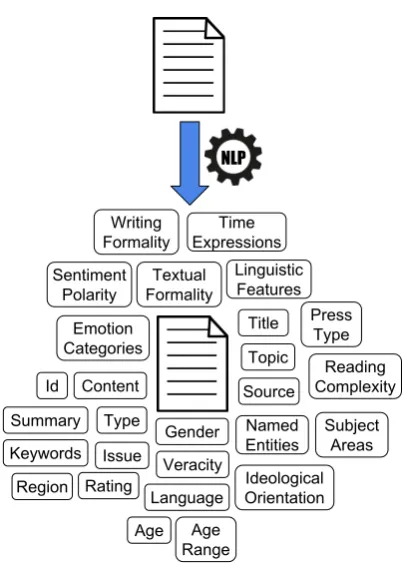
Our proposal mainly consists of designing a doc-ument profile able to represent different features extracted once NLP technologies are applied on documents, assisted or not by humans. Figure 1
provides a brief overview. As can be seen, there are many features that can only be extracted auto-matically from documents by using NLP technolo-gies. This work pretends to unify most of these NLP technologies as a whole able to characterize documents from different points of view.
2.1 Documents and NLP Areas
As a first approach, this work will be focused on English documents from the Internet. This is due to NLP technologies have been mostly developed to cover this language and which makes easier to find out NLP tools. Nevertheless, the overall strat-egy is still valid for other languages. The princi-pal documents addressed are those mostly avail-able on the Internet1. Those are press media, so-cial posts, product/service reviews, blogs or
per-1http://www.quantcast.com/top-sites
Algorithm 1Document Profiling Require: url, Web document url
1: cont←getContent(url) 2: sum←getSummary(cont) 3: type←getType(cont)
4: profile←newProfile(cont,sum,type) 5: listProperties←getProperties(type) 6: for eachprop∈listPropertiesdo 7: nlpTech←prop.getNlpTech() 8: value←nlpTech(cont,summ) 9: profile.add(prop,value)
2.5 A Document Profile Example
In order to figure out how would be a document profile, we have prepared an example considering a document taken from the CNN website. The document is a real news article about Everest’s climber George Mallory. He’s the first person who tried climb to summit the Everest. He was disap-peared and his body was found 75 years later. Ex-pert people tried to discover if he reached the top of Mount Everest or not. The complete news arti-cle it’s available in CNN website5. The procedure follows as to describe the algorithm 1, based on the technologies presented in Table 1, obtaining the next document profile6.
A brief description of the features set is com-mented following: (i) The Id property is auto-gen-erated. (ii) The document type detected is Press Document. (iii)Content,TitleandIssuemeta-data properties can be extracted directly from the arti-cle, and the source corresponds to the web URL of article. (iv) The content summary is gener-ated. (v) The topics list represents the most fre-quently used terms in the text. (vi) The region is obtained analyzing the text, in this case, it talks about the north ridge of Mount Everest located in Tibet (China). About the subject areas detected, we can seeHistorybecause it is a historical news article andSportsit talks about climbing. (vii) The language detected is English. (viii) The article does not presents any rating. (ix) Keywords are the more representative words of the whole text. (x) In this article, it is not detected any ideolog-ical orientation because it only talks about a his-torical fact related to sports. (xi) Sentiment polar-ity determines that it is a positive news for peo-ple interested in history, climbing and the Mount
5http://ow.ly/7JtB305V8z6 6http://ow.ly/Pnmj30dNVtQ
Everest. (xii) It is detected the emotion category
Surprise because the man’s body has been found 75 years later, something unexpected. (xiii) Some time expressions are detected in the text, these ex-pressions have been converted into date format. (xiv) The name entities detected refer persons and locations retrieved in the text. (xv) In this article is not detected any linguistic feature. (xvi) Reading complexity isEasyand withFormaltext and writ-ing. The news article is from a serious press me-dia. The article is feasible to be read by 12 years old people over, since it is a neutral and simplified information. (xvii) The age of author is not pre-dicted due to the high neutrality of the text. How-ever, the gender is predicted asFemale. (xviii) The press type is classified asNews Articleand its ve-racity isTruthful, taking into account the formality of press media.
3 NLP Technologies Study
This section describes in more detail each NLP task considered in our work and exposes some available technologies: tools, APIs or demos re-lated. In some cases, only methods and algorithms had been found. Mainly works with evaluations and results are presented. In this study, our inter-ests are mainly focused on available technology (Web service/API, programming library) with cer-tain automation degree to be able to be incorpo-rated in future frameworks or prototypes. In the final section, it is exposed a comparison table of some NLP technologies studied in terms of au-tomation and reliability degrees.
Text Classification
Text classification task (TC) consists of identify-ing the type of document by analyzidentify-ing its content. The relevance of this task in document profiling is to determinate which type of document is ana-lyzed, depending its type different features would be extracted. For example, Dandelion API7 cat-egorises plain text on eight categories: business, economy, sports, etc.
Information Extraction
Information Extraction task (IE) as has been ad-dressed by (Vila et al.,2013) is a way to search and obtain text on large volumes of unstructured infor-mation to filter relevant inforinfor-mation, using regu-lar expressions, rules and patterns. This is
ful for document profiling because many complex meta-data can be obtained directly from the docu-ment. Since our work is mostly focused on Web documents there are too many tools like DEiXTo8 that can extract information from the W3C DOM documents. The problem with these tools is the low-automation degree due to they should be re-configured.
Topic Recognition
Topic Recognition task (TR) consists of identify-ing topics in the text. This task is interestidentify-ing to classify a document in multiple categories or top-ics and know the different aspects that dealt the document. TextRazor9is a Web tool that lists top-ics from a text. Also, another Web demo is Mean-ing Cloud10that offers many NLP services among which topic recognition is included.
Keyword Extraction
Keyword Extraction task (KE) is the automatic ex-traction of relevant terms from a document. Un-like TR, KE doesn’t intend to know the different aspects that dealt the document, KE extracts terms that best describe the subject of the document. Sta-tistical Keyword Extraction Tool (SKET) (Rossi et al.,2013) is a programming library for extract-ing keywords from the text.
Named Entity Recognition
Named Entity Recognition task (NER) tries to lo-cate and classify named entities according to dif-ferent categories like names of persons, organiza-tions, etc. Stanford NER (Finkel et al., 2005) is a NLP technology available as a programming li-brary and evaluated in some scenarios, domains and corpora, that offers useful NER services.
Time Expression Recognition
Time Expression Recognition task (TER) consists of obtaining temporal expressions from texts. This information is useful to extract historical facts in texts or documents. Stanford SUTime (Chang and Manning,2012) is a tested technology and avail-able to be used as a programming library. An al-ternative is TIPSem (Llorens et al., 2010) which has been tested and available as API.
8http://dexi.io
9http://www.textrazor.com 10http://www.meaningcloud.com
Automatic Summarization
Automatic Summarization task (AS) obtains a re-duced text from a larger text content. It’s interest-ing to obtain a short version of the same document. (Alcón and Lloret, 2015-07) presents a summa-rization system for various purposes and domains. This system has been evaluated and is available as API.
Domain Detection
Domain Detection task (DD) is part of Semantic Parsing. This task detects the meaning of sentence using probabilistic semantic models. Our work is focused on ISR-WN (Gutiérrez et al.,2016) which is able to detect domains or categories from differ-ent resources obtaining and using relevant seman-tic trees from a text.
Language Identification
Language Identification task (LI) consists of iden-tifying the language. AlchemyLanguage11 is a Web demo that offers many NLP services for that purpose.
Polarity Classification
Polarity Classification task (PC) is part of Senti-ment Analysis. According to (Mohammad,2016) this consists of determining whether a text in pos-itive, negative or neutral. Many PC approaches are using machine and deep learning which ob-tains good results. Among others, we mention two relevant works: (Kiritchenko et al., 2014) which presents an approach using supervised statistical machine learning, and Stanford Sentiment (Socher et al.,2013) that is available as a programming li-brary.
Emotion Detection
Emotion Detection task (ED) is part of Sentiment Analysis. This consists of identifying some emo-tions expressed in texts. The following set of the basic emotional categories proposed by (Ekman,
2005) are included in this work: Anger, Disgust, Fear, Joy, Sadness and Surprise. One issue of this task is the lack of annotated corpus for evaluation. ToneAnalyzer12 is a web demo of multiple NLP APIs, including the emotion detection task with 5 Ekman categories: Anger, Disgust, Fear, Joy and Sadness.
Readability Analysis
Readability Analysis task (RA) according to (Martín Valdivia et al., 2014), the detection of RC consists of determining documents suitable for being read by specific people age ranges. This includes determining reading difficulties or text comprehension. For addressing this task it is nec-essary to classify documents on the basis of dif-ferent levels of reading comprehension. Difdif-ferent measures of readability must be selected, we base our work on the study Flesh-Kincaid Grade Level. This study tries to predict the recommended age to understand the text. The tool Readable.io13 is a web demo for evaluating the readability level of a text using various grade levels, including Flesh-Kincaid Grade Level.
Informality Analysis
Informality Analysis task (IA) tries to detect the degree informality in texts. This task arises due to the necessity of processing in a personalized way non-traditional textual sources existing on the In-ternet (i.e. blogs, forums, etc.). TENOR ( Mos-quera and Moreda,2012) provides functionalities aligned to this task.
Age Estimation
Age Estimation task (AE) is part of the Author Profiling area. According to (Rangel and Rosso,
2016) AE tries to predict some aspects of authors like age or gender. This task will contribute to our research the discovery of various authors types de-pending on age ranges. Age Analyzer14 is a web API that provides functionalities aligned to this task.
Gender Detection
Gender Detection task (GD) is strongly related to AE task, but in this case, it tries to detect the gen-der of text’s author. Gengen-der Analyzer15 is appro-priated to this task as has been before mentioned. Irony Detection
Irony Detection task (ID) tries to detect if a lit-eral message has an opposite meaning, without a negation marker. The difficulty resides the ab-sence of face-to-face contact and vocal intonation. In the automatic detection of irony is used senti-ment analysis, information extraction or decision
13http://readable.io 14http://ageanalyzer.com 15http://www.genderanalyzer.com
making to obtain textual features for recognizing irony. (Reyes et al.,2013) presents a research for irony detection in Twitter short documents, using the tasks mentioned above.
Ideology Detection
Ideology Detection task (IDD) tries to detect the ideology orientation expressed in a text content based on a set of opinions or beliefs. Usually, this refers to a set of political beliefs or a set of ideas that characterise a particular culture. (Iyyer et al.,2014) presents a research work where polit-ical ideology orientation is detected using neural network technologies.
3.1 Automation and Reliability Study
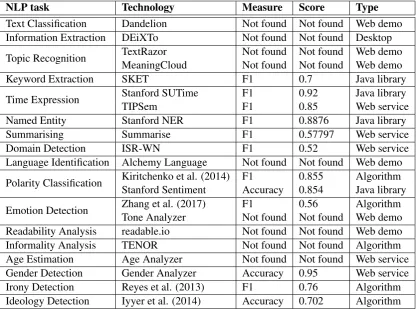
pri-NLP task Technology Measure Score Type Text Classification Dandelion Not found Not found Web demo Information Extraction DEiXTo Not found Not found Desktop Topic Recognition TextRazorMeaningCloud Not found Not found Web demoNot found Not found Web demo
Keyword Extraction SKET F1 0.7 Java library
Time Expression Stanford SUTimeTIPSem F1F1 0.920.85 Java libraryWeb service
Named Entity Stanford NER F1 0.8876 Java library
Summarising Summarise F1 0.57797 Web service
Domain Detection ISR-WN F1 0.52 Web service
Language Identification Alchemy Language Not found Not found Web demo Polarity Classification Kiritchenko et al. (2014) F1Stanford Sentiment Accuracy 0.8550.854 AlgorithmJava library
Emotion Detection Zhang et al. (2017)Tone Analyzer F1Not found Not found Web demo0.56 Algorithm Readability Analysis readable.io Not found Not found Web demo Informality Analysis TENOR Not found Not found Algorithm Age Estimation Age Analyzer Not found Not found Web service Gender Detection Gender Analyzer Accuracy 0.95 Web service
Irony Detection Reyes et al. (2013) F1 0.76 Algorithm
Ideology Detection Iyyer et al. (2014) Accuracy 0.702 Algorithm
Table 1: NLP technologies comparisons.
vate research. However, it is interesting to study them for future evaluations. At respect to Web de-mos, these offer limited NLP services which could be possible resolve through business registration or payment of services. Regarding the type "Al-gorithm", in some cases, this one is not available in the reference papers. Nevertheless, it is con-sidered because the authors could be contacted in some way.
4 Conclusion and Future Work
In this paper, we presented the study of useful NLP technologies to automate the process of building document’s profiles. The study revealed that many NLP technologies are interesting to this aim, how-ever, many of them are difficult to be reused. This depends on the licenses of use, visibility, replica-bility of their algorithms, etc. Another issue is the lack of annotated corpora to evaluate the tech-nologies involved. Clearly, knowing the difficul-ties found to reuse the NLP technologies will help us to be more focused on considering those tech-nologies with high-automation degree instead of high-reliability degree.
As result, in this paper we demonstrated that
many different NLP technologies can converge all in a unique ecosystem, in our case for profiling documents, to be able to provide advanced sights about documents. Based on this result (a ment profile), it can be facilitated searching docu-ments and even be able to recommend docudocu-ments to users taking into account different perspectives never before considered.
As future work, we plan to create a dataset for further supporting the creation and evaluation of document profile. In addition, the study of the results of evaluating different types of document profiles (i.e. social, press, book, etc.) will be in-cluded in our research agenda.
Acknowledgements
References
Óscar Alcón and Elena Lloret. 2015-07. Estudio de la influencia de incorporar conocimiento léxico-semántico a la técnica de análisis de componentes principales para la generación de resúmenes multil-ingües.
M E Basiri, A R Naghsh-Nilchi, and N Ghasem-Aghaee. 2014. Sentiment prediction based on dempster-shafer theory of evidence. Math-ematical Problems in Engineering 2014.
https://doi.org/10.1155/2014/361201.
Angel X. Chang and Christopher D. Manning. 2012. Sutime: A library for recognizing and normalizing time expressions. InIn LREC.
Paul Ekman. 2005. Basic Emotions, John Wiley Sons, Ltd.
Jenny Rose Finkel, Trond Grenager, and Christo-pher Manning. 2005. Incorporating non-local in-formation into inin-formation extraction systems by gibbs sampling. In Proceedings of the 43rd An-nual Meeting on Association for Computational Lin-guistics. Association for Computational Linguistics, Stroudsburg, PA, USA, ACL ’05, pages 363–370.
https://doi.org/10.3115/1219840.1219885.
Rachel M Green, John W Sheppard, Jim Cramer, Lau-ren Young, Josh Brown, and Ben White. 2013. Comparing Frequency- and Style-Based Features for Twitter Author Identification. Proceedings of the Twenty-Sixth International Florida Artificial Intelli-gence Research Society Conferencepages 64–69. Yoan Gutiérrez, Sonia Vázquez, and Andrés Montoyo.
2016. A semantic framework for textual data enrich-ment. Expert Systems with Applications 57:248– 269.
Diego Ingaramo, David Pinto, Paolo Rosso, and Marcelo Errecalde. 2008. Evaluation of Internal Validity Measures in Short-Text Corpora, Springer Berlin Heidelberg, Berlin, Heidelberg, pages 555– 567. https://doi.org/10.1007/978-3-540-78135-648.
Mohit Iyyer, Peter Enns, Jordan Boyd-Graber, and Philip Resnik. 2014. Political ideology detection us-ing recursive neural networks. In Association for Computational Linguistics.
Svetlana Kiritchenko, Xiaodan Zhu, and Saif M. Mo-hammad. 2014. Sentiment analysis of short infor-mal texts. J. Artif. Int. Res.50(1):723–762.
Hector Llorens, Estela Saquete, and Borja Navarro. 2010. Temporal expression identification based on semantic roles. In Proceedings of the 14th In-ternational Conference on Applications of Natural Language to Information Systems. NLDB’09, pages 230–242.
María Teresa Martín Valdivia, Eugenio Martínez Cá-mara, Eduard Barbu, Luis Alfonso Ureña López,
Paloma Moreda Pozo, Elena Lloret, et al. 2014. Proyecto first (flexible interactive reading support tool): Desarrollo de una herramienta para ayudar a personas con autismo mediante la simplificación de textos .
Saif M. Mohammad. 2016. Sentiment analysis: De-tecting valence, emotions, and other affectual states from text. In Herb Meiselman, editor,Emotion Mea-surement, Elsevier.
Alejandro Mosquera and Paloma Moreda. 2012. Tenor: A lexical normalisation tool for spanish web 2.0 texts. InText, Speech and Dialogue - 15th Inter-national Conference (TSD 2012). Springer.
Francisco Rangel and Paolo Rosso. 2016. On the impact of emotions on author profiling. Infor-mation Processing and Management 52(1):73–92.
https://doi.org/10.1016/j.ipm.2015.06.003.
Antonio Reyes, Paolo Rosso, and Tony Veale. 2013. A multidimensional approach for detecting irony in twitter. Language Resources and Evaluation 47(1):239–268.
R.G. Rossi, R. M. Marcacini, and S. O. Rezende. 2013. Analysis of statistical keyword extraction methods for incremental clustering.
Prasha Shrestha, Sebastian Sierra, Fabio A González, Paolo Rosso, Manuel Montes-y Gómez, and Thamar Solorio. 2017. Convolutional neural networks for authorship attribution of short texts. EACL 2017 page 669.
Richard Socher, Alex Perelygin, Jean Wu, Jason Chuang, Christopher D. Manning, Andrew Y. Ng, and Christopher Potts. 2013. Recursive deep mod-els for semantic compositionality over a sentiment treebank. In Proceedings of the 2013 Conference on Empirical Methods in Natural Language Pro-cessing. Association for Computational Linguistics, Stroudsburg, PA, pages 1631–1642.
Katia Vila, Antonio Fernández, José M. Gómez, Antonio Ferrández, and Josval Díaz. 2013.
Noise-tolerance feasibility for restricted-domain Information Retrieval systems. Data and Knowledge Engineering 86:276–294.