Proceedings of Recent Advances in Natural Language Processing, pages 679–685,
Towards Lexical Chains for Knowledge-Graph-based Word Embeddings
Kiril Simov Svetla Boytcheva
Linguistic Modeling and Knowledge Processing Department Institute of Information and Communication Technology
Bulgarian Academy of Sciences
[email protected], [email protected], [email protected]
Petya Osenova
Abstract
Word vectors with varying dimensionali-ties and produced by different algorithms have been extensively used in NLP. The corpora that the algorithms are trained on can contain either natural language text (e.g. Wikipedia or newswire articles) or artificially-generated pseudo corpora due to natural data sparseness.
We exploit Lexical Chain based tem-plates over Knowledge Graph for gener-ating pseudo-corpora with controlled lin-guistic value. These corpora are then used for learning word embeddings. A num-ber of experiments have been conducted over the following test sets: WordSim353 Similarity, WordSim353 Relatedness and SimLex-999.
The results show that, on the one hand, the incorporation of many-relation lexi-cal chains improves results, but on the other hand, unrestricted-length chains re-main difficult to handle with respect to their huge quantity.
1 Introduction
Recent research in NLP has focused on distribu-tional semantic models that incorporate linguistic information from various resources. Such mod-els are trained with different algorithms, among which: Network Language Model (NNLM), La-tent Semantic Analysis (LSA), etc. Word em-beddings have become lately a popular distributed representation. Word vectors with varying dimen-sionalities and produced by different algorithms have been extensively put forward in the litera-ture. The corpora that the algorithms are trained on can contain either natural language text (e.g.
Wikipedia or newswire articles) or artificially-generated pseudo corpora, such as the output of the Random Walk on Graphs algorithm, when run to select sequences of nodes from a knowledge graph (KG) — see (Goikoetxea et al., 2015) and (Ristoski and Paulheim, 2016). We denote the pseudo corpus generated via Random Walk on Graphs algorithm asPseudo Corpus RWG.
In this paper we present the results from our initial experiments of training word embeddings on the basis of generated pseudo corpora over a knowledge graph via lexical chain patterns. We name the pseudo corpus generated via lexi-cal chain patterns Pseudo Corpus LC. The main knowledge graph in the experiments is the En-glish WordNet (WN) (Fellbaum,1998). It is rep-resented as nodes corresponding to synsets in WN and arcs corresponding to relations encoded in WN, such as hypernymy, meronymy, entailment, etc. We have extended the graph with new rela-tions between synsets (i.e. additional arcs in the graph). These new relations come from sources outside WordNet, such as relations extracted from semantically annotated corpora or explication of implicit knowledge in WordNet on the basis of in-ference procedures (e.g. transitive closure over the relations). In our previous work we showed that enriching the knowledge graph with more relations can lead to accuracy improvement in the Word Sense Disambiguation (WSD) task — (Simov et al.,2016b), (Simov et al.,2016a).
However, the relevant evaluation of such dis-tributed semantic models still faces some issues. Here a few of the typical problems in this line of work are listed: a) the evaluation datasets merge similarity and association relations, while the models typically favor one subset and sup-press the role of the other; b) uneven frequency of the words in the corpus; c) the impossibility to cover all words with all their meanings in all
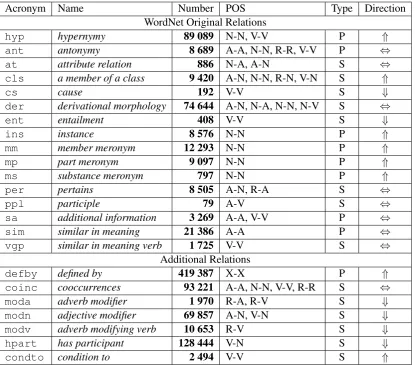
Acronym Name Number POS Type Direction WordNet Original Relations
hyp hypernymy 89 089 N-N, V-V P ⇑
ant antonymy 8 689 A-A, N-N, R-R, V-V P ⇔
at attribute relation 886 N-A, A-N S ⇔
cls a member of a class 9 420 A-N, N-N, R-N, V-N S ⇑
cs cause 192 V-V S ⇓
der derivational morphology 74 644 A-N, N-A, N-N, N-V S ⇔
ent entailment 408 V-V S ⇓
ins instance 8 576 N-N P ⇑
mm member meronym 12 293 N-N P ⇑
mp part meronym 9 097 N-N P ⇑
ms substance meronym 797 N-N P ⇑
per pertains 8 505 A-N, R-A S ⇔
ppl participle 79 A-V S ⇔
sa additional information 3 269 A-A, V-V P ⇔
sim similar in meaning 21 386 A-A P ⇔
vgp similar in meaning verb 1 725 V-V S ⇔
Additional Relations
defby defined by 419 387 X-X P ⇑
coinc cooccurrences 93 221 A-A, N-N, V-V, R-R S ⇔
moda adverb modifier 1 970 R-A, R-V S ⇓
modn adjective modifier 69 857 A-N, V-N S ⇓
modv adverb modifying verb 10 653 R-V S ⇓
hpart has participant 128 444 V-N S ⇓
condto condition to 2 494 V-V S ⇑
Table 1: Relations in Knowledge Graph.
we extract the following relations:{have}hpart
{word}— “word” is a participant in the event de-noted by “have”; {have} hpart {syllable} — “syllable” is a participant in the event denoted by “have”; {word} coinc {syllable} — co-participants in the same event; and {two} moda
{syllable}— “two” modifies “syllable”.
Similarly from {ice-cream cone} defined by “ice cream in a crisp conical wafer” the following logical form is presented:
ice-cream_cone:NN(x1) ->
ice_cream:NN(x1) in:IN(x1, x2) crisp:JJ(x2) conical:JJ(x2) wafer:NN(x2)
From it we extracted the following relation: {crisp} coinc {conical} in the appropriate senses, because they modified the same noun.
The reverse relations have the same character-istics as the original ones, except for the direction which is changed to the opposite one. For some relations the reverse ones are not added because they are symmetric likeantrelation. The knowl-edge graph used in the experiments is defined as
a set of nodes formed by the synsets of WN, and the arcs corresponds to all above relations. This knowledge graph is calledWNUnion.
3.2 Pseudo-corpus Generation
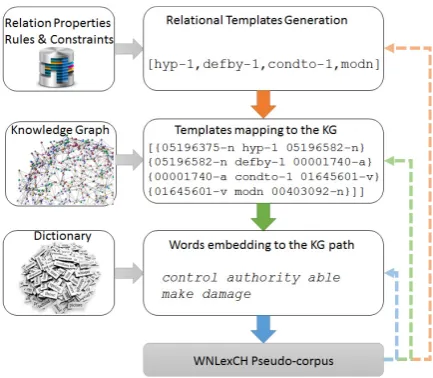
paths — the empty nodes () in templates were filled by synset identifiers in KG. For the template above we generated 8 866 possible combinations of synset ids. Here is one example: {02176178-a}–modn–{03614007-n}–mp– {03928116-n}–hpart-1–{00599992-v}. Finally we applied lemma substitution to each path and generated pseudo sentences. From the above example we generated the follow-ing pseudo sentence: complex keyboard piano learn. Keep in mind that the relation
hpart(and thushpart-1) does not distinguish between the syntactic roles of the event partici-pants. Thus, in the example piano could be a direct object in a real sentence.
Figure 1: WNLexCH pseudo-corpus generation
The method was applied several times iterating the length of the generated templates from 2 up to the desired maximal pseudo sentence length. At each step the method reused the generated templates, paths and pseudo-sentences by joining them into a longer one. The combination of rela-tions in the templates reflects their properties like direction, transitivity, allowed maximal number of repetitions, scope, relation type - paradigmatic and syntagmatic. In addition, some constraints for templates generation were used, like penalties for each direction change; consecutive relation and its opposite were allowed only for transitive relations etc. Note that in these experiments we used only pseudo-sentences generated on the first 3 steps be-cause of the exploding size of the pseudo cor-pus. In the experiments we used subcorpora of WNLexCH, depending on the length of the paths involved in the corresponding subcorpora:
WN-LexCH 2R — paths of length 2 (466 285 957 pseudo sentences); WNLexCH 3R — paths of length 3 (733 998 728 pseudo sentences); WN-LexCH 4R — paths of length 4 (143 416 212 pseudo sentences); and the whole corpus WN-LexCH.
4 Experiment Results
The generated corpora have been fed into the Word2Vec tool6 in order for the models to be trained. Initially, we performed experiments with different settings of the system parameters: con-text window size varying from 1 to 19 words, with the best results in most cases being for context window of 5 and context window of 15 words (ported below); iterations from 1 to 9, with best re-sults for 7 iterations; negative examples set to 5; and frequency cut sampling was set to 7.
The evaluation of the word embeddings was done over the following datasets: Word-Sim353 Similarity,WordSim353 Relatedness7, and SimLex-9998. Each of the datasets consists of pair of words and numeric value of their similarity (WordSim353 SimilarityandSimLex-999) or their relatedness (WordSim353 Relatedness). The nu-merical values were established on the basis of consultation with a number of human subjects. The evaluation was done in the following manner: first, the distance between the words in each pair was calculated on the basis of the corresponding word embedding; then, Spearman’s rank correla-tion between the predicted distances and the gold standard values was calculated.
We have performed a number of experiments through the different subcorpora as described above. As baselines, we evaluated two text-corpus-based word embeddings that are freely available on the web, as well as the best result of Goikoetxea et al. (Goikoetxea et al.,2015), avail-able from the UKB web page9. Thus, the pseudo-corpus-based embeddings have been compared with text-based embeddings. We have selected two text-based sets of word vectors10: Google News trained over 100 billion running words — namedGoogleNews; and Wikipedia dependency trained over context extracted from a dependency analysis of Wikipedia articles — named
Depen-6https://code.google.com/archive/p/word2vec/ 7http://alfonseca.org/eng/research/wordsim353.html. 8https://www.cl.cam.ac.uk/˜fh295/simlex.html 9http://ixa2.si.ehu.es/ukb/
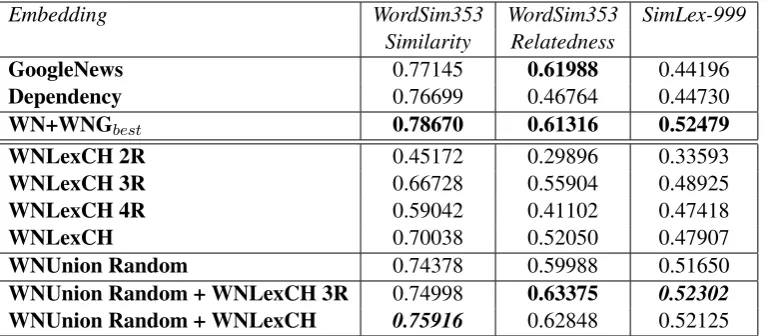
Embedding WordSim353 WordSim353 SimLex-999 Similarity Relatedness
GoogleNews 0.77145 0.61988 0.44196 Dependency 0.76699 0.46764 0.44730 WN+WNGbest 0.78670 0.61316 0.52479
WNLexCH 2R 0.45172 0.29896 0.33593 WNLexCH 3R 0.66728 0.55904 0.48925 WNLexCH 4R 0.59042 0.41102 0.47418
WNLexCH 0.70038 0.52050 0.47907
WNUnion Random 0.74378 0.59988 0.51650 WNUnion Random + WNLexCH 3R 0.74998 0.63375 0.52302
WNUnion Random + WNLexCH 0.75916 0.62848 0.52125
Table 2: Results from experiments with different extensions of the WordNet knowledge graph. All our embeddings were trained with the same options for word2vec.
dency. The results for these baselines are pre-sented in the first three rows of Table 2.
The experiments were divided into two groups: (1) experiments by our algorithm with corpora generated with different numbers of relations; and (2) experiments by the UKB system with a pseudo corpus generated over the same knowledge graph, and its combinations with the corpora generated by our algorithm. In Table2we present some re-sults for each type of the experiments.
The results from the experiments show that in-creasing the length of the lexical chain path im-proves the results of the word embeddings with re-spect to both similarity and relatedness measures. In order to compare our approach to the Pseudo Corpus RWGwe have generated a pseudo corpus over the same knowledge graph WNUnion. The result shows that thePseudo Corpus RWGis bet-ter in comparison to the Pseudo Corpus LCwith its length of the paths up to four. But on the other hand, the combination of thePseudo Corpus RWG and thePseudo Corpus LCproduces better results than each of them separately — the last two rows in Table2.
5 Conclusion
The paper presents an approach to the generation of pseudo corpora on the basis of lexical chain templates over knowledge graphs. We showed that the knowledge within the closer neighborhood of the synsets plays an important role for the simi-larity and relatedness evaluation. In some cases they outperformed the embeddings trained on text corpora. The improvement over Pseudo Corpora RWG, generated on the same KG, shows also that
longer lexical chain paths are necessary. In our view the main reason for the current results is the fact that the pseudo corpus WNLexCH re-flects all the relations in the local context of the synsets in the KG. In our work (Simov et al.,2017) we demonstrated that different combinations of relations in the KG generally improved perfor-mance of similarity and relatedness. Our hope is that knowledge learned by the embeddings over Pseudo Corpus LC is more homogeneous com-paring to embeddings over text corpora where the problem is with the infrequent words. In these cases the embeddings learned less features than the ones for the frequent ones. The problem with the embeddings overPseudo Corpus RWGis that there is no way to control the coverage.
Our research is in-line with the current tendency of building artificial corpora for various NLP tasks due to sparseness and bias of the available data. In future, we envisage to do experiments with selec-tions of longer lexical chain paths. Also we will perform extrinsic evaluation incorporating the var-ious embeddings in Neural Network systems for different NLP tasks. On the basis of the results we plan to do experiments with different lexical chain templates in order to determine the most appropri-ate models for each target NLP task.
Acknowledgements
References
Eneko Agirre, Oier L´opez de Lacalle, and Aitor Soroa. 2014. Random walks for knowledge-based word sense disambiguation. Comput. Linguist.40(1):57– 84.
Christiane Fellbaum, editor. 1998. WordNet An Elec-tronic Lexical Database. The MIT Press, Cam-bridge, MA ; London.
Lev Finkelstein, Evgeniy Gabrilovich, Yossi Matias, Ehud Rivlin, Zach Solan, Gadi Wolfman, and Eytan Ruppin. 2001. Placing search in context: The con-cept revisited. InProceedings of the 10th Interna-tional Conference on World Wide Web. ACM, New York, NY, USA, WWW ’01, pages 406–414. Josu Goikoetxea, Eneko Agirre, and Aitor Soroa. 2016.
Single or multiple? combining word representations independently learned from text and wordnet. In
AAAI. AAAI Press, pages 2608–2614.
Josu Goikoetxea, Aitor Soroa, and Eneko Agirre. 2015. Random walks and neural network language mod-els on knowledge bases. InHLT-NAACL. The Asso-ciation for Computational Linguistics, pages 1434– 1439.
Felix Hill, Roi Reichart, and Anna Korhonen. 2015. Simlex-999: Evaluating semantic models with (gen-uine) similarity estimation. Computational Linguis-tics.
Graeme Hirst and David St-Onge. 1996.Lexical chains as representations of context for the detection and correction of malapropisms, The MIT Press. Rada Mihalcea and Dan I. Moldovan. 2001. extended
wordnet: progress report. In in Proceedings of NAACL Workshop on WordNet and Other Lexical Resources. pages 95–100.
Rada Mihalcea, Paul Tarau, and Elizabeth Figa. 2004. Pagerank on semantic networks, with application to word sense disambiguation. In Proceedings of Coling 2004. COLING, Geneva, Switzerland, pages 1126–1132.
Tomas Mikolov, Kai Chen, Greg Corrado, and Jeffrey Dean. 2013. Efficient estimation of word represen-tations in vector space.CoRRabs/1301.3781. George A. Miller, Claudia Leacock, Randee Tengi, and
Ross T. Bunker. 1993. A semantic concordance. In
Proc. of HLT ’93. pages 303–308.
Petar Ristoski and Heiko Paulheim. 2016. Rdf2vec: Rdf graph embeddings for data mining. In Inter-national Semantic Web Conference. Springer, pages 498–514.
Kiril Simov, Petya Osenova, and Alexander Popov. 2016a. Using context information for knowledge-based word sense disambiguation. In Christo Dichev and Gennady Agre, editors,Proceedings of
Artificial Intelligence: Methodology, Systems, and Applications (AIMSA 2016). Springer International Publishing, Cham, pages 130–139.
Kiril Simov, Petya Osenova, and Alexander Popov. 2017. Comparison of word embeddings from differ-ent knowledge graphs. InProceedings of Language, Data, and Knowledge Conference. Springer Interna-tional Publishing, pages 213–221.