Off-Road LAF: Encoding and Processing Annotations in NLP Workflows
Emanuele Lapponi,
♣Erik Velldal,
♣Stephan Oepen,
♣♥and Rune Lain Knudsen
♣♦♣University of Oslo, Department of Informatics
♥Potsdam University, Department of Linguistics
♦University of Bergen, Department of Linguistic, Literary, and Aesthetic Studies
{emanuel|erikve|oe|runelk}@ifi.uio.no
Abstract
The Linguistic Annotation Framework (LAF) provides an abstract data model for specifying interchange representations to ensure inter-operability among different annotation formats. This paper describes an ongoing effort to adapt the LAF data model as the interchange representation in complex workflows as used in the Language Analysis Portal (LAP), an on-line and large-scale processing service that is developed as part of the Norwegian branch of the Common Language Resources and Technology Infrastructure (CLARIN) initia-tive. Unlike several related on-line processing environments, which predominantly instantiate a distributed architecture of web services, LAP achives scalability to potentially very large data volumes through integration with the Norwegian national e-Infrastructure, and in particular job sumission to a capacity compute cluster. This setup leads to tighter integration requirements and also calls for efficient, low-overhead communication of (intermediate) processing results with workflows. We meet these demands by coupling the LAF data model with a lean, non-redundant JSON-based interchange format and integration of an agile and performant NoSQL database, allowing parallel access from cluster nodes, as the central repository of linguistic annotation.
Keywords:Linguistic Annotation Framework, LAF, GrAF, annotation interchange, interoperability, portal, NoSQL database
1.
Introduction
This paper describes an effort to adopt the data model of the Linguistic Annotation Framework (LAF; Ide & Romary, 2001; Ide & Suderman, 2013) for the interchange represen-tation in NLP workflows. In general terms, a workflow will integrate separate language analysis components in poten-tially complex processing pipelines. A standard example of a workflow could be a sequence of tasks such as sentence segmentation, tokenization, part-of-speech tagging, syntac-tic parsing, and so on – requiring a collection of tools to be chained together in an inter-connected sequence.
We demonstrate how LAF can be used to represent the input and output data for each component in a workflow and observe that, within the general parameters of the data model, there are often degrees of freedom in the design of specific annotation layers. Seeing as our focus is on param-eterizable, efficient, and scalable processing (rather than on static annotation for resource creation), this study evaluates the LAF approach from a new perspective, also discussing aspects of storage and retrieval efficiency in a large, ho-mogeneous LAF database that supports parallel processing and full versioning of intermediate analysis layers.
The LAF encoded analysis workflows we describe are im-plemented in the Language Analysis Portal (LAP) currently being developed at the University of Oslo (UiO), as further presented in Section 2 below. After also reviewing LAF in some detail in Section 3, we discuss the concrete use and implementation of LAF in LAP in Section 4. Some related efforts are then presented in Section 5.
2.
Background: Language Analysis Portal
The Language Analysis Portal (LAP; Lapponi, Velldal, Va-zov, & Oepen, 2013b) is an ongoing initiative forming part of the CLARINO infrastructure project, the Norwegian branch of the pan-European CLARIN federation. The ob-jective of LAP is to provide an easily accessible web
inter-face that eliminates technological barriers to entry for non-expert users. At the same time, by integrating a wide range of NLP tools and transparent access to high-performance computing (HPC), the portal will enable execution of com-plex workflows and ensure scalability to very large data sets. A core component of the current pilot implementation is Galaxy (Giardine et al., 2005; Blankenberg et al., 2010; Goecks et al., 2010), a web-based workflow management system initially developed for data-intensive research in ge-nomics and bioinformatics. In these fields, Galaxy portals allow biologists with no programming skills to access and configure processing tools, conduct experiments, and share both the results and the processing steps associated with them. By adapting Galaxy to the context of NLP, the vision of LAP is to ensure the same kind of access and ease of use of language technology tools for researchers from the humanities and the social sciences (and also for researchers within the field of NLP itself).
Rather than creatingad-hocprocessing tools for LAP,
ex-isting NLP software is adapted and made available from within Galaxy. Note that rather than primarily employing web-services, LAP will offer a centralized repository of tools, built upon a backbone of a large high-performance
computing cluster.1 Through the simple and uniform
Galaxy interface, a user will be able to combine the vari-ous tools into workflows, have them executed on the clus-ter, and retrieve the results. One important challenge here, however, concerns how to make diverse NLP tools work together seamlessly through workflows designed
dynam-ically by the user. The large collection of pre-existing
tools made available by the NLP community comes with
1
a wide range of different, mutually incompatible represen-tation formats for encoding input and output data. If one wants to chain together different processing components that use different encoding formats, some way of trans-lating between one and the other is required. To preserve the dynamic configuration functionality offered by Galaxy,
LAP implements an interchange format that is used as a
lin-gua francato ensure interoperability between components. This means that the NLP tools integrated with LAP must be augmented with the capability of decoding from and en-coding to this shared format. In an earlier development ver-sion of LAP (Lapponi et al., 2013a), we experimented with file-based interchange, where annotations produced by dif-ferent tools would be accumulated in files formatted using various XML, JSON, or tabulated approaches. However, this proved not to be ideal both in terms of communica-tion efficiency and the degree of expressivity provided by the representation. This paper documents the efforts to in-stead use a representation based on the Linguistic Annota-tion Framework, with annotaAnnota-tions stored in a database for more scalable interchange.
3.
The Linguistic Annotation Framework
LAF is a graph-based model for representing multi-modal linguistic annotations that aims at providing full interoper-ability among annotation formats. One of the fundamen-tal principles that guided the development of LAF is that all annotation information should be explicitly represented, i.e., the intepretation of annotations should not require im-plicit knowledge about particular categories and relations (Ide & Suderman, 2013). Another fundamental principle is that one should observe a strict separation between annota-tionstructureand annotationcontent. The focus of LAF is only on the structural part, and it is important to realize that LAF itself is not a format as such. It does not come with pre-specified linguistic labels or categories etc. Rather, it is a general framework for how to represent the annotation structure itself; an abstract data model specifying how to relate annotations to data and how to relate annotations to other annotations.
As a complement to the abstract model, the Graph An-notation Format (GrAF) is intended to be used as an XML serialization for the purposes of interchange (by specifying mappings to/from other existing formats) (Ide & Suderman, 2013). We further detail both the abstract data model and the serialization format below.
The LAF data model for annotations can be seen to com-prise an acyclic directed graph decorated with feature struc-tures (Ide & Suderman, 2013). More specifically, the LAF data model is comprised of three basic components;
• Regions: Standoff references to the media being anno-tated (further detailed below).
• Graph Elements: A graph structure consisting of nodes, edges and links to regions, organizing the struc-ture and the relations of the linguistic information.
• Annotations: Feature structures containing the ac-tual linguistic information, associated with nodes and edges.
<region xml:id="seg-r0" anchors="54 55"/>
<node xml:id="ptb-n00003"> <link targets="seg-r0"/> </node>
<a label="tok" ref="ptb-n00003" as="PTB"> <fs>
<f name="msd" value="DT"/> </fs>
</a>
Figure 1: GrAF serialization of part of a text in the ANC, representing token and part of speech annotations for the first word (“A”) in one of the available texts.
Importantly, LAF falls under the category ofstandoff
an-notation(sometimes calledremote markup), where the ob-ject of description and its annotations are not interspersed
(in contrast toinline annotation). Regions are defined in
terms of so-called anchorsthat reference locations in the
primary data – the media being annotated. In the case of text, the regions are “anchored” in terms of character in-dices, for acoustic data it might be time intervals, and so. The LAF graph elements then simply link to these regions, leaving the primary data untouched.
As mentioned above, GrAF is an XML serialization of LAF. Although not many annotated resources are yet avail-able as GrAF, one notavail-able example is the Manually Anno-tated Sub-Corpus (MASC) of the American National Cor-pus (ANC), for which software is also made available to
extract the annotations.2 Figure 1 shows an excerpt of the
ANC annotations serialized as GrAF, and provides an ex-ample of a possible approach to modeling relations among annotations using the LAF data model. The region element
with idseg-r0references a token found starting at
char-acter position 54 and ending at 55; node ptb-n00003
contains a link to said region and is referenced by a
part-of-speech annotation (anaelement).
LAF was recently approved as an ISO standard (ISO
24612:2012).3 While having been under continuous
devel-opment for about a decade, LAF in its current form is still a fairly new standard. This also means that there is not much to look to in terms of existing best practices when in comes to encoding various annotations in LAF or GrAF. This is particularly relevant given the somewhat underspecified na-ture of the data model. Being simply a general framework rather than a format, LAF leaves much room for variation in exactly how a given annotation should be represented. There is typically more than one LAF-compliant way to represent a given annotation. This observation is practi-cally evidenced by the fact that we were not abel to parse the ANC files mentioned above using a standard GrAF API
like the open-source Python Poio toolkit.4
Issues like these are what we turn to in the next section. Part of the mission of the paper will be to provide some
2http://www.americannationalcorpus.org/
.
3http://www.iso.org/iso/catalogue_detail
.htm?csnumber=37326
4http://media.cidles.eu/poio
id: “repp-r2” anchors: “6 11”
id: “repp-r3” anchors: “11 12” id: “repp-r1”
anchors: “0 5” id: “repp-n1” link: “repp-r1” label: “Sandy”
id:
“hunpos-e
1”
Region Node Edge
id: “repp-n2” link: “repp-r2” label: “barks”
id: “repp-n3” link: “repp-r3” label: “.”
id:
“hunpos-e
2”
id:
“hunpos-e
3”
id: “hunpos-n1” label: “NNP”
id: “hunpos-n2” label: “VBZ”
id: “hunpos-n3” label: “.”
id: “punkt-r1” anchors: “0 13”
id: “punkt-n1” link: “punkt-r1” label: “Sandy
barks.” id: “malt-n2” label: “root” id: “malt-n1”
label: “nn”
id: “malt-n3” label: “punct”
id:
“malt-e
3”
id:
“malt-e2”
id: “malt-e1”
id:
“malt-e5”
id: “malt-e4”
Sentence
Tokens
POS
Dependencies
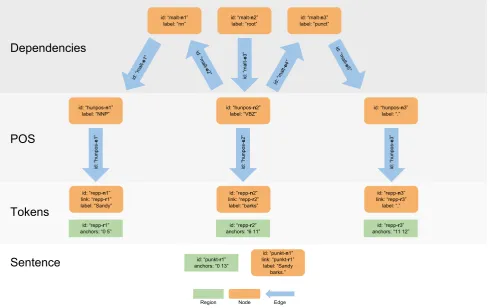
Figure 2: Diagram of LAP records representing a LAF graph for the annotation of a single example sentence; “Sandy barks.” Unlike the ANC example, tokens are represented with their own node and annotations, while also segmenting the text and producing regions. The same goes for sentence annotations, which produce regions with their own anchors to character offsets. POS tag annotations are associated to their own nodes and point to their respective tokens by instantiating edges. Dependency relations are encapsulated in nodes, and head-dependent directionality is preserved within the LAF model by splitting dependency arches at node-points.
concrete examples of LAF used in practice – in particu-lar emphasizing its use as an interchange representation in processing pipelines as opposed to a static, serialized anno-tation format.
4.
LAF in LAP
In the current implementation of LAP, annotations are re-lated to each other and to the original text using the LAF data model. Running a tool on some input (either text or LAP annotations, according to the tool dependencies)
pop-ulates a NoSQL database with records. These are
mod-eled after the core elements of a LAF graph and can be of three different types: region, node or edge. Since record instances are produced as a result of tool execution, their type and characteristics depend on those of the tool itself; e.g., tools that affect text segmentation output both regions and nodes.
Note that adding new annotations always means creating new graph elements, rather than editing and augmenting existing ones. While this approach results in graphs that are less compact than the ones seen in ANC, it also al-lows tools to take advantage of the graph structure when in-voking input annotations, for instance in case only specific parts of the graph built by certain tools is required. An-notations produced by a given tool are associated to
node-and edge-records created during execution in the form of feature structures: Rather than existing separately, they are encapsulated in the corresponding records and are retrieved as the graph is being traversed, in order to avoid unneces-sary queries to the database. In this section we illustrate how graph elements are added to the database by working through the steps involved in an example use case, making comments on implementation and design decisions along the way.
A simple example of a use case for the system could be that of annotating running ‘raw’ text with dependency annotations, export them to some format and download them to analyze them or process them further. This can be achieved in LAP by creating a workflow consisting of tools that produce the annotations required by the depen-dency parser; minimally a sentence segmenter, a tokenizer and a POS tagger, in the case of MaltParser (Nivre et al., 2007). The example corpus for this hypothetical session
consists of a single document containing the string “Sandy
barks.”. The first tool in the chain is the punkt sentence splitter (Kiss & Strunk, 2006), which acts both as a seg-menter, producing regions (in this case, the output consists
of the regionpunkt-r1with anchors 0 and 13), and as an
of the tool (punkt-n1, “Sandy barks.”). Here, the
output consists of the region punkt-r1 with anchors 0
and 13.
The second layer in the chain is the REPP tokenizer (Dridan & Oepen, 2012), which behaves similarly to the sentence splitter, producing both regions and nodes con-taining annotations. The information enclosed in the items produced by these first two annotators (visually represented in Figure 2) is different from that which we observed in Ide and Suderman (2013), where the anchors belonging to sen-tence regions consist of lists of token region ids; this ap-proach assumes that the lists of token produced by different tokenizers comprise a set of “base segmentations” that are anchored to character offsets. This means that other region-producing nodes don’t get access to the offsets.
While this is a viable solution for representing the an-notations, we found that it was not ideal for retaining LAP’s modular approach, as it binds the sentence anno-tations to the tokens, making it harder for another tok-enizer to re-use the information provided by the sentence splitter. In LAP, both tokenizers and sentence segmenters are dependency-less tools, which means that they can be run at the beginning of a workflow; what sets them apart is that tokenizer can exploit the sentence information if it is available in the database. The REPP-wrapper sim-ply assesses their availability (or whether the user ex-plicitly required a specific sentence-splitting tool), calls a
get_sorted_regions()function using the splitter id
as a parameter and prepares the input for the tokenizer based on the sentence information. Tokenizers, working as segmenters as well as annotators, produce both regions and nodes. Nodes are annotated with references to the in-stantiated regions, as well as with feature structures with the token value (which may present a normalization of the underlying region, or not, depending on the tokenizer).
The third layer in the annotation chain is the HunPos part-of-speech tagger. Rather than associating new anno-tations to the token nodes, the tagger produces a new set of nodes, each of which linked to one token node through edge records. This approach is different from the one we observed in the ANC representations, where token annota-tions are implicitly expressed by the regions, and POS tags are associated to token-level nodes. Running multiple to-kenizers and POS taggers on the same primary data adds new regions, nodes, and edges to the same pool of records available to LAP via the database, where different segmen-tations and alternative annosegmen-tations thus can co-exist.
Edge-annotations adhere to the LAF specifications in Ide and Suderman (2013), who state that “[...] annotations on edges specify the structural role of the edge” rather than linguistic content. This affects our internal representation of dependency graphs, where dependency relations have their own node and the head-dependent directionality of the arches is preserved within the LAF model by split-ting each arch in two edges. In the top layer of Figure 2, “barks” is the head of “Sandy” with relation “nn”, so there
is an edgemalt-e2going from nodehunpos-n2(the
part-of-speech node for “barks”) to nodemalt-n1(which
contains the dependency relation information) and an edge
malt-e1that goes frommalt-n2tohunpos-n1(the
part-of-speech node for “Sandy”).
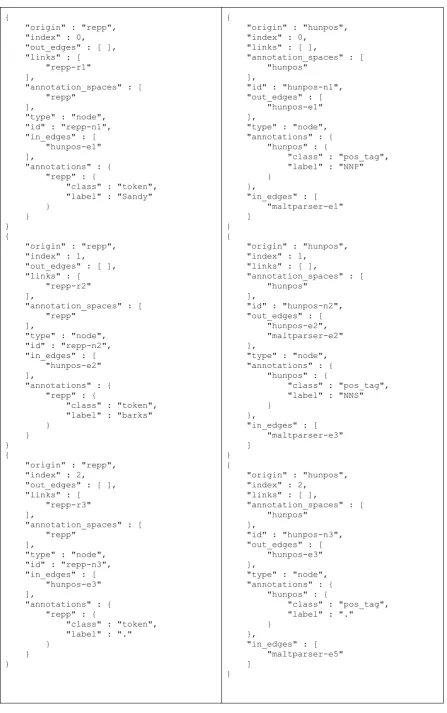
An example of the stored JSON representation, showing the database entries for REPP- and HunPos-nodes depicted in Figure 2, is provided in Figure 3. At the end of a work-flow, users can select which annotations they wish to seri-alize and export them using the available modules in LAP, for example by formatting records from the database into ANC-style GrAF documents.
5.
Related Efforts
In this section we will look briefly at how our approach of using LAF in the LAP context, compares to how related formats are put to use in related settings. We will review a number of interchange formats that are used in similar (albeit typically web service–based) environments for an-notating text.
Travelling Object (TO2) is a stand-off annotation format
used primarily in the Panacea project,5a web service–based
platform for machine translation and general language tech-nological applications. It is directly based on the GrAF se-rialization of LAF and follows the ANC approach. It repre-sents documents with a set of files: one or more primary data documents, up to two segmentation files (sentences and tokens), a header document with metadata conforming to the CES format, and one or more annotation documents. The Format for Linguistic Annotation (FoLiA) is the an-notation format used in the Dutch CLARIN initiative for the
TTNWW workflow platform,6among others. Unlike TO2,
it is a mixed format and represents one annotated document as one XML file containing all the information. It is de-signed with human readability in mind, and supports a set of core annotation types using explicit XML tags. This set of annotation types are divided into four categories: Struc-ture, token, span and subtoken. From the summary on the project web site, FoLiA has its focus more on expressivity rather than on computing efficiency, and is as such not ideal for real-time or resource-constrained applications.
The KYOTO Annotation Format (KAF) is the annota-tion format used in the collaborative Asia–Europe KYOTO
project.7It too is inspired by the LAF paradigm, but
repre-sents annotation types the same way as FoLiA does, using
explicitly named XML tags (e.g.<wf>,<term>, etc.). It
can thus be said to be specialized, XML-based implemen-tation of the LAF data model.
The NLP Interchange Format (NIF) stands out to a cer-tain degree in this comparison due to its core reliance on the Resource Description Framework (RDF) and Web On-tology Language (OWL), i.e., so-called semantic technolo-gies. As such, NIF (like LAF) makes a clear distinction between the underlying data model and a range of pre-existing, fully standardized serializations, including XML and the more compact Turtle. In our view, NIF is to a large degree complementary to both LAF and several of the re-lated initiatives reviewed here: It puts strong emphasis on the complete standardization of its basic building blocks,
5http://www.panacea-lr.eu/
.
6http://yago.meertens.knaw.nl/apache/
TTNWW/
7http://adimen.si.ehu.es/~rigau/
for example the representation of arbitrary Unicode strings and addressing of substrings through Internationalized Re-source Identifiers (IRI), interactions with HTTP content ne-gotiation, or aspects of versioning and persistence. For the structure and labeling of linguistic annotation, on the other hand, NIF leans heavily on existing standards and vocabu-laries, including LAF.
The Text Corpus Format (TCF), finally, is used by the We-blicht workflow platform, which is a part of the German CLARIN ecosystem. It is perhaps the most verbose of all the interchange formats, containing explicitly named XML tags for the annotations it can represent. It does not refer to character positions in the source material, but rather makes use of references to token IDs when anchoring higher layers of annotations.
In LAP, we have chosen to focus primarily on defining an internal representation of the LAF model that lies very close to the database structure, rather than on some exist-ing serialization format (e.g. GrAF, NIF etc.). Maintain-ing a strict adherence to the LAF paradigm, we have no restrictions on the type of annotations available since all annotations are represented as general features contained in feature sets for nodes or edges. The internal LAF rep-resentation is not specifically designed with readability in mind as we deem this to be the responsibility of the export functionality of LAP. Still, the extended JSON format used by MongoDB allows for a fairly transparent representation, making queries, modifications, and serialization transfor-mations a viable task.
Each tool to be integrated needs a thin transformation layer/wrapper that makes use of the appropriate format converter to handle insertion into, and queries from, the database. While this requires the party responsible for in-tegrating a tool to master the knowledge of LAP’s inner database abstraction layer rather than a general serialization format, it enables us to transform any supported input/out-put format into any other. By treating LAF serialization for-mats in the same way as any other input/output format, LAP becomes somewhat agnostic with regards to the format of the source material, which greatly simplifies the process of treating data from a multitude of sources in a uniform man-ner. Every format subsumed by LAF will be implementable in LAP with a reasonable amount of work, as well as vari-ous ad-hoc formats implemented in NLP tools.
We have currently implemented import/export functional-ity for GrAF as defined in (Ide & Suderman, 2013), TCF, CoNNL/TSV data, the CG3 format, and the tabular for-mat used for generating corpora in the IMS Corpus Work-bench (CWB) toolset. This means that a user can upload e.g. a TCF-formatted document, run it through a process-ing workflow, and retrieve the results in the CWB format ready to be inserted into the corpus search tool.
Another practical difference between the LAP approach and these pre-existing interchange formats relates to the ‘granularity’ of inter-component communication: In the file-based TO2 and TCF format, annotations are accu-mulated into ever-growing documents that have to be (re-)parsed and (re-)serialized before and after each pro-cessing step. Thus, even when a tool only requires a cer-tain type of annotation found in the document, it still needs
to decipherallelements of the interchange file. With our
approach, a tool can target specific record types by sub-mitting queries to the database. This property is also prac-tical in terms of parallelization, in that different jobs can invoke separate parts of the database, eliminating the need for wrestling with the bookkeeping of splitting and merging files.
6.
Ongoing and Future Work
As observed in Section 1 above, existing tools need to be adapted and augmented with means to communicate with the LAP database, i.e., retrieve and decode annota-tions from the LAF graph and/or encode their output be-fore adding it to the graph. A functional pilot of LAP with an integrated, interoperable ensemble of common NLP components for English and Norwegian and transparent ac-cess to the Norwegian national HPC eInfrastructure will be launched for public testing in the second quarter of 2014.
Acknowledgments
We are grateful to our colleagues at the Oslo Language Technology Group and at the Research Computing Ser-vices at the University of Oslo—in particular Hans A. Eide, Bjørn-Helge Mevik, Thierry Toutain, and Nikolay A. Vazov—for fruitful discussions and suggestions, as well as to three anonymous reviewers for insightful comments. Large-scale experimentation and engineering is made pos-sible though access to the Abel high-performance comput-ing facilities at the University of Oslo, and we are indebted to the staff of the University Center for Information Tech-nology, to the Norwegian Metacenter for Computational Science, and to the Norwegian tax payer.
References
Blankenberg, D., Von Kuster, G., Coraor, N., Ananda, G., Lazarus, R., Mangan, M., . . . Taylor, J. (2010). Galaxy. A web-based genome analysis tool for experimentalists.
Current Protocols in Molecular Biology, 19.10.1 – 21. Dridan, R., & Oepen, S. (2012). Tokenization. Returning
to a long solved problem. A survey, contrastive
experi-ment, recommendations, and toolkit. InProceedings of
the 50th Meeting of the Association for Computational Linguistics(p. 378 – 382). Jeju, Republic of Korea. Giardine, B., Riemer, C., Hardison, R. C., Burhans, R.,
El-nitski, L., Shah, P., . . . Nekrutenko, A. (2005). Galaxy. A platform for interactive large-scale genome analysis.
Genome Research,15(10), 1451 – 5.
Goecks, J., Nekrutenko, A., Taylor, J., & Team, T. G. (2010). Galaxy. A comprehensive approach for support-ing accessible, reproducible, and transparent
computa-tional research in the life sciences. Genome Biology,
11(8:R86).
Ide, N., & Romary, L. (2001). A common
framework for syntactic annotation. In
Proceed-ings of the 39th Meeting of the Association for Computational Linguistics (p. 306 – 313). Toulouse,
France. Retrieved fromhttp://www.aclweb.org/
anthology/P01-1040 doi: 10.3115/1073012
Ide, N., & Suderman, K. (2013). The Linguistic Annotation Framework: A standard for annotation interchange and
merging. Language Resources and Evaluation,
(forth-coming).
Kiss, T., & Strunk, J. (2006). Unsupervised multilingual
sentence boundary detection. Computational
Linguis-tics,32(4), 485 – 525.
Language resource management – Linguistic Annotation Framework (LAF)(Norm No. ISO 24612:2012). (2012). ISO, Geneva, Switzerland.
Lapponi, E., Velldal, E., Vazov, N. A., & Oepen, S. (2013a).
HPC-ready language analysis for human beings. In
Pro-ceedings of the 19th Nordic Conference of Computa-tional Linguistics(p. 447 – 452). Oslo, Norway.
Lapponi, E., Velldal, E., Vazov, N. A., & Oepen, S. (2013b). Towards large-scale language analysis in the
cloud. In Proceedings of the 19th Nordic Conference
of Computational Linguistics: Workshop on Nordic Lan-guage Research Infrastructure(p. 1 – 10). Oslo, Norway. Nivre, J., Hall, J., Nilsson, J., Chanev, A., Eryı˘gıt,
G., Kübler, S., . . . Marsi, E. (2007). MaltParser:
A language-independent system for data-driven