Language Resource Addition: Dictionary or Corpus?
Shinsuke Mori,
1Graham Neubig
21Academic Center for Computing and Media Studies, Kyoto University 2Nara Institute of Science and Technology
1Yoshidahonmachi, Sakyo-ku, Kyoto, Japan 28916-5 Takayamacho, Ikoma, Nara, Japan 1[email protected],2[email protected]
Abstract
In this paper, we investigate the relative effect of two strategies of language resource additions to the word segmentation problem and part-of-speech tagging problem in Japanese. The first strategy is adding entries to the dictionary and the second is adding annotated sentences to the training corpus. The experimental results showed that the annotated sentence addition to the training corpus is better than the entries addition to the dictionary. And the annotated sentence addition is efficient especially when we add new words with contexts of three real occurrences as partially annotated sentences. According to this knowledge, we executed annotation on the invention disclosure texts and observed word segmentation accuracy.
Keywords:Partial annotation, Dictionary, Word segmentation, POS tagging
1.
Introduction
The importance of language resources continues to increase in the era of natural language processing (NLP) based on machine learning techniques. For mature NLP applied to real problems, such as word segmentation, part-of-speech (POS) tagging, etc., relatively high accuracies are achieved on general-domain data, and much of the problem lies in adaptation to new domains. To cope with this problem, there are many attempts at semi-supervised training and active learning (Tomanek and Hahn, 2009; Settles et al., 2008; Sassano, 2002). However, the simple strategies of corpus annotation or dictionary expansion are highly effec-tive and not so costly. In fact, according to authors’ experi-ences it only took 7 hours×10 days to annotate 5,000 sen-tences precisely with word boundary information, enough to achieve large gains in a domain adaptation setting. Within the context of sequence labeling, a variety of re-sources can be used, including annotated training data, which gives us information about word use in context, and dictionaries, which lack context information but are often available at large scale. In this paper, we investigate the relative effect of dictionary expansion and annotated cor-pus addition (full annotation and partial annotation) to the Japanese morphological analysis problem (MA; a joint task of word segmentation and POS tagging) and word segmen-tation problem.
2.
Morphological Analysis
Japanese MA takes an unsegmented string of characters
xI
1 as input, segments it into morphemeswJ1, and
anno-tates each morpheme with a part of speech tJ1. This can be formulated as a two-step process of first segmenting words, then estimating POSs (Ng and Low, 2004; Neu-big et al., 2011), or as a single joint process of finding a morpheme/POS string from unsegmented text (Nagata, 1994; Mori and Kurata, 2005; Kudo et al., 2004; Naka-gawa, 2004; Kruengkrai et al., 2009).
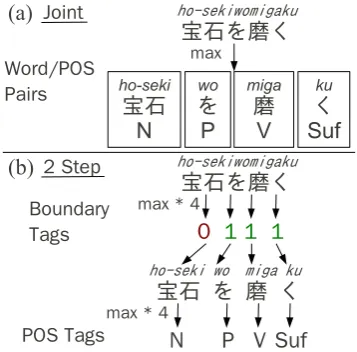
Figure 1: Joint MA (a) performs maximization over the entire sequence, while two-step MA (b) maximizes the 4 boundary and 4 POS tags independently.
2.1. Joint Sequence-Based MA
Japanese MA has traditionally used sequence based mod-els, finding a maximal POS sequence for entire sentences as in Figure 1 (a). The CRF-based method presented by Kudo et al. (2004) is generally accepted as the state-of-the-art in this paradigm. CRFs are trained over segmentation lattices, which allows for the handling of variable length sequences that occur due to multiple segmentations. The model is able to take into account arbitrary features, as well as the context between neighboring tags.
/ /F / /F / /F / /F / /Ac
(each) (hot dog) (cmi) (chili) , (cheese) , (onion) (cmd) (sprinkle) (infl.)
/ /F / /F / /Ac
(hot dog) (cmd) (aluminum foil) (cmc) (cover) (infl.)
English is added for explanation only.cmc,cmd, andcmistand for case marker for complement, direct object, and indirect object, respectively.infl.stands for inflectional ending.
Figure 2: Example sentences in the r-FG corpus.
Adaptation strategy #occurrences #words WS F-measure maximum (n) average BCCWJ Recipe
No adaptation – – 0 98.87% 94.35%
Dictionary – – 1,999 98.90% 94.54%
1 1.00 1,999 98.89% 95.56% 2 1.60 3,191 98.89% 95.81% 3 2.02 4,046 98.89% 95.94% 4 2.36 4,727 98.89% 96.01% Partial annotation 8 3.26 6,523 98.89% 96.07% 16 4.26 8,512 98.89% 96.14% 32 5.10 10,203 98.89% 96.21% 64 5.77 11,542 98.89% 96.28%
∞ 6.60 13,197 98.89% 96.29%
Table 4: Word Segmentation Accuracy in Partial Annotation Case.
1. Extract n occurrences at maximum of the NEs from the training data (see Figure 2, where the NE in focus is andn= 2),
2. Convert them into partially segmented sentences in which only both edges of the NEs and the in-side of the NEs are annotated with word bound-ary information.
ex.) If the NE in focus is , then
| - - | - - | ,
| - - | - - | ,
where the symbols “|,” “-,” and “ ” mean word boundary, not a word boundary, and no informa-tion, respectively.
3. Use the partially annotated data as the additional language resource to train the model.
4.1.2. Result and Discussion
Table 4 shows the word segmentation accuracies (WS F-measure) of “No adaptation” and the strategies that we ex-plained above. The results of the partial annotation strategy varies depending on the parametern(the maximum occur-rences). The table shows these results with the real average occurrences in the partially segmented sentences.
From the result we can note the following. First, the ad-dition of new words as the dictionary to the training data improves the word segmenter. This is consistent with the results shown in Table 2. Second, the partial annotation strategy with one occurrence (n= 1) is as good as the dic-tionary addition strategy. And as we increase the number of occurrences (n), the segmenter improves. The degree of improvement, however, shrinks asnincreases. In a real sit-uation, we have to prepare such partially annotated data and the annotation cost is proportional to the number of
occur-rences to be annotated. Therefore it is good to start annotat-ing new words in descendannotat-ing order of frequency, selectannotat-ing a threshold based on the number of occurrences.
4.2. Invention Disclosure Domain
Finally we report the result of a real adaptation that per-formed. The target domain is the invention disclosure texts, which are one of the important domains for NLP, especially information extraction and machine translation.
4.2.1. Setting
Based on the knowledge we described above, we adopted the partial annotation strategy. Concretely, we performed the following procedures.
1. Extract unknown word candidates based on the dis-tributional similarity from a large raw corpus in the target domain (Mori and Nagao, 1996),
2. Annotate three occurrences with word boundary infor-mation to make partially segmented sentences for each unknown word candidate in the descending order of the expected frequencies5.
For frequent word candidates, i.e. in the beginning of the annotation work, the three-occurrence annotation corre-sponds to the case of those with the maximum occurrence count of 4 and 8 in Table 4, because the average number of the occurrences is expected to be three.
In the practice, we asked an annotator to check unknown word candidates with three different contexts in the raw
5The expected frequency of a word candidate is the frequency
Graham Neubig, Yosuke Nakata, and Shinsuke Mori. 2011. Pointwise prediction for robust, adaptable japanese mor-phological analysis. InProceedings of the 49th Annual Meeting of the Association for Computational Linguis-tics.
Hwee Tou Ng and Jin Kiat Low. 2004. Chinese part-of-speech tagging: one-at-a-time or all-at-once? word-based or character-word-based. InProceedings of the Confer-ence on Empirical Methods in Natural Language Pro-cessing.
Manabu Sassano. 2002. An empirical study of active learn-ing with support vector machines for japanese word seg-mentation. InProceedings of the 40th Annual Meeting of the Association for Computational Linguistics, pages 505–512.
Burr Settles, Mark Craven, and Lewis Friedland. 2008. Active learning with real annotation costs. In NIPS Workshop on Cost-Sensitive Learning.