A Comparative Evaluation of Collocation Extraction Techniques
Darren Pearce
School of Cognitive and Computing Sciences (COGS) University of Sussex
Falmer Brighton BN1 9QH [email protected]
Abstract
This paper describes an experiment that attempts to compare a range of existing collocation extraction techniques as well as the imple-mentation of a new technique based on tests for lexical substitutability. After a description of the experiment details, the techniques are discussed with particular emphasis on any adaptations that are required in order to evaluate it in the way proposed. This is followed by a discussion on the relative strengths and weaknesses of the techniques with reference to the results obtained. Since there is no general agreement on the exact nature of collocation, evaluating techniques with reference to any single standard is somewhat controversial. De-parting from this point, part of the concluding discussion includes initial proposals for a common framework for evaluation of collocation extraction techniques.
1.
Introduction
Over the last thirty years, there has been much discus-sion in the linguistics literature on the exact nature of col-location. Even now, there is no widely-accepted definition. A by-product of the lack of any agreed definition is a lack of any consistent evaluation methodology. For exam-ple, Smadja (1993) employs the skills of a professional lex-icographer, Blaheta and Johnson (2001) use native speaker judgements and Lin (1998) uses a term bank. Evaluation can also take the form of a discussion of the ‘quality’ of the extracted collocations (e.g. Kita and Ogata (1997)).
Since it is somewhat controversial to evaluate these techniques with reference to anything considered as a stan-dard whether relying on human judgement or machine read-able resources, relatively little work has been done on com-parative evaluation in this area (e.g. Evert and Krenn (2001), Krenn and Evert (2001) and Kita et al. (1994)). However, the view taken in this paper is that such evalua-tion does offer at least some departure points for a discus-sion of the relative merits of each technique.
2.
Existing Collocation Extraction
Techniques
Various researchers in natural language processing have proposed computationally tractable definitions of colloca-tion accompanying empirical experiments seeking to vali-date their formulation. With the availability of large cor-pora came several techniques based on N-gram statistics derived from these large bodies of text. This begins with the -score of Berry-Rogghe (1973) and later with Church and Hanks (1990), Kita et al. (1994) and Shimohata et al. (1997).
Smadja (1993) went one step further and developed a technique that not only extracted continuous sequences of words that form collocations but also those with gaps (e.g.
break-down, door in break down the old door). Under-pinning the technique was the implicit inference of syntax through analysis of co-occurrence frequency distributions.
With recent significant increases in parsing efficiency and accuracy, there is no reason why explicit parse infor-mation should not be used. Indeed, Goldman et al. (2001) emphasises the necessity to use such information since some collocational dependencies can span as many as 30 words (in French). Several researchers have exploited the availability of parse data. Lin (1998) uses an information-theoretic approach over parse dependency triples, Blaheta and Johnson (2001) use log-linear models to measure asso-ciation between verb-particle pairs and Pearce (2001) uses restrictions on synonym substitutions within parse depen-dency pairs.
Recent research into collocation extraction (Pearce, 2001) has produced a new technique based on analysing the possible substitutions for synonyms within candidate phrases. For example, emotional baggage (a collocation) occurs more frequently than the phrase emotional luggage formed when baggage is substituted for its synonym
lug-gage. This technique uses WordNet (Miller, 1990) as a
source of synonymic information.
3.
Experiment Description
The experiment compares implementations of many of the techniques discussed in the previous section. Each tech-nique was supplied with bigram co-occurrence frequencies obtained from 5.3 million words of the BNC. For each pair of words in this frequency data, the technique was used to assign a ‘score’ where the higher the score, the ‘better’ the collocation (according to the technique). Alternatively, the technique, based on some predefined criteria (such as the application of a threshold), could opt to ignore scoring the pair. Such a strategy tends to increase precision at the ex-pense of recall.
Evaluation of the output list uses the multi-word infor-mation in the machine-readable version of the New Oxford Dictionary of English (NODE) (Pearsall and Hanks, 1998). This was processed to produce a list of 17,485 two-word collocations such as adhesive tape, hand grenade and value
1 2 3 4 5 6 0
0.1 0.2 0.3 0.4 0.5 0.6 0.7
Frequency
Proportion
Corpus Gold Standard
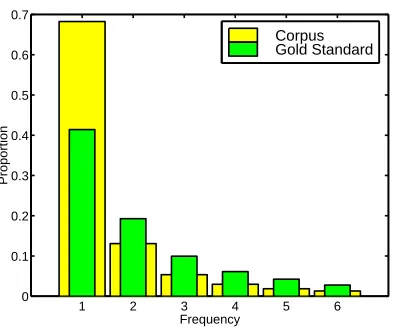
Figure 12: Proportion of bigrams with counts in the range 1 to 6 in the corpus and the gold standard.
Acknowledgements
Much of this work was carried out under a stu-dentship attached to the project ‘PSET: Practical Sim-plification of English Text’ funded by the UK EPSRC (ref GR/L53175). Further information about PSET is available at http://osiris.sunderland.ac.uk/ ˜pset/welcome.html.
I would also like to thank my supervisor, John Carroll, for his continued support and advice.
7.
References
Godelieve L. M. Berry-Rogghe. 1973. The computation of collocations and their relevance to lexical studies. In A. J. Aitken, R. W. Bailey, and N. Hamilton-Smith, edi-tors, The Computer and Literary Studies, pages 103–112. University Press, Edinburgh, New York.
Don Blaheta and Mark Johnson. 2001. Unsupervised learning of multi-word verbs. In 39th Annual
Meet-ing and 10th Conference of the European Chapter of the Association for Computational Linguistics (ACL39),
pages 54–60, CNRS - Institut de Recherche en Informa-tique de Toulouse, and Universit´e des Sciences Sociales, Toulouse, France, July.
Kenneth Ward Church and Patrick Hanks. 1990. Word as-sociation norms, mutual information, and lexicography.
Computational Linguistics, 16(1):22–29, March.
Stefan Evert and Brigitte Krenn. 2001. Methods for the qualitative evaluation of lexical association measures. In
Proceedings of the 39th Annual Meeting of the Associa-tion for ComputaAssocia-tional Linguistics, Toulouse, France.
Jean-Philippe Goldman, Luka Nerima, and Eric Wehrli. 2001. Collocation extraction using a syntactic parser. In
39th Annual Meeting and 10th Conference of the Eu-ropean Chapter of the Association for Computational Linguistics (ACL39), pages 61–66, CNRS - Institut de
Recherche en Informatique de Toulouse, and Universit´e des Sciences Sociales, Toulouse, France, July.
David C. Howell. 1992. Statistical Methods For
Psychol-ogy. Duxbury Press, Belmont, California, 3rd edition.
Kenji Kita and Hiroaki Ogata. 1997. Collocations in lan-guage learning: Corpus-based automatic compilation
of collocations and bilingual collocation concordancer.
Computer Assisted Language Learning: An Interna-tional Journal, 10(3):229–238.
Kenji Kita, Yasuhiko Kato, Takashi Omoto, and Yoneo Yano. 1994. A comparative study of automatic extrac-tion of collocaextrac-tions from corpora: Mutual informaextrac-tion vs. cost criteria. Journal of Natural Language
Process-ing, 1(1):21–33.
Brigitte Krenn and Stefan Evert. 2001. Can we do better than frequency? a case study on extracting PP-verb col-locations. In 39th Annual Meeting and 10th Conference
of the European Chapter of the Association for Computa-tional Linguistics (ACL39), pages 39–46, CNRS -
Insti-tut de Recherche en Informatique de Toulouse, and Uni-versit´e des Sciences Sociales, Toulouse, France, July. Dekang Lin. 1998. Extracting collocations from text
cor-pora. In First Workshop on Computational Terminology, Montreal, Canada, August.
George A. Miller. 1990. WordNet: An on-line lexical database. International Journal of Lexicography. Darren Pearce. 2001. Synonymy in collocation extraction.
In NAACL 2001 Workshop: WordNet and Other
Lexi-cal Resources: Applications, Extensions and Customiza-tions, Carnegie Mellon University, Pittsburgh, June.
Judy Pearsall and Patrick Hanks, editors. 1998. The New
Oxford Dictionary of English. Oxford University Press,
August. Machine Readable Version.
Sayori Shimohata, Toshiyuko Sugio, and Junji Nagata. 1997. Retrieving collocations by co-occurrences and word order constraints. In 35th Conference of the
Asso-ciation for Computational Linguistics (ACL’97), pages
476–481, Madrid, Spain.