Email: fbreck,[email protected]
Introduction
In this paper we present some advances made to the CAMP system since it's inception for MUC-6. Al-though the infrastructure has been completely re-implemented, the architecture has remained fundamentally the same{consequently we will focus some advances we have made in our understanding of coreference and then discuss the performance of the system.
Scoring Coreference Output
Scoring the performance of a system is an extremely important aspect of coreference algorithm performance. The score for a particular run is the single strongest measure of how well the system is performing and it can strongly determine directions for further improvements. In this paper, we present several dierent scoring algorithms and detail their respective strengths and weaknesses for varying classes of processing. In particular, we describe and analyze the coreference scoring algorithm used to evaluate the coreference systems in the sixth Message Understanding Conference (MUC-6)[MUC-6, 95]. We also present two shortcomings of this algorithm. In addition, we present a new coreference scoring algorithm, our B-CUBED algorithm, which was designed to overcome the shortcomings of the MUC-6 algorithm.
Scoring in MUC-6/7: Vilain et al.
Prior to Vilain et al.'s coreference scoring algorithm [Vilain, 95] there had been a graph based scoring algorithm (Sundheim et al.) which produced unintuitive results for even very simple cases. [Vilain, 95] substituted a model-theoretic scoring algorithm which produced very intuitive results for the type of scoring desired in MUC-6. This algorithm computes computes the recall error by taking each equivalence class S
(dened by the links in the answer key) and determining the number of coreference linksmthat would have to be added to the response to place all the entities in S into the same equivalence class in the response. Recall error then is the sum of m's divided by the number of links in the key. Precision error is computed by reversing the roles of the answer key and the response.
The full details of the algorithm are discussed next.
The Model Theoretic Approach To The Vilain et. al Algorithm
1Figure1: Truth
Figure 2: Response: Example 1
In the description of the model theoretic algorithm, the terms \key," and \response" are dened in the following way:
key refers to the manually annotated coreference chains (the truth). response refers to the coreference chains output by a system.
An equivalence set is the transitive closure of a coreference chain. The algorithm computes recall in the following way.
First, let S be an equivalence set generated by the key, and letR1:::Rmbe equivalence classes generated
by the response. Then we dene the following functions over S:
p(S) is a partition of S relative to the response. Each subset of S in the partition is formed by
intersecting S and those response sets Ri that overlap S. Note that the equivalence classes dened by
the response may include implicit singleton sets - these correspond to elements that are mentioned in the key but not in the response. For example, say the key generates the equivalence class S = fA B C
Dg, and the response is simply<A-B>. The relative partition p(S) is thenfA BgfCgandfDg. c(S) is the minimal number of \correct" links necessary to generate the equivalence class S. It is clear
that c(S) is one less than the cardinality of S, i.e.,
c(S) = (jSj,1):
m(S) is the number of \missing" links in the response relative to the key set S. As noted above, this
is the number of links necessary to fully reunite any components of the p(S) partition. We note that this is simply one fewer than the number of elements in the partition, that is,
jSj,1
:
The whole expression can now be simplied to
jSj,jp(S)j jSj,1
: (1)
Finally, extending this measure from a single key equivalence class to an entire set T simply requires summing over the key equivalence classes. That is,
RT=
P
(jSij,jp(Si)j) P
(jSij,1)
: (2)
Precision is computed by switching the roles of the key and response in the above formulation.
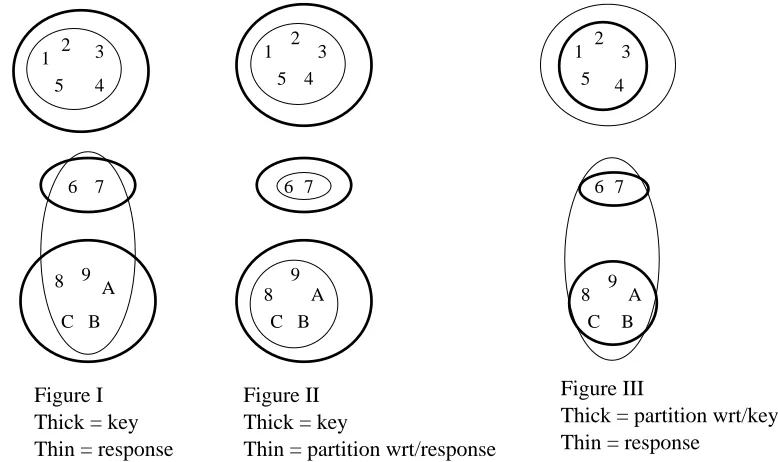
Example
For example, let the key contain 3 equivalence classes as shown in Figure 1. Suppose Figure 2 shows a response. From Figure 3(I), the three equivalence classes in the truth, S1, S2, and S3, are f1, 2, 3, 4, 5g, f6, 7g, and f8, 9, A, B, Cgrespectively. And the partitions p(S1), p(S2), and p(S3), with respect to the
response, shown in Figure 3(II), aref1, 2, 3, 4, 5g,f6, 7g, andf8, 9, A, B, Cgrespectively. Using equation 2,
the recall can now be calculated in the following way:
Recall = (5,1) + (2,1) + (5,1)
(5,1) + (2,1) + (5,1) = 9
=9 = 100%:
Similarly, if the roles of the key and the response are reversed, then the equivalence classes in the truth, S1,
and S2, aref1, 2, 3, 4, 5gandf6, 7, 8, 9, A, B, Cg], and the partitions, p(S1), and p(S2), aref1, 2, 3, 4, 5g
and [f6, 7gf8, 9, A, B, Cg] respectively (Figure 3(III)). The precision can now be calculated as:
Precision = (5,1) + (7,2)
(5,1) + (7,1) = 9
=10 = 90%:
Shortcomings of the Vilain et. al Algorithm
Despite the advances of the model-theoretic scorer, it yields unintuitive results for some tasks. There are two main reasons.
For an entity,i, we dene the precision and recall with respect to that entity in Figure 5. The nal precision and recall numbers are computed by the following two formulae:
Final Precision =XN
i=1wi
Precision i
Final Recall =XN
i=1wi
Recall i
whereN is the number of entities in the document, andwiis the weight assigned to entityiin the document.
It should be noted that the B-CUBED algorithm implicitly overcomes the rst shortcoming of the Vilain et. al algorithm by calculating the precision and recall numbers for each entity in the document (irrespective of whether an entity is part of a coreference chain).
Dierent weighting schemes produce dierent versions of the algorithm. The choice of the weighting scheme is determined by the task for which the algorithm is going to be used.
When coreference (or cross-document coreference) is used for an information extraction task, where information about every entity in an equivalence class is important, the weighting scheme assigns equal weights for every entityi. For example, the weight assigned to each entity in Figure 1 is 1/12. As shown in Figure 6, the precision scores for responses in Figures 2 and 4 are 16/21 (76%) and 7/12 (58%) respectively, using equal weights for all entities. Recall for both responses is 100%. It should be noted that the algorithm penalizes the precision numbers more for the error made in Figure 4 than the one made in Figure 2. As evident from the two examples, this version of the B-CUBED algorithm (using equal weights for each entity) is a precision oriented algorithm i.e. it is sensitive to precision errors.
standard left-to-right processing strategy of most coreference resolution systems. If such a procedure can reliably grow medium sized equivalence classes into large ones, then the recall gures will improve under the B3 scorer. The Vilain et. al scorer notes no dierence between correctly relating two singleton equivalence classes and correctly relating two large equivalence classes.
Since large equivalence classes tend to include topically signicant entities for documents, correctly iden-tifying them is perhaps crucial to applications like summarization and information extraction.
Developing with the Vilain et al algorithm
The below analysis reects how we assesed the individual contributions of the components during devel-opment. Since the B3 algorithm was not yet implemented, we did not use it for develdevel-opment.
Our explicit goal was to maximize recall at a precision level of 80%. We feel that this level of precision provides enough accuracy to drive a range of coreference dependent applications{most important for us was query sensitive text summarization. Our overall approach was to break down coreference resolution into concrete subprograms that resolved a limited class of coreference well. Each component could be scored separately by either running it in isolation, or by blocking coreference from subsequent processes. Below we discuss each component in the order of execution.
Genre Specic Coreference
A problematic aspect of any new genre of data is the existence of idiosyncratic classes of coreference and the MUC-7 data was particularly troubling since very oddly formatted text was fair game for coreference. For example, the strings `HUGHES' and `FCC' in `<SLUG fv=tia-z> BC-HUGHES-FCC-BLOOM </SLUG>' are
coreferent with the same strings in `<PREAMBLE>BC-HUGHES-FCC-BLOOM...' which was outside the scope of
our linguistic tools. Simple programs were written to recognize this sort of coreference. The performance by the Vilain scorer is 4.2% recall 67.5% precision.
This performance is well below what we observed in training data{the precision was 85-90% for similarly sized collections. Perhaps part of the problem was that we never quite grasped why some but not all these all CAPS strings were not coreferent.
La Hack 3
La Hack is a carry over from our original MUC-6 system, and it is responsible for identication of proper noun coreference. This component is indirectly helped by IBM's named entity tool 'Textract' which nd extents of named entities in addition to assigning them properties like 'is person', 'is company'. It is the foundation upon which our coreference annotation is built{mistakes here can be devastating for the rest of the system. In MUC-6, La Hack performed at 29% Recall and 86% precision, but it faired somewhat worse in MUC-7 with, 24.0% precision 80.0% recall.
We observed that the New York Times data had far less regular honoric use and corporate designator use than the MUC-6 corpus based on Wall Street Journal. As a result, there were fewer reliable indicators of proper names.
Highly Syntactic Coreference
This component asserts coreference between phrases that are in appositive relations or that are in predi-cate nominal relations. We were quite surprised at how poorly this component performed since we expected performance to be above the 80% precision cuto. Our actual performance is 3.3% precision 64.0% recall.
in the case of ties the anaphor is not resolved.
When deciencies were noted with the output of LaHack, the simplest solution was to add a proper noun resolution component to CogNIAC. In the end this addition added a bit of recall but with fairly low precision with 1.2% recall and 65.2% precision.
CogNIAC Common Noun Resolution
Common noun coreference is an important part of coreference, but it is very dicult to accurately resolve. Our MUC-6 system had fairly poor performance with 10% recall and a precision of 48%. We were surprised with an increase in performance over training data (78% precision) with 7.1% recall 90.7% precision.
Common noun anaphora is probably one of the most trying classes of coreference to annotate as a human. This is due to many dicult judgment calls required on the part of the human judges, and this was reected in the consistency of annotation in the training data. We found it challenging to develop on the training data because the system would nd what we considered to be reasonable instances of coreference that the annotator had not made coreferent. We believe that common noun anaphora is a large source of inter-annotator disagreement.
CogNIAC Pronouns
The pronominal system performed under our goal of 80% precision. In training, we found that we were constantly balancing the ability of pronouns to i) refer uniquely, and ii) have all entities have the correct property. We adopted a property condence model that encouraged recall over precision. This meant that a proper noun like 'Mrs. Fields' would be both potentially an antecedent to feminine pronouns, and pronouns that referred to companies. A salience model was then applied to these overloaded entities and pronominal resolution served to be a word-sense disambiguation problem in addition to a coreference resolution problem. Our performance was 4.5% recall and 70.0% precision.
Conclusions
One of the stronger conclusions that we have come to regarding coreference is that there is an apparent linear trade-o between precision and recall given the performance of other systems with the coreference task. Our suspicion is that the same can be said with the B3 scorer but that will have to await experimentation. This is a positive result in its self because we now can choose from multiple types of coreference systems depending on our task. We consider high precision systems to be more useful for the types of systems that we build, but, it has not been clear that high precision systems were possible.
REFERENCES
[Bagga, 98a] Bagga, Amit. How Much Processing Is Required for Cross-Document Coreference?, this volume.
[Vilain, 95] Vilain, Marc, et al. A Model-Theoretic Coreference Scoring Scheme, Proceedings of the Sixth Message Understanding Conference (MUC-6), pp. 45-52, November 1995.