Performance-based Specifications in Public
Procurement: Exploring the Case of Germany
Author: Florian Klatt
University of Twente P.O. Box 217, 7500AE Enschede
The Netherlands
ABSTRACT
The large public procurement sector, making up about 16% of the European GDP, is burdened with meeting increasingly economic solutions without disregarding the high-quality aspect and demand for state-of-the-art technology. Further rising requirements on the sector such as sustainability and innovation aspects impose challenges. Proposed by the literature as a tool in helping to foster economic, ecological, innovative and technically valuable solutions is the employment of performance-based specifications (PBS) in the procurement process. This paper seeks to explore the current level of usage as well as underlying reasons for the frequency of this meaningful tool in Germany. A three-stage research approach was chosen, consisting of (1) analysing the legal framework surrounding Germany, (2) analysing tender documents and (3) conducting interviews with public officials. The analysis found that while from a legal perspective there is a clear framework on the use of PBS, in practice these types of specifications are rarely used. Possible reasons for these findings are a lack of adequate education and training on its use and its benefits, and the practitioners’ impression of predominant drawbacks. The findings reveal an imbalance between the theoretical value and practical use of PBS. This possibly calls for more educational initiatives and best-practice examples regarding PBS and its application on part of the German Government.
Supervisors:
1stProf. Dr. Jan Telgen
2nd
Dr. Ir. Fredo Schotanus
Keywords
Performance-based specifications, functional specifications, public procurement
Permission to make digital or hard copies of all or part of this work for personal or classroom use is granted without fee provided that copies are not made or distributed for profit or commercial advantage and that copies bear this notice and the full citation on the first page. To copy otherwise, or republish, to post on servers or to redistribute to lists, requires prior specific permission and/or a fee.
5th IBA Bachelor Thesis Conference, July 2nd, 2015, Enschede, The Netherlands.
into depth, investigating the perceived significance of PBS, its benefits and drawbacks as well as a future outlook on its application and status in the public procurement area. Moreover the most striking findings of the Ethiopian study will be brought up to see if there is some overlap in possible inhibitors to the use of PBS for instance. Along with the key questions, there are some contingencies in place for the instance that the respondent is unable to answer (e.g. most significant upsides/downsides of PBS as identified by academics). For the above listed reasons, it will be put emphasis on the use of open-ended questions in the course of the interview. The audiotaped transcripts are each afterwards analysed (see Analysis section).
3.
LITERATURE REVIEW
3.1
Defining the Concept of
Performance-based Specifications
The literature on performance-based specifications and related concepts is rich and so is its terminology. As Loulakis (2013) puts it, performance-based specifications are incorporated under the umbrella concept of “performance specifications” (p.7). PBS is however not only associated with the concept of performance, but is connected with the very similar and tightly linked concepts of ‘results’ and ‘outcomes’ (Roehrich, Glas, Selviaridis & Essig, 2014). PBS forms one of several kinds of possible specifications procurers can use in the description of their desired product or service. A definition by Turley et al. (2014; p.3) outlines the concept of PBS and its distinction to another very common type of specifications, namely the technical specification:
“Performance-based specifications (PBSs) in particular describe a desired performance level or performance target to be achieved, but do not make specific demands on how that level/target is reached. Instead of prescribing the need in terms of inputs, it is described in terms of
outputs. PBSs are often described in contrast to technical specifications, which are formulated based on the detailed characteristics of goods, services or infrastructure being purchased, or describe exactly how a contractor must perform a service or develop a product”.
The keyword in this definition of PBS is the focus on ‘output’. In this regard the literature reveals many overlaps and synonymous uses. To illustrate this, the Department for Business, Innovation and Skills UK’s definition of ‘outcome (or output) based specifications’ is as follows:
“An Output (or Outcome) Based Specification (OBS) focuses on the desired outputs of a service in business terms, rather than a detailed technical specification of how the service is to be provided; this allows providers scope to propose innovative solutions that might not have occurred to the procurement team”.
Essentially the latter definition is congruent with the former one and points out the utilisation of essentially the same concepts under a different terminology. Moving one step further and not only specifying desired results in terms of performance requirements, but also tying at least some part of the suppliers’ payment to the achievement of these specific and measurable performance standards, brings us to the related concept of performance-based contracting (Principles and Practices of Public Procurement, 2012). Performance-based contracting (PBC) is a contracting method that basically incorporates PBS and connects it with a measurement and payment system, with its aim being to obtain better value, better performance and/or lower costs (p.3). Only paying for delivered results as the basis of PBC is not a new concept, but rather “an old customer wish” (Glas, Hofmann & Essig, 2013, p.5). An early example of PBC
is Rolls Royce’s ‘Power by the Hour” business model, which was introduced in the 1980’s and required engine operators to compensate RR only for the time the engines were actually available for service (hours flown; Wharton University of Pensylvania, 2007). Especially the defence sector, with the US Department of Defense being a pioneer as indicated in the introduction, is making use of performance-oriented contracting for quite some time (since 2001/2002), under the name of performance-based logistics (PBL). The essence of PBL is marked by a change in the definition of performance, “from detailed specified demand descriptions to result oriented performance objectives” and a movement towards long-term buyer-supplier relationships (Glas et al., 2013, p.5f), that can also be tracked in the private sector. Another equivalent to PBC is outcome-based contracting (OBC), which is “a contracting mechanism that allows the customer to pay only when the firm has delivered outcomes, rather than for merely activities and tasks” (Ng & Yip, 2009, p.1). While this is not quite applicable to the acquisition of consumer goods, the service domain is increasingly adopting OBC practices due to a range of benefits for both users and providers (Ng, Maull & Yip, 2009). Overall this realm of the literature is recently receiving increasing attention by academics and their publications (Asfaw Ambaw, 2015), pointing out its relevance in today’s (public) procurement context. Another variation in the terminology under which the principles of PBS can be found, is the term ‘functional specifications’. While functional specifications describe the requirements on a product/service in terms of needed functionalities (“what should the product do?”), they do not state “how” the need should be met. The desired performance characteristics are specified by the procurer, the design of the solution however is the purpose of potential suppliers (Edquist & Zabala-Iturriagagoitia, 2012; Ministry of Infrastructure and the Environment NL, 2013). A third and final definition, which is provided for the sake of illustrating the conformity of several concepts under different names, incorporates the three aforementioned key words of ‘PBS, ‘outcome’ and ‘functional’ into one concise definition: “A performance-based, or functional (or “outcome”) specification is one which describes the function or performance to be achieved rather than specifying the exact product or service which will achieve this. In other words it focuses on your actual needs, and lets the market suggest the best way in which these needs may be met, without being technically prescriptive” (Clement, et al., 2009; p. 20).
For the context of this paper it is noteworthy, that specifications can oftentimes not be distinguished in a clear-cut manner. The most common types, technical and functional specifications, can rather be regarded as two (extreme) ends on a spectrum, where a practical application of specifications is usually composed of both types to a certain degree. In this regard, Turley (2013) outlines the notion of buying products (fleet of vehicles) towards buying functions (mobility functions), with intermediary steps like buying a fleet with warranty, leasing a fleet, or renting a fleet of vehicles by time. This forms a part of the prevalent trend of product-service systems, where products and services increasingly intertwine and are hard to distinguish. In anticipation of a later section analysing tender documents, for illustration purposes it will be made use of a graphical spectrum showing the degree to which technical (on the one end) or performance-based specifications (on the other end) are used (see Figure 1).
PBS Technical
about conformity with ILO labour standards). Regarding the use of performance-based or functional specifications, the TVgG does not make any additional statements. It however repeats the explicit use of performance- and functional requirements regarding environmental protection and energy efficiency in the specifications (§17, (4)).
The relevant regulation concerning specifications in NRW then springs from the first sections of VOL/A and VOL/B. First and foremost, “the contractual performance must be described clearly and exhaustively, so that all candidates must understand the description in the same way and comparable tenders can be expected (contractual specifications)” (§7, (1)). Next to that, the contractual performance or parts of it must be described “employing customary designations as to type, quality and scope” ((2)), or “by purpose, function and other requirements it must meet” (a)), “by means of its essential features and constructional details” (b)), or by a combination of the above types. While the 1st Section of the VOL/A uses a different
wording and less detail regarding performance-based and functional specifications (as opposed to the 2nd Section
applicable for contracts above the threshold), an employment of
these types of specifications can still be regarded as viable. Remarkably, the regularities defining the use of specifications for construction works under VOB/A 1st Section (§7) and the
2nd Section (§7EG) are identical.
What can be generally observed, is that on all three levels, the European, the German and the Federal State, PBS and functional specifications are technically allowed from a legal perspective. The next section now will explore in how far these types of specifications are actually employed by practitioners with the help of acquired tender documents.
4.2
Tender Documents
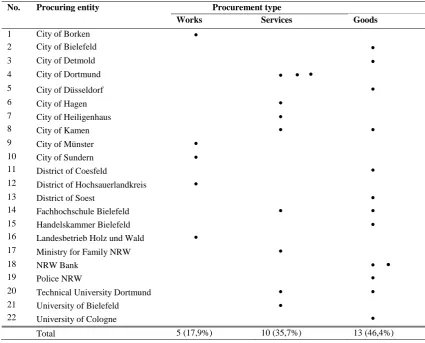
For the assessment to which degree public organisations use PBS in their tendering process, 28 tender documents of public bodies in NRW were acquired. In order to examine a general profile, various types of organisations and tenders (works, services, products) constitute the sample (see Table 1).
No. Procuring entity Procurement type
Works Services Goods
1 City of Borken
2 City of Bielefeld
3 City of Detmold
4 City of Dortmund
5 City of Düsseldorf
6 City of Hagen
7 City of Heiligenhaus
8 City of Kamen
9 City of Münster
10 City of Sundern
11 District of Coesfeld
12 District of Hochsauerlandkreis
13 District of Soest
14 Fachhochschule Bielefeld
15 Handelskammer Bielefeld
16 Landesbetrieb Holz und Wald
17 Ministry for Family NRW
18 NRW Bank
19 Police NRW
20 Technical University Dortmund
21 University of Bielefeld
22 University of Cologne
Total 5 (17,9%) 10 (35,7%) 13 (46,4%)
Due to the documents being diverse in nature, they were individually analysed regarding the use of PBS. Thereby it was focused on elements concerning desired outputs (rather than inputs), requirements on the functionality and performance of products / construction works / services and the degree to which technical and prescriptive types of specifications were employed. The blurring of clear borders between products and services also holds true for parts of the sample at hand, with products being procured in connection with services such as maintenance. The overwhelming part (good or service) was regarded as the deciding criteria in splitting the documents and assigning them to one category. Similarly, technical specifications on the one hand and PBS on the other hand form two opposing ends of a spectrum in the theory, while practically most specifications consist of both types to a certain degree and smoothly blend into each other. The main findings and distinctive features of the tender documents are outlined in the following.
Regarding the sample as a whole it becomes evident, that largely the specifications are based on detailed technical descriptions. However, almost all documents also consist to a certain extent of functional and performance requirements the service, product or work should fulfil. For the works category (n=5) in particular, technical prescriptions seem to be especially prevalent. The principal entity is very clear in the activities to be done, and the required quantities and dimensions. As an example, for road works the City S. describes in detail the requirements on a fence used to highlight and separate the road construction site, including the colour, material and size. Occasionally, specifications are less prescriptive and leave some room to the contractor regarding the planning phase and as to how to specifically go through with an activity (e.g. build and install rails according to given local conditions). The nature of the tender document sample according to VOL/B is conceptually illustrated in Figure 1 and should only be understood as an indicator.
Examining the tenders falling into the category of services under VOL/A (n=10), one can see that functional and performance-based specifications form a marginally bigger part as compared to construction works, however can only be considered to be in ‘full-effect’ in one instance (Figure 2). In this instance, the University of B. seeks a concept for services concerned with the analysis, illustration and intellectual transfer of results deriving from a running project about ‘connected-living’. The principle thereby sets only several overarching requirements on the service and its desired functional and performance characteristics. This leaves the tenderer with a lot of freedom and the potential to offer the most creative and innovative ideas. The majority of the documents however is comprised of very detailed specifications. Exemplary, in a tender of City H. a waste disposal service is sought. While this could present an opportunity to employ PBS, City H. prescribes the service exhaustively, as to when, where and especially how exactly the waste is to be collected. Nonetheless, some performance and functional specifications can be found in the other documents, which mostly describe requirements on the services’ quality-levels, or leave space in the activities’ execution.
The category of goods (n=13) then depicts a rather mixed picture along the spectrum (Figure 3). While three of the tenders can be regarded as using PBS, many others combine technical details with requirements on functionalities such as in the procurement of emergency vehicles and its emission levels, or an audio converter being able to convert digital to analogue signals. Yet again some very prescriptive specifications can be found, leaving little room for interpretation on the contractor’s part. One of the tenders employing PBS is the Federal Bank N; subject to procure is 100% green electricity. The principle in this case only offers a definition of what green electricity and renewable energy is understood as and then gives estimates about the necessary amounts. Over the length of the contract, the contractor is then required to reduce CO2 emission levels
based on the total of delivered power. Another example is the acquisition of a motor pool management system for the Police, where the system is specified in terms of the performance it has to deliver and the activities it has to be capable of. For instance, the system should be ‘easily accessible’ and ‘self-explanatory’ in order to keep the level of required instructions as low as possible.
4.3
Depth Interviews
4.3.1
City of B.
The first interview was conducted with an official of City B., who is responsible for tenders falling under VOL/A corresponding to the acquisition of goods and services; City B. has over 300.000 inhabitants. First of all, the respondent was aware of the possibility to use performance-based type of specifications. After having established a baseline about the subject at hand, it was initially stated that specifications in terms of performance or functional requirements are not used in the official’s line of work. The tenders she is responsible for are usually made up of very technical and detailed descriptions, which are oftentimes “very extensive and elaborate” in their nature, containing exact dimensions, allowable deviations and norms for instance. It was said that there is no usefulness of utilising PBS in the tendering for certain products (e.g. copying paper). Further it was indicated that colleagues in the realm of construction works do not make use of PBS either, although this area is regarded as more fruitful for the possible use of PBS in her perception. In an exemplary tender of washing machines, it was revealed that regarding sustainability issues there are requirements on energy efficiency and emission levels (as prescribed by the TVgG law). Also requirements on the lifespan of products are incorporated in the specification and while it was stated that no PBS is practiced by the official, these can be regarded as elements of functional requirements, which also became clear during the analysis of a tender document of City B. This tender was said to be rather uncommon, because it partially involved performance specifications. So as a matter of fact a usage of PBS by City B. cannot be completely ruled out despite a differing perception by the official. Upon being asked about possible reasons for not using PBS (lack of knowledge, lack of capacities etc.), it was once again mentioned that there is no benefit in using these types of specifications for most of the
Technical PBS
Figure 2: Specifications of construction works (n=5)
Technical PBS
Figure 3: Specifications of services (n=10)
Technical PBS
9.
ACKNOWLEDGMENTS
I would like to thank Prof. Dr. Jan Telgen for his continuous support and supervision, providing me with valuable input and comments along the process of writing this thesis. Also my gratitude goes out to Baynesagn Asfaw Ambaw, who conducted the Ethiopian study on PBC and supported me with significant literature on this topic.
10.
REFERENCES
Asfaw Ambaw, B. (2015). The Practice of Performance-based Contracting in Public Procurement in Developing Countries: The Case of Ethiopia. University of Twente.
Babbie, E. (2013). The Practice of Social Research.
Wadsworth: Cengage Learning.
Beggs, J., Kime, T., & Jones, M. (2007). Performance-Based
Logistics - Considerations for Commercial
Participants. Booz Allen Hamilton Inc.
BME. (2015). Das Profil des öffentlichen Einkaufs - Leitfaden.
Frankfurt am Main: Bundesverband für Materialwirtschaft, Einkauf und Logistik e.V. (BME). BMWi. (2010). Impulse für Innovationen im öffentlichen Beschaffungswesen. Berlin: Bundesministerium für Wirtschaft und Technologie (BMWi).
BMWi. (2014). Impulse für mehr Innovationen im öffentlichen Beschaffungswesen. Berlin: Bundesministerium für Wirtschaft für Wirtschaft und Energie (BMWi). Boyce, C., & Neale, P. (2006). Conducting In-Depth
Interviews: A Guide for Designing and Conducting In-Depth Interviews for Evaluation Input. Watertown: Pathfinder International.
Bundeskabinett. (2015). Eckpunkte zur Reform des Vergaberechts. BMWi.
Clement, S., Tepper, P., Acker, H., Seebach, D., Geuder, A., & Adell, A. (2009). Driving energy efficient innovation through public procurement - A practical guide for public authorithies. SMART SPP consortium. Departmenf of Defense USA. (2009). Guide for Performance
Specifications. Departmenf of Defense USA.
Department for Business, Innovation and Skills. (n.d.). Forward Commitment Procurement. Government UK.
Edler, J., Ruhland, S., Hafner, S., Rigby, J., Georghiou, L., Hommen, L., . . . Papadakou, M. (2005). Innovation and Public Procurement. Review of Issues at Stake.
Fraunhofer Institute Systems and Innovation Research.
Edquist, C., & Zabala-Iturruiagagoitia, J. (2012). Public Procurement for Innovation (PPI) as Mission-oriented Innovation Policy. Lund University. European Commission. (2015). Public Procurement. Retrieved
from http://ec.europa.eu/trade/policy/accessing-markets/public-procurement/
Glas, A., Hofmann, E., & Eßig, M. (2013). Performance-based logistics: a portfolio for contracting military supply.
International Journal of Physical Distribution & Logistics Management, pp. 97-115.
Gruneberg, S., Hughes, W., & Ancell, D. (2007). Risk under performance-based contracting in the UK construction sector. Construction Management and Economics, pp. 691-699.
Guion, L., Diehl, D., & McDonald, D. (2011). Conducting an In-depth Interview. University of Florida.
Loulakis, M. (2013). Legal Aspects of Performance-based
Specifications for Highway Construction and
Maintenance Contracts. Transportation Research Board.
Marshall, M. (1996). Sampling for qualitative research. In
Family Practice (pp. 522-525). Oxford University Press.
Ministry of Infrastructure and the Environment NL. (2013).
Functional Specification guide - Developing a sustainable functional specification in 6 steps. Den Haag: Ministry of Infrastructure and the Environment. Ng, I., & Yip, N. (2009). Identifying Risk and its Impact on
Contracting Through a Benefit Based-Model
Framework in Business to Business contracting: Case of the defence industry. Cranfield: CIRP.
Ng, I., Maull, R., & Yip, N. (2009). Outcome-based Contracts as a Driver for Systems Thinking and Service-dominant Logic in Service Science: Evidence from the Defence Industry. University of Exeter Business School.
Practical Law. (2014). Public Procurement in Germany:
Overview. Retrieved from
http://uk.practicallaw.com/8-521-5162?source=relatedcontent
Principles and Practices of Public Procurement. (2012). Public
Procurement Practice - Performance Based
Contracting. CIPS and NIGP.
Roehrich, J., Glas, A., Selviaridis, K., & Essig, M. (2014).
Performance-Basd Contracting across Public and Private Organisations: Taking Stock. CIPS.
Romeo, T. (2014). Outcomes-based Contracting: A Result-based Approach to Program Success. Contract Management.
Semple, A. (n.d.). Guidance for public authorities on Public
Procurement of Innovation. Procurement of
Innovation Platform.
Steurer, R., Berger, G., Konrad, A., & Martinuzzi, A. (2007).
Sustainable Public Procurement in EU Member States: Overview of government initiatives and selected cases. Vienna University of Economics and Business Administration .
Sustainable procurement resource centre. (2015). Legal
framework for SPP. Retrieved from
http://www.sustainable-procurement.org/about-spp/legal-framework-for-spp/
Turley, L. (2013). Moving Towards Performance-Based Specifications in Public Procurement. International Institute for Sustainable Development.
Turley, L., Hug Silva, M., Benson, S., & Dominguez, C. (2014). Performance-based Specifications: Exploring when they work and why. Canada: International Institute for Sustainable Development.
World Trade Organisation. (2014). Government Procurement:
Revised WTO Agreement on Government
Procurement enters into force. Retrieved from