© 2018 IJSRCSEIT | Volume 3 | Issue 3 | ISSN : 2456-3307
A Novel Fire Recognition System for Safety Applications
Using Morphological Features
K. Kalaiyarasi
Department of CSE, Pondicherry University, Puducherry, Tamil Nadu, India
ABSTRACT
This paper explains the way of unification of flame and smoke detection algorithms by merging the common steps into a single processing flow. Scenario, discussed in the current manuscript, considers using fixed surveillance cameras that allows using background subtraction to detect changes in a scene. Due to imperfection of background subtraction, foreground pixels, belonging to the same real object, are often separated. These pixels are united by morphological operations. All pixels are then labelled by connected components labelling algorithm, and tiny objects are removed since noticeable smoke and flames are to be detected. All the previous steps are processed only once, and then separate smoke and flame parts are started which use the same input image obtained after removing tiny objects. Smoke detection includes colour probability, boundary roughness, edge density, and area variability filtering processes. Flame detection uses colour probability, boundary roughness, and area variability filtering. Preliminary results show that applying unification to smoke and flame detection algorithms makes processing time similar to a single smoke detection algorithm if smoke and flame are processed in parallel. If the whole algorithm is implemented on a single thread, processing time is still lower comparing to running smoke and fire detection without unification. The result of unified processing part can also be used as input for multiple tasks of intelligent surveillance systems.
Keywords: Smoke Detection, Flame Detection, Colour Probability, Edge Density And Boundary Roughness.
I. INTRODUCTION
There are many tasks surveillance systems are designed to solve. The most crucial ones for human safety include detecting drastic changes of the state of the environment, such as flash flood, fire, and smoke. In traditional surveillance systems (SS), a computer gathers video sequences from remote cameras via, for example, Internet connection and displays on the screen the original video. This system may work well when a few cameras are needed to be monitored. If number of cameras if large, an operator is not able to monitor all of them, and there is a probability that a person will miss an accident. To cope with this problem, intelligent surveillance system (ISS) should be used that can detect accidents
by itself. ISS can be described as SS where gathered video sequence is processed to decide whether any special event occured. According to this decision, special actions may be triggered. If more than one camera is used and video stream is automatically analyzed, such ISS becomes the distributed machine vision system. In Intelligent Systems Laboratory (ISLab) at University of Ulsan, ISS is under development that covers a wide range of surveillance tasks from intruder and illegal parking detection to recognition of smoke and flames [1]. The system should be able to run several tasks at a time with appropriate frame rate.
of common processing steps should be introduced to the system as well. This manuscript explains the latter approach when smoke and flame detection algorithms were interwined into a new one. Since a set of sensors at ISS is limited by digital cameras working in visible wave range, algorithms are designed to work at daytime only. Another feature of ISS is that all sequences are received from a fixed camera.
When fire occurs in the scene, flame usually occupies a small area, but produces big amount of smoke for most burning materials. In some situations, such a fire in a forest, flames can spread far before they become visible from a distance. At the same time, burning trees produce noticeable volumes of smoke. Thus, smoke plays the role of early alarm starter when there are no flames visible yet. Current work is based on smoke detection algorithm introduced in [2]. The fact that a camera is fixed made it possible initial detection of changes in the scene via background subtraction technique. In [2], authors could achieve performance using a single CPU that was enough to react on events with appropriate speed. Research on smoke detection was also done by [3] where authors used wavelet transform to analyse frequency characteristics of smoke. Authors in [4] used AdaBoost algorithm and local binary patterns which were improved in their work. According to results presented in [4], existence of smoke can be detected, but researchers did not mention how fast the algorithm is. Another authors also used background subtraction [6], [7]. [5] offered to use the infra-red sensor. In order to decrease processing time, FPGA was utilized in [8]. Fire detection approach is based on [10] with minor changes.
II. SMOKE AND FLAME DETECTION ALGORITHM
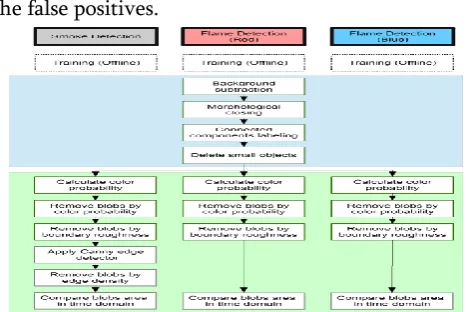
This section explains the algorithm of smoke and flame detection for a fixed camera. The main steps are depicted in Figure 1. Training parts are done
offline in advance and do not affect processing time. Steps placed on the blue background are processed just once for both smoke and flame parts. Also, flame part is divided into red and blue flames because they require different training data. The green part of the algorithm are steps that should be performed separately. In systems with multiple processor cores, steps on the green background can be ran independently.
A. Unified Processing
After the input image is received, it is possible to use background subtraction to distinguish moving objects and static ones. This approach exempts from the false positives.
Figure 1. Proposed algorithm
B.Smoke Detection
After the unified processing part is finished, it is required to starts a separate process for smoke detection.
(A)
In order to apply they ext step of heal algorithm, it is required to train the system. The smoke training database was gathered for different lighting conditions to depict smoke colour.
(B)
(C)
(D)
(E)
Images of the database were united into a single one, and for all the pixels probability density functions (PDF) of normal
Ci(x, y) = e 2(σi)…... (2)
Distributions were built for red (R), green (G), and blue (B) channels of the RGB colour space as shown in Figure 3. Mean and variance values were obtained for each of the PDFs. For Distributions were built for red (R), green (G), and blue (B) channels of the RGB colour space as shown in Figure 3. Mean and variance values were obtained for each of the PDFs. For
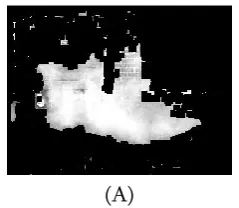
Figure 2. Smoke detection example for low-resolution image: (a) Input image; (b) Background subtraction; (c) Morphology transformations; (d) Colour probability of the blue channel; (e)
Binarized intersection of probabilities; (f) Edges; (g) Result image.
Example, µG and σG are the mean and variance values for the green channel respectively. Using the original RGB image, the 3-channel image is formed: E(x, y) = [R(x, y), G(x, y), B(x, y)]T , (1)
Where x and y are the coordinates of pixels in the image. T is the transpose operation. At this step, by using training data, it is possible to say how high the probability that the current pixel belongs to a smoke region. (2) can do it:
III. EXPERIMENTAL RESULTS
The following hardware was used: Intel i7 4720HQ CPU,
16 GB DDR3 RAM. Software was written in C++ using Microsoft Visual Studio 2013 and ran in Microsoft Windows
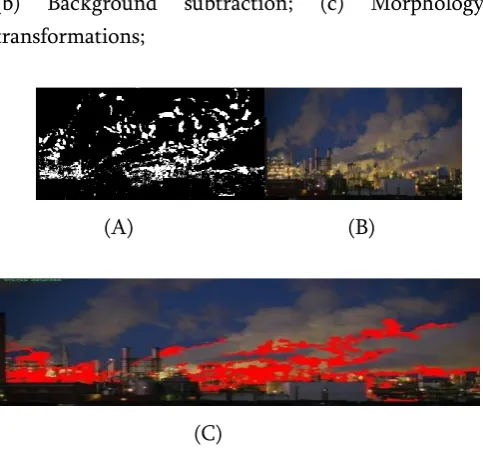
Figure 5: Flame detection example: (a) Input image; (b) Background subtraction; (c) Morphology transformations;
(A) (B)
(C)
Figure 6 .Smoke_detection_at_night:(a)Input image;(b)Background subtraction;(c)Result_image.
All thresholds were tuned heuristically in order to achieve the best results in all test files. For the smoke and fire videos, the open access dataset was used [11]. Table I shows that the method presented in this paper could achieve about 57 frames per second (fps) utilizing i7 CPU for 320x240 image where the separate smoke, red flame, and blue flame parts were processed each on its separate CPU thread. Since all videos in the dataset are stored at low resolution, they were enlarged in order to test how the frame size affects processing time. Videos at 640x480 pixels resolution was working at 22 fps. Processing time significantly increased at 1280x720 pixels resolution mostly due to slow colour probability part. 8.8 fps can be still applicable for video surveillance; however, the algorithm will not be suitable for FullHD videos. There is a good way of improving speed by using GPU to calculate colour probability because each pixel can be processed independently. OpenCV 3 functions for edge detection and morphology operations performed faster that
custom-made code. If there is no possibility to run algorithm in parallel, then processing time is increased to 25.652 ms that is still lower than 35.035 if there is no unification exist for smoke and red flame detection. Also, unification result is used by other parts of IS Lab ISS ∆Ai =I (10) [1]. That makes it useful for multiple tasks integration. True Positive rate for both smoke and flames is 0.901 while, for where Ai and Ai-1 represent the flame area in current and previous frames respectively. To do that, flame blobs in two Example in [7] authors could achieve 0.964. The better the recording quality results the higher detection rate. The current version of algorithm cannot efficiently deal with smoke or flame detection at night. Smoke is not visible; flame colour becomes totally white due to incorrect automatic exposure of a camera. For example, using [13] the background subtraction algorithm failed to successfully separate moving smoke clouds as shown in Figure 6 (b). Additionally, some blobs, extracted by the background subtraction, could not be recognized (Figure 6(c)) because the system was trained for smoke colour characteristics at daytime.
IV. CONCLUSION
V. REFERENCES
[1]. Wahyonos, Alexander Filonenko, AjmalShahbaz, JokoHariyono, Kang, Hyun-Deoks, and Kang-Hyun Jo, Integrating Multiple Tasks of Vision- based Surveillance System: Design and Implementation, FCV 2016, pp. 91-94, Takayama, Japan, 17-19 Feb. 2016
[2]. Alexander and Hyundeoks, Filonenko, DaniloCa ceresHerna ndez, and Kang-Hyun Jo, Smoke Detection for Static Cameras, 21st Japan-Korea Joint Workshop on Frontiers of Computer Vision (FCV), pp. 1-4, 2015
[3]. Jiaqiu Chen, Yaowei Wang, YonghongTian, Tiejun Huang, Wavelet based smoke detection method with RGB Contrast-image and shape con- strain, Visual Communications and Image Processing (VCIP), Kuching, 17-20 Nov. 2013
[4]. HidenoriMaruta, Yusuke Iida, FujioKurokawa, Anisotropic LBP de- scriptors for robust smoke detection, IECON, Vienna, 10-13 Nov. 2013 [5]. Mehdi Torabnezhad, Ali Aghagolzadeh,
HadiSeyedarabis, Visible and IR image fusion algorithm for short range smoke detection, Robotics and Mechatronics (ICRoM), Tehran, 13-15 Feb. 2013
[6]. Yang Zhao, Wei Lu, Yan Zheng, Jian Wang, An early smoke detection system based on increment of optical flow residual, Machine Learning and Cybernetics (ICMLC), Xian, 15-17 July 2012
[7]. HongdaTian, Wanqing Li, Lei Wang, Ogunbonas, P., A novel video-based smoke detection method using image separation, Multimedia and Expo (ICME), Melbourne, 9-13 July 2012
[8]. Li Jinghong, ZouXiaohui, Wang Lu, The design and implementation of fire smoke detection system based on FPGA, Contol and Decision Conference (CCDC), Taiyuan, 23-25 May 2012
[9]. ZoranZivkovic and Ferdinand van der Heijdenb, Efficient adaptive density estimation per image pixel for the task of background subtraction,Pattern Recognition Letters Volume 27 Issue 7, pp. 773–780, 2006
[10]. Paulo ViniciusKoerich Borges, EbroulIzquierdo, A probabilistic approach for vision-based fire detection in videos, Circuits and Systems for Video Technology, IEEE Transactions on, 2010
[11]. Computer vision-based fire detection software
dataset, online:
http://signal.ee.bilkent.edu.tr/VisiFire/Demo/ [12]. Soille, P., Morphological image analysis:
principles and applications,Springer-Verlag, 1999, pp. 173-174.
[13]. Smoke Stacks at Night from Factory in Wyoming, online:
[14]. http://islab.ulsan.ac.kr/files/graphics/isie2016 filonenko/smoke stacks at night from factory in wyoming.mp4
[15]. Liu Chuanju. Research on the digitized production model under the network environment J], Journal of Networks, 2011, 12-3:160-163;
[16]. Yu Shanshan based on NET-business supply chain management system design and realization J]microcomputer, 2011, 12-3:168-170;
[17]. Liu Chuanju. the cluster greenhouse optimization design of the remote monitoring system under the network environment J]. Journal of Multimedia .2012 (12): P82-84; [18]. Li Minzhe, Sun Junmao, Cao Xinming, the
status quo, debate and suggestions of the safety of agricultural products in China J]. China Agricultural Science and Technology, 2012, 5 (3) :68-71
internet of things Systems, IEEE CS and IEEE ComSoc, April-June, 2013.
[20]. Sanford, V., Pervasive Computing Goes the Last Hundred Feet wit internet of things Systems, IEEE CS and IEEE ComSoc, April-June, 2013.
[21]. Wind, G. Creating Business Intelligence from What Were Black Holes of Information and Data, internet of things World, Sydney, 2011. [22]. Ngai E W T et al.internet of things Research:
An Academic Literature Review (1995-2005) and Future Research Direction. International Journal of Production Economics,2012,112 (2): 510 - 520.
[23]. M Karkkainen. Increasing Efficiency in the Supply Chain for Short Shelf life Goods Using internet of things Tagging[J]. Journal of Multimedia,2011,31 (10): 529 - 536. [24]. Finkenzeller, K.: internet of things -Handbuch:
Grundlagenund praktische A wendungeninduktiverFunkanlagen,
Transpondr under kontaktloserChipkarten. 4Auflage, Hanser, München, 2010