CSEIT1833233 | Received : 05 March 2018 | Accepted : 14 March 2018 | March-April-2018 [ (3) 4 : 289-294 ]
International Journal of Scientific Research in Computer Science, Engineering and Information Technology © 2018 IJSRCSEIT | Volume 3 | Issue 4 | ISSN : 2456-3307
289
Modern Security
Data Caching with Service
Separation
in
Wireless Networks
Gutti Swathi1, N. V. Naganjali2, Dr. R. Murugadoss3
1PG Scholar, Department of MCA, St.Ann’s College of Engineering&Technology, Chirala, Andhra Pradesh,
India
2Assistant Professor, Department of MCA, St.Ann’s College of Engineering&Technology, Chirala, Andhra
Pradesh, India
3Professor, Department of MCA, St.Ann’s College of Engineering&Technology, Chirala, Andhra Pradesh, India
ABSTRACT
The present model of networking basically amasses knowledge toward the end has with the network itself offering a basic "best-exertion", "information rationalist" correspondence medium. Be that as it may, this worldview has turned out to be lacking to address the present issues considering the assorted variety of uses and gadgets that are networked. To offer esteem added services to these end clients and applications, more knowledge should be relocated far from the edges and into the network in a controlled and tractable way. In this paper, we show our approach of using semantic information to give content level data to information streams coursing through a network. An arrangement based administration component is used inside the network texture enabling switches to reason over the content and settle on wise choices with respect to the treatment of information parcels. Service differentiation, in-network content adjustment, activity observing and control and so on are a portion of the new services that would now be able to be offered by the network in a bland and adaptable way. By conveying our proposed engineering, a network require never again be seen as a basic information transport medium but instead as an arrangement controlled insightful bundle/stream processor that can offer particular taking care of in view of utilization needs.
Keywords: Wireless Networks, Content Caching
I.
INTRODUCTION
Software-Defined Mobile Networks (SDMN) extends the idea of Software-Defined Networking (SDN) and Network Function Virtualization (NFV) into mobile networks [1]. The aim is improving the scalability and adaptability of the mobile network architectures to varying and diverse traffic demands by leveraging existing host and network virtualization technologies
besides SDN [4]. NFV decouples software
implementations of network functions from the hardware resources [2].We present new concepts for the SDMN architecture leveraging NFV and SDN to
model argue that with such interactions, bandwidth usage optimization, more efficient routing, better QoS guarantees, better power utilization etc. can be achieved [6]. The deployment of wireless network technologies in public places bears the danger of unauthorized people gaining physical access to the
network, secure user authentication and
authorization and a reliable access control mechanism is vital particularly for wireless LANs [7].
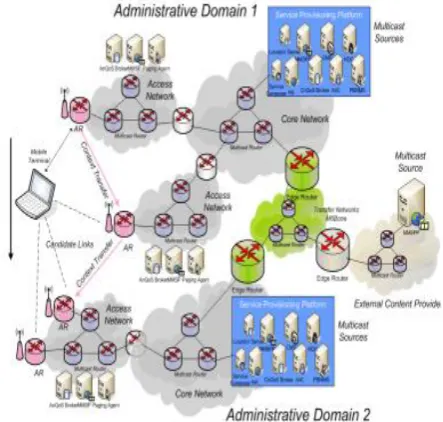
Figure 1. High-Level architecture of SDMN
II.
RELATED WORK
There exist proposals that try to solve the challenges faced by current mobile network architectures with the help of codification NFV, and SDN. Software-defined Radio Access [8]. Wireless Multimedia Sensor Networks (WMSNs) not only enhance existing sensor network applications such as tracking, home automation, and environmental monitoring, but they also enable several new applications such as multimedia surveillance sensor networks, automobile traffic management storage of potentially relevant activities, advanced health care delivery, structural
health monitoring, and industrial process
control[9].The recent context-aware systems are context-aware frameworks that facilitate smart service discovery, delivery and adaptation through rich ontology based context representation [10]. This rich context ontology considers all parameters relevant to an interaction as the context [11]. IPv6 mobility support (MIPv6) proposed to address mobility management for IPv6 at network layer
considering heterogeneous mobile network
environment, is found to be not efficient for
managing frequent mobility [12]. Efforts to improve mobile IPv6 are aimed at minimizing the handover address configuration time and reducing the amount of signaling overhead required to re-route packets to the mobile node's new location [13].
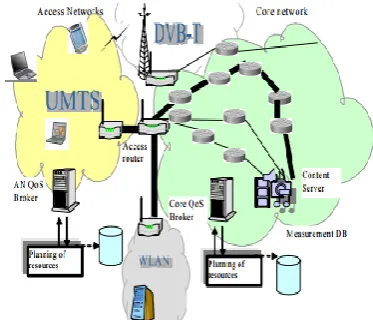
Figure 2. Networking architecture for QoS based multicast transport
III.
SYSTEM ARCHITECTURE
The access control and router management functions are implemented as LARA++ active services.
IV.
PROPOSED APPROACH
This section presents an overview of our proposed framework. We break it down into two components at a node level and at a system level that spans the network the architecture we propose introduces our Node Framework as an additional layer called the CoCoNet layer between the application and the transport layer [17]. This layer is responsible for intercepting socket calls made by applications to the transport layer.The API is enhanced to allow the application to provide semantic level information for messages transmitted over this interface [18]. A Local Policy Decision Point (LPDP) is used to determine what policies to enforce based on the content. In our framework, each Policy Enforcement Point (PEP) is every layer in the networking stack while treats the PEP at a node level [19].
Figure 3. CoCoNet Node Framework
A. Ant Sense Net Algorithm:
Ant Sens Net consists of a protocol based on ACO (Ant Colony Optimization) to discover and maintain routes between CHs and the sink [20]. The route discovery process starts as soon as the cluster process finishes. The data configuration of the ant’s structure
used in its route discovery process is defined below. It comprises the following fields [21].
1. Ant. ID: the ant’s ID
2. Ant. Type: the type of ant in the route discovery process. This field can be a FANT a BANT a MANT (maintenance ant) or a DANT (data ant).
3. Ant. notes: the nodes-visited-stack, contains the IDs of nodes by which the ant passes.
4. Ant. Hop count: calculates the number of hops by which the ant passed from its CH source. This field serves as the ant’s TTL.
5. Ant. info: Each type of ant uses this field to store special information about the route or the nodes, in order to evaluate how appropriate the route
B. Policy Based Multicast QoS Management
The management of QoS provisioning for multicast delivery is based on hierarchically distributed QoS brokers at access, core, and inter-domain level [22]. At the top of this hierarchy the Core QoS Broker is responsible for Inter-Domain and Inter-Access
Network Resources provisioning based on
Differentiated Service (DS) architecture, while the Access Network (AN) QoS Brokers provide flow based QoS to the mobile terminals using signalling mechanisms for Integrated Service support. Part of the QoS architecture is the Multicast Manager which handles the reservation of multicast resources and performs tree optimizations for mobile nodes with multicast services [23].
Policy based QoS management is used to control the multicast distribution from a given server to the multicast users. Policies restrict the multicast transfer for specific services based on resource planning strategies and prediction of mobile user’s behavior for content delivery [24].
C. Information Update Phase
This novel clustering algorithm is based on T-ANT and the clustering protocol uses a collection of agents to form clusters in a sensor network. It is completely distributed and completed in constant time [25]. These are the reasons why this algorithm was selected. As in T-ANT clustering operations are split into rounds. Each round comprises a cluster setup phase and a steady phase [26]. In the steady phase of the algorithm, data transmission takes place between sensors and the sink. A number of timers are used to control the process operations during the cluster setup phase [27].
Algorithm. Tasks developed by the other nodes 1. if an ant arrives at node i then
2. if node i is not a CH then
3. if there is a CH in the radius Rcluster then 4. Pick a random CH neighbor
5. Send the ant to it 6. Else
7. Store the ant {This node is a CH}
8. Broadcast a message ADV_CLUSTER to
9. neighbors in range Rcluster 10. end if
11. else if node i is a CH then 12. Decrement the TTL of the ant 13. if TTL > 0
14. Pick a random neighbor according to the 15. probability function probc
16. Send the cluster ant to it 17. Else
18. Destroy the ant 19. end if
20. end if 21. end if
in order to become a CH, the selected node must have received a cluster ant from another CH (or the sink) located at a distance Rcluster from it. Rcluster was previously defined as the minimal distance between two CHs. Hence, at the moment of selecting the following neighbor, the node reads its neighbors’ information table and selects.
V.
PRELIMINARY RESULTS
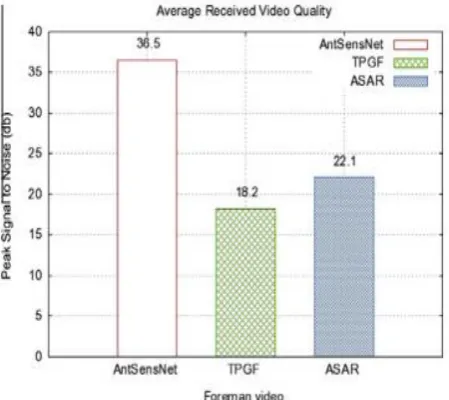
To investigate some of the potential benefits that content awareness within the network can bring, we simulated a cross layer approach where the routing layer proactively maintains alternate routes that can be used immediately upon failure of the primary route. The network topology used is the same used in the previous simulations. Only a video sensor in all the network is capturing, encoding and sending a live video sequences to the sink. We use only two paths to send the packets (in TPGF and AntSensNet for ASAR we use only a path). The video sequence is encoded according to H.264/AVC standard with a reference frame list of size five frames for compensated prediction. They do not implement any distortion minimization rate control and they are only specialized in scalar data transmission. Conversely, AntSensNet is content-aware and is able to take actions in order to minimize the video distortion.
VI.
CONCLUSION
We surveyed routing protocols by taking into account several classification criteria, including location information, network layering and in-network processing, data centricity, Mobility-based, Multipath-based Protocols, network heterogeneity, and QoS requirements. This paper is a leap towards SDN and NFV based mobile network architecture to reap the benefits of both technologies in a unified approach. We have proposed SDMN architecture components to overcome the highlighted limitations in current wireless networks and provide a way-ahead for future mobile networks.Controlled cross layer interactions are used to provide more efficient processing while still retaining tractability. The tight integration of the access control system with our Mobile IPv6 stacks allows for a system which adapts quickly to changes in network environment while maintaining location transparency for applications and a high level of security. Further mechanisms for efficient mobile multicast based on advance pro-active resource reservation and QoS policy control are currently the focus of research and development.
VII.
REFERENCES
[1]. S. Muller, O. Atan, M. van der Schaar, and A. Klein, "Smart caching in wireless small cell networks via contextual multi-armed bandits," in Proc. IEEE International Conference on Communications (ICC), 2016, pp. 1-7.
[2]. A. Gudipati, D. Perry, L. E. Li, and S. Katti, "SoftRAN: Software Defined Radio Access Network," in Proceedings of the Second ACM SIGCOMM Workshop on Hot Topics in Software Defined Networking, ser. HotSDN ’13. ACM, 2013, pp. 25-30.
[3]. X. Jin, L. E. Li, L. Vanbever, and J. Rexford, "SoftCell: scalable and flexible cellular core network architecture," in Proceedings of the
ninth ACM conference on Emerging
networking experiments and technologies. ACM, 2013, pp. 163-174.
[4]. Developing floodlight modules. Floodlight OpenFlow controller. Big Switch
[5]. I. Romdhani, M. Kellil, H-Y. Lach, A. Bouabdallah, H. Bettahar: "IP Mobile Multicast: Challenges and Solutions", IEEE Communications Surveys & Tutorials, 2004 [6]. S. Ardon, P. Gunningberg, B. LandFeldt, M. P.
Y. Ismailov, and A. Seneviratne. March: a distributed content adaptation architecture. International Journal of Communication Systems,
[7]. T.S. Rappaport, "Wireless Communications-Principles and Practice", Prentice Hall Publishing, 1996.ISBN 0-13-375536-3.
[8]. I.F. Akyildiz, T. Melodia, K.R. Chowdhury, A survey on wireless multimedia sensor networks, Computer Networks 51 (4) (2007) 921-960.
[9]. K. Akkaya, M. Younis, A survey on routing protocols for wireless sensor networks, Ad Hoc Networks 3 (3) (2005) 325-349.
[10]. Abowd, G.D. et al, 1997, Cyberguide: a mobile Context-Aware Tour Guide. ACM Wireless Networks. Vol. 3, No. 5 pp 421-433.
[11]. Chaverst, K. et al, 1998, Design of an Object Model for a Context Sensitive Tourist GUIDE. Proceedings of the International Workshop on
Interactive Applications of Mobile
Computing.(IMC 98), Rostock, Germany, pp 883-891.
[12]. I. Miloucheva, H. J. Einsiedler, D. Gomes, K. Jonas: "QoS based multicast architecture for heterogeneous mobile IPv6 environment", 13th
International Conference on
Telecommunications, 9-12 May 2006
[13]. D. Johnson, C. Perkins, J. Arkko: "Mobility Support in IPv6", RFC 3775, June 2004.
[14]. S. Kent, R. Atkinson, "Security Architecture for the Internet Protocol", Internet RFC 2401, November 1998.
Internet Draft, draft-ietf-seamoby-context-transfer-problemstat-02.txt, June 2001.
[16]. W. Arbaug, N. Shankar, Y.C.J. Wan, "Your 802.11 Wireless Network has No Clothes", Technical Report, Department of Computer Science, University of Maryland
[17]. A. Beck and M. Hofmann. IRML: A Rule Specification Language for Intermediary Services:draft-beck-opes-irml00.txt, Febuary 2001.
[18]. H. Bharadvaj, A. Joshi, and S.
Auephanwiriyakul.An Active Transcoding Proxy to Support Mobile Web Access.In 17th IEEE Symposium on Reliable Distributed Systems, October 1998.
[19]. S. Bhattacharjee, K. L. Calvert, and E. W. Zegura.On active networking and congestion. Technical Report GIT-CC-96- 02
[20]. G. Feng, C. Douligeris, K. Makki, N. Pissinou, Performance evaluation of delay-constrained least-cost QoS routing algorithms based on linear and nonlinear lagrange relaxation, in: 2002 IEEE International Conference on Communications, ICC 2002, vol. 4, Piscataway, NJ, USA, 2002, pp. 2273-2278.
[21]. W.B. Heinzelman, A.P. Chandrakasan, H. Balakrishnan, An application-specific protocol architecture for wireless microsensor networks,
IEEE Transactions on Wireless
Communications 1 (4) (2002) 660-670
[22]. A. Mishra, M. Shin, W. A. Arbaush.: "Context caching using neighbor graphs for fast handoffs in a wireless network", Twenty-third Annual Joint Conference of the IEEE Computer and Communications Societies, INFOCOM, 7-11 March 2004
[23]. J. M. Oyoqui, J.A. Garcia-Macias: "Context transfer for seamless micro-mobility",
Proceedings of the Fourth Mexican
International Conference on Computer Science, ENC, page(s):291-297, 2003
[24]. S. Pack, H. Jung, T. Kwon, Y. Choi: "A selective neighbor caching scheme for fast handoff in
IEEE 802.11 wireless networks", IEEE International Conference on Communications, ICC, May 2005
[25]. O. Younis, S. Fahmy, HEED: a hybrid, energy-efficient, distributed clustering approach for ad hoc sensor networks, IEEE Transactions on Mobile Computing 3 (4) (2004) 366-379. [26]. Z. Ying, L.D. Kuhn, M.P.J. Fromherz,
Improvements on Ant Routing for Sensor Networks, Springer-Verlag, 2004.
[27]. T. Dagiuklas, S. Kotsopoulos, I. Politis, M.
Tsagkaropoulos, Power efficient video multipath transmission over wireless multimedia sensor networks, Mobile Networks and Applications 13 (3) (2008) 274-284
ABOUT AUTHORS:
G.SWATHI is currently pursuing his M.C.A in Information Technology Department, St.Ann’s College of Engineering&Technology, Chirala, A.P. She received her Bachelor of Science from ANU.
N. V.Naganjali, MCA is currently working as an Asst.Professor in
MCA Department, St.Ann’s
College of
Engineering&Technology, Chirala. Her research includes networking and data mining.
DR.R.Murugadoss, MCA, M.E
(CSE),Ph.D (CSE), MCSI,