Improving the Knowledge
Management System
at
Match Maker Associates Limited
Supervisors:
Student:
Prof. dr ir. E.J. de Bruijn
Kinga M. Drag
Summary
Knowledge management is a term widely used in companies working in the field where knowledge is a main component. Match Maker Associates (MMA) is a consulting company working resilient on the Tanzanian market, and cooperating with other consulting companies all over the world. MMA’s aim is to work faster and better with respect to knowledge use. The problem at MMA is the lack of a proper filling system and Knowledge Management System (KMS).
As a small consulting company in Tanzania, MMA must work with inconveniences appearing in Developing Countries, like a poor infrastructure and lower level of technology. However, MMA consultants are well-qualified workers, willing to change and develop their company. The IT improvements are a necessity and must be done together with additional training. The organizational structure at MMA must be changed into a decentralized one, to support the activities.
Due to the fact, that MMA consultants are well qualified, the introduction of the new KM system requires a well-designed proposal, according to which the company works more efficient and effective. However, consultants are often avoiding changes, so the introduction of the KMS must consist of the employees behaviour changes as well (Feher, 2004). There are plenty of new IT solutions that help companies with storing and sharing of knowledge. MMA has good IT specialists, who are willing to help with those new IT solutions. A very popular one is e-learning (Fernandez, 2004; Marvick, 2001; Łobejko, 2004), qualified as one of the best ways of training, what should be given by MMA consultants.
The introduction of the new way of working should be done as soon as possible, in order to assist the changes within MMA. The implementation of the new KMS must consists of the following steps: the organization environment, strategic goals, KM pillars, organization structure, final KMS version. The recognition of the organization environment is seen as an input. The current use of knowledge and knowledge transformation leads to efficient use of tacit and explicit knowledge. Moreover, it shows how knowledge is extracted and passed on the environment. The strategic objectives have been specified in the field of knowledge. Other companies were visited in order to find the best solution for the new KMS. The results were compared with MMA preferences and possibilities. The KM pillars, the third step of KMS implementation, required a deep analysis of leadership, organization, technology and learning. The proposals regarding the KM pillars help to balance and integrate an enterprise issues. Finally the designed in the behavioural aspects and social engineering structure of the new KMS showed the possibilities of improvements within the system. The output is the new KMS, which will bring the efficiency, effectiveness and innovation at MMA.
One of the biggest problems for MMA is the new IT solution. The conditions of the Tanzanian IT market limit the possibilities of dealing with that problem. However, the specialists know the most suitable technology. The new KMS supporting filling, sharing and storing of knowledge must be introduced just after realizing the needed change in the worker’s behaviour. IT specialists must assist the new IT proposals. They should make a special training for the consultants, in order to make full use of it. The proposed solution for storing and sharing knowledge is a part of the new KMS and must be done with IT specialists. They will adjust it to the consultants’ wishes. This system requires new software, and a number of prerequisites (like buying licenses, new hardware, involving IT specialists, getting trainings in the field of IT), should be met. Moreover, consultants must subscribe for the thematic magazines, to get the newest ideas about the industry sectors. Other employees should present other activities related to knowledge sharing, in order to give the senior consultants more time for executing assignments. The successful implementation of the useful system of knowledge management must be according to MMA consultants’ wishes and supported by IT specialist.
MMA directors should employ a secretary, who can be also a bookkeeper, and will be responsible for all activities regarding sharing knowledge, accountancy and meetings.
A new, improved Knowledge Management System (KMS) will bring a faster decision making process, better usage of time, and efficient and effective use of knowledge. Moreover, the introduction of the KMS will improve the communication between workers, enable faster response to new business issues and reduce costs of making researches. MMA consultants
Table of contents
Summary__________________________________________________________________ 2 List of figures ______________________________________________________________ 7 List of tables _______________________________________________________________ 8 Acknowledgments ___________________________________________________________ 9 1. Background and objective of the assignment __________________________________ 10
1.1. Problem definition _________________________________________________________ 11
1.2. Research questions_________________________________________________________ 12
1.3. Research approach_________________________________________________________ 14
1.4. Structure of the research ____________________________________________________ 15
2. Models and Theory _______________________________________________________ 16
2.1. Introduction ______________________________________________________________ 16
2.2. Knowledge________________________________________________________________ 16
2.3. Knowledge Management ____________________________________________________ 17
2.4. Knowledge Management System _____________________________________________ 18
2.5. KMS Implementation ______________________________________________________ 19
2.6. KMS implementation in small consulting companies_____________________________ 21
2.7. Knowledge transformation __________________________________________________ 22
2.8. Knowledge Management Technology _________________________________________ 25
2.9. Framework _______________________________________________________________ 26
3. Knowledge Management System implementation at Match Makers Associates Ltd. ___ 29
3.1. Introduction ______________________________________________________________ 29
3.2. Match Maker Associates Ltd. ________________________________________________ 29
3.3. Organization environment __________________________________________________ 30
3.4. Use of knowledge at MMA __________________________________________________ 32
3.5. Conclusion _______________________________________________________________ 34
4. Strategic goals___________________________________________________________ 38
4.1. Introduction ______________________________________________________________ 38
4.2. Strategic goals at MMA _____________________________________________________ 38
4.3. Benchmarking ____________________________________________________________ 39
4.4. KMS preferences and possibilities at MMA ____________________________________ 45
4.5. Conclusion _______________________________________________________________ 47
5. Knowledge Management Four Pillars________________________________________ 49
5.1. Introduction ______________________________________________________________ 49
5.2. Leadership _______________________________________________________________ 49
5.4. Technology _______________________________________________________________ 50
5.5. Learning _________________________________________________________________ 53
5.6. Conclusion _______________________________________________________________ 53
6. Organization structure ____________________________________________________ 55
6.1. Introduction ______________________________________________________________ 55
6.2. Organization structure at MMA______________________________________________ 55
6.3. Conclusion _______________________________________________________________ 56
7. A New Knowledge Management System at MMA ______________________________ 57 8. Conclusions and recommendations__________________________________________ 60
8.1. Conclusions _______________________________________________________________ 60
8.2. Recommendations _________________________________________________________ 61
8.3. Reflections________________________________________________________________ 63
References________________________________________________________________ 65 Appendices:_______________________________________________________________ 68
1. Questionnaire ______________________________________________________________ 68
2. Interview with Bo van Elzakker from AgroEco Netherlands, 24th April 2006 __________ 69
3. Interview with Marg Leijdens from AgroEco Tanzania, 18th May 2006 _______________ 71
4. Interview with Ernst & Young in Tanzania, 25th May 2006 _________________________ 72
5. Interview with Peter Bleeker from Advance Consulting Netherlands, 23rd June 2006 ___ 73
6. Interview with Eline Weijers from MDF Netherlands, 12th June 2006 ________________ 74
7. Interview with Hugo Verkuijl from KIT, the Netherlands, 12th June 2006_____________ 75
8. Interview with IT-specialist Hussein Kitambi from Simbanet, Dar Es Salaam – Tanzania, 10th May 2006_________________________________________________________________ 76
9. Interview with Jonathan Reece, IT-specialist, Arusha – Tanzania, 2nd June 2006 _______ 77
List of figures
Figure 1. Structure of the research 15
Figure 2. Triangle of hierarchy, Jashapara 16
Figure 3. A system approach and methodology if KMS projects 19
Figure 4. KM Pillars, Stankosky, Calabrese, Baldanza 20
Figure 5. Scheme of KMS, Łobejko 21
Figure 6. Overall framework of the structure of the researches 28
List of tables
Table 1. Companies visited during research 39
Table 2. Process of the consulting activities 40
Table 3. Knowledge sharing and exchange 42
Table 4. External and internal sources of knowledge 43
Acknowledgments
The time, that I spent executing the assignment for Match Makers Associates Ltd., was full with new experiences. The time spent in Tanzania helped me to familiarize with this different culture and style of working. It showed me the meaning of a Developing Country. The interviews that I made for my research, gave me the opportunity to know how other companies work and struggle with inconveniences from the infrastructure and technological side. I would like to thank the people from MMA (Mr Henri van der Land, Mr Peniel Uliwa, Mr Edmond Ringo), who supported me during the execution of this assignment. Moreover, I would like to thank my both supervisors from the University of Twente, Prof. Erik de Bruijn and MSc. Stephan Maathuis, for their contribution and support. I would like to thank also PhD Stanisław Łobejko who supported chapter 7 with his knowledge and KMS model.
1. Background and objective of the assignment
Small consulting companies have huge influence on the market in the developing countries, through improving and developing business. Because of the expensiveness, consulting corporations stay usually beyond reach of the beginning businesspersons. This niche of small, new companies is approached by small consulting companies, which pay attention to the needs of emerging businesses. An example of such consulting company is Match Makers Associates (MMA), operating on the Tanzanian market where new businesses appear frequently.
Match Maker Associates Limited (MMA) is a private limited company based in Tanzania striving to develop and manage a centre of excellence in private sector development and business services consultancy. Its clients vary from private, public and donor organizations involved in private and/or small enterprise development mainly in East and Southern Africa. MMA runs two offices, one in Arusha in the North East Tanzania and another one in Dar Es Salaam, the country business capital and on the coast of the Indian Ocean.
The directors of MMA have a broad experience especially in working with projects in small enterprises. They undertake also large projects in countries like Tanzania, Zambia and Zimbabwe. MMA offers a broad range of services, including development of private sector, its management and evaluation, analysis of value chain, and business development services. Moreover, MMA helps with mobilizing funds for joint ventures, new businesses in small enterprises sector and promoting and sharing knowledge from best practice. Therefore, the object of MMA is three folded:
1. MMA delivers applicable and adaptable methodologies in value chain development. 2. MMA operates in a network of professional consultants of high standards and
integrity.
3. MMA acknowledges and promotes mutual learning1
Because of working on projects, MMA has an excellent knowledge in applying such methodologies like: the market linkages approach, the credit guarantee mechanism through
1
commercial banks, economic mapping and sub sector analyses. Since two years, MMA is specializing in value chain development.
MMA consultants are currently occupied by assignments and have limited time to sort out in-house knowledge management and operational issues. These issues exist since knowledge is relative chaotic and especially to a large degree a context-bound factor, that is difficult to organize due to its characteristics. MMA directors strongly believe that a proper filing system will be instrumental for upgrading the possessed knowledge in the company. This filing system can then be used to provide easy access to all the data available in the company. This data consists not only of internal reports in the areas of sub sector selection, sub sector analysis and value chain development, but also of general information like demographic, socioeconomic and regulatory information.
Small consulting companies working in less developed markets need a proper Knowledge Management System (KMS) that will help with the effective and efficient use of possessed information and knowledge. Well-developed systems will bring a company a competitive position, reduce the time of executing an assignment, broaden the sources of knowledge and adjust the company to the prevailing market situation. Proper transformation of tacit and explicit knowledge helps consulting companies with improvement of their KMS and emphasizes different sources of knowledge (tacit, explicit, implicit knowledge).
MMA faces difficulties with the storing and sharing knowledge, tacit and explicit knowledge transformation and the limited time which consultants can put into an assignment. Therefore MMA wants to improve its activities by exploring the possibilities of improving the existing KMS. Those problems bring me to the following objective for my research:
The objective of my research is to explore how consulting companies, like Match Makers Associates Ltd. can improve the Knowledge Management
System in order to enable them to perform better.
1.1. Problem definition
has already some kind of tacit and explicit knowledge. Improving the Knowledge Management System (KMS) should be based on the existing problems and possibilities. A successful improvement of KMS will have to be guided by a well-detailed plan. Next to that, it is also possible that the way of working of MMA has to be reshaped to better fit to the KMS requirements.
Based on the above considerations, combined with the background of MMA, the problem formulation is defined as follows:
What is a suitable KMS, for Match Maker Associates Ltd., and how can it be implemented?
Successful implementation of the KMS requires a number of pre-requisites which have to be met. First of all a thorough analysis of the activities of MMA has to be performed. The way of working and the information demands of MMA have to be analysed. With this, I can compare the situation at MMA with how consultancy and matchmaking processes are carried out according to the applicable literature. Comparing MMA to other companies offering similar services will lead to a best practice suggestion of working. Using this comparison, I can make a judgement about what information is actually needed in the company.
1.2. Research questions
Taking into consideration the Match Makers Associates Ltd. case and available literature it was possible to formulate the questions. Since this project is based on the a knowledge management system implementation, the Stankosky and Baldanza model [2001] will be used as a main framework. This model leads to the following questions:
1. How is MMA currently using KMS in Tanzania? 2. What is the desired KMS at MMA? (strategic goals)
3. Which objectives are formulated for the desired KMS with respect to the KM pillars? 4. What will be the most proper organization structure for MMA, as a prototype of
Answering these questions will bring the answer to the problem definition. In the meantime, other issues connected with KMS implementation appear like transformation of the tacit and explicit knowledge. That transformation is based on the technological solution for the KMS. With respect to the market of Tanzania, the possibilities of implementing new technological solutions should also be explored. This leads to the question 1a and 1b.
1. How is MMA currently using KMS in Tanzania?
a) To which extent does the environment influence KMS development and implementation?
b) How does MMA currently use existing knowledge?
The Stankosky and Baldanza [2001] model helps with the correct implementation of KMS. The implementation requires preparations that must be known before starting improvements. For a better understanding the KMS implementation idea, it is good to observe the way of working other consulting companies, both small and big corporations. The comparison of all visited companies will be done and resulting in a benchmark for MMA.
2. What is the desired KMS at MMA?
a) What are the relevant strategic goals at MMA? b) What can be learned from other companies?
c) What are the possibilities and preferences at MMA?
After this the analysis of four pillars will be done, as proposed by the authors of the same model, leading to question 3a, 3b, 3c and 3d.
3. Which objectives are formulated for the desired KMS with respect to the KM pillars a) leadership
b) organization c) technology d) learning?
4. What will be the most appropriate organization structure for MMA, as a prototype of KMS?
1.3. Research approach
In order to find the answers to the research questions specific methods and models, that are applicable to the issue of Knowledge Management System at MMA, have been used. The research started in the Netherlands and had the aim to recognize the environment of international consulting companies, working on the well-developed market. The tool used is a survey. The purpose of visiting companies was to understand their KMS and consequently improvement KMS at MMA as required.
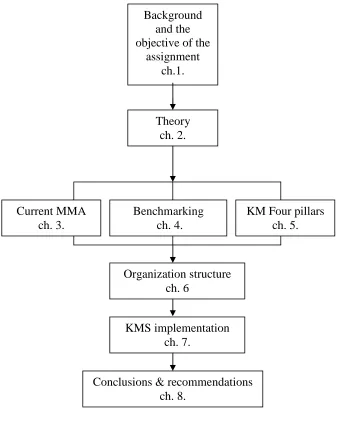
1.4. Structure of the research
Figure 1. Structure of the research
Background and the objective of the
assignment ch.1.
Current MMA ch. 3.
Benchmarking ch. 4.
Organization structure ch. 6
KMS implementation ch. 7.
Conclusions & recommendations ch. 8.
KM Four pillars ch. 5. Theory
2. Models and Theory
2.1. Introduction
Introducing models and theories follows the research plan and is used to find an answer to the research problem. The literature research was done in the Netherlands. First the concept of knowledge management and its implementation will be explained. Then the knowledge management system is analyzed according to the available literature. Finally the research framework is introduced.
2.2. Knowledge
Knowledge is seen as everything what we know, how to refer that to existing situation and how to recognize facts, techniques, methods. The first ideas of knowledge were defined by Plato’s dialogue of the Theaitetos [Jasaphara, 2004]. According to him knowledge was described as “justified true belief”. In the modern literature there are many different definitions describing this term. Nonaka [1991] says that knowledge consists of convictions and expectations; it applies to actions and meanings. According to Jashapara [2004], knowledge is seen as ‘actionable information’. Such actionable information allows better decision-making and provides an effective input to dialogue and creativity in organization. He says also that knowledge allows acting more effective actions than information or data and equips with a greater ability to predict future outcomes. Jashapara created the triangle of hierarchy of data, information, and knowledge (Figure 2.)
Figure 2. Triangle of hierarchy, Jashapara [2004] Data
Information Knowledge
Knowledge according to Marvick [2001] includes both the experience and understanding of the people in the organization and the information artefacts, such as documents and reports, available within the organization and in the world outside.
Knowledge has some special characteristics. It belongs to the owner and due to this fact it is hard to transfer. Also sharing the knowledge requires special features. The value of knowledge may be higher if the owner is using it properly and relatively often. Lack of that causes disappearance of knowledge [Łobejko, 2001].
Common division of knowledge with respect to questions asked, is what, know-why, know-how, and know-who. Know-what describes usually information, facts and
incidents. Know-why is about rules and laws in the environment, society and human mentality. Know-how is an answer on a question about ability of doing some things. The last question is know-who and is about who knows what and how to do that. According to de Jong and Freguson-Hesselar [1993] knowledge is identified as declarative, procedural, situational and strategic (know-what, know-how, know-when and know-why).
2.3. Knowledge Management
The objectives of KM is to acquire and maintain highly skilled workers in case of using knowledge in an efficient way, to make organisation better than others and to create new opportunities for workers to upgrade their capabilities. Proper understanding of KM at consulting companies will improve the services, which they offer. Moreover, it will encourage workers to share knowledge and due to this fact brings efficiency in the way of working.
2.4. Knowledge Management System
Knowledge Management System (KMS) is a term describing the connection between the latest technologies and social/structural mechanisms [Fernandez, 2004]. Within the KMS process, technology plays an important role in development, discovering, sharing, storing and application of knowledge. Effective use of KMS brings knowledge as the most workable tool for the growth of the organisation. Nevertheless human capital is, according to scientists, in 80% responsible for creating knowledge. Only 20% of that is brought by technology [Fernandez, 2004]. Therefore, the technology only assists creating knowledge. A KMS helps to use it in an efficient and effective way.
2.5. KMS Implementation
The success of the organisation depends on proper implementation of KMS. Stankosky and Baldanza [2001] developed a system approach and methodology of KMS projects.
The Stankosky and Baldanza [2001] model details an approach for a new KMS (Figure 3). That new system should be based on the analysis of the microenvironment (customers, suppliers, and competitors), macro environment (law, political situation, economy and culture of the country where the company exists), research and development, innovation monitoring, workers skills and experience, technology transfer, own market researches, databases, conferences and exhibitions. [Łobejko, 2004]
INPUTS PROCESS OUTPUTS
Figure 3. A system approach and methodology if KMS projects, Stankosky, Baldanza [2001]
During designing a new KMS, the first step is to analyse the environment of the organisation, both external and internal. This information helps to explore how knowledge will be extracted and passed on to the environment. The next step is to specify strategic objectives; it means needs in the field of knowledge. Furthermore, it is required to define four objectives of KM: leadership, organization, technology and learning which help with balancing and integration of the KMS in an enterprise setting. The organisational structure should be designed in the fourth step, with respect to the four objectives of KM and measurable objectives of the organisation. Through such design process, the new KMS meets organisation culture and supports its strategic aims. Moreover, it must support the desired benefits and expectations of the company and recognize the requirements and conditions for
Efficiency, effectivenes, innovation KMS Organisation
structure KM Pillars
Strategic goals
(measurable) Organisation
success. The KM has a higher chance for success if the organizational structure is streamlined (Cheseborough, 2004).
Figure 4. KM Pillars, Stankosky, Calabrese, Baldanza [1999]
Four pillars of KM help with designing the right KMS. According to Stankosky and Calabrese, Baldanza [1999] leadership deals with the environmental, strategic and enterprise – level decision-making processes involving the values, objectives, knowledge requirements, knowledge sources, prioritisation and resource allocation of the organization’s knowledge assets. It stresses the need for integrative management principles and techniques, primarily based on systems thinking approaches. Further organization deals with the operational aspects of knowledge assets, including functions, processes, formal and informal organizational structures, control, measures, process improvement and business process reengineering. Technology deals with the various information technologies peculiar to supporting and/or
implementation of the four pillars brings balance in the company during introducing KMS. This helps with proper management of knowledge.
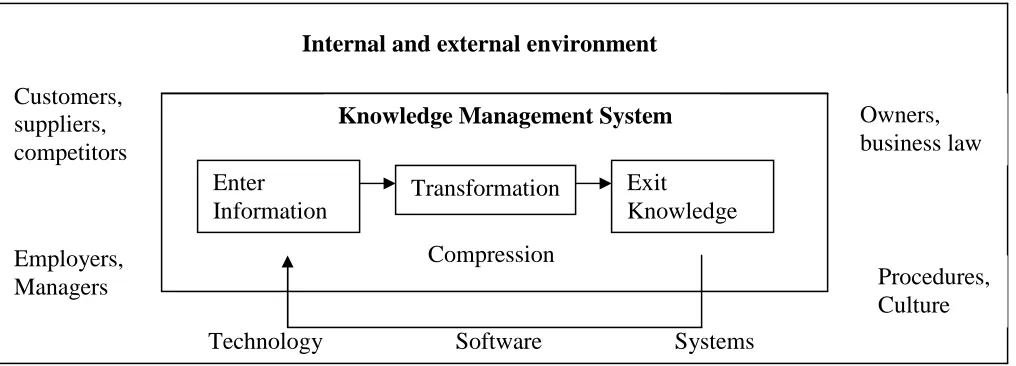
Łobejko [2004] designed the scheme of KMS consisting of all above-mentioned elements (see figure 5). The schematic KMS is drawn below.
Technology Software Systems
Figure 5. Scheme of KMS, Łobejko S. [2004]
In this scheme, KMS the input is information that is then transformed and after the context addition, is possible to create knowledge about specific entrance topic. The information might come from both the internal and external environment of the organisation, its employees and IT systems. The factors of the internal and external environment in the Łobejko model connect with the first step of Stankosky and Baldanza [2001] model. Those factors strongly influence KMS and partly are transferred to the external environment of the organization through new technologies, ideas, patents, etc. [Łobejko, 2004]. The transformed knowledge may be used further both by workers and as new quality information that enriches the existed information system. Figure 5 is a continuation of Figure 3 and gives the outlook of the new KMS.
2.6. KMS implementation in small consulting companies
The Hungarian scientist Feher [2004] argued that the knowledge management requires always changes in the daily routines, behaviour, and processes and organisational structures. Moreover, he proved that employees resist changes because they have to give up the process
Enter Information
Transformation Exit
Knowledge Knowledge Management System
Compression Customers,
suppliers, competitors
Employers, Managers
Owners, business law
of working and behaviour and have to form a new contract with the organization. Feher [2004] made also researches with respect to the consulting companies by comparing two organizations, IT-Consult and MR Consulting. Both companies had problems with organisational and IT solutions. Elements of the solution for those problems can be used in MMA case as well. According to Feher “the managers are not committed, not really leaders of changes, not involving employees. Leadership and cultural change are basic factors of change processes that are also basic enablers of KM activities. Without good change management, there are also problems with knowledge management activities: factors, that are important to change the organisation, later are required to support KM activities.” Feher [2004] stated also that spending time with formalisation of the documents was seen among employees as a kind of punishment, instead of accepted and honoured work. He pointed out the benefits of e-learning, where consultants were developed by group trainings.
Fernandez et al [2004] show the benefits of a web-based system. According to them, the web-based companies are expecting to discover all this knowledge in the logs maintained by their web servers. Furthermore, e-business provides a fertile ground for learning market trends. All companies must follow it and the competitors are up to. Fernandez [2004] proved also the need for constant changes, because all web-based information is doubled every nine months. All these points must be considered before implementation of the new KMS in small consulting companies.
2.7. Knowledge transformation
Nonaka and Takeuchi [1995] distinguished two different kinds of knowledge: tacit and explicit. The first one comes from the experience of the knowledge owner, his beliefs and values. It is seen as the most valuable knowledge, because it is not fully shared with other people. Explicit knowledge is drawn from physical and formal sources like books, documents, reports and is easy to articulate. Moreover, knowledge transformation is enlarging the first step of Stankosky and Baldanza model [2001] where the current use of knowledge and transformation must be analyzed.
procedural knowledge exist. Declarative knowledge is more similar to explicit, as a way of description of facts and things and tasks and methods. As they say, sometimes declarative and explicit knowledge may be used as synonyms. The reason for that is that both may be articulated. On the other hand, procedural knowledge is similar to tacit one which is reflected in mental skills. It is a way of doing something and knowing how to do that. Procedural knowledge is difficult to articulate.
According Nonaka and Takeuchi [1995] the process of transformation tacit and explicit knowledge consists of four approaches:
1. From tacit to tacit knowledge – socialisation, 2. From tacit to explicit knowledge – externalisation, 3. From explicit to explicit knowledge – combination, 4. From explicit to tacit knowledge – internalisation.
2.7.1. Socialisation
Knowledge transformation from tacit to tacit, so-called socialisation consists of sharing experiences between workers during face-to-face meetings. However nowadays the virtual technology is well-developed and personal meetings are replaced by online tools like chats, videoconferences, Internet calls, etc. Sharing experience is the most important activity during socialisation. Workers can learn not only through verbal contact, but also through observation, followed by practice. Interactions with clients is also a process of sharing tacit knowledge among each other what brings much better ideas for diversification or differentiation business. The most well known socialisation’s technologies are e-meetings and synchronous collaboration (chat).
2.7.2. Externalisation
gives new ideas based on tacit knowledge. Newsgroups and other free discussions are the most proper way of externalisation. People participating in such meetings are more willing to share the knowledge, give advice, answer on appearing questions, and annotations.
2.7.3. Combination
Transformation from explicit to explicit knowledge is known as combination. This process is based on classification and selection of information. It is also sorting out and making conception in usable system of knowledge [Nonaka, 1995]. Moreover, within this process different elements of explicit knowledge are put together. Through the selection and categorization of existing knowledge, it might contribute to arise new knowledge. It is based on document categorization, e-mails, text searching. It is the best supported by IT tools, which are available to all company’s workers. Through making presentations, sending e-mails, writing softcopy reports workers share knowledge with colleagues. Document categorization is highly required as data collection of the company. One of the most important technologies in transformation technology is searching skill. Searching documents via a searching browser brings plenty of useless information for the searcher. Moreover, all this information is growing rapidly and it is getting harder and harder to find proper information.
2.7.4. Internalisation
Internalisation is a term describing explicit to tacit knowledge transformation. Most of the time it is learning from reports through visualization and making presentations more workable as video/audio conversation. Workers recognizing relationships between reports, learn by exploring information there included. Visualization creates better understanding of available information. In other words, internalisation is a process of learning by doing. Internalisation brings also so called operational knowledge usually in project management and production processes.
technological solutions, what is the part of improved KMS. The reason for knowledge transformation at the consulting company is better understanding the need for changes and finding and extracting the best technology tools. Moreover, knowledge transformation emphasizes personal contacts between workers as a necessity for an efficient way of working.
To conclude, the practical application of the above-mentioned models should bring an answer to the first research question together with sub-questions. The models of Nonaka and Takeuchi [1995] and Marvick [2001] will explain the transformation of knowledge, with respect to the tacit and explicit knowledge, used by MMA. Furthermore it will also show points, where knowledge may be used in a more effective and efficient way. The comparison with other companies and their views on the tacit and explicit knowledge will be used for benchmarking and improving the way of working at MMA.
2.8. Knowledge Management Technology
The technology of knowledge management is a broad topic. It has a special place in the Stankosky and Baldanza’s four pillar’s model [2001]. Since computer networks, Internet and telecommunication have entered organisations, KM developed more and more. Storing and sharing knowledge is now much easier and faster, especially in big corporations that are dispersed all over the world. This technology makes knowledge management far easier. Thanks to technology, knowledge sharing can be done fast, reliable and with constant quality. An important point here is personal contact. Many companies make special “talking rooms” where new experiences are shared between workers. Emphasizing personal contact helps to build trust and reliability among workers in the company. Nothing can replace face-to-face meetings, which help with sharing tacit knowledge. Nevertheless, in the globalize world it is sometimes impossible to meet and discuss important points. Technology gives plenty of possibilities to get, store and share knowledge.
profile may be changed in the way as demanded. In addition, activities such as discussion groups and e-mails create the required culture and the interpersonal relationships. It helps to understand different situations on the market in a faster way. The administrator can put some useful information and advertisements for third parties on the internet.
Recently quite common became the so-called e-learning. The whole idea is based on online learning, computer-based training and web-based training. Through Internet, it is possible to attend courses without leaving the office. It forces workers to be very active during the course. The place of giving such lectures may be thousands kilometres away from the participant. E-learning should not replace personal meetings, only completes the whole training system. Connecting e-learning with working causes no delays in production and problems with orders.
From the consulting companies’ point of view, KM technologies bring competitiveness and give possibilities to broaden consulting activities. Consequently, the technology allows consulting companies to share and store any knowledge they possess. This brings an easier and faster way of working. Technology portals are especially important for getting proper information from the Internet. Other KM technologies like online learning may save time with respect to training and knowledge exchange. New KM technologies, used in companies all over the world will show MMA the possibilities of diversifying its services using IT systems.
2.9. Framework
The main framework that will be used for the implementation of a new KMS at MMA is the Stankosky and Baldanza model [2001] enlarged with Łobejko model [2004], and Nonaka and Takeuchi’s [1995] knowledge transformation. This model, presented in the Figure 6, consists of inputs and processes where the output is a proper KMS. MMA as a small
consulting company must plan each step of introducing the KMS very carefully. All steps are important and missing one could cause the whole system to fail.
will be found during analysis of MMA and its interrelations with the market. The knowledge transformation will suggest the need for changes and the technological possibilities.
The second step is used for the description of strategic goals at MMA and comparisons with other consulting companies, according to survey that was done in the Netherlands and Tanzania (appendix 10). Benchmarking is an ongoing process of searching for the best practices that leads to the best performance. This allows organizations to develop plans on how to adapt the best practices. However benchmarking provides only the short-term competitive advantage to the benchmarking organisation. By making these comparisons, MMA has the opportunity to know the best practices and avoid potential mistakes in the field of KM. The reason for visiting Dutch companies was to find solutions for some problems appearing at MMA. The reason for visiting Tanzanian companies was to adapt to the situation on the market in the less developed country. According to Matzans et al. [2003] the goal of strategic planning is to focus on knowledge that counts and delivers value to the company. So MMA needs to set its strategic goals in case of setting the criteria for choosing the knowledge assets that it plans to pursue and how it will go about capturing, sharing and using them.
The integration of each organization depends on the interactions between people, processes and technology. The four KM pillars described in the third step and presented in the Figure 4, point out the places where changes within KM should be emphasized for
improvement. It shows the sense of knowledge management changes at the consulting company. The model of transformation of Nonaka and Takeuchi [1995] completes the third pillar of knowledge management where especially proposals of technology changes at MMA can be used as technology recommendations for a consulting company during designing KMS.
The organization structure shows the new KMS. Through Łobejko’s model [2004], the new KMS is easier to understand and visualize. That model gives an answer, on how the new KMS must look like and is a peculiar extension of the Stankosky and Baldanza model [2001], explaining appearance of the KMS. Furthermore, it shows where MMA gets the information that is further transformed. After information transformation MMA, consultants find out the best answer for the assignments and show new sources of the information on the market. The knowledge is transferred to the external environment and builds the culture of the organization.
During designing the improvement of KMS, each change must follow the model, and of course meets the expectations of MMA owners. The application of the model consists of the analysis of all steps, with respect to the MMA, and choosing the best solution for improving the KMS.
The overall framework of the research is presented below in Figure 6.
INPUTS PROCESS OUTPUTS
Figure 6. Overall framework of the research.
Efficiency, effectivenes,
innovation KMS Organisation
structure KM Pillars
leadership organization
technology learning
Strategic goals (measurable)
benchmarking possibilities & preferences at
MMA
Organisation environment
Current use of knowledge Transformation
Nonaka and Takeuchi’s knowledge transformation
Łobejko KMS model Feher KMS
3. Knowledge Management System implementation at Match
Makers Associates Ltd.
3.1. Introduction
The chapter will describe MMA and its activities, which is the basis of all further steps. According to Stankosky and Baldanza [2001] the organization environment will be analysed as the first step in order to explore how knowledge will be extracted and passed on to the environment. Further, the analysis of proper use of knowledge at MMA will help the company with finding the solution for overloading the knowledge.
In this part the following research questions will be analyzed:
1. How is MMA currently using KMS in Tanzania?
a) To which extent does the environment influence KMS development and implementation?
b) How does MMA currently use existing knowledge?
3.2. Match Maker Associates Ltd.
Match Maker Associates Ltd. (MMA)2 is a private company trying to develop and manage a centre of excellence in private sector development and business services consultancy, based in Tanzania. Its clients are usually private customers, public and donor agencies working on private and or small enterprise development, mainly in East, West and Southern Africa. MMA has two offices, one in Arusha in the North East of Tanzania, and another one in Dar Es Salaam the country business capital and on the coast of the Indian Ocean. MMA offers different kinds of services, such as:
• Private sector development (PSD) program development and management
• Sub sector/ value chain analysis
• Business development service, market assessment and program design
2
• Market linkages, and out growers scheme facilitation
• Business to business linkages
• Capacity building for small enterprise development
• Developing innovative project for emerging markets
• Mobilizing funds for joint ventures
• Promoting and sharing knowledge from best practices
MMA has a broad experience. The directors are well-educated, and have worked for many years in small enterprise promotion projects. They have successfully managed large projects in East and Southern Africa. MMA senior consultants are business economists by specialty and have undertaken a wide range of assignments within the region and internationally. MMA believes in social entrepreneurship and that business-to-business support holds the key to socio-economic development. MMA tries continuously to be on the forefront of private sector development methodologies in terms of adaptability and applicability. This is portrayed further during sharing of best practices. MMA is actively working in collaboration with consultants of high calibre within the region, in Europe and USA. MMA acknowledges and promotes mutual learning.
Because of working on projects, MMA has an excellent knowledge in exerting such methodologies as: the market linkages approach, the credit guarantee mechanism through commercial banks, economic mapping and sub sector analyses. MMA has specialized for two years in Value Chain Development.
3.3. Organization environment
MMA is the company situated in East Africa – Tanzania. Due to the low GDP per capita – 700$ [2005], GDP real growth rate – 0,0% [2005], this country is qualified as one of the less developed. MMA has well-educated workers, with broad experience, but the development of the country where it works, slows down possibilities of fast growth.
final clients) are also seen as part of the external environment. At MMA, clients are all those customers, who use the final version of MMA assignments, its reports and collections. MMA uses also national and international sources of knowledge, such as libraries, publications of ministries, and forums.
Direct and indirect competition is also seen as external. Plenty of companies, not only from Tanzania, are ready to start and develop the consulting activities. Most of MMA competitors have their roots in Europe. Due to the fact, that the market, where MMA operates, is not saturated, it is possible for other consulting companies to settle. After thorough researching the services, which MMA offers, it was recognized that MMA is one of the best companies in Tanzania. The country development forces MMA to look for new ideas and competitiveness.
Institutions, which have direct impact on the company, are also seen as an element of external environment. MMA has a very good name among public institutions, banks, research institutions, and certification offices. MMA uses services of all those organisations, which has a direct influence on its way of working. Moreover, MMA is well known among other research institutions, what is supporting its competitiveness, and development. Therefore, MMA takes knowledge from external environment, and uses it for improving and developing its services.
Internal environment is as important as the external environment for the company. Internal environment consists of employers and their families, directors, managers, and advisers. MMA is a small company. It has three workers, two of them are managers/directors, and one is employee. Due to the fact, that MMA has a mixed culture (one Dutch and two Tanzanian workers) the internal environment is diverse. MMA uses also advisers, especially in the field of IT systems and solutions. The knowledge extraction comes from the close cooperation between MMA and all above-mentioned participators of the internal environment.
that the environment can be characterized as follows: international, competitive, consisting of the huge group of institutional clients, final clients, technical and infrastructure limited.
3.4. Use of knowledge at MMA
Knowledge transformation helps with conversion of the tacit and explicit knowledge, and gives new views on that. Knowledge can be transformed from tacit to tacit, tacit to explicit, explicit to explicit and explicit to tacit. MMA has four years of experience, and the way that the consultants use knowledge is on a very high level, but still can be improved. The implementation of knowledge transformation also should be done. Issues of the knowledge transformation, according to the researches done by Nonaka and Takeuchi [1995] and Marvick [2001] are described in the next subsections.
3.4.1. Socialisation at MMA
Tacit to tacit knowledge transformation is difficult to formalise and share with other people. It is rooted to a person and his skills. Mostly such knowledge consists of personal meetings and exchanging experiences. However, with a high-developed IT system this transformation becomes to be less personal and more online based. As Marvick [2001] said thanks to the chat programs like MSN, Skype, Microsoft NetMeetings, more and more workers meet each other in virtual reality.
MMA consultants make appointments as often as possible to discuss all urgent issues, progress and plans for the next weeks. It is indeed important to be always informed about the way of working of each employee and finding a solution for the appearing problems.
3.4.2. Externalisation at MMA
Tacit to explicit knowledge transformation is based on dialog within team, and answering appearing questions, annotations. Newsgroups and other free discussions are the most popular way of externalisation. People participating in such meetings are more willing to share the knowledge and give advice. MMA was once subscribed in forum and newsletters. During this time, the directors recognized that it was a good way of sharing knowledge with other consulting companies. Thanks to that activity, MMA got the knowledge and ideas how other companies struggle with their businesses.
3.4.3. Combination at MMA
3.4.4. Internalisation at MMA
Internalisation is the phase where explicit knowledge is transformed into tacit knowledge. Most of the time it is taken from reports through visualization, and making presentations more workable as video/audio conversation. MMA workers during discovering some relationships between reports, learn by exploring information included. Visualization creates better understanding of available information. In other words, internalisation is a process of learning by doing.
Transformation has, as each activity, advantages and disadvantages. The main disadvantage is relying on the technology more than on humans. Virtual meetings are preferable, instead of personal contact, which brings trust and reliability on co-workers. Next disadvantage is that the use of the technology is sometimes not possible, especially when the team is not susceptible to high-tech changes. A young team can learn almost everything, but older workers sometimes have problems with proper use of computer tools. As a disadvantage may be also seen the technology in less developed countries, where Internet is still not very advanced. Transformation including technology has also advantages as assisting teams, who meet only few times per year, and there are no possibilities to have personal interactions. Technology helps also people to share knowledge, not only from the same organization, but also from the whole world. New ideas and experiences may be supported by other cultures and seen as an opportunity for other people. The advantage of knowledge transformation is helping with categorization of information. So knowledge transformation will enable MMA to use proper knowledge, and work with the problem of overloading. The four kinds of the knowledge transformation by Nonaka [1995] help with passing the knowledge to the environment via the newest technology solution. The way of working at MMA and following it limited personal meetings, may be solved also by using the newest technological solutions. Problem with the Internet connection is already solved at MMA (the office in Arusha has a reliable Internet provider, the Internet in the office in Dar es Salaam must be still improved), so there is no disadvantage of using this technology. Only the problem may appear with workers preparation for using computer tools and software. This can be solved through special training.
The conclusion is that knowledge management system is a tool. MMA uses KMS for a longer time, but it needs improvements to work better on the Tanzanian market. MMA has a specific way of getting information for its assignments, and transforming them into solutions. Nevertheless, after analysis of the knowledge possessed by MMA, and comparing it with the Nonaka and Takeuchi [1995] model and Marvick [2001] solutions, it appeared that consultants do not work as efficient as possible. It requires also a change in the way of thinking of workers and adapting new technologies.
The present KMS that was designed a few years ago did not evolve with the company and the market. The extraction of knowledge from the environment is currently done at a high level. MMA gets the most important information from its surrounding (external and internal). Afterwards this information is transformed and passed again to the environment. The way of extracting the knowledge from the environment is based on the close cooperation between the subjects (participants) of the internal environment. The passing of knowledge to the environment goes via the newest technology solutions, which is based on the four kinds of the knowledge transformation. To sum up, MMA uses KMS in a high level and in order to work better and more efficient, the owners want to improve this system and adapt to the current situation on the market.
influenced by the environment. However, MMA tries to work independently and uses different aspects of tacit and explicit knowledge to improve its services.
Analyzing the second sub question, it was recognized that MMA uses knowledge at the moment of executing assignment. Afterwards it is set aside and hardly ever used again. Like each company MMA should emphasize on development. Reducing time of executing assignments is desired. This is possible by involving third parties. Other consulting companies that work on similar topic may be very helpful with collecting information. MMA uses those sources of knowledge very often. Also communication is a problem between workers. The huge doze of discipline and goodwill will surely improve this activity. Positive point here is that MMA owners realize the necessity of reliable Internet connection. Due to this fact it is possible to schedule meetings once per week, to stay in touch and get informed about problems appearing during working for clients. Nowadays the basis of KMS is technology. MMA uses it in a high-developed way. E-mails, forums, data warehousing and search engines – all those tools are familiar to MMA workers.
MMA tries to full use the knowledge, which it possesses, but there are still plenty of activities where it can be improved. However, the way of working of MMA consultants and the possibilities of development on the Tanzanian market may slow down the whole process of knowledge transformation and adaptation.
Using Nonaka [1995] and Marvick [2001] points of view, the following potential of improvements for MMA can be formulated:
• With respect to socialization – the latest IT solutions are a necessity for MMA, due to the fact, that its offices are 700km away from each other;
• With respect to externalization – newsgroups and free discussions are seen as the most proper way of externalization; video conferences will be helpful in sharing experience between MMA workers and other third parties
• With respect to internalization – MMA should make as visible as possible its reports through presentations, video conferences, visualization. Workers then explore the information included in reports;
4. Strategic goals
4.1. Introduction
The next step for the right implementation KMS for MMA is specifying strategic goals, needs in the field of knowledge. In this chapter first MMA strategic goals will be analyzed. Secondly the result of a survey on similar consulting companies will be concluded, leading to the best practices. Finally the KMS preferences and possibilities at MMA will be analyzed to make a peculiar combination of the strategic goals with possibilities of the company.
Next section analysis shall bring answers for the following questions:
2. What is the desired KMS at MMA?
a) What are the relevant strategic goals at MMA? b) What can be learned from similar companies? c) What are the possibilities and preferences at MMA?
4.2. Strategic goals at MMA
Strategic goals are seen as an overall accomplishment, and should be Specific, Measurable, Achievable, Realistic, and Timely (SMART). Strategic goals are for becoming more efficient. The first goal is the establishment of a proper filling system that supports a full use of knowledge. The research done in Tanzania, with respect to the filling system gave the opportunity to find out which system is required. The IT specialist J. Reece, introducing the IT solutions at MMA, recommended using a web-based system where MMA directors can use the Internet webpage as a server and store all data on the server of the web host. Such a system is easy to update and can synchronize the server with every company-laptop.
since they use customer-employees in their assignments. This means that MMA should consider setting up strategic alliances. Strategic alliances might be seen as a threat of loosing competitiveness. Strategic alliances between not-for-profit organizations and MMA however may bring only profits without the risk of loosing competitiveness.
To avoid the human resources problems, MMA does not want to employ new consultants, unless the new business requires that. The goal is employing the new employee with fluent knowledge of French. That worker will help to expand MMA in West Africa.
4.3. Benchmarking
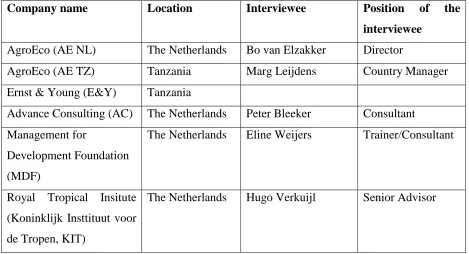
Many consulting companies have departments in different countries for better knowledge exchange and experience. Most of them cooperate in the execution of an assignment (appendices, p. 68). During the research the following consulting companies, working on the Dutch and Tanzanian market, were visited in order to analyse their KMS. The interview protocols and the questionnaire can be found in the appendices:
Table 1. Companies visited during research.
Company name Location Interviewee Position of the
interviewee AgroEco (AE NL) The Netherlands Bo van Elzakker Director
AgroEco (AE TZ) Tanzania Marg Leijdens Country Manager
Ernst & Young (E&Y) Tanzania
Advance Consulting (AC) The Netherlands Peter Bleeker Consultant Management for
Development Foundation (MDF)
The Netherlands Eline Weijers Trainer/Consultant
Royal Tropical Insitute (Koninklijk Insttituut voor de Tropen, KIT)
The Netherlands Hugo Verkuijl Senior Advisor
is a global company, which operates also in the developing countries. Advance Consulting is an international company, working mainly in Africa and South-East Europe. Similar to Advance Consulting, MDF is an international company, being 22 years on the market. The last company visited was KIT, and this one is different from previous, because it is not-for-profit organization.
4.3.1. Process of the consulting activities
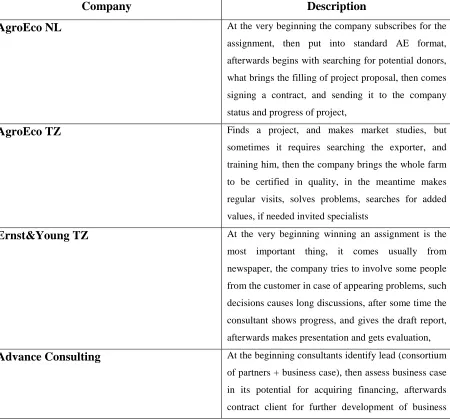
To check the way of executing the assignment, the companies were asked to give a short description of the process of the consulting activities, from project initiation until completing the report. The answers to this question are presented in the table 2.
Table 2. Process of the consulting activities.
Company Description
AgroEco NL At the very beginning the company subscribes for the assignment, then put into standard AE format,
afterwards begins with searching for potential donors,
what brings the filling of project proposal, then comes
signing a contract, and sending it to the company
status and progress of project,
AgroEco TZ Finds a project, and makes market studies, but sometimes it requires searching the exporter, and
training him, then the company brings the whole farm
to be certified in quality, in the meantime makes
regular visits, solves problems, searches for added
values, if needed invited specialists
Ernst&Young TZ At the very beginning winning an assignment is the most important thing, it comes usually from
newspaper, the company tries to involve some people
from the customer in case of appearing problems, such
decisions causes long discussions, after some time the
consultant shows progress, and gives the draft report,
afterwards makes presentation and gets evaluation,
Advance Consulting At the beginning consultants identify lead (consortium of partners + business case), then assess business case
in its potential for acquiring financing, afterwards
case and acquiring financing, assist client or
consortium in developing business case and finance
acquisition, the decision made by finance provider
most of the times results in completion of the
assignment
MDF Usually contacts are searched by clients, after the decision of cooperation the questions are prepared,
and further logistic preparations are made, there are
three steps of making assignment at the company –
getting in touch, execution and results of assignment,
working out in NL
KIT Prohibited to share,
MMA The company is choosing or being chosen by a client, and then come meetings to discuss the assignment
with customers, afterwards consultants searches
information on the websites, make interviews, visit
potential producers, after collecting those information
a draft copy is made, this activity causes discussions
on the topic, if everything is done as expected, the
assignment given back to the client
All companies are working in a standardized way. After acquisition of the assignment, consultants meet with the customer to discuss the details. Then consultants search for the information needed. Afterwards the draft copy is made and presented to the customer, what often brings discussions on the topic. When the customer’s expectations are met, the final versions of the assignment are given to the customers.
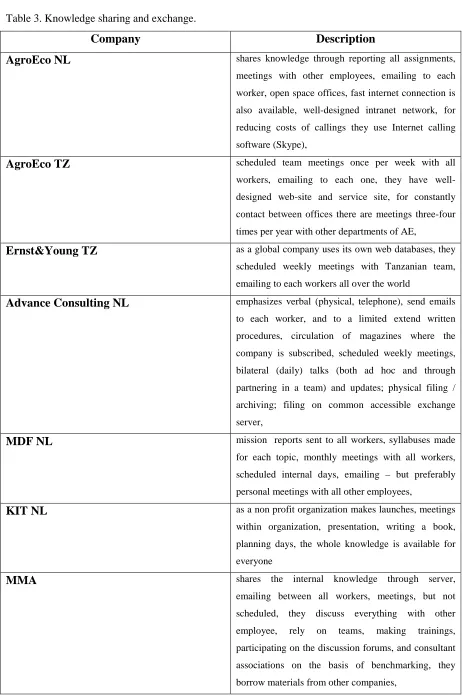
4.3.2. Knowledge sharing and exchange
Table 3. Knowledge sharing and exchange.
Company Description
AgroEco NL shares knowledge through reporting all assignments, meetings with other employees, emailing to each
worker, open space offices, fast internet connection is
also available, well-designed intranet network, for
reducing costs of callings they use Internet calling
software (Skype),
AgroEco TZ scheduled team meetings once per week with all workers, emailing to each one, they have
well-designed web-site and service site, for constantly
contact between offices there are meetings three-four
times per year with other departments of AE,
Ernst&Young TZ as a global company uses its own web databases, they scheduled weekly meetings with Tanzanian team,
emailing to each workers all over the world
Advance Consulting NL emphasizes verbal (physical, telephone), send emails to each worker, and to a limited extend written
procedures, circulation of magazines where the
company is subscribed, scheduled weekly meetings,
bilateral (daily) talks (both ad hoc and through
partnering in a team) and updates; physical filing /
archiving; filing on common accessible exchange
server,
MDF NL mission reports sent to all workers, syllabuses made for each topic, monthly meetings with all workers,
scheduled internal days, emailing – but preferably
personal meetings with all other employees,
KIT NL as a non profit organization makes launches, meetings within organization, presentation, writing a book,
planning days, the whole knowledge is available for
everyone
MMA shares the internal knowledge through server, emailing between all workers, meetings, but not
scheduled, they discuss everything with other
employee, rely on teams, making trainings,
participating on the discussion forums, and consultant
associations on the basis of benchmarking, they
The conclusion at this point is that MMA shares and exchanges knowledge in almost the same way as other consulting companies. Activities, which MMA could use to improve its system are: Intranet network (AE NL, AE TZ, E&Y TZ), team meetings scheduled once per week (AE TZ, E&Y TZ, AC NL), subscription for thematic magazines (AE NL, AE TZ, AC NL), syllabuses from each assignment (MDF), writing a book with the farmers about assignments, as KIT did.
4.3.3. External and internal sources of knowledge
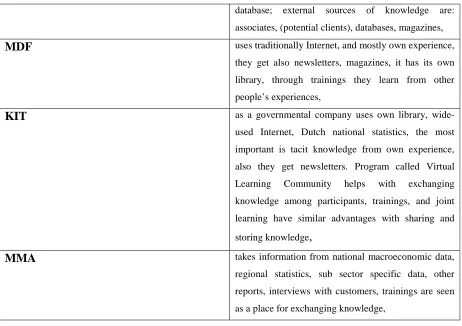
Next question which appeared during researches was about sources of knowledge used. The answers are presented in table 4.
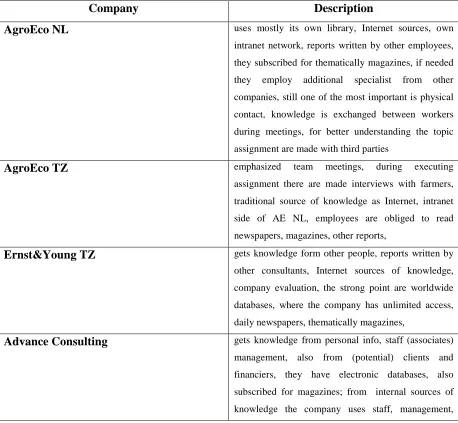
Table 4. External and internal sources of knowledge.
Company Description
AgroEco NL uses mostly its own library, Internet sources, own intranet network, reports written by other employees,
they subscribed for thematically magazines, if needed
they employ additional specialist from other
companies, still one of the most important is physical
contact, knowledge is exchanged between workers
during meetings, for better understanding the topic
assignment are made with third parties
AgroEco TZ emphasized team meetings, during executing
assignment there are made interviews with farmers,
traditional source of knowledge as Internet, intranet
side of AE NL, employees are obliged to read
newspapers, magazines, other reports,
Ernst&Young TZ gets knowledge form other people, reports written by other consultants, Internet sources of knowledge,
company evaluation, the strong point are worldwide
databases, where the company has unlimited access,
daily newspapers, thematically magazines,
Advance Consulting gets knowledge from personal info, staff (associates) management, also from (potential) clients and
financiers, they have electronic databases, also
subscribed for magazines; from internal sources of
![Figure 2. Triangle of hierarchy, Jashapara [2004]](https://thumb-us.123doks.com/thumbv2/123dok_us/1033909.1128739/16.595.147.401.551.706/figure-triangle-of-hierarchy-jashapara.webp)
![Figure 3. A system approach and methodology if KMS projects, Stankosky, Baldanza [2001]](https://thumb-us.123doks.com/thumbv2/123dok_us/1033909.1128739/19.595.61.521.330.510/figure-approach-methodology-kms-projects-stankosky-baldanza.webp)
![Figure 4. KM Pillars, Stankosky, Calabrese, Baldanza [1999]](https://thumb-us.123doks.com/thumbv2/123dok_us/1033909.1128739/20.595.107.487.148.361/figure-km-pillars-stankosky-calabrese-baldanza.webp)