International Journal of Scientific Research in Computer Science, Engineering and Information Technology
© 2018 IJSRCSEIT | Volume 3 | Issue 4 | ISSN : 2456-3307
Web Application Developmentfrom Desktop Application
Using Java Technologies
BhargaviR1,PushpanjaliP2
1Department of MCA,Sree Vidyanikethan Institute of Management, A.Rangampet, Tirupati,Andhra Pradesh,
India
2Assistant Professor, Department of MCA, Sree Vidyanikethan Institute of Management,A.Rangampet,
Tirupati,Andhra Pradesh, India
ABSTRACT
These paper investigations the issue of programmed change of legacy desktop applications to Java web applications with accentuation on how such transformation methodology can help in movement of legacydesktop engineers to current web advancement. Authors clarify how programmed converter can empower desktop designers to begin conveying new web applications quickly without knowing complex web advances. At last, the paper will demonstrate that after change of legacy applications to web innovation, it is additionally conceivable to enhance changed over applications with current web and business functionalities. Keywords: business web application, Desktop2web converter, Java web development, desktop application, migration, converter, conversion, automatic code generation
I.
INTRODUCTION
Authors of this paper investigated the advantages of programmed transformation during the time spent relocating inheritance desktop applications and legacy designers to web improvement. The relocation alludes to groups that create desktop applications, either having graphical UI (GUI) or text mode user interface (TUI), however need to create in a web situation.
While considering procedures of legacy framework modernization to web improvement, it is critical to safeguard preferences of the inheritance framework, for example, its high business esteem and great quality code, yet in addition to deal with different issues like support and redesigning. The most suitable technique that meets these goals is the relocation procedure.
The migration technique is the approach that moves the whole inheritance framework and its center structure to the new condition while protecting the first framework's information and usefulness.
Authors propose Evolution Framework as a solid Java web structure that must exist with the end goal of the programmed change. System based programming advancement has been demonstrated as valuable procedure to build up an application. In any case, the advancement of a structure itself is viewed as mind boggling because of its substantial size and the unclear necessities.
II.
DESKTOP VERSUS WEB DEVELOPMENT
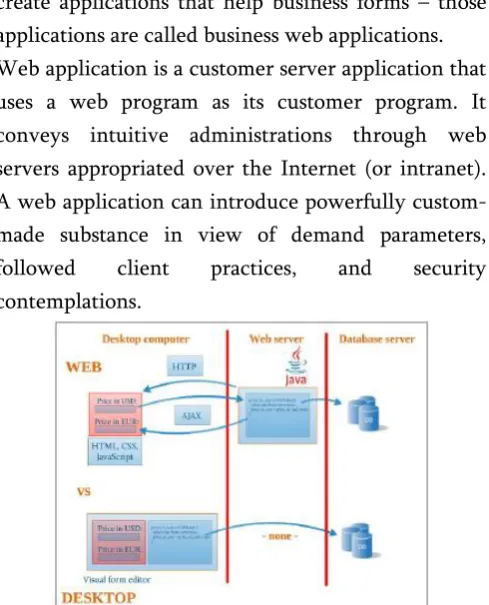
create applications that help business forms – those applications are called business web applications. Web application is a customer server application that uses a web program as its customer program. It conveys intuitive administrations through web servers appropriated over the Internet (or intranet). A web application can introduce powerfully custom-made substance in view of demand parameters, followed client practices, and security contemplations.
Figure 1. Technical difference between desktop and web development
The greatest contrast between creating desktop and web applications is standing out the UI is assembled and how it functions, as found in Fig. 1. Numerous authors contend the significance of UI plan inside the general application advancement.
The engineering of desktop UI: UIs for big business desktop applications are composed in a visual supervisor gave by a portion of the desktop innovation: Visual Basic, Delphi, Visual C++ or approximately 4GL apparatuses like Panther (Prolifics).
With regards to composing the code for the shape, engineer's code commonly handles occasions on the frame. The main occasion that engineer handles is generally the one that happens when the frame is shown to the client out of the blue and the designer needs to instate it. Later on, the client will tap on a catch, or double tap a line in the lattice, or press a console alternate way, and the code should deal with
these occasions associating with a database or outer administrations in a multi-level frameworks.
Characteristics of web User Interface: When creating web applications, planning the UI is substantially more unpredictable. Building up an online UI can be very dull, it is a circulated program which needs to keep running in an unfriendly situation. The web application UI is the path through which the web client conveys to the web framework. Web applications are basically customer server applications - there is dependably a web customer.
At the point when web applications are created with web system that doesn't give a visual manager, developers need to compose the shape format character by character, tag by tag, utilizing HTML, CSS and JavaScript code. Some web structures do give visual editors that create HTML code, however they are simply halfway influencing HTML to code while developer still needs to touch up produced HTML code physically and after greater manual changes some visual editors can't stack altered HTML pages once more.
Another imperative part of web advancement is correspondence. Web design requires the utilization of HTTP to send an underlying structure format to a web program. At that point, when a client clicks a catch, AJAX innovation must be utilized as a part of the web program to call the occasion code on the web server to associate with the database. At long last, designers need to restore the refresh data from the web server to the web program to refresh shape format, e.g. the information lattice with new information columns or information fields with new esteems.
an ease back process inclined to mistakes and, at last, extremely costly and difficult to learn. Noteworthy enhancements in programming advancement effectiveness are accomplished via programmed code age which at last outcomes in higher profitability and consistently high.
III.
BUSINESS ASPECTS OF MIGRATION TO
WEB DEVELOPMENT
During the procedure of relocation there are sure business viewpoints that must be considered by improvement office and its administration:
Aspect 1: a security of business know-how. Outsourcing accomplices is a typical case during the procedure of relocation, however outsourcing the improvement of business functionalities suggests giving ceaselessly learning about organization procedures and plans. In this manner, it is imperative to secure the business know-how.
Aspect 2: a security of existing workforce. The current improvement group has numerous focal points that an organization needs to hold:
They have a colossal business know-how increased through numerous times of functioning in the organization,
They have a decent relationship and correspondence with application clients over the organization,
They are the main ones who are versed in existing business applications and can fix or redesign them rapidly,
They are extremely proficient in desktop improvement and astounding as a group.
Aspect 3: consistent conveyance. As organization forms are advancing, the current advancement group needs to keep up current undertaking applications and invest energy in redesigning them always. This implies they don't have enough time to take in new complex web innovations without any preparation.
This brings into question the need to learn web advancements rapidly and begin conveying new web applications without backing off current improvement and conveyance. Enlisting new individuals is frequently impossible since it speaks to an extra cost.
Aspect 4: reuse of existing applications. After some time, current endeavor desktop applications is hard to keep up in light of the fact that the old specialized learning will be lost and old programming or old equipment support will be stopped. Normally, there are a great many desktop shapes in real life. A few applications are as yet being updated all the time and the movement procedure must permit to keep enhancing and overhauling them on web innovation.
Aspect 5: a total system for the proficient advancement. It is prescribed that web improvement structure is intense, worked for big business condition and has a visual editorial manager for shapes. Likewise, if system incorporates well known highlights that are required for present day endeavor web applications, this furthermore adds to the proficiency of advancement. Nowadays clients request not only networks with information and structures with input fields yet additionally archive administration, work process and assignment administration highlights, answering to various document configurations, for example, PDF or Excel, mix with email and web applications which should likewise take a shot at cell phones and tablets.
IV.
METHODOLOGY OF THE MIGRATION
PROCEDURE
Remembering all said perspectives, it is important to settle on two critical choices toward the start of the movement procedure: picking innovation and picking system.
advancement of big business level business web applications, it is allowed to download and there is a gigantic Java open source group with numerous accessible arrangements.
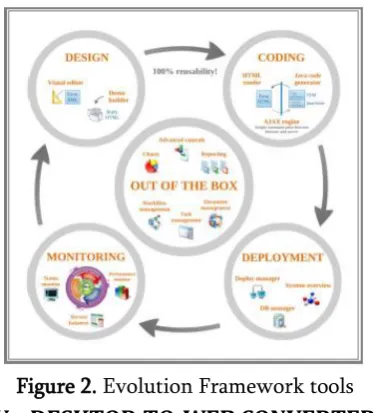
With regards to picking system, every above goal infers that desktop developers must have the capacity to skirt the utilization of complex web innovations and rapidly begin with the conveyance of web shapes. Such a proficient advancement of present day venture applications can be accomplished just by utilizing a web structure that permits desktop like web improvement. A structure of such kind is Evolution Framework whose devices were produced particularly for the relocation procedure as portrayed in this paper. A diagram of Evolution Framework apparatuses can be found in Figure 2.
Those high and particular necessities for structure drives us to the approach of web designing that advances fruitful web application improvement through all periods of advancement, including movement of legacy framework to web situations.
Meeting the special prerequisites of electronic applications during entire application lifecycle can get the potential confusion online framework advancement under control, limit dangers, and upgrade practicality and quality.
Figure 2. Evolution Framework tools
V.
DESKTOP-TO-WEB CONVERTER
While thinking about how to move the current applications to the web, a product device can change over old desktop structures to web frames consequently. With such a converter, a large number of old frame formats and a huge number of lines of old code could be naturally changed over to the web condition (Figure 3.). This spares the engineers critical measure of time required for changing old code.
Figure 3. Desktop-to-web converter
The primary reason for the converter is to change over old code, yet in this paper we especially show how it empowers an extraordinary movement technique for designers.
VI.
THE MIGRATION STRATEGY WHEN
HAVING A CONVERTER
While having a converter, authors recommend that movement procedure is done in 3 stages:
Web development with converter:With the desktop to-web converter it is conceivable to begin the web improvement very quickly. Initial, an engineer needs to setup a web advancement, testing and creation conditions. A visual framework outline screen makes this considerably less demanding, without wasting time with numerous setup documents.
the desktop shape to a web shape. Along these lines, desktop developers can begin conveying web structures and web applications in a flash.
Comparison of codes:The desktop to-web converter isn't only a device for changing over old structures to web frames. It is likewise a learning apparatus. Subsequent to changing over desktop shapes, designers can contrast the old desktop frame code and the new Java frame code and take in the punctuation all the more rapidly. An examination of the old and new converter code can be seen at Fig. 4. A few authors propose certain techniques to enhance precision of code change.
Figure 4. New converted Java code on the left, the old desktop code on the right
After the developers take in the new Java code linguistic structure and get comfortable with system devices, they can begin outlining structure formats specifically in visual proofreader and compose Java code utilizing e.g. Shroud for Java as a prominent IDE.
Conversion of old applications:Moving old applications to the web condition will be done just by utilizing the desktop to-web converter. More often than not, this progression begins with top need possibility for relocation, the ones that will soon be out of old programming or equipment bolster, or perhaps those that they need to update with new current specialized highlights.
Some of the time, the transformation of old applications is the initial phase in movement venture
and a short time later the conveyance of new web structures can start.
VII.
ARCHITECTURE OF CONVERTER
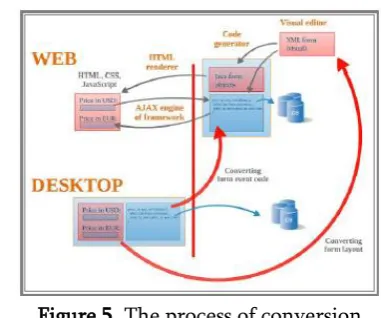
In desktop innovation, each shape has two principle parts: the format data and the frame occasion code (Figure 5.) Therefore, the converter must incorporate the transformation of both frame format and shape code.
Format data for a solitary frame is generally composed as a twofold or content record. Such a document contains a rundown of all controls like catches, input fields and networks which show up on the frame alongside their underlying property estimations like x and y position, empowered/impaired, obvious/imperceptible, and so on.
Figure 5. The process of conversion
The initial phase in making the converter was to influence it to deal with the change of this old design data to the new format data composed as a visual proofreader frame record. After the transformation, clients can utilize the visual editorial manager to adjust the frame format and add some more controls to the shape, even some propelled ones that didn't exist before in the old condition.
The second step in making the converter was to influence it to deal with the change of such occasion code. The converter must break down the old code and influence equal Java to code.
Some old regularly utilized API capacities, accessible in the old desktop system, must be changed over also, with the goal that the software engineer has nearly a similar look and feel of the Java code in the web condition.
VIII.
CONCLUSION
In this paper we have exhibited the part of the desktop to-web converter during the time spent transformation of legacydesktop applications to current web applications and in addition an estimation of such an instrument in moving an inheritance advancement group to a web improvement. Aftereffects of this exploration affirm the high significance of the programmed transformation and abnormal state web structures for defeating the unpredictability of local web advancements. With a specific end goal to guarantee moment web advancement, it is essential that a converter instrument deals with every single particular normal for web engineering.
The automatic conversion has turned out to be a safe method to protect functionalities of old desktop applications however just an entire web system will enable those applications to be further effectively overhauled and kept up in new condition.
IX.
REFERENCES
[1]. Murugesan S., Deshpande Y., Hansen S., Ginige A., Web Engineering: A new Discipline for Development of Web-based Systems, in Web Engineering: Managing Diversity and Complexity of Web Application Development, Springer-Verlag, 2001.
[2]. Zhang W., Berre A.J., Roman D. and Huru H.A., Migrating Legacy Applications to the Service Cloud, in Proc. of Towards Best
Practices in Cloud Computing, OOPSLA09, Orlando, USA, pp. 59-68, 2009.
[3]. Sudhakar P. and Sakthivel P., Predicting Source Code Irregularities in Automated Code Conversion Systems using SRASG, European Journal of Scientific Research, 67(3), 486-491, 2012.
[4]. C.S. Horstmann and G. Cornell. Core Java 2, Volume I: Fundamentals. Prentice/Hall International, sixth edition, 2002.
[5]. G. E. Krasner and S. T. Pope. A Cookbook for Using the Model-View-Controller User Interface Paradigm in Smalltalk-80. Journal of Object-Oriented Programming, 1(3):26-49, August 1988.
[6]. Strahonja V. and Picek R., User Interface Modeling Within Application System Development, Proceedings of the 27th International Conference Information Technology Interfaces, 285-291, Cavtat, Croatia, 2005.
[7]. Strahonja V. and Picek R., User Interface Modeling With RUP, Proceedings of the 16th International Conference on Information and Intelligent Systems, 57-54, Varaždin, Croatia, 2005.
[8]. El-Bakry H. M., Riad Alaa M., Abu-Elsoud M., Mohamed S., Hassan A. E., Kandel M. S. and Mastorakis N., Adaptive User Interface for Web Applications, Publisher: WSEAS, 190-211, 2010.
[9]. Choo C.H. and Lee S.P., Towards Persistence Framework-based Rapid Application Development Toolkit for Web Application Development, Journal of Computer Science, vol. 4., no. 4., 2008.
[10]. Burke P. and Sweany P., Automatic Code Generation Through Model-Driven Design, 20th System and Software Technology Conference, Las Vegas NV, 2008.
Workshop on SOA Migration and Evolution SOAME 2010, Madrid, 2010.
[12]. Dongjin Yu, Towards the Rapid Application Development Based on Predefined Frameworks, Journal of software, vol. 6., no. 9., 2011.
[13]. Shklar L. and Rosen R., Web Application Architecture: Principles, Protocols and Practices, 2nd ed., John Wiley & Sons Ltd, Chichester, England, 2009.
[14]. Henrich V., Hinrichs E., Hinrichs M. and Zastrow T, Service-Oriented Architectures: From Desktop Tools to Web Services and Web Applications, Romanian Academy Publishing House, Bucharest, Romania, 2010.
About Authors:
Ms. Bhargavi.R is currently pursuing
her Master of Computer
Applications, Sree Vidyanikethan
Institute of Management, Tirupati,
A.P. She received her Master of
Computer Applicationsfrom Sree Venkateswara
University, Tirupati, A.P
Ms.Pushpanjali.P is currently working as an
Assistant Professor in Master of
Computer Applications
Department, Sree
Vidyanikethan Institute of