conducted and published many works high estimated [2],[4],[6],[8],[14]. Especially in 2012, the authors from Natural Science University succeeded in building Voice Server System [9] to explore potential applications of Voice Processing whose use was made of by media systems, such as Voice Information Providing System through mobile and fixed phones, this work was awarded the second prize of Vietnamese Gifted. However, the works above only focused on improving the processing of Vietnamese voice and still neglected the semantic analyzing of voice commands.
Weather Voice is Voice Server System built on the combination of speech language processing and text language one. It can recognize numerous patterns of Vietnamese voice commands in order to transform them into text, then analyze their syntax and semantics, afterwards carry out searching data base, and eventually answer to users with the data searched in Vietnamese voice. The analyzing syntax and semantics of commands is assisted by DCG (Definite Clause Grammar) [3],[7],[11],[12],[17]. During the voice processing, we call for HTK (Hidden Markov Model Toolkit) [13] to recognize voices and apply Unit - selection [1] method to synthesizing voices.
2. System structure
The system is designed to achieve the following functions: Recognizing query statements through phones; analyzing them; searching data from database; answering to users through phones. Here is the scenario in details:
(0) Standby state
(1) User calls on the system and asks a command in Vietnamese. (2) The system reasserts the content of the user's command.
_ (2.0) If the user confirms it, the system continues to carry out the step (3) _ (2.1) If the user disapproves of it, the system returns to the step (0)
(3) The speech is transferred to the processing unit ASR and transformed into Vietnamese text. (4) The system analyzes the command's syntax and processes its semantic meaning.
* The system conducts searching database and answers to the user in speech. * When finishing, it returns to the step (0)
_ (4.1) If it is not the case, which means that the command is grammatically incorrect, the system will ask the user to redo a command in speech.
We will follow the example of a specific transaction: − The system: Hello.
− The user: Please tell me what the weather is like in Can Tho tomorrow?
− The system: Do you want to know about the weather of tomorrow in Can Tho?
− The user: That's right.
− -The system: The temperature is between 24 degrees and 34 tomorrow, it is sunny in the daytime, it rains in the evening and at night.
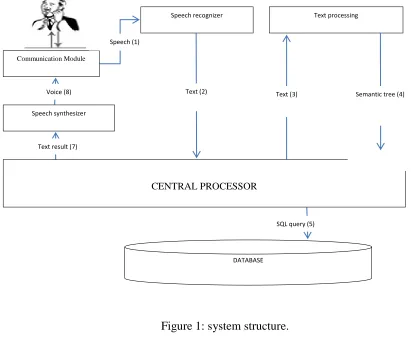
For achieving the above functions, the system must require the following components:
− Voice recognizer component: to transform speech data which is human speech into data text.
− Vietnamese language processing component: to analyze commands' syntax and semantic meaning from users.
− Central processing component: to connect the other components each to another through such operations:
1. Transforming data text from speech recognizer into standard data to be executed by Prolog in Vietnamese language processing.
2. Transforming commands' semantic expressions into a file of select statements which is sent to database and executing them.
3. Filtering, arranging, and returning processed results via system to user.
o Database: contains selected data.
o Vietnamese language synthetizing component: transforms text data into speech.
Figure 1: system structure.
3. Voice recognizer component
In the Weather Voice system, we use HTK to build the voice recognizer component. HTK provides us with instruments analyzing voice, specially the one recognizing voice, based on HMM [13]. According to approaches of [9], [10], [15], [16], [18] we implement a context-dependent model making use of triphone to recognize words from word list as well as to identify patterns' grammatical meaning which can happen in application context for the sake of recognizing sentences more correctly.
A. Steps in building voice recognizer component.
Building a voice recognizer component includes two main periods: 1. Training period:
• Preparing voice data file needs training and codifying this file. Speech synthesizer
Voice (8)
Communication Module
Speech recognizer Text processing
Text (2)
DATABASE
SQL query (5)
CENTRAL PROCESSOR
Text result (7)
Speech (1)
• Labelling, building dictionary.
• Creating HMM prototypes for each of phone units.
The training period's output is the file of trained HMM prototypes. 2. Recognizing period:
• The file of trained HMM set is the result of the training period.
• Building dictionary.
• Extracting characteristics for voice series needing being recognized.
The recognizing period's output is the text series. B. Data to train.
The file of data to train is recorded for 200 minutes in amount of 2,500 patterns. Those data must satisfy the criterion of 8,000 Hz, 16bit according to PCM format and be recorded in 50 different accents and in a quiet environment. The word list comprises 63 cities and towns' names over the country and key words concerning command sentences.
C. Building language grammar.
Our grammar is language prototypes providing information of sentences' syntax, semantics and word order. This component will help the system choose the best recognized results from the list of 'candidates' previously selected by the recognizing period.
Sentence structures are likely to exist in application contexts.
Building a language prototypes involves the determining its grammar. The complexity of grammar depends on that of the system needing being recognized.
Corpus
unit segmentation
Text processing
unitised sentence set
segments
speech synthesizing Training phase Synthesizing phase
Text
standardized sentence set
D. Voice synthesizing (text-to-speech).
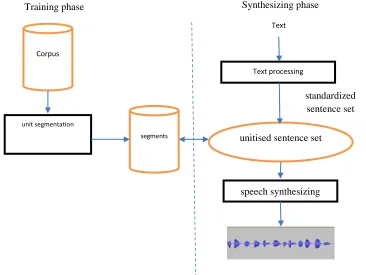
Text-to-speech system includes two main phases: text analyzing (processing phase, standardizing text input in order to synthesize it) and text -to - speech phase (building speech signals from the former's results). The second phrase can be implemented by Formant text-to-speech [8] or Unit-selection approach [1],[8]… For Weather Voice, we have chosen unit-Unit-selection, the phrase is undergone in the next procedure:
Figure 6: Text-to-speech procedure by connecting to unitise. $tinh_thanh= HOOF CHIS MINH | HAF NOOJI | DDAF NAWXNG | CAAFN THOW;
$ngay=HOOM NAY | NGAFY MAI | NGAFY MOOST;
…
4. Vietnamese language processing
A. Query statement syntax.
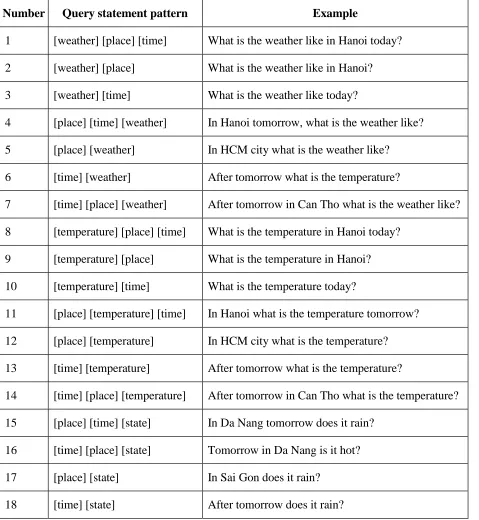
Our system in all represents 18 query statement patterns as shown in the table 1. Table 1: Some query statements classified according to them.
Number Query statement pattern Example
1 [weather] [place] [time] What is the weather like in Hanoi today?
2 [weather] [place] What is the weather like in Hanoi?
3 [weather] [time] What is the weather like today?
4 [place] [time] [weather] In Hanoi tomorrow, what is the weather like?
5 [place] [weather] In HCM city what is the weather like?
6 [time] [weather] After tomorrow what is the temperature?
7 [time] [place] [weather] After tomorrow in Can Tho what is the weather like?
8 [temperature] [place] [time] What is the temperature in Hanoi today?
9 [temperature] [place] What is the temperature in Hanoi?
10 [temperature] [time] What is the temperature today?
11 [place] [temperature] [time] In Hanoi what is the temperature tomorrow?
12 [place] [temperature] In HCM city what is the temperature?
13 [time] [temperature] After tomorrow what is the temperature?
14 [time] [place] [temperature] After tomorrow in Can Tho what is the temperature?
15 [place] [time] [state] In Da Nang tomorrow does it rain?
16 [time] [place] [state] Tomorrow in Da Nang is it hot?
17 [place] [state] In Sai Gon does it rain?
B. Analyzing statement semantic.
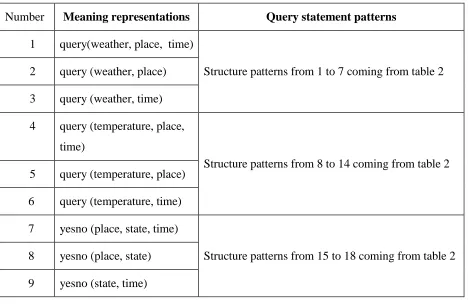
To represent query statement semantic, we use DCG [3],[7],[11],[12],[17] all nine representation patterns of query statement semantic are given in table 2:
Table 2. Representation patterns of query statement semantic.
Number Meaning representations Query statement patterns
1 query(weather, place, time)
Structure patterns from 1 to 7 coming from table 2 2 query (weather, place)
3 query (weather, time)
4 query (temperature, place, time)
Structure patterns from 8 to 14 coming from table 2 5 query (temperature, place)
6 query (temperature, time)
7 yesno (place, state, time)
Structure patterns from 15 to 18 coming from table 2 8 yesno (place, state)
9 yesno (state, time)
Example 1: What is the weather like in Hanoi tomorrow? DCG syntactic and semantic order will be defined as follows:
query(query(Weather,Place,Time)) --> n_weather(Weather),prep_place,n_place(Place), n_time(Time),w_how.
prep_place --> [in].
DCG syntactic and semantic order has defined semantic pattern of example 1's query statement as:
query( weather(thoi_tiet), place(can_tho), time(ngay_mai)). This pattern is the pattern number 1 in the table 3.
We carry out transforming these semantic patterns into corresponding SQL statements in order to search corresponding weather information in the database. These data are automatically extracted from Yahoo Weather APL.
5. Experiments and evaluations
The experiments, at first, were conducted by each of system's components, which comprised voice recognizer, Vietnamese language processor and central processor. Afterwards, we experimented the entire system as well as performed surveys on users' reviews of the system including text-to-speech component.
A. Speech recognizer component.
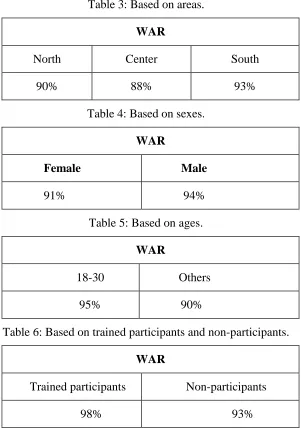
The performance of speech recognizer is often evaluated by the metric WER (Word Error Rate), it is computed as the next formula:
WER= (S+D+I) / N x 100%
Where:
• N is the number of words,
• S is the number of substitutions,
• I is the number of insertions,
• D is the number of deletions.
But here, we used the metric WAR (Word Accuracy Rate) in the evaluation of the system's performance by the formula:
WAR= (1– (S+ D+ I) / N) x 100%
Table 3: Based on areas.
WAR
North Center South
90% 88% 93%
Table 4: Based on sexes.
WAR
Female Male
91% 94%
Table 5: Based on ages.
WAR
18-30 Others
95% 90%
Table 6: Based on trained participants and non-participants.
WAR
Trained participants Non-participants
98% 93%
B. Natural language processing component.
Thanks to this component, we succeeded in experimenting 50 statements, the results for the statements involved exactly corresponded to our expectation. These statements are circumscribed within the syntastic structures having been built for the system. The system's ability to correctly process all these standard statements attests its stability and accuracy.
demonstrates our synstatic regulations DCG is incomplete and yet our grammar cannot cover every case which is likely to occur.
If words grammar is added to it and synstatic regulations are improved, the system's amplitude will significantly expand.
C. Surveys on users' reviews.
During these surveys, users were asked the question coming from the system: "Is the system easy to use?". The answers are ranked in order of usefulness as mentioned in the table 7.
Table 7: Indication of levels of the system's usefulness.
Very useful Quite useful Slightly useful Useless
25% 27% 23% 25%
D. Experimenting the entire system.
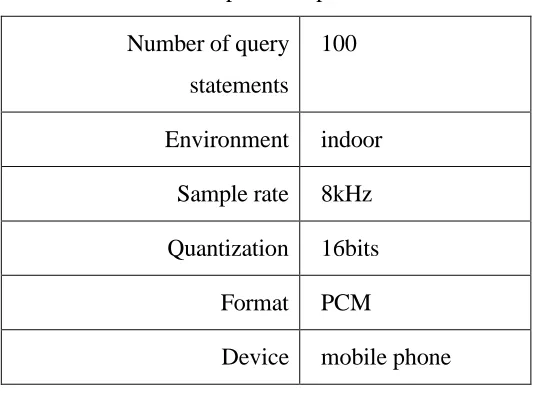
The system is built in PC environment with Java language and SWI-Prolog version 6.6.5. Table 8: Experiment parameter.
Number of query statements
100
Environment indoor Sample rate 8kHz
Quantization 16bits
Format PCM
Device mobile phone
The results given by the system are correct for 48 out of 50 Vietnamese query statements. As seen above, all the unexpected results happened during the identifying period. The feedback time is 2.6 seconds on average.
[19] Tran, T.K., Phan, T.T.: A hybrid approach for building a Vietnamese sentiment dictionary. J. Intell. Fuzzy Syst. 35(1), 967–978 (2018).